Tag Archives: Northumberland Fusiliers

Second Lieutenant Dudley Weedon

Second Lieutenant Dudley Weedon

Dudley Harry Weedon was born in Islington, Middlesex in the spring of 1891. The second of two children, his parents were solicitor’s clerk Thomas Weedon and his wife, Frances.

When Dudley finished his schooling, he also found work as a clerk. The 1911 census recorded the Weedon family living at a prestigious address – an eight roomed Victorian villa at 59 Canonbury Park North, Islington. Thomas was still employed as a solicitor’s clerk, Dudley as a clerk for a corn merchant, and his older brother, Horace, as a clerk for a mining company.

War came to Europe in the summer of 1914, and Dudley was keen to step up and play his part. He enlisted early on, joining the 1st/2nd County of London Yeomanry, also known as the Westminster Dragoons. The regiment spent most of the war in the Middle East, and by November 1914, Private Weedon found himself in Egypt.

Dudley would spend the next year or so overseas, and was sent to, and evacuated from, Gallipoli. In February 1916, he received a promotion – to the rank of Second Lieutenant – this increase in rank coming with a transfer to the Northumberland Fusiliers. His new unit – the 8th (Service) Battalion – had also served in the Dardanelles, but by that summer they had moved to France.

Second Lieutenant Weedon spent the next eighteen months on the Western Front, fighting at Messines and at Ypres. It was here, possibly at the Battle of Polygon Wood, that Dudley was injured. Details are unclear, but his wounds were sever enough for him to be medically evacuated to Britain for treatment.

Dudley was admitted to a hospital in Roehampton, Surrey, but his injuries were to prove too severe. He passed away on 20th November 1917, at the age of 26 years old.

Dudley Harry Weedon was laid to rest in Highgate Cemetery, not far from his grieving family’s home.

Private Herbert Smart

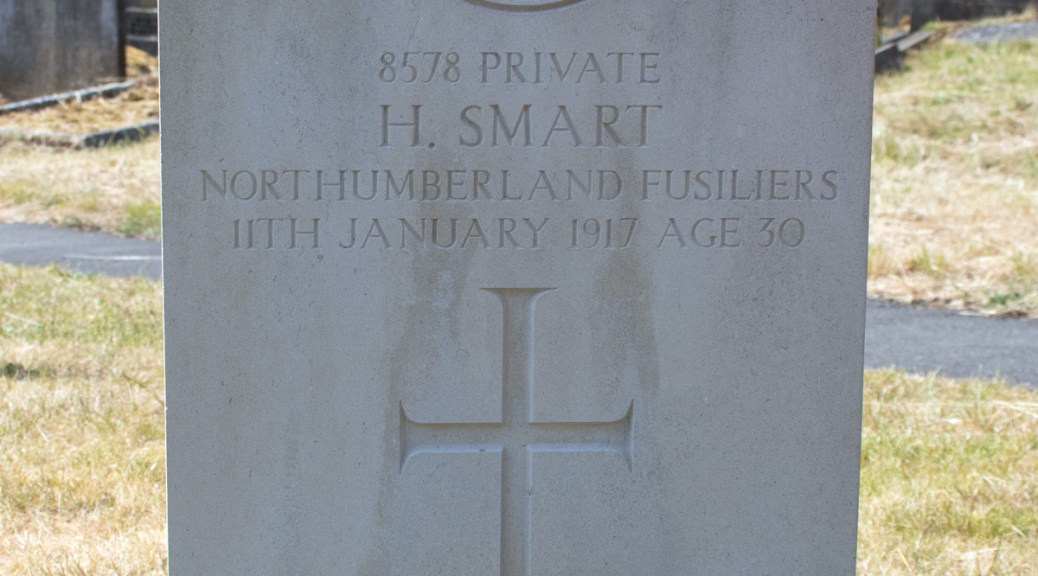
Private Herbert Smart

Herbert – or Bertie – Smart was born on 9th February 1885, and was the middle of five children to John and Lucy. John worked as a gardener and the family were raised in the Kent town of Sidcup.

By the early 1900s, Bertie had moved to London, and had settled in Islington, Middlesex. He was working as a fruiterer and, on 19th May 1907, he married Lucy Purton, a policeman’s daughter from the east of the capital.

The couple set up home in Kensington, and went on to have four children: Frank, Herbert, Kathleen and Frederick. The 1911 census found the family renting three rooms in a tenement at 36 Netherwood Road. They were sharing their home with Lucy’s younger brother, Frederick.

When war broke out across Europe, Bertie was called upon to play his part. Full service details have been lost to time, but it is clear that he enlisted in the second half of 1916, and was assigned to the Northumberland Fusiliers. Attached to the 2nd/4th Battalion, it seems that he may have been sent to the South West for training.

Private Smart’s time in the army was not to be a lengthy one. He came down with cerebrospinal meningitis, and was admitted to the War Hospital in Bath, Somerset. The condition was to get the better of him: he passed away was still admitted, on 11th January 1917. He was 31 years of age.

Herbert Smart was laid to rest in the sweeping grounds of Bath’s Locksbrook Cemetery.


These were tragic times for the Smart family. Lucy’s brother died just four months after her husband, and Lucy herself passed away in February 1918. In just over a year, the four children – Frank, Herbert, Kathleen and Frederick – had become orphans.


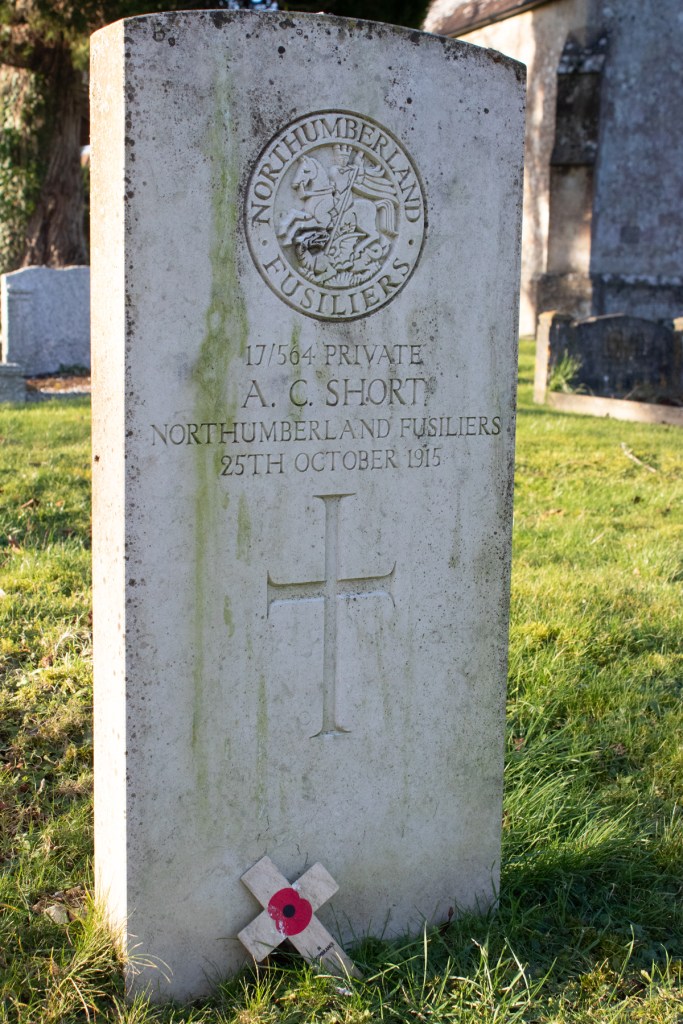
Private Alexander Short

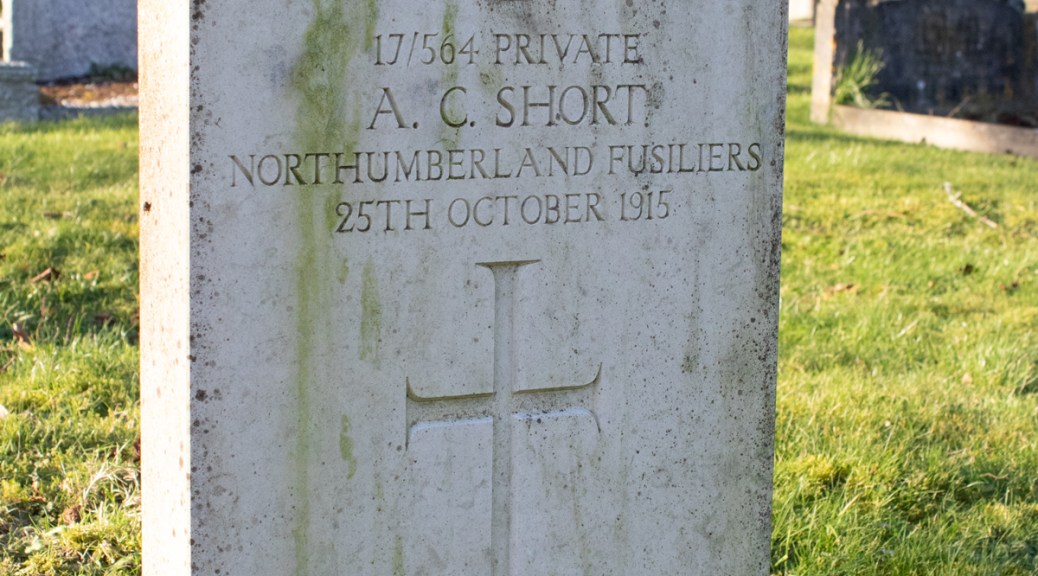
Private Alexander Short

Alexander Coverdale Short was born in the Yorkshire village of Nafferton in the autumn of 1890. One of twelve children, his parents were labourer Benjamin Short and his wife, Emily.

Benjamin died in 1908, and the following year Emily remarried, to widow William Jefferson. He was a clerk for the council in neighbouring Driffield but, by the time of the 1911 census, the family had moved to Sculcoates, near Kingston-upon-Hull, where he had taken up employment at an auctioneer’s.

The 1911 census found the extended family living at 44 Hopwood Street in Hull, a seven-room property. William and Emily headed the household, sharing the house with William’s son Alfred, Alexander and four of his sisters, Alexander’s nephew, two boarders and two visitors – another of Alexander’s sisters and her son.

Alexander was employed as a bricklayer’s apprentice by this point, but at some point found alternative employment working for the North Eastern Railway Company. War was on the horizon, however, and he had enlisted in the Northumberland Fusiliers by the spring of 1915.

Private Short was attached to the 17th (Service) Battalion (North Eastern Railway Pioneers) and, by August 1915, his unit had moved to Codford, Wiltshire, on the edge of Salisbury Plain.

Knowing a trip across the English Channel was likely imminent, before he left Yorkshire, Alexander married Dora Harrison. The daughter of a butcher, she had been born and raised in Sculcoates.

Alexander’s time in the army was not to be a long one. Within a matter of months, his health began to deteriorate, and on 25th October 1915, he died of heart failure at Codford Military Hospital. He was just 24 years of age.

Finances appear to have prevented Private Short’s family from bringing their son and husband home. Instead, Alexander Coverdale Short was laid to rest in the peaceful St Mary’s Churchyard in Codford.


Private Alexander Short (from findagrave.com)

Private Percy Payne

Private Percy Payne

Percy Payne was born in the village of Kingston Seymour, between Weston-super-Mare and Yatton, Somerset. His parents were agricultural labourer Harry Payne and his wife, Elizabeth, and he had three brothers.

It seems that Percy’s parents may well have separated by 1911; Elizabeth is listed as a widow in the 1911 census, but Harry appears to be alive and well and living in South Wales.

According to the census records, Elizabeth was working as a charwoman, while three of her children were working to help support the family. Percy’s two older brothers were employed as a carter and a domestic servant, while Percy himself was working as an errand boy.

By the time war broke out, Percy has stepped up the ladder. His service records listed his trade as a groom, working in Congresbury, near Bristol. He enlisted in March 1916, at the age of 19 years and 8 months, and was assigned as a Private in the Northumberland Fusiliers. He spent most of that year training on home soil, before being shipped out to France at the end of December.

Illness seems to have dogged Private Payne; he returned to England after a couple of months, and was transferred to the Labour Corps fairly soon afterwards. By September 1917 a further transfer was made, this time to the Royal Army Medical Corps, before he was finally discharged from military service on 21st January 1918, suffering from tuberculosis.

Sadly, the lung condition was to prove fatal, and Percy passed away on 26th June 1918. He was just 21 years old.

Percy Payne lies at rest in the graveyard of St Mary’s Church in the village of Yatton, Somerset.