Tag Archives: phthisis

Bombardier Frank Sloman

Bombardier Frank Sloman

Frank Sloman was born in the autumn of 1887, and was the youngest of five children to Frank and Emma. Frank Sr was a mason from Jersey, in the Channel Islands, but it was in Tiverton, Devon, that he and Emma made their home and raised their family. The 1891 census found the family living on Castle Street, but by 1901 they had moved down the road to St Peter’s Street.

Frank Jr found work as a painter when he finished his schooling, but he sought adventure and a career. He was already a volunteer for the Devonshire Regiment, and, on 7th May 1904, he officially enlisted as a paid member of the troop. Private Sloman’s records show that he was 5th 10.5ins (1.79m) tall, and weighed 129lbs (58.5kg). He was noted as having brown hair, grey eyes and a fresh complexion.

Private Sloman spent two years on home soil. He quickly extended his contract, and this led to more opportunities. By December 1906 his unit was in India, and he would go on to spend five and a half years there.

In December 1907, Frank transferred to the Royal Garrison Artillery. He initially held the rank of Gunner, before being promoted to Bombardier in January 1912, and Corporal just three months later. In October, Frank returned to Britain, and was stood down to reserve status. He returned to Tiverton, and found work as a porter at the local station.

War was on the horizon, however, and when conflict broke out, Frank was called upon to play his part once more. Initially taking up the rank of Corporal in the Royal Field Artillery, he reverted to the role of Gunner at his own request. By this point, his unit was in France, and he would remain there for the next eight months.

On 6th May 1915, Frank returned to Britain, and was attached to 2B Reserve Brigade. He was based at the training facility in Bettisfield Park in Clwyd, and would spend the next eighteen months there. In June 1916, he was once again promoted to the rank of Bombardier.

Love was on the cards, and, on 17th June 1916, Frank married Frances Hadlow. There is little information available for her, but the couple exchanged vows at the Register Office in Windsor, Berkshire.

By the autumn of 1916, Frank’s health was becoming an issue. He contracted phthisis, or tuberculosis, and was sent to the the south coast for recuperation. His condition would ultimately render him unfit for continued military service, and Bombardier Sloman was discharged from the army on 17th December 1916.

His papers show that he had grown to 6ft 2.5ins (1.89m) in height, and, while physically unfit, he was a steady, sober and reliable man. He and Frances had taken rooms at 7 Hawley Street, Margate, Kent, but it seems that the couple soon moved back to Devon. Their new home was a small cottage at 3 Westbrook Place in Tiverton.

At this point, Frank’s trail goes cold. It is unclear whether he took up work again – or was able to do so – but his lung condition was ultimately to get the better of him. He passed away on 3rd June 1918, at the age of 30 years old.

Frank Sloman was laid to rest in Tiverton Cemetery, on the outskirts of the town in which he had grown up.

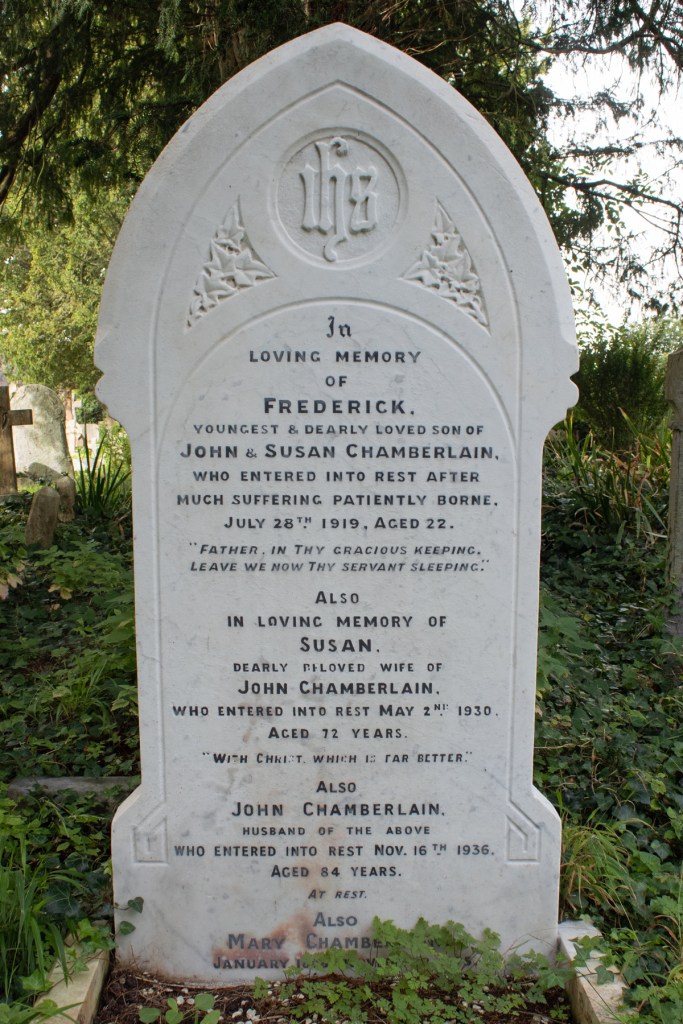
Corporal Frederick Chamberlain

Corporal Frederick Chamberlain

Frederick Chamberlain was born in the summer of 1896, the youngest of six children to John and Susan Chamberlain. John was a gardener from Dulverton in Somerset, but it was in Abbots Leigh, near Bristol, that the family were born and raised.

When he finished his schooling, Frederick found work in service and, by the time war broke out, he was employed as a footman. War presented a new adventure, however, and he was quick to step up and serve his country. He enlisted on 1st September 1914, just a few weeks after hostilities were announced, and was assigned to the 1/4th (City of Bristol) Battalion of the Gloucestershire Regiment.

Private Chamberlain’s service records are pretty sparse, but his unit was sent to France in May 1915, and he was to spend the next thirteen months on the Western Front. He seemed to have performed his duty well, however, and during that time was promoted to Corporal. Frederick returned to Britain in the summer of 1916, for what seemed to be health reasons. He was discharged from the army on medical grounds in November, suffering from phthisis, or tuberculosis.

At this point, the trail goes cold. He returned to Somerset, but his health deteriorated. Frederick passed away at home on 18th July 1919: he was just 22 years of age.

Frederick Chamberlain was laid to rest in the family plot in Holy Trinity Churchyard, Abbots Leigh. His funeral was presided over by Reverend Walter Brinkley, who had performed his baptism two decades earlier.


Private Thomas Parsons

Private Thomas Parsons

Thomas Alfred Parsons was born in the summer of 1885 in Twerton, Somerset. One of six children, his parents were railway engine driver William Parsons and his wife, Mary. When Thomas finished his schooling, he found work at a labourer at a mineral water supplier, something he continued doing through to the outbreak of war.

On 27th May 1912, Thomas married Lily Howell, a labourer’s daughter, the couple tying the knot in Twerton parish church. They were living in Charlton Buildings, next to the river and now student accommodation for Bath’s universities. Lily had had a son, in November 1905: young Ronald was either Thomas’, or he was accepted as his own.

When war came to Europe, Thomas stepped up to play his part. He enlisted on 11th December 1915, although he was not formally mobilised until six months later. Private Parsons initially joined the Devonshire Regiment, but by early 1917, he became attached to the 169th Labour Corps.

Sent to France in February that year, Private Parsons only remained overseas for a matter of six months. By early September Thomas had fallen ill, contracting a combination of bronchitis and phthisis (or tuberculosis). Medically evacuated back to Britain, he was admitted to a hospital in Plymouth, Devon, but grew weaker until, on 2nd October 1917, he passed away. He was 32 years of age.

The body of Thomas Alfred Parsons was taken back to Somerset for burial. He was laid to rest in Twerton Cemetery, not far from his widow’s home.


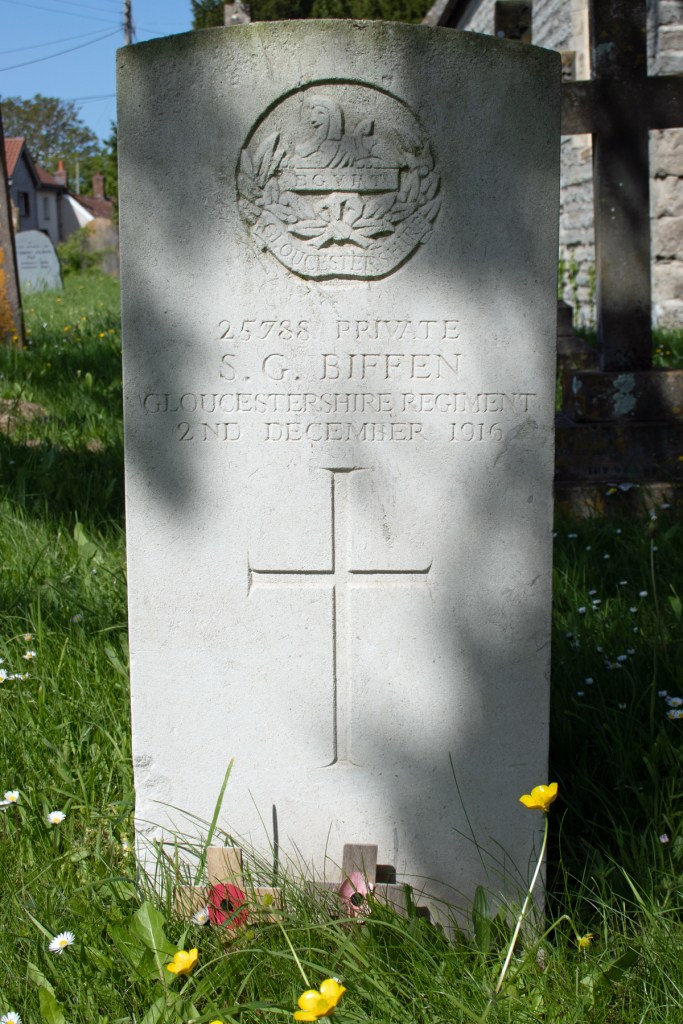
Private Stanley Biffen

Private Stanley Biffen

Stanley George Oliver Biffen was born in the autumn of 1894 in the Somerset village of East Huntspill. He was the second child to Oliver and Fanny Biffen, although his older sibling, sister Florence, had passed away at just three months of age.

Oliver was a carter and farm labourer, and the family went where the work was. The 1901 census found them living in Eastover, Bridgwater, Fanny’s widowed father, George, also living there. Ten years later, the four of them had moved to the village of Stawell. Stanley had finished his schooling, and had also taken up farm work.

When war came, Stanley stepped up to play his part. Full details of his service are lost to time, but he had enlisted in the Army by the spring of 1915. He initially joined the 1st Battalion of the Somerset Light Infantry, and by May that year, was in France.

It is not possible to track Private Biffen’s movements during the conflict, but he did transfer across to the Gloucestershire Regiment at some point. Assigned to the 7th (Service) Battalion, his was a troop that served at Gallipoli and in North Africa, although there is no evidence that Stanley fought in there.

The only other concrete evidence available for Private Biffen relates to his passing. By the autumn of 1916, he had been admitted to the 1st Western General Hospital in Fazakerley, Liverpool. He was suffering from phthitis, or tuberculosis, and this was the condition that was to get the better of him. He passed away on 2nd December 1916, at the age of just 22 years old.

The body of Stanley George Oliver Biffen was brought back to Somerset for burial. He was laid to rest in the quiet graveyard of Stawell Church.


Stanley’s parents had now lost both of their children, and this is likely to have taken a toll on them. Fanny passed away in December 1924, at the age of 64 years old. Oliver died just a year later aged 54 years old.


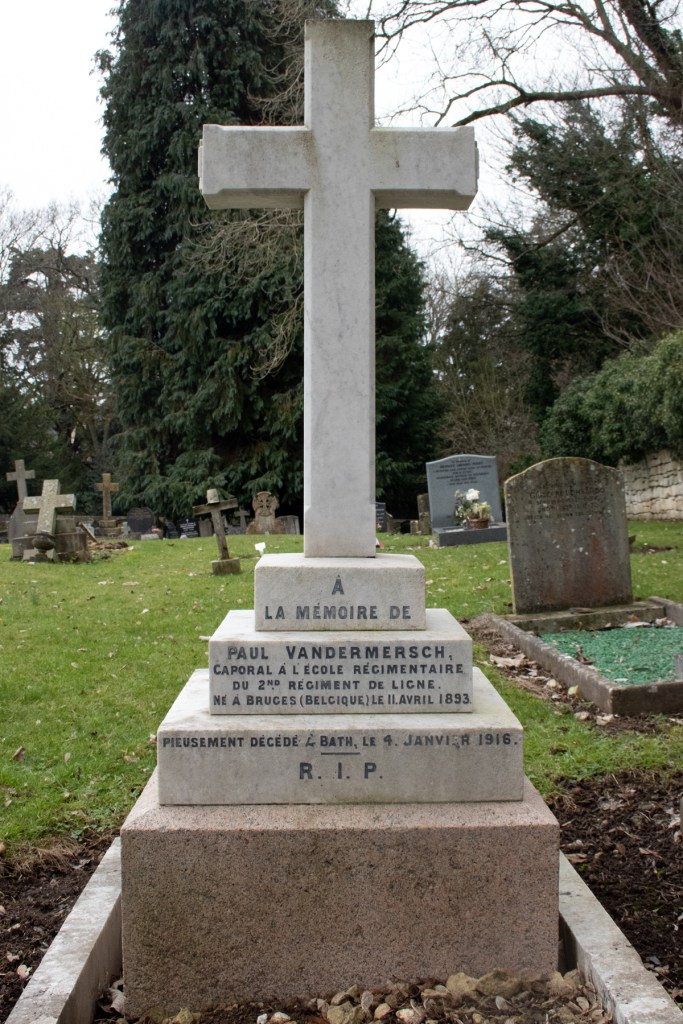
Korporaal Paul Vandermersch

Korporaal Paul Vandermersch

The funeral took place on Friday last, at Bath, of Paul Vandermersch, second son of Paul Vandermersch, Divisional Chief, Provincial Administration, Western Flanders. Deceased passed away the previous Tuesday at 86, Shakespeare-avenue, Bath, at the early age of 22. He had served in the Belgian Army, but suffering from phthisis, he was invalided out.

Catholic Times and Catholic Opinion: Friday 14th January 1916

Paul Pierre Arnold Joseph Vandermersch was born on 11th April 1893 in Bruges, Belgium. Details of his early life are scarce, but it is clear that he was the son of Paul and Louise Vandermersch.

During the First World War, Paul served as a Korporaal (Corporal) in the Belgian Army, and was assigned to the 2 Linie 1/1 (second line). Full service records are not available, but having contracted tuberculosis, and with the influx of Belgian refugees to Britain during the conflict, it is likely that, having been medically discharged from the army, he was sent to Somerset to recuperate.

Korporaal Paul Pierre Arnold Joseph Vandermersch died on 4th January 1916, and was laid to rest in the Roman Catholic Cemetery in Bath.


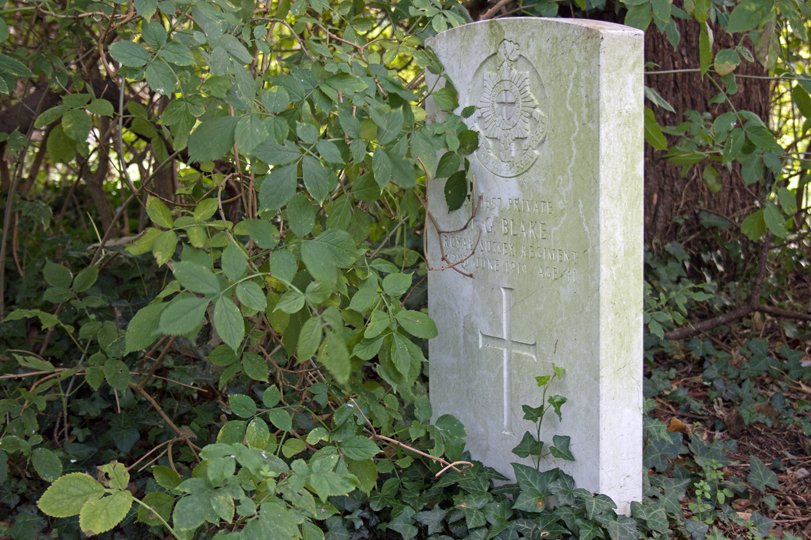
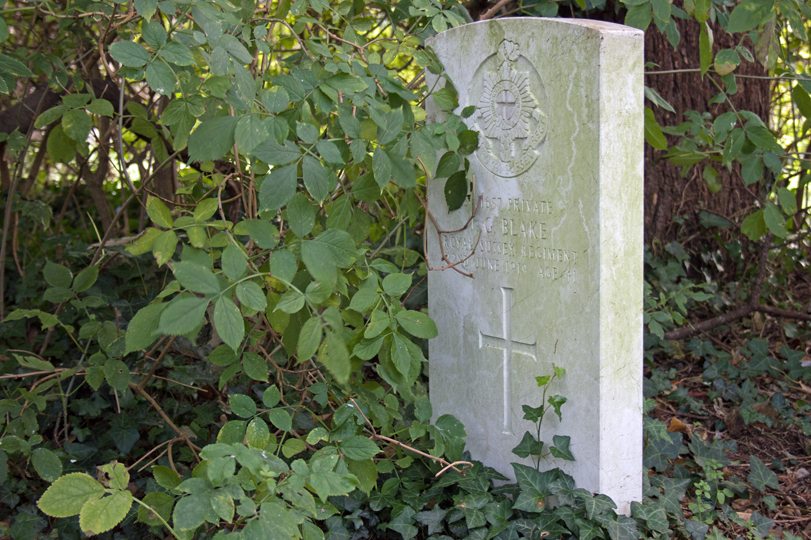
Private John Blake

Private John Blake

John George Blake was born early in 1878, and was the oldest of seven children. His father, Job, was a general labourer, and, with Eliza, John’s mother, brought the young family up in the West Sussex town of Worthing.

Job died in 1898, ages just 36 years old; Eliza found work as a housekeeper, while John was employed as a carter for the railway. By the 1901 census, the family were living in a terraced house near the centre of town, Eliza living there with her three sons, two daughters, son-in-law and granddaughter.

In October 1904, John married Alice Attwater, a labourer’s daughter from mid-Sussex. The couple moved into a house close to the station and went on to have four children; John Jr, Ernest, Bertha and Dorothy. John was by now working as a porter for the railway, a role he continued through to the outbreak of war.

John enlisted in November 1914; he joined the Royal Sussex Regiment, working as a member of the depot staff. Private Blake was shipped overseas, arriving in France in March 1916.

Almost exactly a year after landing in France, John was injured in the line of duty. The medical report confirmed that a “scald on the left arm and neck [had] occurred while on duty on March 1st 1917, in France. He was preparing hot soup for his company in the front line at midnight. He was not to blame. Injury caused by enemy shelling the company kitchen“.

Private Blake was shipped back to England for treatment, and admitted to Netley Hospital near Southampton. While there, he contracted phthisis (tuberculosis), which left his totally incapacitated. He was medically discharged from military service in August 1917.

Further details of John’s life are scarce. He returned home to his family, although whether he took up his job again is unknown. He passed away on 22nd June 1919 at the age of 41. The cause of his death is unknown, although it seems likely to have been related to the tuberculosis.

John George Blake lies at rest in the Broadwater Cemetery of his home town, Worthing.