Tag Archives: pneumonia

Private Henry Boyce

Private Henry Boyce

Henry Leslie Boyce was born on 14th June 1872 in the parish of St Michael, in Barbados, then the British West Indies. His parents were Samuel and Mary Boyce.

Further details of his early life are scant, but Henry appears to have moved to England at some point in the early 1890s. The 1911 census shows him living in Ilford, Essex, and working as an iron and metal merchant. His wife Rosanna, a dressmaker, was born in Wincanton, Somerset, and they married in 1896. The young couple had two children; sadly they both died young.

Henry was quick to do his duty when war broke out, joining up in September 1914. He enlisted in the British West Indies Regiment, and after training on the home front, served in France from April 1917. While there, he was promoted to Acting Corporal, but contracted bronchial pneumonia and was sent back to England to recuperate after only five months.

A medical report from November 1917 states that Acting Corporal Boyce remained unfit for military service, and he was discharged from the army at the end of that year. The same report showed him as a former commercial traveller, living in Forest Gate. It marks him as having a very good military character – “Judging from his records, he is a steady, sober, well-conducted man“.

While no information after that point is available for him, it seems that he succumbed to the disease less than a year later.

Henry Leslie Boyce died on 24th October 1918. He was 46 years old.

He lies at rest in the graveyard of St Leonard’s Church in Butleigh, Somerset; presumably close to his widow’s family.


There is some discrepancy over Henry’s rank. He was discharged with the rank of Acting Corporal, although his headstone cites his previous rank of Private.

Private Herbert Pittard

Private Herbert Pittard

Herbert Leonard Pittard was born in 1896, the youngest of two children – both boys – to Frederick and Lily Pittard. Frederick was a bootmaker, employed by the Clark’s factory in the town.

Herbert’s mother died in 1910, and by the time of the 1911 census, he was living with his father, brother and grandmother in Park Terrace, Glastonbury. All three of the household’s men were bootmakers, all were working at the Clark’s factory in Street.

Frederick Pittard was out to seek pastures new, emigrating to America in 1912. Herbert is recorded as having visited his brother a year later.

Herbert’s military records are sparse; it seems that he enlisted in the Devonshire Regiment, joining the 3rd Battalion as a Private, before transferring to the Southern Command Labour Centre of the Labour Corps. When this happened, and for how long he enlisted, is not known, but he survived through to the Armistice in 1918.

A short notice in the Central Somerset Gazette (Friday 29 November 1918) confirmed that “Mr Pittard, Park Terrace [Glastonbury], has just lost his younger son through the influenza epidemic. Private Bert Pittard died in Bath War Hospital from pneumonia subsequent to influenza at the age of 22.

Herbert Leonard Pittard died on 26th November 1918. He lies at rest in the cemetery in Street, Somerset.


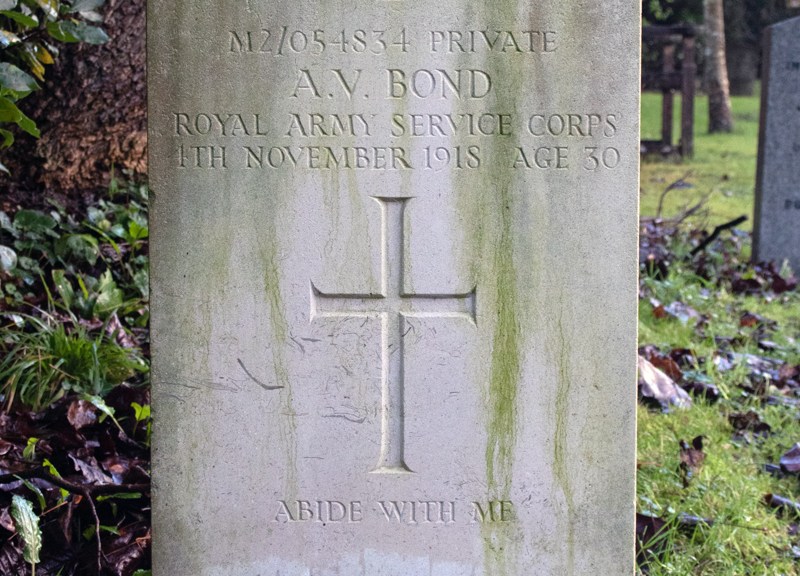
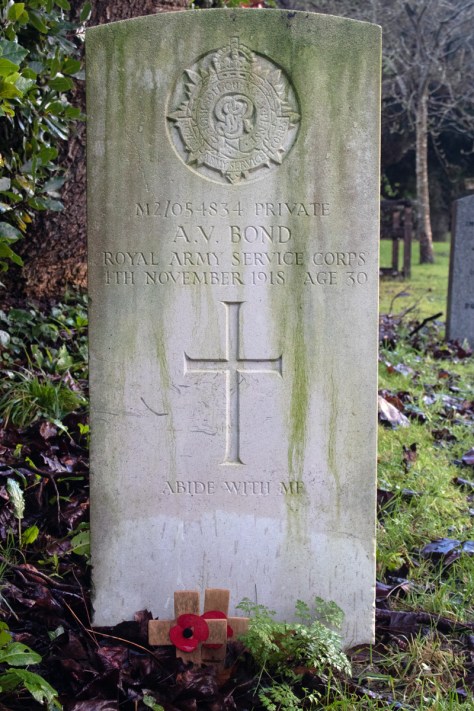
Private Albert Bond

Private Albert Bond

Albert Victor Bond was born in 1887, the only child of John and Sarah Bond. John was an engine driver, with a steam roller, and the family lived in the Somerset village of Butleigh.

Albert started working for the local baker and, by the time of the 1911 census, when his parents were celebrating their 25th Wedding Anniversary, this is the job he was doing.

He enlisted in March 1915, joining the Royal Army Service Corps. While his full service record is not available, Private Bond’s service was relatively short lived. He was discharged as medically unfit in February 1916, having served for just 332 days.

He was discharged with pneumonia, and this seems not to have cleared up and he was eventually admitted to the military hospital in Wool, Dorset. Albert passed away from the disease on 4th November 1918, just a week before the Armistice. He was 30 years old.

Albert Bond lies at rest in the graveyard of St Leonard’s Church in his home village of Butleigh.


Private Robert Hunt

Private Robert Hunt

Robert Edward Nichols Hunt was born in Somerton, Somerset in 1894. One of five children to Charles and Rose Hunt, his father was a bootmaker.

By the 1911 census, however, things had taken a different turn; Charles and two of his sons were working for a brewer, Rose was working as a shop assistance in Boots, and the youngest of the family, Kate, was apprenticed to a dressmaker.

It was against this backdrop that war came, and, within a year, Robert had enlisted in the Royal Army Medical Corps. His sign-up documents confirm that he was short sighted, although this was corrected with glasses and he was deemed fit for active service.

Sent to the Western Front in October 1915, Private Hunt definitely found himself in the thick of the action.

In August 1916, he was supporting the fighting at High Wood on the Somme, when a gas shell exploded near him. He fell and, when he woke, he remembered little of what happened. Robert had inhaled a lot of gas, however, and was left coughing with difficulty breathing. He was transferred back to England by train and ship to recover, arriving back on the 2nd September.

There is no record of Robert having gone back to the front. The impact of the gas appears to have been severe and long-lasting. At the end of October 1918, he was admitted to the Becket House Auxiliary Hospital in St Albans with influenza and bronchial pneumonia. Sadly, this was to be a battle he would not recover from, and he passed away on 4th November 1918. He was 24 years old.

Robert Edward Nichols Hunt lies at rest in the cemetery of his home town, Somerton.


Ordinary Seaman Donald Burgess

Ordinary Seaman Donald Burgess

Donald Burgess was born in 1901 in the village of Queen Camel in Somerset. His father, Frank Luther Burgess was the local schoolmaster, and he and his wife Frances has four children, all sons.

By the time of the 1911 census, Donald and his three brothers – Claud, Wilfred and William – were all at school, and Frank was, by now, the village headmaster.

Donald seems to have volunteered as soon as his age allowed. He joined the Royal Naval Voluntary Reserve in September 1918, and was stationed at HMS Victory in Crystal Palace. He was training to become a wireless operator, but his time there seems to have been cut cruelly short.

Ordinary Seaman Burgess contracted pneumonia and was admitted to the 4th London General Hospital in nearby Camberwell. Sadly, he succumbed to the condition and passed away on 8th October 1918, after just a few weeks’ service. He was just 17 years of age.

Donald Burgess lies at rest in sight of his father’s school, in the graveyard of St Barnabas Church.


Stoker 2nd Class Frederick Pople

Stoker Frederick Pople

Frederick Richard Pople was the second of three children – all sons – of Frederick and Emma Pople, born in 1887 in Street, Somerset.

He married Beatrice Cox in 1910 and, by the following year the newlyweds had moved to South Wales, when Frederick found work on the railways. The couple had one child, Frederick Alonzo Pople, who was born in 1912.

Sadly, Beatrice passed away a couple of years later; Frederick married again, to Beatrice Salmon, in November 1914; the couple had a son, Edward George Salmon Pople, who was born on Valentine’s Day 1918.

Frederick enlisted relatively late in the war – he was 30 when he signed up on 25th January 1918, and is likely to have missed the birth of his son.

He enrolled in the Royal Navy and his training took place at HMS Vivid II in Devonport. By March of that year, he was serving as a stoker on the HMS Attentive III, part of the Dover patrol.

Stoker Pople continued to work on the HMS Attentive after the conclusion of hostilities in November 1918. Sadly, he contracted pneumonia and passed away 11th February 1919, leaving Beatrice with a son of less than a year old.

Frederick Richard Pople is buried in the Cemetery of his home town, Glastonbury.

Guardsman Harold Dummett

Guardsman Harold Joseph James Dummett

Harold Joseph James Dummett was born in early 1900, one of ten children – and the eldest son – of Harry and Elizabeth of Kingsdon, Somerset.

Harold joined the Coldstream Guards, although there are no records to confirm the date of his enlistment. His battalion – the 5th – remained stationed in Windsor throughout the war; it is likely, therefore, that Guardsman Dummett never saw front line service.

His pension records give his mother as his next of kin, while the Register of Soldier’s Effects also name his father.

Guardsman Dummett passed away from pleurisy and pneumonia at the Military Hospital in Purfleet on 15th February 1919. He was 19 years of age.

Harold Joseph James Dummett lies at peace in the quiet All Saints’ Churchyard in his home village of Kingsdon.


While Harold does not appear in the newspaper records, his parents do. In April 1937, the Taunton Courier reports that

Mr and Mrs Harry Dummett celebrated their golden wedding… There was a happy family gathering of all their children and two grandsons.

Taunton Courier and Weston Advertiser – 24th April 1937

Shoeing Smith George Stone

Shoeing Smith George Henry Stone

George Henry Stone was born in 1872, son of Milverton’s blacksmith James Stone and his wife Mary Ann. He followed in his father’s footsteps and, by the time he married Mary Florence Paul in 1894, he was also working in the forge in Milverton.

George and Mary had eight children – seven girls and one boy; by the time he signed up in 1915, he listed himself as a blacksmith.

His military records show that he was medically certified as Category B2 (suitable to serve in France, and able to walk 5 miles, see and hear sufficiently for ordinary purposes). He was assigned to the Remount Depot in Swaythling, Southhampton, which was built specifically to supply horses and mules for war service. (In the years it was operating, Swaythling processed some 400,000 animals, as well as channelling 25,000 servicemen to the Front.)

While serving George contracted pneumonia. He was treated in Netley Military Hospital, but passed away on 19th November 1918, aged 47.

Shoeing Smith George Henry Stone lies at peace in a quiet corner of St Michael & All Angel’s churchyard in his home village of Milverton.

Private Cecil Paine

Private Cecil John Paine

Cecil John Paine was born in Sherborne, Dorset, in May 1899, the son of John and Emily Paine. He was the fifth of seven children, and the second son.

Cecil’s military records are sparse, but the local newspaper provides more information. According to the Western Gazette, Cecil joined up on reaching his 18th year, and had only been in service for three weeks, when he succumbed to pneumonia at Chiseldon Camp in Wiltshire on 6th June 1917.

Private Cecil Paine lies at rest in Sherborne Cemetery.


As an aside, Chiseldon Camp was initially set up to train new soldiers. In 1915, part of it was developed into a hospital for wounded soldiers before, in 1916, it began to treat soldiers coming back from the front who had contracted VD. Interesting times that Private Paine probably knew little about.


Cecil’s eldest brother, Frederick William Paine also served in the Great War. He had enlisted in the navy in 1903, initially for 12 years, but continued on and was finally discharged in 1919.

Deck Hand Harry Cook

Deck Hand Harry Cook

Harry Sidney Cook was born in April 1892, the youngest of six children. His parents John, a clay digger, and Ann lived in Rainham, Kent, and had two other boys and three girls.

By the 1911 census, the family seem to have gone their separate ways. John and his youngest son were boarding away from the rest of the family, and Harry listed himself as a fisherman. There is no immediate record of his mother, Ann, while his oldest brother Arthur had passed away, and his closest sibling Albert was working as a labourer in Essex.

Shortly after the census was taken, he married Alice Pearce. They lived in a house by Rainham Station and soon had a son, Frank Sidney.

Harry enrolled in the Royal Navy in March 1916, and served on a number of vessels during the war and in the months afterwards. Shortly after enrolling, he and Alice had twins, Daisy and Edith.

Deck Hand Cook was serving on HMS Hermione in February 1919. A guard ship in Southampton, towards the end of the war, she became the HQ Ship for motor launches and coastal motor boats serving the Solent.

It was while he was working there that Harry contracted pneumonia. He was admitted to the Haslar Royal Naval Hospital in Gosport, but passed away on 14th March 1919. At 26 years old, he had become a father for the fourth time just three weeks before; it is likely that he never got to meet his youngest daughter, Alice.

Deck Hand Harry Cook was brought back to his home town of Rainham to be buried. He lies at rest in the St Margaret’s Churchyard, Rainham.