Tag Archives: Royal Engineers

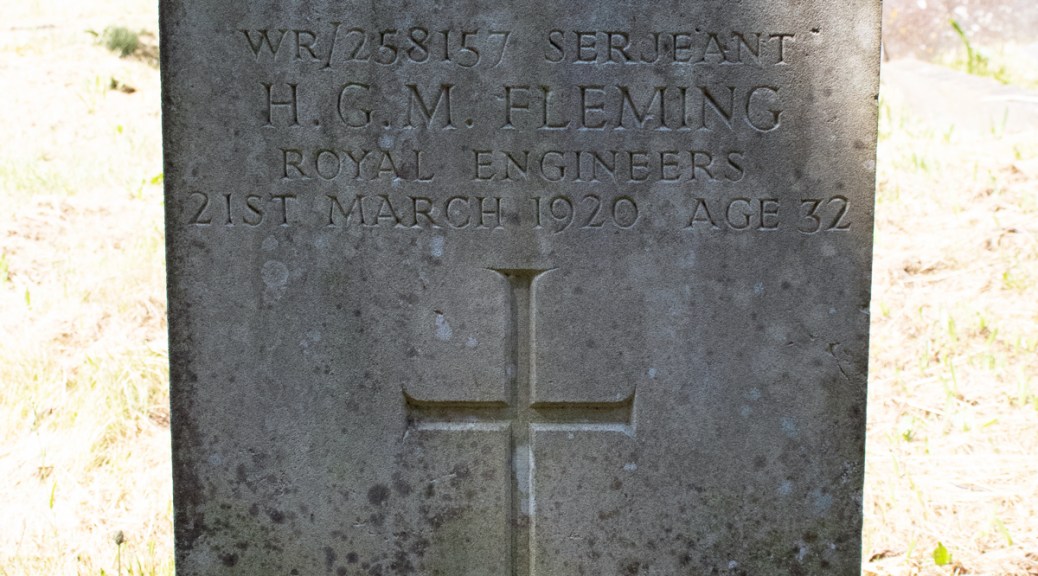
Serjeant Herbert Fleming

Serjeant Herbert Fleming

Herbert Gordon Maurice Fleming was born in Stockton, Wiltshire, on 24th March 1888. An only child, his parents were carpenter and wheelwright George Fleming and his wife, Annie.

Little further information is available about Herbert’s early life. On 25th June 1910 he married Ethel Young, a shepherd’s daughter from Wiltshire: they would go on to have four children, Herbert Jr, Ivy, George and Harold.

Herbert’s marriage certificate noted that he was employed as an engine driver. In his spare time, he also volunteered for the Wiltshire Regiment. When war broke out in the summer of 1914, he was called upon to play his part, and was formally mobilised in July 1916.

Sapper Fleming joined the Royal Engineers. His service records show that, at 28 years of age, he stood 5ft 7.5ins (1.71m) tall, and weighed 159lbs (72kg). He was of good physical development, although his medical report noted that some dental attention was required, and he had a pendulous mole on his back.

After his initial training, Herbert was sent to France. He was to remain part of the British Expeditionary Force for the next three years. While details of his service are scarce, his commitment to the army was clear: he was promoted to Lance Corporal in December 1918; full Corporal in June 1919; and Serjeant just three months later.

In October 1919, Herbert arrived back in Britain and the following month he was formally demobbed. He returned to his family, who were now living in Bath, Somerset. Back on civvy street, Herbert took up work as a motor waggon driver in the city, but his post-army life was to be short-lived.

The enquiry into the death on Saturday of Herbert John Maurice Fleming… was held at Bath Guildhall… Medical evidence proved that the cause of death was heart failure, due to an unexpected attack of pneumonia.

The widow said her husband did not complain of illness until Friday evening, when he returned from a journey to Reading. He then said he ached all over, and would go to bed at once. On Saturday evening he said he felt better, and sent her to the chemist for a tonic. He told her not to send for a doctor, as he expected to be quite well on Monday. On Sunday he still appeared fairly well, and was quite cheerful: but in the afternoon he complained of sickness, and the end came very suddenly.

[Bath Chronicle and Weekly Gazette: Saturday 27th March 1920]

Herbert John Morris Fleming was just three days short of his 32nd birthday when he died. He was laid to rest in Bath’s sweeping Locksbrook Cemetery.


The spelling of Herbert’s second middle name is variously noted as Maurice and Morris. For consistency, I have used the spelling noted on his birth certificate.


Pioneer Richard Crook

Pioneer Richard Crook

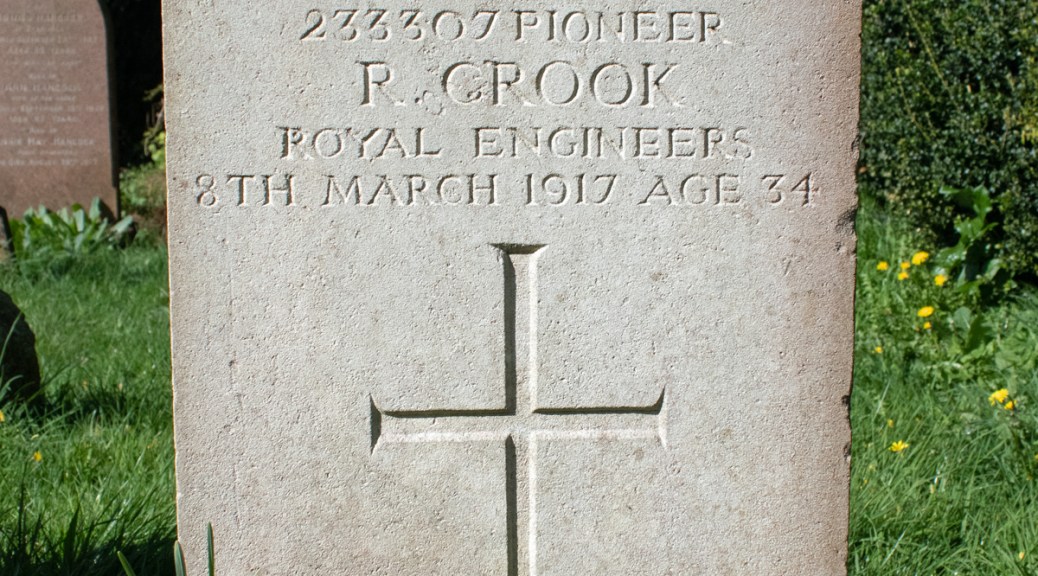
Richard Crook was born in the spring of 1883 in the Devon village of Locksbeare. The youngest of three children, his parents were Richard and Ann Crook. Richard Sr was a general labourer, and his son followed suit when he completed his schooling.

On 5th November 1904, Richard married farmer’s daughter Elizabeth May. The couple went on to have four children, and moved around Devon to wherever his farm work took them. Ann died in 1910, and by the time of the following year’s census, they had settled in Burlescombe, near Sampford Peverell.

By the start of 1917, Richard was called upon to serve his King and Country. He enlisted on 30th January and joined the Royal Engineers. His service records show that he was attached to the Inland Water Transport Corps, and given the rank of Pioneer.

Richard was sent to Kent for training, but within a matter of weeks he was admitted to a military hospital in Canterbury. He had contracted German measles, and it was so severe that he quickly succumbed to it. He passed away on 8th March 1917, at the age of 34 years old. He had been in the army for less than five weeks.

Richard Crook’s body was brought back to Somerset for burial. He was laid to rest in the graveyard of St Peter’s Church, Uplowman, Devon, not far from where his widow and children were living.


Sapper George Bush

Sapper George Bush

George James Bush was born in the autumn of 1889 in Bath, Somerset. One of eight children, his parents were Edward and Sarah Bush. Edward was a general labourer turned fishmonger and the family lived in a ramshackle cottage in Griffin’s Court, off Milk Street towards the centre of the city.

When he finished his schooling, George found employment as a general labourer. By the time of the 1911 census, he and three siblings were still living at home with their parents, and all of them were working to bring together an income for the household. Times were obviously hard for the Bush family, and the list of trades reads like something from one of Dickens’ novels: fishmonger, charwoman, box maker, carter and daily domestic.

Edward died in 1912, and this put a further strain on the household. When war came to Europe two years later, a career in the army seemed a price worth paying for the additional financial support it would bring George and his family. He had enlisted in the Royal Engineers as a Sapper by the spring of 1917.

Attached to the 503rd Field Company, George’s full service details are lost to time. He definitely saw action overseas, however, fighting in some of the fiercest battles of the war, at the Third Battles of Ypres in 1917. It was here, at Passchendaele, that Sapper Bush was wounded, his injuries severe enough for him to be medically evacuated to Britain.

George was admitted to Sheffield War Hospital, but complications set in.

Sapper G Bush, RE, formally employed by the Corporation as a motor lorry driver, died in the Warecliffe Hospital, Sheffield, on Saturday. He was wounded a short time ago, but the cause of death was pneumonia, which supervened. Sappe Bush, who was… unmarried, was a son of Mrs R Bush, of 19, Denmark Road, Twerton. He had been in the army close on two years. He was one of three brothers, all of whom joined the army. A younger brother, who enlisted soon after the outbreak of war, is now in Egypt with the Somersets.

[Bath Chronicle and Weekly Gazette: Saturday 1st December 1917]

George James Bush died on 24th November 1917: he was 28 years of age. His body was brought back to Somerset for burial, and he was laid in the family plot in Locksbrook Cemetery, Bath, reunited with his father far too soon.


Private Stanley Newman

Private Herbert Newman

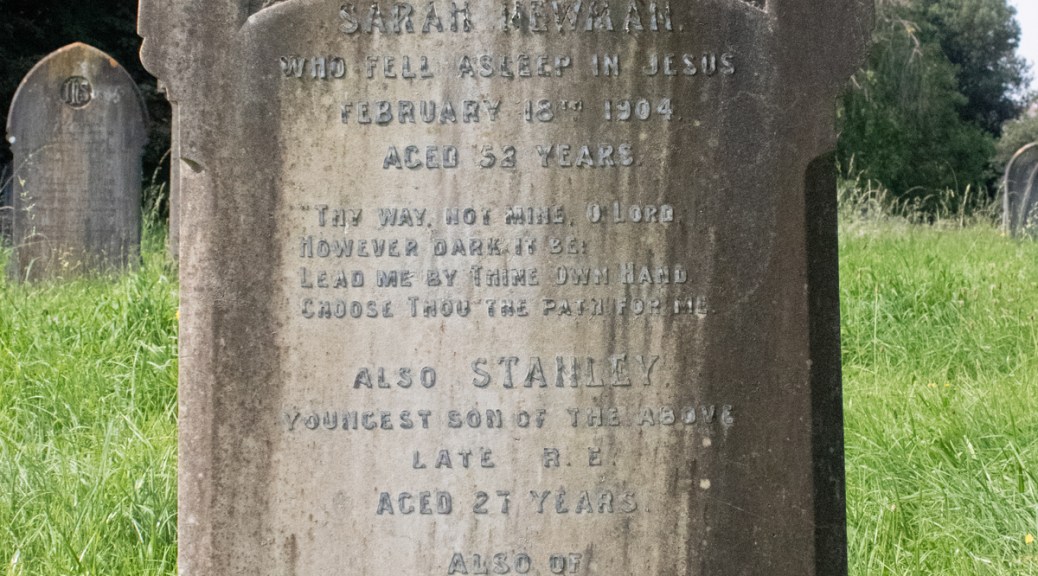
Stanley Herbert Newman was born on 14th May 1890 in the Walcot area of Bath, Somerset. One of at least six children, his parents were Charles and Sarah Newman. Charles was a stonemason and, when Sarah died in 1904, he married again, to widow Matilda Shearn, raising her children as part of the family.

When Stanley left school, he found work as a mason’s labourer – presumably either assisting his father, or having found work through him. On 3rd August 1912, he married Rosa Bean, a farm worker’s daughter from Bathwick, to the east of the Bath. The couple set up home at 7 Margaret’s Hill, and went on to have two children, Mabel and Albert.

With a growing family to support, Stanley’s work as a labourer was not going to bring enough money in, and he sought a more reliable career. On 2nd September 1912, he enlisted in the army, joining the Royal Engineers. His service record shows that he was 5ft 5.5ins (1.66m) tall.

Detailing Sapper Newman spent just over two years in the Royal Engineers, his time there coming to an end on 11th December 1914 when he was deemed medically unfit to serve.

At this point Stanley’s trail goes cold. At some point he joined the Somerset Light Infantry, although his service documents for this period of time in the army as lost to time. Attached to a Depot Battalion, it seems likely that he remained in Somerset, although this is not conclusive.

Private Newman died in a military hospital on 28th July 1917, through causes unknown. He was 27 years of age.

Stanley Herbert Newman was laid to rest in the family plot in Bath’s sweeping Locksbrook Cemetery. He was reunited with his mother, who had been buried there thirteen years before. His father, Charles, was buried with them in 1921.


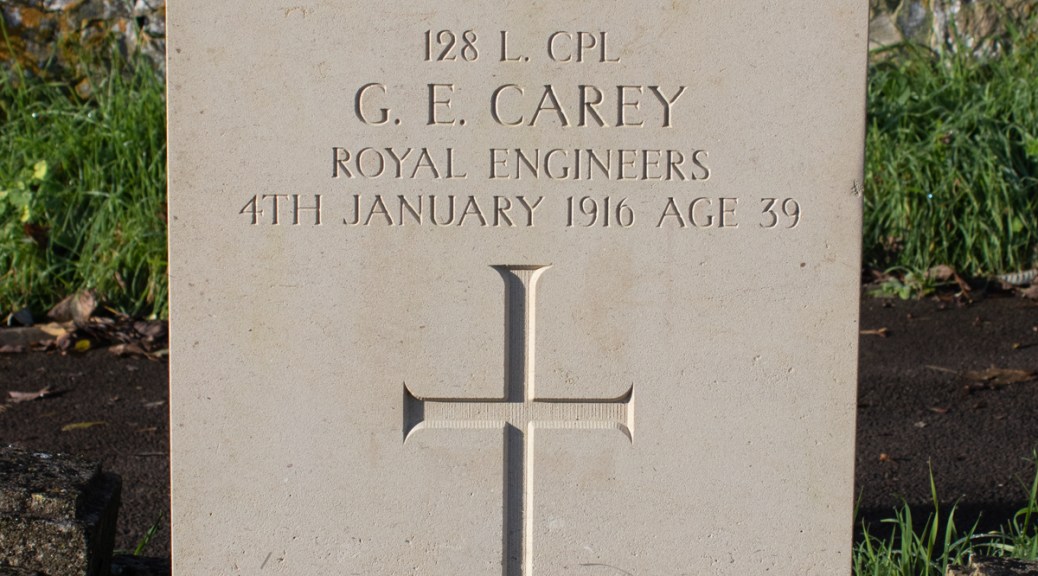
Lance Corporal George Carey

Lance Corporal George Carey

George Edward Carey was born at the start of 1877 and was the oldest of eight children to Samuel and Hester Carey. Samuel was a solicitor’s clerk from Clevedon in Somerset, and this is where the family were born and raised. Samuel was not one to sit on his laurels, however, and the 1891 census recorded his occupations as law clerk, innkeeper and insurance agent.

George followed a different path to his father, and found work as a printer’s apprentice when he finished his schooling. He worked up to being a full compositor quite quickly, and was employed as such when, on 30th January 1899, he married Lizzie Taylor. A civil engineer’s daughter, she was working as a teacher when the couple wed: they set up home in Clevedon, and went on to have four children.

By 1911, the Carey family were living in a seven-room house on Strode Road, Clevedon. George was still working as a compositor, but was employed by the local sanitary works. His widowed brother, Albert, who was lodging with his brother and sister-in-law also did the same job.

With storm clouds brewing over Europe, George stepped up to play his part. He enlisted in the Royal Engineers in the autumn of 1914 and was attached to the 503rd Field Company in Exeter. Little information is available about his time in the army, and he only comes to light again a year or so later.

Lance-Corporal Carey, 2nd Wessex RE, who has been employed at the office in Colleton-crescent, Exeter, was found dead, with his neck broken, at the bottom of a flight of stairs at the Grapes Inn, South-street, on Thursday morning. The discovery was made by Mrs Dorothy, wife of the licensee of the inn. Information was given to the police, and Dr Pereira visited the scene, and subsequently the body was removed to the mortuary by PCs Wise and Barrett. Carey was fully dressed. He was about 48 years of age, and leaves a widow and four children. For about fourteen months he had been engaged on the Wessex RE staff, and was billeted at a house in the Friars. His home is at Clevedon, Somerset, where he was engaged as a compositor before mobilisation with the Territorials. He was under orders for transfer to another station.

Taunton Courier and Western Advertiser: Wednesday 12th January 1916

George Edward Carey died on 4th January 1916: he was, in fact, not quite 39 years of age. His body was brought back to Somerset for burial and was laid to rest in the stunning graveyard of St Andrew’s Church in his home town of Clevedon.


Sapper John Mably

Sapper John Mably

John Leslie Mably was born on 21st May 1899, the only son to Elizabeth Janie Mably. Elizabeth lived with her widowed mother and two older brothers, in the Cornish parish of St Minver.

There is scant information available for John’s short life. The 1911 census showed that he was still at school, and when war broke out, he enlisted in the Royal Engineers, although the date for this happened is unclear. Sapper Mably was assigned to the 69th Division Signal Company, but records do not confirm whether he served overseas or on home soil.

At some point later in the conflict, John was in Yorkshire, as he was admitted to the general hospital in Sheffield. Again, details are sketchy, and it is not possible to identify if he was based in the area, or medically evacuated there from overseas. Either way, it was in the hospital that he breathed his last, passing away on 15th August 1918, at the age of just 19 years old.

John Leslie Mably’s body was taken back to Cornwall for burial. He was laid to rest in the picturesque setting of St Michael’s Churchyard in the village of Rock.


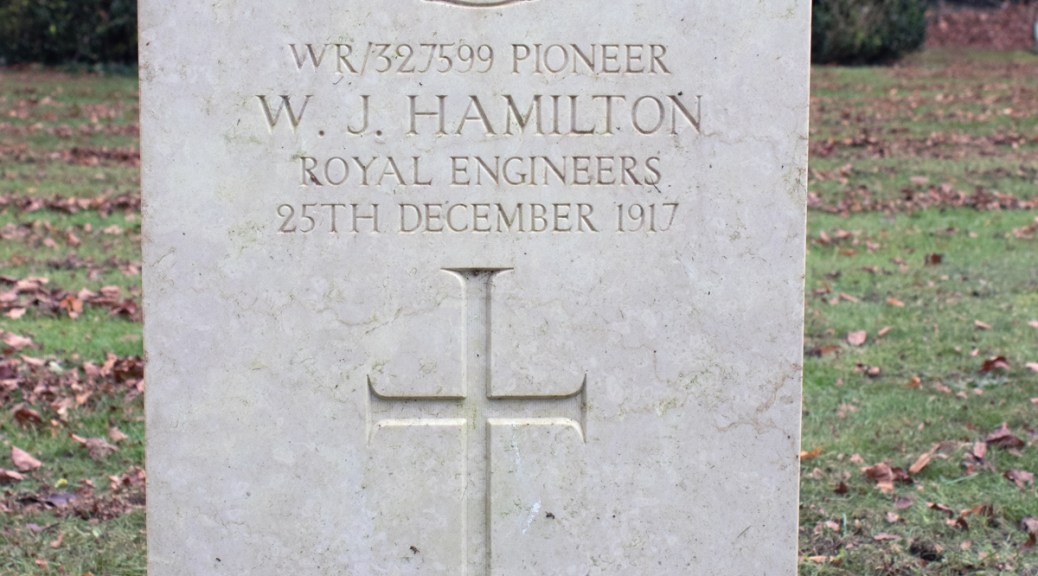
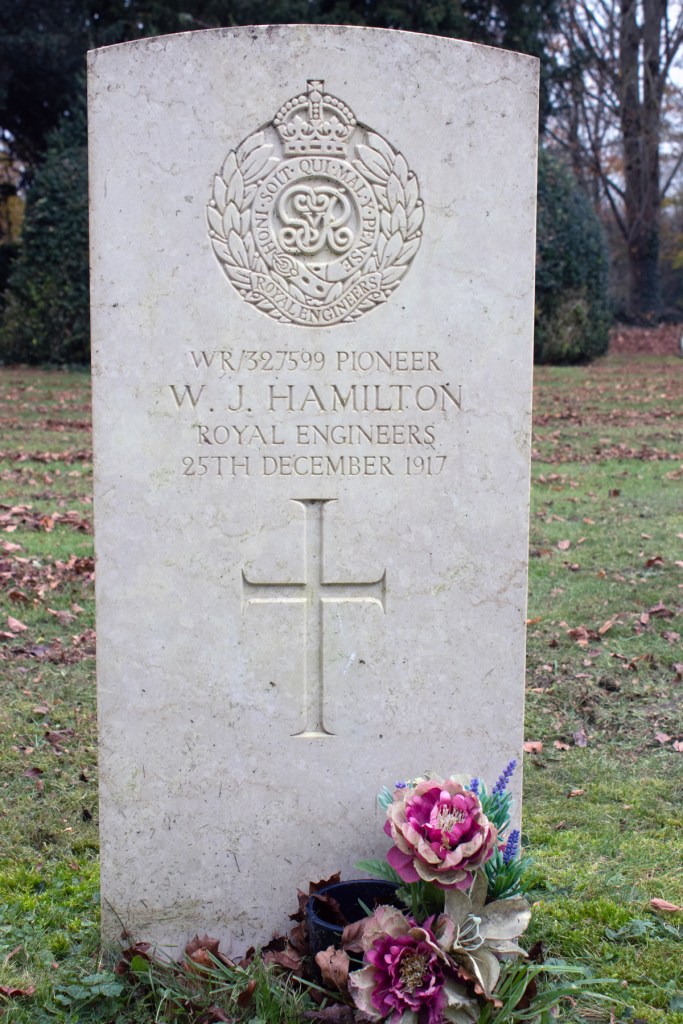
Pioneer William Hamilton

Pioneer William Hamilton

William John Hamilton was born in Urney, County Tyrone, in 1870. One of ten children, his parents of John and Bella. Little further information is available about his early life, but on 29th September 1895, William married Sarah McLaughlin.

The couple set up home in Ballycolman Lane, Strabane, and had at least six children. William worked as a shop porter, while Sarah kept house for the family.

By the time of the 1911 census, William was working as a general labourer. War was brewing over the continent by this point, however, and when hostilities were declared, he stepped up to play his part.

Full details of William’s service are lost to time. What documents remain, however, confirm that he enlisted no earlier than June 1917, and that he joined the Royal Engineers as a Pioneer. He was attached to an Inland Water Transport unit and sent to Salisbury Plain, Wiltshire, for training.

Pioneer Hamilton’s Pension Ledger Card provides a tantalising insight into his passing. On 25th December 1917, he died from “suffocation from submersion accidentally drowned while on active service.” There is no other documentation to expand on what happened, and no contemporary newspaper report on his passing. William was 47 years of age.

It would appear that Sarah was unable to afford the cost of bringing her late husband’s body back to Ireland for burial. Instead, William John Hamilton was laid to rest in Amesbury Cemetery, close to where he had passed away.


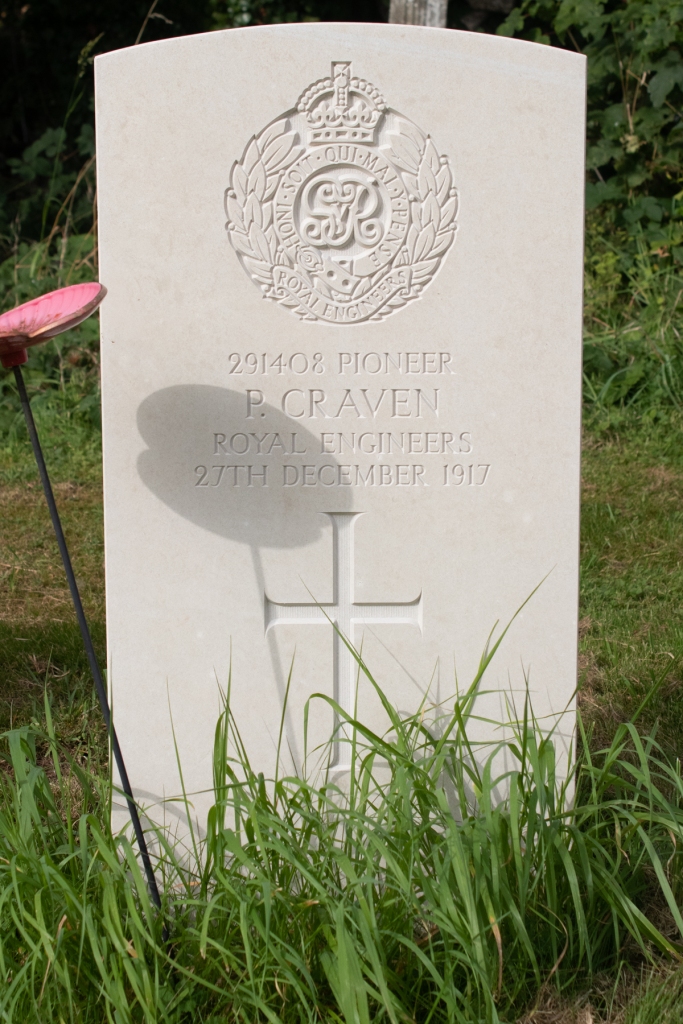
Pioneer Patrick Craven

Pioneer Patrick Craven

Patrick Craven was born in the summer of 1898 in Drogheda, County Louth. The oldest of three children, his parents were Francis (or Frank) and Mary Craven. Mary died in 1909, and the following year Patrick’s father remarried, to widow Kate Devin. The 1911 census found the extended family living in a cottage on North Road, Frank, Kate and their seven children.

Frank was a farm labourer, and this is work that Patrick also went into when he finished his schooling. War came to Europe in 1914, and he was to be called upon to play his part.

Patrick enlisted in the Royal Engineers on 6th June 1917. His service records confirm that he was 5ft 6ins (1.68m) tall, and weighed 127lbs (57.6kg). Pioneer Craven was assigned to the Inland Waterways Transport Division, and sent to Henbury, on the outskirts of Bristol, Gloucestershire, for training.

There was one blip on Patrick’s otherwise spotless service when, on 1st October 1917, he was confined to barracks for two days for ‘conduct to the prejudice of good order and military discipline, leaving the ranks without permission‘. Shortly after this, Pioneer Craven was assigned to a unit in Portbury, Somerset.

The wet summer of 1917 had given way to a cold, harsh winter, and the conditions were to lead to Pioneer Craven’s tragic demise on 27th December. The detailed report from the Medical Officer explained what had happened:

This man was found dead… in a small harness room at the Lodway Brewery, Pill, a room occupied by the IW&D, Portbury. I was called in to see him and pronounced him dead, the body was quite stiff and cold and death had probably taken place several hours before. When first discovered the body was fully pronated, with the mouth flattened against the floor, the hands were gripping the Army greatcoat which he had pulled over himself.

The harness room was heated by a coke stove the flue of which passed through the room to the ceiling and was cracked, allowing the fumes of the burning coke to emanate into the room. There was no ventilation except through a door communicating with the stables, which was found shut at the time the cadavre [sic] was found. The stove was situate[d] between the position where the body lay and the door, in a cul-de-sac.

One other man slept in the same room the same night, the deceased man having evidently entered the place after the former had fallen asleep. The second man was not affected by the fumes to any degree, but was lying between the stove and the door under which there was a certain amount of draught.

Sheltering himself from the cold winter night, Private Craven had passed away in his sleep from carbon monoxide poisoning. He was just 19 years of age.

Patrick Craven’s family were unable to afford to bring him back to Ireland for burial. Instead, he was laid to rest in the peaceful graveyard of St George’s Church in Easton-in-Gordano, not far from the brewery stables where he had passed.


Lance Corporal Charles Bayliss

Lance Corporal Charles Bayliss

Charles Bayliss was born in Birmingham in 1861. Little concrete information is available about his early life, but later documents confirm his father was called John, and he was one of at least five children.

Charles married Ellen Kimberley on 8th April 1888. The couple wed at St Mary’s Church in Kidderminster, Worcestershire, and went on to have four children – Nellie, Charles, Burt and Eva.

Charles took up manufacturing work, and ended up being a machine belt maker. He also served in the South Staffordshire Regiment, although whether this was on a paid or voluntary basis is not clear.

When was came to Europe, Charles felt the need to serve his country once more. He enlisted on 23rd August 1917, taking five years off his age to ensure he was accepted. He was assigned to the Royal Engineers, and attached to the Inland Waterways and Docks unit.

Private Bayliss was based at Portbury Camp near Bristol, and records suggest that Ellen moved to be near him, finding lodgings on Myrtle Hill in Pill.

Charles was respected for the work that he was doing, and was promoted to Lance Corporal in May 1918. His health was against him, however, and just two months later he collapsed and died from a heart attack while at work. He was 58 years of age.

Charles Bayliss was laid to rest in the graveyard of St George’s Church, Easton-in-Gordano, not far from the docks where he had served, and the riverside home in which his widow still lived.


Sapper Edward Pullinger

Sapper Edward Pullinger

Edward Arthur Pullinger was born in Sutton, Surrey, in the summer of 1897. The oldest of three children, his parents were gardener Arthur Pullinger, and his wife, Ellen.

Arthur seemed to move the family to wherever the work was. By 1902 they had settled in Monkton Wyld, in Dorset, where he was employed on a local estate. Edward’s two siblings, sisters Constance and Nellie, were both born there, but the 1911 census shows that the Pullingers had moved again, to the village of Charlton Mackrell in Somerset.

When war came to Europe, Arthur stepped up to play his part. Sadly, full service records are no longer available, but it is clear from what remains that he enlisted in the Royal Engineers as a Sapper. He remained in the army, until being discharged from duty on 21st May 1919.

Another sad death took place on Wednesday of last week in the person of Mr EA Pullinger, only son of Mr and Mrs A Pullinger… Deceased, who was of a bright and happy disposition and a favourite with all, was gassed in the Great War, from the effects of which he never really recovered. He was always ready and willing to help in the social life of the village and will be missed greatly.

Langport & Somerton Herald: Saturday 12th March 1921

Edward Arthur Pullinger had succumbed to tuberculosis on 2nd March 1921, at the age of 23 years old. He was laid to rest in the peaceful graveyard of St Mary’s Church, in Charlton Mackrell.