Tag Archives: sister

Matron Jean Walker

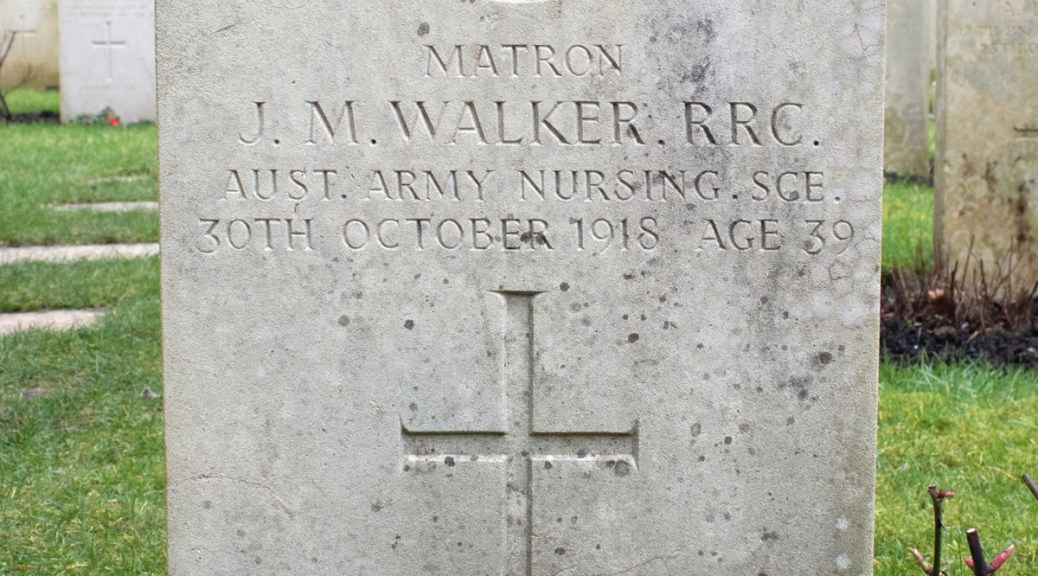
Matron Jean Miles-Walker

Jean Nellie Miles Walker was born in Hamilton, Tasmania, on 16th November 1878. Her parents were Arthur and Louisa Walker, and her surname moves from Walker to Miles-Walker, depending on the document. There is little information about Jean’s early life, but by 1906 she had taken up nursing.

When war broke out, Jean was quick to step up and help those who were fighting. Initially enlisting on 27th September 1914, she was assigned to a hospital ship a year later, arriving in Ismailia, Egypt, in January 1916.

Now a Sister in the Australian Army Nursing Service, Jean’s records shot the woman she had become. At 36 years of age, she was 5ft 10ins (1.78m) tall, and weighed 128lbs (58kg). She had dark brown hair, brown eyes and a dark complexion.

Over the next couple of years, Sister Walker moved to where she was needed. By September 1916 she was attached to the No. 15 General Hospital in Alexandria, by the end of the year saw her in the 3rd Australian Auxiliary Hospital in London. Jean’s service records note that she was mentioned in despatches on 1st October 1916, but there is no clarification about why she was recognised.

Jean was promoted to Matron in the summer of 1917, and over the next year, she spent time at hospitals in both Britain and France. By the autumn of 1918, she had moved to the No. 1 Australian General Hospital in Sutton Veny, Wiltshire. It was while based here that she fell ill, contracting a fatal combination of influenza and pneumonia.

Sister Walker passed away in the Sisters’ Quarters on 30th October 1918. She was just a couple of weeks short of her 40th birthday.

Jean Nellie Miles Walker was laid to rest in the grounds of St John’s Church, Sutton Veny, close to the hospital in which she had served.


Matron Jean Walker
(from findagrave.com)

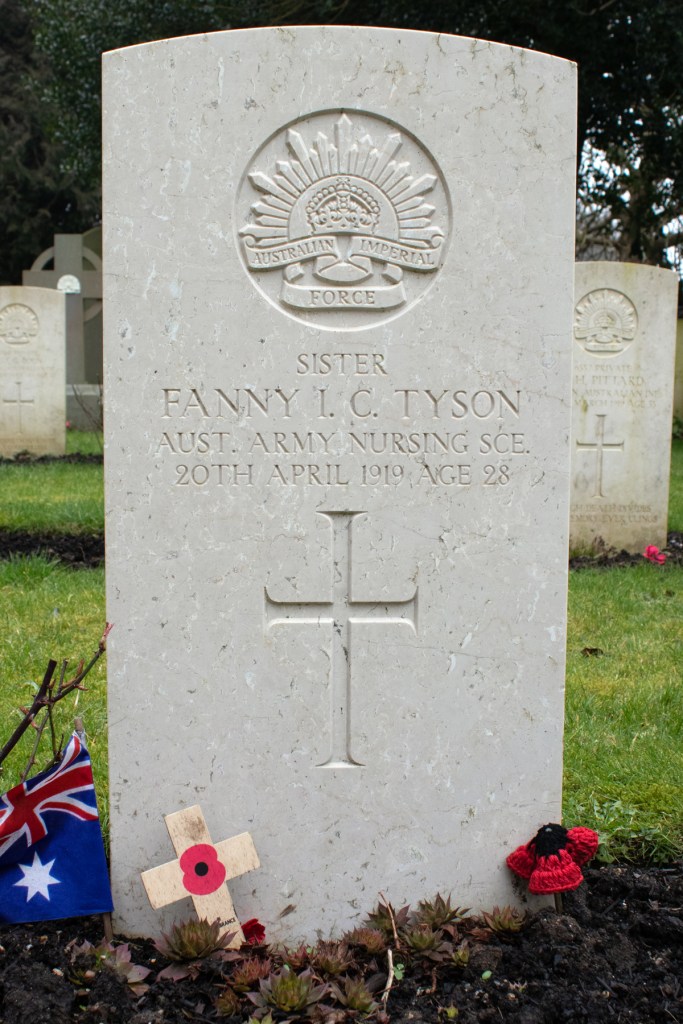
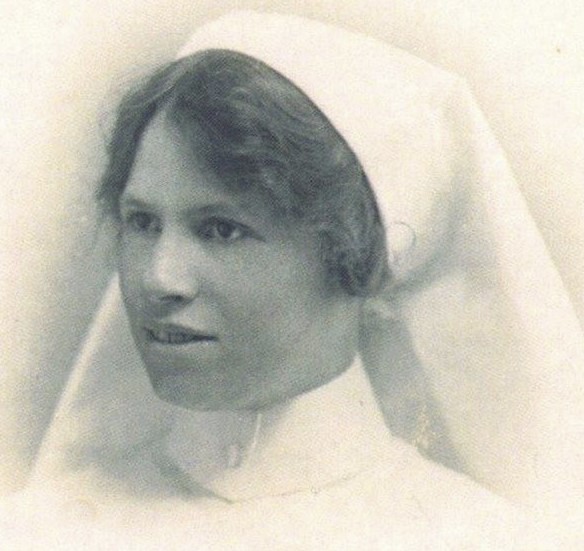
Sister Fanny Tyson

Sister Fanny Tyson

Fanny Isobel Catherine Tyson was born in Balranald, New South Wales, Australia, in 1890, and was the fourth of ten children to John and Teresa Tyson.

There is little information about Fanny’s early life, but when she finished her schooling, she went into the medical profession, and, by October 1911 she was working as a nurse at Bendijo Public Hospital. She became a staff sister and, when war broke out, she stepped up to support the troops being sent to Europe.

On 20th May 1915, Fanny enrolled in the Australian Army Nursing Service and by the following spring, she was on her way across the world. Arriving in France on 6th April 1916, she soon made her way to Rouen. For the next fourteen months Staff Nurse Tyson was attached to the No. 1 Australian General Hospital, but in the summer of 1917, she transferred to the No. 10 Stationary Hospital in Saint-Omer.

Fanny was committed to her job, which would have been traumatic at the best of times. She moved to Dieppe in February 1918, and in the closing weeks of the war, she transferred to Britain, working at the 2nd Australian General Hospital in Southall, Middlesex. On 1st October 1918 she was promoted to the rank of Sister.

Fanny would remain in Britain through the Armistice and beyond. On 20th April 1919, she was admitted to the No. 1 Australian General Hospital in Sutton Veny. Her service records do not confirm what had taken her to Wiltshire, but it seems likely that she was either accompanying wounded soldiers being transferred to Southall, or was training or supporting nurses there.

Sister Tyson had suffered a cerebral haemorrhage. She passed away that evening, as the age of 28 years old.

Fanny Isobel Catherine Tyson was laid to rest in the grounds of St John’s Church, Sutton Veny. She was buried alongside the soldiers her unit had made comfortable in their last days.


Sister Fanny Tyson
(from findagrave.com)

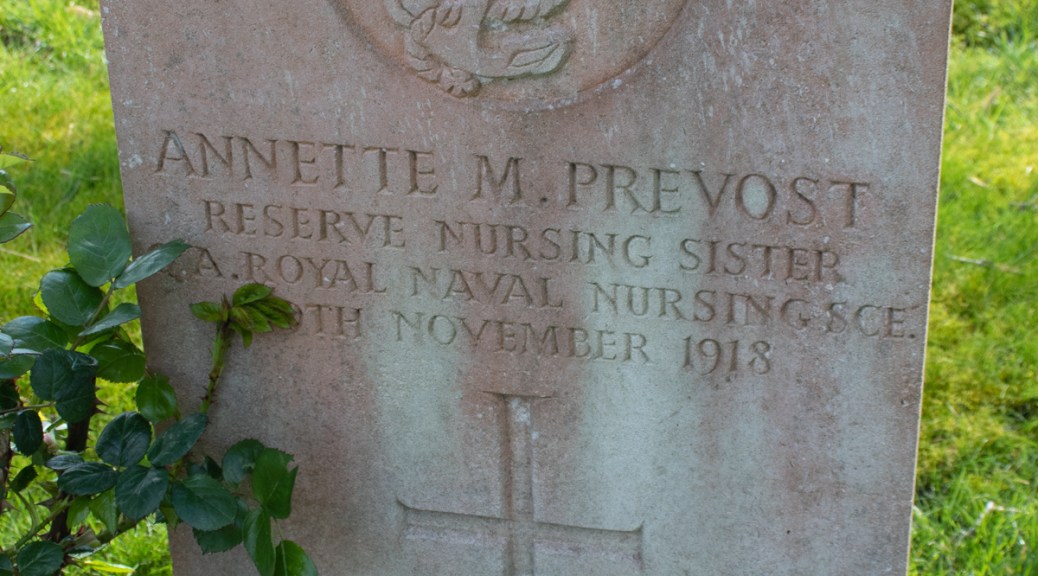
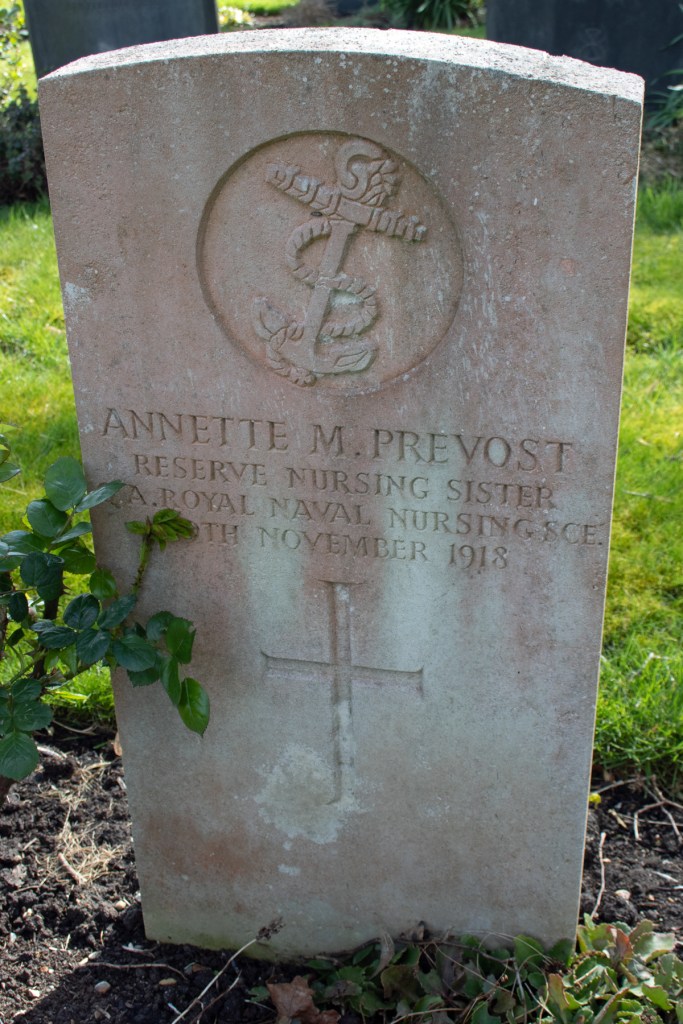
Reserve Nursing Sister Annette Prevost

Reserve Nursing Sister Annette Prevost

Annette Maud Prevost was born on 27th August 1892 in Bombay, India. Her parents were Cumbria-born Francis Prevost and his wife, Maud, who came from Somerset, and she was their only child.

It is unclear why the Provosts were in India, although Annette’s paternal grandfather was a Major in the army and her maternal grandfather was a clerk in holy orders (as per Maud’s baptism record). It is likely, therefore that her grandparents’ work took her parents overseas, which is how Francis and Maud ended up meeting.

Full details of Annette’s life are not readily available. She does not feature on any surviving census records, but it appears that the family returned to England in the early 1910s.

War was on the horizon, of course, and the tragedy of Edwardian culture is that women’s roles in the conflict were under-documented. What is clear, however, is that Annette wanted to play her part and she enlisted in the Queen Alexandra’s Royal Naval Nursing Service as a Nursing Sister, and was based at Chatham, in Kent.

During the conflict, she would have treated servicemen from the nearby Royal Naval Dockyard, as well as from the Royal Engineers Barracks. As the conflict progressed towards its end, an increasing number of cases would have been for pneumonia and tuberculosis, and, in the autumn of 1918, Annette contracted influenza. She developed sepsis, and died of heart failure on 19th November, a week after the Armistice was declared. She was just 26 years of age.

Annette Maud Prevost was laid to rest in the Woodlands Cemetery, Gillingham, not far from the Naval Hospital in which she served and died.


Private Albert Gale

Private Albert Gale

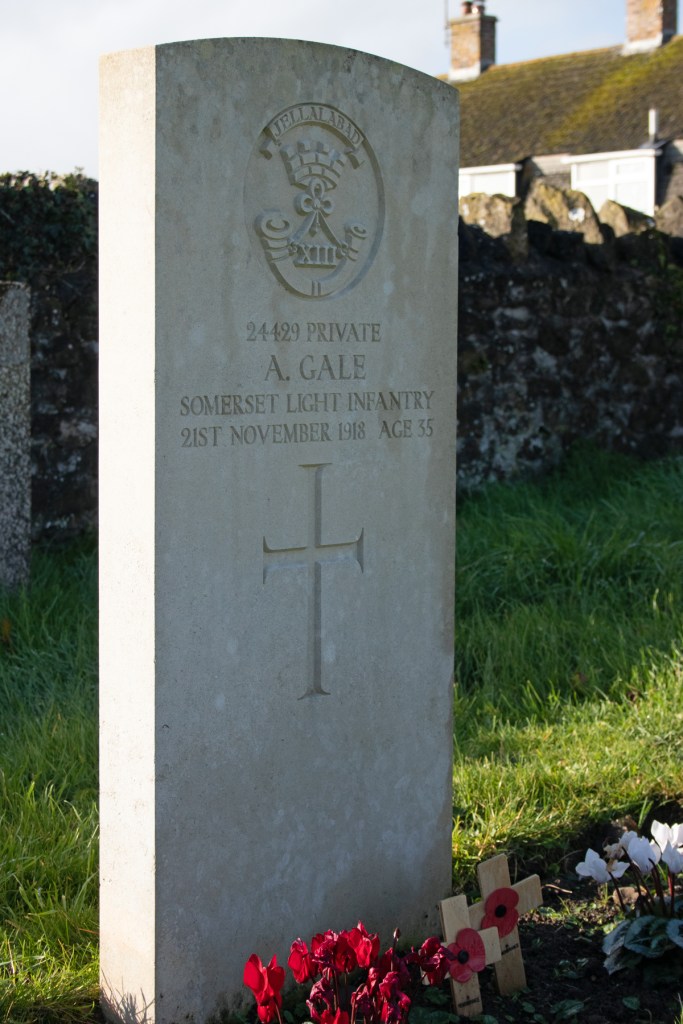
Albert Gale was born in the Devon village of Chudleigh Knighton in October 1883, one of five children to John and Elizabeth Gale. It seems that Elizabeth may have died when Albert was young, as, by the time of the 1901 census, John was married to a Sarah Gale, and the family were living in the village of Hennock.

John was a clay cutter, and this was a trade into which Albert followed his father. Again, as time moves on, things change; the 1911 census found Albert boarding with his sister Sophy and her husband, fellow cutter Thomas Willcocks, back in Chudleigh Knighton.

War was coming to Europe and, in April 1916, Albert enlisted, joining the Somerset Light Infantry as a Private. He would have cut a commanding figure; his enlistment papers show that he stood at 5ft 10ins (1.77m) tall.

Albert served on home soil. While attached to the Somerset Light Infantry, he was assigned to the 661st Agricultural Company of the Labour Corps, working in Kent and Sussex.

During this time, he received hospital treatment on four separate occasions: in August 1916, he was admitted with cellulitis of the arm; in December 1916 and January 1917, he was treated on two separate occasions for scabies. In November 1918, however, he was admitted to the Military Hospital in Chichester, West Sussex, as he was suffering from influenza. Sadly, this last condition was to worsen and, on 21st November 1918, Private Gale died, having subsequently contracted pneumonia. He was 35 years old.

Albert Gale’s body was brought back to Devon for burial. His brother-in-law Thomas had died the previous summer; his story can be found here. Albert was laid to rest in the grave next to his sister’s husband in the churchyard of St Paul’s in Chudleigh Knighton.


With Thomas dead, Sophy had been left a widow. Understandably bitter at what the war had taken from her, when she was asked if she wanted a memorial for her brother, she returned the form with the following statement: “I don’t require the plaque and scroll in memory of my dear brother; a piece of paper won’t keep me.”

Private Sidney Alner

Private Sidney Alner

Sidney William Alner was born in Shaftesbury, Dorset, in March 1899, one of eleven children to Sidney and Ellen Alner. Sidney Sr was a grocer’s porter, and the family lived on the celebrated Gold Hill in the town.

War was to come when Sidney Jr was only young – he had just turned 15 when it broke out. He saw his older brothers go off to war and was obviously keen to do his bit as well. Until he was old enough, however, he worked as an errand boy for his father’s employers, Stratton Sons and Mead.

His time would come, of course, although dates for Sidney’s enlistment are not clear. A contemporary newspaper record confirms that he arrived in France in January 1918, so it is likely that Private Alner joined up at some point during the previous year.

He joined the Hampshire Regiment, and was assigned to the 1st Battalion. Heavily involved during most of the conflict, the battalion was seen as key to the Final Advance of the autumn of 1918. Private Alner was caught up in the fight to break the Hindenburg Line, fighting on the River Selle and capturing the town of Monchaux.

It was while his battalion was advancing on the village of Préseau on 2nd November, that Private Alner was injured. Shot in the arm, he was evacuated back to England, and admitted to the Cambridge Military Hospital in Aldershot. He would have survived his injuries, had pneumonia not set in, and it was to this that he would succumb on 19th November. He was just 19 years old.

Sidney William Alner’s body was brought back to Dorset. He lies at rest in the Holy Trinity Churchyard in Somerset, within walking distance of his family’s home.


Sidney was the second member of the Alner family to die as a result of the Great War.

His older brother Harry, who had become a chauffeur and went to live in London, joined the Royal Army Service Corps in 1915. Private H Alner had served three years in France when he was killed on the front line just three weeks before his brother. He was 32 years old, and left a widow and two children.


When researching Sidney Alner in newspaper articles, an interesting report surfaced.

An unfortunate accident has happened to a little girl, not quite four years old, the daughter of Sidney Alner, who resides in Gold Hill. Heals’ steam hobby horses visited the town on Friday and Saturday in last week, and on the evening of the former day, Alner took his little girl for a ride on the horses.

Whilst they were in motion, the bolt that kept the horse on which Alner sat with his child attached to the connecting rod came out, and he and the little girl were precipitated to the ground.

Alner escaped without injury, but his daughter had one of her legs fractured above the knee. She was taken home, and Dr Evans set the injured limb. Later in the evening she was removed to the Westminster Cottage Hospital.

Salisbury and Winchester Journal: Saturday 31st October 1891

This Sidney Alner was Private Alner’s father, and the daughter would have been his older sister Sarah. Nothing more is reported of the incident, and Sarah went on to live until 1945, when she was 57 years old.