Tag Archives: Somerset Light Infantry

Corporal William Dunster

Corporal William Dunster

William John Dunster was born in Uffculme, Devon, at the beginning of 1894. The older of two children, his parents were Robert and Mary Dunster. Robert was a carter and farm labourer, but when William left school, he found work on the railways. By the time of the 1911 census, the family had moved to Milverton in Somerset, and William was employed as an engine cleaner at the station in Taunton.

William had always had a keen interest in the army, and joined the Somerset Light Infantry early in 1914. His full service records are not available, but he was assigned to the 1st Battalion and, when hostilities were declared, he was dispatched to France.

On 26th August 1914, with the heroic men of his Regiment, he leaped over the trench amid a hail of bullets: a terrible gunshot wound laid him low, and he was taken prisoner by the Germans. For two years he remained in the hands of his captors, and endured all those sufferings and privations which our brave men have to bear in Germany.

[In 1916] he was removed to Switzerland Then all was done that could be done to save a young soldier’s life – the skill of the doctor, the comfort of the hospital, the care of the nurse – but unfortunately his constitution had been undermined.

In December 1916, by the kindness of [the secretary of the Prisoners of War Society] Mrs Walsh, he was enabled to see his mother, who paid him a visit, and this for a time revived him wonderfully.

Taunton Courier and Western Advertiser: Wednesday 26th June 1918

By the spring of 1918, Corporal Dunster had been medically evacuated to England, and was admitted to a military hospital in Southampton. This gave Robert and Mary the chance to see their son again, and Mary remained at her son’s side until he passed away on 19th June 1918. He was 23 years of age.

William John Dunster was brought back to Somerset for burial. He was laid to rest in the graveyard of St Bartholomew’s Church in the village of Oake, where his family were living.

Private Robert Creasey

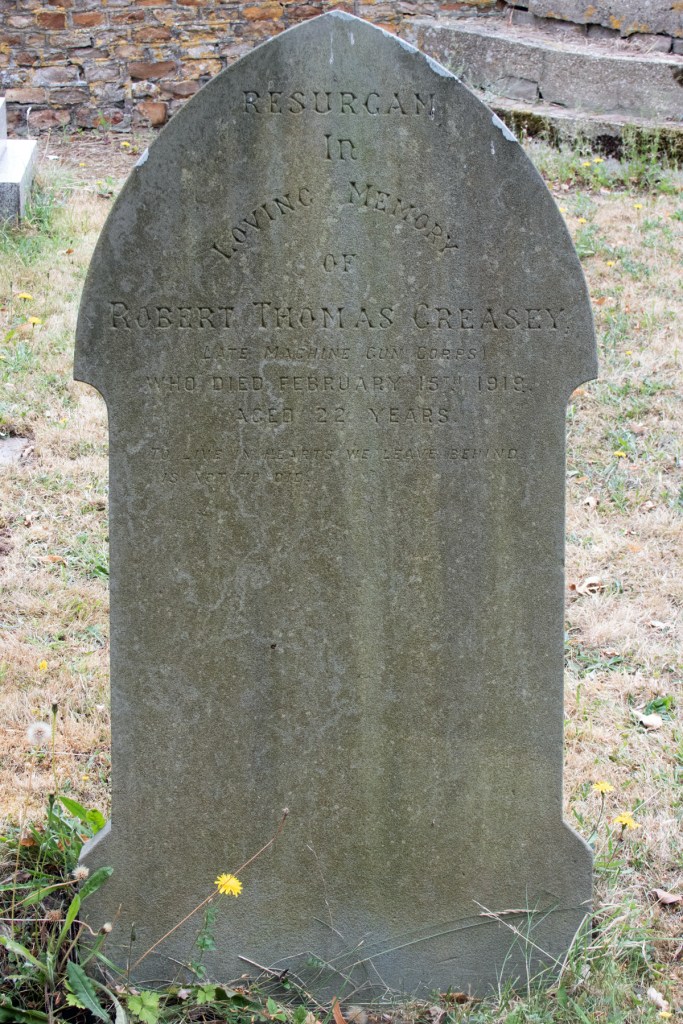
Private Robert Creasey

Robert Thomas Creasey (also known as Thomas Robert Creasey) was born in the village of Ash, near Farnham in Surrey, on 3rd January 1896. He was the youngest of four children to Edwin and Elizabeth Creasey. Edwin was the landlord of the Standard of England public house in the village.

When he died in 1902, Elizabeth moved her family to Somerset, where she had been born and where she still had relatives living. With four young children to raise, she married again in April 1903, to local dairy farmer Frederick Gould.

Robert was working as a farmer when war was declared, but was one of the first to step forward and volunteer. He enlisted in the Somerset Light Infantry and in the autumn of 1915 was involved in the fighting in Gallipoli.

In July 1916 Private Creasey transferred to the Machine Gun Corps. Sadly, little further information about his military life is available, but he survived the war, and returned home to Somerset on furlough, before being demobbed.

This is where Robert’s trail ends. He passed away at home on 15th February 1919, presumably from one of the lung conditions running rampant across a war-torn continent. He was just 23 years of age.

Robert Thomas Creasey was laid to rest in the graveyard of St Michael and All Angel’s Church in Angersleigh, Somerset, not far from where his mother lived.


Private Tom Simmons

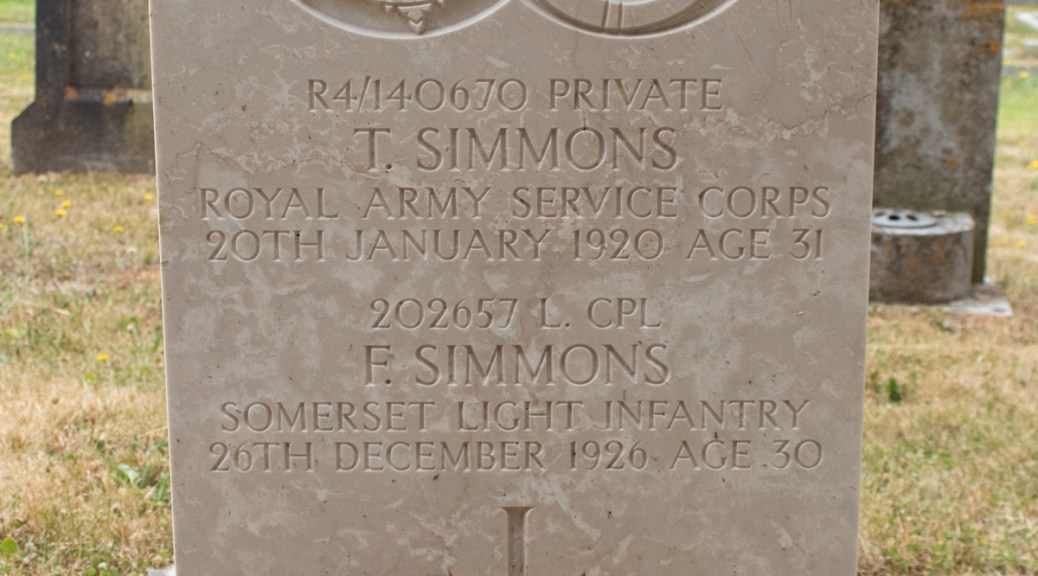
Private Tom Simmons

Tom Simmons was born early in 1889, one of fourteen children to William and Elizabeth Simmons. William was a farm labourer from Devon, who had moved to Runnington, near Wellington in Somerset, with Elizabeth in the late 1880s. This was where their growing family was born and raised.

Tom found work away from Somerset when he left school and, by the time of the 1911 census, he was lodging in a house in Llanwonno, Glamorgan. He was employed as an assistant machine repairer at the local colliery.

War was beginning to encroach on England’s shores, and Tom was to play his part. Full service details are not available, but he enlisted in the Royal Army Service Corps and served as part of a territorial force. For the part he played, he was awarded the Victory and British Medals and the Silver War Badge.

It would seem that Private Simmons survived the war and was demobbed, returning to Somerset at some point by the end of 1919. Sadly, his trail goes cold: the next record available is of his death – through causes unspecified – at home on 20th January 1920, at the age of 31 years old.

Tom was buried in Wellington Cemetery, not far from his family home.


Tom’s headstone also includes a dedication to a Lance Corporal F Simmons.

Frederick Simmons was seven years younger than his brother. When he left school, he worked as a wool spinner in the local wool mill. When war came to Europe, he too played his part. Again, full details of his service are sketchy, but he enlisted in the Somerset Light Infantry.

Like Tom, Frederick served as part of the territorial force, and worked his way to the rank of Lance Corporal. After the war he returned home, but his life there was not set to be a long one. He passed away, through causes not noted, on 26th December 1926. He was just 30 years of age.

Frederick was laid to rest in the same grave as his brother. Technically not entitled to an official Commonwealth War Grave (the rules are laid out here), his service was remembered alongside that of Tom’s.


Private Samuel Troake

Private Samuel Troake

Samuel Troake was born in Wellington, Somerset, on 24th August 1890. His parents were Samuel and Mary Troake and he was one of seven children to the couple. Mary had been married before, and had a daughter of her own. Samuel Sr was a shepherd turned labourer: when Mary died in around 1894, he married again, to widow Sarah Carter. She also had children of her own, something that is noted in the 1901 census, which records husband and wife sharing the house (from his perspective) with six of his children and five step-children.

By the time of the next census, ten years later, the Troake family home was a lot less crowded. Road contractor Samuel Sr and Sarah were recorded living with Samuel Jr and his younger brother, Charlie – both of whom were wool spinners , and the couple’s grandson, Percy.

Working at the wool factory came with benefits for Samuel Jr. It was there that he met Alice Slade, and the couple married on 10th December 1914, at the local parish church. The couple set up home not far from his parents, but war was soon to take him away from his new bride.

Full details of Samuel’s military service are not available: he enlisted in the Somerset Light Infantry, and was assigned to the 8th (Service) Battalion. He served on the Western Front, and remained there until almost the end of of the conflict.

Private Troake was recorded as being caught up in the conflict, and was medically evacuated to England for treatment to a bullet wound. Sadly, the injuries to his abdomen and bladder were to prove too severe – he passed away in a Portsmouth hospital on 30th October 1918. He was 28 years of age.

Samuel Troake was brought back to Somerset for burial. He was laid to rest in Wellington Cemetery, not far from where his widow and father still lived.


Private Thomas Salter

Private Thomas Salter

Thomas Salter – better known as Tom – was born on 5th June 1877, in the Devon village of Uffculme. He was the only child to John and Selina Salter. John was seventeen years older than his wife and, by the time his son was born, was 57 years old. Selina had been married before and widowed, and had had five children of her own.

When he left school, Tom found work as a butcher’s assistant at the Uffculme’s Commercial Hotel (now the Ostler Inn on Commercial Road). Food was not destined to be his career, however. By the time of the 1901 census, he had moved from Devon to Gloucestershire, and found employment as a labourer in the engine works at Knowle, Bristol.

His landlady was an Elizabeth Bobbett, who had been born in Trull, near Taunton, and this connection may have pre-destined what was to come. In the spring of 1908, Tom married Florence Taylor, a labourer’s daughter from Wellington, Somerset, five miles (8km) from his landlady’s home village.

Tom and Florence settled in Wellington, close to the centre of the town. They had four children – Harold (born in 1909), Evelyn (1912), Irene (1914) and Edna (1916). Tom found work as a packer at the Fox Bros. woollen mill in nearby Tonedale.

War was coming to Europe by this point and, in January 1917, Tom enlisted. Private Salter joined the 11th Battalion of the Somerset Light Infantry: this was a territorial troop, and Tom found himself based in Yeovil.

There is little concrete information about Private Salter’s military life. All that can be confirmed is that within a couple of months of joining up, he had been admitted to hospital, suffering from bronchial pneumonia. Sadly, he was not to recover from the lung condition: he passed away on 10th May 1917, at the age of 37 years old.

Tom Salter was brought back to Wellington for burial. He was laid to rest in the town’s cemetery.


Private Walter Chapman

Private Walter Chapman

Walter Stanley Chapman was born in the summer of 1897, the younger of two boys to William and Sarah (known as Annie) Chapman. William was a carter on a farm in North Cadbury, near Yeovil, Somerset, and this is where the young family grew up.

When he left school, Walter became apprenticed to a local carpenter, but war was on the horizon. His older brother Frederick was quick to enlist, joining the Royal Marine Light Infantry as a Private. He served on HMS Hood during the Battle of Jutland in the spring of 1916, and was killed during the fighting. He was buried at sea, and was just 23 years old when he died.

The loss of his brother may have spurred Walter into action. He enlisted as well, joining the 1/4th Battalion of the Somerset Light Infantry as a Private. Details of his service are limited, but his battalion served in Mesopotamia during the conflict, and it is likely that he spent some time in the region.

Private Chapman survived the war, and returned to Somerset on furlough, waiting to be demobbed. Sadly, he passed away during this time, breathing his last on 19th April 1919, at the age of just 21 years old. William and Annie had lost both of their sons because of the conflict.

Walter Stanley Chapman was laid to rest in the graveyard of St Michael’s Church in his home village of North Cadbury. His gravestone also commemorates the passing of his older brother.


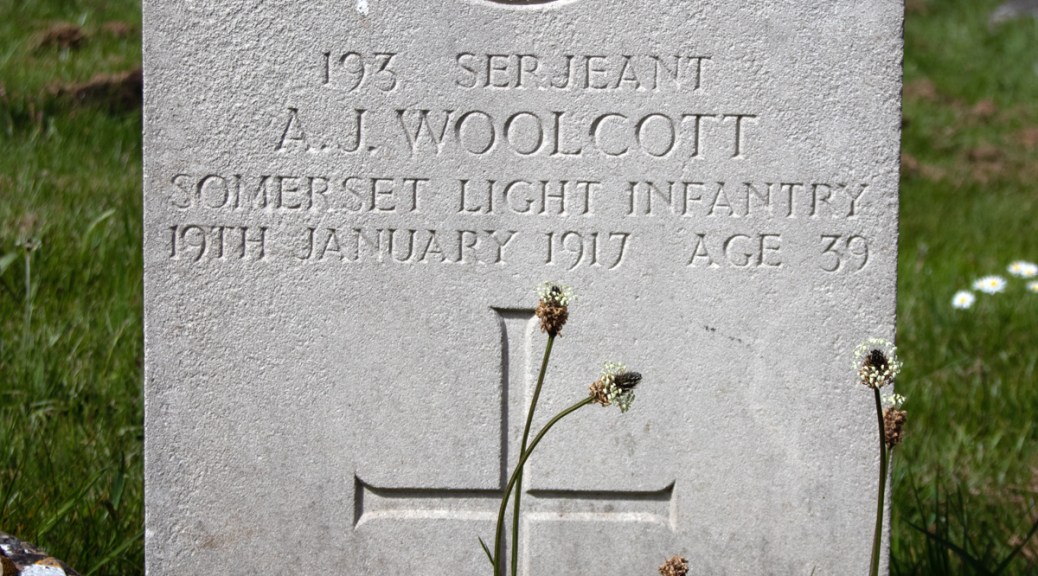
Serjeant Albert Woolcott

Serjeant Albert Woolcott

Albert John Woolcott was born in the spring of 1877 and was one of three children to Thomas and Mary. Thomas was a labourer for a spirit company, and both he and his wife came from Chard in Somerset, which is where Albert and his siblings were born.

When he finished school, Albert was apprenticed to a local iron foundry and, by the time of the 1901 census, he was recorded as being a blacksmith in his own right.

By this point, Albert had met local woman Mary Pattimore: the couple married in the local church on Boxing Day 1901, and went on to have four children, all of them boys. Albert continued with his ironwork: the 1911 census records him as being the blacksmith at Chard’s Gifford Fox & Co.’s lace factory.

Albert played a keen role in the local volunteer movement for the Somerset Light Infantry. Through the town’s Constitutional Club he took an active role in its rifle range and was known to be a particularly skilled marksman. He also played in both the Volunteer Band and Chard’s Municipal Band.

When war came to Europe in August 1914, Albert was already billeted on Salisbury Plain as part of the volunteers, and was promoted to the rank of Serjeant. He was sent to India with his troop – the 5th Battalion of the Somerset Light Infantry – and remained there until April 1916.

By this point, Serjeant Woolcott was suffering from dorsal abscesses on his hands, and was evacuated back to England for treatment. Over the next nine months he was in and out of Netley Hospital on the outskirts of Southampton, where he had a number of operations to try and fix the problem.

Sadly, his treatment proved unsuccessful: Serjeant Woolcott passed away in the hospital on 19th January 1917, at the age of 39 years old.

Albert John Woolcott’s body was taken back to Somerset for burial. He was laid to rest in his home town’s cemetery.


Private Wilfred Follett

Private Wilfred Follett

Wilfred Alson Follett was born in the spring of 1898, and was the second of eight children to Robert and Ellen (known as Nellie) Follett. Robert was a scavenger (or street cleaner) for Chard council, and it was in this Somerset town where his and Nellie’s young family were raised.

Lace making was the predominant industry in the area, and it was for local employer Boden & Co.’s Old Town Mills that Wilfred worked when he finished school. The 1911 census recorded him as being a threading boy in the factory.

War was coming to Europe, however, and Wilfred was keen to play a part. Sadly, full details of his military service are lost to time, but he had enlisted by the spring of 1917, initially joining the Somerset Light Infantry. He soon transferred across to the Welch Regiment, however, and was assigned to the 10th (Service) Battalion.

Private Follett was sent to the Western Front at the start of July 1917, and was soon caught up in the thick of the action at Ypres. He came through the Battle of Pilkem, but was injured at the fighting in Langemark. His wounds were severe enough for him to be evacuated to England for treatment, and he was admitted to a hospital in Bradford, Yorkshire.

Robert was sent for, but sadly did not arrive in time to see Wilfred before he passed away from his injuries. He died on 20th August 1917, at the tender age of just 19 years old.

Wilfred Alson Follett was brought back to his home town for burial. He was laid to rest in Chard Cemetery.


Private Frederick Harris

Private Frederick Harris

Frederick Jacob Harris was born in Wadeford, near Chard in Somerset, on 28th August 1887. The fourth of eleven children, his parents were William and Grace Harris. William was an agricultural labourer and carter, but the busy lace and weaving industry in the area is what provided Frederick and his siblings with work when they finished school.

It may have been through his work in the factory that Frederick met Alice Dowell: she was the daughter of a lace hand from Chard. The couple married on 20th October 1906, and settled in a house near the centre of the town. They went on to have four children, two boys and two girls.

War was closing in on Europe by this point, although there is little specific information about Frederick’s service. He initially joined the Somerset Light Infantry, although he soon made the move to the Royal Fusiliers. He received the Victory and British Medals, as did everyone else who served in the Great War, but there is no confirmation of whether he saw action overseas or not.

However and wherever Private Harris served, he survived the conflict, and was demobbed on 25th May 1919. His discharge record suggests that, at the point of being released from duty, he had no injuries or disabilities, and nothing that could be attributed to his time in the army.

Frederick appears to have returned to Chard, and spent the next six months adjusting to civilian life. However, something changed, as, on 10th December 1919, he passed away at home. No cause of death is evident, and nothing in the contemporary local media suggests that he died of anything other than natural causes. Whatever led to his passing, he was taken early, as he was only 32 years of age.

Frederick Jacob Harris was laid to rest in Chard Cemetery.


Private Sidney Budd

Private Sidney Budd

Sidney John Budd was born in the spring of 1888, the middle of three children to Abel and Mary Budd. Abel was a gardener from Tiverton, Devon, and this is where the family were born and raised. In the late 1890s, the family moved to West Monkton, near Taunton in Somerset.

When he finished school, Sidney found work as a house painter, and, by the time of the 1911 census, was boarding in a house near Minehead. Within a few years, he had moved again, this time to Chard, and had met Florence Moulding, the daughter of a shepherd from the town. The couple married on 1st August 1914, just days before the outbreak of war.

There is little information available relating to Sidney’s military service. He enlisted before the end of 1917, joining the 3rd (Reserve) Battalion of the Somerset Light Infantry as a Private. This was a wholly territorial troop, and Private Budd would have served in Somerset and Devon.

One of the downsides to being in close proximity to servicemen from other parts of the country in tightly-packed barracks was the ease with which disease could spread. Sadly, Private Budd was not immune from this and, in the spring of 1917, he contracted pulmonary tuberculosis. He was admitted to the Ford House Hospital in Plymouth, but his condition deteriorated and he passed away on 31st May 1917. He was just 29 years of age.

Sidney John Budd’s body was brought back to Chard for burial: he lies at rest in the town’s cemetery.


Florence went on to marry again, wedding Harry Golesworthy in the spring of 1918. Sadly, her happiness was to be short-lived: she passed away just two years later, at the age of 28 years old.


Sidney’s older brother, named Abel after his father, was an interesting character. When he left school, he found work as an apprentice to a photographer.

In July 1909, though, he was brought to court for stealing a bicycle. It seems that he had rented one from a dealer in West Monkton in order to visit friends in Cullompton, but not returned it at the end of the day, as expected.

The dealer contacted Abel’s parents, and he was found to have stayed over in Cullompton. It seems that while there, he had run low on funds, and had sold the bicycle to a dealer in the town. A week later, he returned to the Cullompton dealer, asking to buy the bike back, but hadn’t brought any money with him.

Eventually, Abel’s father went to Cullompton, bought the bicycle, then took it to the original dealer in West Monkton. By this point, however, Abel had been charged with theft, and pled guilty. His father stood witness, and, according to the Taunton Courier and Western Advertiser [Wednesday 14th July 1909], admitted that Abel “was rather weak of mind” and had not intended to steal the bicycle.

Abel was bound over for twelve months, with his father standing surety of five pounds.

The later parts of Abel’s life seem a mystery. There is a record of him travelling to Brisbane, Australia, in the spring of 1914, where he was to work as a farm labourer. He must have returned home, possibly as part of the war effort, and five years later he married Annie Talbot in Taunton, Somerset.

At this point, however, he falls off the radar, and there is no further information about him.