Tag Archives: Surrey

Private Arthur Rousell

Private Arthur Rousell

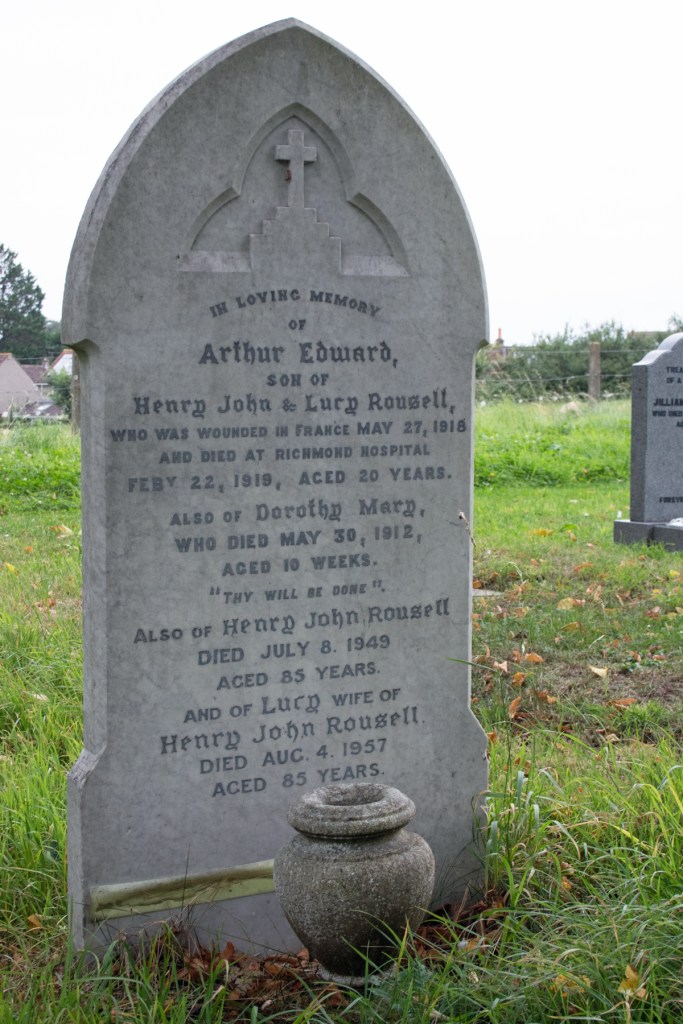
Arthur Edward Rousell was born in the summer of 1898, one of five children to Henry and Lucy Rousell. Henry was a police constable in Worle, near Weston-super-Mare, and this is where he initially raised his family. By the time of the 1911 census – when Arthur was a schoolboy of 12 years old – the family had moved to the village of Huish Episcopi, on the outskirts of Langport.

Details of Arthur’s military career are sketchy. Initially enlisting with the Royal Lancashire Regiment, he was soon transferred over to the 1st Battalion of the Lincolnshire Regiment. He certainly saw action abroad, and was caught up on the Western Front.

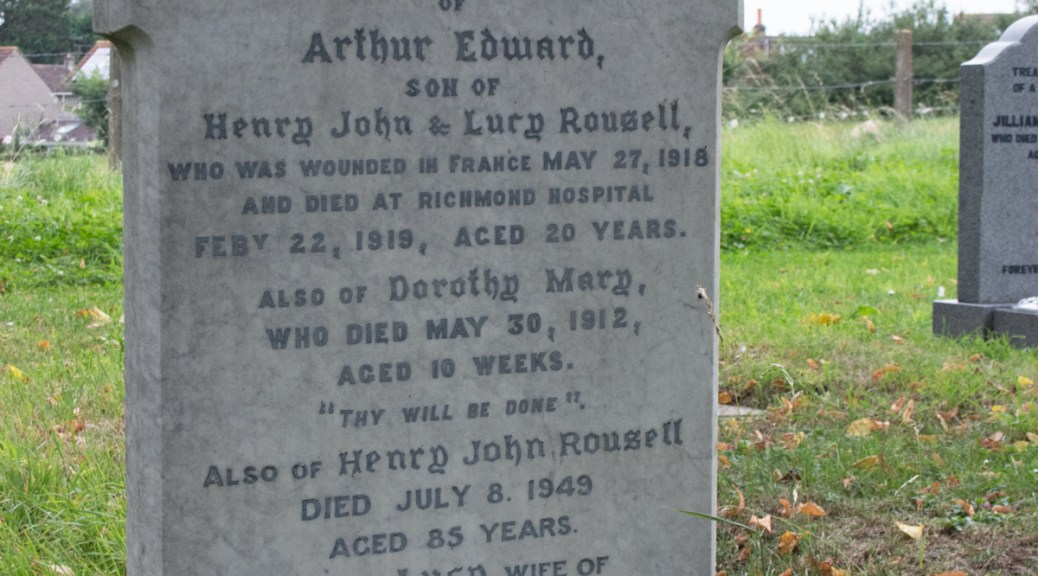
Private Rousell was injured on 27th May 1918, this the first day of the Battle of Aisne. His battalion was certainly involved in the battle, but whether this was where he was injured, and what his injuries actually were, cannot be confirmed.

Evacuated back to England for treatment, Private Rousell was admitted to the South African Hospital in Richmond. Whether he was there for a long time, is not recorded, but he was certainly there in nine months after he was wounded.

It seems that his injuries left him susceptible; his pension record confirms that he died of sickness, and it seems likely that this was one of the lung conditions – pneumonia, influenza – that was prevalent following the cessation of hostilities.

Private Arthur Edward Rousell died on 22nd February 1919, at the age of 20 years old. His body was brought back to Huish Episcopi, and he lies at rest in the family grave in the graveyard of St Mary’s Church.


UPDATE : 19th April 2022

An article on Arthur’s passing sheds more light onto his life:

We regret to record the death of Pte. AE Rousell, of the 1st Lancs. Regt., eldest son of PC and Mrs HJ Rousell of Newtown, which occurred at Richmond Hospital on Saturday morning. Deceased, who was 20 years of age, had been seriously ill a week with influenza, death being due to septic pneumonia, which followed.

The late Pte. Rousell, was a member of the staff of “The Langport and Somerton Herald” where he served his apprenticeship, when war broke out, and joined up early in 1917, his regiment being the King’s Own Yorkshire Light Infantry. After a period of training he proceeded to the front and took part in several engagements. He was gassed, and in the winter of that year was invalided home with trench feet. On recovery he was transferred to the Lancs. Regt., and again proceeded to the front.

On May 27th last he was severely wounded in the right leg by shrapnel, the bones being badly splintered. He was sent to a military hospital in this country and had been in hospital ever since. He had made a fairly good recovery and his parents were expecting him home shortly, when on Thursday last week a wire was received, informing them of his serious illness. Mrs Rousell at once proceeded to Richmond and was able to see her son before he passed away.

Deep sympathy is extended to the relations in their sad bereavement.

Langport & Somerton Herald: Saturday 1st March 1919
Lance Corporal Ernest Hawkins

Lance Corporal Ernest Hawkins

Ernest Frederick Hawkins was born in Street, Somerset, in 1884. He was the youngest of six children to Charles Hawkins and his wife Elizabeth. Both of Ernest’s parents were shoemakers in the Clark’s Factory in the town, and this was the trade Elizabeth continued in after her husband’s death in 1887.

Ernest’s life has some mysteries about it and there is a sense that he spent time trying to escape from something. In August 1904, he enlisted in the army, joining the Scottish Rifles (also known as the Cameronians). He did this under an assumed name, preferring to be called James Fisher.

“James” gave his next of kin as his parents, listing them as George and Annie in South Acton (even though these were not his actual parents’ names, and that his father had passed away 17 years previously).

His enlistment papers give an interesting insight into the young man. He was listed as 22 years old, 5ft 4ins (1.62m) tall, with brown eyes, black hair and a sallow complexion. His arms were adorned with a number of tattoos, including Buffalo Bill on his upper right arm and a ship surrounded by flags on his upper left.

Private Fisher served for a year on home soil, before being shipped out to India. He returned to the UK in October 1907, and transferred to the Army Reserve.

Ernest returned to Somerset, and it was here that he met Sarah Jane Manning. The couple married in a registry office in Bristol, and went on to have two children, Hubert and Iris.

War broke out, and Private Fisher was remobilised. By August 1914 he was promoted to Lance Corporal, and sent to France as part of the British Expeditionary Force. Here he became caught up in a number of the key battles of the conflict.

On 24th July 1916, during the British attacks on High Wood at the Somme, he was wounded in the right arm, and invalided back to England for treatment. Admitted to the War Hospital in Guildford, Surrey, it was confirmed that he had received a gun-shot wound to his right arm, which had resulted in a compound fracture of the humerus, radius and ulna. Sadly for Ernest, the only option was a full amputation of his right arm.

After some time to recover, Ernest was transferred to the Pavilion Military Hospital in Brighton where he was fitted for an artificial limb. He spent three months in the Brighton facility, before being moved to the Queen Mary’s Convalescent Home in Roehampton to recuperate. He was eventually discharged – from the hospital and the army – on 10th March 1917, and returned to his wife and family in Somerset.

There is little further documented information about Ernest. He and Sarah went on to have a further child – Leslie – in 1917. Sadly, where Ernest had been a toddler when his father had died, Leslie was consigned to be a babe-in-arms when Ernest passed away.

Ernest Frederick Hawkins – also known as James Fisher – died in Swindon on 2nd July 1918, at the age of 34. He lies at rest in St Mary’s Cemetery in his adopted home town of Taunton, Somerset.


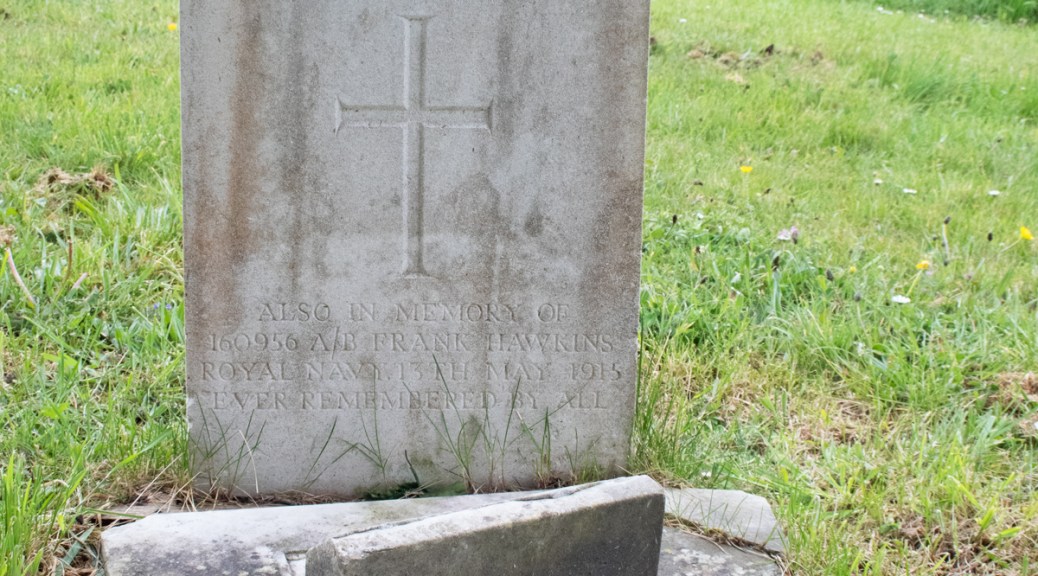
Ernest’s gravestone also commemorates his brother Frank Hawkins. Frank was nine years older than Ernest, and, like his younger brother, had decided that the military life was for him.

Frank enlisted in the Royal Navy in November 1894 and was assigned a Boy 2nd Class on HMS Impregnable – the training ship based in Chatham, Kent. Over the period of his twelve years’ service, Frank rose through the ranks to Able Seaman. When his term was up, he joined the Royal Fleet Reserve for a further five years.

When war came, Able Seaman Hawkins was immediately called back into action. He was assigned to HMS Goliath, serving off German East Africa and the Dardanelles. On the night of the 12th May 1915, the ship was guarding the water off Gallipoli, when it was struck by three Ottoman torpedoes. The resulting explosions caused the ship to sink quickly, and 570 souls – out of a total complement of 750 crew – were lost.

Able Seaman Hawkins was one of those lost, and was subsequently commemorated on his brother’s gravestone.


Private William Bellham

Private William Bellham

William Harry David Bellham was born in September 1888, the only child to William and Rosina Bellham. William Sr was a foreman for a collar manufacturer, and the young family lived in Taunton, Somerset, in a house they shared with Rosina’s mother, Mary Hale.

Life continued pretty much unchanged. When William Jr left school, he became a stenographer for a coal merchant, and, when war erupted in 1914, he didn’t sign up as soon as you would expect for someone of his age.

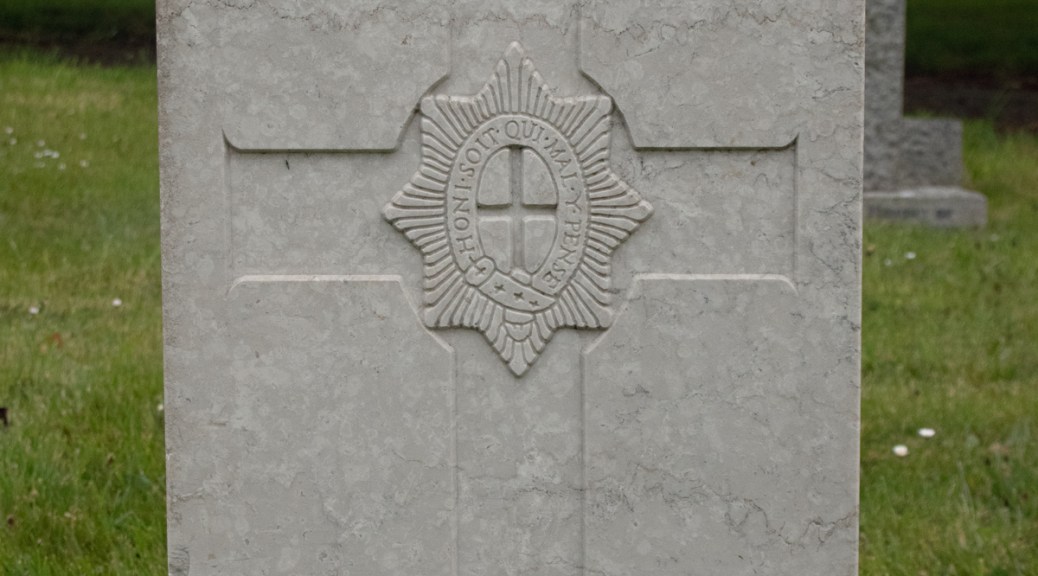
William enlisted in February 1916 and was assigned to the Coldstream Guards – given he stood 5ft 11ins (1.8m) tall, this probably went in his favour. Initially placed on reserve duty, Private Bellham was eventually mobilised in January 1917, and sent to Caterham for training.

Within a matter of weeks, William had an accident. Slipping on some ice, he suffered an inguinal hernia, which subsequently became strangulated, causing him severe pain. After initial treatment in hospital, he was discharged, but was then admitted again five months later when the hernia returned. A further operation was ruled out by the medical examiner, and he was discharged from the army on medical grounds at the end of June 1917.

Once back in Taunton, it did become necessary for William to undergo an additional operation. This was carried out in the local hospital and, according to the records, was a success. Sadly, however, William subsequently contracted pneumonia, and he died on 10th December 1917. He was just 29 years old.

William Harry David Bellham was buried in St Mary’s Cemetery in his home town of Taunton.


Cruelly, the contemporary local media had a less sympathetic take on the incident that caused William’s troubles. The Taunton Courier and Western Advertiser [on Wednesday 26th December 1917] suggested that he “was not really strong enough to stand the strain and hardships of military training and was invalided out after some months’ service.” Not exactly the picture that his medical records had outlined.


Private Richard Taylor

Private Richard Taylor

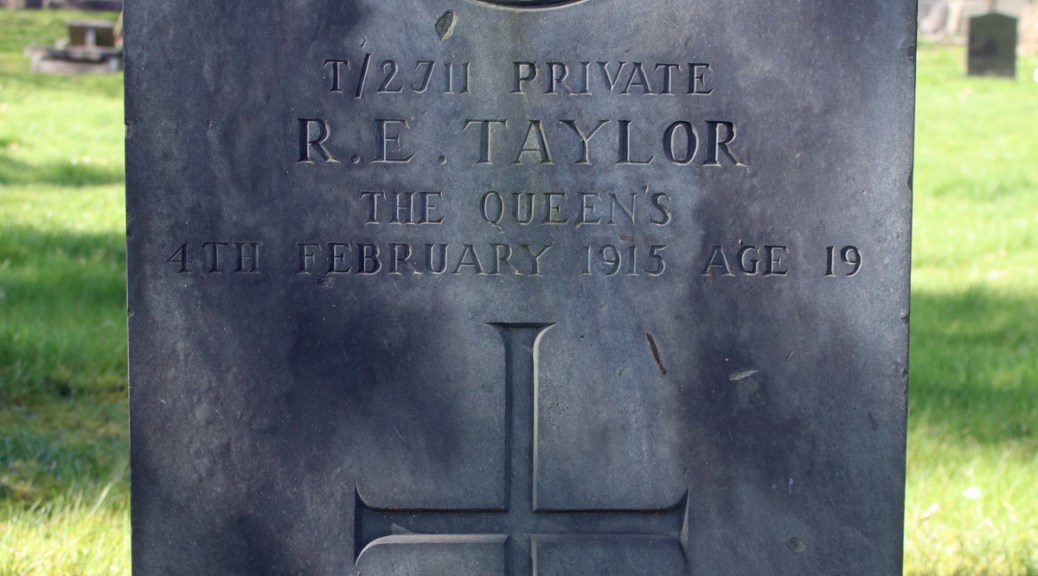
Richard Edmundson Taylor was born in 1895, one of nine children to Frederick and Emma Taylor. Frederick was from Portsmouth, Emma from Blackburn, but the couple had settled their family in Kent, where Frederick worked as an engineer and pattern maker at the Naval Dockyard in Chatham.

When he left school, Richard took work as an apprentice photographer – his older sister Mildred worked as a re-toucher in the same studio. The 1911 census reveals that his eldest sister, Alice, was working as a governess; the family of eleven were living in a small terraced house in Seaview Road, Gillingham – a road that, ironically, had no view of the nearby River Medway or Thames Estuary.

At this point, Richard’s trail goes cold. He enlisted in the Royal West Surrey Regiment – also known as the Queen’s – but there is no documentation to confirm when this was.

Private Taylor’s battalion, the 2/4th, would go on to fight at Gallipoli, but he would not have been involved, and, more than likely, did not see any overseas service. The prefix to his service number (T/2711) may well have indicated he was in training when he passed away, although, again, there is no physical evidence to confirm this.

Nor is there any indication of the cause of Private Taylor’s death. His name does not appear on any contemporary newspaper reports, so it is unlikely that it was due to any misadventure; more probably, he passed away from one of the many communicable diseases that became common in the training camps of the 1910s.

Whatever the cause, Private Taylor died at home on 4th February 1915. He was just 19 years old.

Richard Edmundson Taylor lies at rest in the Woodlands Cemetery in his home town of Gillingham, Kent.


Sergeant Ernest Coombs

Serjeant Ernest Coombs

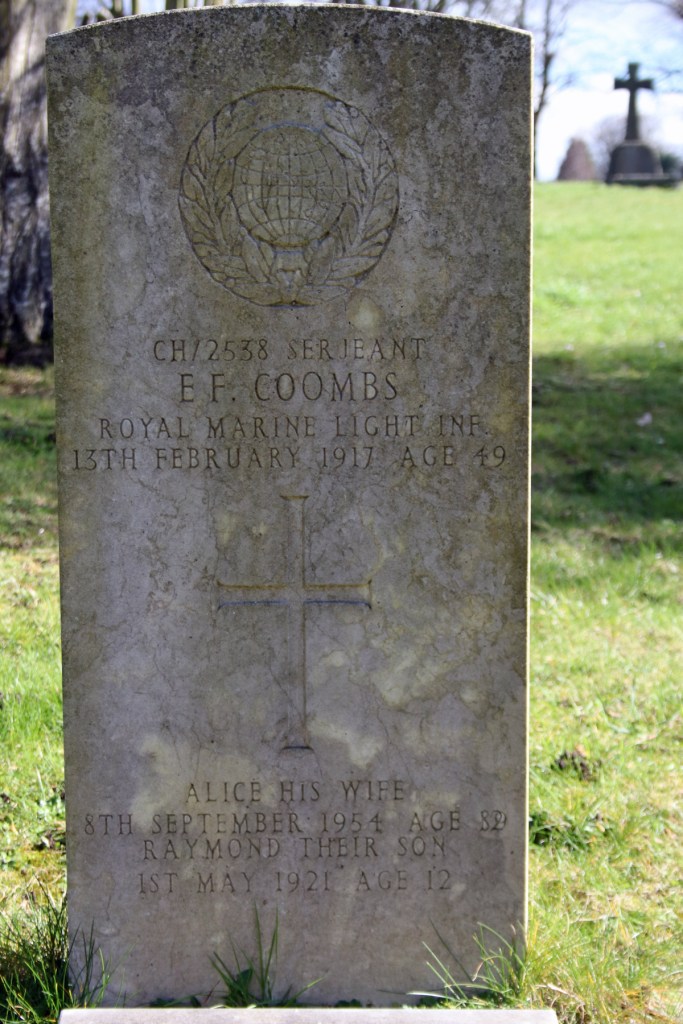
Ernest Frederick Coombs was born in the summer of 1866. One of four children to cabinet maker Frederick Coombs and his wife Julie, the family lived in Leatherhead, Surrey.

Unfortunately, the documentation around Ernest’s life is a little scattered. What we do know is that he married Alice Amelia Kinnear in June 1889, and the couple went on to have fourteen children.

Jumping forward, and by the time of the 1911 census, the family were living in a small terraced house on the outskirts of Dover. Ernest listed his trade as a canteen managed for a provision merchant.

Sadly, Ernest’s military records are also lost to time. He enlisted in the Royal Marines Light Infantry, and was promoted to Serjeant during his time there.

The only other information available about him comes from the obituaries section of a local newspaper in March 1917:

COOMBS: On February 13th, at the Royal Naval Hospital, Chatham, after a short illness, Ernest Frederick Coombs, aged 50 [sic] years (late of 14 Leighton Road, Dover). RIP

Dover Express: Friday 2nd March 1917

Ernest Frederick Coombs was actually 49 when he died; he lies at rest in the Woodlands Cemetery in Gillingham, Kent.


Ernest’s grave was also the last resting place for his youngest son, Raymond, who died aged just twelve years old, two months after his father, and his widow, Alice, who passed away in 1954, at the age of 82.