
Tag Archives: Telegraphist

Leading Telegraphist Leonard Wort

Leading Telegraphist Leonard Wort

Leonard James Wort was born in the Wiltshire village of Woodfalls, on 28th September 1888. He was the second of eleven children – and the oldest son – to James and Annie Wort.

James was a sawyer, but Leonard sought a better life for himself. Initially finding work as a blacksmith’s mate when he completed his schooling, but took up a career in the Royal Navy at the start of 1907. Employed as a Stoker 2nd Class, documents show that he was 5ft 6.5ins (1.69m) tall, and that he had brown hair, hazel eyes and a fresh complexion. He was also noted as having scars on the thumb and finger of his left hand.

Leonard was sent to the training ship HMS Nelson for his initial induction. He remained there for four months, before being given his first sea-faring appointment, on board the cruiser HMS Spartiate. Over the next seven years, he would serve on nine ships in total, but his service took an unexpected route.

In February 1908, Leonard was promoted to Stoker 1st Class, and the next expected progression would have been to Leading Stoker. However, year later, while serving on HMS Hindustan, he took a different route, and became a Telegraphist. He appears to have enjoyed this role, and been more than capable of carrying it out: his annual reviews noted his superior ability on more than one occasion.

Over the next few years, Leonard spent time at HMS Victory – the Royal Naval Dockyard in Portsmouth, Hampshire – presumably to receive the training needed to undertake his role. At the start of 1911, he was promoted again, taking the rank of Leading Telegraphist.

Away from the sea, love was blossoming. Leonard had met Florence Bysouth, a casemaker’s daughter from Bankway, Hertfordshire. The couple exchanged their vows in Bromley, Kent, but had set up home in Poplar, East London.

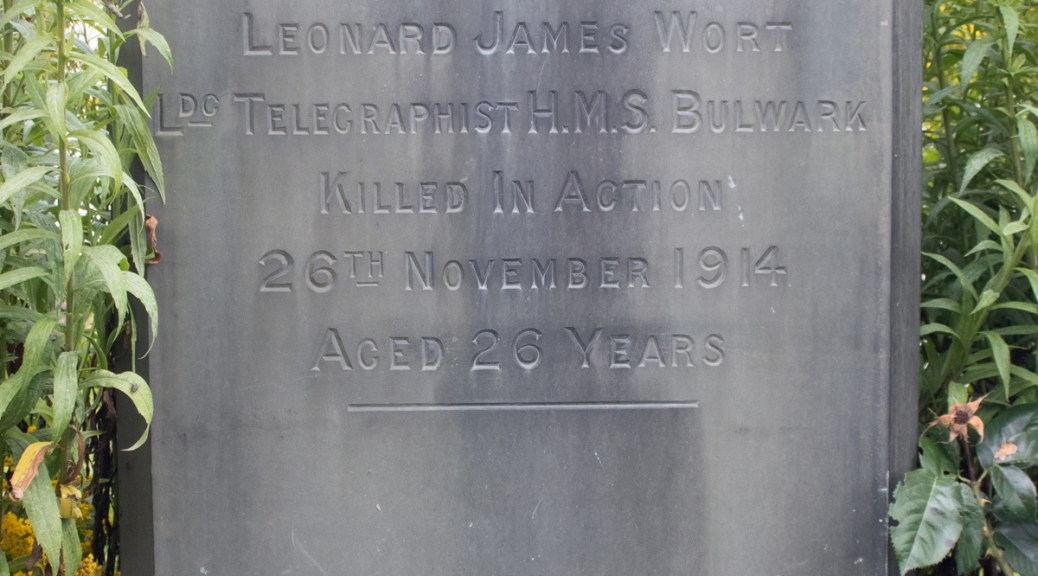
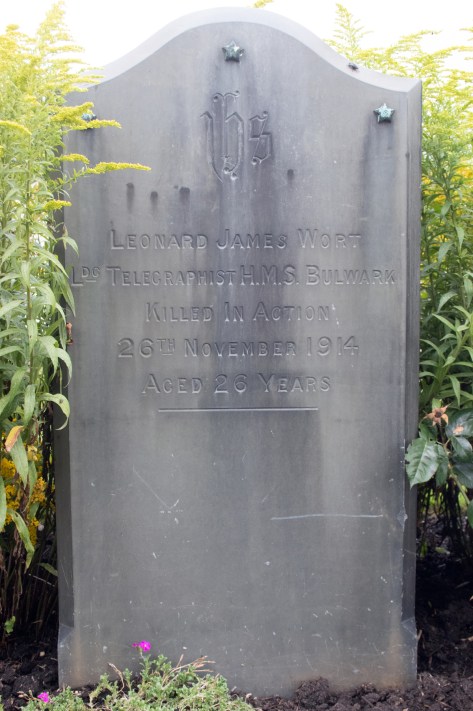
In November 1912, Leading Telegraphist Wort was assigned to the pre-dreadnaught battleship HMS Bulwark. Part of the Channel Fleet, she was tasked with patrolling the southern coasts of Britain. On 26th November 1914, Bulwark was moored in the River Medway, close to Sheerness, and was being stocked with shells and ammunition. That morning, some of the cordite charges overheated, detonating the shells stored nearby. The resulting explosion ripped through the battleship, and more than 740 crew were killed. The body of Leading Telegraphist Wort was recovered: he was 26 years of age.

Those who were killed in the explosion were laid to rest during a mass funeral in Woodlands Cemetery, Gillingham, Kent. As his body had been identified, Leonard James Wort was laid to rest in a marked grave.
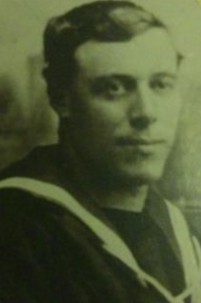

Leading Telegraphist Leonard Wort (from findagrave.com)

Leonard was not the only one of the Wort sons to sacrifice his life during the First World War. His younger brother, Alfred, also enlisted in the Royal Navy, giving up his role as footman and valet to serve as an Officer’s Steward.

Alfred’s service records show that he was attached to HMS Vivid – the Royal Naval Dockyard in Devonport – when, on 4th April 1918, he drowned. He was 26 years of age, and left a widow and son.

Leading Telegraphist Ernest Webber

Leading Telegraphist Ernest Webber

Ernest Webber was born on 19th April 1897 in Newton Abbot, Devon, although there is little further documented about his early life

The 1911 census records Ernest as being at the Scattered Home in Newton Abbot. This was, in fact, the Greenaway Home for Boys, part of the town’s Union Workhouse. It was run by a Mrs Louise Foote, had 22 ‘inmates’ and was located on the Highweek Road.

The following year, however, Ernest found a way to better himself, enlisting in the Royal Navy. His service records confirm that he joined up on 9th October 1912 and gave a physical description of him: he was 5ft 5ins (1.65m) tall, had fair hair, blue eyes and a fresh complexion. He was also noted as having a scar on his left index finger.

As he was below the age for full service, he was given the rank of Boy, and was sent to HMS Ganges, the naval base in Ipswich, Suffolk, and HMS Impregnable, a training ship, for his initial instruction. Some talent seems to have been unearthed as he was soon promoted to Boy Telegraphist.

In August 1913, Ernest was assigned to the battleship HMS Conqueror. He spent nearly two years on board and, during that time, came of age. Now formally inducted into the service, he was given the rank of Ordinary Telegraphist, before being promoted again – to the full role of Telegraphist – in April 1915.

Two months later Telegraphist Webber was transferred to HMS Phaeton; over the next year, he spent time on two further vessels, before being assigned to HMS Victorious in April 1916. With this assignment came a further promotion: Ernest was now a Leading Telegraphist.

In the summer of 1917, Ernest moved again, this time to HMS Vivid, the Royal Naval Dockyard in Devonport. At this point, however, he had fallen ill, and was medically discharged from duty on 5th September 1917, having contracted tuberculosis.

At this point, Ernest’s trail goes cold. He returned to Newton Abbot, but the events of the next year are lost to time. All that can be confirmed is that he passed away, presumably of his lung condition, on 11th December 1918. He was just 21 years of age.

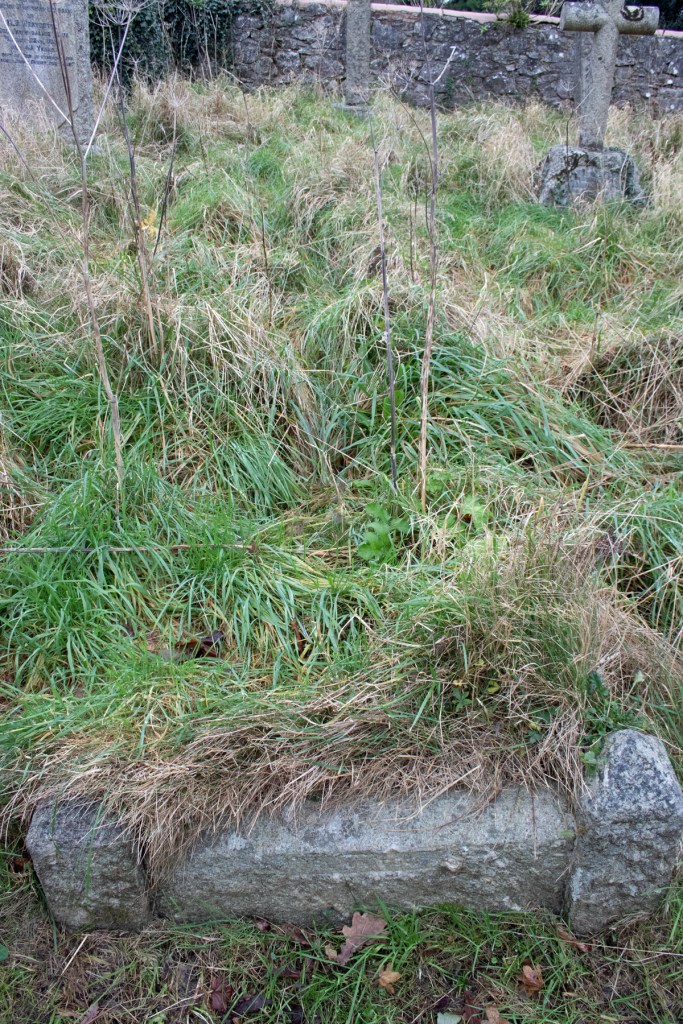
Ernest Webber was laid to rest in the graveyard of All Saints Church in Highweek, near Newton Abbot.


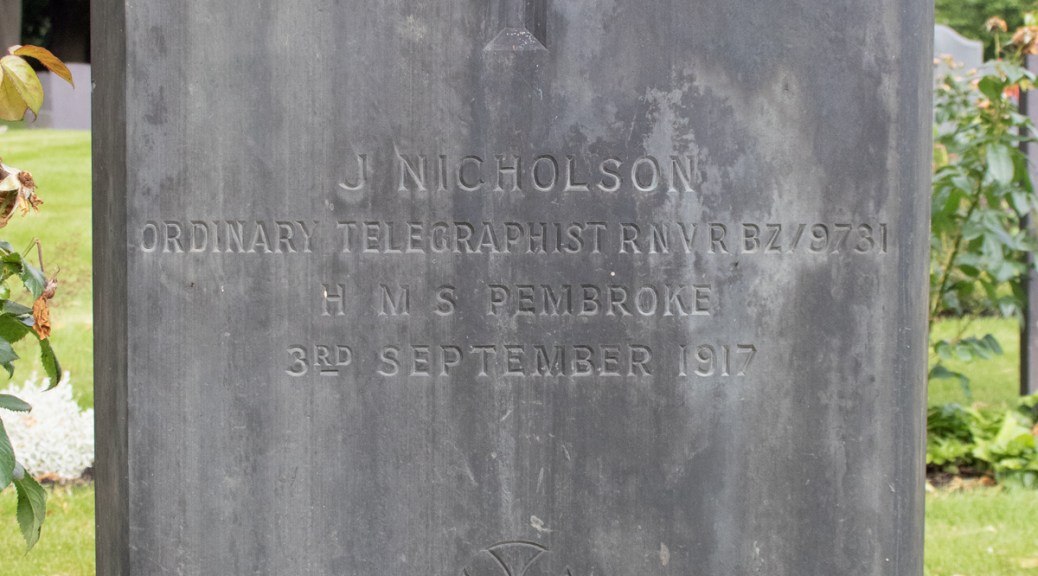
Ordinary Telegraphist Jack Nicholson

Ordinary Telegraphist Jack Nicholson

Jack Nicholson was born on 23rd August 1893. There is very little documentation on his life, although the following can be pieced together.

Jack was called up for military service on 22nd March 1916, at which point he was working as a music hall artist. His service records show that he stood 5ft 11.5ins (1.82m) tall, had dark brown hair, brown eyes and a sallow complexion.

Jack enlisted in the Royal Navy as an Ordinary Seaman, and was assigned to HMS Victory in Portsmouth. After a couple of months he was promoted to Able Seaman and, by March 1917, he had been reassigned, to HMS Vivid in Plymouth. By this point he had taken on a specific role with the navy, and alongside Able Seaman, held the rank of Ordinary Telegraphist.

Within a matter of months, Jack was on the move again, this time to the Royal Naval Dockyard in Chatham, Kent. HMS Pembroke – as it was also known – was a busy place during that summer of 1917, and, with its barracks having reached capacity, Jack found himself billeted at Chatham Drill Hall, which was being used as temporary accommodation.

At this point in the war, the German Air Force was aiming to minimise the losses it was suffering during daylight raids. It began trialling bombing raids at night and, on 3rd September 1917, Chatham found itself in their line of fire. The Drill Hall Ordinary Telegraphist Nicholson was sleeping in received a direct hit, and he was killed. He was just 24 years old.

Jack Nicholson was buried alongside the other 97 victims of the Chatham Air Raid. He lies at rest in the Woodlands Cemetery, Gillingham, not far from the Royal Naval Dockyard in neighbouring Chatham.