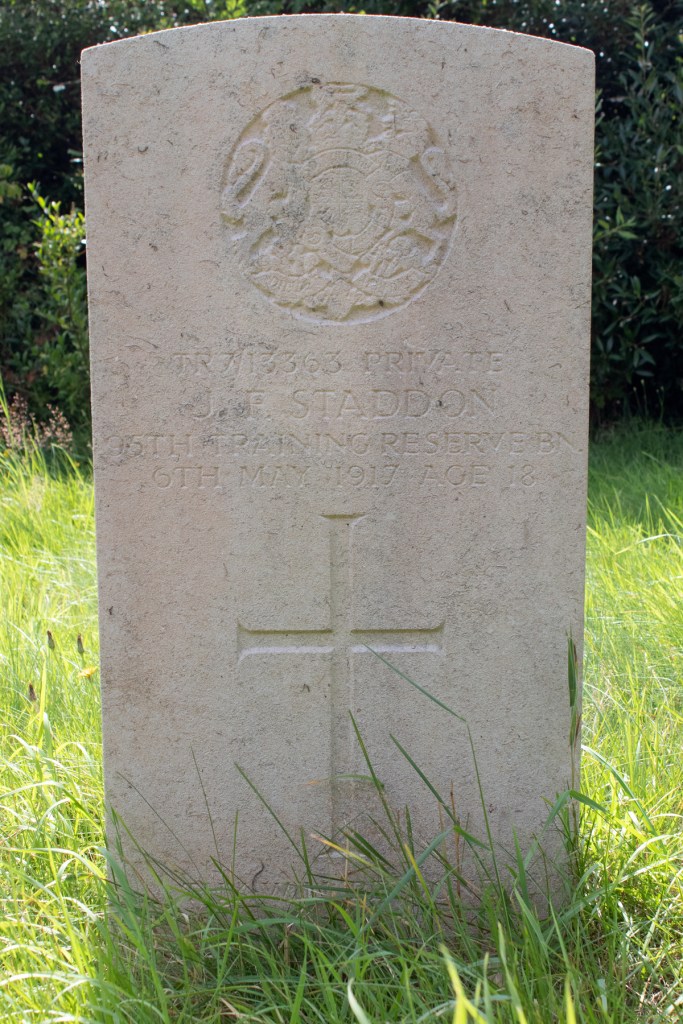
Joseph Frederick Staddon was born at the start of 1899, the oldest of seven children to John and Mary Ann Staddon. John was a farmer from Luccombe in Somerset, and it was in this small village that the family were born and raised.
There is little documentation to expand on Joseph’s life. He enlisted in the Duke of Cornwall’s Light Infantry when he turned 18, and was initially attached to the 95th Training Reserve Battalion.
Private Staddon was barracked in Chiseldon, Wiltshire, but his time in service was not to be a lengthy one. Admitted to a military hospital near the camp, he passed away from what was probably an illness on 6th May 1917. He was just eighteen years of age.
Joseph Frederick Staddon’s body was brought back to Somerset for burial. He was laid to rest in the cemetery extension to St Mary’s Church, Luccombe.
Tragedy was to strike again when, ten months after his son’s passing, John also died. Mary was left picking up the pieces, while supporting her six remaining children, the youngest of whom, Dorothy, was not even two years old.
The family survived, Mary running the farm with her oldest boy, Edward. She passed away on 4th August 1937, at the age of 63 years old.
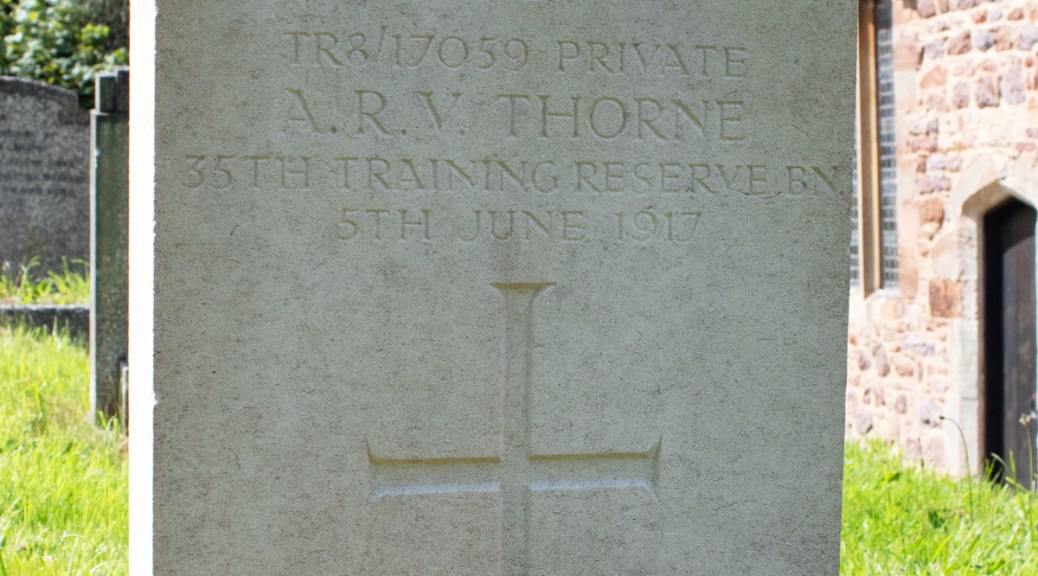
Arthur Reginald Vellacott Thorne was born at the start of 1899 in Bridgwater, Somerset. One of six children, his parents were Sidney and Bessie Thorne. Sidney was a butcher and, by the time of the 1901 census, the family had moved to Chichester, West Sussex, where he had found employment in a sausage factory.
The Thornes’ time on the south coast was not to last long: they had moved to Timberscombe, back in Somerset, by the time Sidney and Bessie’s youngest child, daughter Ivy, was born in March 1908. Tragically their happiness was not to last for long: Sidney passed away in October that year, aged just 35 years old.
With six children under the age of 12 to raise, times would have proved tough for Bessie. Her oldest child – Arthur’s older brother, Sidney – went to live with his paternal uncle’s family in Taunton, and began learning the butchering trade. Bessie took on the role of caretaker at Timberscombe School where her five younger children were being taught.
Being a butcher was not Sidney’s chosen career path. When he turned 17, in March 1914, he enlisted in the Coldstream Guards, lying about his age to do so. Six months later he was promoted to the rank of Lance Corporal and attached to the 3rd Battalion. With war having been declared in Europe, he soon found himself on the Front Line, fighting in the First Battle of Ypres.
Over the next couple of years, Lance Corporal Thorne remained on the Western Front. He was killed in fighting on 15th September 1916: he was just 19 years of age. Sidney’s body was never identified: he is commemorated on the Thiepval Memorial in Picardie.
Arthur’s trail had gone cold at this point, but when he turned 18 years old, his brother having passed just months before, he too was called up. Assigned as a Private in the 35th Training Reserve Battalion, he was sent to Bovington Army Camp in Dorset for his induction. While there, in the cramped conditions of the military barracks, he fell ill. He was admitted to the Salisbury and District Isolation Hospital, which treated infectious diseases, and this was to be where he passed away. Private Thorne was just 18 years of age, and Bessie had lost her two oldest boys.
While Sidney’s remains were never recovered, Arthur Reginald Vellacott Thorne was brought back to Somerset to be laid to rest. He was buried in the peaceful graveyard of St Petrock’s Church in Timberscombe, not far from his father.
Bessie was to our live four of her children. Her youngest two sons, Edwin and Cecil, were to die too young. Cecil passed away in Timberscombe in May 1922, when he was just 16. Edwin died in November 1929, at the age of 26 years old.
Bessie lived on until 1958, passing away in Minehead when she was 84 years of age.
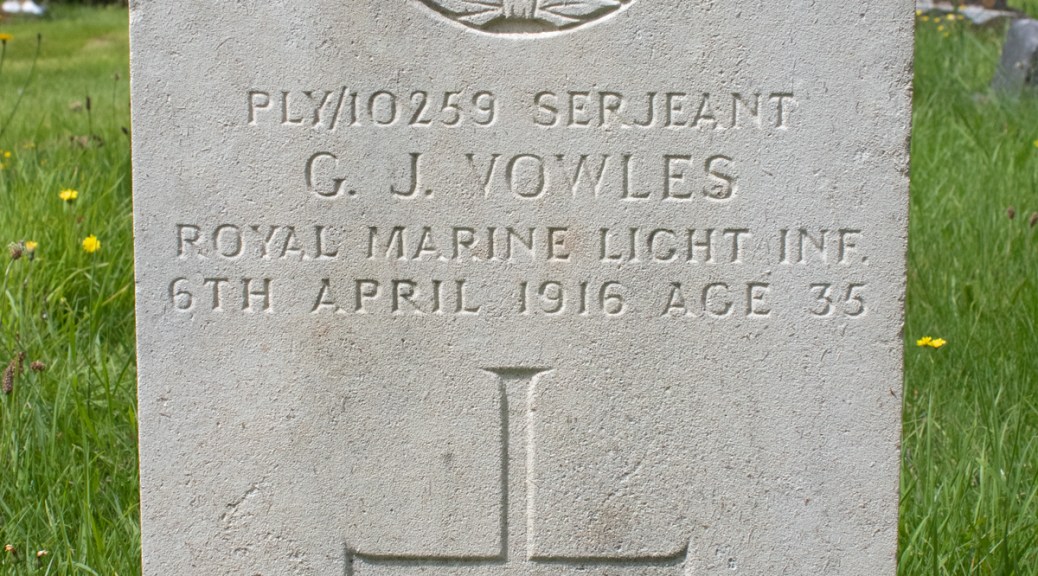
George Joseph Vowles was born in Winsley, Wiltshire, on 18th September 1881. The older of two children, his parents were Joseph and Sophia Vowles. Joseph was an agricultural labourer from Bedminster, who was 46 when his son was born, and twenty years older than his wife. By the time George’s sister was born, in 1890, the family had moved west, and had settled in Wraxall, near Nailsea in Somerset.
George found work as a gardener when he finished his schooling, but he had his sights set on bigger and better things. Sophia had died in 1894 and on 21st March 1900, he enlisted in the Royal Marine Light Infantry. His service records show that he was 5ft 6ins (1.68m) tall, with light brown hair, brown eyes and a fresh complexion. He was also noted as having a scar on the back of his neck.
For the next ten years, George seemed to flourish, serving on a number of ships, including HMS Niobe and HMS Andromeda. In between voyages, he was based at the RMLI depot in Plymouth. During this time he was promoted twice, to the rank of Corporal in September 1902 and Serjeant five years later.
Serjeant Vowles’ contract of service ended in 1911, but with his father now also having passed, he was re-engaged. He continued to make great strides, and, as war broke out, served on HMS Medea and HMS Theseus.
George’s service was cut short in the spring of 1916. Based back at the Plymouth Depot at the time, he fell ill with pulmonary tuberculosis. Sadly, the condition was to get the better of him, and he passed away on 6th April 1916, at the age of 35 years old.
George Joseph Vowles’ body was brought back to Somerset for burial. He was laid to rest in the graveyard of All Saints’ Church in Wraxall, alongside his parents, and not far from where his now-married sister, Dorothy now lived.
William Reginald Hunt was born in the Somerset village of Butcombe on 14th September 1900. The youngest of six children, his parents were farmers Walter and Bertha Hunt.
Little information about William – who was known in the family as Reggie – is available. He was still at school at the time of the 1911 census and enlisted in the army in the summer of 1918. His service papers no longer exist, and his life in between these points is lost to time.
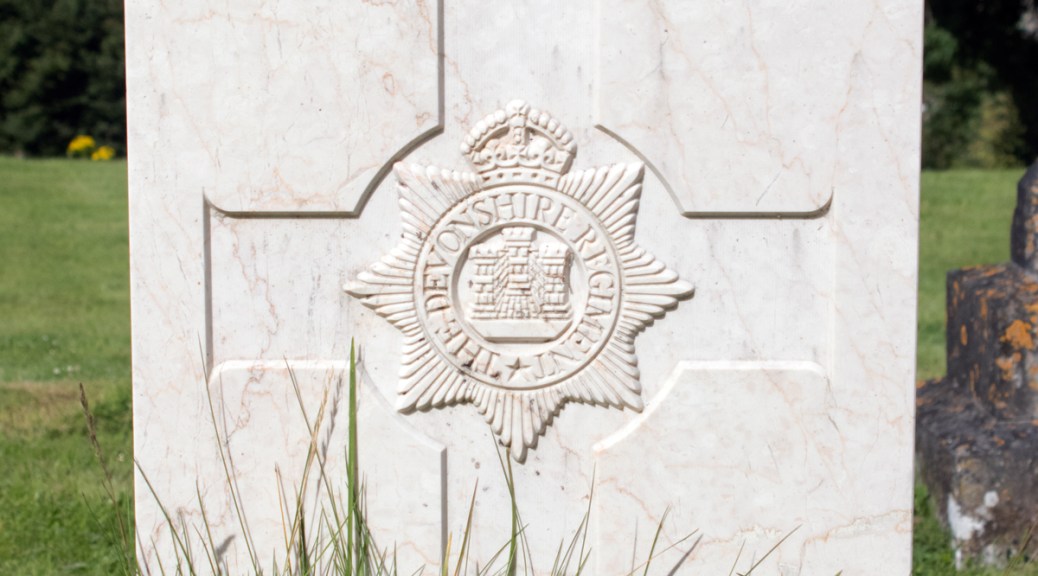
Private Hunt joined the Devonshire Regiment, and was attached to the 53rd (Young Soldier) Battalion. He was based at Rolleston Camp in Wiltshire and, while billeted there, in the cramped and overcrowded conditions of the army barracks, he contracted pneumonia.
William was admitted to the camp’s hospital, but the condition was to prove too much. He passed away on 23rd November 1918, aged just eighteen years old.
The body of William Reginald Hunt was brought back to Somerset for burial. He was laid to rest in the graveyard of St Michael’s Church, in his home village of Butcombe.
Frederick Reginald Channing was born in the autumn of 1869, in Bath, Somerset. He was one of five children to carpenter Allen Channing and his dressmaker wife, Sarah. When Frederick was just a toddler, Allen moved the family south to Chard, and this is where his younger siblings were born.
When Frederick left school, he found work as a lace machine operator and, in fact, all of Allen’s children found work with their hands: Frederick worked alongside one of his brothers, while his two other brothers built on their father’s woodworking skills, one as a coachbuilder, another as a cabinet maker.
By the autumn of 1905, Frederick had moved back to Bath. This is where he met Elizabeth Scammell, a farm labourer’s daughter from Wiltshire. The 1901 census appears to record her as being a servant to a surgeon’s family in Wincanton, and this may have prompted a further move to the larger city where the couple met.
The couple married in Bath towards the end of 1905, and had a son, Frederick Jr, who was born in November the following year. Frederick Sr was doing general labouring work by this point, and the family had moved to Wedmore by the time a second boy, William, was born in 1910. Frederick and Elizabeth had a daughter, Eva, in 1911, and another, Gwendoline, in 1913, tragically, the same year that Eva died.
When war came to Europe, Frederick stepped up to play his part. He enlisted in September 1914, joining the Somerset Light Infantry as a Private. His service records confirm that he was 5ft 6ins (1.67m) tall, and weighed 154lbs (69.9kg). The document also gives his age as 35, although he was actually ten years older than that by this point.
Private Channing spent a year on home soil, during which time Elizabeth gave birth to their fifth child, Percival, who was born in May 1915. Based at a camp in Aylesbury, Buckinghamshire, he was hospitalised twice in this time, suffering from a contusion of his left shoulder.
By September 1915, Frederick was in France, and he remained on the Western Front, apart from when on leave, for the next three-and-a-half years. At some point during this time, he was promoted to the rank of Lance Corporal, and transferred across to the Royal Engineers.
Back at home, Elizabeth was doing her best to raise the family. She didn’t always do the right thing, though, and this resulted in her being taken to court.
Elizabeth Mary Rose Channing, 30… was indicted for having been delivered of a certain female child, did unlawfully by a secret disposition of the deceased child, endeavour to conceal the birth thereof at Wedmore the same day in the month of September 1916.
Mr Wethered prosecuted, and said that the prisoner was a married woman. Her husband was a soldier now on active service. He was last home on leave in April or May, 1917. Previously to that he had not been home for 18 months or two years, so the child could not have been his. Some boys found a parcel in the well, and they discovered the body of the child. The boys communicated with the police, who searched the well and found some pieces of carpet which agreed with a similar carpet in the possession of the prisoner. When arrested she confessed to the crime.
Frederick Channing, husband of the prisoner, said he was home on leave five months ago – May 27th. He went back on June 4th. Previously he had not been home for twenty months. He pleaded for the prisoner in the interests of their four children. He was very sorry for her to think she had thrown herself away like that.
His Lordship, addressing the prisoner, said that while her husband was away doing his duty for her any everybody, she was not faithful to him, and the result was the birth of the child which had been concealed and not revealed till a year afterwards. His Lordship understood that prisoner was already legitimately in a certain condition, and he did not wish her child to be born in prison. She would be sent to prison therefore for three months.
Wells Journal: Friday 26th October 1917
Elizabeth was released in February 1918, and the couple’s last child, Kathleen, was born the following month.
Frederick, meanwhile, returned to the Western Front. He remained in France through to the end of the conflict and beyond, only returning to Britain in February 1919, having fallen ill. Admitted to the North Evington War Hospital in Leicester with influenza, he remained there for two months.
In April 1919, Lance Corporal Channing was transferred to the Bath War Hospital, back in Somerset. This was presumably so that he could be closer to his family, although there is no evidence of whether he was fully reconciled with Elizabeth. His condition did not improve, however, and by this point he was also suffering from myalgia.
Frederick remained in hospital for eighteen months. As time passed, carcinoma of the liver was identified, and this, eventually, was the condition that would take his life. Lance Corporal Canning passed away on 5th September 1920. He was 49 years of age.
Sarah and the children were still living in Wedmore, by this point. Frederick Reginald Channing’s last journey was not to be that far, however. He was moved only a short distance from the hospital, and was laid to rest in the sweeping grounds of the Locksbrook Cemetery in Bath.
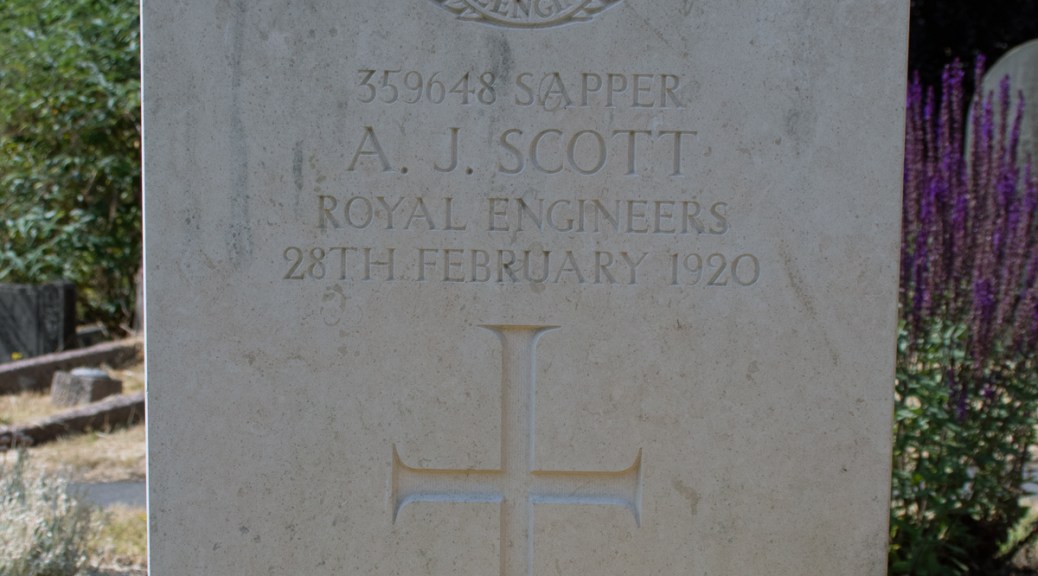
Abraham James Scott was born in Bathford, Somerset, in the spring of 1893. He was one of fourteen children to Abraham and Lucy Scott, and became known as James, to avoid any confusion with his father. Abraham was a shepherd, who travelled where work took him: both he and Lucy were from Wiltshire, but had moved to Somerset by the end of the 1880s. When James was just a babe-in-arms, the family had relocated to Gloucestershire, but by the time of the 1901 census, they were back in Wiltshire once more.
Abraham Sr died in 1910, at the age of just 41 years old. The following year’s census found the now widowed Lucy living in North Wraxhall, Wiltshire, with eight of her children. Abraham Jr is absent, and, indeed, does not appear on any of the 1911 censuses.
Lucy needed options and, on Christmas Day 1912, she married carter William Amblin in the village church. Abraham was, by this time, living in Bath and working as a carter.
When war came to Europe, Abraham felt the need to step up and play his part and, on 15th December 1915, he enlisted in the army. His service records show that he was 5ft 5ins (1.65m) tall and weighed 132lbs (59.9kg). He had a vaccination mark on his left arm which, according to the document’s section on ‘distinctive marks’, has a tendency to rupture.
Private Scott was mobilised in March 1916, and was assigned to the 1st/5th Gloucestershire Regiment. He soon found himself on the Western Front, and, having transferred to the 1st/4th Battalion, served at the Somme.
Abraham was in for a chequered time in Northern France. On 26th August 1916, he was injured when he received a gunshot wound to his scalp. He was admitted to the 1st Canadian General Hospital in Etaples, the moved to Rouen to recuperate. Private Scott rejoined his unit on 21st October 1916.
Just weeks later, however, Abraham was back in a hospital in Rouen, having fractured his ankle. After a couple of weeks in the 1st Australian General Hospital, the injury was deemed severe enough for him to be evacuated back to Britain for recuperation, and he was posted to Ballyvonare Camp in County Cork. Abraham returned to his unit in France in September 1917, nine months after his ankle injury.
On 1st March 1918, Abraham transferred to the Royal Engineers where, as a Sapper, he was attached to the Depot in Rouen. He remained there for more than a year, during which time he was admitted to hospital once more, this time with trench fever. Little additional information is available about this spell in hospital, other than that Lucy had written to the regiment thanking them for informing her of her son’s illness, and confirming a new address for her.
Sapper Scott’s health continued to suffer, however. In May 1919, he was admitted to a camp hospital, suffering from appendicitis. He was operated on, and medically evacuated to Britain for further treatment and recuperation. Abraham was admitted to the Bath War Hospital on 25th July 1919, and remained there for four months.
Abraham’s health seemed to improve, albeit slowly, and he was moved to the Pension’s Hospital in Bath on 27th November. The head wound, broken ankle and bout of trench fever appear to have taken their toll on his body which, by this point, seems to have been too weak to recover. On 28th February 1920, two months after being transferred to the Pension’s Hospital, he passed away there from a combination of appendicitis and pelvic cellulitis. He was just 26 years of age.
Abraham James Scott’s body did not have to travel far after this point. He was laid to rest in the sprawling Locksbrook Cemetery in his adopted home city of Bath.
Henry George Poole was born in the summer of 1892 in Creech St Michael, Somerset. The older of two children, his parents were carpenter Benedict Poole, and his wife, Louisa.
When he finished his schooling, Henry was apprenticed to a carpenter, but also devoted time to the village’s Friendly Society.
With war on the horizon, Henry was drawn to play his part and serve his country. He enlisted early in the conflict and, while full details of his military career are lost to time, documents confirm that he was assigned to the 8th (Reserve) Battalion of the Wiltshire Regiment.
It is unclear whether Private Poole served any time overseas but his battalion moved between Trowbridge in Wiltshire, to Weymouth and Wareham in Dorset. Indeed, by the end of 1915, Henry was based at Bovington Camp, to the west of Wareham. He was here when he fell ill, and when, on 28th November 1915, he passed away from an undisclosed condition in the camp hospital. He was just 23 years of age.
Henry George Poole was brought back to Somerset for burial. He was laid to rest in the peaceful graveyard of St Michael’s Church in the village of his birth.
A local newspaper reported on Henry’s funeral, but the article underlines how facts were gotten wrong then, as they are sometimes now. The Taunton Courier and Western Advertiser reported that Henry was 22, instead of 23, that he had ‘sisters’, when he only had one, and gave his father’s name as Benjamin, not Benedict.
The youngest of three children to William and Annie, Walter Harold Fry was born in the summer of 1897 in Shepton Mallet, Somerset. William’s job as a railway guard and porter meant the family moved around the area and, by the time of the 1901 census, they had settled in Twerton, to the west of Bath.
Little information is available about Walter’s early life and, indeed, documents from that time seem to record him as both Walter Harold and Harold Walter. When war came to Europe, He was keen to serve his country, presumably because his older brother, William Jr, was already serving overseas in the Somerset Light Infantry.
Walter enlisted in the Gloucestershire Regiment, and, as a Private, was assigned to the 4th (City of Bristol) Battalion. His initial training took place in Wiltshire and Essex, but by March 1915, the battalion had been sent to the Western Front.
Private Fry’s service records no longer exist, by his headstone, in the family plot, suggests that he was injured in France in March 1916. He was medically evacuated back to Britain, although, again, details are sketchy, and admitted to a military hospital in Aldershot, Hampshire.
At this point, Walter’s trail goes cold. The next record for him is that of his passing, while still admitted to the hospital, on 31st December 1916. He was just 19 years of age.
The body of Walter Harold Fry was brought back to Somerset for burial. He was laid to rest in Bath’s Twerton cemetery, a short walk from the family home.
Walter’s brother William had enlisted in the Somerset Light Infantry by 1911. That year’s census recorded him as being billeted at St Andrew’s Barracks in Malta, but by the time war broke out, his troop, the 2nd Battalion, was based in Quetta, India.
He remained based in this far outpost for the duration of the conflict and, while his service records are no longer available, he seemed to have been dedicated to his job as, by October 1918, he had risen to the rank of Sergeant.
William was based in Rawalpindi by that point, and it was here that he died, through causes unknown, on 31st October 1918. He was 26 years of age.
Buried in Rawalpindi Military Cemetery, Sergeant William Fry is also commemorated on the family grave in Twerton.
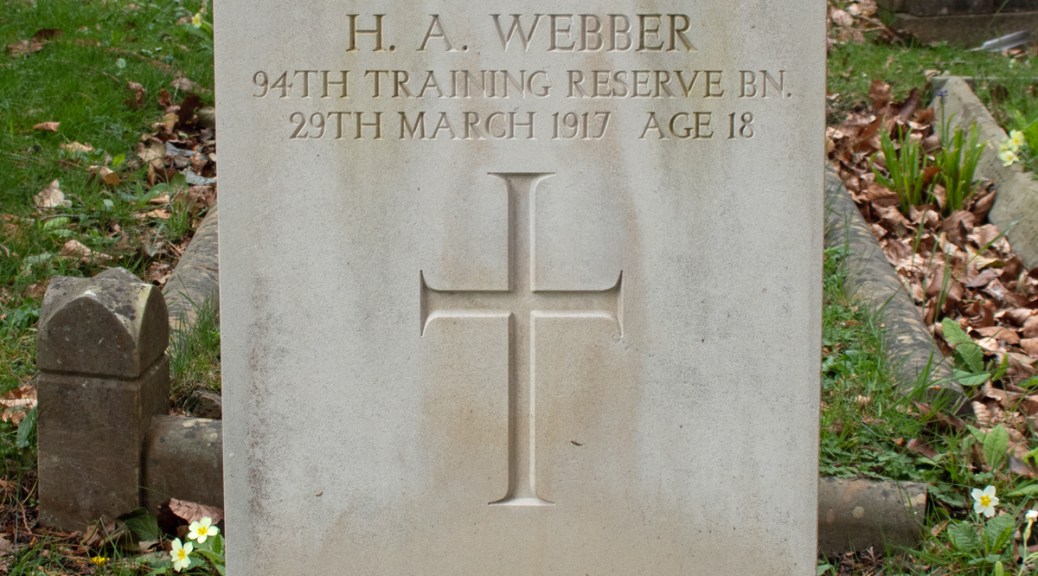
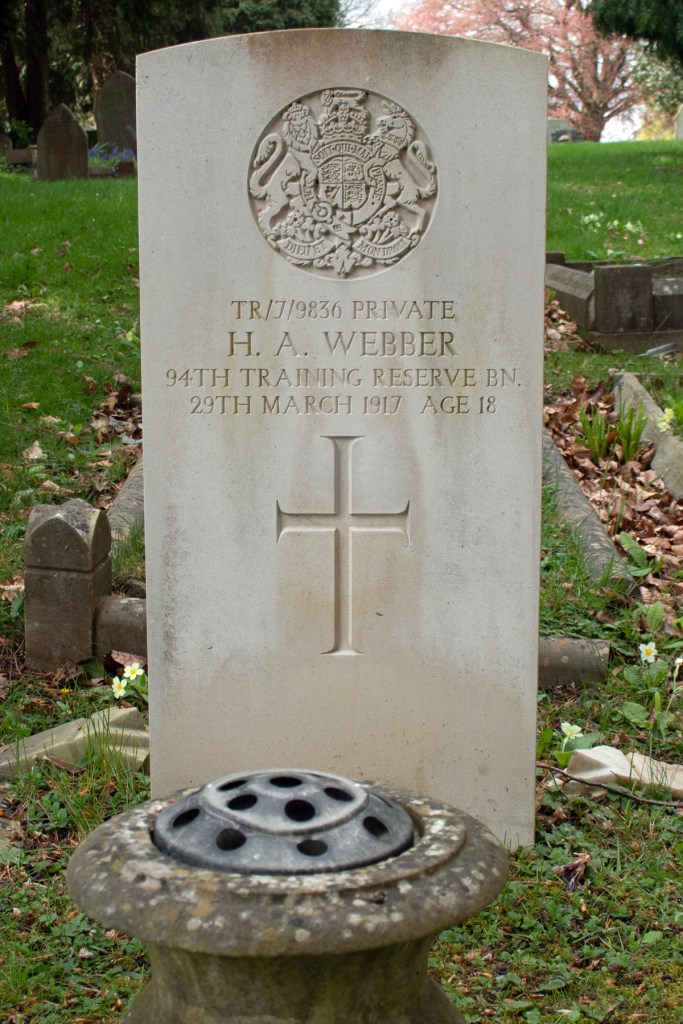
Herbert Alfred Webber was born on 22nd October 1898 in Yatton, Somerset. The younger of two children, his parents were Ernest and Ada. Ernest was a platelayer for the Great Western Railway and, by the time of the 1911 census, the family had moved to Keynsham, near Bristol. With Herbert and his sister still at school, they had taken in two boarders – railway porters Walter Prince and Victor Coombs – to help bring in a little money.
When Herbert left school, he found work at a local chemist, but as soon as he turned 18, he signed up to serve his King an Country. Assigned to the 94th Training Battalion, Private Webber was sent to the Chiseldon Camp in Wiltshire to begin his career.
Tragically, Herbert’s was not to be a long service. Within a month of arriving at camp near Swindon, he fell ill, and was admitted to an Isolation Hospital in the town. While the condition he had contracted is unclear, it was one to which he would succumb. He passed away on 29th March 1917, aged just 18 years old.
Herbert Alfred Webber was brought back to Somerset for burial. With the family having moved to Bath with Ernest’s work, he was laid to rest in the city’s Twerton Cemetery.
Private Herbert Webber (from britishnewspaperarchive.co.uk)
Arthur Reuben Thomas was born in Banwell, Somerset, on 27th September 1899. The older of two children, his parents were blacksmith Edwin Thomas and his wife, Mary.
Little information about Arthur’s life is documented. At the time of the 1911 census he was still a schoolboy, and it is likely that he helped his father out in the smithy when he finished his education.
By this point war was raging across Europe, and it is likely that young Arthur was keen not to miss out. Details of any military service are lost to time, but it seems possible that he joined up as soon as his age allowed.
Private Thomas was assigned to the 53rd (Young Soldier) Battalion of the Hampshire Regiment, and sent to Rollestone Camp on Salisbury Plain, Wiltshire, for training.
Sadly, Arthur’s time in the army seems to have been a short one. He was admitted to a camp hospital in nearby Tidworth, suffering simply from ‘disease’, and it was from this that he passed away on 6th January 1918. He was just eighteen years of age.
Arthur Reuben Thomas’ body was brought back to Somerset for burial. He was laid to rest in the quiet graveyard of St Andrew’s Church in his home village of Banwell.










 Death and Service