Tag Archives: Ypres

Private Bert Mayled

Private Bert Mayled

Bert Mayled was born in the autumn of 1889, the fourth of four children – all boys – to Benjamin and Anna Mayled. Benjamin was a butcher from Somerset, who raised his young family in the seaside town of Weston-super-Mare.

The whole family followed in Benjamin’s trade, with all four siblings supporting in one way or another, either through farm work or, in Bert’s case, becoming a butcher as well.

On 6th July 1914, Bert married Catherine Swearse, a builder’s daughter from nearby Axbridge. They married in Catherine’s local church, but settled – albeit briefly – back on the coast.

Bert may even have enlisted by the time of the wedding. While he is noted as a butcher on the marriage banns, within weeks war had broken out across Europe, and he found himself in the North Somerset Yeomanry.

Private Mayled’s regiment was one of the first into the fray – he was soon on the Front Line at Ypres. He was wounded early on, and medically evacuated to England for treatment. Admitted to the 2nd Western General Hospital in Manchester, he succumbed to tetanus, contracted from his wounds. He died on 25th November 1914, at just 25 years of age.

Bert Mayled was brought back to Weston-super-Mare for burial. He lies at rest in the Milton Road Cemetery there.


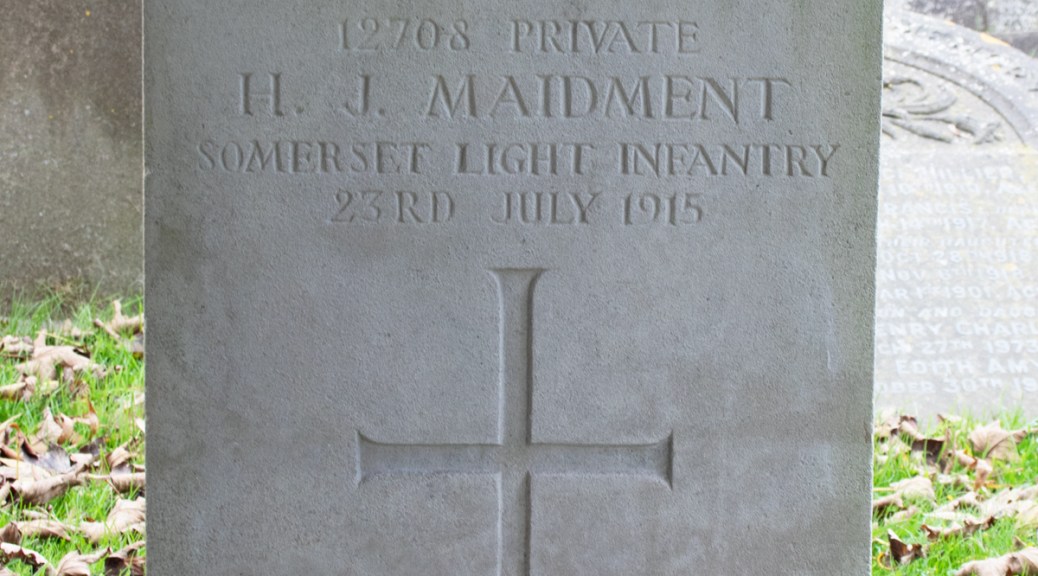
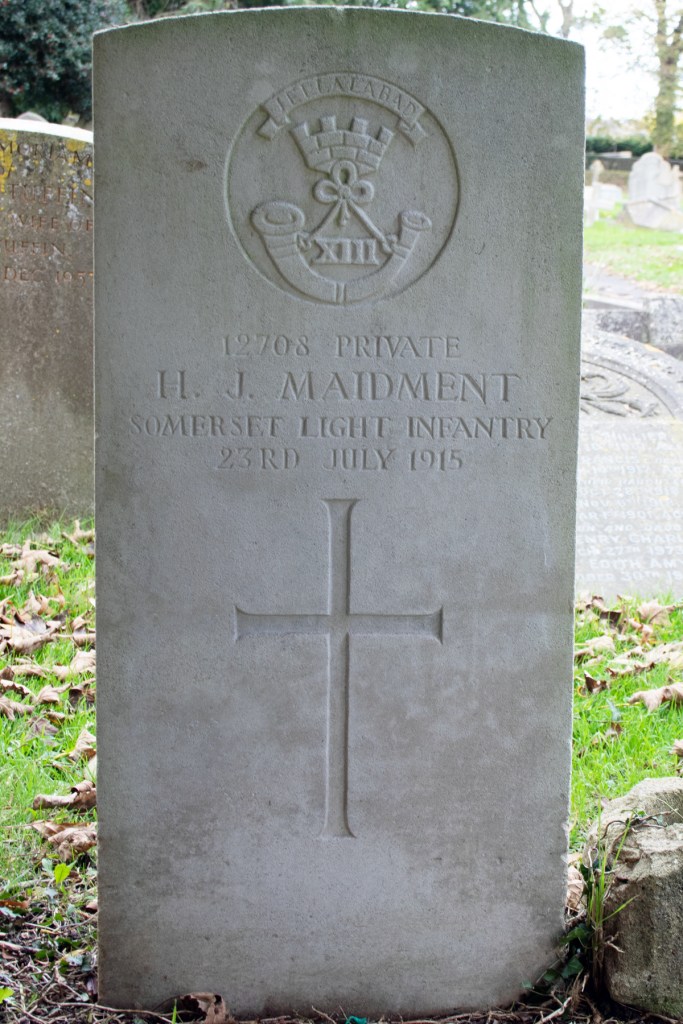
Private Harry Maidment

Private Harry Maidment

Henry James Maidment – known as Harry – was born in Penarth, South Wales, in the autumn of 1890. He was one of seven children to Somerset-born Henry and Minnie Maidment. Henry Sr was a general labourer, and, when he died in 1899, Minnie remained in Penarth, earning money to support the family as a hawker of fruit.

By the time of the 1911 census, most of Minnie’s children were still living at home, with all but one of them working. Harry was employed as a van driver for a laundry, while his siblings were working variously as labourers, sailors and a housekeeper.

In the autumn of 1911, Harry married Annie Hillier, a servant who had been born in Yeovil, but who had also moved to South Wales. The couple went on to have a son, Henry, in October 1912, but he tragically passed away when he was just a couple of months old. They were not to have any other children.

War was coming to Europe by this point, and Harry was keen to play his part. He enlisted towards the end of 1914, joining the 1st Battalion of the Somerset Light Infantry as a Private. He arrived in France at the beginning of May 1915, and would have seen fighting at Ypres that spring.

It seems that Private Maidment was wounded at Ypres; he was medically evacuated home and was admitted to the Graylingwell Hospital in Chichester, West Sussex. Details of his injuries are not available, but they must have been severe; he passed away from them on 23rd July 1915, aged just 25 years old.

Harry James Maidment’s body was brought back to Somerset; he was laid to rest in the graveyard of Christ Church, Frome, his parents’ home town, and where his widow, Annie was living.


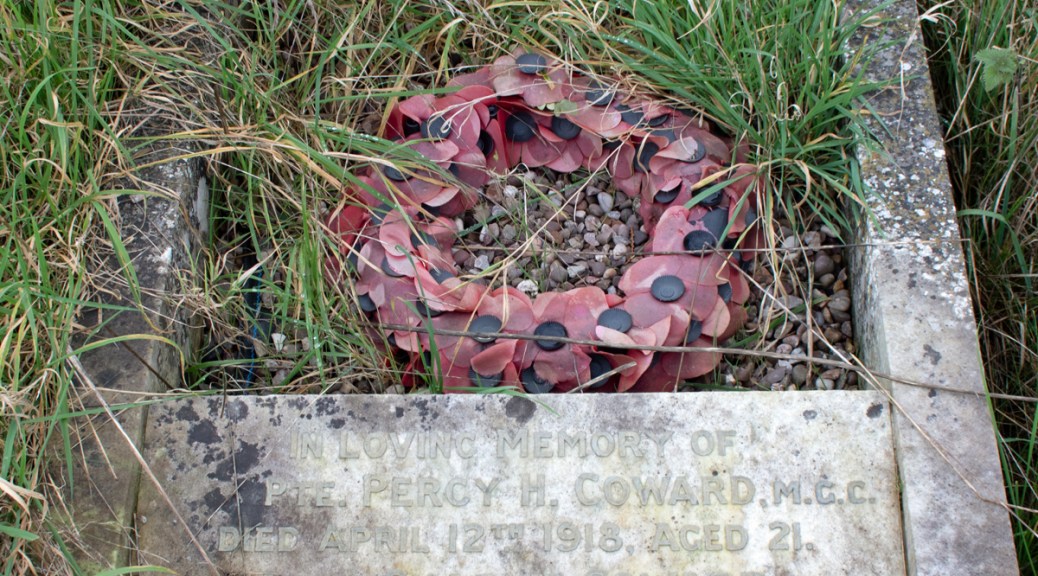
Private Percy Coward

Private Percy Coward

Percy Herbert Coward was born in the Wiltshire town of Westbury in the autumn of 1896. He was one of seven children – all boys – to Lily Coward and her weaver husband Charles. Not long after Percy was born, the family moved across the county border to Frome, Somerset, presumably for Charles’ work.

By the time of the 1911 census, the Coward family were living in a five-room end-of-terrace cottage on the outskirts of the town. Charles and Percy were both working as warpers – threading looms – in the cloth industry; two of his brothers were working for a printer in the town. Percy was proving himself an integral part of the community.

[Percy] was very highly esteemed by a large circle of acquaintances… He was a worker with the YMCA and Frome Brotherhood, a member of the band and in other directions showed himself a young man of much promise. He was employed successively at Messrs Houston’s [Woollen Mill] and at the Silk Factory.

Somerset Standard: Friday 26th April 1918

An active member of the town’s territorial force, when the Great War broke out he was mobilised. Initially attached to the Royal Army Medical Corps, he subsequently served with the Royal Army Service Corps and the North Staffordshire Regiment, before obtaining his final transfer to the 42nd Company of the Machine Gun Corps.

During his time in the army, Private Coward would have seen action in some of the fiercest battles of the war – at the Somme, Arras and Ypres. In the spring of 1918, his battalion was involved in the Battles of St Quentin and the Avre, and it was during this last skirmish that he was wounded.

Percy’s injuries were severe enough for him to be medically evacuated back to England and, once there, he was admitted to the Royal Woolwich Hospital in South London. His wounds were to prove too much for him, however, and he passed away at the hospital on 12th April 1918. He was just 21 years of age.

Percy Herbert Coward was brought back to Somerset for burial. He was laid to rest in the Dissenters’ Cemetery, Vallis Road, within walking distance of his family home.


Lance Corporal William Neads

Lance Corporal William Neads

William John Neads was born on 16th December 1892, the middle of three children to cab driver and groom William Neads and his wife Ellen. Both William Sr and Ellen were from Somerset, although William Jr and his brother Charles – who was eleven months older – were both born in the Monmouthshire village of Cwmcarn.

William’s parents soon moved the family back to Clevedon in Somerset, and, when he left school, he found work as a farm labourer. He was eager to see more of the world, however and, in April 1913, he emigrated to Canada.

After working as a labourer there for a year or so, back in Europe war was declared. Keen to do his bit for King and Country, William enlisted in the 1st Battalion of the Canadian Infantry in January 1915. He soon found himself caught up on the Front Line.

In October 1916, he was involved in the Battle of the Somme – either at Le Transloy or The Battle of the Ancre Heights – and received a shrapnel wound to his left shoulder. Initially admitted to the Canadian General Hospital in Etaples, he was subsequently evacuated to England and the Northern General Hospital in Leeds. He spent three months recovering from his injuries, and was back on the Western Front in January 1917.

Later that year, William – now a Lance Corporal – was involved in the fighting at the Second Battle of Passchendaele (part of the Third Battle of Ypres). He was wounded again, this time receiving a rather unceremonious gunshot wound to the right buttock. Treated at the scene, he was evacuated back to England and admitted to the Fusehill War Hospital in Carlisle on 17th November.

Sadly, despite treatment, Lance Corporal Neads’ health deteriorated, and he passed away from his injuries on 16th December 1917, his 25th birthday.

William John Neads was brought back to his family’s home of Clevedon, and buried in the clifftop churchyard of St Andrew’s, overlooking the sea.


Tragically, William’s father had died in May 1917, at the age of 51. While no details of his passing are recorded, it meant that Ellen had, in just over a year, seen her son wounded, her husband die and her son wounded again and die as a result.


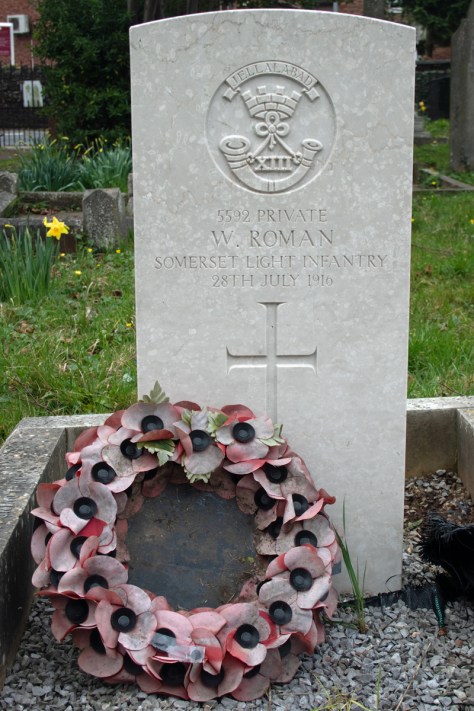
Private Walter Roman

Private Walter Roman

Walter James ‘Rattler’ Roman was born in July 1880, one of six children to George and Betsy Roman. George was a labourer in a brickyard, and the family lived in Bridgwater in Somerset.

Walter’s passion was rugby football, and he made the Bridgwater & Albion first team at the age of 15. Two years later had reached county level, and was playing for Somerset.

Walter enlisted in the army in around 1897, joining the Somerset Light Infantry. He spent several years abroad, serving as a Private in India and South Africa and fighting at Cawnpore and in the Second Boer War.

When Walter’s service ended, he returned to England, and continued his rugby career. He was a regular for the Bridgwater and Somerset teams, gaining the nickname ‘Rattler’, before being signed up by Rochdale Hornets in 1910.

Walter married Henriette Washer in Bridgwater in April 1911, and the couple had two children, Edna – born in 1912 – and Leonard – who was born a year later.

Continuing with rugby union, Walter was called to county level, where he joined Lancashire for a number of games. Walter also played for England, receiving a cap in the international match against Wales in February 1914, and he toured Australia and New Zealand the same year.

War broke out, and Private Roman was re-enlisted, one of twenty-five Hornets players to enlist. He served on the Western Front with the 1st Battalion of the Somerset Light Infantry and was caught up in the engagements at Ypres and Armentieres. Fighting at in the Battle of the Somme, he went over the top at Beaumont-Hamel at the start or fighting, on 1st July 1916 – his 36th birthday.

In that initial charge, he was shot several times, in both arms, a leg and the torso. Initially treated at a local field hospital, he was evacuated to England and admitted to the Voluntary Aid Hospital in Cheltenham. His condition initially improved, and he wrote letters to Henrietta, who was living back in Rochdale.

Sadly, Walter’s contracted sepsis and his health deteriorated; Henrietta was called to the hospital in Cheltenham on 27th July 1916. It is likely that she didn’t make it in time, as Walter passed away at 1pm the following day. He was just 36 years old.

Walter James Roman lies at rest in the Wembdon Road Cemetery in his home town of Bridgwater, Somerset, one of may sporting heroes to perish in the First World War.


Walter Roman (courtesy of findagrave.com)

Walter was one of 25 Rochdale Hornets players to enlist when war broke out. Of those men, five did not return: Private Walter Roman; Sergeant John Twigg; Private Archie Field; Private Tom West and Private CJ Burton.


Sapper Leonard Francis

Sapper Leonard Francis

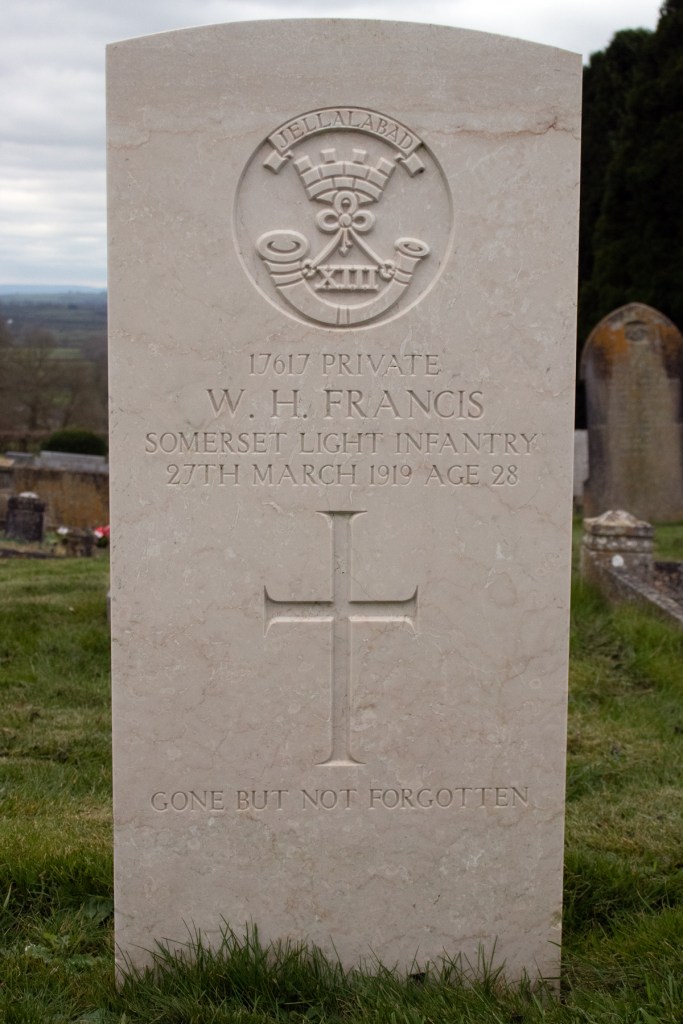
Leonard George Francis (who was known by is middle name) was born in October 1895. He was one of fourteen children to Jonas and Eleanor (or Ellenora) Francis, and his father worked on the railways as a plate layer or ganger.

George followed his father into manual labour, and, by the time of the 1911 census, aged 15, he was already listed as a mason.

He seems to have enlisted fairly early on in the war, and by January 1915 had joined his troop – the 2nd Wessex Field Company of the Royal Engineers – on the front line.

Sadly, Sapper Francis’ time in the army was to be brief. He was caught up in the fighting at Ypres, and he was injured at Hill 60 on 27th April. He was moved to a local hospital for treatment.

It seems that messages crossed in the communication with George’s family. They received a letter confirming that he was recovering in hospital after receiving a wound to the body, but not to worry. A day or so later his postcard confirming his arrival in France was received, but by this time he had been shipped back to England for treatment.

His parents received a telegram to confirm this, and his father and brother set out to visit him. By the time they had reached the hospital, however, he had sadly passed from a tetanus infection. In his pocket was a piece of shell; a sad souvenir of his frontline action.

Leonard George Francis died at Netley Hospital 3rd May 1915. He was just 19 years old.

He lies at rest in the cemetery of his home town, Shepton Mallet in Somerset.


Second Lieutenant George Palmer

Second Lieutenant George Palmer

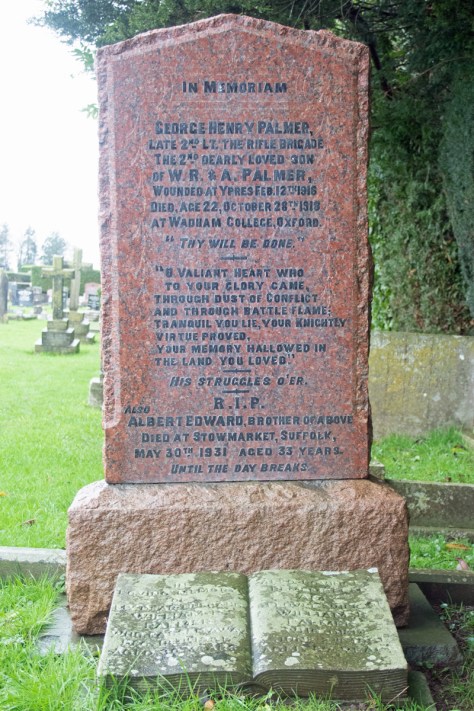
George Henry Palmer is one of those names that has been a challenge to research and who risked being lost to time.

George and Henry are common names for the late Victorian era, so a simple search on Ancestry brought up too many options to confirm anything specific.

Given the ornate nature of his headstone, it seemed reasonable that his passing and funeral would have been recorded in contemporary media, and indeed it was; the only identifiable name was his own. (His parents “WR and A Palmer” and featured, as is his grandfather “Rev. J Palmer”, but, again, this is not enough to go on for research.)

The additional name on the gravestone, however – George’s brother Albert – proved to be the key, though, identifying the following.


George Henry Palmer was born in May 1896, one of five children to William Richard Palmer and his wife Amy. William was a chemist’s assistant, a job that seemed to move him around the country. William was born in Wells, Somerset, as was his wife and eldest son; George was born in Regents Park, London, while Albert, who was a year younger, was born back in Wells. By the time of the 1901 census (when George was 4 and Albert 3), the family were living in Leicester, and they remained so for the next ten years.

Details of George’s military service comes primarily from the newspaper report of his funeral:

Deceased… was discharged from the Army through wounds received at Ypres in February, 1916, and had resumed his studies at Oxford and entered on a course of forestry, which he was following with great success.

He was well known in Wells, having spent a considerable time in the city and vicinity. He took a great interest in the Wells Volunteers, and was able to drill them in true Army style, having received his training in the Artist Rifles, and later gained his commission in the Rifle Brigade, where he was spoken highly of by his brother officers and men.

Mr Palmer was most thorough and painstaking in all his duties and studies. He was a Wyggestine [sic] scholar at the age of ten years in open competition, and later senior scholar at Wadham College Oxford.

Wells Journal: Friday 1st November 1918.

Second Lieutenant Palmer contracted pneumonia while up at Oxford, succumbing to the illness on 28th October 1918, just a fortnight before the end of the war. He was 22 years of age.

George Henry Palmer lies at rest in the cemetery of his home city of Wells.