William Thomas Woodham was born at the end of 1877 in Peasedown St John, Somerset. One of four children, his parents were coal miner and pit worker William Thomas and his wife, Sarah. The young family quickly moved from Peasedown to nearby Radstock to set up home.
William Jr did not immediately follow his father to the mine: instead, when he left school, he found work as a cowherd for a local farm. By the time of the 1911 census, however, he was recorded as being a colliery stoker.
The following year, William married Matilda Gulliford. She was a local coal miner’s daughter: the couple went on to have three children, Gwendoline, Stanley and Irene.
In his spare time, William volunteered for the Somerset Light Infantry and, when war broke out, he was formally placed on reserve – mining was one of the reserved occupations. However, in June 1915, he transferred to the Royal Engineers, and was sent to the Military Barracks at Taunton for training.
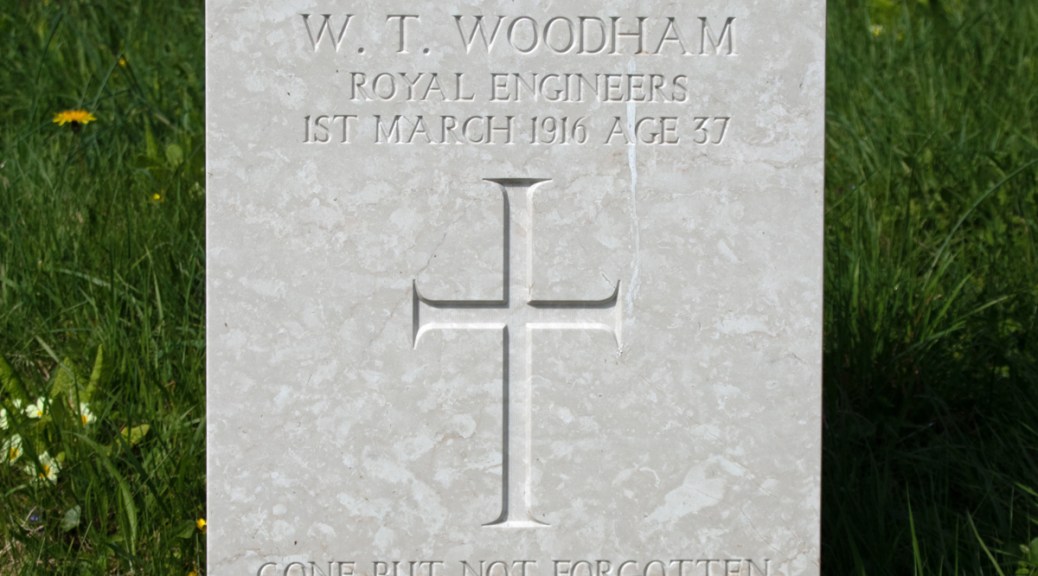
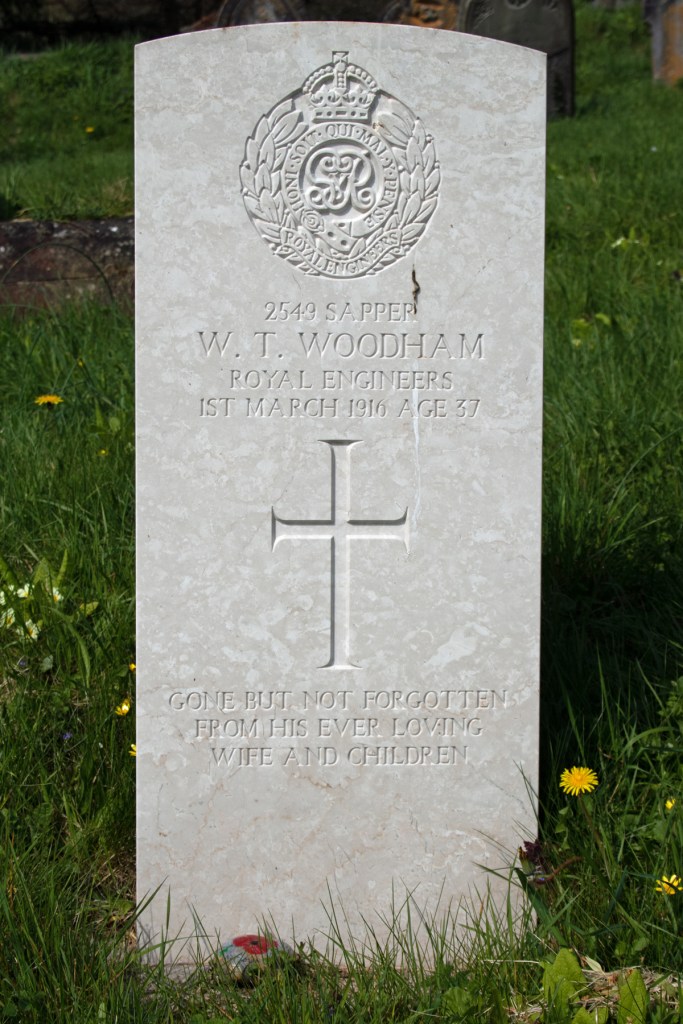
Sapper Woodham was due to be sent to France in the spring of 1916, but started feeling unwell. He was admitted to the Taunton Military Hospital, suffering from pneumonia on 20th February, but his condition worsened. He passed away at the hospital on 1st March 1916, aged 38 years old.
William Thomas Woodham’s body was brought back to Radstock; he was laid to rest in the graveyard of the town’s St Nicholas’ Church.
Sapper William Woodham (from britishnewspaperarchive.co.uk)
Frederick Charles Flint was born in the summer of 1872 in Bath, Somerset. He was the oldest of seven children to tailor Frederick Flint and his wife, Mary Ann.
Tailoring, however, was not a career that Frederick Jr wanted to follow and, in November 1890, he enlisted in the 7th Battalion of the Somerset Light Infantry. Over his twelve years’ service, he was posted to India and South Africa, gaining clasps for the Punjab Frontier 1897-1898, Relief of Ladysmith, Tugela Heights, Orange Free State, Cape Colony, Transvaal, South Africa 1901 and 1902 and the King’s South Africa Medal.
He returned to England in 1902, when he found employment as a postman back in Bath. He met Florence Novena Fishlock and the couple married at St Michael’s Church in Bath on 5th February 1905, before moving to nearby Radstock.
Frederick remained with the Post Office until the outbreak of war, when he again enlisted for duty, re-joining the Somerset Light Infantry. While he did not serve overseas, Serjeant Flint took on a training and mentoring role on Salisbury Plain. Suffering from tuberculosis, he was formally discharged from the army on medical ground in August 1915, and returned home.
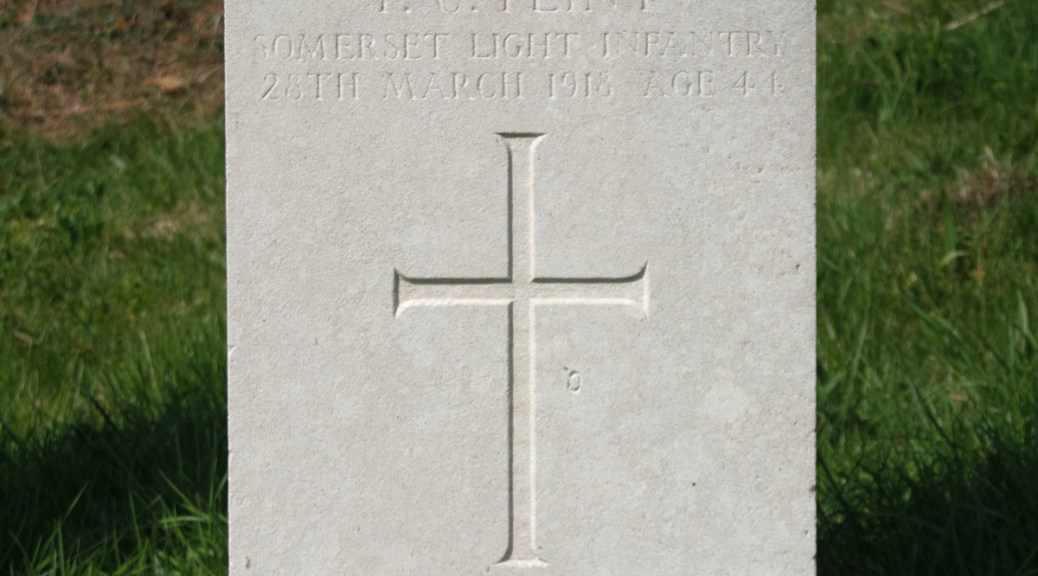
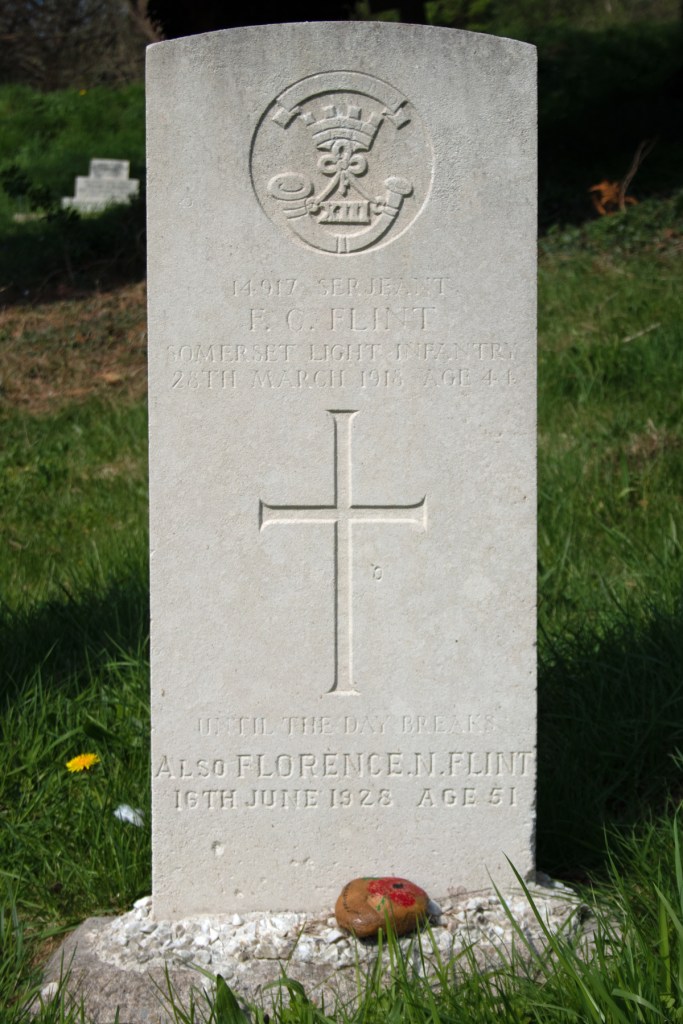
The next few years proved challenging for Frederick, as his illness left him incapacitated. He was nursed through by Florence, but eventually his body could take no more. He succumbed to the condition on 28th March 1918, at the age of 45 years old.
Frederick Charles Flint was laid to rest in the graveyard of St Nicholas’ Church in Radstock. Florence passed away ten years after her husband; she was laid to rest in the same plot in the summer of 1928.
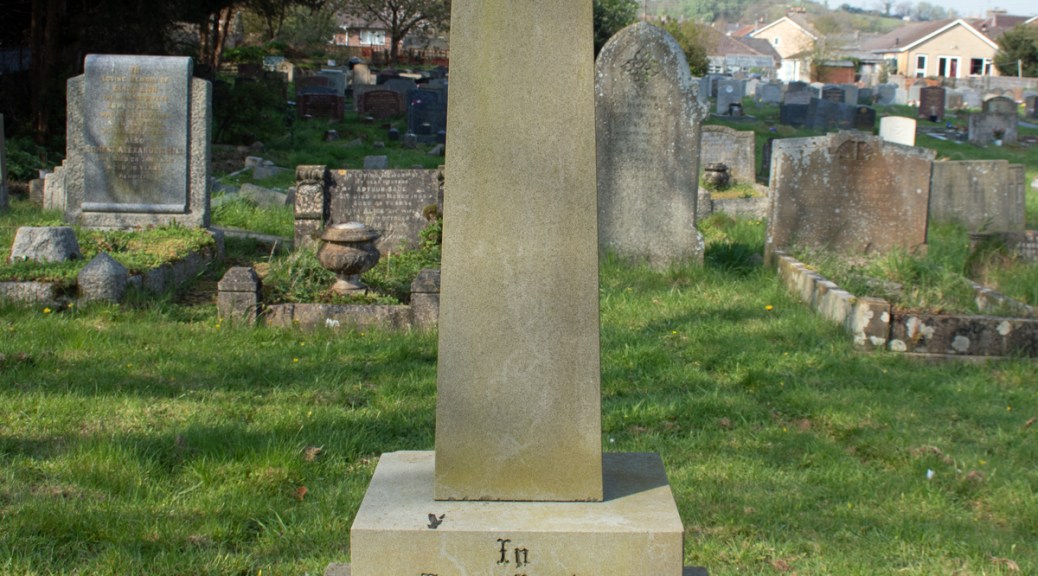
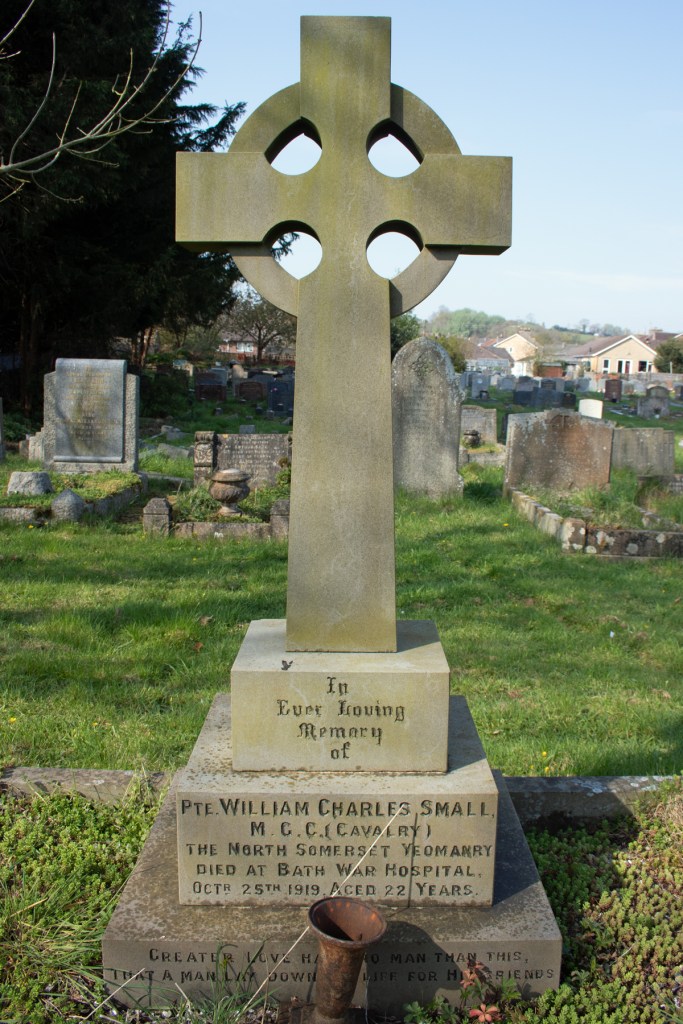
William Charles Small was born towards the end of 1896 in the Somerset town of Midsomer Norton. He was one of six children to coal hewer William George Small and his wife Margaret.
When he left school, William worked for the Co-op store in nearby Radstock, but when war came, he was keen to play his part. His service records are lost to time, but the local newspaper’s report on his funeral in 1919 sheds light on Private Small’s army career:
…he joined the army in May 1915, then being only 18 years of age. He joined the North Somerset Yeomanry and went to France on active service in September the same year, being sent straight to Belgium. There being a shortage of machine gunners, he was transferred to the [Machine Gun Corps], in the 3rd Cavalry Division.
He fought at Peronne, at Cambrai, Arras and Verdun, and other places. His regiment were commended by its General for their bravery in holding back the Germans. He first had leave after one year and eight months’ service in France, and another in August 1918.
He was in the Third Army which stemmed the German attack when they attempted to break through, and fought night and day till they succeeded in holding the enemy back. He had many narrow escapes while in battle, but came through without a scratch.
He was demobilised in January 1919, and was discharged A1, but the strain of 3 years and 6 months of active service proved too much and his health entirely broke down, and he was not able to follow his employment at all. His case was taken up by the military two months ago, and he was sent to Bath War Hospital, where he never recovered from the severe strain…
Somerset Guardian and Radstock Observer: Friday 7th November 1919
Private William Small died in the hospital on 25th October 1919, at the age of just 22 years of age. His body was brought back to Midsomer Norton for burial and he was laid to rest in the family plot in the graveyard of St John the Baptist Church there.
Private William Small (from britishnewspaperarchive.co.uk)
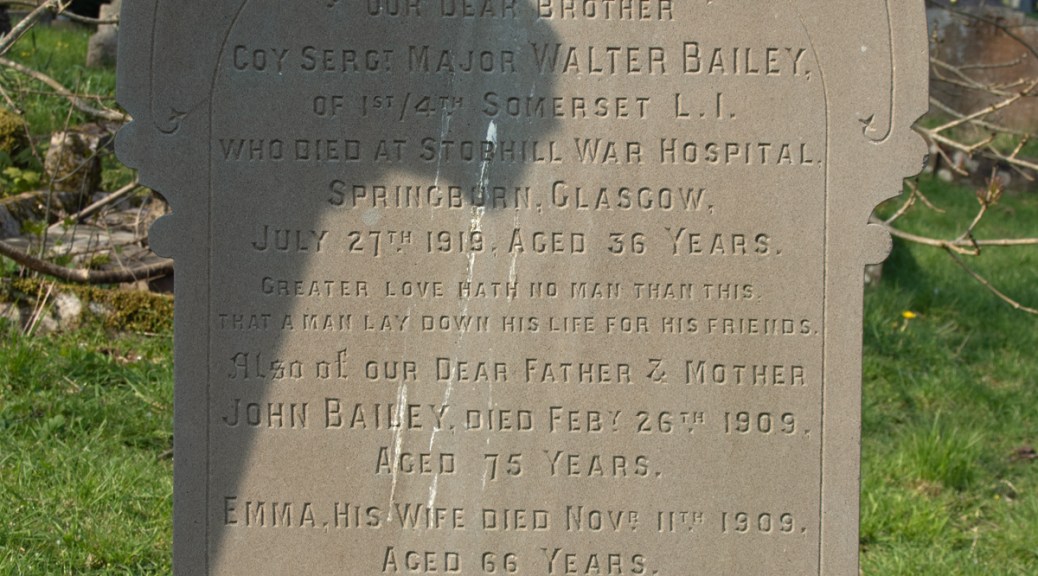
Walter Bailey was born on 6th October 1882 in Midsomer Norton, Somerset. He was one of eight children to Wiltshire-born labourer John Bailey and his wife, Emma, who came from the town in which they settled.
When he left school, Walter followed his siblings into the local boot industry and, by the time of the 1901 census, was working as a shoemaker. He was a sporty young man, and played in the local Welton Rovers Football Club.
When war came to Europe, Walter was eager to play his part. He enlisted in the 1/4th Somerset Light Infantry and, on 9th October 1914, was shipped to India. His battalion later moved to Mesopotamia where, on 8th March 1916, he was wounded in the foot in fighting. (Walter’s nephew, Corporal Tom Bailey was in the same regiment and, in the same fighting, he was killed. He is commemorated on the memorial in Basra, Iraq.)
Walter was invalided to India, but returned to his regiment when he recovered. He continued fighting, and was eventually promoted to Company Sergeant Major, while being mentioned in dispatches in 1918.
While waiting to return to England when the war ended, Walter fell ill. He was transported back to Southampton on a hospital ship, and from there was taken to a hospital in Glasgow. Sadly, the dysentery and anaemia he was suffering from were to get the better of him: Company Sergeant Major Bailey passed away on 27th July 1919, at the age of just 36 years old.
Walter Bailey’s body was brought back to Somerset for burial. He lies at rest in the family plot in the cemetery of St John the Baptist Church in his home town, Midsomer Norton.
Company Sergeant Major Walter Bailey (from britishnewspaperarchive.com)
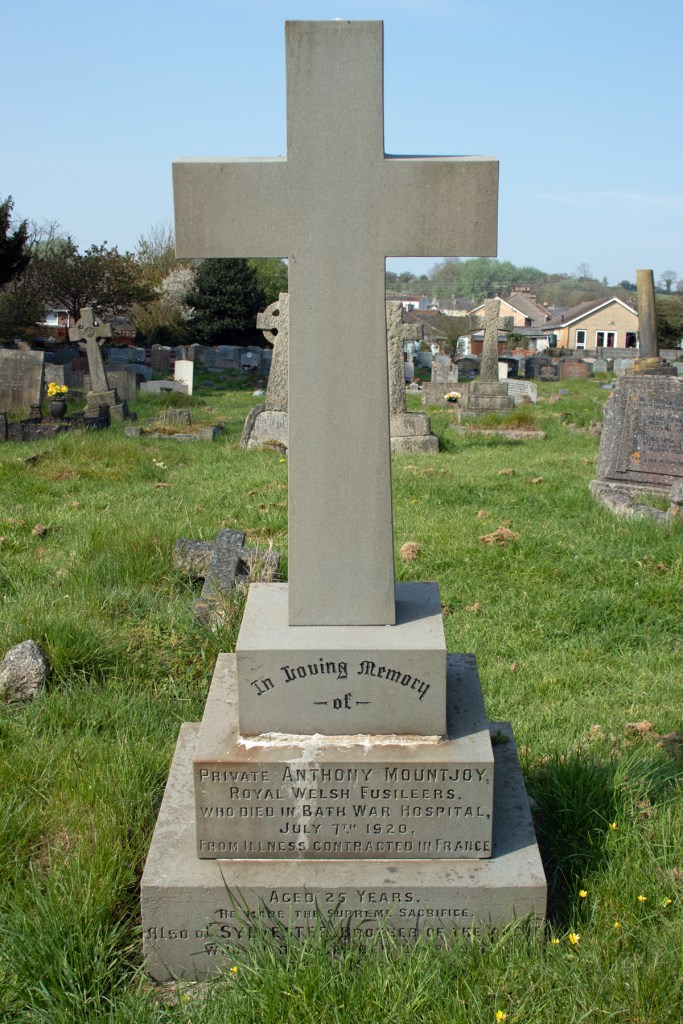
Anthony Mountjoy was born in the Somerset village of Clutton in the spring of 1895. One of eleven children, his parents were William and Sarah. William worked as a hewer in a local coal mine, and this is a job into which Anthony and at least two of his brothers went.
War was coming to Europe and, while there is limited documentation relating to his military service, a newspaper report on his funeral sheds some light into his life.
The funeral took place at Midsomer Norton on Monday afternoon of Private Anthony Mountjoy, 2nd Royal Welch Fusiliers, who died at the Bath Pensions Hospital… at the age of 25 years. Private Mountjoy… enlisted in the army on January 22, 1916, and went to France in July 1917. He was gassed and wounded at Passchendaele in March 1918, and arriving in England was take to the Tusehill Military Hospital, Carlisle in June. He was transferred to Bristol in April, 1919, and from there to Bath Pensions Hospital in November of the same year. He never recovered from the effects of active service.
Somerset Guardian and Radstock Observer: Friday 16th July 1920
Private Anthony Mountjoy died on 7th July 1920. He was laid to rest in the family plot in the graveyard of St John the Baptist Church in Midsomer Norton.
Bertie Ball was born in Westcott, Berkshire, in the spring of 1890, the oldest of ten children to John and Matilda Ball. John was from Berkshire, who raised his family in Wantage. He began life as a farm labourer, but, by the time of the 1901 census, he had found other employment, as a groom at a racing stable.
Details of Bertie’s life are scarce. When he left school, he found work as a garden labourer and, when war broke out, he enlisted in the Royal Army Service Corps. Private Ball was assigned to the Mechanical Transport Company, but whether he served overseas or on home soil is unknown.
Bertie died on 4th March 1915 from cerebrospinal meningitis. He was just 24 years old. He was laid to rest in the graveyard of St John the Baptist Church in Midsomer Norton – I can find no Somerset connection, so can only imagine that he passed away in or near the town.
Bertie’s younger brother Percival Ball also served in the First World War. He served with the 5th Battalion of the Wiltshire Regiment and fought in Mesopotamia. Sadly, he was killed there, dying on 5th April 1916. He was just 17 years of age. He is commemorated on the Basra Memorial in Iraq.
Edmund George Durnford was born in the spring of 1881 in the Somerset village of Pitcombe. The second oldest of twelve children, he was the oldest son to Edmund and Eliza Durnford. Edmund Sr was an agricultural labourer who travelled with the work – the 1891 census recorded the family living in Mells, near Frome.
When Edmund Jr left school, he found work at an ironmonger’s. He moved to Midsomer Norton and, in 1907, he married local carter’s daughter Bessie Welch. The young couple set up home in a terraced house on the road to nearby Radstock, and went on to have two children: Ian, who was born in 1908, and Ronald, born the following year.
War came to Europe, and Edmund was keen to play his part. He enlisted in the Royal Army Service Corps as a Driver, and was assigned to the 827th Company. Full details of his service are not available, but he remained a part of the territorial force and was promoted to Lance Corporal.
The local newspaper of the time reported on what became of Edmund:
Lance Corporal Edward [sic] G Durnford, Army Service Corps… son of Mr and Mrs EG Durnford… died suddenly on April 18 at Duston Hospital, Northampton, from shell shock and hemorrhage [sic] of the brain, was 38 years of age. The body was brought back from Northampton, and the deceased accorded a military funeral at Midsomer Norton last week.
Somerset Guardian and Radstock Observer: Friday 3rd May 1918
There are a couple of inconsistencies with the report. The newspaper has Edmund’s name wrong, while his pension record does not mention shell shock as the cause of death (it confirms the cerebral haemorrhage, but also cites a granular kidney). Given that Lance Corporal Durnford did not serve abroad, it seems unlikely that shell shock was a contributing factor.
The same article also places three of Edmund’s brothers in the war, and gives an insight into what had become of them before the conflict. Gunner Percy Durnford was with the Canadian Field Artillery, training in the South of England; Sergeant Major Arthur Durnford, of the Australian Light Horse, was based in Sydney; Bombardier Horace Durnford, of the Royal Garrison Artillery, had served in France, where he had been gassed, but was, at the time of his oldest brother’s death, based in Egypt.
Edmund George Durnford died in Northampton on 18th April 1918. He was 38 years of age. His body was brought back to Somerset, and he was laid to rest in the graveyard of St John the Baptist Church in Midsomer Norton.
Edmund’s younger son, Ronald, served in the Second World War. He joined the Royal Artillery, reaching the rank of Lance Bombardier. Ronald was serving in the Far East early in 1942, and for the next year, no news was heard of him.
However, contact was made in March 1943, confirming that Ronald had been captured by the Japanese, and was a prisoner of war in Borneo. Three months later, his wife, Kathleen, received a postcard from him, confirming he was a prisoner of war, well and unwounded.
Tragic news was quick to follow, however:
In last week’s issue it was stated that Mrs [Bessie] Durnford… had received through her daughter-in-law news that her son, Lance Bombardier Ronald Durnford, was a prisoner of war in Jap hands and was unwounded.
On Saturday she received the sorrowful news that he was dead in the following messages, which her daughter-in-law had sent on:
“I deeply regret to inform you a report has been received from the War Office, that [Ronald], who was reported a prisoner of war in Borneo Camp, had died from dysentery. The date of his death is not yet known, but you may rest assured as soon as any further information is received, I will immediately let you know.”
Somerset Guardian and Radstock Observer: Friday 30th July 1943
Lance Bombardier Durnford was laid to rest in the Labuan War Cemetery in Malaysia.
Further family tragedy, albeit with a life well-lived, was to follow as, on 6th September 1943, Bessie too died at the age of 86. She was laid to rest alongside Edmund in the family plot. Her obituary confirmed that “She leave a husband, seven daughters, and four sons to mourn her loss. One son and one daughter are in Canada, and one son in Australia, and one daughter and son in London.” [Somerset Guardian and Radstock Observer, Friday 17th September 1943]
Bessie had not, in fact, remarried: the husband was, in fact, the one who had died some 25 years before.
Arthur George Baguley was born in the autumn of 1897 in Warwick, and was one of six children to George and Rosa Baguley. George was a journeyman butcher who had moved his family to Frome, Somerset, by the time Arthur was three years old. George died in 1908, leaving Rosa to raise the younger members of her family alone.
Little information about Arthur’s life remains, and the only other documents that can be directly connected to him relate to his passing towards the end of the war. These confirm that he enlisted as a Guardsman in the Coldstream Guards at some point after April 1918.
Based in barracks in Hampshire, Guardsman Baguley was admitted to the Connaught Hospital in Aldershot, suffering from infective endocarditis, a bacterial infection of the heart. Sadly, he succumbed to the illness, passing away on 13th September 1918, aged just 20 years old.
Arthur George Baguley’s body was brought back to Somerset for burial. He was laid to rest in the graveyard of St John the Baptist Church, Midsomer Norton, where his mother was living by that point.
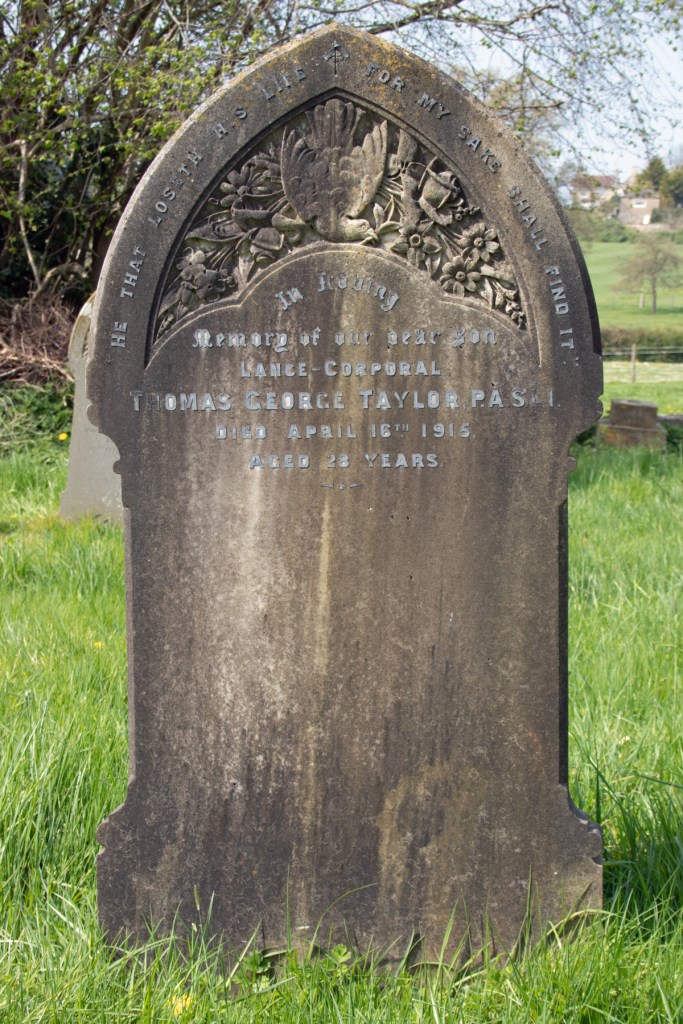
Thomas George Taylor was born in the summer of 1886, and was the youngest of five children to George and Sarah Taylor. George was a gamekeeper in Clutton, Somerset, and he and Sarah raised their family in Rudges Cottage opposite the village church.
Thomas’ older brother John found a variety of jobs, from boot finisher to coal miner, but Thomas followed in his father’s footsteps, and, by the 1911 census, was recorded as a butcher’s apprentice.
Storm clouds were brewing across Europe by this point and, when war broke out, Thomas was one of the first to enlist. Sadly, there is little information on his military service, but it is clear that he joined the 7th Battalion of the Somerset Light Infantry and was quickly promoted from Private to Lance Corporal.
The only other documentary evidence for Thomas is his entry in the Army Register of Personal Effects. This confirms that he was admitted to the Isolation Hospital in Aldershot, suffering from meningitis. Lance Corporal Taylor passed away from the condition on 16th April 1915, aged just 29 years old.
Brought back to Somerset for burial, Thomas George Taylor was laid to rest in the graveyard of St Augustine’s Church, across the road from his family home in Clutton.
Lionel Millard Gibbons was born in the spring of 1898 and was one of four children. His father, Benjamin, was a seed merchant from Camerton, Somerset, while his mother, Mary, had been born in Taunton. The family lived at Sheep House Farm in Camerton, where Benjamin employed a couple of servants to help manage things.
When war broke, out, Lionel was keen to play his part. He enlisted in the 4th Battalion of the Gloucestershire Regiment as a Private. While there are no dates to confirm when and where Lionel served, the regiment itself was involved at the Somme in 1916 and Ypres the following year.
Private Gibbons was badly wounded by shrapnel in the autumn of 1917, and returned to England to recover. Once he had, he was transferred to the 449th Agricultural Company of the Labour Corps and employed on farm work in Egford, near Frome.
It was while he was there that Private Gibbons contracted influenza and pneumonia; he passed at the farm on 28th October 1918, at the age of just 20 years old.
Lionel Millard Gibbons’ body was brought back to Camerton for burial. He lies at rest in the family grave in the ground of St Peter’s Church there.








 Death and Service