Cyril Robert Pratt was born on 31st October 1899 in the Somerset village of Halse. The younger of two children, his parents were local baker Robert Pratt and his wife, Elizabeth.
Little information about Cyril’s early life remains. He enlisted in the army not long after his eighteenth birthday, joining the Royal Warwickshire Regiment as a Private in November 1917. He was sent to Salisbury Plain for training, and was barracked in Larkhill, just north of Stonehenge.
Sadly, this seems to have been Private Pratt’s undoing. As with numerous other soldiers at the time, being billeted in cramped quarters with other men from across the country meant that disease was quick to spread. During his first winter at the camp, Cyril contracted pneumonia, and was admitted to the local Fargo Hospital. The lung condition was to get the better of him, and he passed away on 28th February 1918, at the age of just 18 years old.
Cyril Robert Pratt was brought back to Somerset for burial. He was laid to rest in the graveyard of St James’ Church in his home village, Halse.
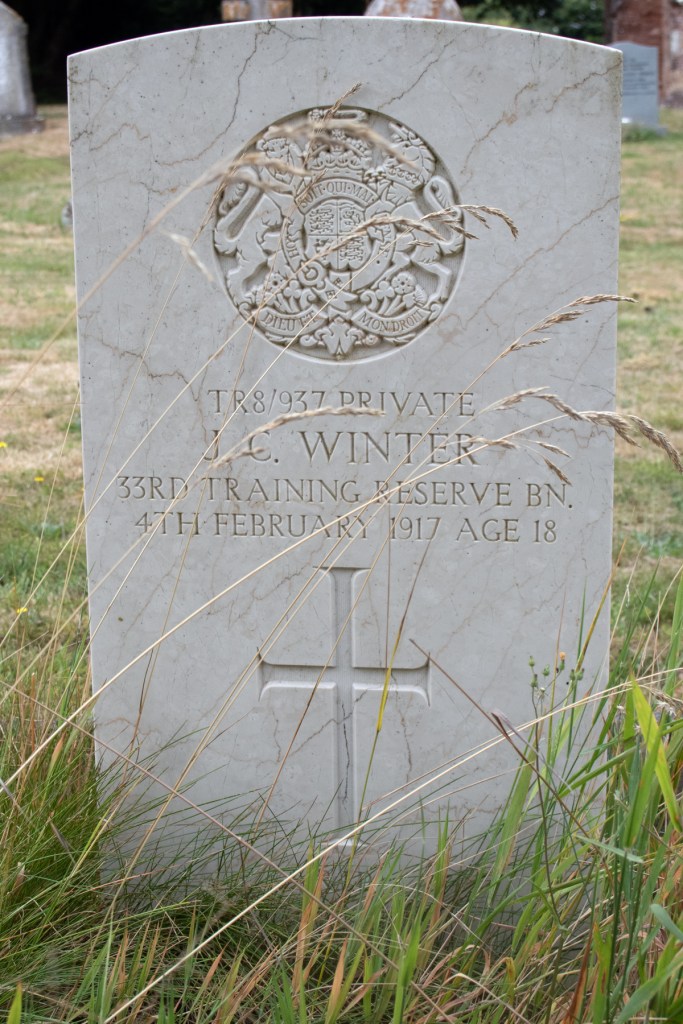
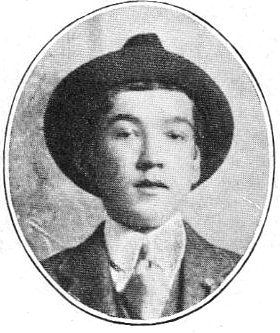
John Charles Winter was born in the summer of 1898, the younger of two children to James and Henrietta Winter. James was an agricultural labourer and carter from the village of Oake in Somerset. Henrietta had been born in Ontario in the USA, and was the daughter of English immigrants.
Little is documented about John’s early life. The 1911 census shows him living with his parents and his mother’s widowed brother, an army pensioner. At 12 years old, John was still at school.
War was coming to Europe by this point, and, as soon as he was able to (and probably encouraged by his uncle), John enlisted. He joined the 33rd Training Reserve Battalion, which was connected to the Warwickshire Regiment, at some point after August 1916.
Again, the details of his military service are scarce, but it seems that he soon fell ill, presumably from one of the medical conditions that tend to run rife in barracks crowded with men from across the country. The illness was to get the better of him and, on 4th February 1917, Private Winter passed away. He was just 18 years of age.
John Charles Winter was laid to rest in the graveyard of St Bartholomew’s Church in his home village of Oake.
Frederick William Bullock, who was known by his middle name, was born in the spring of 1894 in the small Somerset village of Hillfarrance. His parents were Frederick and Mary, and he was one of eleven children.
Frederick Sr was an agricultural labourer, but William wanted a life of adventure, and, by 1910, he had joined the army. It seems likely that he lied about his age when he enlisted, as he would only have been 16 years of age. Assigned as a Private to the 6th Dragoon Guards (The Carabiniers), he was based in Aldershot, Hampshire. His service records show that he was 5ft 6ins (1.68m) tall, had black hair and grey eyes.
Private Bullock’s early years of service were seemingly free of incident but this was to change. On 22md January 1914, his troop were preparing to board ship to sail to Egypt, but William went AWOL. He was apprehended a week later, tried and convicted of desertion. He was imprisoned for 56 days and his previous service with the army was forfeited.
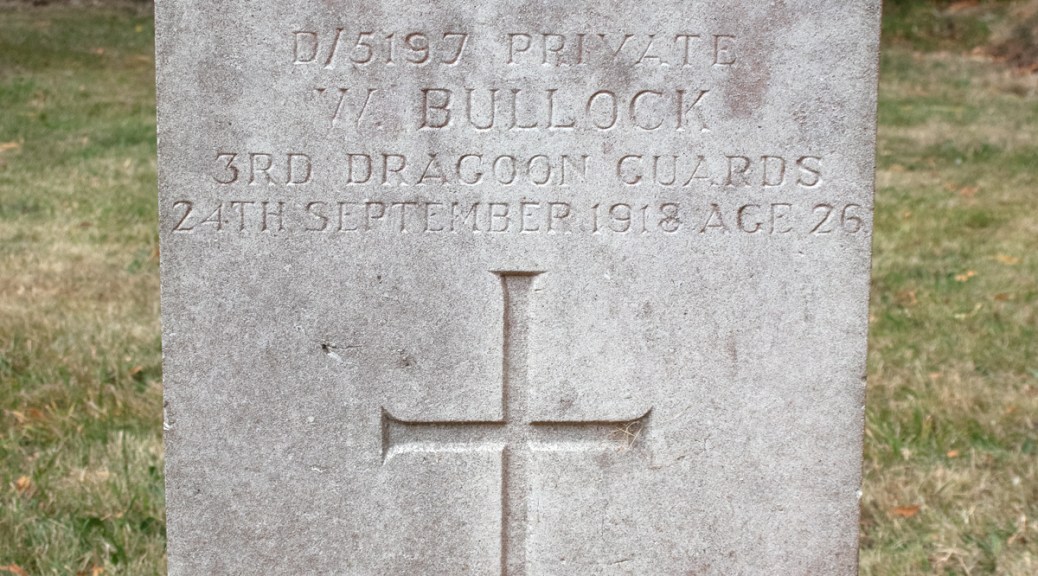
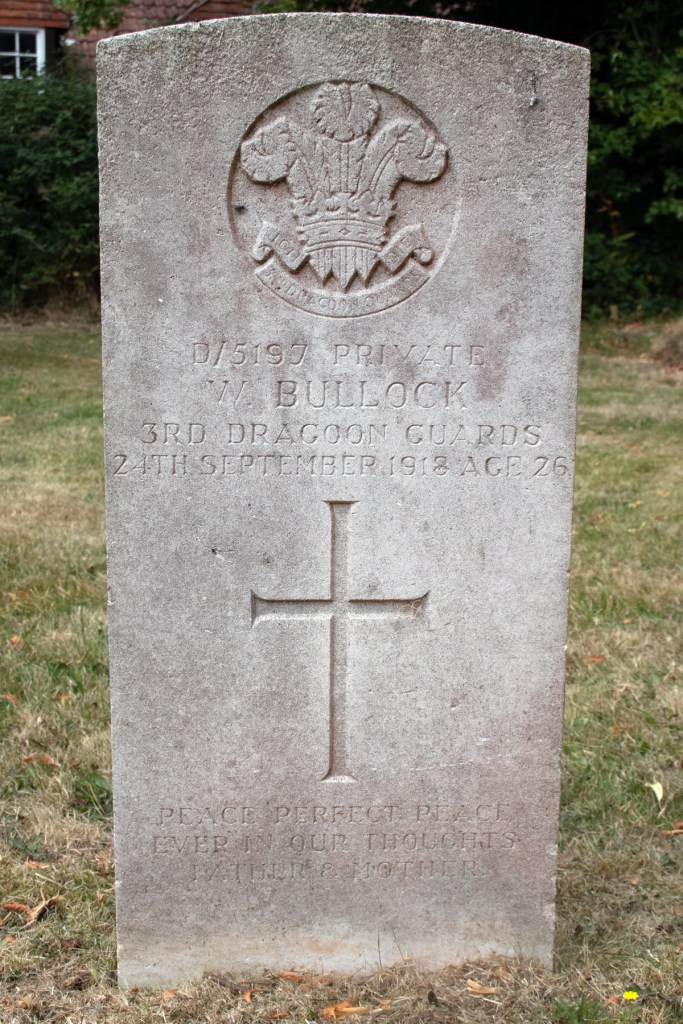
On 16th August, just a fortnight after war was declared, Private Bullock was sent to France. He spent three months on the Western Front before returning to England. In June 1915, he had transferred to the 3rd (Prince of Wales) Dragoon Guards, and was again sent to France.
William remained in France until the end of July 1916, when he fell ill and was medically evacuated to England for treatment. He was initially admitted to the 2nd Southern General Hospital in Bristol with a crumbling spine, but then transferred to the 2nd Western General Hospital in Manchester for more specialist treatment.
The condition, while not aggravated by his military service, was enough to have him medically discharged because of it. Private Bullock left the army on 28th July 1917.
At this point, William’s trail goes cold. What can be confirmed is that he passed away on 24th September 1918, at the age of 24 years old. He was laid to rest in the graveyard of St Giles’ Church in Bradford-on-Tone, a village not far from his birthplace, where his family now lived.
Victor Frank Langdon was born in the autumn of 1897, the only child to Francis and Martha Langdon. Frank was a carter and cowman from Clatworthy in Devon, but it was in Bradford-on-Tone in neighbouring Somerset that Victor was raised.
Victor was 16 years old when war was declared, but he was still keen to play his part. While full details of his military service are not available, he initially enlisted in the Hampshire Yeomanry, before transferring across to the 15th (Service) Battalion of the Hampshire Regiment in 1917.
Records suggest that Private Langdon served as part of a territorial force and, by the summer of 1918, was based in Norfolk. It was here that he fell ill, and, while in the camp hospital on 15th June 1918, he passed away. Details of his condition are lost to time, but it was noted as “disease”. He was just 21 years of age.
Victor Frank Langdon was brought back to Somerset for burial. He lies at rest in the graveyard of St Giles’ Church, in his home town of Bradford-on-Tone.
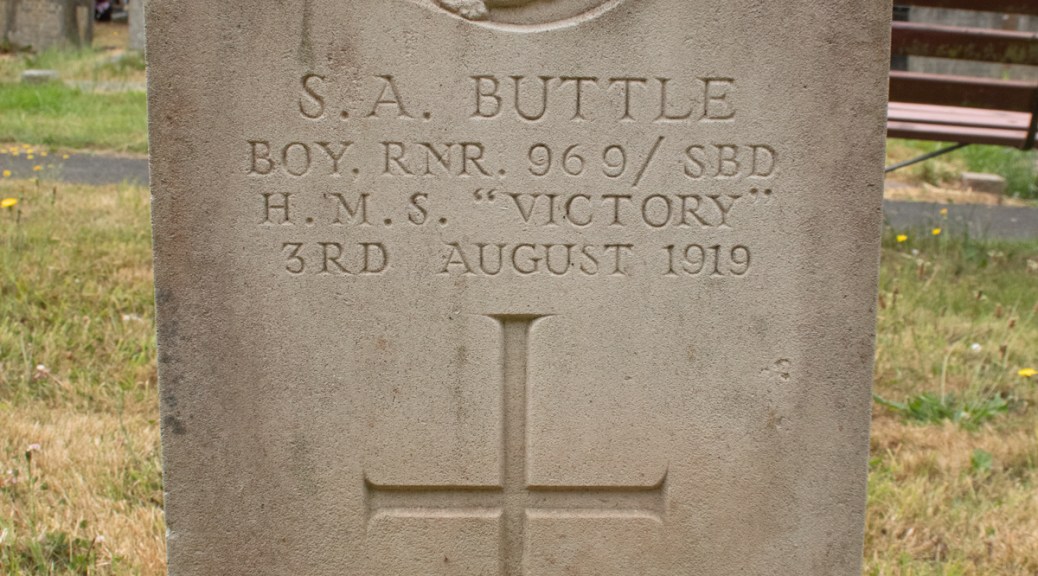
Sidney Alfred Buttle was born on 7th November 1900, one of eight children to Walter and Alice Buttle. Walter was a brickyard labourer from the Somerset hamlet of Churchstanton, but it was in nearby Wellington that he and weaver Alice raised their young family.
Sidney was just 13 years old when war broke out, but he was a young man who appeared keen to play his part. On 31st July 1917, he enlisted in the Royal Naval Reserve, a regiment that suggests that, even at his young age, he had some experience of working with boats.
His service records show that Sidney was just 5ft 2.5ins (1.59m) tall, had a fresh complexion with hazel eyes. Given the rank of Boy, he was initially posted to Falmouth, Cornwall, where he spent nine months training. After this, he spent a further six months on short postings as a deck hand, before being sent to HMS Victory, the Royal Naval Dockyard in Portsmouth, Hampshire.
Boy Buttle was, by this point, suffering from neurasthenia, a nerve disorder, and it was this condition that led to his eventual discharge from naval service in December 1918.
Sidney returned home, but seems to have been weakened by the condition. He passed away at home on 3rd August 1919, at the tender age of just eighteen years of age. He was laid to rest in Wellington Cemetery, not far from where his family still lived.
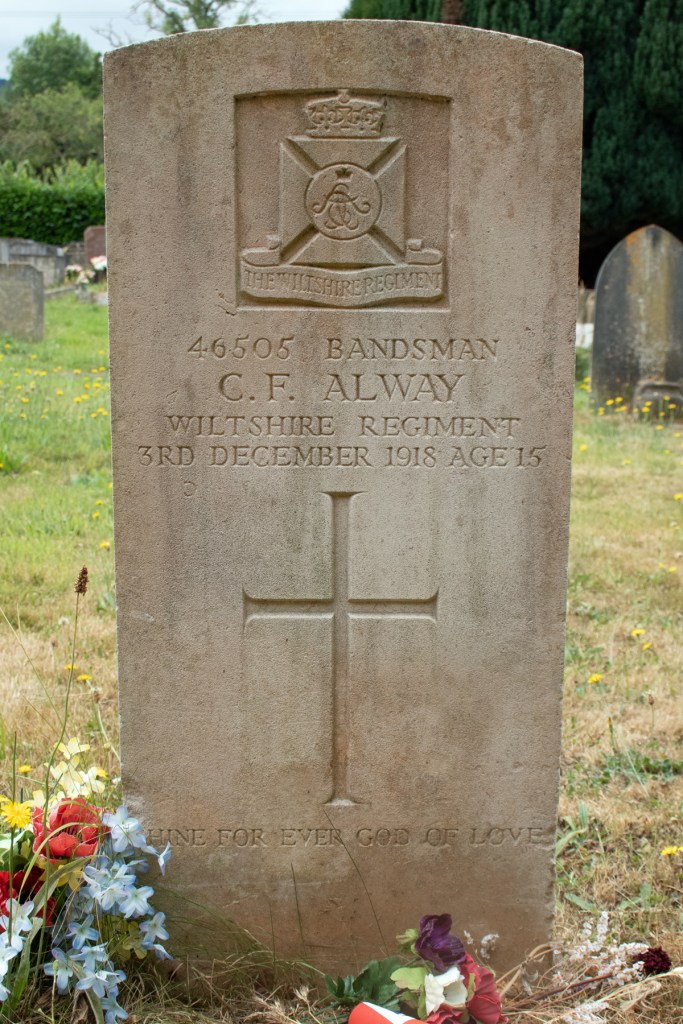
Clifford Frederick Alway was born on 2nd February 1903 in Wellington, Somerset. He was the fifth of fourteen children to Samuel and Ann Alway. Samuel was a farm labourer and butcher and, when war broke out, he stepped up to play his part, enlisting as a Driver in the Royal Field Artillery.
Clifford also seemed keen to be involved, and it can only be assumed that one or both of his older brothers – William (born 1898) and Wyndham (born 1901) – had joined up. By the summer of 1918, Clifford enlisted in the Wiltshire Regiment. It seems likely, given that he was only fifteen years old, that he had lied about his age, as so many young men did.
He joined the 3rd (Reserve) Battalion of the Wiltshire Regiment as a Bandsman. This was a territorial force, and Clifford was posted to Kent, as part of the Thames and Medway Garrison.
It was here, where it was billeted in crowded barracks, that Bandsman Alway contracted influenza and pneumonia. Admitted to hospital in Aylesford, the conditions proved too much for his system, and he passed away on 3rd December 1918. Tragically, Clifford was just 15 years of age.
Clifford Frederick Alway was brought back to Somerset for burial. He was laid to rest in Wellington Cemetery, not far from where his family still lived.
Samuel survived the war, spending more than three years in France – he was overseas when his son passed away, and so was unable to attend the funeral.
Herbert William Towell was born in the autumn of 1899, the oldest of six children to James and Prudence. James was a wool sorter in a factory, who had been born in Rockwell Green, on the outskirts of Wellington, Somerset, and this is where he and Prudence raised their children.
The Towell family were locals to Rockwell Green. James’ brother Charles lived just a few doors away from him and the 1911 census recorded James and Prudence living at 105 Rockwell Green Road, while Herbert, aged eleven, was living with his paternal grandparents, William and Charlotte, at 131 Rockwell Green Road.
When he left school, Herbert found work as an engine cleaner. War, however, was imminent and he was keen to play his part, but was initially too young do so. His time came, though, and on 30th June 1917 he was enlisted into the 34th Training Reserve Battalion.
At seventeen years and nine months, Private Towell’s service record gives his height as 5ft 11ins (1.80m), his weight as 144lbs (65.3kg) and confirms that he had a mole on his right cheek. He was initially assigned to the 53rd (Young Soldier) Battalion of the Hampshire Regiment, and posted to the army base at Durrington, close to Stonehenge.
In November 1917, Private Towell was admitted to the camp hospital with diarrhoea. Sadly, he had also contracted tuberculosis and it was recommended that he spend some time in a sanatorium. On 6th February 1918, he was discharged from service on medical grounds, and ordered to present himself for review the following year.
Herbert was not to get the chance to do so: within a month of his discharge he succumbed to the lung condition, breathing his last on 5th March 1918. He was just 18 years of age.
Herbert William Towell was brought back to Somerset for burial. He was laid to rest in Wellington Cemetery, within sight of his parents’ home.
Tragedy was to strike James and Prudence again less than a year later, when Herbert’s younger sister, Florence, passed away, aged just ten years old. No further information about her passing is available, so she may also have succumbed to one of the lung conditions running rampant across Europe in the aftermath of the war.
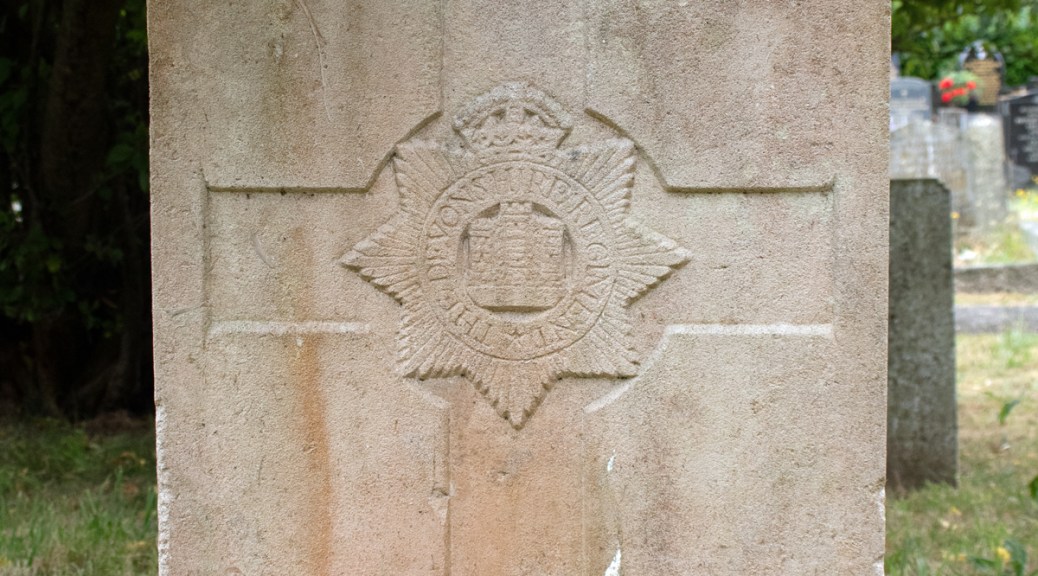
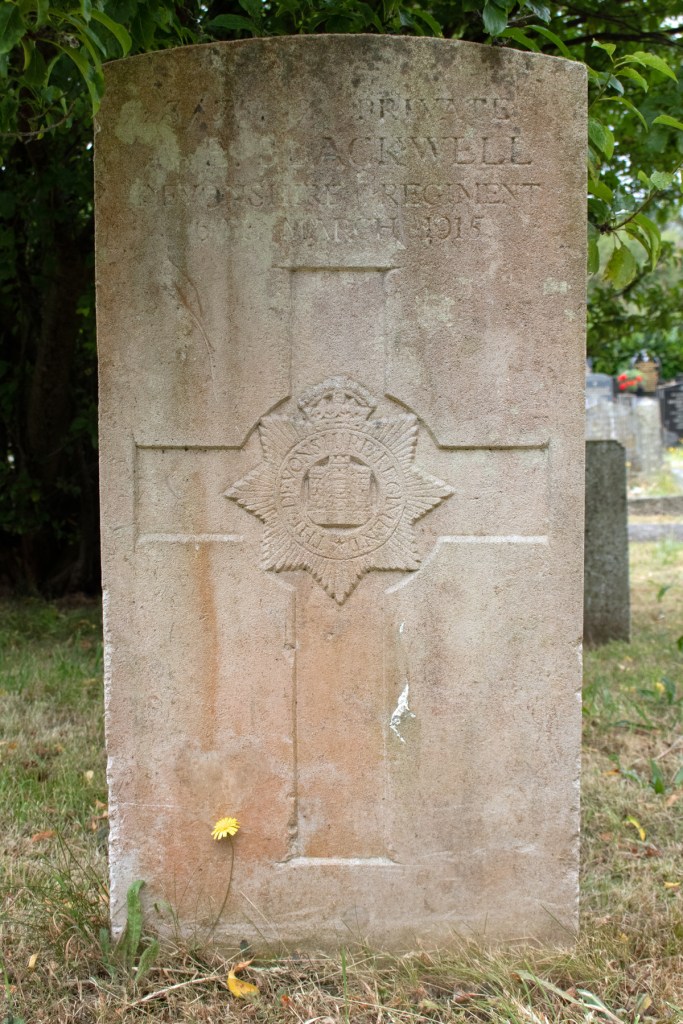
Albert Edward Blackwell was born in Corfe, Somerset, in the autumn of 1872. He was the third of eight children to Francis and Harriet Blackwell. Francis was a farm labourer, while Harriet supplemented their income by taking in washing. Albert didn’t follow in his father’s footsteps, however, but found work as a ropemaker when he left school.
On 21st September 1905, Albert married Mabel Hellen Fry, a factory hand and porter’s daughter from Wellington, Somerset. The couple began their married life living with Mabel’s parents, and went on to have five children. By the time of the 1911 census, Albert was working as a carter for a local coal merchant, but war was on the way.
There is little information available about Albert’s military service. He enlisted at the start of the conflict, joining the 9th Service Battalion of the Devonshire Regiment by September 1914. Private Blackwell was based at Aldershot, Hampshire, but his service was not to be a long one.
Albert was admitted to the Connaught Military Hospital near Marlborough, suffering from tuberculosis. This became bronchitis, and the lung conditions proved too much for Private Blackwell’s constitution to take. He passed away at the hospital on 6th March 1915, at the age of 42 years old.
Albert Edward Blackwell was brought back to Somerset for burial. He was laid to rest in Wellington Cemetery, not far from where Mabel was still living.
Now widowed, Mabel still had children to raise. In the spring of 1916, she married Alfred Barnfield, a greengrocer from Bath. He had served in the Coldstream Guards for two years, before he was discharged for misconduct in May 1911. Sadly, no further information is available for him and Mabel’s trail also goes cold at this point.
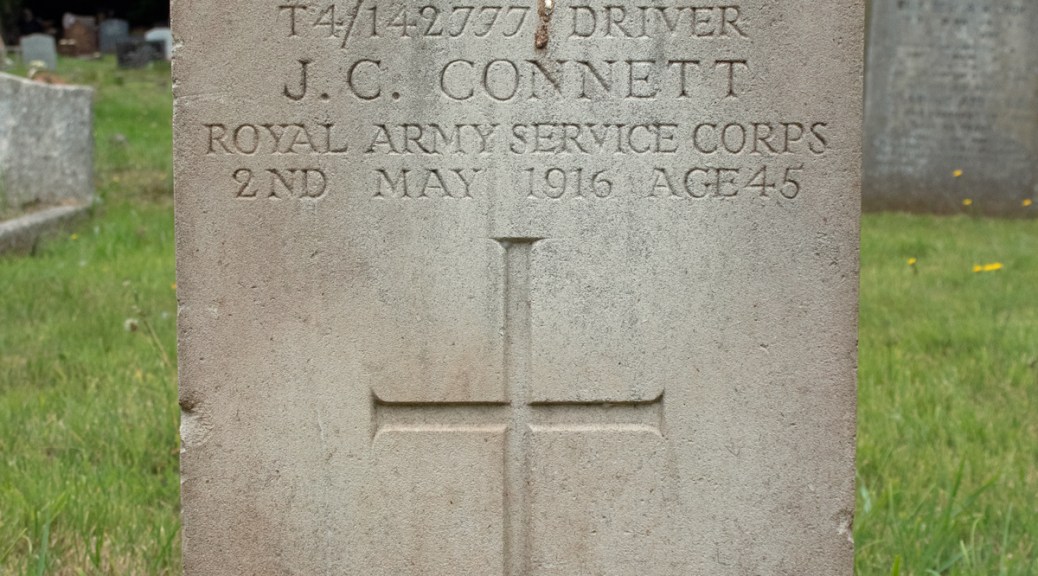
John Charles Connett was born at the end of 1870 in Holway, on the outskirts of Taunton, Somerset. He was one of seven children to Charles and Thursa Connett. Charles was a farm labourer and, in John’s early years, Thursa worked from home as a glover to bring in a little extra money for the growing family.
In 1897, John married a woman called Annie; the couple settled down in a small cottage near the centre of Wellington, Somerset. John found work as a coachman, and the couple went on to have one child, a daughter called Ethel, in 1900.
When war came to Europe, John was keen to play his part, even though he had turned 43 by the time hostilities were declared. He enlisted, joining the Royal Army Service Corps by November 1915, and was assigned to the 663rd Company.
Driver Connett’s time in the army was to be tragically short, however. He is recorded as passing away at home on 2nd May 1916, having contracted bronchitis and pneumonia while on active service. He was 45 years old.
John Charles Connett was laid to rest in Wellington Cemetery, within walking distance of where his widow and daughter still lived.
Frederick William Best was born in Wellington, Somerset, early in 1898 and was the middle of three children to factory worker Frederick Best and his wife, Bessie. When he left school, he found work as a delivery boy for a local baker, unlike his father, who was a long-time working in the local woollen factory.
War was closing in on Europe, however, and Frederick Jr was soon keen to play his part. Full details of his military service are not available, but it appears that he enlisted in the Worcestershire Regiment as soon as he was able, Private Best was assigned to the 15th (Transport Workers) Battalion, and served on home soil, initially in Swindon, and then in Southampton.
It was while he was billeted in Hampshire that Frederick contracted meningitis. He was admitted to a hospital in the city, but the condition was to get the better of him, and he passed away on 2nd January 1918, aged just 19 years old.
Frederick William Best’s body was brought back to Somerset for burial. He was laid to rest in the cemetery in his home town, Wellington, where his parents were both buried in the 1930s.











 Death and Service