Category Archives: illness

Private Sidney Budd

Private Sidney Budd

Sidney John Budd was born in the spring of 1888, the middle of three children to Abel and Mary Budd. Abel was a gardener from Tiverton, Devon, and this is where the family were born and raised. In the late 1890s, the family moved to West Monkton, near Taunton in Somerset.

When he finished school, Sidney found work as a house painter, and, by the time of the 1911 census, was boarding in a house near Minehead. Within a few years, he had moved again, this time to Chard, and had met Florence Moulding, the daughter of a shepherd from the town. The couple married on 1st August 1914, just days before the outbreak of war.

There is little information available relating to Sidney’s military service. He enlisted before the end of 1917, joining the 3rd (Reserve) Battalion of the Somerset Light Infantry as a Private. This was a wholly territorial troop, and Private Budd would have served in Somerset and Devon.

One of the downsides to being in close proximity to servicemen from other parts of the country in tightly-packed barracks was the ease with which disease could spread. Sadly, Private Budd was not immune from this and, in the spring of 1917, he contracted pulmonary tuberculosis. He was admitted to the Ford House Hospital in Plymouth, but his condition deteriorated and he passed away on 31st May 1917. He was just 29 years of age.

Sidney John Budd’s body was brought back to Chard for burial: he lies at rest in the town’s cemetery.


Florence went on to marry again, wedding Harry Golesworthy in the spring of 1918. Sadly, her happiness was to be short-lived: she passed away just two years later, at the age of 28 years old.


Sidney’s older brother, named Abel after his father, was an interesting character. When he left school, he found work as an apprentice to a photographer.

In July 1909, though, he was brought to court for stealing a bicycle. It seems that he had rented one from a dealer in West Monkton in order to visit friends in Cullompton, but not returned it at the end of the day, as expected.

The dealer contacted Abel’s parents, and he was found to have stayed over in Cullompton. It seems that while there, he had run low on funds, and had sold the bicycle to a dealer in the town. A week later, he returned to the Cullompton dealer, asking to buy the bike back, but hadn’t brought any money with him.

Eventually, Abel’s father went to Cullompton, bought the bicycle, then took it to the original dealer in West Monkton. By this point, however, Abel had been charged with theft, and pled guilty. His father stood witness, and, according to the Taunton Courier and Western Advertiser [Wednesday 14th July 1909], admitted that Abel “was rather weak of mind” and had not intended to steal the bicycle.

Abel was bound over for twelve months, with his father standing surety of five pounds.

The later parts of Abel’s life seem a mystery. There is a record of him travelling to Brisbane, Australia, in the spring of 1914, where he was to work as a farm labourer. He must have returned home, possibly as part of the war effort, and five years later he married Annie Talbot in Taunton, Somerset.

At this point, however, he falls off the radar, and there is no further information about him.

Private Joseph Vickery

Private Joseph Vickery

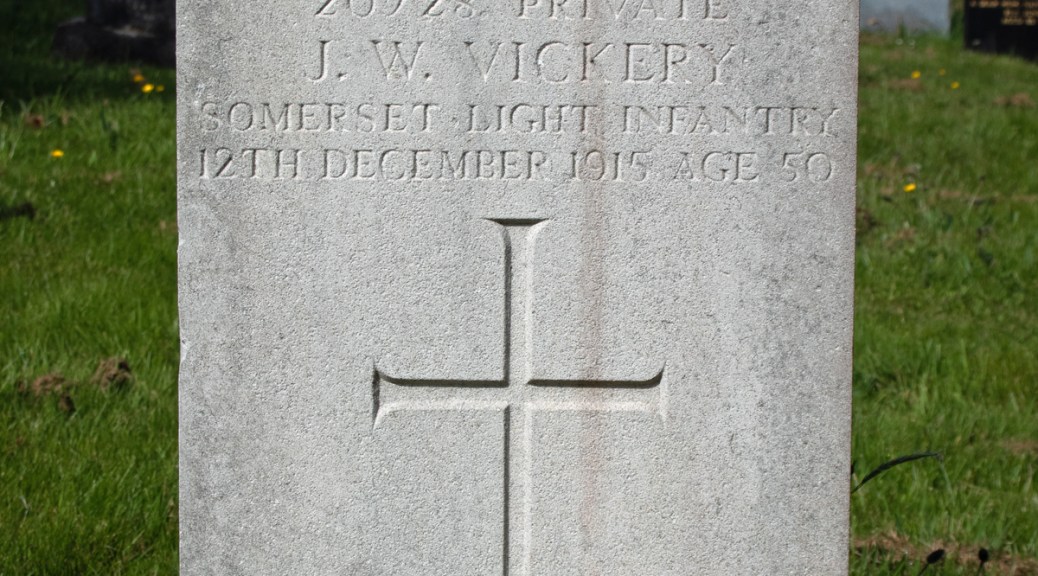
Joseph William Vickery was born in the spring of 1865 in the Somerset village of Isle Abbots. He was the older of two children to farm carter James Vickery and his wife Sarah. James died when Joseph was around six years old, and Sarah remarried, going on to have five children with her new husband, John Kitch.

The new family moved to North Curry, where Joseph found work as a farm labourer when he finished school. The years passed and, on 15th September 1894, Joseph married Elizabeth Ann Saturday, a labourer’s daughter from Chard. The couple settled in the town, and went on to have five children.

By the time war broke out in 1914, Joseph was approaching 50 years old. He still felt a duty to play his part, however, and enlisted towards the end of the following year. Little information survives of Joseph’s military career, but he enlisted in the Somerset Light Infantry and was assigned to the 1/5th Battalion.

Sent to Salisbury Plain for training, Private Vickery was billeted at Tidworth, Wiltshire. While there, he contracted bronchitis and was admitted to hospital. Sadly, the lung condition was to prove too much for his body to bear, and he passed away on 12th December 1915, at the age of 50 years old.

Joseph William Vickery was brought back to Somerset for burial. He was laid to rest in Chard Cemetery.


Joseph and Elizabeth’s son Victor also played his part in the conflict.

Born in 1900, he was too young to enlist at the start of the war, but, by April 1918, he had joined the Scots Guards as a Private. There is no evidence of him serving overseas, and his service seems to have passed uneventfully. He was demobbed in February 1919, and returned to Somerset to continue his work as a furnaceman.


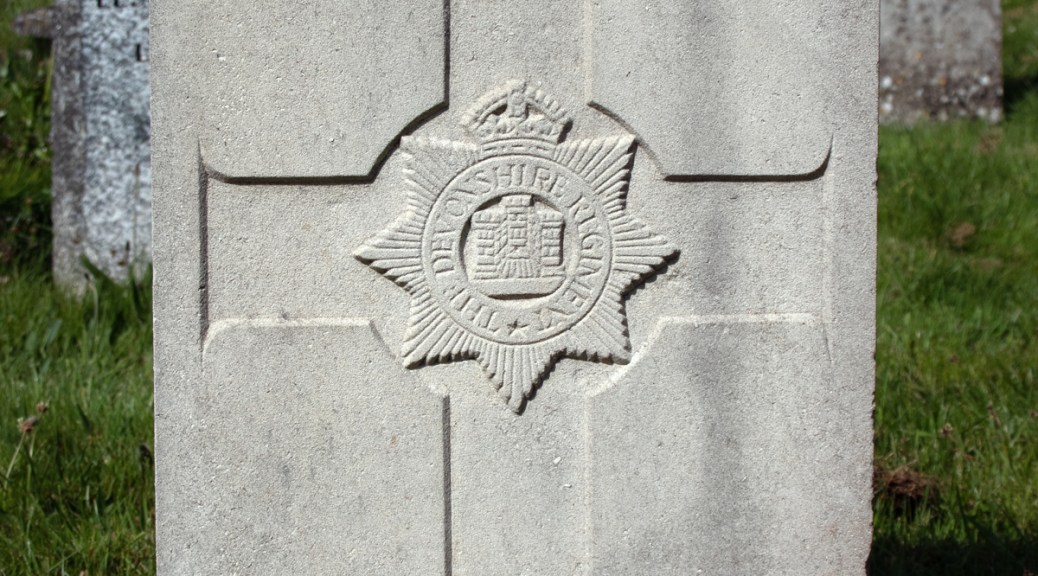
Serjeant Tom Harris

Serjeant Tom Harris

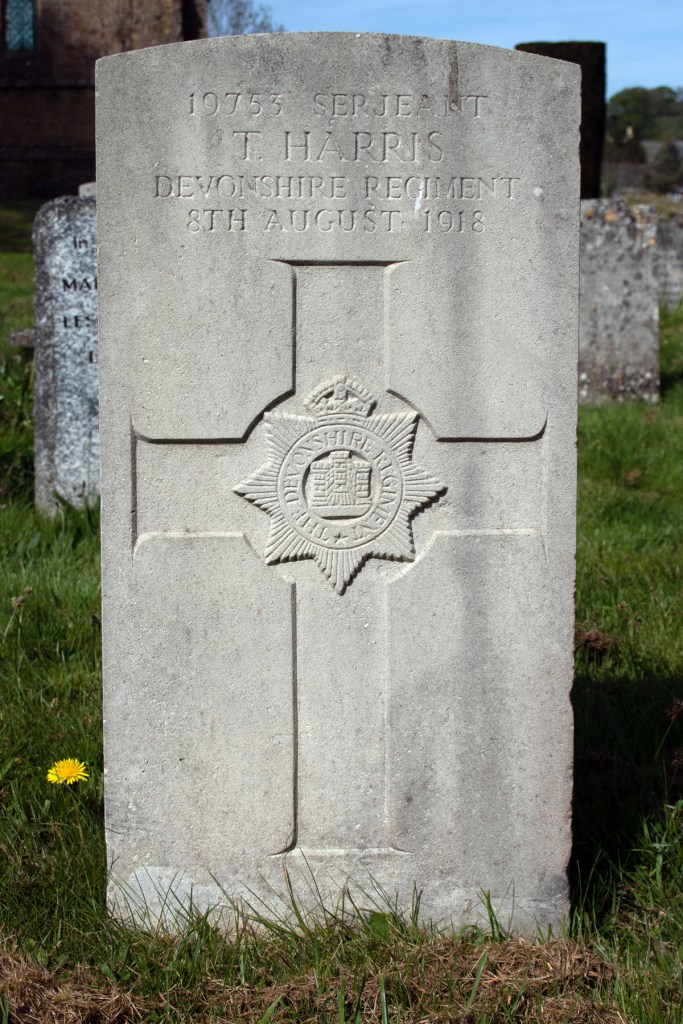
Thomas Harris – known as Tom – was born on 13th October 1876, the only son of Edmund and Mary Harris. Edmund was an agricultural labourer from the Somerset village of Seavington St Mary, and this is where Tom was born and raised.

Mary had married Edmund in the spring of 1876, but had been married before; she was widowed when her previous husband, Alfred Vickery, died ten years before. They had had seven children of their own, half-siblings to Tom.

Edmund died in the Wells Lunatic Asylum when Tom was only six years old. When he left school, he found work as a farm labourer, but sought bigger and better things, even though he was now the only one of Mary’s children still living at home.

Tom enlisted in the Somerset Light Infantry in January 1893, and soon found himself overseas. During his sixteen years’ service, he spent seven years in India and six months fighting in the Second Boer War. Corporal Harris seems to have had a sickly time of it, and while in India, was admitted to hospital a number of times for fever, ague and diarrhoea, as well as a bout of conjunctivitis.

When Tom’s contract came to an end in 1909, he returned to Britain, setting up home in Newport, South Wales, where he found work as a sheet weigher at the local steel works.

Mary died of senile decay and cardiac failure in May 1910. She was 74 years old, and sadly passed away in the Chard Workhouse, in similar circumstances to her late husband.

In October 1913, Tom married Ada Long in Chard. She was the daughter of a shopkeeper, and the couple set up home in South Wales, where Tom was still working.

War, by now, was closing in on Europe, and Tom wanted to use his previous experience to serve his country once again. He enlisted on 20th August 1914 in Newport, joining the Devonshire Regiment as a Private, although he was quickly promoted first to Corporal and then to Serjeant. His service records show that he was 5ft 8ins (1.73m) tall, had blue eyes, brown hair and a tattoo of a Spanish girl on his right forearm.

After a year on the Home Front, Serjeant Harris was sent to Egypt in September 1915. On the way out, he contracted a severe cold, which left him deaf in his left ear. He was also suffering from varicose veins, which left him in pain in his right leg. He was treated for both conditions, and put on light duties for three months.

In November 1916, Serjeant Harris was supporting a food convoy when it came under attack. Buried in sand and wounded, he was laid up in a hole for two days and nights before help came. He was initially treated for shell shock in the camp hospital, but was eventually evacuated to Britain for treatment.

The incident had put too much of a strain on Tom, and he was medically discharged from the army in April 1917. While his medical report confirmed that the general paralysis he was suffering from was a result of the attack, it also noted on six separate occasions that he had previously suffered from syphilis, suggesting this may also have been a contributing factor to his mental state.

Tom was discharged initially to an asylum in South Wales, before returning home to Ada. The couple were soon expecting a child, and a boy, Sidney, was born in February 1918. By that summer, however, Tom’s condition had worsened enough for him to be admitted back to the Whitchurch Military Hospital in Cardiff.

It was here that Tom passed away, dying from a combination of chronic phlebitis – an extension of the varicose veins he had previously complained of – and general paralysis on 8th August 1918. He was, by this point, 41 years of age.

Tom Harris was brought back to Somerset for burial. He was laid to rest – finally at peace – in Chard Cemetery.


Serjeant Tom Harris
(from ancestry.co.uk)

Private Arthur Wellman

Private Arthur Wellman

Arthur Wellman was born in the spring of 1891 and was one of nine children. His parents – road builder Thomas and collar machinist Eliza – were both born in Somerset, and it was in Chard that they married and raised their family.

Arthur and his siblings found work in the local lace industry – the 1911 census recorded him living with his family in Chard, working as a lace hand, minding the machinery in the mill.

In the summer of 1915, Arthur married Daisy Jane Slade, the daughter of an agricultural labourer from North Curry, Somerset. They went on to have a daughter, Beryl, who was born in May 1916.

By May 1916, Arthur had seen two of his brothers serve and die in the war: Private Bert Wellman had been killed serving with the Somerset Light Infantry in Mesopotamia, while Gunner William Wellman died from tuberculosis having served with the Royal Field Artillery. Whether through a sense of duty or a sense of guilt, he put his name forward to play his part. Full details are not available, but he enlisted in the Somerset Light Infantry that autumn.

Private Wellman was assigned to the 4th (Reserve) Battalion, and was sent for training. Sadly, while in barracks, he contracted cerebrospinal meningitis; he died in hospital on 20th March 1917, at the age of just 25 years old.

Arthur Wellman’s body was brought back to Somerset for burial. He was laid to rest in Chard Cemetery, not far from his brother, William.


Gunner William Wellman

Gunner William Wellman

William Wellman was born in March 1890 and was one of nine children. His parents, road builder Thomas and collar machinist Eliza were both born in Somerset, and it was in Chard that they married and raised their family.

William and his siblings found work in the local lace industry – the 1911 census recorded most of the family in Chard, but William was boarding in Stapleford, Derbyshire, with his older brother Fred; both were working as lace hands.

War was coming to Europe, and, as a previous member of the territorial force of the Somerset Light Infantry, William was keen to play his part. In February 1915, he enlisted in the Royal Field Artillery: his records show that he was 5ft 7ins (1.69m) tall, had light brown hair, grey eyes and a slender build, weighing 129lbs (58.5kgs).

Gunner Wellman was sent to Wiltshire for training but, while in barracks, he fell ill. Having contracted tuberculosis of the kidney, he was admitted to a hospital in Sutton Veny. After two months’ treatment, his health did not improve sufficiently enough, and he was discharged from the army on medical grounds in February 1916.

William returned to Chard, but was not to get any better. He passed away at home on 1st April 1916; he was just 26 years old.

William Wellman was laid to rest in the cemetery of his home town, not far from his brother, Private Arthur Wellman.


William and Arthur were not the only two of the siblings to fight in the Great War.

Their youngest brother, Private Bert Wellman fought with the Somerset Light Infantry, and died in fighting in Mesopotamia on 22nd November 1915. He was just 20 years of age.


Private Edward Welch

Private Edward Welch

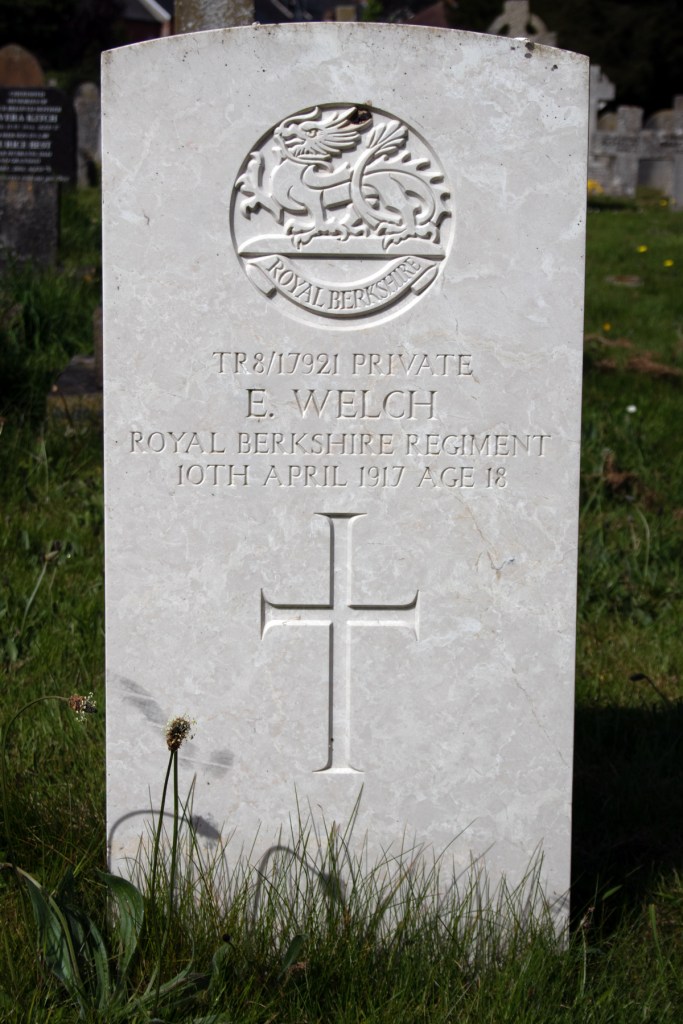
Edward Welch was born in Chard, Somerset, at the start of 1899. His parents were Edward and Sarah and he was one of five children, although he also had three half-siblings from Sarah’s previous marriage.

Edward Sr was a gardener who passed away in 1910, leaving Sarah a widow for a second time. She was already working as a lace maker, and this was a trade that Edward Jr’s older siblings also followed.

War was coming to Europe and, while he was too young to enlist when it was first declared, Edward was keen to play his part when he could. He enlisted in the Royal Berkshire Regiment at some point after October 1916, and was assigned to the 9th (Reserve) Battalion. Private Welch was part of the territorial force, and so did not see any action overseas.

There is little additional information about Private Welch’s life: all that can be confirmed is that he passed away “of disease” in hospital on 10th April 1917. He was just 18 years of age.

Edward Welch’s body was brought back to Somerset for burial. He was laid to rest in Chard Cemetery, not far from his family home.


Lieutenant Arthur Tett

Lieutenant Arthur Tett

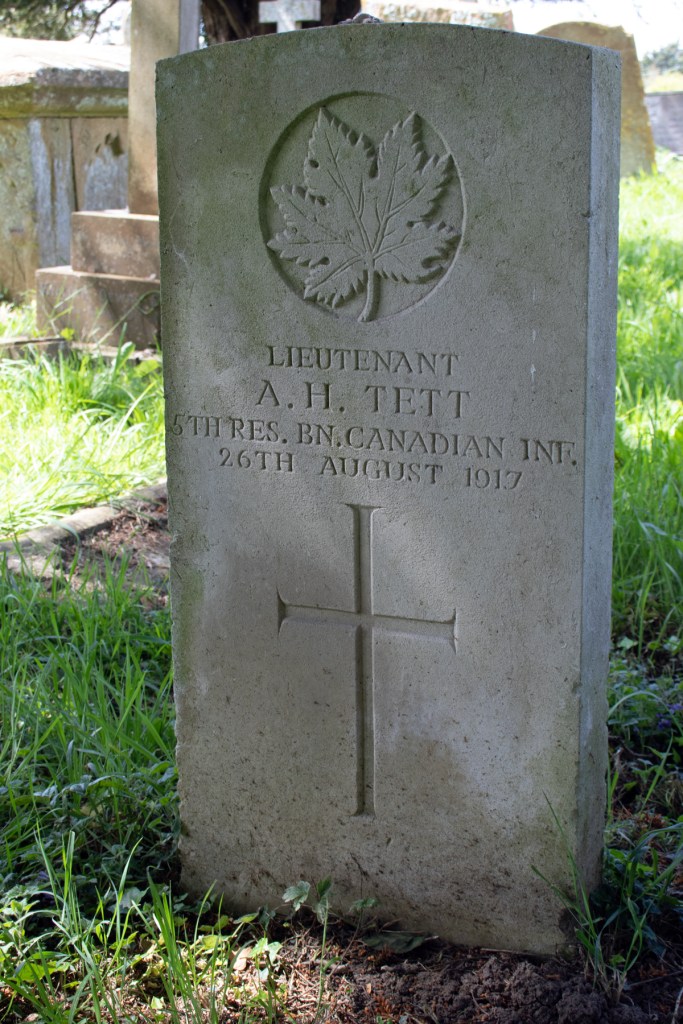
Arthur Hopkins Tett was born on 22nd August 1881 in Bedford Mills, Ontario, Canada. He was one of six children to lumberjack John Tett and his wife, Harriet. Both sets of Arthur’s grandparents had moved to Canada in the 1830s – John’s from Somerset, Harriet’s from Ireland – and his paternal grandfather had gone on to represent the county of Leeds in Ontario’s first parliament.

Arthur wanted to see the world, and viewed the army a a way to do that. After leaving school, he attended the Royal Military College, and was subsequently appointed a Signaller in the 3rd Canadian Mounted Rifles. He spent time in South Africa and, on returning to his home country, he took work as a bank clerk with the Union Bank, where he worked his way up to Head Office in Winnipeg.

He soon sought another challenge, and set up business in Outlook, Saskatchewan. In January 1913, Arthur married Bessie Kearns, an artist from back in Westport, Ontario. The couple settled in a detached property on Bagot Street, Kingston, Ontario and went on to have a son, John, who was born in 1917.

Arthur was still active in military circles at this point, playing a part in the local 14th Regiment. When war was declared, he again stepped forward to play his part, taking up a role of Lieutenant in the 253rd Battalion of the Canadian Expeditionary Force: this was a regiment made up mainly of students from the Kingston area, and it is likely that Arthur’s expertise would have been welcomed.

Having initially enlisted on 1st November 1916, Lieutenant Tett was declared fit a few months later and sent to Europe in May 1917. Based in Somerset, Arthur was not far from where his paternal grandparents had come from, nor where his cousins still lived. Sadly, however, his time in England was not to be a long one.

Lieutenant Tett was admitted to the Military Hospital attached to Taunton Barracks, suffering from pneumococcal meningitis. Sadly, this was to get the better of him, and he passed away on 26th August 1917, days after his 36th birthday.

Arthur Hopkins Tett was brought to the village of Kingstone in Somerset for burial. He was laid to rest in the graveyard of his second cousin George’s local church, St John and All Saints.


Bessie Tett did not marry again after her husband’s passing. She remained in Ontario for the rest of her life, passing away in October 1974, at the age of 89.

Arthur and Bessie’s son, John, was a babe-in-arms when his father died. He also remained in Ontario for much of his life, although he served in Europe during the Second World War. He married Sylvia Bird in September 1941; the couple went on to have two children. They returned to Canada when the war was over, and remained in Ontario until August 1974, when he passed away.


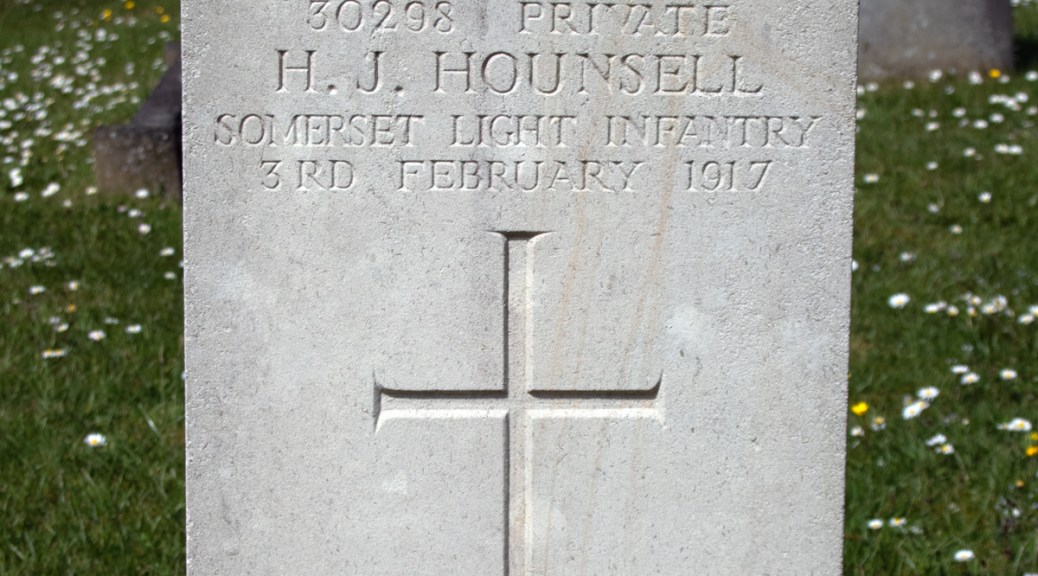
Private Henry Hounsell

Private Henry Hounsell

Henry James Hounsell was born in the spring of 1891, one of ten children to George and Emma Hounsell. George was a farm labourer and carter, and the family were raised in Tatworth, on the outskirts of Chard, Somerset.

Henry may have followed his father in farm work, but he wanted bigger and better things from life. The 1911 census recorded him as boarding with the Burt family in Corscombe, Dorset, where he was working as a baker’s van man.

Henry’s two older brothers, George and Alfred, died in 1913 and 1914 respectively; this left him as the oldest male of the siblings. In the summer of 1915, he married Lydia Lentell, the daughter of a shirt starcher and collar maker from East Coker, Somerset.

By this point, however, war was raging across Europe, and Henry was called upon to play his part. Full details of his service are lost to time, but it is clear that he enlisted in the Somerset Light Infantry as a Private in the 4th (Reserve) Battalion. By the time he joined up – at some point after August 1916 – his troop had already been sent out to Mesopotamia; it is unclear whether Henry also went overseas, but it appears unlikely.

The only other documents relating to Private Hounsell are those concerning his passing. His pension record confirms that he died on 3rd February 1917, having been suffering from a tumour in the back of his head, which had been aggravated by his military service. He was just 25 years old.

Henry James Hounsell was brought back to Somerset for burial. He was laid to rest in Tatworth Cemetery in Chard.


Lydia and Henry had had no children; she remained a widow for a number of years, before marrying for a second time in the autumn of 1939. Tragically, this was also destined to be a short-lived marriage – her new husband, Frederic Hodge, died just three years later.


Private Sam Mattocks

Private Sam Mattocks

Samuel Mattocks was born in Combe St Nicholas, Somerset, in 1885, one of six children to farm labourer George Mattocks and his wife, Anna. Sam sought a trade when he left school and soon found work as a butcher.

Documentation relating to Sam’s life is pretty scarce. When war broke out, he stepped forward to play his part, enlisting in the Army Service Corps (presumably because of his profession) by the start of 1916.

Private Mattocks was sent to Hampshire to work at one of the supply depots there. Sadly, this appears not to have been for long as, on 1st April 1916, he passed away at his base in Aldershot. No specific cause of death is evident – his records just note that he died ‘of disease’. He was 31 years old.

The body of Samuel Mattocks was brought back to Somerset for burial. He was laid to rest in the family plot in the graveyard of St Nicholas’ Church in his home village.


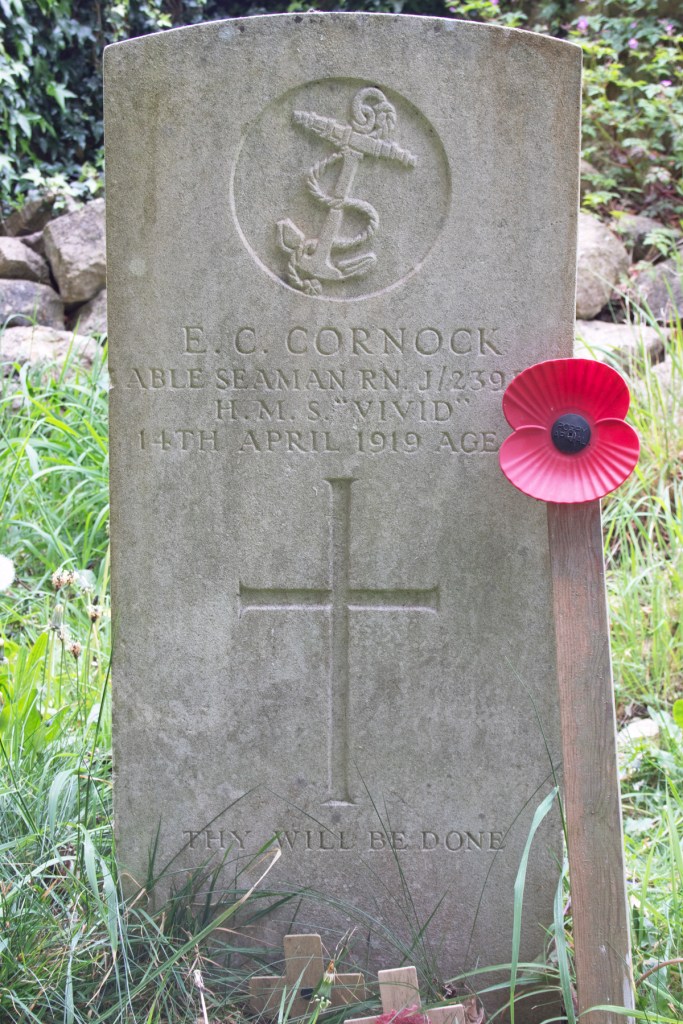
Able Seaman Ernest Cornock

Able Seaman Ernest Cornock

Ernest Charles Cornock was born on 16th June 1896, in the Gloucestershire town of Wotton-under-Edge. His parents were carter Charles Cornock and his wife, Millicent, both born and bred in the town, and he was one of eight children.

When he left school, Ernest found work as a rubber winder in the local mill. However, he wanted bigger and better things and so, on 8th April 1913, he enlisted in the Royal Navy. His service records show that he stood just 5ft 3ins (1.60m) tall, had brown hair grey eyes and a fresh complexion. He was also noted as having a scar on his right cheek.

As Ernest was under age when he joined up, he was initially given the rank of Boy 2nd Class. He was sent to HMS Vivid, the Naval Dockyard in Devonport and, after four months’ training, during which he was promoted to Boy 1st Class, he was given his first posting on board the battleship HMS Queen.

After five months on board, Boy Cornock was given another assignment, and was transferred to HMS Lion. While on board, a number of things happened: the First World War broke out, and the battle cruiser fought at Heligoland Bight and Dogger Bank; Ernest came of age, and was given the rank of Ordinary Seaman on his 18th birthday; with ongoing good conduct, in September 1915, he was then given a promotion to Able Seaman.

After a short spell back in Devonport, Ernest served on a further five ships, taking him through to the end of the war. By the start of 1919, however, Able Seaman Cornock’s health was beginning to suffer. Having contracted tuberculosis, he was medically discharged from service on 19th February, and was admitted to a sanatorium back in Gloucestershire. Sadly the condition was to get the better of him, and he passed away on 14th April 1919, at the age of just 22 years old.

Ernest Charles Cornock was brought back to Wotton-under-Edge for burial. He was laid to rest in the graveyard of St Mary the Virgin Church in the town, not far from his second cousin, Albert Cornock, who had been buried just the week before.


As an aside to Ernest’s tale, the newspaper that reported on his funeral also noted that his grandmother, Ruth Cornock, had not long received a message from the King, congratulating her on the fact that nine of her sons had served in the conflict