Category Archives: injury

Ordinary Seaman William Radford

Ordinary Seaman William Radford

William Richard Radford was born in the spring of 1900 in Cogan, on the outskirts of Penarth, Glamorgan. He was one of eight children to coal trimmer turned dock labourer Richard Radford and his wife, Susan.

Little information is available about William’s life. What is documented is that he enlisted in the Royal Navy, and, by the time he came of age in 1918, he held the rank of Ordinary Seaman. William was serving at HMS Victory, the Royal Naval Dockyard, by the end of the war.

At this point, details of Ordinary Seaman Radford’s life become a little unclear. He seems to have been stepped down to the Marine Mercantile Reserve, returning home in January 1919, when he passed away. His Pension Ledger Card gives the cause of death as a fractured shoulder, while another document states that he died from a sarcoma.

Whatever the cause of his passing, William Richard Radford was laid to rest in the graveyard of St Augustine’s Church in Penarth. He shared his grave with his mother, who had passed away the previous year. Richard Radford was also buried in the same plot when he passed away in 1926.


Company Serjeant Major Henry Bird

Company Serjeant Major Henry Bird

Henry Sidney Bird was born on 2nd December 1884 in Penarth, Glamorgan. He was the second of two children to painter and glazier Frederick Bird and his wife Emma. Henry’s mother passed away when he was only eleven years old and, by the time of the 1901 census, he was boarding with a family in the town, and working as a domestic gardener.

The next census – in 1911 – found the family back together again. Henry’s brother Frederick Jr was the head of the household, and she and his family – wife, Eliza, and three children – shared their home with Henry and his father. Harry, by this time, was working as a ship’s fireman.

Little information remains about Henry’s military service. He joined up when war broke out, and records show that he had enlisted in the South Staffordshire Regiment by the start of 1916. Assigned to the 8th (Service) Battalion, it is likely that he soon found himself on the Front Line.

Henry’s bravery seems to have been without fault. He went on to reach the rank of Company Serjeant Major in his battalion and was awarded the Distinguished Service Medal. The citation confirmed this was for “conspicuous gallantry. When the enemy rushed an isolated trench he saved the situation by collecting bombs and superintending the erection of stops and barbed wire. During the whole operations he set a splendid example to his company.

Company Serjeant Major Bird’s battalion was caught up in the fighting at Ypres early in 1916 and, by the summer, was involved in the Battle of Albert. It was here that Henry was wounded, and he was quickly evacuated to Britain for medical treatment. Admitted to the General Hospital in Northampton, his wounds were to prove too severe, and he passed away from them on 18th July 1916. He was just 31 years of age.

Henry Sidney Bird’s body was brought back to Wales for burial: he was laid to rest in the graveyard of St Augustine’s Church in his home town of Penarth.


Guardsman Bertie Thomas

Guardsman Bertie Thomas

Bertie John Thomas was born in Penarth, Glamorgan, in 1890, one of twelve children to Henry and Elizabeth Thomas. Henry was a ship’s rigger, but much of Bertie’s life remains a mystery.

The 1901 census recorded the family living together in a small terraced house in Cliff Street, but ten years later, with the family having grown, many had dispersed. Bertie’s older sisters had moved on – Hannah as a live-in barmaid in nearby Barry; Gladys working as a dressmaker in the Rhondda, living with her aunt and uncle. Of Bertie himself, however, there is no record.

When war came to Europe, Bertie would have played his part. He had enlisted in the Welsh Guards by the spring of 1916, and was a Guardsman in the 1st Battalion. The Guards Division were involved in many of the key conflicts of the war, including at Loos in 1915 and at the Somme the following year.

Guardsman Thomas was caught up in the Battle of Flers-Courcelette in September 1916, and was badly wounded. He was medically evacuated to home soil for treatment, and was admitted to a hospital in Cardiff. His wounds were to prove too severe, and he died on 26th September 1916, aged just 26 years of age.

Bertie John Thomas was brought back to Penarth for burial. He was laid to rest in the graveyard of St Augustine’s Church in the town.


Corporal William Dunster

Corporal William Dunster

William John Dunster was born in Uffculme, Devon, at the beginning of 1894. The older of two children, his parents were Robert and Mary Dunster. Robert was a carter and farm labourer, but when William left school, he found work on the railways. By the time of the 1911 census, the family had moved to Milverton in Somerset, and William was employed as an engine cleaner at the station in Taunton.

William had always had a keen interest in the army, and joined the Somerset Light Infantry early in 1914. His full service records are not available, but he was assigned to the 1st Battalion and, when hostilities were declared, he was dispatched to France.

On 26th August 1914, with the heroic men of his Regiment, he leaped over the trench amid a hail of bullets: a terrible gunshot wound laid him low, and he was taken prisoner by the Germans. For two years he remained in the hands of his captors, and endured all those sufferings and privations which our brave men have to bear in Germany.

[In 1916] he was removed to Switzerland Then all was done that could be done to save a young soldier’s life – the skill of the doctor, the comfort of the hospital, the care of the nurse – but unfortunately his constitution had been undermined.

In December 1916, by the kindness of [the secretary of the Prisoners of War Society] Mrs Walsh, he was enabled to see his mother, who paid him a visit, and this for a time revived him wonderfully.

Taunton Courier and Western Advertiser: Wednesday 26th June 1918

By the spring of 1918, Corporal Dunster had been medically evacuated to England, and was admitted to a military hospital in Southampton. This gave Robert and Mary the chance to see their son again, and Mary remained at her son’s side until he passed away on 19th June 1918. He was 23 years of age.

William John Dunster was brought back to Somerset for burial. He was laid to rest in the graveyard of St Bartholomew’s Church in the village of Oake, where his family were living.


Private Samuel Troake

Private Samuel Troake

Samuel Troake was born in Wellington, Somerset, on 24th August 1890. His parents were Samuel and Mary Troake and he was one of seven children to the couple. Mary had been married before, and had a daughter of her own. Samuel Sr was a shepherd turned labourer: when Mary died in around 1894, he married again, to widow Sarah Carter. She also had children of her own, something that is noted in the 1901 census, which records husband and wife sharing the house (from his perspective) with six of his children and five step-children.

By the time of the next census, ten years later, the Troake family home was a lot less crowded. Road contractor Samuel Sr and Sarah were recorded living with Samuel Jr and his younger brother, Charlie – both of whom were wool spinners , and the couple’s grandson, Percy.

Working at the wool factory came with benefits for Samuel Jr. It was there that he met Alice Slade, and the couple married on 10th December 1914, at the local parish church. The couple set up home not far from his parents, but war was soon to take him away from his new bride.

Full details of Samuel’s military service are not available: he enlisted in the Somerset Light Infantry, and was assigned to the 8th (Service) Battalion. He served on the Western Front, and remained there until almost the end of of the conflict.

Private Troake was recorded as being caught up in the conflict, and was medically evacuated to England for treatment to a bullet wound. Sadly, the injuries to his abdomen and bladder were to prove too severe – he passed away in a Portsmouth hospital on 30th October 1918. He was 28 years of age.

Samuel Troake was brought back to Somerset for burial. He was laid to rest in Wellington Cemetery, not far from where his widow and father still lived.


Serjeant Frank Ely

Serjeant Frank Ely

Frank Harold Ely was born in November 1889, and was the oldest of four children. His parents were coal porter Frank Ely and his wife, Florence. They were both born in Kent, and raised their family in their home town of Faversham.

When Frank Jr left school, he found work as a bottler, but he had his eyes set on bigger adventures. In January 1908, at the age of 18, he enlisted in the 1st Battalion of the Rifle Brigade. His service records show that he was 5ft 5.5ins (1.66m) tall and weighed 109lbs (49.5kg). Rifleman Ely had brown hair, grey eyes and a fair complexion. He was also noted as having a scat on his right knee.

Rifleman Ely’s early service was wholly territorial, but not without incident: in 1909 he was treated for tonsillitis, two years later, he received treatment for syphilis.

He was also not one to toe the line. In August 1911, he was reprimanded for not appearing at the 6:30am parade. On 9th March 1912, he was severely reprimanded for ‘improper conduct in town, at about 11:35pm’. On 25th September 1913, he was reprimanded once again, this time for irregular conduct – using the officers’ latrines.

When war came to Europe, the Rifle Brigade were soon in the thick of it. On 26th August 1914, Frank was wounded in the hand during fighting at Ligny, France, and was then captured and held as a prisoner of war in Hamelin until the spring of 1918.

Moved to the Netherlands, Rifleman Ely was finally released after the Armistice was signed, and returned to England on 19th November 1918. He was demobbed the following March, but re-enlisted within weeks, was given the rank of Serjeant and was due to be shipped to India to continue his service.

However, while at an army camp in Aldershot, Frank contracted pneumonia. The struggles the previous few years had had on his health proved too much for him, and, on 26th August 1919 – five years to the day that he had been shot and captured – Serjeant Ely passed away. He was 40 years of age.

Frank Harold Ely was brought back to his home town for burial. He was laid to rest in Faversham Borough Cemetery.


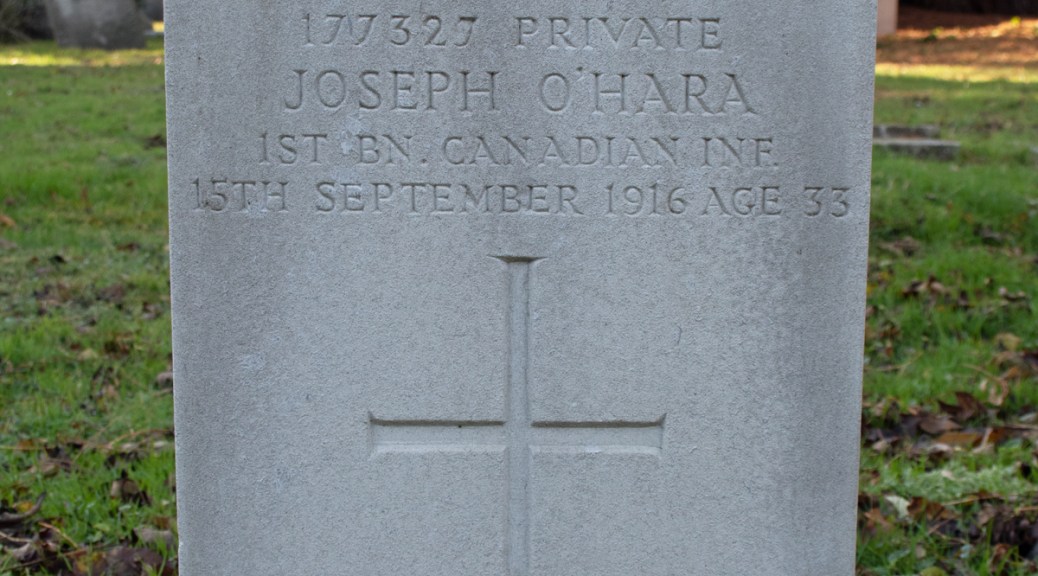
Private Joseph O’Hara

Private Joseph O’Hara

Joseph O’Hara was born in Manchester on 30th May 1882, the son of John and Kate O’Hara. There is little information available about his early life, although it is clear that at some point the family emigrated to Canada, settling in Toronto.

When war broke out, Joseph enlisted, joining the 1st Battalion of the Canadian Infantry. By 1916 Private O’Hara was not only back in Europe, but fighting on the Western Front. Details are scarce, but a contemporary newspaper sheds a little light on what happened to him next.

A contingent of 132 wounded men was detrained at Faversham last Friday morning. Forty-four of the number were taken to The Mount, seventy-one to Lees Court, and seventeen to Glovers (Sittingbourne).

With one exception the cases were all “sitting up” cases and were in a separate train by themselves. This train, however, was preceded by a train of “cot” cases which was going through to Chatham, but owing to the serious condition of one of the men – Joseph O’Hara, of the Canadian Expeditionary Force – the train was stopped at Faversham for his removal to the Mount Hospital. O’Hara had been badly wounded in both legs and he died at the Mount a few hours after his arrival there.

Faversham News: Saturday 23rd September 1916

Private Joseph O’Hara was 34 years of age when he passed away. He was laid to rest in the Faversham Borough Cemetery.


Private Joseph O’Hara
(from findagrave.com)

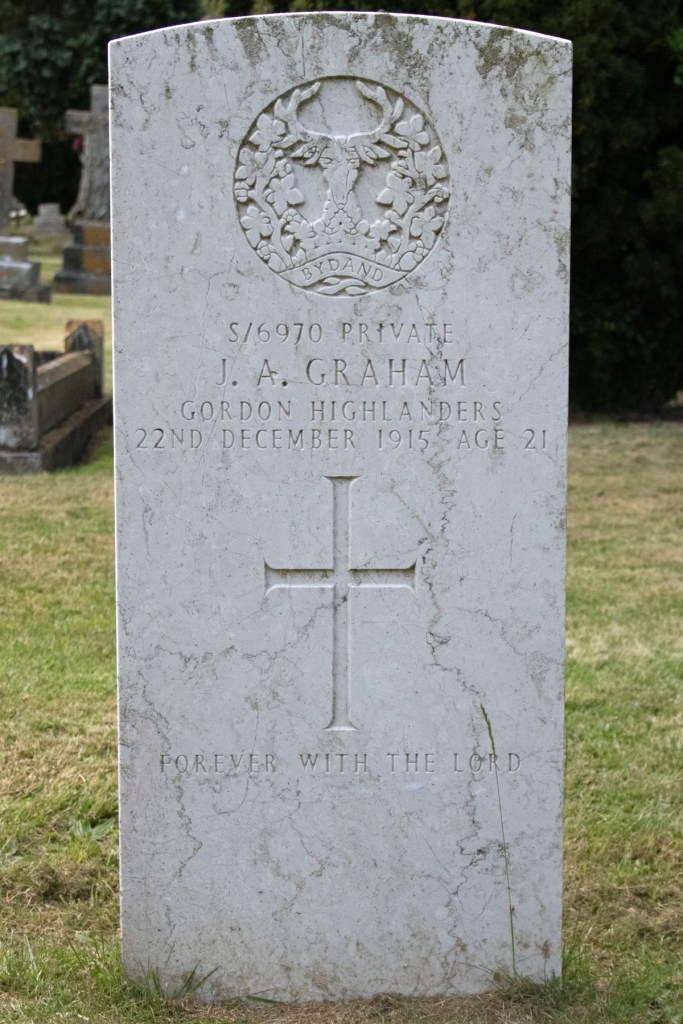
Private Joseph Graham

Private Joseph Graham

Joseph Aitken Graham was born in Kirkmichael, Dumfries, in 1894 and was the son of James and Bella Graham. There is little detail about his early life, but by the time war broke out, he was working with his father as a ploughman.

Joseph enlisted in November 1914, joining the 2nd Battalion of the Gordon Highlanders as a Private. His medical report records that he was 5ft 9.5ins (1.77m) tall, weighed 145lbs (65.8kg), had grey eyes, brown hair and a fresh complexion.

After a short period of training, Private Graham was sent to the Western Front, arriving in France on 2nd February 1915. He was involved in the fighting at Neuve Chapelle and Aubers Ridge. It was at Festubert, however, that things took a turn for the young private.

On the first day of the battle, 16th May 1915, Graham was badly injured, receiving gunshot and shrapnel wounds to his head and legs. He was initially treated at nearby Bethune, before being moved to Rouen. He was then evacuated to England in July, to further his recovery, and admitted to hospital in Wincanton, Somerset.

He was making such good progress that he was able to take a short walk each morning, and it was after one of these walks that he was taken ill. In spite of all that medical skill could do his condition became gradually worse, and it was thought advisable to send to Dumfries for his parents, who at once proceeded to Wincanton.

Dumfries and Galloway Standard: Saturday 8th January 1916

Sadly, nothing could be done for Private Graham: he passed away from a suspected brain haemorrhage on 22nd December 1915, at the age of just 21 years old.

Joseph Aitken Graham was laid to rest in the quiet and peaceful Wincanton Cemetery.


Private Alfred Beake

Private Alfred Beake

Alfred Beake was born in December 1898 and was one of nine children to Alfred and Charlotte Beake. Alfred Sr was a baker from Westonzoyland in Somerset, but it was in Chard that he and Charlotte had set up home and raised their family.

There is little documented about Alfred’s life. He played his part in the First World War, and had joined the Worcestershire Regiment by November 1918. His troop – the 5th (Reserve) Battalion – was a territorial force, and he would have split his time between Harwich, Essex, and Plymouth, Devon.

Private Beake survived the war and, by the spring of 1919 had been moved to Dublin. It was here on 18th May that he met with colleagues Private Simpson and Swindlehurst in the centre of the city. The trio caught a tram to the coastal town of Howth for a day out, where tragedy struck.

The Dublin Evening Telegraph reported on what happened next:

Private Sydney Simpson, Royal Engineers, stated… when they got to Howth, they walked along the Cliff Walk for about a mile, when they saw some seagulls down the cliff. [Beake and Swindlehurst] went out of witness’s sight for a while, when he heard a shout from Swindlehurst for help. On hurrying back, he saw Swindlehurst looking towards the sea, and he said the deceased had slipped down. The cliff was so steep that, although they tried to get down, they could not do so. Witness sent for help. None of the party had taken any drink.

Private Swindlehurst… said that he and deceased climbed down the grassy slope to get some seagulls’ eggs, but that the deceased suddenly slipped down. There was no horseplay going on at the time when the accident took place.

Captain Wynne, Royal Army Medical Corps, who made a post mortem examination, described the terrible injuries which the deceased had sustained. Death must have been instantaneous.

Dublin Evening Telegraph: Wednesday 21st May 1919

Private Beake had suffered a fractured skull from the fall. He was just 20 years of age.

Alfred Beake’s body was brought back to Somerset for burial. He was laid to rest in the family plot in Chard Cemetery.


Alfred’s oldest brother, Walter George Beake, had also served in the First World War.

Private Beake fought with the 7th Battalion of the Somerset Light Infantry, and was involved in some of the key skirmishes of the Somme. But it was at Ypres that he was buried alive during an attack, and the resulting shell shock left him totally incapacitated.

Walter was discharged from the army on medical grounds in September 1916. He returned home to try and piece his life together again. He never married, and passed away in December 1978, at the age of 87 years old.


Private Wilfred Follett

Private Wilfred Follett

Wilfred Alson Follett was born in the spring of 1898, and was the second of eight children to Robert and Ellen (known as Nellie) Follett. Robert was a scavenger (or street cleaner) for Chard council, and it was in this Somerset town where his and Nellie’s young family were raised.

Lace making was the predominant industry in the area, and it was for local employer Boden & Co.’s Old Town Mills that Wilfred worked when he finished school. The 1911 census recorded him as being a threading boy in the factory.

War was coming to Europe, however, and Wilfred was keen to play a part. Sadly, full details of his military service are lost to time, but he had enlisted by the spring of 1917, initially joining the Somerset Light Infantry. He soon transferred across to the Welch Regiment, however, and was assigned to the 10th (Service) Battalion.

Private Follett was sent to the Western Front at the start of July 1917, and was soon caught up in the thick of the action at Ypres. He came through the Battle of Pilkem, but was injured at the fighting in Langemark. His wounds were severe enough for him to be evacuated to England for treatment, and he was admitted to a hospital in Bradford, Yorkshire.

Robert was sent for, but sadly did not arrive in time to see Wilfred before he passed away from his injuries. He died on 20th August 1917, at the tender age of just 19 years old.

Wilfred Alson Follett was brought back to his home town for burial. He was laid to rest in Chard Cemetery.