Category Archives: killed in action

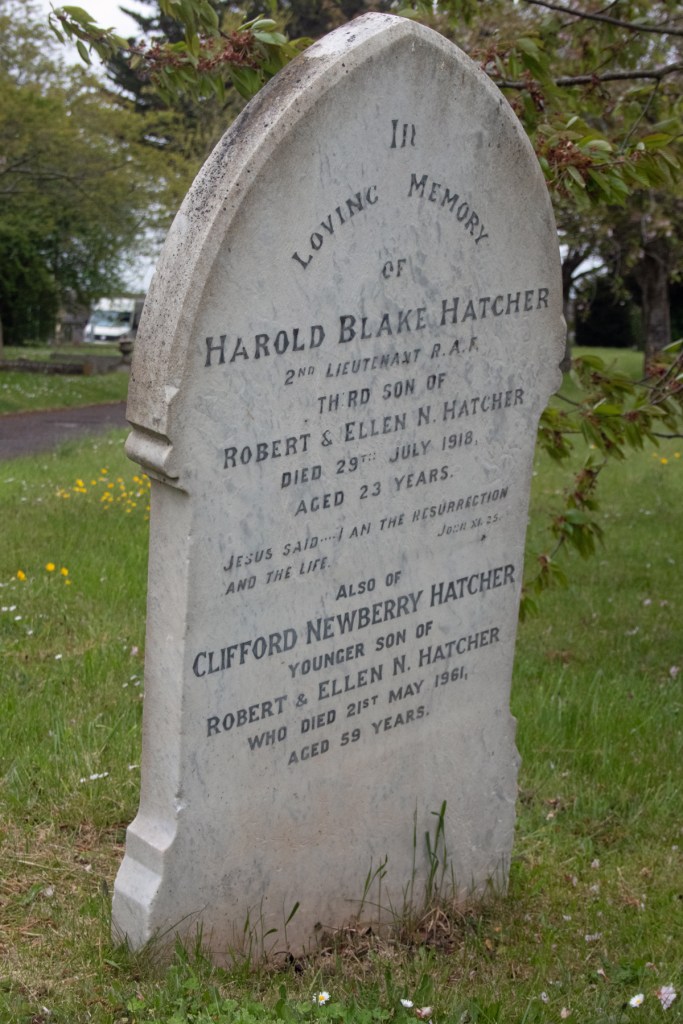
Second Lieutenant Harold Hatcher

Second Lieutenant Harold Hatcher

Harold Blake Hatcher was born on 11th February 1895, one of nine children to Robert Hatcher and his wife Ellen. Robert was a draper, and brought his family up in his home town of Taunton in Somerset. At least one of his children followed him into the cloth business, and, after he died in 1908, this seems to have fallen to Harold’s older brothers, Arthur and Ernest.

After leaving school, Harold became a dental student. Initially studying with Kendrick’s in his home town, he was about to begin training at Guy’s Hospital in London when war broke out.

Harold joined up in May 1915, and was initially assigned as a Lance Corporal to the 6th Battalion of the Somerset Light Infantry, before being transferred to the Middlesex Regiment.

In November 1917, he was badly injured in while fighting at Bourlon Woods, as part of the Battle of Cambrai. It was while he was recuperating that he transferred again, this time to the fledgling Royal Air Force.

Second Lieutenant Hatcher gained his wings in June 1918, and soon became a flying instructor. It was while he was working at RAF Fairlop in North West London, that an incident occurred. A local newspaper picked up the story.

Many in Taunton have learnt with sincere regret of the accidental death whilst flying of Lieutenant Harold Blake Hatcher of the Royal Air Force, third son of the late Mr Robert Hatcher of Taunton, and of Mrs Hatcher, now of Bristol.

The accident in which he met his death on Monday was a triple fatality, two other airmen being killed at the same time, Second Lieutenant Laurie Bell, of Bournemouth, and Flight Sergeant AR Bean, of Burslem.

At the inquest… it was stated in evidence that while Lieutenant Hatcher and Sergeant Bean were flying at a height of about 500ft, Second Lieutenant Bell, who w flying a single-seater, dived from a position some 700 feet higher, his machine striking and cutting clean through the double-seater, which folded its wings, hovered a few second, and then crashed to the earth. The three men were instantaneously killed.

A verdict of Accidental Death was returned.

Taunton Courier and Western Advertiser: Wednesday 7th August 1918

Further witness testimony described how the Sopwith Camel, piloted by Bell, cutting the AVRO airplane it in two. Hatcher fell out of the wrecked two-seater as the Camel’s wings slowly folded into a V and fluttered free following the fuselage to the ground. All three airmen lost their lives. Bean was found in a sitting position, still strapped in the front half of the AVRO’s fuselage, his instructor’s body was found unmarked thirty yards away in the grass where it had fallen. The wingless Camel crashed close by and Bell was found to have almost every bone in his body broken.

The accident took place on 30th July 1918. Second Lieutenant Hatcher was just 23 years old.

Harold Blake Hatcher lies at rest in St Mary’s Cemetery in his home town of Taunton, Somerset.
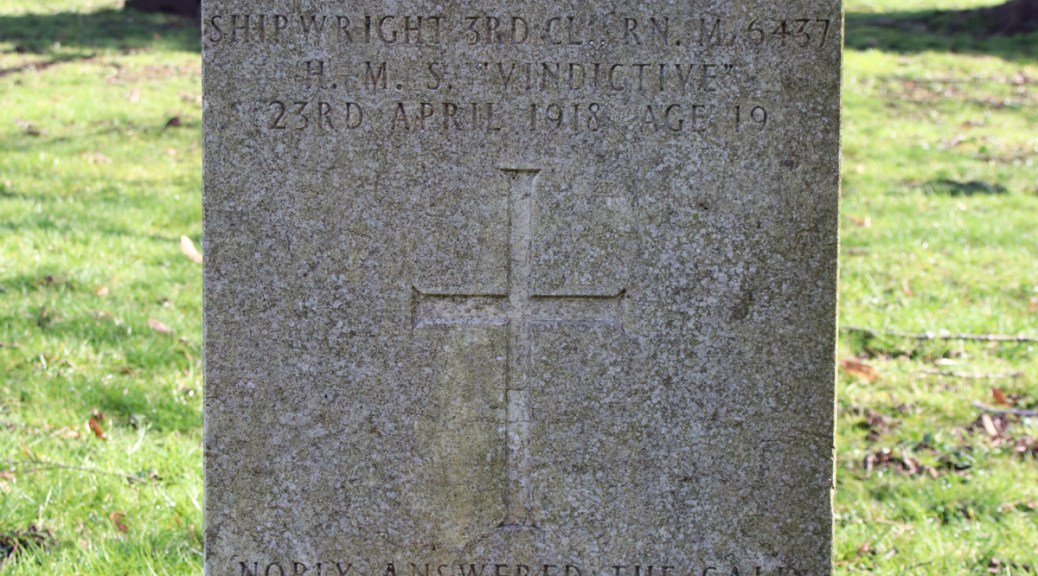

Shipwright 3rd Class Thomas Cochran

Shipwright Thomas Cochran

Thomas Tannahill Cochran was born on 28th February 1899, in Gillingham, Kent. He was one of nine children to Woodrow Cochran and his wife, Janet, née Tannahill. Woodrow was an engine fitter and both he and Janet were from Paisley in Scotland; they moved to Kent not long after getting married, presumably as Woodrow found work in the Naval Dockyard in Chatham.

Thomas followed his father and older brothers into the Navy, initially enlisting as a Boy Shipwright on 12th August 1913. He served most of his time at the local dockyard, before setting out to sea in March 1918.

At this point, Shipwright Cochran’s service records need a bit of translation. Tragedy certainly occurred, but the details are a bit disparate.

According his naval service records, Shipwright Cochran was aboard HMS Pembroke II when he was killed in action off the Belgian coast on 23rd April 1918. However, HMS Pembroke II was actually a land-based vessel in Kent.

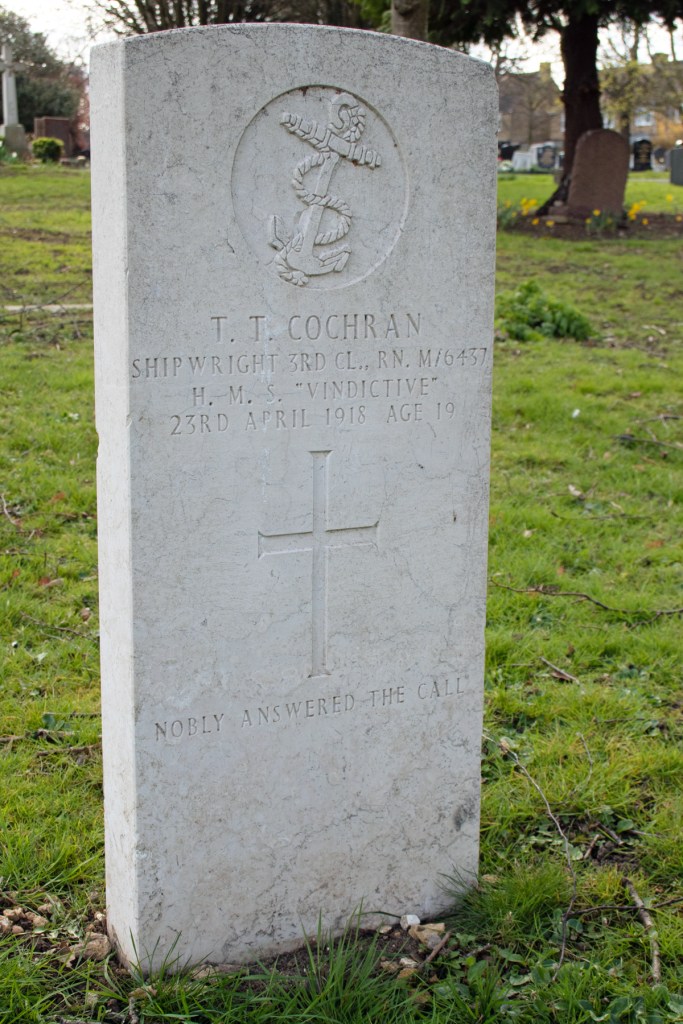
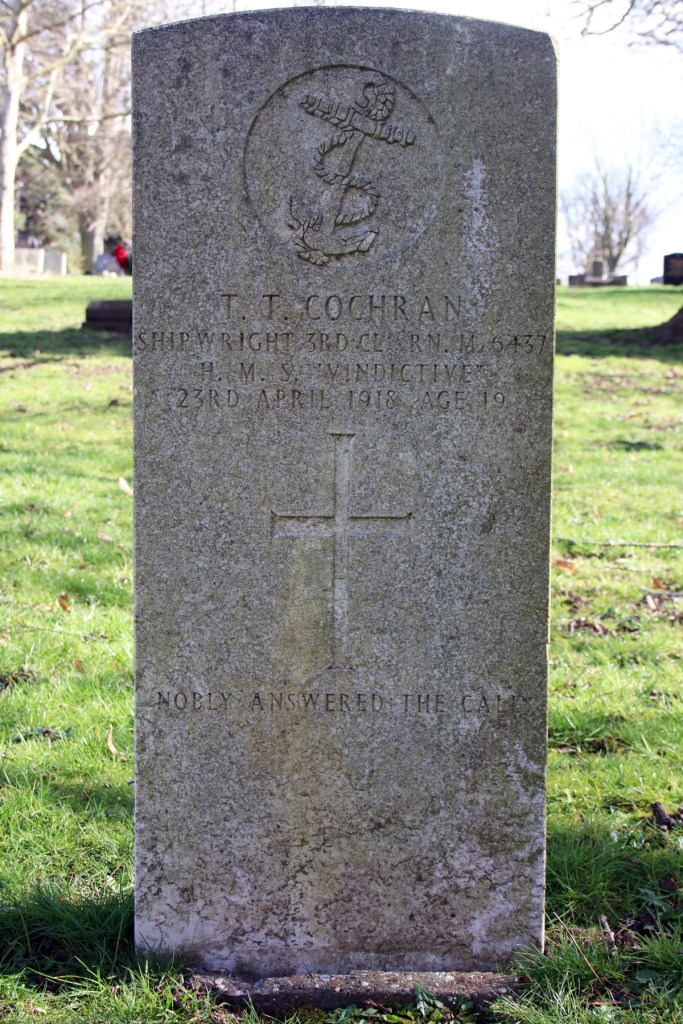
His gravestone, however suggested that he was assigned to another ship – HMS Vindictive. This was one of the vessels involved in the “Zeebrugge Raid”, an attempt by the Royal Navy to block the Belgian port by scuppering obsolete vessels in the canal entrance.

The Vindictive was to lead a diversion, drawing any attack away from the raid’s true target. However, bad weather blew the ship off course, which brought her within reach of enemy guns. Sadly, casualties were numerous, and Shipwright Cochran was one of those who fell in the German attack. He died on 23rd April 1918 at just 19 years old.

Thomas Tannahill Cochran’s body was recovered, and he lies at rest in the Woodlands Cemetery in his home town of Gillingham, Kent.


Shipwright Thomas Cochran

Chief Engine Room Artificer 2nd Class Arthur Herring

Artificer Arthur Herring

Arthur Herring was born on 5th December 1877, the third of five children to William and Constance Herring. William was a sign writer at the Naval Dockyard in Chatham, Kent, and the family lived in neighbouring Gillingham.

Arthur joined the Royal Navy in September 1899, just short of his 22nd birthday. He worked as an Engine Room Artificer (ERA), and over the twelve years of his initial service, he crewed on board ten different ships. This was in addition to his service at HMS Pembroke, the shore vessel in his home town of Chatham.

Arthur was evidently a hard worker, and he rose through the ranks from ERA 5th Class to ERA 1st Class during this time.

In September 1912, Arthur married Angela Beck; she was also born in Chatham, and was the daughter of a naval Sergeant. The couple didn’t go on to have any children.

War was looming by the time Arthur completed his twelve years’ service. Arthur was recommissioned, serving as Chief Engine Room Artificer 2nd Class on HMS Aquarius and HMS Tyne during the conflict.

In February 1917, Artificer Herring transferred to HMS Torrent. This was a naval destroyer, part of the Harwich Force, patrolling the North Sea.

One of the duties of the Harwich Force was manning the “Beef Run”; the convoys between England and the Netherlands. It was on one of these runs that tragedy struck HMS Torrent.

At about 2am on 23rd December, the convoy, including HMS Torrent, ran into a German minefield, and Torrent struck a German mine. Two of the other ships in the convoy, HMS Surprise and HMS Tornado went to rescue Torrent’s crew, but Torrent struck a second mine and quickly sank. In an attempt to rescue survivors, Surprise and Tornado also struck mines and sank.

Only the fourth convoy ship, HMS Radiant was undamaged and picked up the survivors from the three ships. In total, 12 officers and 240 other ranks were killed from the three ships. On HMS Torrent, only three of the crew survived; sixty-eight others perished that night. This included Artificer Herring, although his body was rescued from the water; he was 40 years old.

Arthur Herring lies at peace in the Woodlands Cemetery in his home town of Gillingham, Kent.


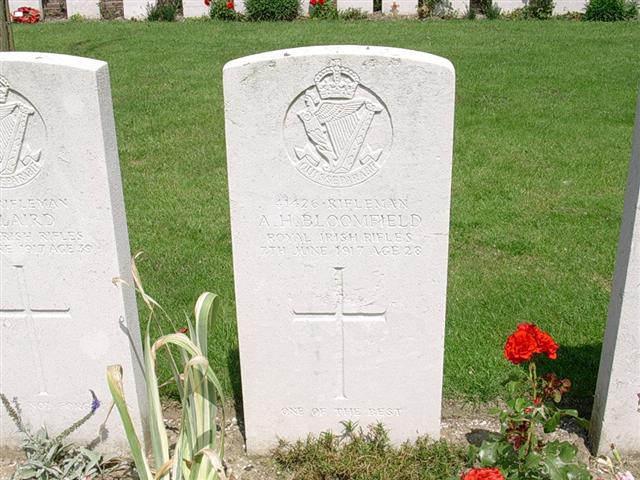
Private Arthur Bloomfield

Private Arthur Bloomfield

Arthur Henry Bloomfield was born on 19th December 1888, the youngest of six children. His parents, agricultural labourer and carter William and his wife Mary, raised the family in the small Norfolk village of East Harling, which was about halfway between the larger towns of Thetford and Diss.

Arthur married Rose Howlett in November 1911; the couple had two children – Margaret and Frederick – who became siblings for Rose’s daughter, Violet.

While Arthur’s military records are scarce, it is evident that he enlisted in the 9th Battalion of the Royal Irish Rifles. Private Bloomfield’s troop fought at a number of the key skirmishes on the Western Front, including the devastating (for the battalion) Battle of Albert in 1916.

A year later, the 8th and 9th Battalions were caught up in the Battle of Messines and it was here that Private Bloomfield met his fate. His pension records show that he was killed in action on 7th June 1917. He was 28 years old.

Arthur Henry Bloomfield lies at rest in the Lone Tree Military Cemetery in Mesen, West Flanders, Belgium.


Interestingly, Arthur’s pension records only cite his beneficiaries as Rose, Margaret and Frederick. This may go further in confirming that Violet was not his daughter.


Arthur Henry Bloomfield was my great great uncle.


Photo courtesy of Commonwealth War Graves Commission.