
Category Archives: Middlesex

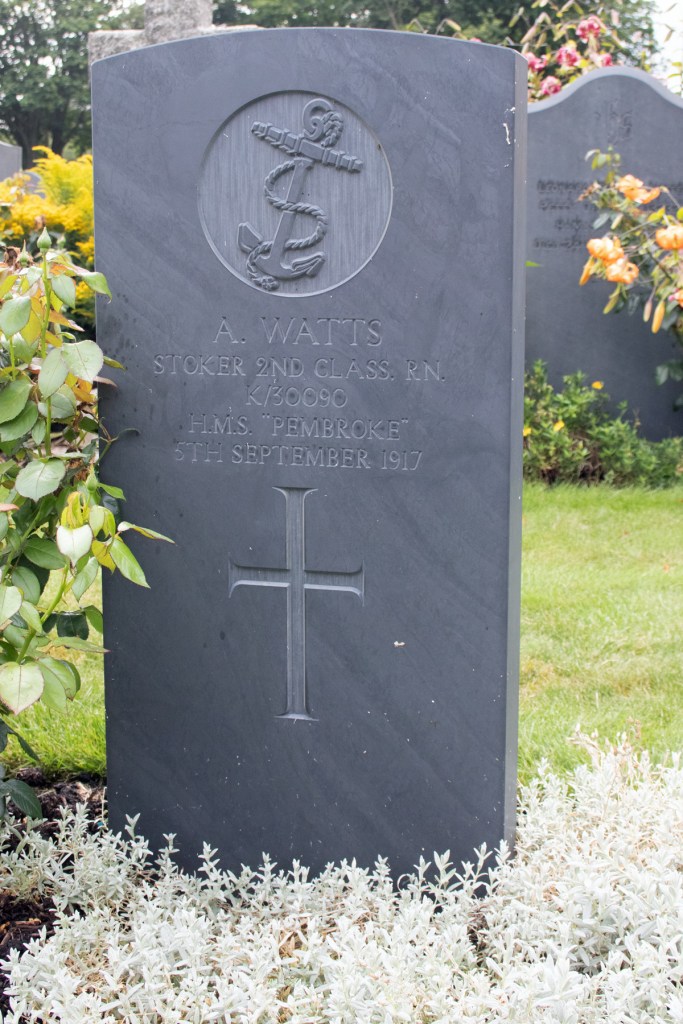
Stoker 2nd Class Alfred Watts

Stoker 2nd Class Alfred Watts

Alfred Watts was born on 16th April 1897 in Marylebone, Middlesex. His mother was called Polly, but there is little further information about his early life.

When he left school, he became a seaman, although in what capacity is not entirely evident. What can be confirmed is that, on 24th November 1915, with war raging across Europe, he decided to make this his full career, and enlisted as a Stoker 2nd Class in the Royal Navy.

Alfred’s military records show that he stood 5ft 4ins (1.63m) tall, had brown eyes, dark brown hair and a fresh complexion. He was also noted as having a birthmark on his right breast.

Alfred’s first posting was at HMS Pembroke, the Royal Naval Dockyard in Chatham, Kent. He spend four months training here, before being assigned to HMS Wallington, a depot shop that served in the Humber Estuary.

On 6th September 1916, in the column marked Discharged is one word: Run. It seems that, for whatever reason, he deserted his post, and having been rounded up nearly three weeks later, he was taken back to Chatham under police guard. He was imprisoned, and only returned to his duties on 30th October.

Stoker Watts was given another posting, on board the battleship HMS Dominion, but again absconded in June 1917, and was detained for a further three weeks, this time at HMS Victory, the dockyard in Portsmouth.

Within a month, Alfred was transferred back to Chatham. HMS Pembroke was a busy place that summer and temporary accommodation was put in place. Chatham Drill Hall was brought into service for this purpose, and Alfred found himself billeted there.

On the 3rd September 1917, the German Air Force carried out its first night air raid: Chatham was heavily bombed and the Drill Hall received a direct hit. Stoker 2nd Class Watts was among those badly injured. He was taken to hospital, but died of his wounds two days later. He was just 20 years of age.

Alfred Watts was laid to rest, alongside the other victims of the Chatham Air Raid, in the Woodlands Cemetery, Gillingham.


Ordinary Seaman George Shuttle

Ordinary Seaman George Shuttle

George James Henry Shuttle was born in Brentford, Middlesex, on 12th July 1899. His mother was Helen (or Ellen or Nellie) Shuttle, but he does not seem to have had a close connection to her and, according to the records, there was no father on the scene. Initially fostered out to Noah and Carmina Scott as a nurse child, by the time of the 1911 census, the couple had adopted him.

When he left school, George worked as a milk boy, but he seemed to know that a life of adventure awaited him. In June 1915, he joined the Royal Navy; being only 15 at the time, he was given the rank of Boy 2nd Class.

His initial posting was on board the cruiser HMS Powerful, and his training there paid off, as he quickly rose to Boy 1st Class. After a couple of months’ at HMS Victory – the Royal Naval Dockyard in Portsmouth – George was assigned to his second ship, HMS Malaya. Within weeks, the brand new battleship had cut her teeth in the Battle of Jutland, during which 65 of her crew were killed.

George spent more than eighteen months on Malaya; his time on board saw him turn eighteen, and gain the rank of Ordinary Seaman. His service records at the time show that he was 5ft 3.5ins (1.61m) tall, had brown hair, grey eyes and a fresh complexion.

By August 1917 Ordinary Seaman Shuttle had returned to shore, and was assigned to HMS Pembroke, the Royal Naval Dockyard in Chatham, Kent. The base was particularly busy when he arrived. Temporary accommodation at Chatham Drill Hall had been set up, and George found himself billeted there for the summer.

On the 3rd September 1917, the German Air Force carried out one of the first night-time air raids on England: an unprepared Chatham was heavily bombed and the Drill Hall received a direct hit. Ordinary Seaman Shuttle was badly injured and died of his wounds in hospital the following day.

George James Henry Shuttle was laid to rest, along with the other victims of the Chatham Air Raid, in the Woodlands Cemetery, Gillingham.


George’s mother, Helen, had continued with her life. A year after George was born, she had another son, Cyril, but he also seems to have been fostered out to enable her to work.

In 1903, she married musician Harry Burgiss-Brown, and the couple set up home in Richmond, Surrey. They went on to have two children, and Helen seemed focused on her new life, rather than the one she had before marrying.

Helen died in 1949, just short of her 70th birthday.


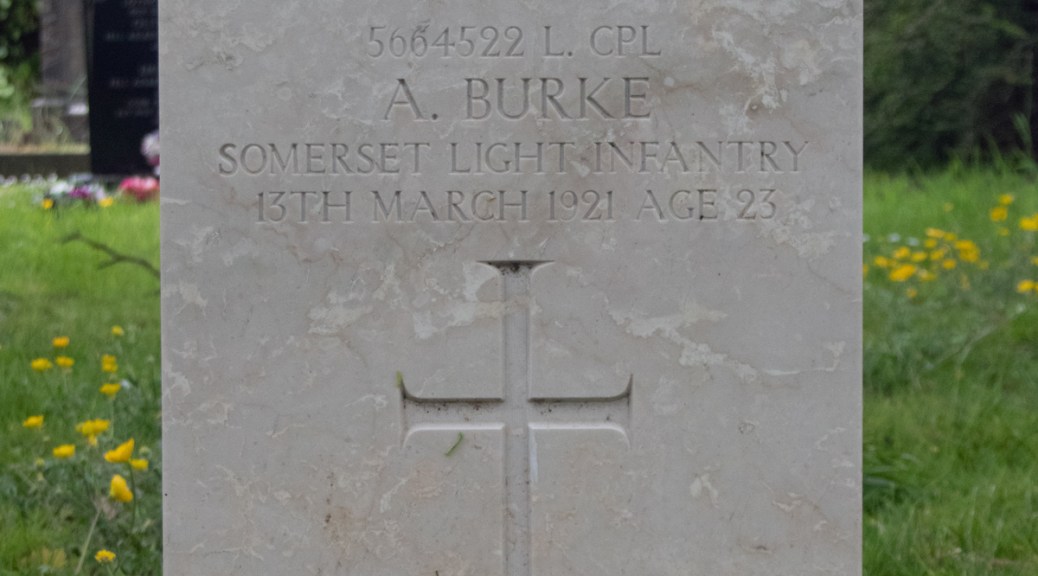
Lance Corporal Albert Burke

Lance Corporal Albert Burke

Sometimes, researching war graves can throw a bit of a curve ball, and the things you uncover can make you stop in your tracks. Such is the story surrounding Lance Corporal Albert Burke, and a media report surrounding his death in March 1921.


SCHEME OF VENGEANCE

Taunton Suicide’s Amazing Last Letter

Toll On Young Women

A sensational affair has occurred at Taunton Barracks. On Sunday morning, Albert (or Alfred James) Burke, aged 23, a Lance Corporal in the Somerset Light Infantry, was found to have taken his life by inhaling chloroform, his dead body being found on a bed at the military hospital, where he was employed as an orderly.

On Saturday night, according to the evidence, deceased appeared to be in his usual health and spirits. The next morning, a comrade found his dead body with a chloroform bottle by its side and near his face a large piece of cotton wool which he had evidently used for the purpose of inhaling the poison.

Some light was thrown on the tragedy by a letter addressed to a Taunton young woman, found on his clothing, and which was read at the inquest yesterday.

It was of an extraordinary character, and began “You wish to know what my intentions are in regard to you. Well, in the first place let me tell you I am not, as the coroner who holds the inquest will adjudge me, insane. In fact I don’t think I was ever so rational or level-minded as at the present moment, although I have had a glass or two.

“Well, Beatrice, mine is a rather long and interesting story. I married Louisa Wills some time in 1917, and I think the least said about her the better, but I wish to say this, that I have never knocked across a beast to equal her for violence. I am afraid the people around Brentford, Middlesex, could give you a far better account of her than I can.”

The writer went on to make certain allegations against the woman, and then referred to other towns where, he said, he had ruined girls before coming to Taunton and joining the Somerset Light Infantry. He added that he spent Friday night, when he was supposed to go out with Beatrice, with another girl in the barracks.

He said his father committed suicide owing to a “thing” who called herself a woman, and he (deceased) got a feeling with him that he would like to pay it back on a few girls. In conclusion, Burke expressed his satisfaction at knowing the condition Beatrice was in, and that he had been able to add another to the list of those on whom he wished to have his revenge.

Evidence was given by Alec Treeby, civilian orderly at the Barracks, who found deceased. In reply to the coroner, witness said that he knew the man was keeping company with a girl, but was not aware that there was any trouble about her.

PC Carter stated that the police had made enquiries, and a telephone message had been received that nothing was known of the man or of a wife and family of the name at Brentford…

[The] medical officer at Taunton Barracks said deceased was a steady, hard working man, and, so far as he knew, perfectly sane.

The jury returned a verdict of “suicide while of unsound mind”.

Western Times: Wednesday 16th March 1921

The newspaper report confirms the Lance Corporal’s name as either Albert or Alfred James Burke; the coroner also went on to say that he had also used the aliases of Povery and Pavey. Sadly, research around these names – and that of Louisa Wills – have either led to frustrating dead ends, or to results too vague to concretely connect them to Lance Corporal Burke.

The life and loves of Lance Corporal Burke are destined to remain a mystery. All that can be confirmed is that he took his own life on 13th March 1921; he was 23 years old.

Albert Burke lies at peace in St Mary’s Cemetery in Taunton, Somerset. He was accepted for commemoration as war dead on 27th May 2016 and was afforded a gravestone by the Commonwealth War Graves Commission.