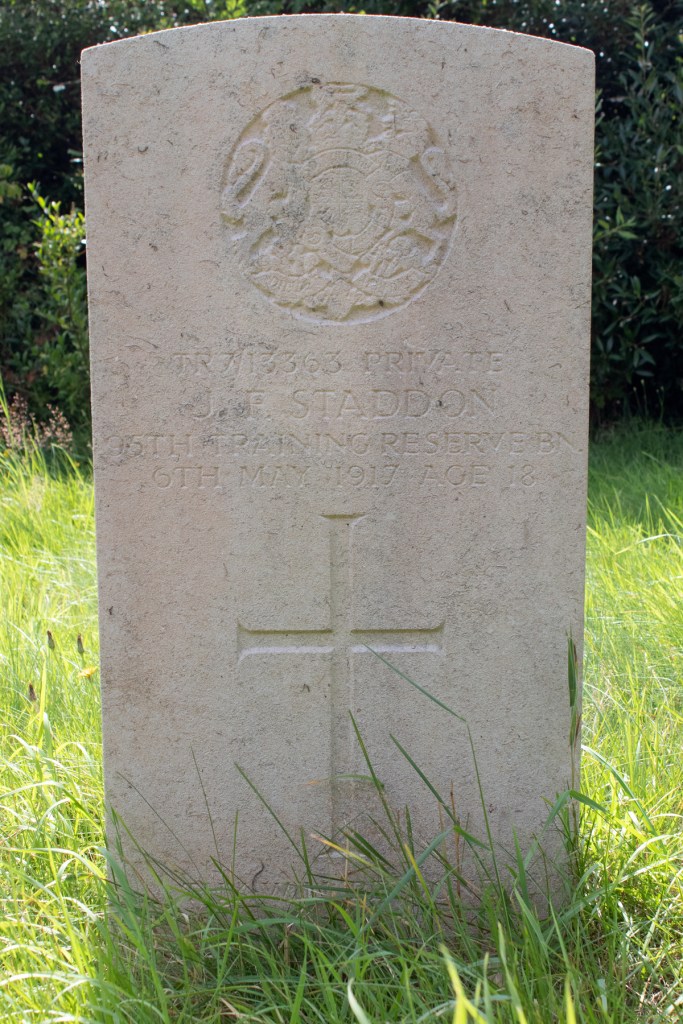
Joseph Frederick Staddon was born at the start of 1899, the oldest of seven children to John and Mary Ann Staddon. John was a farmer from Luccombe in Somerset, and it was in this small village that the family were born and raised.
There is little documentation to expand on Joseph’s life. He enlisted in the Duke of Cornwall’s Light Infantry when he turned 18, and was initially attached to the 95th Training Reserve Battalion.
Private Staddon was barracked in Chiseldon, Wiltshire, but his time in service was not to be a lengthy one. Admitted to a military hospital near the camp, he passed away from what was probably an illness on 6th May 1917. He was just eighteen years of age.
Joseph Frederick Staddon’s body was brought back to Somerset for burial. He was laid to rest in the cemetery extension to St Mary’s Church, Luccombe.
Tragedy was to strike again when, ten months after his son’s passing, John also died. Mary was left picking up the pieces, while supporting her six remaining children, the youngest of whom, Dorothy, was not even two years old.
The family survived, Mary running the farm with her oldest boy, Edward. She passed away on 4th August 1937, at the age of 63 years old.
Albert Daymond was born on 7th June 1893, in Porlock, Somerset. The youngest of seven children, his parents were Devon-born Albert and Maria, who was also born in Porlock. Albert Sr was a wall mason, and, by the time of the 1901 census, his work had moved the family to the sleepy village of Luccombe.
When he finished his schooling at the village’s Church of England School on 20th December 1908, Albert found employment in a bakery. This was the employment he would continue in until, in the summer of 1914, war broke out across Europe.
Albert enlisted on 9th October 1914, joining the West Somerset Yeomanry as a Private. Little information about his military service is available, although the Commonwealth War Grave Commission records note that he was known by the surnames of Daymond and Daiman.
Tragically, Private Daymond’s time in the army was not to be a long one. He passed away while in a camp in Minehead, Somerset, on 10th December 1914. The cause of his passing is not known, but he was just 21 years of age.
Albert Daymond was brought back to Luccombe for burial. He was laid to rest in the village’s St Mary’s Churchyard.
Albert’s older brother, Alfred, also served in the First World War. Read his story here.
Alfred Daymond was born on 9th July 1891, in Porlock, Somerset. The second youngest of seven children, his parents were wall mason Albert Daymond and his wife, Maria. By the time of the 1901 census, Albert’s work had moved the family to the sleepy village of Luccombe.
When Alfred finished his schooling, he followed his father into wall building. This was the career he was still following when, in 1914, war broke out.
Alfred was quick to play his part for King and Country. He enlisted on 4th November 1914, joining the Somerset Light Infantry. Private Daymond’s service records show that he was 5ft 10ins (1.78m) tall, with good vision and a fair physical development.
Initially serving as part of a territorial force, Alfred remained on home soil until September 1916. At this point he was transferred over to the Duke of Cornwall’s Light Infantry, and became attached to the 7th (Service) Battalion. Details of his time in the army are sketchy, but his troop certainly fought at the Somme in 1916, and at Ypres the following year.
In May 1917, Alfred returned to British shores. His health appears to have been suffering, although it is not clear from what ailment. On 8th February 1918, Private Daymond was discharged from army service as being no longer physically fit.
Alfred’s trail goes cold at this point. It is likely that he returned home to Luccombe, and this is where he passed away, on 11th November 1918, Armistice Day. He was 27 years of age.
Alfred Daymond was laid to rest in the family plot of St Mary’s Church, Luccombe. He was interred alongside his younger brother, Albert.
Alfred’s younger brother, Albert, also enlisted for war service. Read his story here.
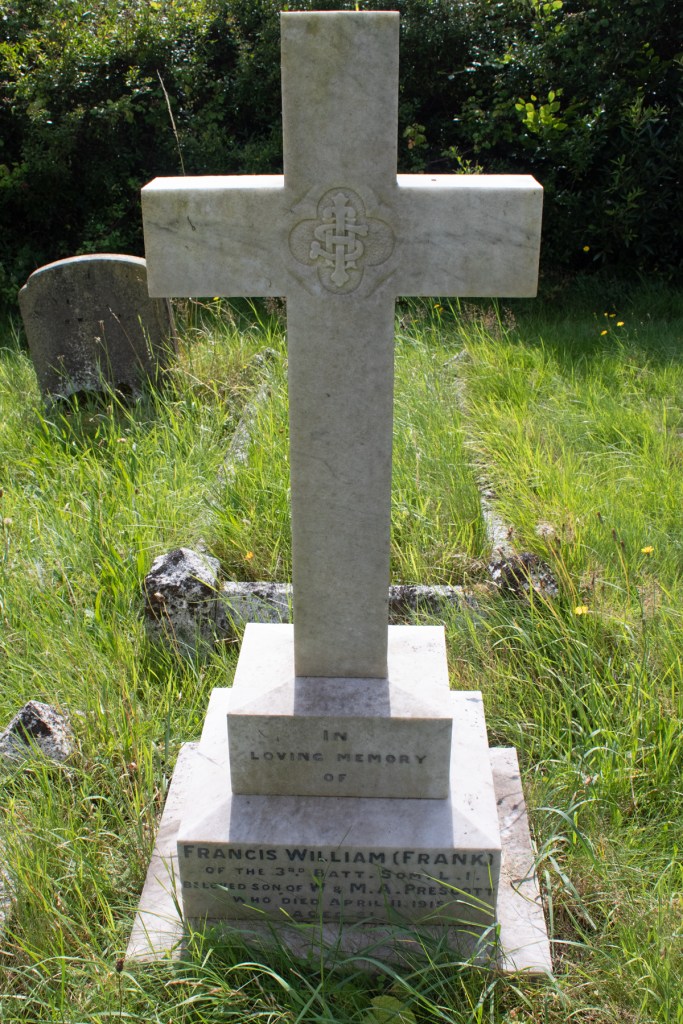
Francis William Prescott – better known as Frank – was born on 17th March 1894, and was one of four children to William and Mary. William was an agricultural labourer from Somerset, and, by the time of the 1901 census, the family had settled in the village of Luccombe, in the western outreaches of the county.
Frank went to school in Allerford, before spending a year at Luccombe’s Church of England school – from 13th May 1907 to 29th May 1908. Now aged 14 years old, he was considered old enough to be earning his keep. He found work as a farm boy on a farm on the outskirts of the village, but with storm clouds brewing across the Channel, he was keen to play his part.
Little information is available about Frank’s military service, but it is clear that he enlisted in the first weeks of the war, as imperial fervour gripped the country. He enlisted in the Somerset Light Infantry and, as a Private, was assigned to the 3rd (Reserve) Battalion. Contemporary documents do not confirm either way, but as this particular troop was based at Devonport, Devon, for most of the war, it is unlikely that Private Prescott saw any action overseas.
Indeed, he was in barracks on 11th April 1915, when he passed away. Again, the cause is lost to time, but he was just 21 years of age when he died.
Francis ‘Frank’ William Prescott was taken back to Somerset for burial. He was laid to rest in Luccombe Church Cemetery, not far from where his family still lived.
Frank’s younger brother, Harold, also enlisted in the war. He joined the Royal Engineers as a Private and, unlike his brother, he did go to the Western Front.
Harold was caught up in the fighting, and received a gunshot wound to his arm. He recovered, but the injury dogged him. He was formally discharged on 14th May 1919, and found work as a lorry driver. Harold married Kathleen Peck in December 1929: the couple’s only child, Edward, was born just over a year later.
Harold spent his life in Somerset. He died in Exmoor in the spring of 1968, at the age of 71 years old.
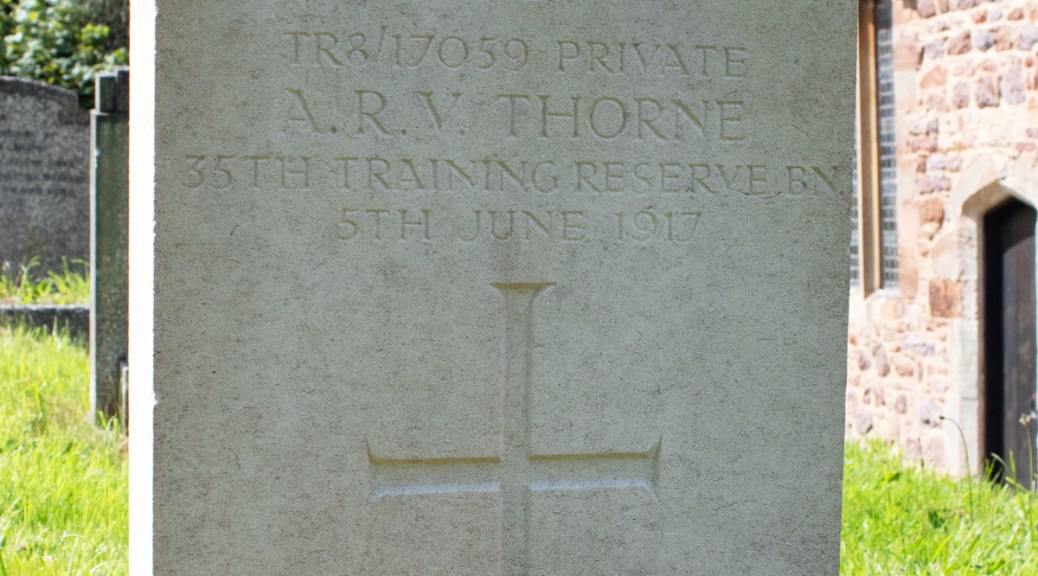
Arthur Reginald Vellacott Thorne was born at the start of 1899 in Bridgwater, Somerset. One of six children, his parents were Sidney and Bessie Thorne. Sidney was a butcher and, by the time of the 1901 census, the family had moved to Chichester, West Sussex, where he had found employment in a sausage factory.
The Thornes’ time on the south coast was not to last long: they had moved to Timberscombe, back in Somerset, by the time Sidney and Bessie’s youngest child, daughter Ivy, was born in March 1908. Tragically their happiness was not to last for long: Sidney passed away in October that year, aged just 35 years old.
With six children under the age of 12 to raise, times would have proved tough for Bessie. Her oldest child – Arthur’s older brother, Sidney – went to live with his paternal uncle’s family in Taunton, and began learning the butchering trade. Bessie took on the role of caretaker at Timberscombe School where her five younger children were being taught.
Being a butcher was not Sidney’s chosen career path. When he turned 17, in March 1914, he enlisted in the Coldstream Guards, lying about his age to do so. Six months later he was promoted to the rank of Lance Corporal and attached to the 3rd Battalion. With war having been declared in Europe, he soon found himself on the Front Line, fighting in the First Battle of Ypres.
Over the next couple of years, Lance Corporal Thorne remained on the Western Front. He was killed in fighting on 15th September 1916: he was just 19 years of age. Sidney’s body was never identified: he is commemorated on the Thiepval Memorial in Picardie.
Arthur’s trail had gone cold at this point, but when he turned 18 years old, his brother having passed just months before, he too was called up. Assigned as a Private in the 35th Training Reserve Battalion, he was sent to Bovington Army Camp in Dorset for his induction. While there, in the cramped conditions of the military barracks, he fell ill. He was admitted to the Salisbury and District Isolation Hospital, which treated infectious diseases, and this was to be where he passed away. Private Thorne was just 18 years of age, and Bessie had lost her two oldest boys.
While Sidney’s remains were never recovered, Arthur Reginald Vellacott Thorne was brought back to Somerset to be laid to rest. He was buried in the peaceful graveyard of St Petrock’s Church in Timberscombe, not far from his father.
Bessie was to our live four of her children. Her youngest two sons, Edwin and Cecil, were to die too young. Cecil passed away in Timberscombe in May 1922, when he was just 16. Edwin died in November 1929, at the age of 26 years old.
Bessie lived on until 1958, passing away in Minehead when she was 84 years of age.
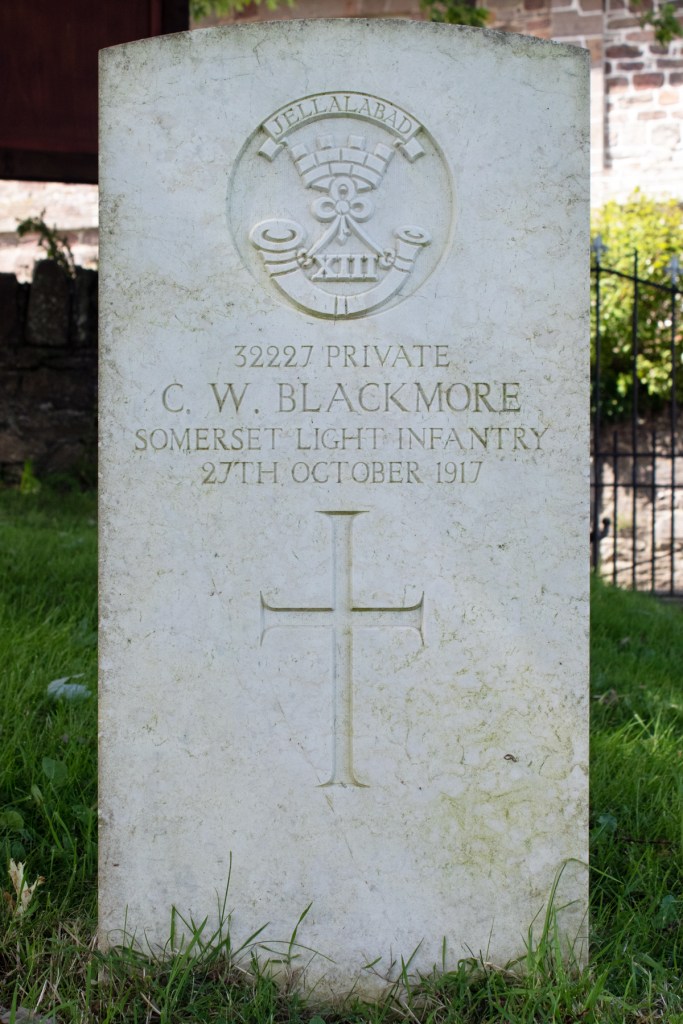
Charles William Blackmore was born in Brompton Regis (or Kingsbrompton), Somerset, on 19th August 1896. He was the twelfth of thirteen children to journeyman carpenter Joshua Blackmore and his wife, Margaret. Charles attended the nearby Upton Primary School until Christmas 1909 at which point he started working with his father.
When war erupted across Europe, however, he stepped up to play his part. He enlisted as a Private in the Somerset Light Infantry on 14th January 1916. Little remains of his service documents, but his medical report confirms that he was 5ft 9ins (1.75m) tall, with light brown hair and grey eyes. Interestingly, the document also gives his date of birth as 14th February 1897, six months later than his school intake record.
The documents that remain for Private Blackmore’s time in the army, do not specify exactly where he served, but his battalion – the 1st – were heavily involved in the Battle of the Somme in 1916, and at Arras the following year.
It was during that summer that Charles fell ill, contracting tuberculosis. He was medically evacuated to Britain for treatment, and admitted to the Toxteth Park Auxiliary Military Hospital in Liverpool. The former workhouse was to be where Charles breathed his last: he died on 27th October 1917, at the age of 21 years old.
The body of Charles William Blackmore was brought back to Somerset for burial. He was laid to rest in the peaceful and picturesque graveyard of the Church of the Blessed Virgin Mary in his home village, Brompton Regis.
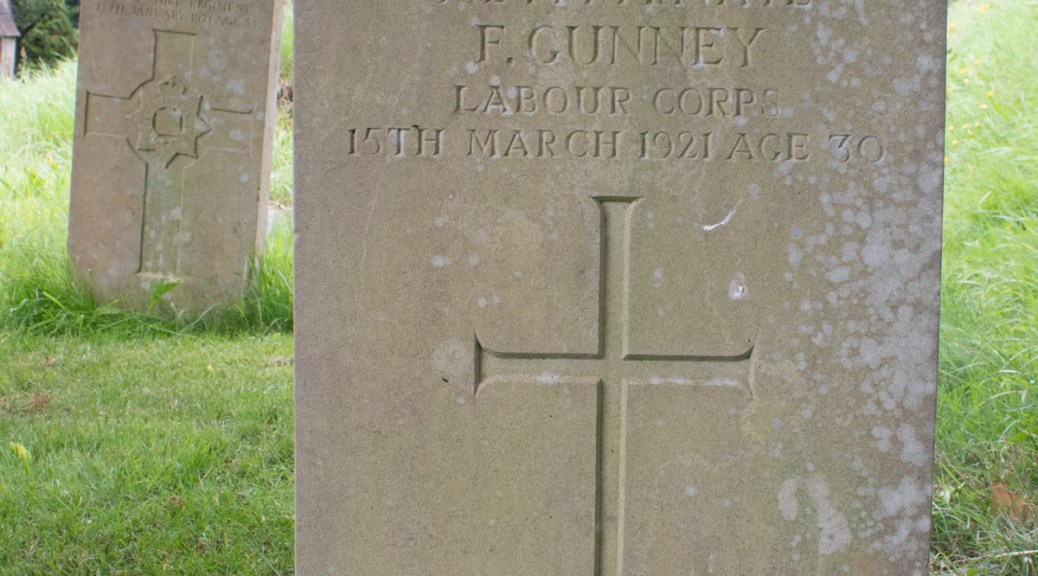
Frank Gunney was born in Brushford, Somerset, in the spring of 1890. The youngest of four children, with two sisters and a brother, his parents were William and Mary. William was a groom-turned-gardener, but when Frank left school, he found other employment: by the time of the 1911 census, he was recorded as being a tailor.
Frank’s older brother, James, followed his father’s trade, becoming a groom when he finished his schooling. His work took him to South Wales, where he met and married Emma Lewis. The couple went on to have two children: Hilda and Kenneth. When war came to Europe, James enlisted, joining the Royal Army Service Corps as a Private.
Frank followed his brother into the army, enlisting in the Somerset Light Infantry on 11th December 1915. This must have proved a tragic time for his mother, Mary, as, just ten days later, William died “after a long and painful illness.” [Western Times: Friday 24th December 1915]
Frank’s service records give little away about the man he had become, but do note that he was 5ft 5ins (1.65m) tall. He was re-assigned to the 1st/21st Battalion of the London Regiment, and was sent to France in June 1916.
Private Gunney’s service papers suggest that he was injured on 9th September 1916, having received a gun shot wound to the head. He appears to have been treated on site, and there seems to be no notable break in his time on the front line.
James was killed in action on 7th April 1917: he was 33 years of age, and was laid to rest in the Warlincourt Halte British Cemetery in Saulty. Mary had lost a husband and a son within eighteen months, and James had left a widow and two children.
In March 1917, Private Frank Gunney had transferred to the Labour Corps, and aside from a six-month period on home soil, would remain in France until September 1919. He then returned to Britain, and was demobbed a month later.
Frank returned to Somerset, but his trail then goes cold. Two documents give an idea as to what happened next, however. The first is a newspaper report about his burial:
The funeral took place in All Saints’ Churchyard, Dulverton… of Mr F Gunney, only don of Mrs Gunney… who died on Tuesday last. Deceased served three years in France, and has been in failing health practically ever since demobilisation, although the end came rather suddenly.
Western Times: Tuesday 22nd March 1921
His army Pension Ledger Card, confirms that he had been discharged from the army because of a ‘septic wound to his left thumb’, which was due to his military service. It appears that this had festered over the ensuing years: Frank Gunney passed away on 15th March 1921, aged 30 years of age.
Walter Hayes was born in Somerset in 1883. The oldest of seven children, his parents were William and Mary Hayes. William was an agricultural labourer, and the family lived and worked at Houndhill, to the south east of Stogumber.
Walter also fell into farm work and, in the spring of 1914, he married Emily Mary Tarr. The wedding took place in Tiverton, Devon, but the couple did not stay there for long as, just weeks after their wedding day, Emily gave birth to a daughter, Edith, over the Somerset border in Dulverton.
Storm clouds were brewing over European shores, and Walter was called upon to play his part. His service records are also sparse, but they confirm that he initially joined the Somerset Light Infantry, before moving across to the Devonshire Regiment.
Walter had either been in the army earlier in his life, or he worked his way up during the war, and at some point he reached the rank of Serjeant. He saw fighting overseas and, according to later documentation, was caught up in a gas attack. This was to have an impact on his health and he was discharged from army service sooner than he might otherwise have done. Officially stood down in March 1919, he returned home to his wife and family.
Emily and Walter had a second child, William, later that year, and the family were finally able to settle into a routine. Walter’s health, however, was severely impacted and, on 12th January 1921, he passed away from bronchitis. The lung condition was found to be directly attributable to his war service, and that gas attack, Walter was 38 years of age.
Walter Hayes was laid to rest in the quiet graveyard of All Saints’ Church in Dulverton.
Emily was pregnant when her husband died: she gave birth to their third child, a son she named Walter, just a few months later. She did not re-marry, and, according to the 1939 Register, she was boarding in a house in Dulverton and carrying out unpaid domestic duties.
Emily lived on until the autumn of 1973, passing away in Taunton at the age of 85.
Serjeant Walter Hayes (courtesy of Trevor Hayes)
The early life of Walter Hayes was a challenge to piece together, as his was not an uncommon name in the area at the time. My thanks go to his great nephew, Trevor Hayes, for his help in pulling together the story and for the image of his great uncle.
Walter John Greedy was born in the spring of 1889, the eighth of nine children to Theophilus and Mary Greedy. Theophilus was an agricultural labourer from Wiveliscombe in Somerset, and it was here that the Greedy family were born and raised.
When he finished his schooling, Walter found work as a carter for a brewery. In 1906 his oldest sister, Charlotte, was widowed, and he moved in with her and her children to help provide some additional support. He soon found alternative employment, however, and within a couple of years was employed by Great Western Railways as a plate-layer.
On 26th December 1913, Walter married Irene Hobbs. She was a blacksmith’s daughter from nearby Fitzhead, who was working as a domestic servant when the couple wed. They went on to have three children: Frederick, Winifred and Dorothy.
When war was declared, Walter stepped up to play his part. Full details of his military service no longer remain, but he had certainly enlisted by the summer of 1918. Walter joined the Royal Engineers, and, based on his previous employment, was assigned to the 278th Railway Company.
Sapper Greedy served in Northern France, and was based in and around Boulogne. He survived the war, and was back on home soil by December 1918. This may have been because of illness: Walter was admitted to Exeter War Hospital in Devon, having contracted influenza and pneumonia. Sadly, the combination of conditions was to prove a fatal one: he passed away on 22nd December 1918, at the age of 29 years old.
Walter John Greedy was brought back to Somerset for burial: he was laid to rest in the peaceful graveyard extension of St Nicholas’ Church in Brushford, where Irene and their children were now living.
Bertie James Parsons was born in the summer of 1889, and was the fourth of six children to James and Elizabeth Parsons. James was a quarryman and slate-maker from Somerset, and he and Elizabeth raised their family in the parish of Ashbrittle.
While his older siblings found farm work in this peaceful part of the county, Bertie found employment as a baker’s assistant. This meant a move away from Somerset, and, by the time of the 1911 census, he was apprenticed to a bakery in the Crediton area of Devon.
The following year proved a tragic one for the Parsons family. Bertie’s younger brother, Richard, had found work as a hall boy for an estate in Wheathampstead, Hertfordshire. This was to prove a springboard for him, and he landed work for one of the new class of liners ploughing the waters of the Atlantic. Employed as a 2nd Class Steward, he was employed on the RMS Titanic and, like most of the ship’s 900 crew, he perished on that fateful night of 15th April 1912.
Among the large number of souls who perished with the Titanic recently we regret to report that among that number was a young man named Richard Parsons, aged 18, a native of Ashbrittle, and whose relatives still live in the neighbourhood, his father, James Parsons, being an invalid.
The deceased, who a couple of years ago embarked on a seafaring life, was on board the Olympic when it collided with the Hawke, and he left his home about a month ago, and journeyed to Belfast to assist in getting the Titanic ready for her maiden voyage.
He was particularly pleased at being appointed to a post on the largest ship in the world.
Deceased, who was a bright lad and much respected in the village, occupied the position of lift steward on his previous boat, and on the Titanic was a steward in a second-class dining saloon.
He was unable to swim.
Somerset County Gazette: Saturday 27th April 1912
Steward 2nd Class Richard Parsons
Back in Devon, Bertie was still working as a baker. When war came to Europe, however, he stepped up to play his part. While full service details are not available, it is clear that he enlisted in the Royal Army Service Corps as a Private. He was attached to the 2nd/1st Wessex Field Ambulance, who were sent to France in January 1916.
Private Parsons saw action – or helped treat the results of it – at some of the key battles on the Western Front: the Somme, Ypres, Cambrai, Givenchy and Festubert. In the autumn of 1917, Bertie returned home to marry Florence Riddaway, a milliner from Bow, Devon, who he had courted while working in nearby Crediton. The couple went on to have a son, Douglas, who was born on 26th May 1918.
It is unclear how long Bertie remained in the army after the Armistice was signed. By the summer of 1920, he was back on British shores, and had fallen ill. He was admitted to hospital in Bath with acute staphlococcic infection and a cerebral embolism. He died in hospital on 13th August 1920, at the age of 31 years old.
The body of Bertie James Parsons was taken back to Ashbrittle for burial. He was laid to rest in the village’s St John the Baptist Churchyard.
Tragedy was to remain close by for the Parson family. Florence was a couple of months pregnant when Bertie died. Bertie Jr was born on 26th March 1921, but both mother and son died during childbirth. They were laid to rest near her family in Devon.
Douglas, just two years old, was now an orphan. There is little information about his life in the aftermath of his parents’ passing, but by the time of the 1939 Register, he was working as a motor mechanic in Wellington, Somerset. He lived on until 1993, passing away in Taunton Deane, at the age of 74.