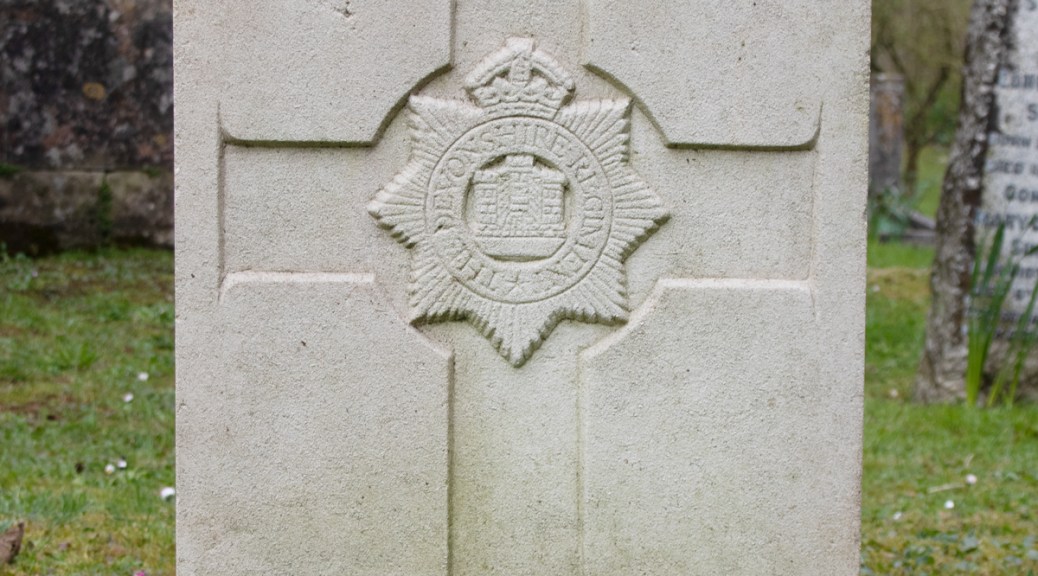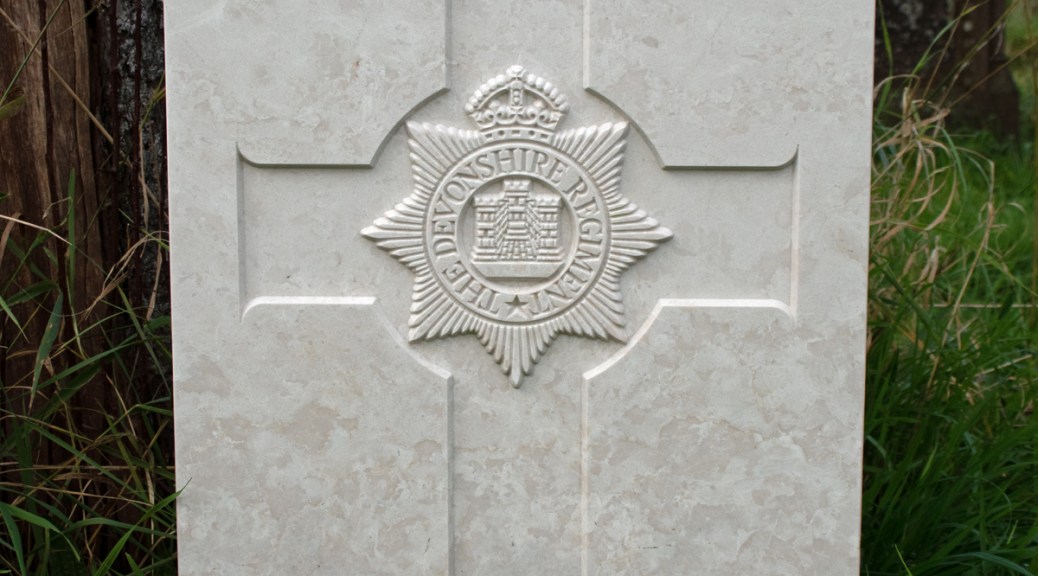
Category Archives: Devonshire Regiment

Captain John Trayler

Captain John Trayler

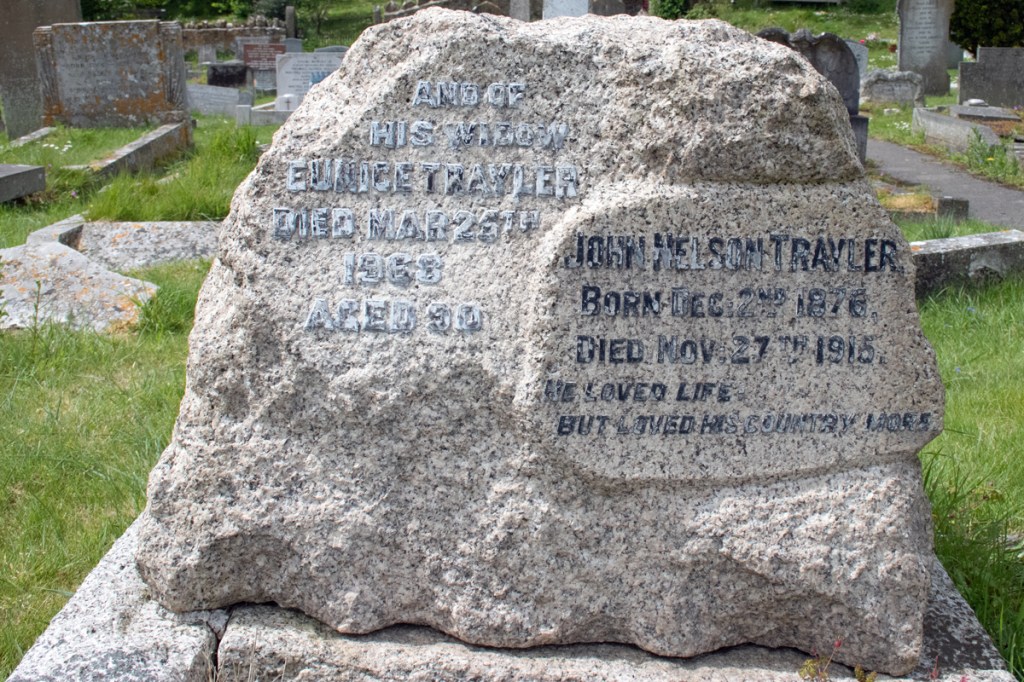
John Nelson Trayler was born on 2nd December 1876, the oldest of seven siblings. His father, Jonas Trayler, was born in London, but moved to South Wales to become a farmer. He married Elizabeth Green, who was from Haverfordwest, and John was their eldest child, born in Pembrokeshire.

In December 1895, having just turned 19, John joined the 1st Devonshire Volunteer Corps. He seemed eager for a life of action; given that the 1901 census lists his profession simply as ‘farmer’s son’, it’s easy to see why. By this time, the family had moved to a farm in Broadclyst, to the north east of Exeter in Devon.

There was a change of direction for the family, however. By 1908, both father and son were working as tanners; John had moved back to Wales, while Jonas had set up work in Bridgwater, Somerset.

John, by this time, had met Eunice Sully; she was the daughter of a gentleman, and her family lived in Wembdon, near Bridgwater. They married in July 1908, and lived in the village of Lamphey in Pembroke.

John was, by now, the managing director of a tannery and obviously had the business acumen to run a company. He joined the local freemason’s – the Lodge of Perpetual Friendship – but, in January 1914, it was reported in the local newspaper that the business was to be voluntarily wound up.

John’s father Jonas was also forging ahead with his ambitions, and was a councillor for the Bridgwater area.

When the Great War broke out, John’s time with the Devonshire Volunteer Corps was such that he had attained the rank of Captain. Assigned to the 11th (Reserve) Battalion, John was based out of Exeter and it is unlikely that he saw any active service in France.

In August 1915, the Exeter and Plymouth Gazette reported that Captain Trayler had relinquished his commission on account of poor health, and this seems to have been an ongoing issue. In fact, when he was staying with Eunice’s parents in Clevedon later that year, he fell seriously ill. While his medical condition is lost to time, sadly it was one he succumbed to. He died at his in-laws’ house on 27th November 1915, at the age of 39 years old.

John Nelson Trayler was laid to rest in the picturesque graveyard of St Mary’s Church in Clevedon, Somerset.


Private Henry Oaten

Private Henry Oaten

Henry Oaten was born in 1876, the second youngest of seven children to Henry and Mary Ann Oaten. Henry Sr was an agricultural labourer, who raised his family in his home village of Pitminster, to the south of Taunton in Somerset.

When he left school, Henry Jr followed in his father’s footsteps as a farm worker. Sadly, however, there is very little further documentation to expand on his life.

Henry married a woman called Emily; this is likely to have been at some point around 1900, although there is nothing to confirm an exact date. The couple went on to have four children – John, Albert, William and Howard.

When war broke out, Henry joined up. Again, dates for his military service are not available, but he enlisted in the Devonshire Regiment as a Private. He was assigned to the 13th (Works) Battalion, which was a territorial force, based in Plymouth.

Little further documentation exists in relation to Private Oaten. The next time he appears is on his pension record, which confirms that he passed away on 20th February 1917, having been suffering from bronchitis. He was just 40 years old.

Henry Oaten was brought back to Taunton and laid to rest in the St James’ Cemetery in the town.


As an aside to this story, while researching Private Oaten, an additional piece of information about his father came to light. A record confirms that, on the 1st October 1851, at the age of just 16, Henry Oaten was admitted to gaol. Sadly further details – including that of his crime and his sentence – are lost to time, but it adds an interesting footnote to his son’s background.


Private Arthur Batten

Private Arthur Batten

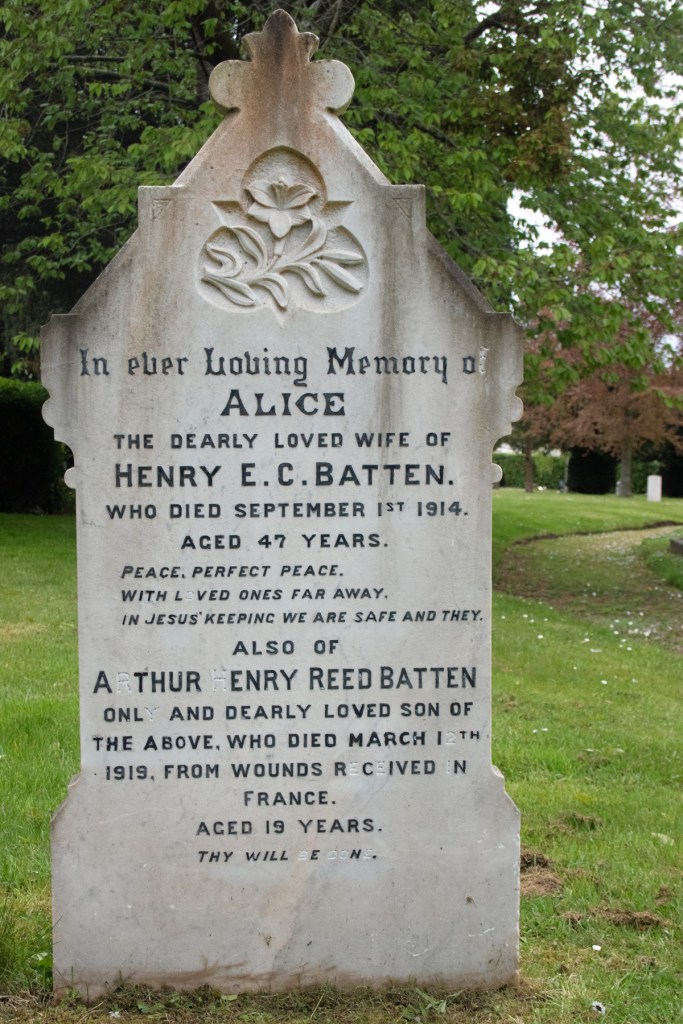
Arthur Henry Reed Batten was born in the spring of 1900, the only child to Henry and Alice. Henry was a gardener, and the young family lived in the Somerset town of Taunton.

There is little documentation about Arthur’s short life. When war broke out, he enlisted in the 1st Battalion of the Devonshire Regiment. While there is nothing to confirm the date he joined up, it may well have been a reaction to the passing of his mother, who died on 1st September 1914, at the age of 47 years old.

Private Batten’s battalion initially fought on the Western Front during the war, before moving to Italy in November 1917, then back to France the following April. It seems likely that it was during this second stint in France at some point late in 1918 that Arthur was caught up in the fighting.

He received a gunshot wound, and was shipped back to England for treatment. Admitted to the Military Hospital in Stockport, Greater Manchester, he seems to have suffered for a long time, passing away from his injuries on 12th March 1919, three months after the Armistice was signed. He was just 19 years of age.

Arthur Henry Reed Batten was brought back to Taunton burial, and lies in the family grave in St James’ Cemetery, alongside his mother.


Private Hubert Parsons

Private Hubert Parsons

Hubert Stanley Parsons was born towards the end of 1892, the eldest of eight children to Frank and Emily Parsons. Frank was a burner, working in the lime kilns in his home village of Yatton, in Somerset. When he left school, Hubert followed in his father’s footsteps, while his younger siblings found work in the local paper makers and bakers.

Sadly, a lot of Hubert’s military records are lost to time. What is clear is that he enlisted on 22nd September 1915, joining the 10th Battalion of the Devonshire Regiment as a Private. He served on the Western Front, gaining the Victory and British Medals and the 1915 Star in the process.

In November 1915, Private Parsons’ battalion was moved to Salonika, Greece, to help fight on the Serbian front. Whether Hubert ever fought in the Balkans is not known; the next – and last – time he appears in documentation is in the Register of Soldiers’ Effects. This confirms simply that he died in hospital on 27th March 1917. The cause and location are not known, but he was just 24 years of age.

Hubert Stanley Parsons lies at rest in the graveyard of St Mary’s Church in Yatton, Somerset.


Private Henry Boon

Private Henry Boon

Henry Boon was born in May 1880, the youngest of ten children to Edwin and Fanny Boon. Edwin worked in service – consecutive census records list him as a manservant, coachman and gardener – and the family lived in the Somerset town of Taunton.

Henry was working as a packer in a factory when he met Alice Mockridge. The couple married in June 1902, and went on to have three children – Henry, Dorothy and Vera.

By the time of the 1911 census, Henry had put the factory behind him and was working as a labourer in the local sewage works. Employed by the town council, it is likely that the job paid more, particularly with a young family to support. Alice was also working, doing ironing and sewing to help them make ends meet.

Storm clouds were gathering over Europe, however, and soon Henry was needed to do his duty. Full details of his military service are not readily available, but he joined the Devonshire Regiment early on in the conflict, and was assigned as a Private to the 13th (Works) Battalion.

Private Boon seems to have been based in England for the duration, although full details of his movements are not clear. He was certainly living in Taunton by December 1916, and it was here that he fell ill.

Admitted to hospital with apoplexy, it seems that it was this haemorrhage or stroke that killed him. Private Boon passed away on 23rd December 1916. He was just 36 years of age.

Henry Boon lies at rest in St Mary’s Cemetery in his home town of Taunton in Somerset.


Private William Gulliford

Private William Gulliford

William Gulliford was born on 8th November 1877 in the village of Thurloxton, just to the north of Taunton, Somerset. William’s father – also called William – was an agricultural labourer who, with his wife Charlotte, had nine children in total.

William Jr found work as a labourer for a brewery and, by 1899, had moved to Staffordshire, met and married a local woman called Elsie Sutton. The couple settled down in Burton-on-Trent, and went on to have a daughter, also called Elsie.

War was coming, however, and, in August 1916, William enlisted. Initially assigned as a Private in the 14th Devonshire Regiment, he was soon moved to the Labour Corps, and within a couple of months was on the Western Front as part of the British Expeditionary Force.

In November 1917, Private Gulliford was shipped back to England, suffering from ill health. He was admitted to the Military Hospital in Taunton with heart failure, and sadly passed away from this a month later. He had just turned 40 years old.

William Gulliford lies at rest in St Mary’s Cemetery in Taunton, Somerset.


Private Thomas Winter

Private Thomas Winter

Thomas Henry Winter was born in 1887, one of six children to James and Mary. James was a farmer, and the family lived in Milverton, in the Somerset countryside to the west of Taunton.

James died in 1900, and Thomas found his way into farm work as well. He met and married a local woman called Ada Thynne in February 1909, and the couple went on to have five children: Beatrice, James, Charles, Frank and Thomas.

There is little confirmed information about Thomas’ military career. When he joined up, he enlisted in the 13th Battalion of the Devonshire Regiment, although, as his service records no longer exist, it is not possible to identify when this was.

Private Winter later transferred to the Labour Corps – again there are no records to confirm the dates – and this is the division in which he remained.

Illness was to dog Thomas, however; in early 1918, he contracted enteric fever (known nowadays as typhoid), and was hospitalised. Sadly, he succumbed to the disease, and passed away on 14th February 1918. He was 30 years of age.

Thomas Henry Winter lies at rest in St Mary’s Cemetery in Taunton, Somerset.


An additional tragic turn to Thomas’ story is that Ada was pregnant when he passed away. His youngest son, whom Ada named after him, would never know his father.


Private Henry Venn

Private Henry Venn

Henry John Venn was born in September 1900, the youngest of three children to Charles and Mary Venn. Charles was a gardener, and the family lived in the small Somerset village of Shipham.

Sadly, there is little information available about Henry’s life, although when war broke out, he enlisted as a Private in the Devonshire Regiment. There is no documentation to confirm exactly when he enrolled, although, given his age when the conflict began, it it unlikely to have been before 1918.

Indeed, later records show that his parents were refused a war gratuity. This was only usually the case where a soldier had completed less than six months’ service. It is likely, therefore, that Private Venn did not join up before he turned 18 years old in September 1918.

Henry joined the 53rd Training Reserve Battalion; they were based at the Rollestone Camp near Stonehenge, Wiltshire. It is here that he likely became unwell, as he was subsequently admitted to the Military Hospital on Salisbury Plain. He was suffering from influenza and pneumonia, and this is what he succumbed to. Private Venn passed away on 10th November 1918 – the day before the Armistice that ended the conflict. He was just 18 years old.

Henry John Venn lies at rest in the graveyard of St Leonard’s Church in his home village of Shipham in Somerset.


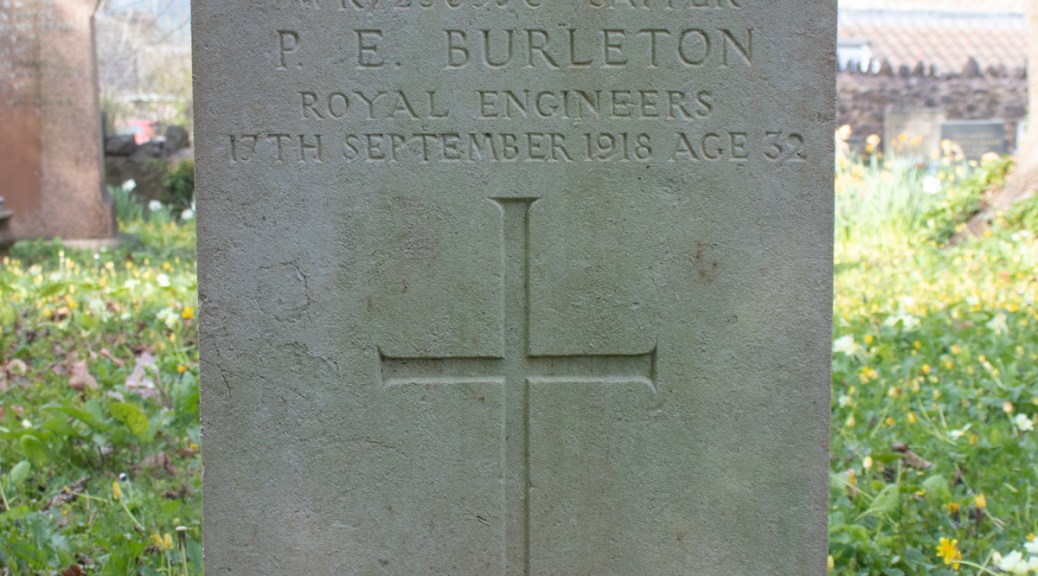
Sapper Percy Burleton

Sapper Percy Burleton

Percy Edward Burleton was born on 24th July 1885, the youngest of seven children to George and Lucy Burleton. George was a quarryman, and the family lived in the village of Draycott, near Wells in Somerset.

Percy’s older brother Lewis worked for the railways, and this is a trade that his younger sibling followed. By the time of the 1911 census he was living with his brother in Glastonbury and worked as a carman, delivering goods to and from the local station.

In February 1914, Percy appeared as a witness in an inquest about the death of a colleague, George Gillett. George had gone missing one night after the two had met for a drink in a local pub. The alert was raised when George’s coat was found hanging on a branch on the banks of the River Brue, to the south of the town; the waters were dredged and George’s body found.

At the inquest, Percy confirmed that the two men had had a drink in a local pub, and that George had seemed a little strange, but not the worse for drink. He reported that the deceased man had been quieter than usual at the railway stables for a week or so. George had left the pub at 10:55 that evening, and that was the last time that Percy had seen him.

Part of a carman’s duty was to collect money for the goods they had delivered; this was then paid to the station clerk on a daily basis. In the week leading up to his death, the stationmaster had been advised of some financial discrepancies, and on the day he drowned, he had been spoken to and advised the matter would be reported to the police if the missing amount was not paid back.

The place where George’s coat was found was not on his way home from the pub, and he would have had to have gone out of his way to get there. When considering their findings, the jury returned a verdict of suicide during temporary insanity, citing that the financial situation George had apparently gotten himself into.

When war broke out, Percy seemed to have been keen to get involved. Initially joining the Devonshire Regiment in September 1914, his experience with his job saw him transferred to the Railway Operating Division of the Royal Engineers.

Shipped to France on 22nd September 1915, his service saw him awarded the Victory and British Medals and the 1915 Star. Sapper Burleton was moved to the Eastern Front and served in the Balkans for three years. According to the Central Somerset Gazette, which reported his passing, he contracted ‘a chill’ on the boat back to England and was admitted to Frensham Hill Hospital in Surrey.

Sadly, the chill seems to have been more severe than the report suggested, and Sapper Burleton passed away on 17th September 1918. He was 32 years old.

Percy Edward Burleton lies at rest in the graveyard of St Peter’s Church in his home village of Draycott, Somerset.


Private Charles Dibble

Private Charles Dibble

Charles Lang Dibble was born in 1890, one of nine children to Evan and Eliza Dibble from Bridgwater in Somerset. Evan was a labourer in a brickyard, and clay must have been run through the family’s veins, as Charles found employment as a kiln hand in a local tile maker when he left school.

By the 1911 census, Charles was boarding with William Rainey and his family in Bridgwater; whether there was a connection before he moved in or not, I don’t know, but the following year he married one of William’s daughters, Constance. The young couple wed on Christmas Day 1912 and went on to have one child, Charles, who was born in 1915.

Full details of Charles’ military service are not available. However, when he enlisted, he initially joined the Somerset Light Infantry, before transferring to the Devonshire Regiment and finally the Oxfordshire and Buckinghamshire Light Infantry. During his service, he was awarded the Victory and British Medals, but there is little further information about Private Dibble.

Charles survived the war, but his pension records confirm that he passed away on 7th May 1921; the cause of death was noted as exhaustion and sarcoma of the rectum. He was 31 years old.

Charles Lang Dibble lies at rest in St John’s Cemetery in his home town of Bridgwater.