Category Archives: Royal Engineers

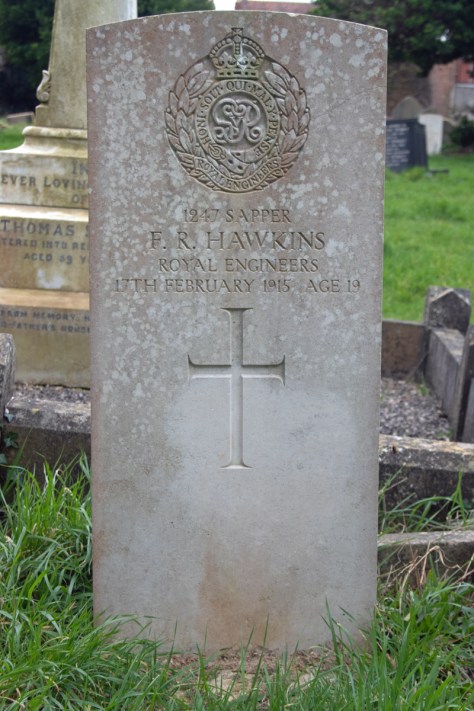
Sapper Francis Hawkins

Bridgwater (Wembdon)

Francis Ralph Hawkins was born in Somerset in March 1895 and was one of twelve children to Charles and Jane Hawkins. Charles was a police sergeant and the family lived in Bishop’s Lydeard, a village to the west of Taunton.

By the time of the 1911 census, Charles had retired from police work, and was operating as a licenced victualler in nearby Bridgwater. While Jane was supporting her husband running the business, Francis was apprenticed to a local clothier.

When war broke out, Francis was quick to enlist – he joined the Royal Engineers, and was appointed a Sapper. He wasn’t with the company for that long, however, as by February he had been admitted to the Red Cross Hospital in Christchurch, Dorset, with a fever.

Sadly, he was not to recover; Sapper Hawkins passed away from spinal meningitis on 17th February 1915. He was just 19 years of age.

Francis Ralph Hawkins lies at rest in the Wembdon Road Cemetery, Bridgwater.


Sapper John Chapman

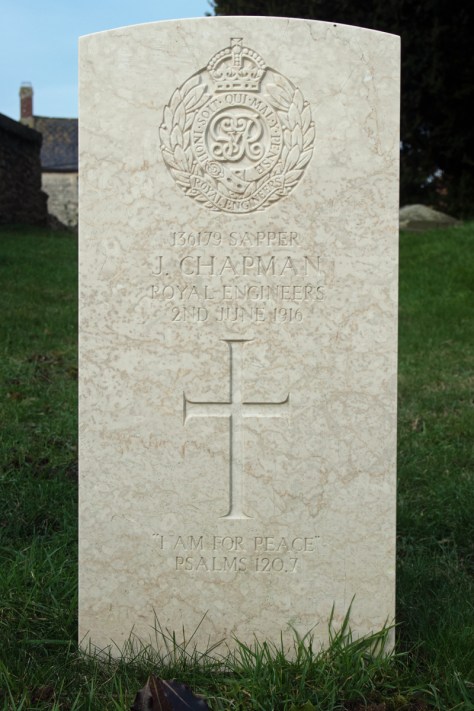
Sapper John Chapman

John Chapman was born in October 1892 in the small Somerset village of Ashwick, just to the north of Shepton Mallet. One of five children to Albert and Mary Ann, John followed his father into mining, and, by the time of the 1911 census, he was listed as a coal mining hewer.

In November 1914, he married Louisa Elizabeth Perkins from Shepton Mallet. The war had begun by this point, and before the couple had even been married a year, John had enlisted.

His background made him ideal for the Royal Engineers, and soon Sapper Chapman was bound for France with the British Expeditionary Force. He seems to have been abroad for around six months, and was shipped back to England at the end of April 1916.

John was admitted to a military hospital in Brockenhurst, Hampshire, with bronchial pneumonia, and this is what he succumbed to a matter of weeks later. He died on 2nd June 1916, at the age of 23 years old.

John Chapman is buried in the village of Croscombe, Somerset, where his widow now lived.


An additional tragedy to the loss of this young life is that Louisa was pregnant at this point. The birth of their daughter, Selina, was registered between April and June 1916, and, while I have been unable to pinpoint an exact date of birth for her, it is likely that John never got to see his daughter.


Driver Sidney Hoskins

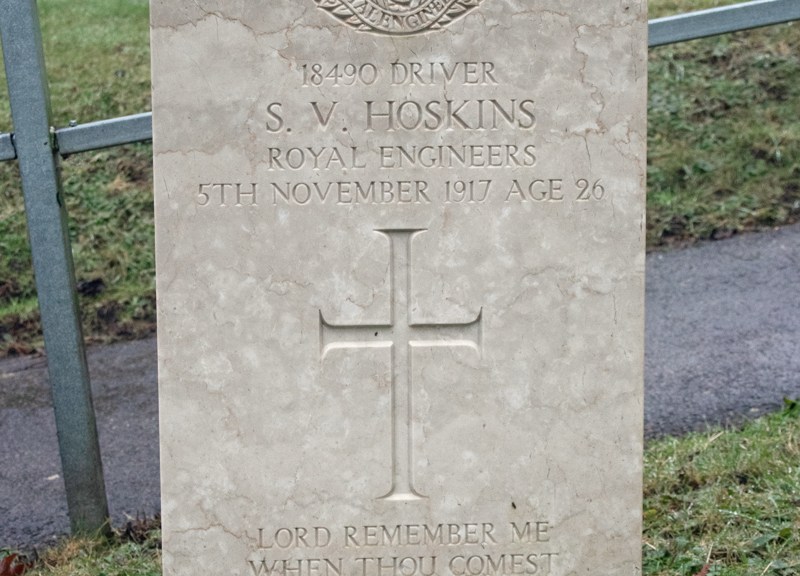
Driver Sidney Hoskins

Sidney Victor Hoskins was born in February 1892, one of eleven children to Sidney and Elizabeth Hoskins from Shepton Mallet in Somerset. Sidney Sr worked as a quarryman and labourer in local factories.

Sidney was keen to make a life for himself, enlisting in the army in 1909. He served two years as a driver for the Royal Engineers, before being put on the reserve list. By the time of the 1911 census, he was listed as a packer on the railway. In November of that year, Sidney married Ada Lambert, also of Shepton Mallet.

While working on the line in April 1913, Sidney had an accident, suffering a fractured skull. He wasn’t able to carry out any hard labour form that point.

War broke out and Sidney was remobilised; just a month after Ada gave birth to their one and only child, a daughter they named Ada.

New baby notwithstanding, Driver Hoskins was shipped to France as part of the British Expeditionary Force. After two months he was sent down the line after suffering a fit, and was subsequently treated for pleurisy in Nantes. In November 1914, he returned to England and was ultimately discharged on medical grounds in February 1915.

During his time in France, he had also developed tuberculosis, and eventually spent three months in a sanitorium in Taunton, Somerset, to recover.

The condition continued to haunt Sidney, however, and he succumbed to the illness on 5th November 1917. He was 25 years of age.

Sidney Victor Hoskins lies at rest in the cemetery of his home town of Shepton Mallet.


Sidney’s younger brother, William Napier Hoskins, was also involved in the Great War. He had enlisted in the Somerset Light Infantry, and was based in India. Injured in fighting in the Persian Gulf, he was invalided back to India to recover. He was well enough to return to the fray, and was shipped to Mesopotamia, where he was injured again. He died of his wounds in Kut-al Amarah, Iraq, in 1915, aged just 20 years old.

The boys’ older brother Charles had also died in 1895, aged just six years old. While Sidney Sr and Elizabeth had had a family of eight girls, they were to outlive all three of their sons.


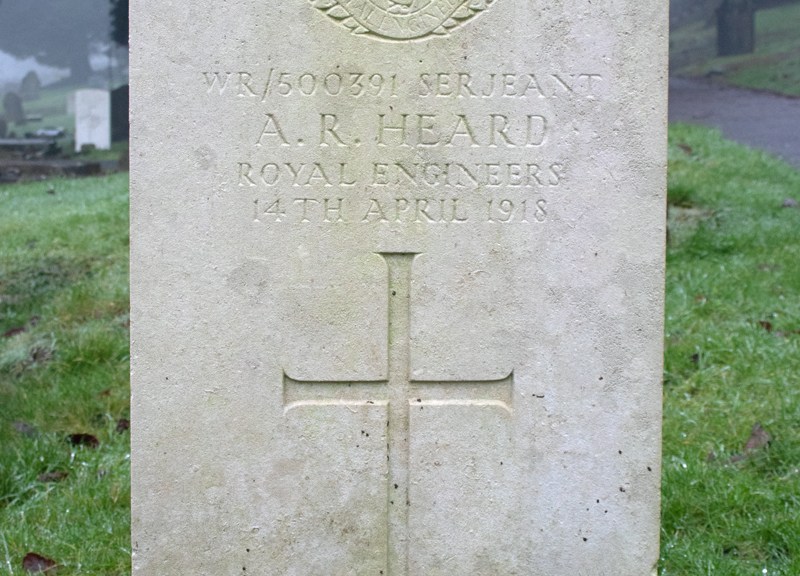
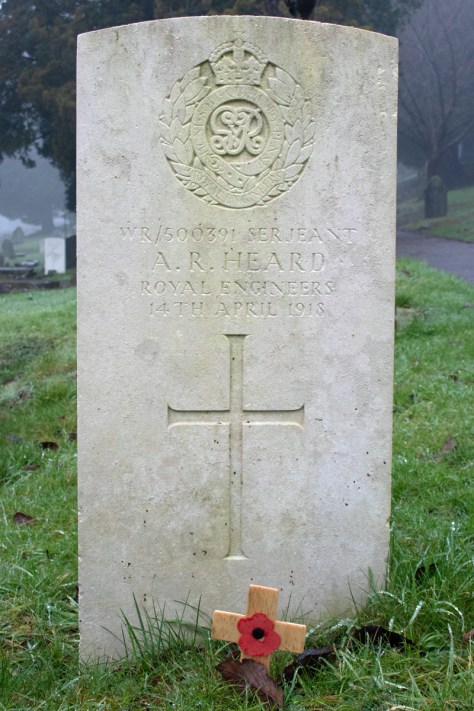
Serjeant Arthur Heard

Serjeant Arthur Heard

Arthur Reginald Heard was born in 1887, the youngest son to Herbert and Emily. Herbert was a local surveyor and land agent, and the family lived in the middle of Shepton Mallet in Somerset, two doors up from the town’s Baptist Church and within sight of the Magistrate’s Court.

In 1908, aged 21, Arthur made the journey across the Atlantic to Argentina, settling in Buenos Aires and working for the Pacific Railway Company. When war broke out, however, he immediately returned to England, when he enlisted in the army, and was assigned to the Royal Engineers.

Sapper Heard was shipped out to France and was quickly promoted, first to Corporal, then to Serjeant. In November 1917, Arthur was caught up in a shell impact on the front, and was buried. He was quickly dug out, and not severely hurt.

On 25th March 1918, Serjeant Heard was due to return home on leave, but was taken ill. Back in England, he was hospitalised in Birmingham, where meningitis was confirmed. He seemed to recover – even going out for tea with his sister-in-law when she visited him – and was transferred to recuperate in Saltash, Cornwall.

Within days of arriving, he collapsed with a fit, and passed away within half an hour. Subsequent examination confirmed that Arthur had died from a brain tumour. He was just 30 years old.

Arthur Reginald Heard lies at rest in the cemetery of his home town, Shepton Mallet.


Sapper Leonard Francis

Sapper Leonard Francis

Leonard George Francis (who was known by is middle name) was born in October 1895. He was one of fourteen children to Jonas and Eleanor (or Ellenora) Francis, and his father worked on the railways as a plate layer or ganger.

George followed his father into manual labour, and, by the time of the 1911 census, aged 15, he was already listed as a mason.

He seems to have enlisted fairly early on in the war, and by January 1915 had joined his troop – the 2nd Wessex Field Company of the Royal Engineers – on the front line.

Sadly, Sapper Francis’ time in the army was to be brief. He was caught up in the fighting at Ypres, and he was injured at Hill 60 on 27th April. He was moved to a local hospital for treatment.

It seems that messages crossed in the communication with George’s family. They received a letter confirming that he was recovering in hospital after receiving a wound to the body, but not to worry. A day or so later his postcard confirming his arrival in France was received, but by this time he had been shipped back to England for treatment.

His parents received a telegram to confirm this, and his father and brother set out to visit him. By the time they had reached the hospital, however, he had sadly passed from a tetanus infection. In his pocket was a piece of shell; a sad souvenir of his frontline action.

Leonard George Francis died at Netley Hospital 3rd May 1915. He was just 19 years old.

He lies at rest in the cemetery of his home town, Shepton Mallet in Somerset.


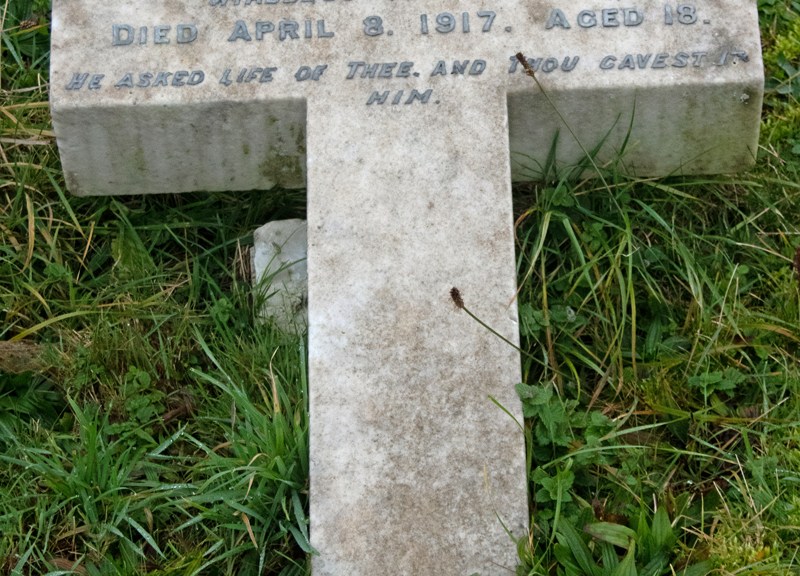
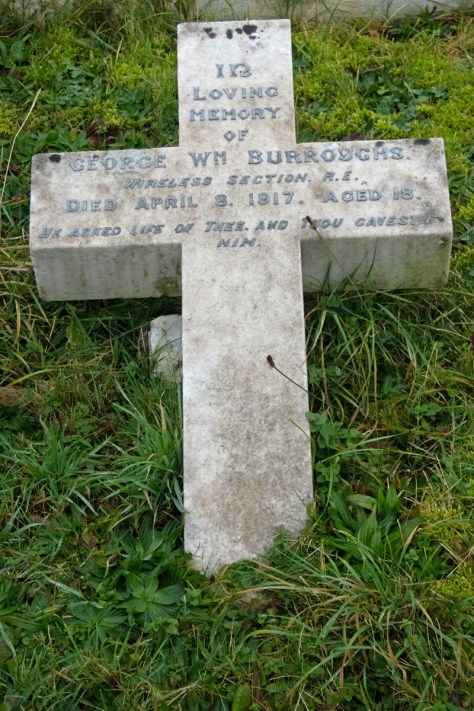
Pioneer George Burroughs

Pioneer George Burroughs

George William Burroughs was born in 1899, the eldest of two sons to harness maker Stratton Burroughs and his wife Alexandra. George was born in Warminster, Wiltshire, but the family soon moved closer to Alexandra’s family in Somerton, Somerset.

The 1911 census found the young family living in Market Place in the centre of Somerton, with a visitor, fancy goods seller Joseph Cazes from Constantinople.

George seems to have enlisted almost as soon as he was old enough to do so, giving up his job as a school teacher (surprising given he was only 17 at the time). He signed up for the Royal Engineers in January 1917, gaining the role of Pioneer.

Sadly, his time in the services was very short. Within weeks of being posted, Pioneer Burroughs was admitted to hospital with meningitis, an illness that was becoming more widespread within the armed forces.

Tragically, after a month in the Norton Barracks Military Hospital in Worcestershire, George passed away from the disease. He was just 18 years old.

George William Burroughs lies at rest in the cemetery of his home town of Somerton.


Driver William Hagger

Driver William Hagger

William Joseph Hagger was born in the spring of 1885, one of thirteen children to William Henry Hagger and his wife Emily Ann. The family lived on the Isle of Grain in Kent, where William Sr worked as a labourer in the local cement works.

William Jr was evidently keen to travel. On the 1901 census he is listed as a navyman on HMS Lion, a training vessel in Devonport, Plymouth.

His First World War records state that he officially joined the Royal Navy in 1906, travelling to West Africa as an Able Seaman. While there, he contracted a fever, and was invalided out of the service the following year.

William married Esther Elizabeth Reed in May 1909; by the 1911 census, she was living in Northfleet, Kent, working as a cartridge maker for the local arsenal. William himself is not recorded at the same property, and I have been unable to locate him at this point.

He next appears on the enlistment papers for the Royal Engineers. He joined up very early in the war – December 1914 – and after his training, Driver Hagger embarked for the Western Front in August 1915.

While serving, it seems that his previous affliction resurfaced, and William was dogged by colds and coughs. In the autumn of 1916, he was admitted to a field hospital with haemoptysis (coughing up blood), eventually returning to his unit three months later.

Driver Hagger’s health was fair until, in October 1917, his unit was gassed; he was sent back to England and hospitalised in Aldershot, and this time was discharged from the army six months later.

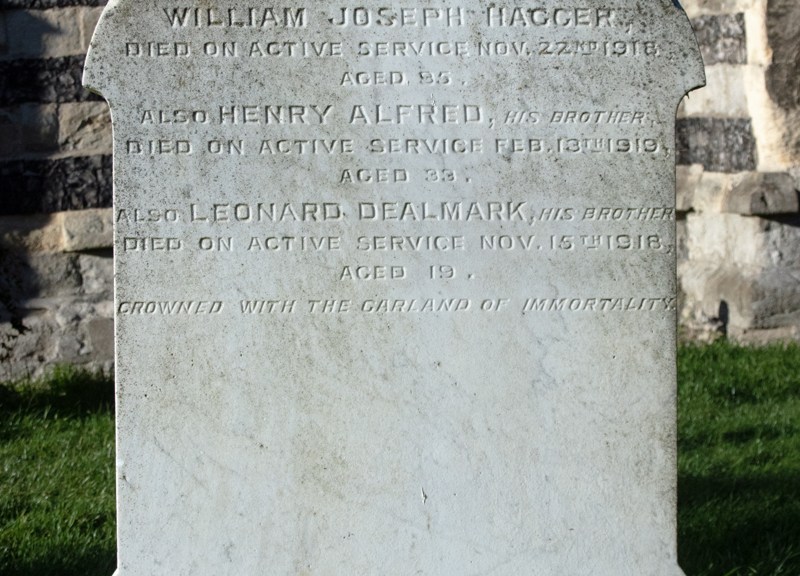
It seems that William did not recover from his illness and passed away on 22nd November 1918. He was 33 years old.

William Joseph Hagger lies at peace in a quiet corner of St Helen’s Churchyard, in Cliffe, North Kent.


William’s gravestone also acts as memorial to two of his brothers, Henry and Leonard.


Henry Alfred Hagger was born two years after William. He was also keen to make a name for himself, emigrating to California, and working as a streetcar conductor in Oakland. Initially declaring himself exempt from draft as he had a wife to support, he subsequently joined the British Columbia Regiment on 31st July 1917.

Henry was attached to the Forestry Depot of the Canadian Expeditionary Force, who were to be shipped to Europe to harvest trees for use on the Western Front. However, at the point of his medical – in September 1917 – he was discharged as unfit for active service due to his asthma.

Henry Hagger died on 13th February 1919, presumably of his lung condition. He is buried in Ross Bay Cemetery in British Columbia.


Leonard Dealimark Hagger was born in 1899. He enlisted as soon as he was able to, just short of his 18th birthday. Joining the York & Lancaster Regiment, he was posted in 1918.

His battalion saw some of the fiercest of the battles in the closing months of the war – Estaires, Messines, Bailleul, Kemmel Ridge, Scherpenberg, Selle, Valenciennes – and it is likely that Leonard was involved in some of these engagements.

Private Hagger was wounded in the closing weeks of the war, and passed away in a hospital in Liege, Belgium on 15th November 1918. He had just turned 19 years of age.

Private Leonard Hagger lies at peace in the Robermont Cemetery in Belgium.


Lance Corporal Albert Stapleton

Lance Corporal Albert Stapleton

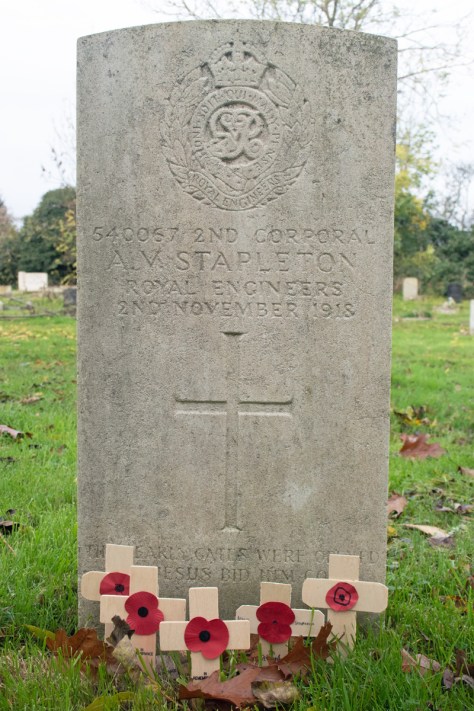
Albert Victor Stapleton was born in East London in 1893. One of five children to James and Mary Anne Stapleton, he lost his father when he was only eight years old. Mary Anne married again, and where her first husband has been a glass blower, her second, Edward, was a cooper/barrel-maker, and the family moved to Rainham in Kent.

Albert joined the armed forced early, enlisting in the Royal Engineers in December 1910 for a period of four years. When war was declared, this was extended for a further four years.

In 1915, Private Albert married Daisy, and they lived in the Rainham area. Over the next couple of years, he was promoted, joining the London Electrical Engineers and becoming Lance Corporal.

On 24th October 1918, just a couple of weeks before the end of the war, Albert was admitted to hospital in South London with influenza; while there, he developed pneumonia in the right lung. Lance Corporal Stapleton died on 2nd November 1918. He was 25 years old.

Lance Corporal Albert Victor Stapleton lies at rest in the churchyard of St Mary the Virgin in the quiet village of Upchurch in Kent.


Tragically, just weeks after Albert’s death, Daisy gave birth to a son. Albert William Stapleton would never know his father.