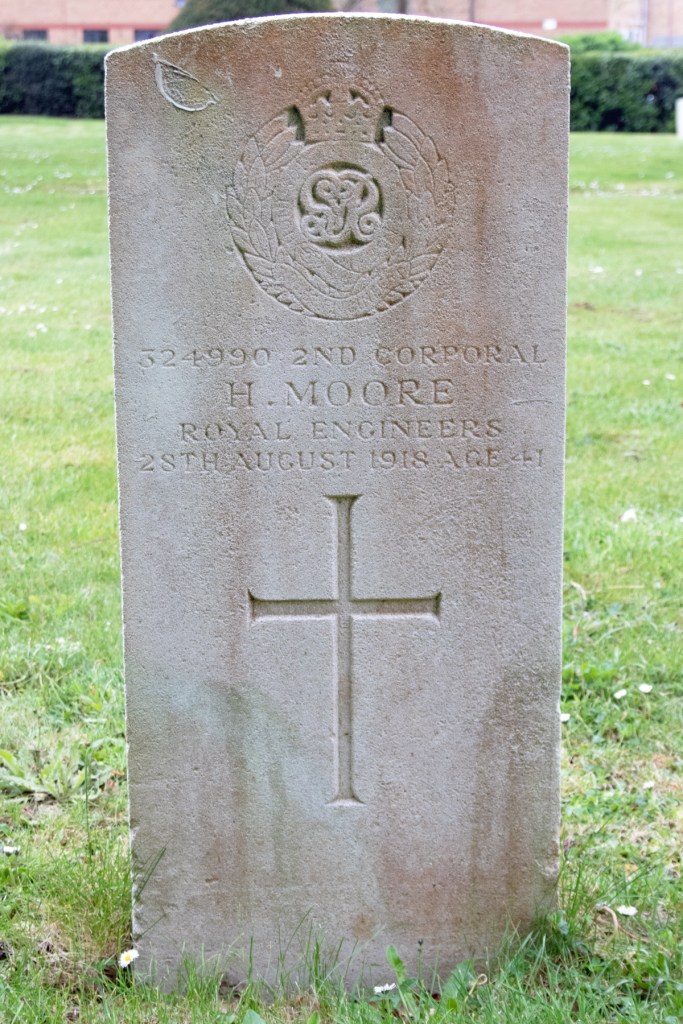
Harry Moore was born in Tiverton, Devon, in early 1877. He was the fourth of eleven children to James Moore, a railway policeman, and his wife Ann.
By 1890, James had moved the family to Taunton, in Somerset (where his work was now listed as railway porter). Over the next decade, Harry was to encounter tragedy and happiness.
In 1894, his father died from Bright’s disease (a kidney complaint), at the age of just 45 years old.
Three years later, Harry’s mother died, from what appears to have been heart failure. Ann was 49 years of age.
On 13th November 1898, Harry married Alice Mary Larcombe, a dressmaker from Taunton. The young couple set up home together in the north of the town. They went on to have five children, although, sadly, only one would live to reach their 20s.
By now Harry had found employment as an insurance agent, but war was coming to Europe. His military records are lost to time, but he enlisted in the Royal Engineers and was assigned to G Depot Company. (The Depot Battalions received men who had returned from the Expeditionary Force and also those men who had enlisted for Tunnelling Companies, Special Companies and other specialist units.)
The next evidence we have of Corporal Moore is in the Army Register of Soldiers’ Effects. This confirms that he had been admitted to the Southern General Hospital in Bristol with an illness, and that he subsequently passed away on 28th August 1918, at the age of 41.
Harry Moore was laid to rest in the St James’ Cemetery in his home town of Taunton.
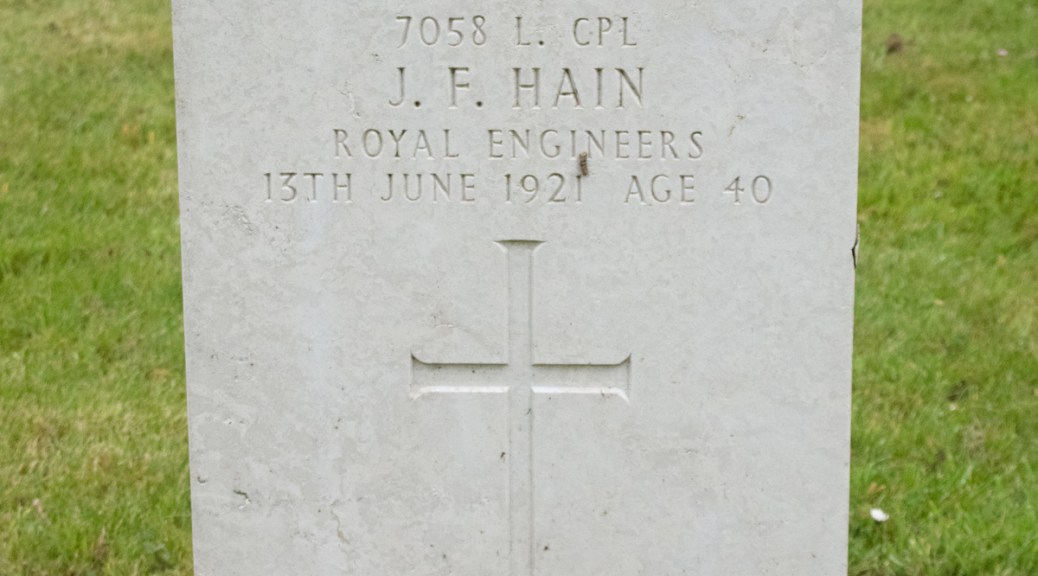
James Frederick Hain was born on 5th November 1881 in the village of Holmer in Herefordshire. He was one of seven children to James and Catherine Hain, and was more commonly known as Fred. On James Jr’s birth certificate, his father was listed as a manure agent, although by the time of the 1891 census, the family had moved to London, where James Sr was now running a coffee house.
When he left school, James Jr started work as a French polisher, but he had a taste for adventure and joined the army. He served in South Africa during the Boer War campaign of 1899-1900, attaining the Cape Colony, Orange Free State and Transvaal Clasps.
In 1900 James returned home, finding work as a French polisher. The military life was in his blood by now, though, and in September, he re-enlisted. Initially joining the Royal Berkshire Regiment, he was soon transferred over to the Royal Engineers as a Sapper.
James had signed up for a period of eight years and, as part of his role as a wireman (maintaining and fitting telegraph cables), he was stationed abroad. On one particular trip, when his battalion was travelling from Plymouth to Limerick early in 1908, he was injured. According to the accident report: “owing to bad weather on boat between Fishguard and Waterford he was thrown violently forward, striking his head against a girder.” Treated in Limerick, “the disability is of a slight nature, and in all probability will not interfere with his future efficiency as a soldier.”
Sapper Hain’s time with the service was nearly up, and he was put on reserve status in November 1908. By 1911, he was working as a linesman, and boarding in a house in Hayle, Cornwall.
War was on the horizon by now, and on 5th August 1914, James was called back into service. He saw action on the Western Front, adding the Victory and British Medals and the 1915 Star to his count. In October 1915, he was treated for shell shock, and evacuated back to England.
At the beginning of 1917, Lance Corporal Hain was transferred back to the Army Reserve, suffering from neuritis. His health was to suffer for the rest of his life.
In September 1917, having settled in Cornwall, James married Beatrice Opie, an innkeeper’s daughter from the village of Wendron, Cornwall. The couple would go on to have a son, who they called Frederick, two years later.
Discharged from the Army, James put his engineering experience to good use, joining the General Post Office to work with telegraphs.
By this time, James’ medical condition had been formally diagnosed as General Paralysis of the Insane. A degenerative disease, similar to Alzheimer’s disease, it was associated with brisk reflexes and tremors (usually most obvious of the lips, tongue, and outstretched hands) and characterised by failing memory and general deterioration.
By August 1920, James was admitted to the Somerset and Bath Asylum in Cotford, because of his worsening condition. He was not to come out again, and passed away ten months later, on 13th June 1921. He was just 39 years old.
James Frederick Hain was buried in the St James’ Cemetery in Taunton, Somerset.
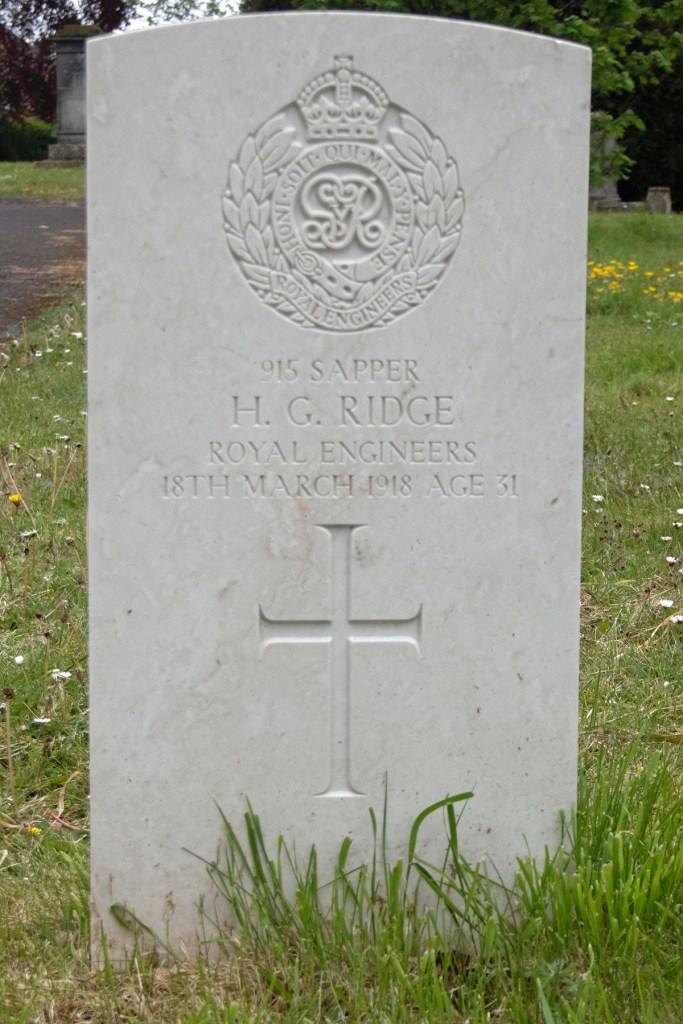
Herbert Gladstone Ridge was born in December 1886, the youngest of three children to Alfred and Sarah. Alfred was from Lancashire and had met and married his wife in Ireland, which is where Herbert’s older siblings had been born.
Sarah had died when Herbert was only eleven years old. Alfred’s skills were as a machine engineer, and, after his wife had passed away, he brought his family down to Somerset. Initially living with his father in Taunton, Herbert had found work as a piano tuner, and moved to a boarding house in Bristol to further his trade.
War was close, however, and, in July 1915, Herbert enlisted. Joining the Welsh Field Company of the Royal Engineers as a Sapper, he was quickly posted as part of the Mediterranean Expeditionary Force. He served nearly a year in Egypt, before being sent back to England in September 1916.
By this point, Sapper Ridge was suffering from a bout of tuberculosis, and had been sent back to England for treatment. The condition refused to clear up, however, and he was eventually discharged from the army on medical grounds three months after returning home.
Details of Herbert’s life after the army are sparse. It can be assumed, however, that he remained dogged by tuberculosis, and this is what eventually killed him. He passed away on 18th March 1918, aged just 31 years old.
Herbert Gladstone Ridge lies at rest in St Mary’s Cemetery in his adopted home town of Taunton in Somerset.
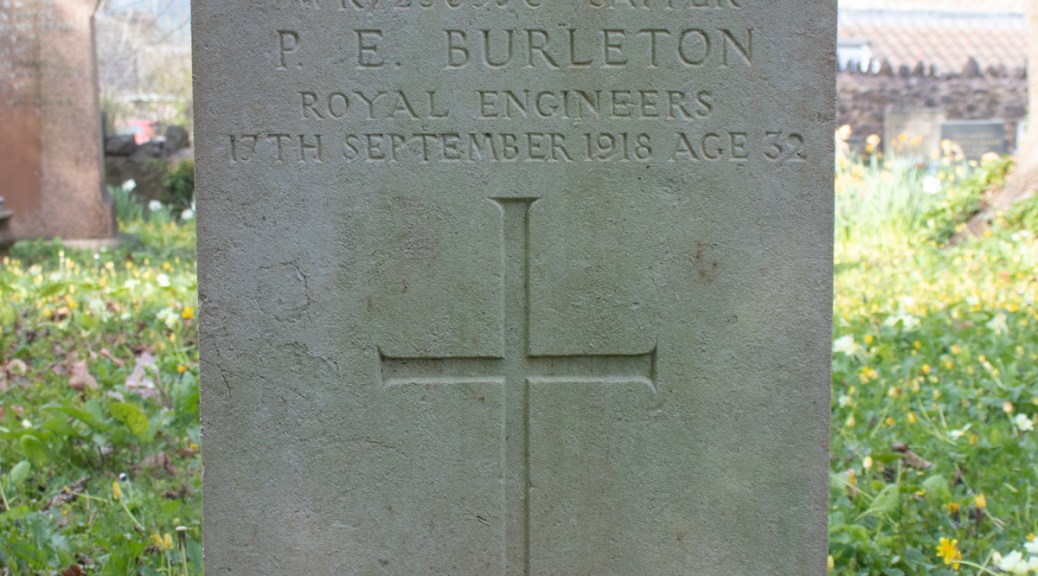
Percy Edward Burleton was born on 24th July 1885, the youngest of seven children to George and Lucy Burleton. George was a quarryman, and the family lived in the village of Draycott, near Wells in Somerset.
Percy’s older brother Lewis worked for the railways, and this is a trade that his younger sibling followed. By the time of the 1911 census he was living with his brother in Glastonbury and worked as a carman, delivering goods to and from the local station.
In February 1914, Percy appeared as a witness in an inquest about the death of a colleague, George Gillett. George had gone missing one night after the two had met for a drink in a local pub. The alert was raised when George’s coat was found hanging on a branch on the banks of the River Brue, to the south of the town; the waters were dredged and George’s body found.
At the inquest, Percy confirmed that the two men had had a drink in a local pub, and that George had seemed a little strange, but not the worse for drink. He reported that the deceased man had been quieter than usual at the railway stables for a week or so. George had left the pub at 10:55 that evening, and that was the last time that Percy had seen him.
Part of a carman’s duty was to collect money for the goods they had delivered; this was then paid to the station clerk on a daily basis. In the week leading up to his death, the stationmaster had been advised of some financial discrepancies, and on the day he drowned, he had been spoken to and advised the matter would be reported to the police if the missing amount was not paid back.
The place where George’s coat was found was not on his way home from the pub, and he would have had to have gone out of his way to get there. When considering their findings, the jury returned a verdict of suicide during temporary insanity, citing that the financial situation George had apparently gotten himself into.
When war broke out, Percy seemed to have been keen to get involved. Initially joining the Devonshire Regiment in September 1914, his experience with his job saw him transferred to the Railway Operating Division of the Royal Engineers.
Shipped to France on 22nd September 1915, his service saw him awarded the Victory and British Medals and the 1915 Star. Sapper Burleton was moved to the Eastern Front and served in the Balkans for three years. According to the Central Somerset Gazette, which reported his passing, he contracted ‘a chill’ on the boat back to England and was admitted to Frensham Hill Hospital in Surrey.
Sadly, the chill seems to have been more severe than the report suggested, and Sapper Burleton passed away on 17th September 1918. He was 32 years old.
Percy Edward Burleton lies at rest in the graveyard of St Peter’s Church in his home village of Draycott, Somerset.
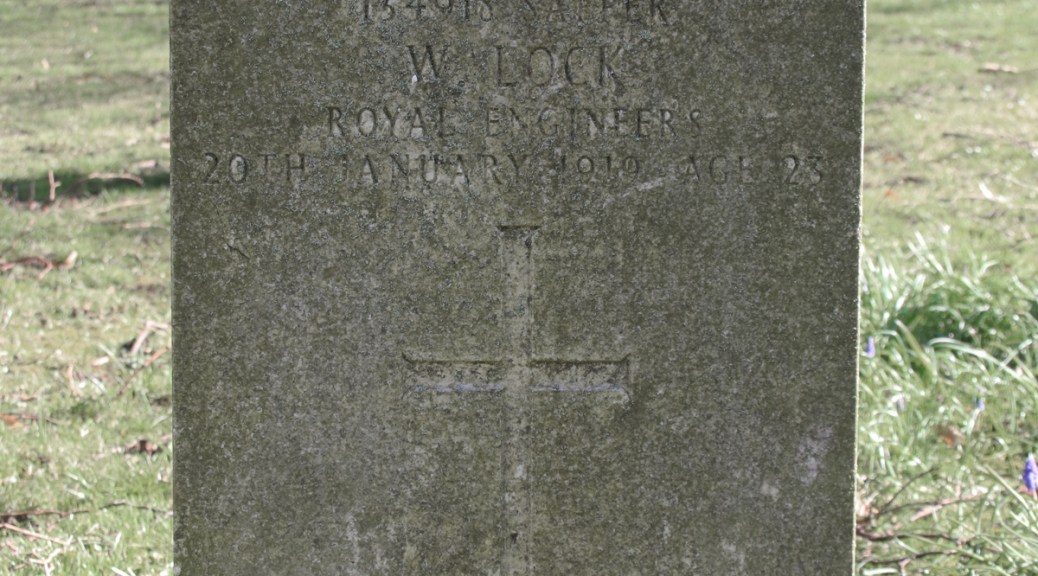
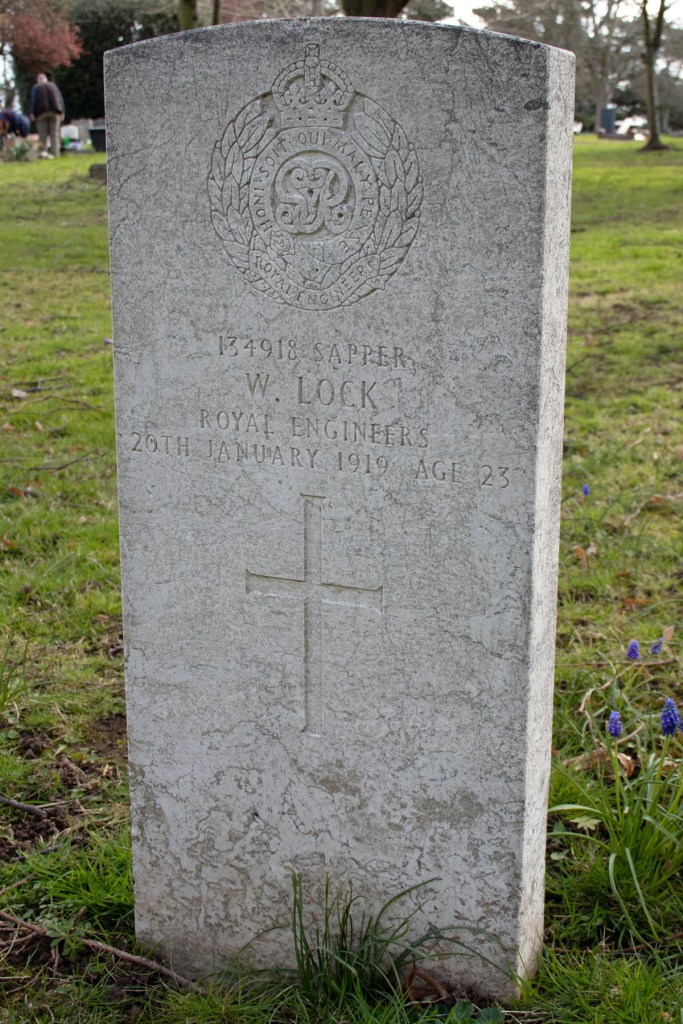
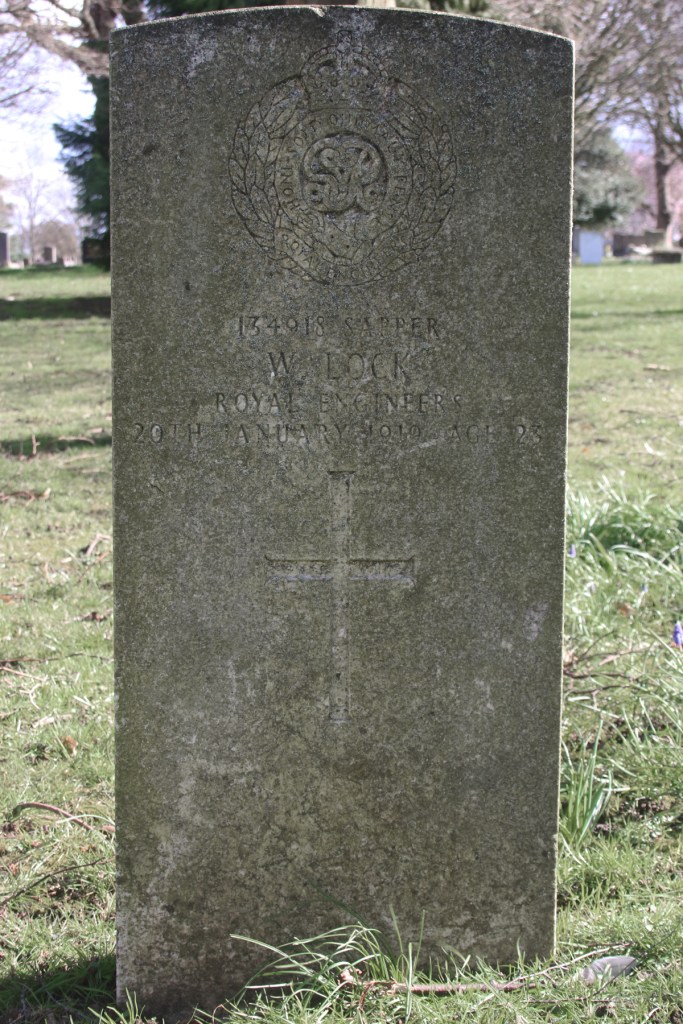
William Lock was born in Devon in 1896, one of three children to Tom and Mary Lock, although sadly only William survived childhood. Tom was a shipwright in on the Devon coast, but brought his young family to Kent, where he found work in the Naval Dockyard in Chatham.
When William left school, he set about finding a trade. By the time of the 1911 census, aged 15, he was listed as “learning house joinery”, presumably a trade for which his father’s work would have stood him in good stead.
War was looming, however, and William enlisted. He joined the Royal Engineers at a time where they were being inundated with volunteers. Sapper Lock was assigned to G Company, a provisional troop that formed part of the Depot Battalion.
Documentation relating to Sapper Lock’s military service are no longer available; he was awarded the Victory and British Medals, which suggests that he saw some kind of service overseas, but there is nothing on file to confirm this.
The next document relating to William is his war pension, which confirms that he died on 20th January 1919 from ulcerated endocarditis, or heart disease. He was just 23 years old.
Tom and Mary had lost the third of their three children.
William Lock was laid to rest in the Woodlands Cemetery in Gillingham, Kent.
Thomas James Clark was born in Worcester at the beginning of 1853, the oldest of two children to James Clark and his wife Sarah. James was an engine smith and gas fitter, and moved the family with his work, initially to London, then on to the Kent coast.
Documentation relating to Thomas’ early life is difficult to track down; the 1871 census has him listed as a gas fitter like his father, but it is likely that he enlisted in the army fairly shortly after this date.
In 1875, he married a woman called Emily Ann. There life was to take on a grand new adventure as their first child, a boy named after his father, was born in Bombay, India, later that year.
It seems likely that it was Thomas’ military service that took the young family overseas. This was to be the case for at least a decade, as Emily gave birth to four further children in India. James, their fifth child, was born in Bombay in 1884. Their sixth, and last child, Ellen, was born in Gillingham, Kent, ten years later.
Given that the standard time for military service was twelve years, it is possible that Thomas served all of that time overseas, returning to England in around 1887.
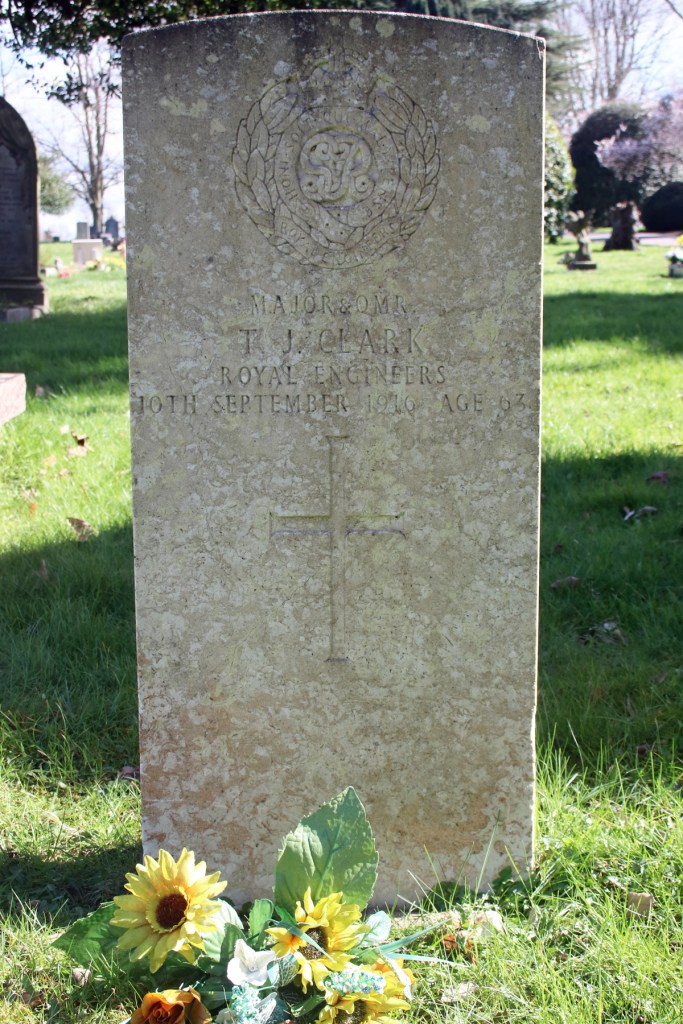
Back home in Kent, Thomas is given the commission of Quartermaster in November 1897. By this point, he has been in the Royal Engineers for just under 21 years. He and his family are living in central Gillingham, within easy walking distance of the Royal Engineers Barracks and School of Engineering.
The 1901 census also lists Thomas as Quartermaster for the regiment, while three of his sons are by this time working in the Naval Dockyard as shipwrights and engine fitters.
Ten years later and the family are still living in the same house. By now, and aged 57, Thomas is recorded as a Retired Captain and Quartermaster for the Royal Engineers. He and Emily have been married 36 years, and their three youngest children (now aged 29, 26 and 17) are still living with them.
War was looming by now, although, age 61 when it broke out, it is unlikely that Retired Quartermaster Clark would have been involved in any front line activity. While no military records survive for Thomas, it seems possible that he may have been recalled for a training or administrative role at the barracks nearby.
Any re-commission would not have lasted for long, however, as Quartermaster Clark passed away at home on 10th September 1916. He was 63 years old.
Thomas James Clark lies at peace in the Woodlands Cemetery in Gillingham, Kent.
Thomas’ widow, Emily, passed away just two years after her husband. She was also laid to rest in the Woodlands Cemetery.
Thomas left his estate in the hands of his youngest son, James, who was still living at his parents’ home when they passed away.
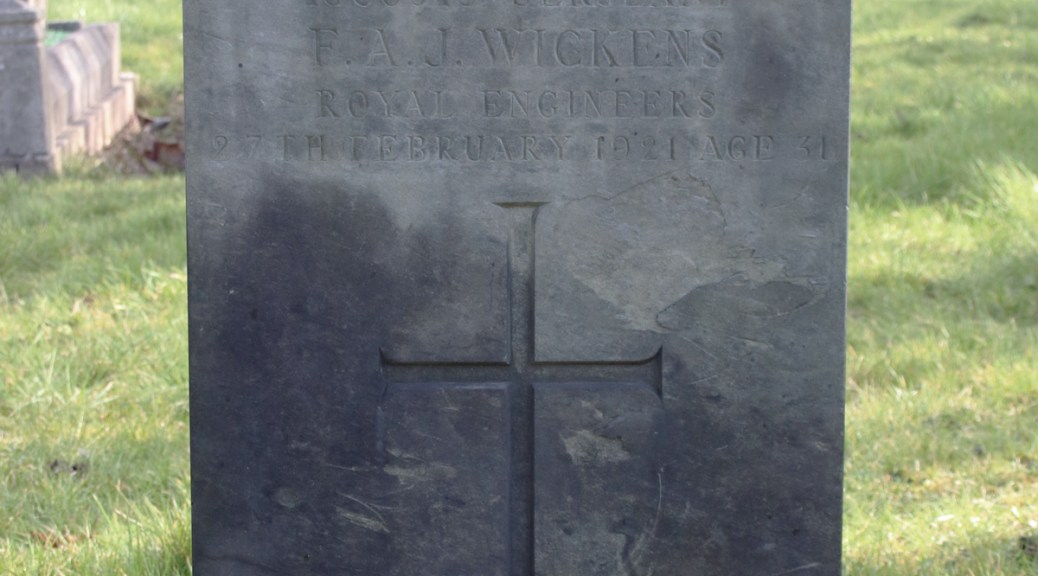
Frederick Albert John Wickens was born in Newbury, Berkshire, in the summer of 1889. The oldest of four children to Alfred and Emily Wickens, his father was a brewer’s labourer.
The military life proved more of a draw to Frederick, however. While his full records no longer exist, by the time of the 1911 census, he was recorded as being a Sapper with the 2nd Field Troop of the Royal Engineers. He was based at Potchefstroom, around 75 miles (120km) south east of Johannesburg in South Africa, and his trade was listed as a tailor.
Sadly, it is at this point that Frederick’s trail goes tepid, if not cold.
From a personal perspective, he married a woman called Rose, who was a year younger then him. Her details are scarce, and there is nothing to confirm when or where they married (other than the 1911 census, when Frederick was listed as ‘single’).
The couple must have had some connection to Gillingham, as this is where they lived; given the proximity of the Royal Engineers Barracks in neighbouring Chatham.
Sapper Wickens’ military service continued into the Great War. He was awarded the medaille militaire by Belgium, and achieved the rank of Serjeant during his career. Unfortunately, there are no details of the actions around either the award or his promotion.
Serjeant Wickens passed away on 27th February 1921; he died in Chatham, although the cause was not recorded. He was 31 years old.
Frederick Albert John Wickens lies at rest in the Woodlands Cemetery in Gillingham, Kent.
Frederick’s younger brother Thomas, also served in the Great War. He enlisted in the Princess Charlotte of Wales’s (Royal Berkshire) Regiment, and was involved in the battles on the Western Front. Sadly he was killed in the fighting on 24th May 1916, at the age of 19 years old.
Henry Louis Selley was born in 1876, one of nine children to Richard and Mary Ann Selley. His father was an agricultural labourer and the family lived in Exminster, Devon.
Initially, Henry followed his father in becoming an agricultural labourer, but the military life seems to have sparked an interest. While Henry’s military records no longer exist, he is recorded as having completed 24 years’ service with the Royal Engineers at the time of his death. He would have enlisted, therefore, in around 1897, when he was about 21 years of age.
As to his duties while in the military, these can only be guessed at. He is intriguingly noted as Musician, although there is no documentation to expand on Henry’s role any further. There were many professional musicians in the army, and they performed table music, serenades, and home concerts, mainly for high-ranking officers.
Musician Selley’s role may also have to be set timing for marches, etc, although, again, this is purely speculation on my part, as there is no evidence to suggest this was the case.
Henry married a woman called Constance in 1905; she had been born in Devon, but there is no further information on her. The 1911 census records the young couple as living in a terraced house not far from the Royal Engineers Barracks, where Henry would have been based. The couple did not go on to have any children.
And there, Musician Selley’s trail goes cold. The next that he appears in any documentation is in 1921, when his army pension record confirms that he passed away. He had been admitted to the Royal Herbert Hospital in Woolwich with pulmonary tuberculosis, and succumbed to the disease on 26th May 1921. He was 45 years old.
Henry Louis Selley lies at rest in the Woodlands Cemetery in Gillingham, Kent.
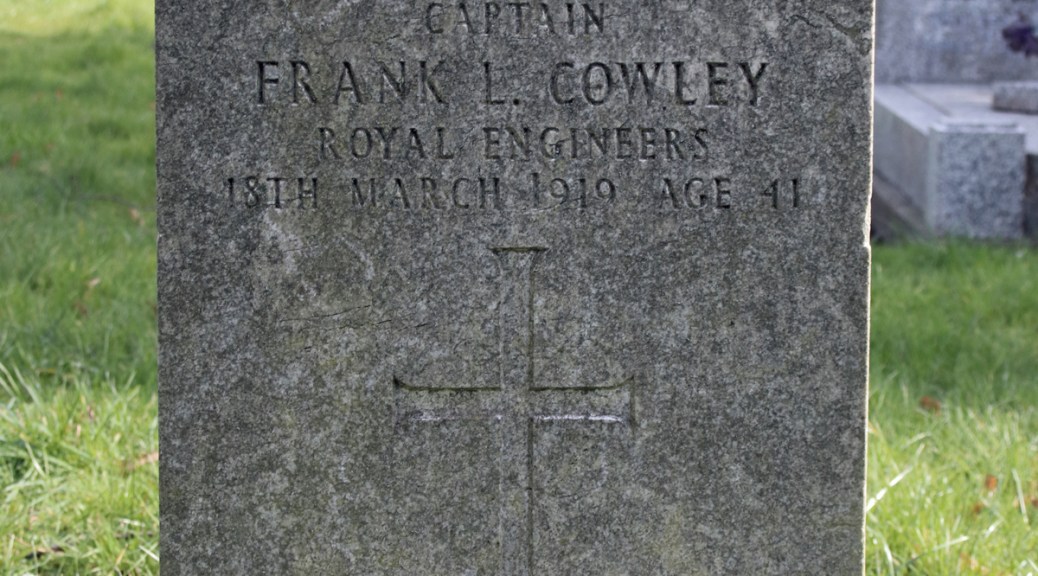
Francis Llewellyn Cowley – also known as ‘Frank’ was born in July 1877 on the Isle of Man. He was one of ten children to Thomas and Ann Cowley, farmers who owned 133 acres on the northern tip of the island.
Frank’s trail goes cold for a few years; he was still living on his father’s farm in 1891, but by 1913, had moved to to the mainland, settling in Kent.
It was here, in Gillingham, that Frank married Lily Matilda Carrington in the summer of 1913. Sadly there is little information about Lily, but the couple do not appear to have had any children.
Frank enlisted shortly after war broke out; he joined the Royal Engineers on 27th October 1914, and within a couple of years has reached the rank of 2nd Lieutenant.
Sadly again at this point Frank’s trail goes cold. He next appears in a newspaper article from 1st March 1919, when he is listed as having attended the funeral in Rainham, Kent, of Air Mechanic Herbert Holdstock. He is now listed as Captain F Cowley RE.
That was resolved to be a tantalising glimpse into Captain Cowley’s final few weeks. From this point, all the documents tell us is that he worked at the School of Military Engineering in Chatham.
Frank passed away on 18th March 1919, although no cause of death is recorded. He was 41 years old.
Francis Llewellyn Cowley lies at rest in the Woodlands Cemetery close to his home in Gillingham, Kent.
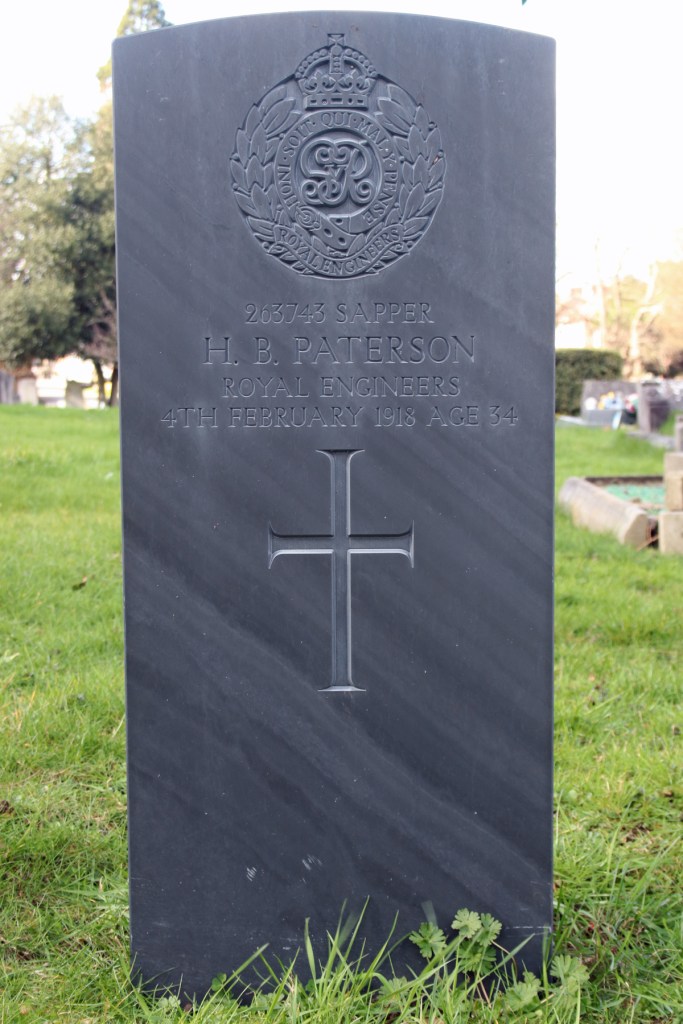
Harry Bruce Paterson was born towards the end of 1893, one of two children to John and Jane Paterson. John worked at Chatham Dockyard fitting ships’ engines, and the family lived in a small terraced house close to the centre of Gillingham in Kent.
When Harry left school, he became a plumber’s apprentice, soon qualifying as a full plumber.
He married Ellen Keeler in 1906, and the couple lived a short walk away from his parents’. They went on to have four children, Lilly, Harry Jr, Mabel and Kathleen.
War was on the horizon, but Harry’s military service records are a bit sketchy.
He enlisted as a Sapper in the Royal Engineers on 14th July 1915, and served in France. He attained the Victory and British Medals as well as the 1915 Star.
Sadly, Sapper Paterson’s health seems to have been impacted by his service. In January 1918 he was invalided back to England and admitted to the military hospital at the army camp in Thetford, Norfolk. Diagnosed with pulmonary tuberculosis, he quickly succumbed to the disease, and passed away on 4th February 1918. He was 34 years old.
Harry Bruce Paterson lies at rest in the Woodlands Cemetery, Gillingham, just a few minutes’ walk from both his parents and his widow and children.











 Death and Service