Category Archives: Royal Marines

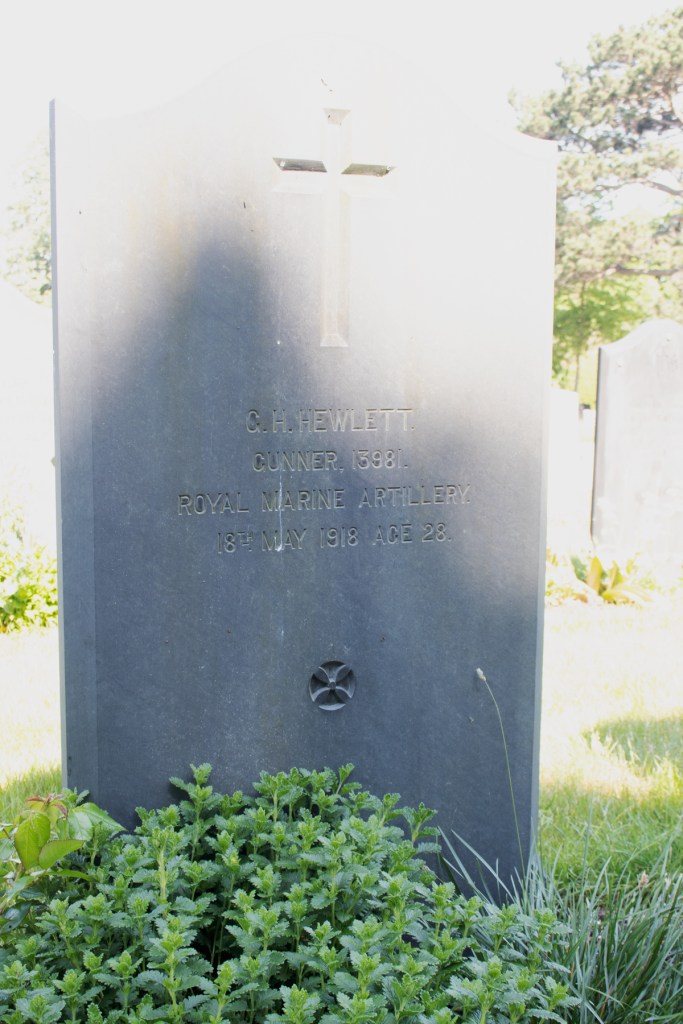
Gunner George Hewlett

Gunner George Hewlett

George Henry Hewlett was born on 11th July 1892, the oldest of four children to Henry and Louisa Hewlett. Henry was a painter from Hampshire, who travelled for work. George and his youngest sibling were born in Romsey, while his two brothers were born in Swindon, Wiltshire. By the time of the 1901 census, when George was eight years old, the family had settled in Hammersmith, London.

The next census, in 1911, recorded the family as living in Caterham, Surrey. By this time, George and his father were working as gardeners, while his brothers were working as grocers. Louisa, meanwhile, was employed as a live-in housekeeper for a spinster and her mother just around the corner.

War was coming and George was determined to do his bit. Full details are not available, but he enlisted in the Royal Marine Light Infantry, taking on the role of Gunner. In May 1918 he was on board HMS Iris, a Mersey ferry requisitioned by the Royal Navy for support in the planned raid on Zeebrugge.

On 23 April 1918, HMS Iris was towed across the English Channel to Zeebrugge by HMS Vindictive; she was carrying a couple of platoons of the 4th Battalion of the Royal Marines as a raiding party. When the Vindictive neared the Zeebrugge she cast the ferry aside. Iris tried to pull up to the breakwater under heavy fire in order to off-load the raiding parties which were on board. She sustained heavy fire and a shell burst through the deck into an area where the marines were preparing to land. Forty-nine men were killed, including Gunner Hewlett. George was 28 years of age.

George Henry Hewett’s body was brought back to England. He was laid to rest in the Woodlands Cemetery in Gillingham, Kent, not far from the dockyard at which he was based.

George’s two brothers also fought in the First World War.

John William Hewlett, who was two years younger than George, joined the 1st Royal Marine Battalion of the Royal Naval Division as a Private. He fought on the Western Front, and was killed in fighting on 22nd October 1916. He was 21 years of age. John was laid to rest at the Mesnil-Matinsart Cemetery near the town of Albert in Northern France.

Joseph Herbert Hewlett was born three years after George. When war was declared, he enlisted in the Buffs (East Kent Regiment), joining the 4th Battalion as a Private. Dispatched to India, he was initially based in Bombay, but was injured in fighting. He was sent back to England, and treated at the Military Hospital at Netley, near Southampton. Sadly, his wounds proved too severe – he passed away on 4th April 1915, aged just 20 years old.

In the space of three years, Henry and Louisa Hewlett had lost all three of their sons to the war. After George’s death, a local newspaper reported this was their “sad and proud record”. [Dover Express: Friday 31st May 1918]


Private Henry Teahen

Private Henry Teahen

Henry Teahen (or Teahan) was born in around 1898 in Castlegregory, County Kerry, Ireland. One of twelve children – eight of whom survived infancy – his parents were John and Catherine Teahan.

John was a wayman (or road surveyor), who was born in Kerry. Catherine was born in Wandsworth and it was in London that the couple met and married. By the time Henry was born, the family had moved back to Ireland, although Catherine had made the journey back to England in the early 1900s, after John passed away.

The 1911 census found the family living in Forest Gate in the east of the capital; Henry’s oldest brother, Joseph, was head of the household and, at 24, was working as a police constable. Schoolboy Henry was there, as was his mother, two more of his brothers, one of his sisters and his niece and nephew.

War was imminent, though, and, within a week of hostilities breaking out, Henry – who had been working as a waiter – enlisted in the Royal Marine Light Infantry. Private Teahen’s service records show that he was 5ft 8ins (1.72m) tall, had a fair complexion, grey eyes and brown hair. They also give his date of birth as 22nd June 1896, although he may have adapted this, as he would have been underage at the point he joined up.

Over the next few years, he served on a number of ships, switching between the Plymouth and Chatham divisions of the regiment. Full details of his duties are not immediately apparent, although is seems that he was injured while on board HMS Valiant in February 1916 – six months before her involvement in the Battle of Jutland – receiving a contusion to his right knee.

By the closing months of the war, Private Teahen had transferred back to the Naval Dockyard in Chatham, Kent. It was while here, early in 1919, that he fell ill. Details of his condition are lost to time, but it is known that he succumbed to them, passing away on 1st March 1919; he was 21 years old when he died.

Henry Teahen was laid to rest in the Woodlands Cemetery in Gillingham, within walking distance of the dockyard at which he was based.


Henry’s older brother James, also fought in the First World War. Full details are not clear, but documents show that he enlisted in the 6th City of London Regiment (also known as the City of London Rifles).

James’ regiment fought in many of the fiercest battles on the Western Front, including Loos, Vimy, High Wood and Messines, but it was at Ypres in the late summer of 1917, that he was injured. He died of his wounds on 30th September, aged just 23 years old.

Private James Teahan was laid to rest at the Mendinghem Military Cemetery in Poperinghe, Belgium.


Private Cecil Sims

Private Cecil Sims

Cecil Frank Sims was born in the village of Manston, Dorset, towards the end of 1897. The youngest of six children, his parents were Henry and Ann Sims. Henry was a dairyman and, after his death in 1909, his wife continued in this line of the work.

Cecil was just 16 years old when war was declared, but he was keen to do his bit for King and Country as soon as he could. In May 1917, he joined the 2nd Battalion of the Royal Marine Light Infantry in Portsmouth.

Sadly, information on Private Sims dries up at this point. His service records no longer exist, and the only document that remains is his pension record. This confirms that he died on 11th February 1919 from ‘disease’, but there is no further information to be had. He was just 21 years of age.

Cecil Frank Sims was laid to rest in Yeovil Cemetery.


There is one other element that adds to Cecil’s family story. When researching the local newspapers for any reports on his funeral, an advert was posted just a few days before he passed:

Farmer’s son wanted: Willing to help on farm. Lodgings found close. Good place for willing chap, age 16 or 17 years preferred. SIMS, Poplars Farm, Yeovil Marsh.

Western Gazette: Friday 7th February 1919

It would seem that, if he was at home, Cecil’s health was weakening, and so extra support to manage the farm was being sought.


Private James Hayden

Private James Hayden

James Hope Hayden was born in Shorncliffe Military Camp in 1875, the son of Mary Anne Hayden. The youngest of five children, James’ father appears to have died when he was just a toddler; there are no records for him, and Mary Anne – who preferred to caller herself Annie – was listed a a widow by the time of the 1881 census.

The document confirms that Annie was lodging in a house near the Naval Dockyard in Chatham, working as a seamstress. She was living there with her landlady Anne Roberts and her five children, John, William, Annie, Charles and James, who seems to have gone by the name of Mathew.

By the time of the nest census, Annie had moved and was lodging in another house in the same road. She was still employed as a seamstress, and was sharing the rooms with her two youngest children and her brother, William.

The 1901 census finds Annie living in an adjacent road to her previous houses. Head of the household this time, she was working as a laundress. Her brother William was also living there – he was listed as an army pensioner. Mathew is the only one of her children still living with her; he had, by this time, found employment as a labourer in the dockyard.

Moving forward another ten years, and the family have moved one street over. Annie, at 69 years old, remained the head of the household, while Mathew is living there with his wife and three children.

Mathew’s wife is listed as Florence, but there is no record of their wedding, other than the census document which confirms they have been marred for ten years. Mathew is listed as an ex-soldier although again, there is no longer any documentation to confirm this.

From this point, Mathew’s/James’ life goes a bit hazy. The next available record is his army pension document. This confirms that he was a Private in the Royal Marine Light Infantry, under the name James Hope Hayden. By this time, he and Florence had had seven children, although it seems to suggest that they were not actually married.

Sadly, it also confirms that Private Hayden had passed away on 1st May 1917, having been suffering from pneumonia, contracted whilst on active service. He was 42 years old.

Mathew was laid to rest in the Grange Road Cemetery in Gillingham, Kent, under the name James. The cemetery has since been turned into a public park, and he is commemorated in the nearby Woodlands Cemetery.


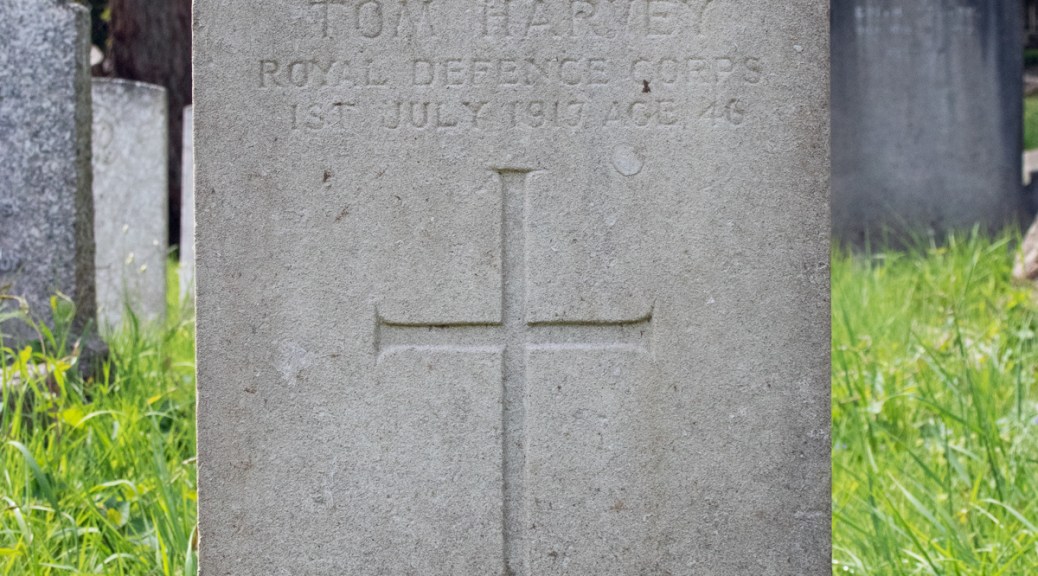
Serjeant Tom Harvey

Serjeant Tom Harvey

Tom Harvey was born in the spring of 1871, one of four children to John and Caroline. John was a fly driver, hiring out a pony and trap for a fee, while his wife brought in extra money working as a laundress. The family lived in Weston-super-Mare, on the Somerset coast, in a town house they shared with another family, the Painters.

Details of Tom’s early life is a bit sketchy. The 1891 census lists him as a Private in the Royal Marine Light Infantry, with his address as the Royal Naval Hospital in East Stonehouse, Plymouth, where he was ‘receiving treatment’. Sadly, none of his military records survive, so there is nothing to confirm his dates of service.

In 1894, demobbed and working as a cab driver in his home town, Tom married a woman called Sarah. Little other information exists about her, but what is known is that she worked as a dressmaker to supplement her husband’s income, and the couple did not go on to have any children. The couple lived in Hopkins Street, near the centre of Weston-super-Mare, and initially took in boarders to help finances.

By the time war broke out in 1914, Tom was in his forties. Eventually called back into service, he joined the 261st Company of the Royal Defence Corps and, with the role of Serjeant, he would have had men under his command. The 261st was part of Southern Command, which provided a territorial defence force, or Home Guard, and a lot of his time was spent in Birmingham.

It was while he was home on leave that Tom fell ill. The local media picked up the story:

The death occurred on Sunday under sudden circumstances of Sergeant Tom Harvey, Royal Defence Corps… The deceased was proceeding to his residence… when he fell, and was only able to give his address and to state that he was suffering from chronic indigestion before he expired. Prior to joining up as a National Volunteer, the deceased has been engaged as an omnibus driver.

Western Daily Press: Tuesday 3rd July 1917

Tom Harvey was 46 years old when he died. He was laid to rest in the Milton Cemetery in his home town of Weston-super-Mare.


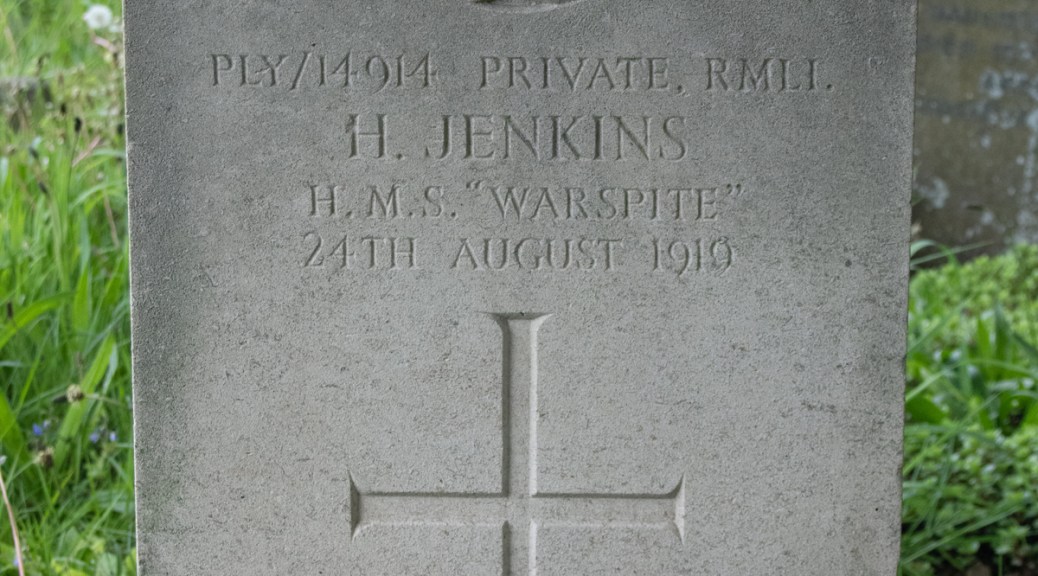
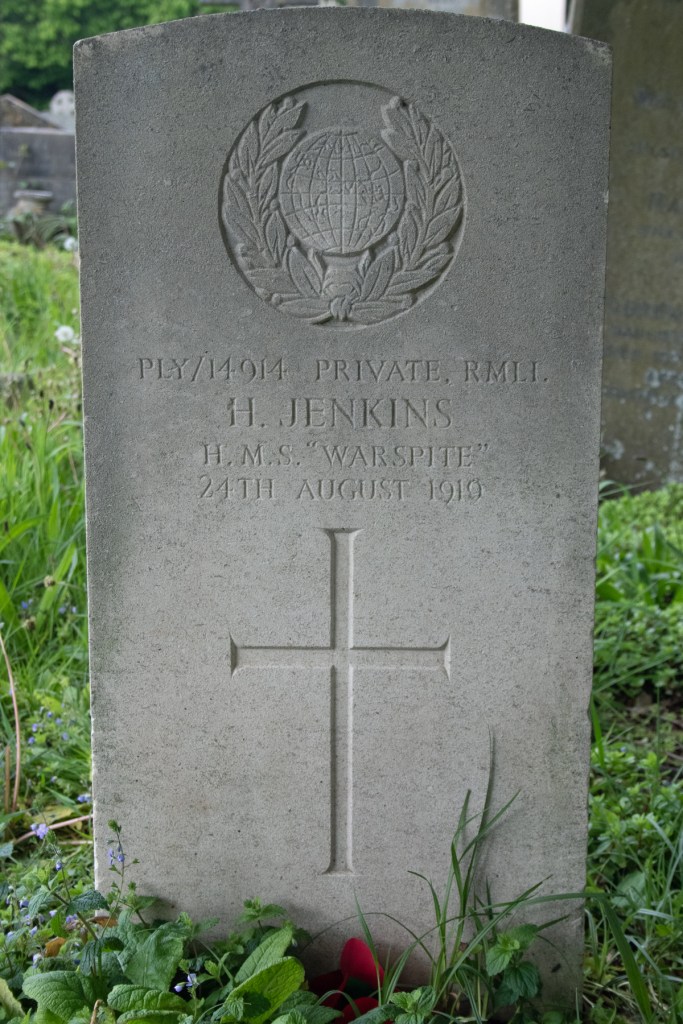
Private Herbert Jenkins

Private Herbert Jenkins

Herbert Jenkins was born in 1891, the youngest of five children to George and Amelia Jenkins. George was a domestic gardener, and the family lived in the Somerset village of Yatton next to the Prince of Orange public house. Amelia helped make ends meet, by working as a seamstress and upholsterer.

Amelia passed away in 1909, and it was around his time that Herbert felt the calling of military service. He enlisted as a Private in the Royal Marines Light Infantry on 17th September 1909.

Sadly, little documentation remains about Private Jenkins’ naval service, although the 1911 census gives his location as the Stonehouse Barracks in Devon.

Herbert’s family life held a series of highs and lows. His father George died in 1915, and he went on to marry Blanche Elvins, a bootmaker’s daughter from Bristol, the following year. Sadly, however, she passed away in December 1918, and Herbert was alone again.

By this time, the Great War was over, although Private Jenkins was still serving. He was assigned to HMS Warspite, which had fought, and been damaged, in the Battle of Jutland. While there is no evidence that Herbert had been on board during the skirmish, this is the last vessel on which he served.

As with his military career, details of Herbert’s passing are lost to time. All that is known is that he died in Bristol on 24th August 1919 and that the cause was ‘disease’. He was just 27 years of age.

Herbert’s next of kin was his sister Jennie; she brought him back to his home town of Yatton to be buried in the graveyard of St Mary’s Church.


Herbert Jenkins

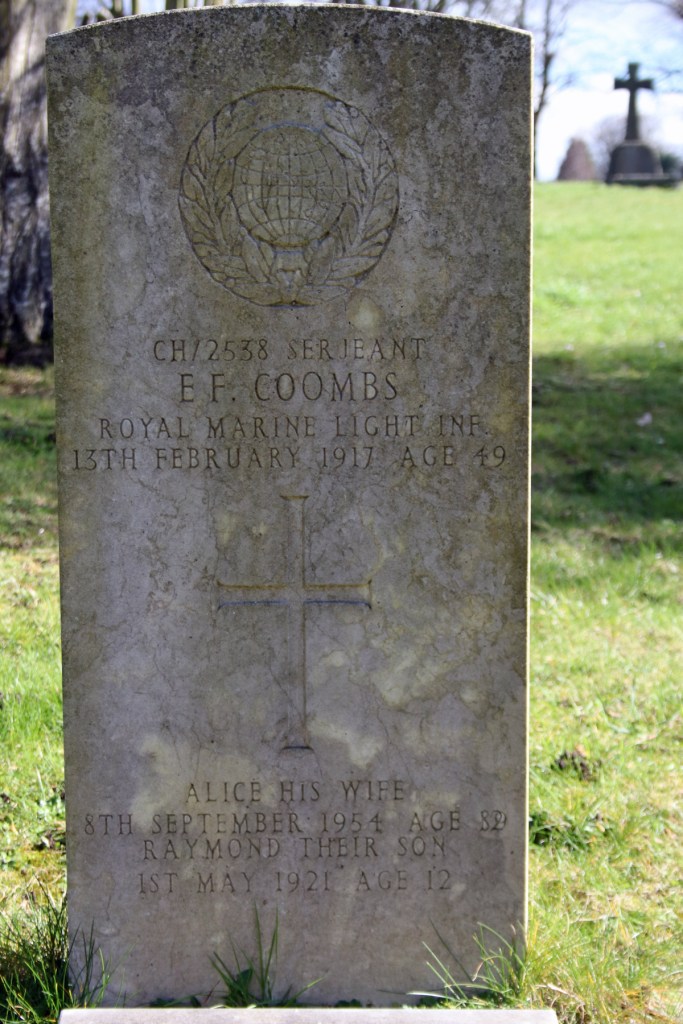
Sergeant Ernest Coombs

Serjeant Ernest Coombs

Ernest Frederick Coombs was born in the summer of 1866. One of four children to cabinet maker Frederick Coombs and his wife Julie, the family lived in Leatherhead, Surrey.

Unfortunately, the documentation around Ernest’s life is a little scattered. What we do know is that he married Alice Amelia Kinnear in June 1889, and the couple went on to have fourteen children.

Jumping forward, and by the time of the 1911 census, the family were living in a small terraced house on the outskirts of Dover. Ernest listed his trade as a canteen managed for a provision merchant.

Sadly, Ernest’s military records are also lost to time. He enlisted in the Royal Marines Light Infantry, and was promoted to Serjeant during his time there.

The only other information available about him comes from the obituaries section of a local newspaper in March 1917:

COOMBS: On February 13th, at the Royal Naval Hospital, Chatham, after a short illness, Ernest Frederick Coombs, aged 50 [sic] years (late of 14 Leighton Road, Dover). RIP

Dover Express: Friday 2nd March 1917

Ernest Frederick Coombs was actually 49 when he died; he lies at rest in the Woodlands Cemetery in Gillingham, Kent.


Ernest’s grave was also the last resting place for his youngest son, Raymond, who died aged just twelve years old, two months after his father, and his widow, Alice, who passed away in 1954, at the age of 82.


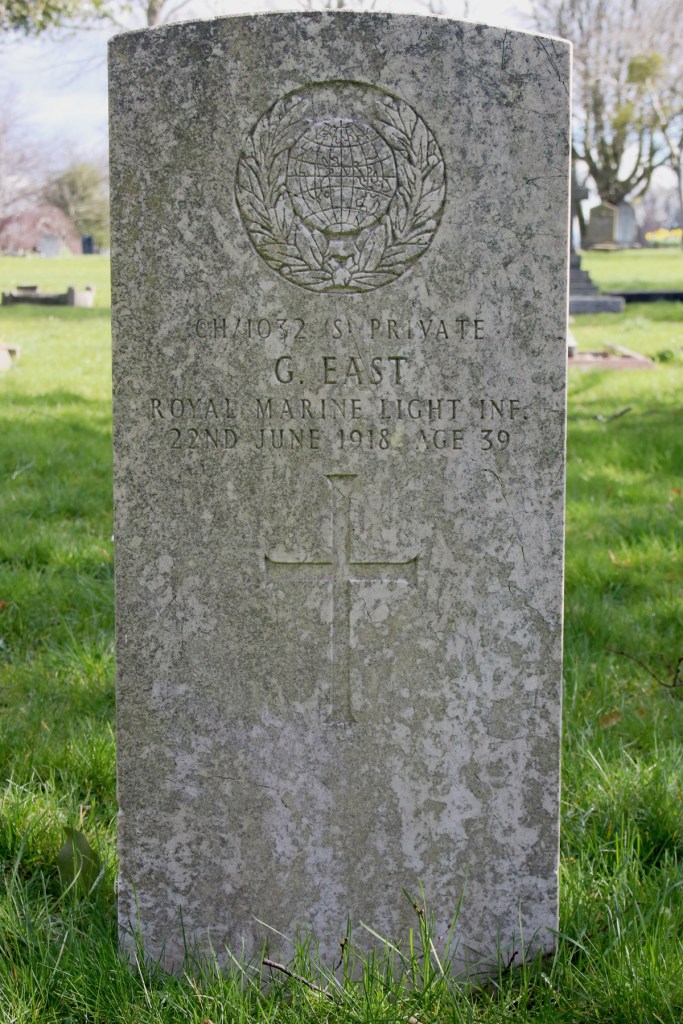
Private George East

Private George East

George East was born in 27th May 1879 to George and Agnes East. Agnes was George Sr’s second wife, which led to George Jr having four siblings and a further eight half-siblings. George’s father was a painter and handyman, who sadly passed away when his son was only seven years old.

Sadly, a lot about George remains a mystery, as a lot of documentation about him no longer exists. The snippets that are available give a tantalising glimpse into his life.

He married a woman called Jessie, and they had a daughter, Vera, who was born in July 1912.

George enlisted in the Royal Marine Light Infantry on 29th September 1915, and served at the Naval Dockyard in Chatham, Kent. Private East was based there for most of the war, but fell ill, succumbing to stomach cancer on 22nd June 1918. He was 39 years old.

George East lies at peace in the Woodlands Cemetery in Gillingham, Kent.


Sergeant Christopher Faulkner

Sergeant Christopher Faulkner

Christopher William Thomas Faulkner was born in 1881, one of five children to William and Harriet Faulkner. There is little information about Christopher’s early life, but the 1891 census shows him living with his mother and siblings in the St George’s Barracks in St Martin in the Fields in central London. William is not listed, so it can only be assumed that he was away on duty when the census was completed.

Christopher attended the military school; his record confirms that he was born on 17th June 1881, and spent four months at the school when he was ten years old. William is listed as a Sergeant and the family were living at the St George’s Barracks, which were located in the site now occupied by the National Portrait Gallery.

The military life was indelibly in Christopher’s life by this point. Whilst the records are sparse, he had certainly enlisted by the time he was 25. On Boxing Day 1904 he married a woman called Essie Brant, the daughter of a tailor from Croydon.

On the marriage certificate, Christopher was listed as a Lance Corporal in the Royal Marine Light Infantry and was based at the barracks in Chatham, Kent.

The young couple went on to have four children together and, by 1911, Essie was living in Gillingham, not far from the naval base in Chatham. The majority of Christopher’s career was served here, although when war broke out, he also saw conflict overseas.

By 1916, he was promoted to Sergeant and was assigned to HMS Dominion, which patrolled the North Sea. Ill health must have taken hold, however, and by the end of 1917, Sergeant Faulkner was reassigned to Chatham, before being medically discharged at the beginning of the following year.

Sadly, there is no record of the cause of his release from duty, but it appears to have been something to which he would eventually succumb. The next record is of Sergeant Faulkner’s death, on 5th January 1920, at the age of 39 years old.

Christopher William Thomas Faulkner lies at rest in the Woodlands Cemetery in Gillingham, Kent.


Christopher’s grave also acts as a memorial to his son.

Leslie Albert Gerald Faulkner was born on 9th June 1910. On leaving school, he sought military service like his father, and enlisted in the Royal Navy for a period of twelve years’ service.

Unusually, details of his service appear to end after just three years, in January 1929. However, later records confirm that he continued to serve at HMS Pembroke, the on-shore vessel in Chatham, through to the Second World War, achieving the rank of Chief Petty Officer.

Chief Perry Officer Faulkner’s military records did thrown up some further information, though. Surprisingly, his death records give specific details of the cause of his passing, stating that it was a “rupture of the liver due to secondary neoplasm of the liver, due to primary seminoma of testis”. In effect, Leslie had suffered testicular cancer, which then spread to his liver.

Leslie Albert Gerald Faulkner died on 28th November 1945, at the age of just 35 years old. He was buried in the same grave as his father, in Woodlands Cemetery, Gillingham.


Corporal Albert Shrubsall

Corporal Albert Shrubsall

Albert Arthur Shrubsall was born in Deptford, South London, in April 1896. He was the youngest of three children – all boys – to ironmonger George Shrubsall and his wife Jessie.

While his brothers continued to live at home after they had left school and got jobs, Albert found live-in work as a pageboy, or servant, for Wilfred Lineham, who was a professor of engineering for a London college. It was while he was working here that his mother, Jessie, passed away. She died in 1913, aged just 43.

Details of Albert’s military service are a bit scant. He enlisted in the Royal Marine Light Infantry, although I have been unable to confirm when he joined up. He was assigned to the Chatham Division, and was based at the Naval Dockyard in Kent, ultimately being promoted to Corporal.

Albert married Gertrude Spoore – affectionately known a ‘Ginty’ – in Deptford in October 1917. Sadly, the marriage was to las less than six months, as, on 9th April 1918, Albert passed away, having contracted pneumonia and septicaemia. He was just 22 years old.

Albert lies at rest in the Woodlands Cemetery in his adopted home town of Gillingham in Kent.


Albert’s two brothers George and Alfred were also involved in the First World War.


George, had gone on to become a tailor’s assistant when he left school. He married Emily Hawkes in 1911, and the couple went on to have a son, also called George, the following year.

When war broke out, he enlisted in the Machine Gun Corps, and served on the Western Front. Sadly, he was caught up in the fighting, and was killed in action on 22nd August 1917. He was buried at the Tyne Cot Memorial in Flanders.


When he left school, Alfred went on to become a butcher’s assistant. War came along, and he enlisted straight away.

Enrolling in the Royal Field Artillery, Gunner Shrubsall was assigned to the 95th Brigade. Sadly, he had recorded less than six months’ service, as he passed away on 8th January 1915, aged just 21 years old. His brigade did not go to France until the following year, so, while no cause of death is recorded, it is likely that he died from a communicable disease like influenza or pneumonia.

Alfred is buried in the family grave in Deptford, South London.


Within a period of just three years, George had lost all three of his sons to the Great War. Given the previous death of his wife, you can only imagine the heartbreak he was going through.