Category Archives: Worcestershire Regiment

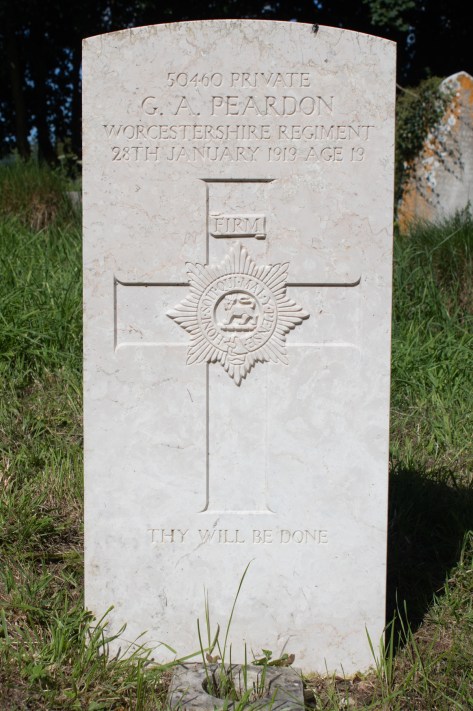
Private Garfield Peardon

Private Garfield Peardon

Garfield Ambrose Peardon was born on 24th February 1899, the older of two children to William and Margaret. Both farm labourer William, who had been widowed in 1885, and his second wife, Margaret were from Devon. The 1891 census found the extended family – Garfield and his parents and his older half-brother, William Jr., living in Market Street, Buckfastleigh.

Ten years later, and the family had moved just up the road to Market Street. Both of Garfield’s parents were working for the local woollen mill, William as a horseman and Margaret as a serge weaver. Garfield and his younger brother, Eric, were too young to work, and were both still at school.

Garfield stepped up to play his part for King and Country, although details of his service are a bit of a mystery. He had certainly enlisted by the start of 1918, presumably as soon as he came of age. He joined the Worcestershire Regiment, and was attached to the 3rd Battalion.

Private Peardon served in France, and was likely involved in the Battles of the Somme and Lys in the spring of 1918. His pension ledger records note that, on 27th May, he was recorded as ‘missing’: this was the day of a massive German gas and artillery bombardment and, in the confusion that followed, it appears that Garfield was identified as a potential casualty.

At this point, Private Peardon’s trail goes cold. The next available document is his entry on the Army Register of Soldiers’ Effects: this confirms that he passed away on 28th January 1919 in the 2nd Scottish General Hospital in Edinburgh. This would suggest that Garfield was wounded in the attack, and medically evacuated to Britain for treatment. He was a month short of his 20th birthday when he died.

The body of Garfield Ambrose Peardon was taken back to Devon for burial. He was laid to rest in the the grounds of Holy Trinity Church, Buckfastleigh.


Second Lieutenant Clement Edwards

Second Lieutenant Clement Edwards

Clement Edward Arthur Edwards was born in the summer of 1898, and was the oldest of six children to Clement and Caroline Edwards. Clement Sr was a colonel in the army, and had been born in Dublin, Ireland. His wife hailed from Cheltenham, Gloucestershire, but it is clear that the family travelled as it grew, as each of the Edwards children were born in a different location. Clement Jr was born in Devon, while Caroline had given birth to his younger siblings in locations as distant as Sussex, Hampshire and the West Indies.

By the time of the 1911 census, Clement Sr had retired from duty. The family had settled back in Devon, and were living in the 12-roomed North Grange in the village of North Lew. Clement and Caroline employed five staff, including a cook, a nurse, a housemaid, a kitchen/parlour maid and a stable boy.

It seemed inevitable that Clement Jr would have followed his father into the army. Sadly his service records are lost to time, but a later newspaper report gives an insight into this time in the army:

Colonel and Mrs Edwards of Townsend House, Halberton, have the sympathy of all their friends and neighbours in the loss they have sustained by the death of their eldest son, 2nd-Lieut. Clement Edwards Alexander Edwards, of the Worcestershire Regiment, from pneumonia, following influenza, at the Northern General Hospital, Newcastle-on-Tyne [sic]. Edwards was formerly at Blundell’s School. He joined up at the earliest possible opportunity, obtaining a commission in his father’s regiment. He was a great favourite with all who knew him.

[Tiverton Gazette: Tuesday 10th December 1918]

Clement Edward Alexander Edwards died on 5th December 1918: he was just 20 years of age. His body was taken back to Devon for burial. He was laid to rest in the peaceful graveyard of St Andrew’s Church in Halberton.


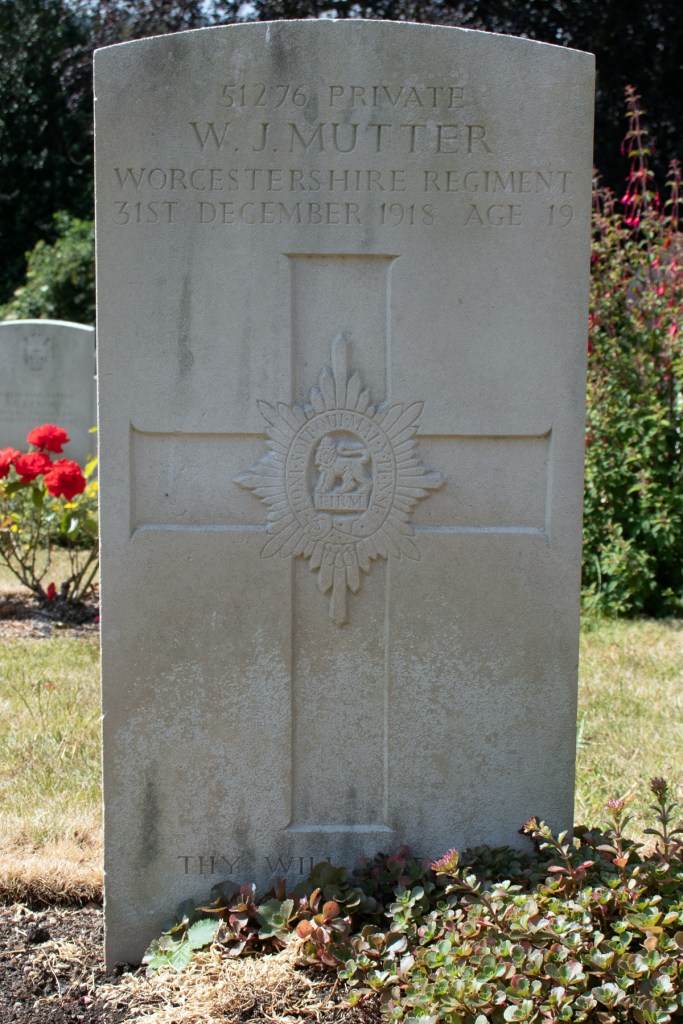
Private Walter Mutter

Private Walter Mutter

Walter John Mutter was born in the spring of 1899, the youngest of four children to William and Sarah. William was a lime burner from Pitminster in Somerset, but the family had settled in nearby Corfe by the time Walter was born.

The 1911 census recorded the Mutters as still living in Corfe; William and his two eldest sons – Harry and Francis – were working as farm labourers, while Walter was still at school.

When war came to Europe, Walter was keen to step up and play his part. Full details of his service are unclear, although he probably did not enlist early in the conflict, because of his young age. Private Mutter had joined the Worcestershire Regiment probably by the start of 1918, and soon found himself overseas.

An inquest was held at Bath… on Private Walter John Mutter, 8th [Battalion of the Worcestershire Regiment]. It was stated that deceased was only 19, and had been a prisoner in German hands three months behind enemy lines carrying munitions. He told his brother he had been served badly by the Germans, and was kicked and struck with the butt end of a rifle. A doctor said his legs below the knees were covered with the scars of very severe sores. He was practically starved, his food consisting of two meals daily, a bit of black bread and a kind of turnip wash. He was admitted to Bath War Hospital in a starved, emaciated, and debilitated condition, and although he improved in health, he died in the hospital after spending Christmas at his home near Taunton. A post mortem revealed that the wall of deceased’s stomach, which was as thin as blotting paper owing to starvation, was ruptured. His appetite was good while home, and he had probably given his debilitated stomach too much work. Death was due to hemorrhage [sic], but the state of starvation was dur to ill treatment by the Germans. A verdict in accordance with the evidence was returned, the Coroner commenting on the German brutality to their prisoners that the case revealed.

Wells Journal: Friday 10th January 1919

Walter John Mutter died on 31st December 1918, aged just 19 years old. He was laid to rest in the army section of Bath’s Locksbrook Cemetery, not far from the hospital where he had passed away.


Private Godfrey Beames

Private Godfrey Beames

Godfrey George Beames was born in the spring of 1891, in Henbury, Gloucestershire. One of eleven children, his parents were Thomas and Minnie Beames. Thomas was in the navy, which meant that Minnie was left to her own devices a lot of the time. While her husband came home often enough for them to build a large family, the 1891 and 1901 censuses record Minnie and the children living with her farm labourer brother-in-law, George Watkins.

The 1911 census gives the same information for Minnie and the children – living with George in Redwick, Gloucestershire. Minnie is, however, noted as a widow, although this seems to be out of convenience, as the now naval pensioner Thomas was living with his wife of eight years, Louisa, in Arundel, West Sussex.

Godfrey, now 21 years old, was working as a farm labourer. In the autumn of 1913, he married a woman called Lily Ball, although little information about her remains today. War was coming to Europe, and things were to change for the young couple.

Godfrey stepped up to play his part. While his full service records no longer exist, what remains paints a picture of his time in the army. He had enlisted by the spring of 1917, joining the Royal Engineers. At some point, however, he moved to the Worcestershire Regiment, and was assigned to the 10th (Service) Battalion.

While it’s not possible to determine exactly where Private Beames fought, he was definitely caught up in the fighting on the Western Front and, by October 1917, was entrenched at Passchendaele. It was here that he was wounded, and he was medically evacuated to Britain for treatment.

Private Beames was admitted to the General Hospital in Nottingham, but his injuries were to prove too severe. He died on 15th November 1917, at the age of just 26 years old.

Godfrey George Beames’ body was brought back to Somerset for burial. He was laid to rest in the graveyard of Ss Mary and Peter’s Church in Winford, where Lily was now living.


Private Godfrey Beames
(from ancestry.co.uk)

Private Henry Wiggs

Private Henry Wiggs

Henry Wiggs was born in Camberwell, Surrey, in the autumn of 1880. One of eleven children, his parents were dock labourer Thomas Wiggs and his wife, Sarah.

When he finished his schooling, Henry also took up labouring work and, by the time of the 1911 census, was working as a partition block maker in the building trade. The census shows him a living with his brother William and his family.

On 3rd August 1913, Henry married Blanche Hill. She was eight years older than Henry, and the daughter of a Sergeant in the Royal Horse Artillery. Blanche had been widowed ten years earlier, and had four children, who Henry took on as his own.

At this point, Henry’s trail goes cold. When war broke out, he stepped up to play his part, initially joining the Worcestershire Regiment. At some point he was transferred to the Royal Berkshire Regiment, subsequently becoming attached to the Labour Corps.

Details of Private Wiggs’ military service are lost to time, and it is unclear whether he served on the Home Front or overseas. He survived the war, and was discharged from the army on 13th March 1919. He was suffering from heart disease, directly attributable to his military service.

Again, Henry falls off the radar at this point. He and Blanche made the move to Somerset, setting up home in Weston-super-Mare. His heart problem seems to have dogged him, however, and likely caused his admission to a hospital in Bath towards the end of 1920. It was in the city that he passed away, on 28th December 1920, at the age of 40 years old.

Henry Wiggs’ body was not brought back to Weston-super-Mare for burial – the cost of doing so may have been too much for the now twice-widowed Blanche to afford. Instead, he was laid to rest in the sweeping Locksbrook Cemetery in Bath.


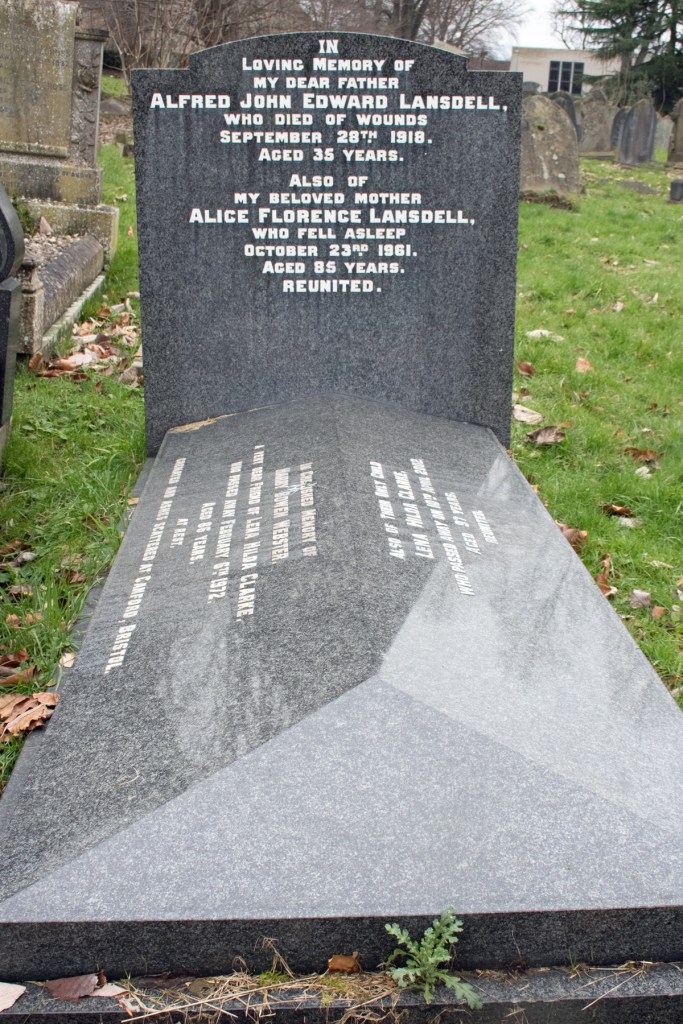
Private Alfred Lansdell

Private Alfred Lansdell

Alfred John Edward Lansdell was born on 25th October 1882 in Fulham, London. The fourth of six children, his parents were James and Matilda Lansdell.

James was a trunk maker, working in his father’s business. By the time of the 1901 census, he was recorded as living by his own means, while Alfred had taken up employment as a hotel porter in Chelsea.

By 1902, Alfred had moved to Somerset and set up home in Bath. He married local woman Alice Stevenson, and the couple went on to have a daughter, Lena, who was born in November 1904.

The 1911 census found the family living in central Bath, Alfred continuing his portering work, with one of his colleagues, lift operator Thomas Ward, boarding with them.

War came to Europe and on 9th December 1915, Alfred stepped up to play his part. He enlisted in the Worcestershire Regiment, and was formally mobilised the following June. Alfred’s service records confirm that he was, at the time of his review, he was 35 years old and 5ft 6ins (1.67m) tall.

Private Lansdell was assigned to the 1st/7th Battalion and by October 1916, he was shipped to France. He was very much on the Front Line, and was wounded on 19th August 1917, while at Ypres. His casualty record notes that “while waiting in a shell hole for a further move on he was wounded… in the back”. He has been shot, and the bullet penetrated his kidney.

Initially treated in a hospital in France, Private Lansdell was transferred to England on 25th October. He was admitted to the Norfolk War Hospital and remained there for some time.

Alfred’s injuries were too severe for him to continue in the army, and he was formally discharged on 20th March 1918. He eventually returned home to Bath, but in the end his poor health was to get the better of him. He passed away at home on 28th September 1918, at the age of 35.

Alfred John Edward Lansdell was laid to rest in St James’ Cemetery, Bath. Alice lived on until 1961, when she was buried with her late husband, a couple reunited after more than four decades.


Second Lieutenant Eric Guillebaud

Second Lieutenant Eric Guillebaud

The death occurred on Thursday of Mr Eric Cyril Guillebaud. Deceased was the youngest son of the late Rev. ED Guillebaud, Rector of Yatesbury, near Calne. On the outbreak of war he joined the Army, and was given a commission in the 11th (Service) Battalion of the Worcestershire Regiment. His physical strength not being equal to his patriotic zeal, he broke down under the strain of military duty. He came to rest at Combe Royal, Bathwick Hill, where his brother, Mr H Guillebaud, resides, but on medical advice entered a nursing home. Mr Guillebaud was 22 years of age. He was officially invalided from the Army six weeks ago. Deceased was a nephew of the late Mr Charles Marshall, of The Sycamores, Bathford, and the interment will take place in the churchyard there on Tuesday next.

Bath Chronicle and Weekly Gazette: Saturday 5th June 1915

Little further information is available on the life of Eric Guillebaud. The 1901 census confirms that he was living at The Rectory in Yatesbury, with an extended family: his parents, Reverend Erneste and Mabel Guillebaud; his maternal grandfather, William Marshall; his maternal uncle, Charles; and his cousin, William. The family also employed four servants: a nurse, cook and two housemaids.

There is no information relating to Eric’s military service, although it is clear from his headstone that he reached the rank of Second Lieutenant. His troop – the 11th Battalion of the Worcestershire Regiment – was based on Salisbury Plain and, from subsequent reports, uniforms and equipment were not provided until the spring of 1915: everything up to then was improvised.

The 11th Battalion did not leave for France until September 1915, three months after Eric’s passing: he would not, therefore, have seen any action overseas.

The only other document relating to Second Lieutenant Guillebaud is his probate record. This confirms that he died on 3rd June 1915 at 15 Somerset Place, Bath. His effects – totalling £5041 18s 10d – were left to his brother, Harold, who was listed as a gentleman.

Eric Cyril Guillebaud was 32 years old when he died. He was laid to rest in the graveyard of St Swithun’s Church, Bathford.


Private Herbert Cleal

Private Herbert Cleal

Herbert Henry Cleal was born on 6th November 1899, in the Somerset village of Hambridge. The tenth of twelve children, his parents were Daniel and Emily Cleal.

Daniel was a cowman on a farm, and it is likely that Herbert would have started in agricultural labouring, had war not intervened.

Full details of Herbert’s military service are not available, although it is clear that he had enlisted in the Worcestershire Regiment by the summer of 1918. By this point in the war, Private Cleal’s battalion – the 2nd/8th Battalion – was already in France, although, according to his records, it does not appear as if he saw any service overseas himself.

The only other record for Herbert is his entry in the Army Register of Soldiers’ Effects. This confirms that he passed away at Bradford War Hospital on 1st January 1919. The cause of his passing is not noted, but he had just turned 19 years of age.

Herbert Henry Cleal was brought back to Somerset for burial. He was laid to rest in the graveyard of St James-the-Less Church in his home village of Hambridge.


Private Frederick Best

Private Frederick Best

Frederick William Best was born in Wellington, Somerset, early in 1898 and was the middle of three children to factory worker Frederick Best and his wife, Bessie. When he left school, he found work as a delivery boy for a local baker, unlike his father, who was a long-time working in the local woollen factory.

War was closing in on Europe, however, and Frederick Jr was soon keen to play his part. Full details of his military service are not available, but it appears that he enlisted in the Worcestershire Regiment as soon as he was able, Private Best was assigned to the 15th (Transport Workers) Battalion, and served on home soil, initially in Swindon, and then in Southampton.

It was while he was billeted in Hampshire that Frederick contracted meningitis. He was admitted to a hospital in the city, but the condition was to get the better of him, and he passed away on 2nd January 1918, aged just 19 years old.

Frederick William Best’s body was brought back to Somerset for burial. He was laid to rest in the cemetery in his home town, Wellington, where his parents were both buried in the 1930s.


Private Alfred Beake

Private Alfred Beake

Alfred Beake was born in December 1898 and was one of nine children to Alfred and Charlotte Beake. Alfred Sr was a baker from Westonzoyland in Somerset, but it was in Chard that he and Charlotte had set up home and raised their family.

There is little documented about Alfred’s life. He played his part in the First World War, and had joined the Worcestershire Regiment by November 1918. His troop – the 5th (Reserve) Battalion – was a territorial force, and he would have split his time between Harwich, Essex, and Plymouth, Devon.

Private Beake survived the war and, by the spring of 1919 had been moved to Dublin. It was here on 18th May that he met with colleagues Private Simpson and Swindlehurst in the centre of the city. The trio caught a tram to the coastal town of Howth for a day out, where tragedy struck.

The Dublin Evening Telegraph reported on what happened next:

Private Sydney Simpson, Royal Engineers, stated… when they got to Howth, they walked along the Cliff Walk for about a mile, when they saw some seagulls down the cliff. [Beake and Swindlehurst] went out of witness’s sight for a while, when he heard a shout from Swindlehurst for help. On hurrying back, he saw Swindlehurst looking towards the sea, and he said the deceased had slipped down. The cliff was so steep that, although they tried to get down, they could not do so. Witness sent for help. None of the party had taken any drink.

Private Swindlehurst… said that he and deceased climbed down the grassy slope to get some seagulls’ eggs, but that the deceased suddenly slipped down. There was no horseplay going on at the time when the accident took place.

Captain Wynne, Royal Army Medical Corps, who made a post mortem examination, described the terrible injuries which the deceased had sustained. Death must have been instantaneous.

Dublin Evening Telegraph: Wednesday 21st May 1919

Private Beake had suffered a fractured skull from the fall. He was just 20 years of age.

Alfred Beake’s body was brought back to Somerset for burial. He was laid to rest in the family plot in Chard Cemetery.


Alfred’s oldest brother, Walter George Beake, had also served in the First World War.

Private Beake fought with the 7th Battalion of the Somerset Light Infantry, and was involved in some of the key skirmishes of the Somme. But it was at Ypres that he was buried alive during an attack, and the resulting shell shock left him totally incapacitated.

Walter was discharged from the army on medical grounds in September 1916. He returned home to try and piece his life together again. He never married, and passed away in December 1978, at the age of 87 years old.