Thomas Jones (known as Tom) was born in Wednesbury on 7th September 1882 and was the middle of seven children. His father, also called Thomas, was a grocer and, with his mother Mary, they raised their family first in the Staffordshire town and then in Blackpool, Lancashire.
When he left school Tom helped his dad in the shop, primarily dealing with meat. His mind was on greater adventures, however, and in November 1898, he enlisted in the Royal Navy. Due to his age, he was initially given the rank of Boy, but was officially signed up as an Ordinary Seaman on the day after his 18th birthday.
Over the time of his initial twelve years’ service, Tom rose through the ranks, from Able Seaman to Leading Seaman and Petty Officer. In May 1912, however, he was ‘disrated’ back to Able Seaman, but there is no evidence to confirm why this was done. By this time, he had served on nine ships, as well as having time in shore-based establishments, and had completed his twelve years as a mariner.
Meanwhile, in the autumn of 1904, Tom had married Hannah Kennedy, a dockyard labourer’s daughter from Gillingham, Kent. The couple went on to have four children and set up home in the centre of the town, not far from the Naval Dockyard where Tom was sometimes based.
With war in Europe on the horizon, Tom immediately volunteered to continue his duty when he term of service came to an end. Working hard, he soon regained the rank of Leading Seaman and, by April 1915, was back up to Petty Officer once more.
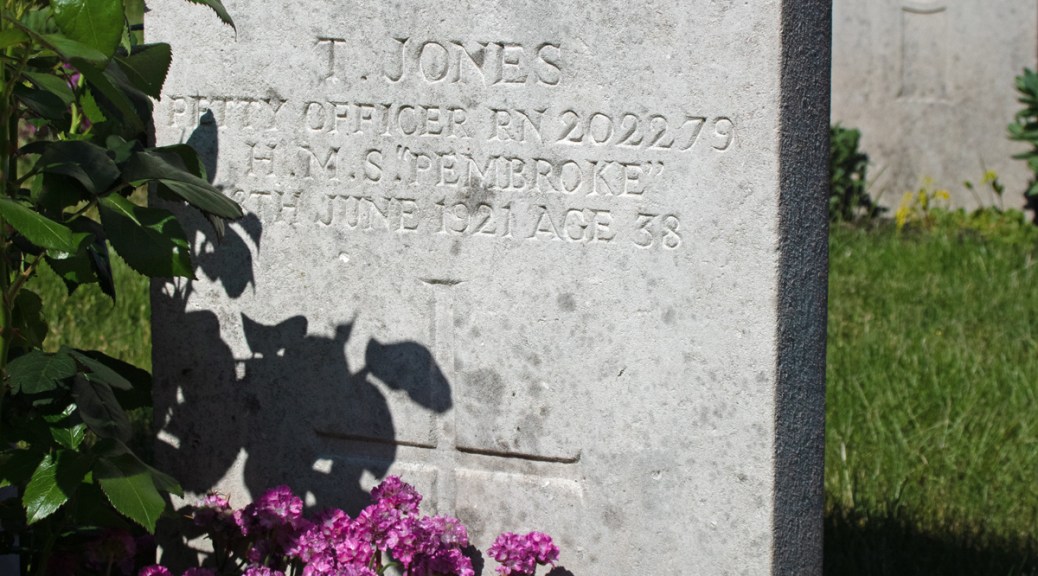
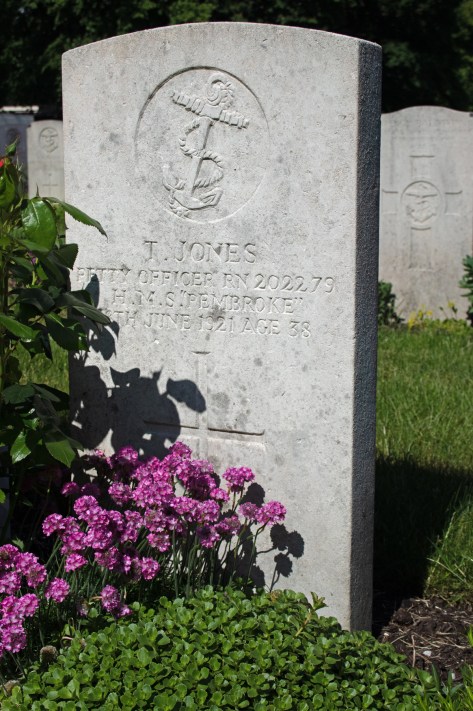
During the remainder of his time in the Royal Navy, Petty Officer Jones served on a further seven vessels. In October 1920, after more than two decades’ service, he was invalided out, having contracted tuberculosis, rendering him unfit to continue.
At this point Tom’s trail goes cold. It seems likely that his lung condition got the better of him; he passed away on 20th June 1921, at the age of 38 years old.
Petty Officer Tom Jones was laid to rest in the Woodlands Cemetery in Gillingham, Kent.
Petty Officer Tom Jones (courtesy of ancestry.co.uk)
William Edmund Dale was born in Worthing, West Sussex on 25th November 1886 and was the older of six children. His father, also called William, was a carman, and he and William’s mother, Eliza, brought the family up in the Sussex town.
William Jr seems to have had a number of jobs, working as a draper’s errand boy, a milkman’s assistant and a gardener. He found his true calling at the age of 12, however, when he enlisted in the Royal Navy.
Initially acting as a Boy 2nd Class, over his initial twelve years’ employ he served on eleven vessels, and rose through the ranks to Boy, Ordinary Seaman and Able Seaman.
It was while serving on HMS Blake in 1910, that he married Mary Williams. The couple went on to have two children, William, born in 1910, and Harry, born the following year. The family set up home in Portsmouth, where the sailor was based.
With his initial service complete in 1916, William’s term of duty was extended until the end of hostilities. A promotion to Leading Seaman followed, and he was assigned to HMS Attentive, part of the Dover Patrol guard.
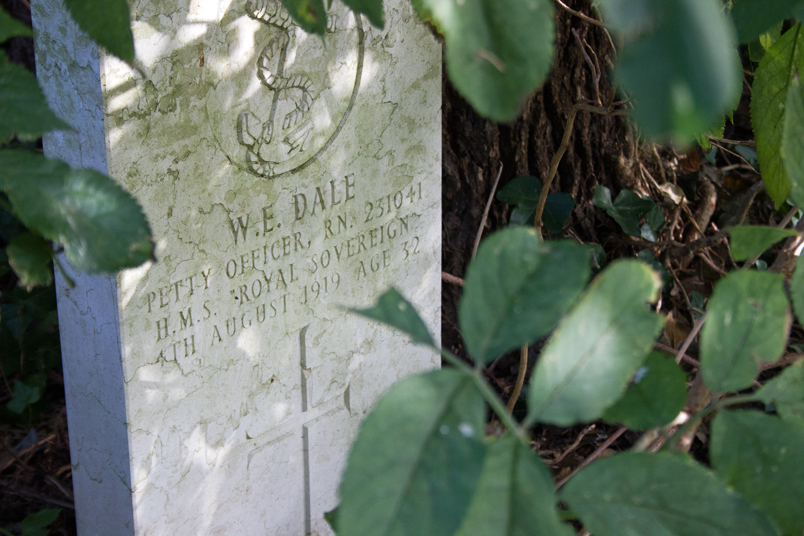
In 1917, William was promoted again, this time to the role of Petty Officer, and was assigned to HMS Royal Sovereign, the Navy’s new battleship. He served on the vessel for the remainder of the way, and through into the summer of 1919.
It was in the last month of his service, that Petty Officer Dale fell ill. He was taken ashore, and sent to the Royal Naval Hospital in Chatham, Kent. He had contracted meningitis, and sadly succumbed to it within days of being admitted. He died on 4th August 1919, at the age of just 32 years old.
William Edmund Dale was brought back to the town of his birth; he lies at rest in a quiet corner of the Broadwater Cemetery in Worthing, West Sussex.
Charles Frederick Clarke was born on the 14th April 1869 to James and Jane Clarke. James was born in Suffolk, but moved to London, where he found work as a watchman (guarding the city streets at night). Jane was from Essex, and the couple went on to have five children, of whom Charles was the middle child.
Charles was set on a life of adventure, joining the Royal Navy in 1887, for a period of twelve years. During this time, he served on eleven vessels, working his way up through the ranks from Boy to Ordinary Seaman to Able Seaman, Leading Seaman and eventually Petty Officer.
In October 1895, he married Lydia Rogers, a sailor’s daughter from Portsmouth. The couple would go on to have nine children, eventually settling in Sussex.
When his naval service ended in 1899, Charles enlisted again. Within six years, he had achieved the rank of Chief Petty Officer, and in March 1909, after 22 years’ service, retired from active duty. He was obviously well respected, however, and was selected to serve on the staff of the Royal Naval Recruiting Office in Portsmouth. His service records suggest that he resigned from this role on 14th April 1914.
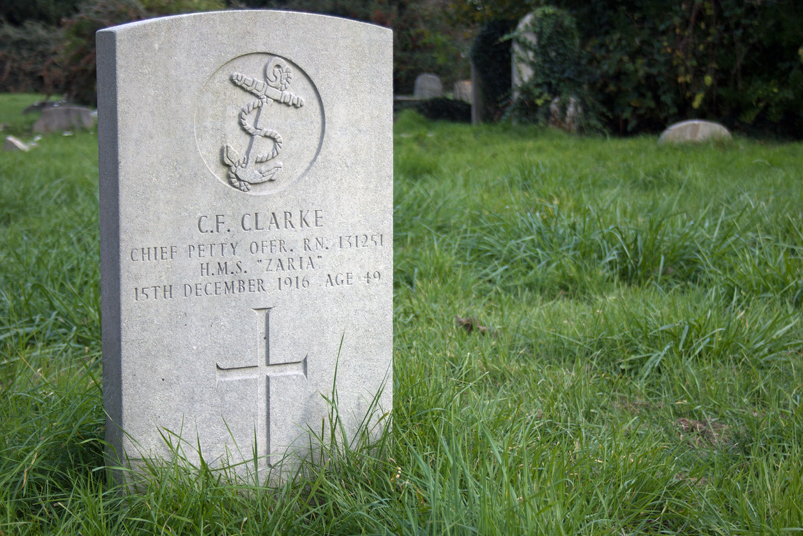
It seems that Chief Petty Office Clarke took on a role on the vessel HMS Zaria. This was a ship that was requisitioned by the Royal Navy, which acted as a patrol ship, guarding the coastal waters around the UK. While details are scant, Charles certainly served on board for a couple of years, and he died on board, from causes undisclosed, on 16th December 1916, at the age of 47 years old.
Brought back to West Sussex, Charles Frederick Clarke was laid to rest in the Broadwater Cemetery in Worthing. This was where Lydia was now living; she was buried in the same grave, when she passed away eight years after her husband.
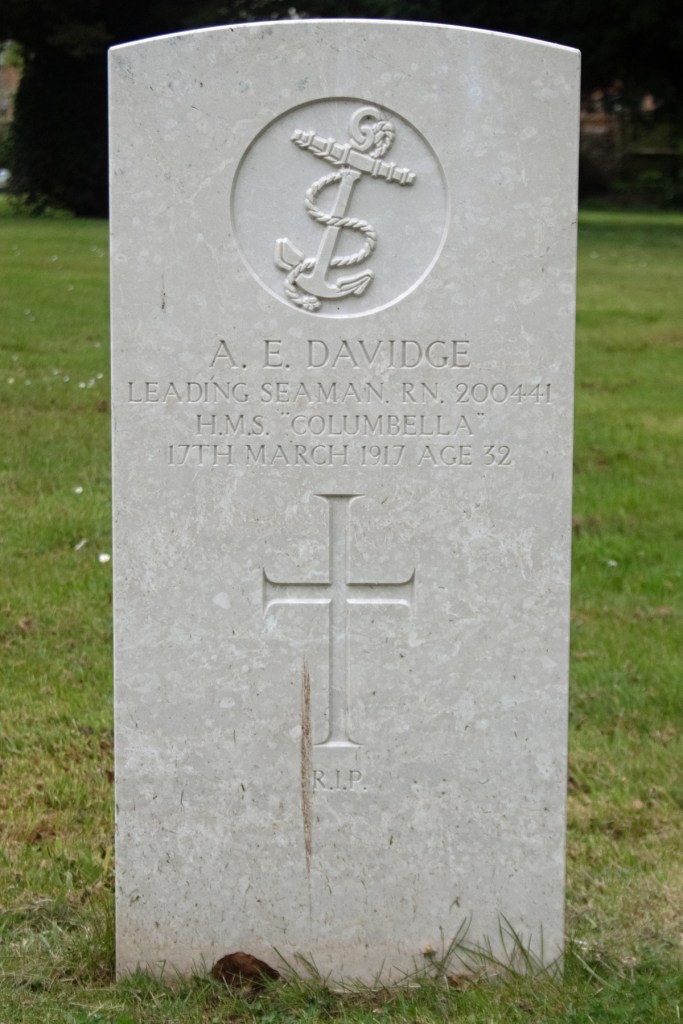
Alfred Ernest Davidge was born on 22nd July 1882, one of six children to Richard and Ermina. Richard was a boilermaker from Bristol, but brought his family up in the Wiltshire town of Swindon.
Alfred was keen on adventure, and sought out a live on the open seas. In August 1898, at the age of sixteen, he joined the Royal Navy. After serving two years at the rank of Boy, he officially enlisted for a term of twelve years.
Starting as an Ordinary Seaman, Alfred had worked his way up to Leading Seaman by 1905. He continued in this role until 7th June 1909, when he was knocked back a rank for misconduct. He evidently realised the error of his ways, however, as, just over a year later, he was promoted again.
Leading Seaman Davidge’s term of service came to an end in July 1912, and, having been assigned to seventeen vessels during that time, he became part of the Royal Naval Reserve.
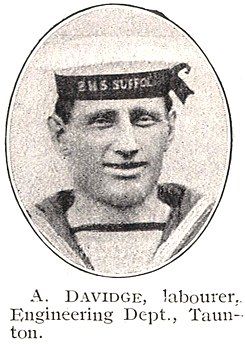
Back on home soil, and Alfred set up home in Taunton. He found work as a labourer and, in October 1913, married local lady Louisa Pomeroy. The couple went on to have a daughter, Hilda.
Storm clouds were gathering over Europe by now, and Alfred was soon recalled to the Royal Navy. He took up his previous role, and, after a period of training at HMS Vivid in Plymouth, he was assigned to HMS Suffolk.
Leading Seaman Davidge spent eighteen months aboard HMS Suffolk (during which time the photo below was taken), before being transferred to HMS Columbella in November 1916. His time there was short, however, as he became unwell.
Admitted to the Royal Infirmary in Glasgow with influenza, Leading Seaman Davidge sadly succumbed to the condition on 17th March 1917. He was 34 years old.
Alfred Ernest Davidge was brought back to Taunton for burial. He lies at rest in the St James Cemetery in the town.
Gerald Montague Brine war born in October 1897, the youngest of seven children to John and Annie Brine. John was a potter, and, while the children were born in Dorset, the family soon moved to the Somerset village of Binegar.
Gerald’s three older brothers all went to work in a local stone quarry, as an engineer, breaker and foreman respectively. When Gerald left school, he found work with the local blacksmith as a striker. It was while employed there, in 1912, that his mother Annie passed away, aged just 50 years old.
War was on its way however, and where his brothers enlisted in the army, Gerald was bound for the sea. He enlisted in the Royal Navy on 3rd November 1915 and, as an Ordinary Seaman, was assigned to HMS Iron Duke. He was aboard the vessel when it became embroiled in the Battle of Jutland in May 1916, and was subsequently transferred to HMS Discoverer.
Promoted to Able Seaman in April 1918, the Discoverer headed back to Chatham a couple of months later. A Somerset newspaper picks up on Gerald’s sad tale from there.
When one of His Majesty’s ships was returning to port, and her crew were looking forward to “leave”, an unfortunate tragedy occurred by which Gerald Montague Brine, a young Able Seaman [and] a native of Binegar, lost his life. It appears that in the course of storing gear, a loaded revolver was removed by mistake to the armourer’s room, instead of to the officer’s cabin, and was placed on a table.
Curiosity led Peter Macfarlane, another able seaman, to handle it, and as he was bringing it to his side from an upward position, he, to use his own words, unconsciously pulled the trigger. It fired, and the bullet entered Brine’s body just under his left shoulder, fracturing his spine and producing paralysis of his lower limbs.
Wells Journal: Friday 12th July 1918
Gerald’s parents had a telegram to say that he was seriously wounded and in the Royal Naval Hospital, Chatham. They travelled at once to Chatham and found him very ill, but conscious. They remained with him until he died a week later, on 1st July 1918. He was just 20 years of age.
At the inquest, Macfarlane described Brine as his best chum, and all witnesses agreed that “the best possible relations existed between the members of the crew.” According to the doctor’s evidence at the inquest, Gerald was unable to be saved. The jury reached a verdict of Accidental Death.
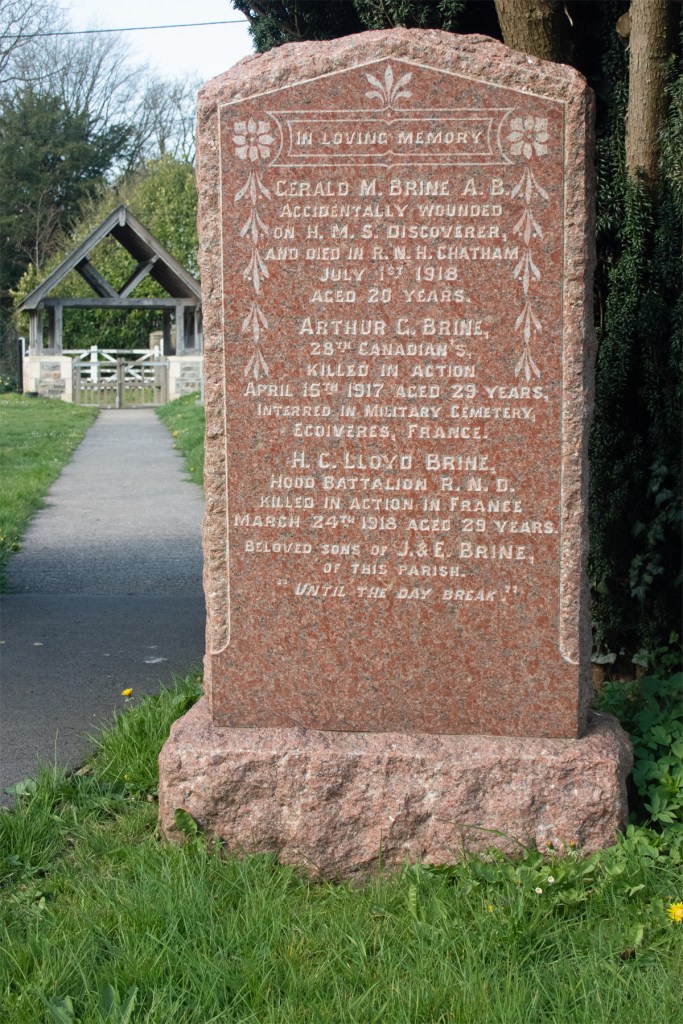
Able Seaman was brought home to Binegar, and lies at rest in the graveyard of Holy Trinity Church.
Gerald’s grave also acts as a memorial to two of his older brothers.
Arthur Brine, who had been the stone breaker in the quarry, emigrated to Canada after his mother had died, finding work there as a fireman. The Great War brought him back to European shores, however, and he enlisted in the Canadian Expeditionary Force, joining the 188th Battalion.
Private Brine arrived in England in October 1916; he transferred to the 28th Canadians, and set off for France the following January. He was caught up in the Battle of Arras and was hit and killed by a piece of shrapnel on 15th April 1917. He was just 29 years old.
Arthur Brine lies at peace in the Ecoivres Cemetery to the north west of Arras in Northern France.
Herbert Brine had been the foreman at the stone quarry He married Sarah Lucy James shortly before his mother’s death in 1912; the couple went on to have two children, Arthur and Kenneth.
Herbert was mobilised in July 1917, initially joining the 3rd Reserve Battalion. He was drafted, as an Able Seaman, to the Hood Battalion, Royal Naval Division (RND) in November 1917, before re-joining his RND Battalion at Flesquières, near Cambrai, two months later.
In early March 1918, the Germans started bombardments in preparation for a major offensive. For ten days from 12th March, the Flesquières salient was drenched with nearly a quarter of a million (mostly mustard) gas shells, There were over 2,000 resultant casualties in the RND. After this preparatory shelling, the Germans attacked in enormous numbers.
By the end of the day, the situation was precarious and the Division was forced to retreat in steps, through Bertincourt, Ytres and the Metz lines, through the old Somme battlefields.
Able Seaman Brine was first reported missing on 24th March, but was only accepted as having been killed in action on that date nine months later. As such, Herbert is commemorated by name on the Arras Memorial; his name also resides on Gerald’s gravestone back home in Binegar.
The Great War took its toll on the Brine family. Three of the four brothers died during those tumultuous years, leaving only John’s oldest son, Wallace, to carry on the family name. John himself died in 1942, aged 84, and lies with his wife and youngest boy in the small Binegar churchyard.
Albert Brooks was born in February 1877 in Cambridge. Sadly, a lot of the documentation for his early life is lost to time, but he enlisted in the Royal Navy in July 1893, at the rank of Boy 2nd Class.
He formally enrolled in naval service in February 1895, initially for a period of twelve years. Beginning as an Ordinary Seaman aboard HMS Thunderer, during his initial time in the navy, he was promoted to Able Seaman and then Petty Officer 2nd Class, while serving on vessels including Hawke, Wildfire, Eclipse and Vernon.
In 1904, Albert married Rosina Wise. A couple of years younger than her new husband, she had been born in Camberwell, South London. The couple had a daughter, Gwendoline, and they set up home in Gillingham, Kent, where Albert was based when not at sea.
War was on the horizon, however, and Petty Officer Brooks’ naval service was extended until the end of the conflict.
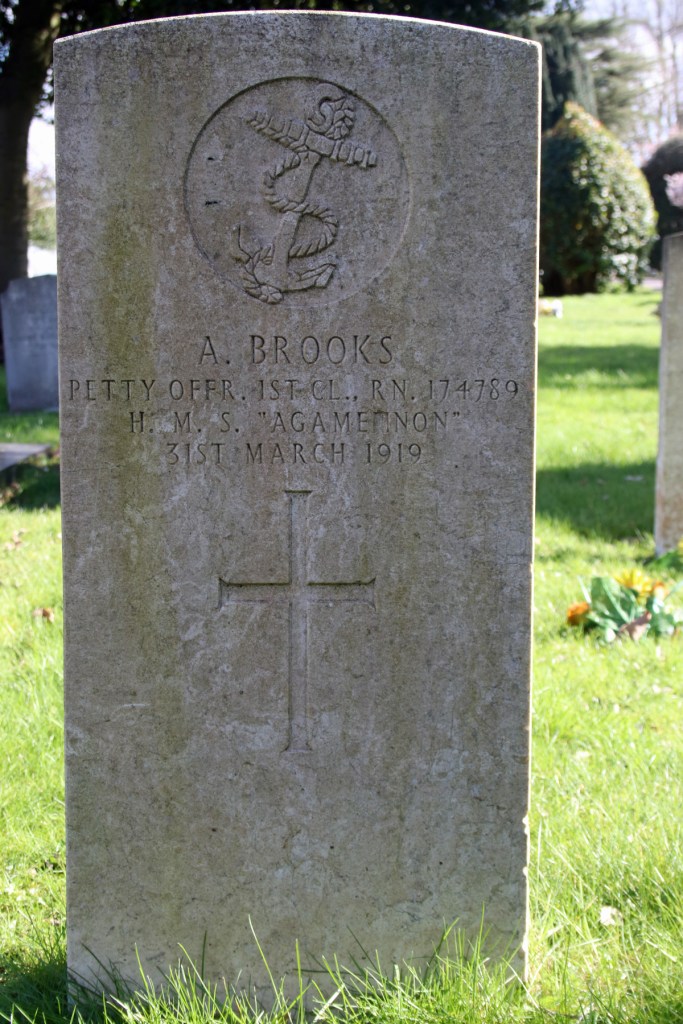
Albert was promoted to Petty Officer 1st Class, and continued his service on vessels that included Andromache, London and Hibernia. He transferred to what would be his final ship, HMS Agamemnon, in November 1917.
Petty Officer Brooks served aboard Agamemnon for eighteen months, but it was while stationed at the Naval Dockyard in Chatham that he fell ill. He passed away from aortic disease of the heart – more than likely a heart attack or cardiac arrest – on 31st March 1919. He had just turned 42 years of age.
Albert Brooks lies at rest in the Woodlands Cemetery in Gillingham, Kent.
Alfred Charles Walters was born in March 1900, one of six children to Alfred and Sarah Walters from Bridgwater, Somerset. Alfred Sr was a labourer in a brickyard, and the family lived in the centre of the town.
When war broke out, Alfred seemed very eager to be involved. Lying about his age (giving his date of birth as 26th August 1898), he enlisted in the Royal Naval Reserve. Training in Portsmouth – on HMS Victory II, HMS Excellent and HMS President III – he was assigned to the SS Tanfield.
The steamer was heading out of London en route for Bombay and Karachi in April 1918, and was making its way west through the English Channel. On 15th April, it was located and tracked by the German U-Boat UB74, under the command of Ernst Steindorff. The German fired a torpedo, which hit and crippled Able Seaman Walters’ ship. Thankfully, there was no loss of life, and the Tanfield managed to limp back to port.
Little else remains of Able Seaman Walters’ military life. In February 1919, he was admitted to the Dreadnought Seaman’s Hospital in Greenwich, suffering from influenza and bronchial pneumonia. Sadly, he succumbed to the disease, passing away on 20th February 1919. He was just 18 years old (although his military record and gravestone give him as 19).
Alfred Charles Walters lies at peace in the Wembdon Road Cemetery in his home town of Bridgwater, Somerset.
Percy William Strong was born in April 1897, the youngest of five children to Albert Strong and his wife Elizabeth. The family lived in Shepton Mallet, Somerset, where Albert worked as a mason’s labourer.
Percy was keen to make his own way in the world. By the 1911 census, and having left school, he was working as a farm boy on Kingsdown Farm in Shepton, alongside a couple of other paid, and boarding, employees.
He seemed to have been after adventure in his life too; in January 1913, he enlisted in the Royal Navy, getting his training on a number of vessels, even before the start of the Great War. In his six years of service, he was promoted from Boy to Able Seaman, and served on nine ships.
Able Seaman Strong’s final assignment was at HMS Idaho, the naval base in Milford Haven, Pembrokeshire, which he joined in May 1918. It was while he was stationed at HMS Idaho that tragedy would strike.
A boat belonging to a Government Patrol-boat capsized in Milford Haven, when three members of the crew lost their lives. They were Sub-Lieutenant Lever (20), Birkenhead; Leading Seaman Thomas Palmer (30) Shepton Mallet; and AB Percy Strong (21), Shepton Mallet.
The boat, containing six men, had come ashore in a rough sea. It left Milford Haven Naval stage on return to the ship at eleven am. A sharp squall caught the men when well out on their return journey, and this the craft failed to weather, and was capsized. The six occupants were cast into the sea, and despite the efforts of men in boats from other vessels, the three named were drowned, and the others had a narrow escape.
Western Mail: Friday 11th October 1918
Able Seaman Strong has lost his life on 9th October 1918. He was just 21 years old.
Percy William Strong’s body was returned to Shepton Mallet, the town of his birth, and lies at rest in the cemetery there.
Donald Burgess was born in 1901 in the village of Queen Camel in Somerset. His father, Frank Luther Burgess was the local schoolmaster, and he and his wife Frances has four children, all sons.
By the time of the 1911 census, Donald and his three brothers – Claud, Wilfred and William – were all at school, and Frank was, by now, the village headmaster.
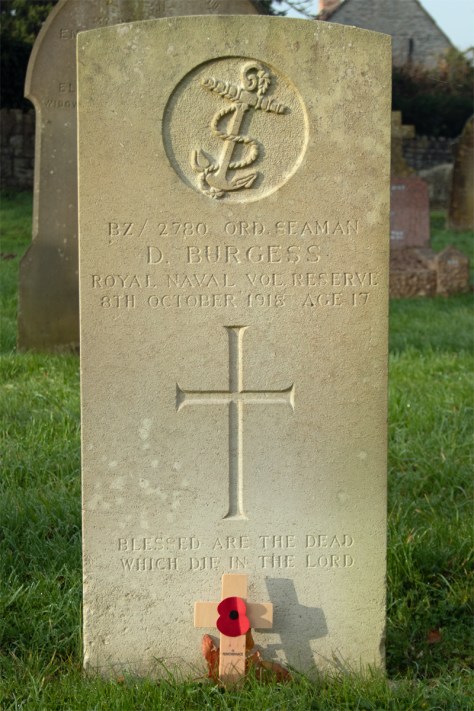
Donald seems to have volunteered as soon as his age allowed. He joined the Royal Naval Voluntary Reserve in September 1918, and was stationed at HMS Victory in Crystal Palace. He was training to become a wireless operator, but his time there seems to have been cut cruelly short.
Ordinary Seaman Burgess contracted pneumonia and was admitted to the 4th London General Hospital in nearby Camberwell. Sadly, he succumbed to the condition and passed away on 8th October 1918, after just a few weeks’ service. He was just 17 years of age.
Donald Burgess lies at rest in sight of his father’s school, in the graveyard of St Barnabas Church.









 Death and Service