Category Archives: Air Mechanic

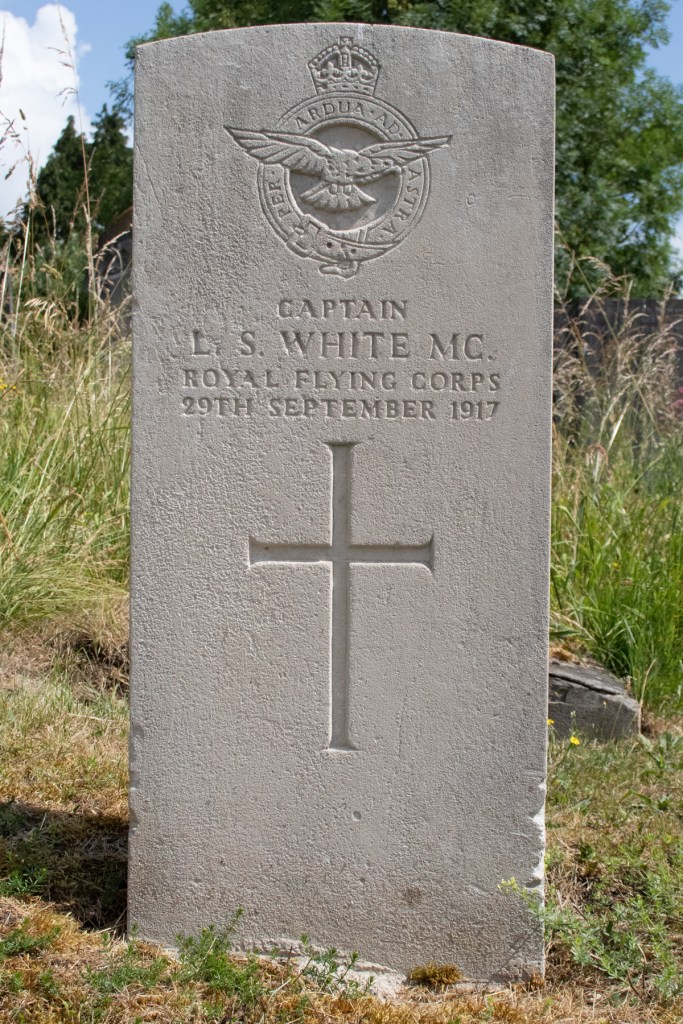
Captain Lewis White

Captain Lewis White

Lewis Scott White was born at the start of 1896 in Bath, Somerset. The youngest of four children, his parents were surgeon Edward White and his wife, Fanny. The 1911 census recorded the family living in a substantial property in Green Park: the now medical practitioner Edward, Fanny and Lewis sharing the 12-room house with a servant, Ellen Fry.

As befitting of his station in life, Lewis’ education was a well rounded one: “[he] was educated at Bath College and Kelly College, Tavistock, and was coached for his matriculation examination by Mr Samuel Edwards, of Grosvenor College. He exhibited a fondness for aeronautics when quite a lad. While at Victoria College he evinced much enthusiasm for the art of flying, and made models of flying machines. One of these miniature planes he flew successfully on Lansdown, and we believe showed at an exhibition in London. He was one of the leading spirits in the Bath Aerial Club, which used to meet at the Church Institute.” [Bath Chronicle and Weekly Gazette – Saturday 06 October 1917]

Lewis’s mechanical mind was put to good use in his working life as well. He found employment as a motor fitter, and this is what he was doing when war broke out in the summer of 1914. He felt duty bound to service his King and his Country, and, on 20th October, he enlisted in the Royal Flying Corps as an Air Mechanic. His service records confirm the man he had become: at 18 years of age, he was 5ft 4ins (1.63m) tall and weighed 117lbs (53kg). He had dark brown hair, brown eyes and a fresh complexion.

His skill and daring earned promotion, and he was given a commission… He accomplished many fine feats in actual aerial warfare on the Western Front, and for one of these some months ago he was awarded the Military Cross. He was acting as an observer when the flight occurred; the pilot in the same machine was given the DSO.

While wearing only one wing he came home to England to train as a pilot. He rapidly passed all the tests for this, and obtained the two wings, and was gazetted Captain of the RFC on May 5th last. It was only on Wednesday last week that Captain White attended an investiture at Buckingham Palace and was decorated by the King with the MC. So complete was his mastery of flying machines and so great his initiative that Captain White was appointed Flight Instructor, and for the last two months he had been Flight Commander quartered in Wiltshire.

[Bath Chronicle and Weekly Gazette – Saturday 06 October 1917]

On 29th September 1917, Captain White was piloting a Sopwith Camel from RAF Yatesbury, Wiltshire, when the aircraft failed to pull up from a dive. It crashed into the ground and Lewis was killed instantly. He was just 21 years of age.

It is no secret that the aeronaut whose intrepid feats in the air above Bath of late had caused much notice was Captain White. He would loop the loop with the greatest ease, and his nose-diving was most daring. When questioned why he performed these dangerous acts in the air Captain White would declare that there was no risk from engine trouble unless a man ‘lost his head,’ and apparently he had no idea that is was possible for him to get into difficulties from that cause. It is to be surmised therefore that in the accident which had cost his life, so especially valuable to the country now, something beyond engine trouble must have happened.

To stay-at-home and peacefully minded citizens some of the manoeuvring by aeroplanes in flight savours too much of the sensational, and they are apt to think that it is unnecessarily throwing away chances. But such an impression is as unjust as it is unkind. The strange evolutions described by machines in mid-air are just the kind that have to be executed in actual aerial warfare when seeking to gain an advantage over the foe, and unless this preliminary training were carefully and systematically gone through it would be hopeless to seek to acquire the necessary skill in the moment of crisis. Captain White was absolutely fearless, and his death will be deeply deplored by by many comrades who knew his worth.

[Bath Chronicle and Weekly Gazette – Saturday 06 October 1917]

A subsequent inquest found no immediate cause for the crash, but suggested that Captain White may have misjudged the distance whilst diving and flew into ground.

The body of Lewis Scott White was brought back to Somerset for burial He was laid to rest in the majestic Locksbook Cemetery in Bath, his funeral attracting a full page report in the city’s Chronicle and Weekly Gazette.


Captain Lewis White
(from findagrave.com)

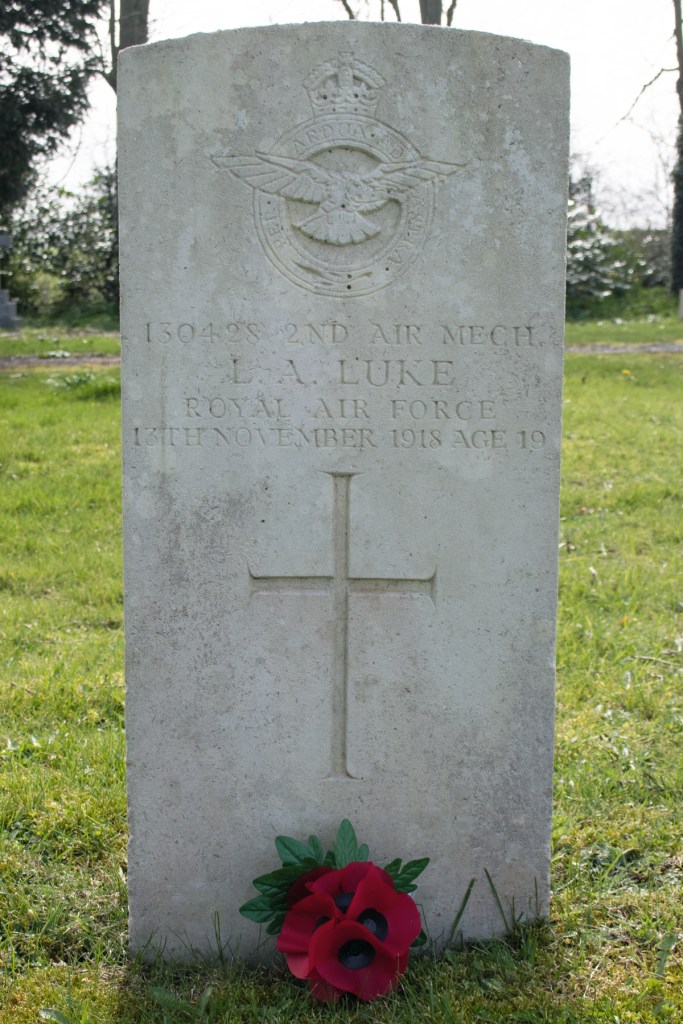
Air Mechanic 2nd Class Leonard Luke

Air Mechanic 2nd Class Leonard Luke

Leonard Arthur Luke was born in the autumn of 1899 in Shepton Mallet, Somerset. He was the fifth of ten children to railway guard George Luke and his wife, Georgina.

By the time of the 1911 census, the family had moved north west, to the village of Wellow, where George continued his employment with the railway. The track and station have now since disappeared, but at the time, it was a busy stopping point for the mining village.

When Leonard left school, he found work as a porter with the Somerset & Dorset Railway, but by now war was raging across Europe, and he was keen to play his part. He initially enlisted in the Somerset Light Infantry on 3rd January 1918, but moved to the Royal Flying Corps after a matter of weeks.

On 1st April 1918, Leonard transferred across to the Royal Air Force. Formally holding the rank of Air Mechanic 2nd Class, he was training to become a wireless operator in Winchester, Hampshire. He was admitted to the Red Cross Hospital in the city, having contracted rheumatic fever. Sadly, this was to take his life, and he passed away on 13th November 1918, two days after the Armistice. He was just 19 years of age.

Leonard Arthur Luke’s body was brought back to Somerset for burial. He was laid to rest in the quiet Wellow Cemetery.


Air Mechanic 2nd Class Leonard Luke
(from britishnewspaperarchive.co.uk)

While Wellow Station was a bustling place, it is highly likely that Leonard would have known Edward Bending, one of the clerks at the time he was there. Edward also went off to war, and his story can be found here.


Air Mechanic 1st Class Joseph Chivers

Air Mechanic 1st Class Joseph Chivers

Joseph Shore Chivers was born in the summer of 1889 in Walcot, Bath, Somerset. He was the youngest of seven children to William and Jane Chivers. William was a blacksmith and, after he and Jane died within nine months of each other in 1904/05, Joseph went to live with his brother, Edward, remaining there with his sister-in-law when his sibling also died in 1910.

Joseph had found work as a French polisher and cabinet maker by this point and this is what he was doing when he married local woman Ellen West in on 11th September 1915.

War was on the horizon by this point and Joseph was soon called on to serve his country. On 26th July 1916 he enlisted in the Royal Flying Corps, as an Air Mechanic 2nd Class. His service records give little away, but do confirm that he was 5ft 8ins (1.73m) tall.

Joseph was dedicated to his role and, on 1st January 1918, was promoted to Air Mechanic 1st Class. Three months later, when the Royal Flying Corps and Royal Naval Air Service combined to become the Royal Air Force, Joseph made the transfer across.

In August, Air Mechanic Chivers moved to RAF Bracebridge, to the south of Lincoln, where he remained until the end of the war and beyond. He was attached to 120 Squadron, which delivered mail and communications to the troops overseas. Little additional information is available about his life there, other than his admission to the 4th Northern Hospital in April 1919, through causes unknown.

Whatever the cause of his need to be admitted, he was to succumb to it. Air Mechanic Chivers passed away on 1st May 1919, at the age of 29 years old.

Joseph Shore Chivers’ body was brought back to Somerset for burial. He was laid to rest in St James’ Cemetery, in his home city of Bath.


Air Mechanic 3rd Class William Mells

Air Mechanic 3rd Class William Mells

William John Mells was born in Southwark, Surrey, on 13th November 1873. His parents were Thomas and Elizabeth Mells, although much of his early life is lost to time.

The 1891 census found the 19-year-old William as one of four boarders living with the Skinner family in Peckham, Surrey, where he was working as a shoe maker. By the turn of the century, however, he had changes jobs, and was employed as an advertising contractor, possibly fixing signs to walls across the country.

It was while William was working in Somerset when he met Ethel Pryor. She was the daughter of a caterer, born and bred in Somerset. On 16th August 1903, the couple married at Ethel’s parish church in Bath. They set up home in a small cottage on King Edward Road in the city, and went on to have two children, Edith, who was born in 1904, and John, who was born the following year.

Storm clouds were brewing across Europe at this point, and William was called upon to play his part in the autumn of 1918. He had previously served as part of the Army Service Corps Volunteers, and had reached the rank of Lance Corporal. When his time to actively serve King and Country came, however, he chose the fledgling Royal Air Force and, on 24th October 1918, joined them as an Air Mechanic 3rd Class.

William was sent to Blandford Forum, Dorset, for training. While here, in packed and busy billets, he contracted influenza, which developed into pneumonia. He passed away from the conditions at the camp hospital on 3rd November 1918, ten days short of his 45th birthday, eight days before the end of the conflict and after just ten days’ service.

William John Mells’ body was brought back to Somerset for burial. He was laid to rest in the city’s St James’ Cemetery, and was joined by his widow, when she passed away in 1955.


The Commonwealth War Graves Commission headstone and website gives Air Mechanic Mells’ name as John William, but all other records – including censuses, marriage document and service records – confirm his name as William John Mells.


Air Mechanic 1st Class Harold Weston

Air Mechanic 1st Class Harold Weston

Harold Stanley Weston’s early life is destined to remain a mystery. He was born, according to his Royal Air Force service records, in Southgate, Middlesex in 1887 and, before war broke our, was working as a waiter before enlisting.

On 3rd August 1915, he married a woman called Gertrude in Hastings, Eat Sussex, and it appears that this is where the couple set up home. Harold has initially enlisted in the army, but transferred across to the Royal Flying Corps on 28th October 1915. Air Mechanic 2nd Class Weston’s service records show that he stood just 5ft 2.5ins (1.59m) tall.

Over the next three years, Harold rose through the ranks to Air Mechanic 1st Class, and served in France for nine months during 1916. He then returned to England, and was based at an airfield near Detling, Kent. When the Royal Flying Corps and the Royal Naval Air Service merged in April 1918, he transferred across to the newly-formed Royal Air Force, and was attached to 27 Squadron.

In November that year, Harold was admitted to the Military Hospital in Maidstone, also in Kent, having contracted influenza and pneumonia. Sadly, the lung conditions were to get the better of him, and he passed away on 1st November 1918, at the age of just 31 years old.

Air Mechanic 1st Class Harold Stanley Weston’s body was laid to rest in the quiet graveyard of St Martin’s Church in Detling, not far from the base at which he served. Gertrude posted her thanks to “all [their] friends for their kindness and sympathy shown to her in her sad bereavement, more especially Captain Saunders, RAF, Major Chapman, KCC [Kent County Council?], Sergeant Fowle, KCC, and Sergeant Weller, RAMC [Royal Army Medical Corps]” [Maidstone Telegraph: Saturday 9th November 1918]


Air Mechanic 1st Class Albert Young

Air Mechanic 1st Class Albert Young

Albert Franklin Young was born on 15th August 1899 in Marylebone, London. He was the older of two children – and the only son – to Kathleen (Kate) Young, and her photographer husband, Albert Antonio Young.

Albert Sr seemed to have made a successful of his photography business: Albert Jr attended St Hugh’s School in Chislehurst, Kent, before moving on to Margate College, also in Kent, and Watford Grammar School.

From leaving school, Albert Jr joined the Royal Flying Corps as a wireless operator on 28th September 1915. He was just sixteen years old, but within eight months he was serving with the British Expeditionary Force in France. He was involved in operations at the Somme and continued his flight training.

In November 1915, Albert was promoted to Air Mechanic 1st Class, and remained on the Western Front. On 28th March 1918, a German air raid hit No. 2 Air Depot, where Albert was working: he was badly wounded, and brought back to England for medical treatment.

Admitted to London Hospital in Chelsea, Air Mechanic Young was operated on a number of times, but was to finally succumb to his wounds on 9th June 1918. He was just 18 years of age.

As highlighted in de Ruvigny’s Roll of Honour, one colleague noted “I can assure you he was very greatly esteemed for his fine qualities by all with whom he came into contact, and the news of his death was received by all of us with most profound sorrow. He was a splendid boy.” Another said that the “great courage and coolness he always displayed at most critical moments were on many occasions an incentive to me. He was truly a gallant lad.”

Brought to West Sussex, where his parents were now living, Albert Franklin Young was laid to rest in Cuckfield Cemetery: “The scene… was very solemn and pathetic, yes beautiful and effective, and as all moved forward to the grave, and viewed the fair expanse of the Sussex Weald, the sweet melody of the Choir [was] ringing in our ears.” [Mid Sussex Tomes: Tuesday 18th June 1918]


Private George Knight

Private George Knight

George Albert Knight was born in Dover, Kent, on 27th September 1888, the second of seven children to Thomas and Frances Knight. Thomas was a railway porter from Hampshire, and the family lived in a small terraced house a few minutes’ walk from his workplace, Dover Priory Station.

By the turn of the century, the family had moved to Faversham: Thomas was working a signalman, and two of George’s brothers also worked for the railway – one as a clerk, the other as a number taker. George, meanwhile, was working as a butcher.

In the summer of 1916, George married Alice Smith, who was working as a domestic servant for an government inspector in Willesborough, Kent. George was still working as a butcher at this point, and continued to do so up until the spring of 1918, when he was eventually called up.

Private Knight enlisted in March 1918, joining the Royal Naval Air Service shortly before it merged with the Royal Flying Corps to become the fledgling Royal Air Force. He was based in Cornwall, and his role included mechanic work.

On the evening of 21st September 1918, George collapsed and, despite being rushed to hospital in Truro, he passed away the following morning. It appears that he had not been unwell before, and his death came as a shock. He was just short of his 30th birthday.

George Albert Knight was brought back to Kent for burial. He was laid to rest in Faversham Borough Cemetery, not far from where his widow and family were living.


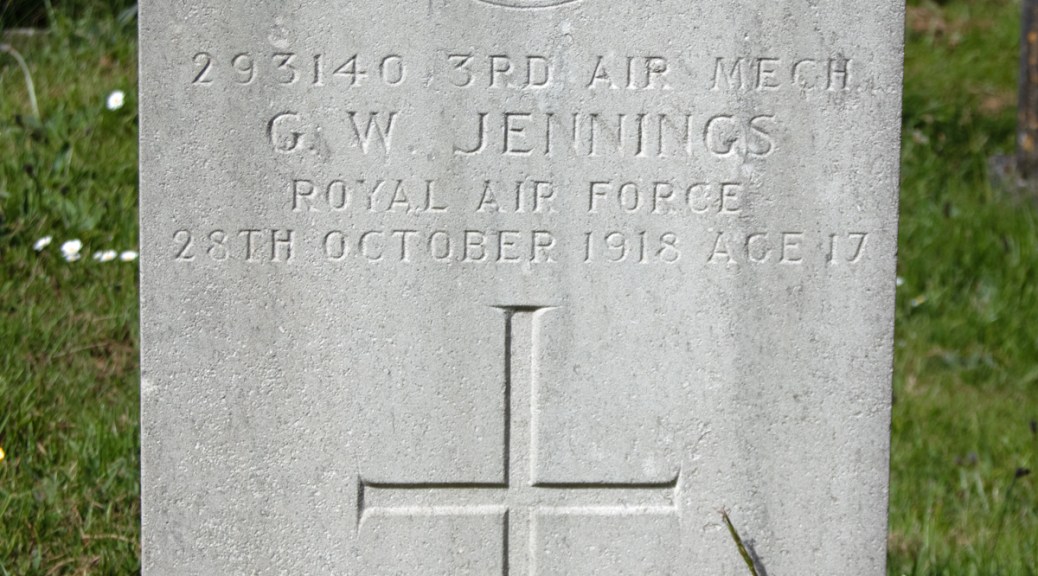
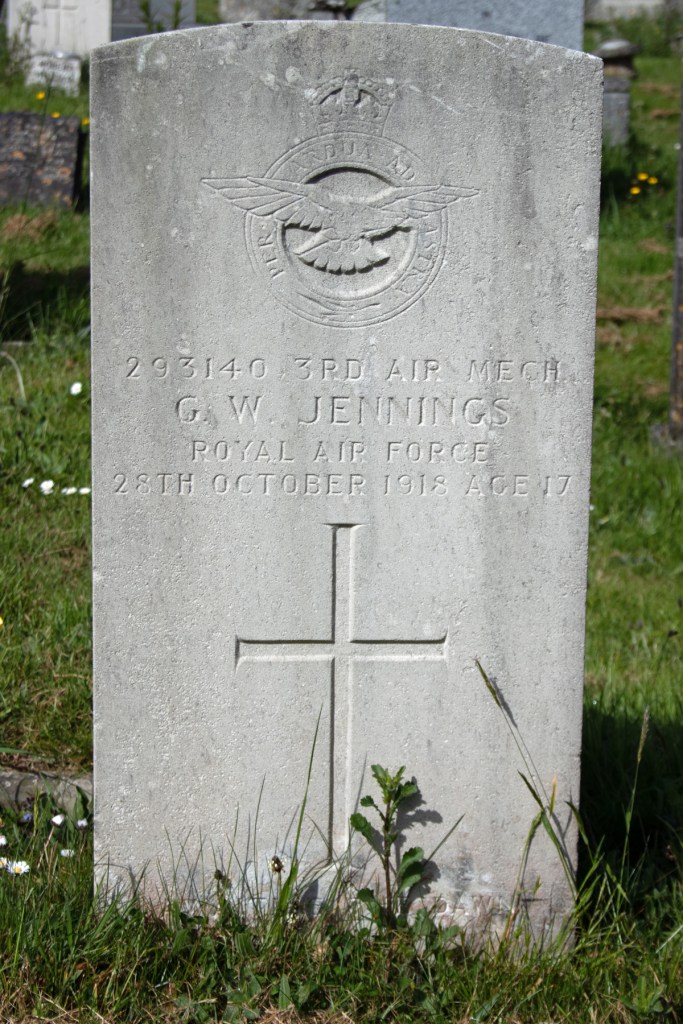
Air Mechanic 3rd Class Gilbert Jennings

Air Mechanic 3rd Class Gilbert Jennings

Gilbert William Jennings was born on 4th January 1901, and was the third of four children to William and Lily Jennings. Both were born in Chard, Somerset, and this is where they raised their young family. William was a foreman in one of the town’s lace factories and when he finished school Gilbert followed his father into the industry.

War broke out across Europe in 1914 and, while Gilbert was too young to enlist at the start of the conflict, it is evident that he wanted to play his part as soon as he was able to.

On 6th September 1918 he enlisted in the Royal Air Force: his experience with factory machinery led him to the role of Air Mechanic 3rd Class. His service records confirmed that he was 5ft 7ins (1.70m) tall, had brown hair, hazel eyes and a fresh complexion.

Air Mechanic Jennings was sent to Buckinghamshire for training, but his time there was to be tragically short. Within a matter of weeks he was admitted to the Central Military Hospital in Aylesbury with pneumonia. The condition was to prove too much for his body: he passed away on 28th October 1918. He had been in the Royal Air Force for just 52 days and was a victim of his desire to get involved in the war before it was too late to do so. He was 17 years of age.

Gilbert William Jennings’ body was brought back to Somerset for burial: he was laid to rest in the cemetery of his home town, Chard.


Air Mechanic Walter Naish

Air Mechanic Walter Naish

Walter Matthias Naish was born in the autumn of 1896, and was one of of five children to agricultural labourer Matthias Naish and his wife, Sarah Ann. Born in Lovington, near Castle Cary, Somerset, this is where the family is recorded as living for the 1901 and 1911 censuses.

When he left school, Walter found work as a cabinet maker; war was on the horizon, however, and he enlisted on 28th February 1916. He was immediately put on reserve, however, and was only mobilised in January 1917, when he was assigned to the Royal Flying Corps as an Air Mechanic.

Tragically, Walter’s military career was not to be a long one. He was admitted to the Connaught Hospital in Aldershot with conditions unknown, and passed away on 3rd March 1917, just 51 days after leaving home. He was just 20 years old.

Walter Matthias Naish’s body was brought back to Somerset for burial. He lies at rest in the Castle Cary Cemetery, not far from his home.


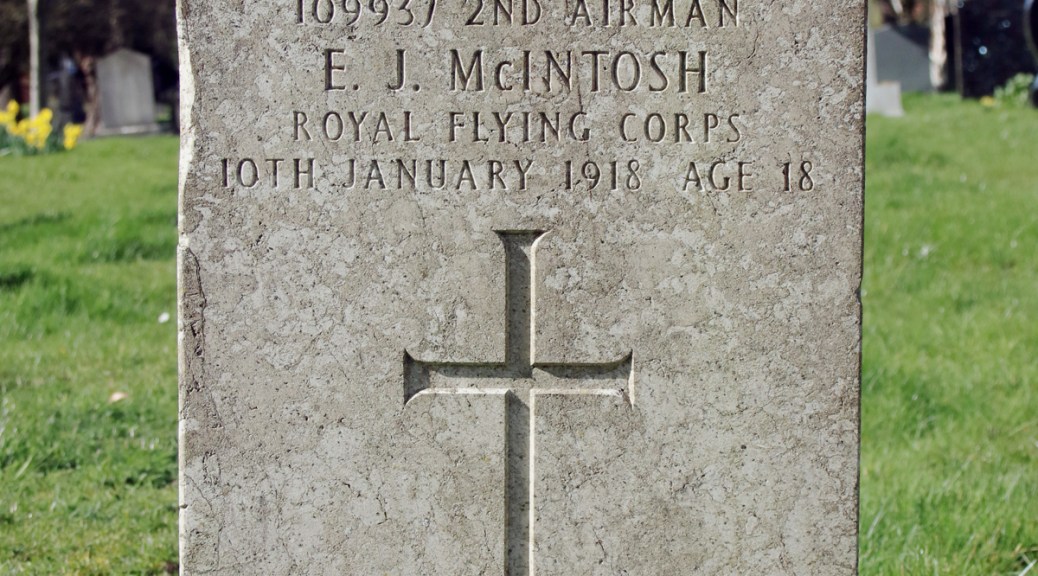
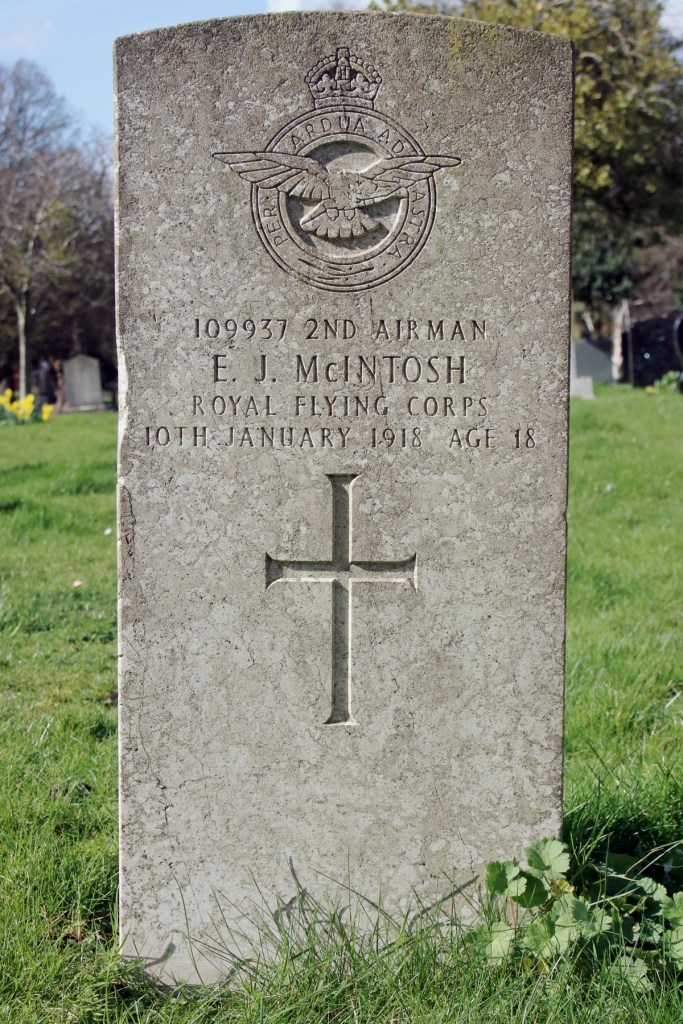
Air Mechanic 2nd Class Edward McIntosh

Air Mechanic 2nd Class Edward McIntosh

Edward James McIntosh was born in January 1899, the youngest of four children to Henry and Caroline McIntosh from Gillingham in Kent. Henry and Caroline ran a greengrocer’s and their eldest son, Harry, followed them into the business when he left school. One of Edward’s sisters Beatrice became a dressmaker, while the other, Gertrude, became a servant for the secretary to an engineering company.

Sadly, little else remains of young Edward’s life. He enlisted in the Royal Flying Corps when war broke out; given his age, it is unlikely that he signed up before 1917, although there is no record to confirm this.

Edward achieved the rank of Air Mechanic 2nd Class (although his gravestone gives his rank as Second Airman), but there is little more documentation to flesh out his military service.

Edward was admitted to the Military Hospital in Aldershot in January 1918, suffering from meningitis. Sadly this was to take his life, and he passed away on 10th January 1918, having just turned 18 years old.

Edward James McIntosh lies at rest in the Woodlands Cemetery in his home town of Gillingham, Kent.