Category Archives: Chief Stoker

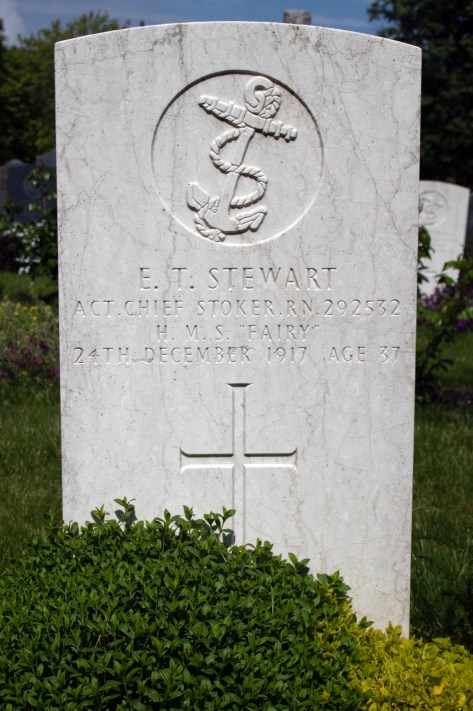
Acting Chief Stoker Edward Stewart

Acting Chief Stoker Edward Stewart

Edward Thomas Stewart was born on 7th September 1880 in the Kent village of Sturry. The middle of three children, his parents were farm labourer James Stewart and his wife, Frances.

When he finished his schooling, Edward found work as a coachman, but he sought a life of adventure and, on 24th July 1899, he enlisted in the Royal Navy as a Stoker 2nd Class. His service records show that he was 5ft 7.5ins (1.71m) tall, with light brown hair, grey eyes and a fresh complexion.

Stoker Stewart was sent to HMS Pembroke, the Royal Naval Dockyard in Chatham, Kent, for his training, and remained there for the next eight months. He was then given his first assignment, on board the battleship HMS Sans Pareil. She became his home for the next year, during which time he was promoted to full Stoker.

Edward’s initial term of contract was for twelve years, and over that time he would serve on nine different vessels. Between voyages his shore home remained Pembroke, and he spent more than two years based there. By the summer of 1911, Edward had been promoted three times – to Stoker 1st Class in July 1906, Leading Stoker in March 1908, and Stoker Petty Officer in March 1910.

When his contract came to an end, Edward immediately re-enlisted. By this point, his records show that he had grown to 5ft 10.5ins (1.79m) tall, and had a scar on his nose.

In the autumn of 1912, Stoker Petty Officer Stewart was assigned to the troop ship HMS Tyne. She would become the ship on board which he would spend the longest part of his career, not disembarking until 31st May 1917. He transferred to HMS Fairy, a destroyer, and with the move came a promotion to Acting Chief Stoker.

Attached to the Grand Fleet, Fairy was engaged in convoy work off the east coast. Edward’s time on board would not be a lengthy one, however. On 24th December 1917, he fell overboard, and was killed. He was 37 years of age. There is little additional information about the incident, although his service papers note that “no blame was attributable to anyone.”

Edward Thomas Stewart’s body was recovered, and brought back to Kent for burial. He was laid to rest in the naval section of Woodlands Cemetery, Gillingham, not far from the base he had called home for so long.

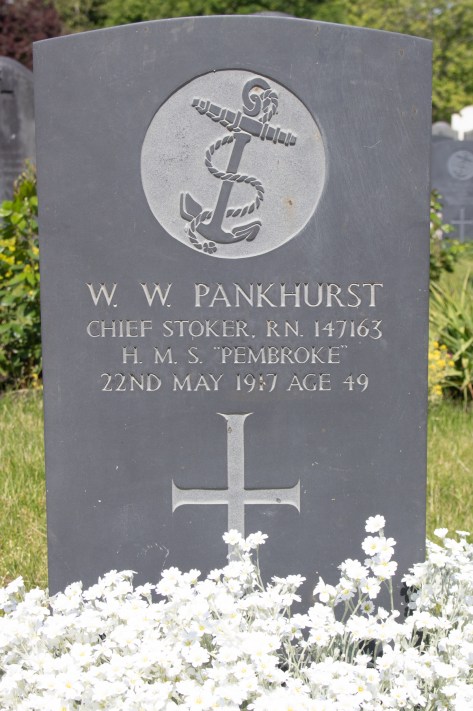
Chief Stoker Walter Pankhurst

Chief Stoker Walter Pankhurst

Walter William Pankhurst was born on 21st March 1867, and was the third of four children – and the only son – to Thomas and Harriet Pankhurst. Thomas was a farm labourer from Staplehurst, Kent, but he and Harriet raised their family in Murston, to the east of Sittingbourne.

Walter initially followed his father into farm work, but he sought a bigger and better life and, on 3rd December 1888, he enlisted in the Royal Navy. His service records show that, at 21 years of age, he was 5ft 7ins (1.7m) tall, with dark hair, hazel eyes and a ruddy complexion.

Given the rank of Stoker 2nd Class, Walter was sent to HMS Pembroke, the Royal Naval Dockyard in Chatham, Kent, for his training. In the summer of 1889 he was given his first posting, on board the gunboat HMS Pigmy, and she would remain his home for the next three-and-a-half years.

When he joined up, Walter had committed to twelve years’ service, and this time was not wasted. By the time his contracted came up for renewal, he had served on three further ships, returning to Chatham in between voyages. He had also progressed through the tanks, to Stoker 1st Class in January 1890, Leading Stoker 2nd Class in March 1897 and, with the renewal of his service, to Leading Stoker 1st Class in February 1901.

On 15th June 1904, Walter married Ellen Goddard. A gardener’s daughter from Eastling, Kent, by the time of their wedding, she was working as a domestic servant for a chemist in Hampstead, Middlesex. The couple exchanged their vows in St Stephen the Martyr’s Church, Hampstead, Ellen’s sister Susan acting as one of the witnesses.

Back in the Navy, Walter’s career continued its progression. Regularly noted as being of very good character, within three months of his wedding he was promoted to Acting Chief Stoker. By October 1905 the role was formalised, and he would end his naval career in December 1910 as Chief Stoker.

Stood down to reserve status, Walter made the move to civilian life. The 1911 census found him and Ellen living at 95 Glencoe Road, Chatham, a small terraced house with just four rooms. The couple had had three children by this point, and Susan was also living with them. A naval pensioner, Walter was still employed by the navy, and was working as a bootmaker’s labourer in the dockyard.

When war was declared in the summer of 1914, Chief Stoker Pankhurst was called into service once more. For the next couple of years he would be based at HMS Pembroke, either working in the dockyard’s boiler rooms or training new recruits.

In the spring of 1917, Walter was taken ill. He was suffering from haematemesis, and the condition was to prove his undoing. He passed away on 22nd May 1917, at the age of 50 years old.

The body of Walter William Pankhurst was laid to rest in the naval section of Woodlands Cemetery, Gillingham, a few miles from where Ellen was now living on Luton Road, Chatham.


By the time Walter passed, he and Ellen had had four children. His widow never remarried, but when she died, on 7th April 1961, she was buried alongside her husband. She was 90 years of age.

The couple’s eldest daughter, Nancy, remained a spinster throughout her life, initially supporting her mother after Walter died. Nancy was buried with her parents, when she died in 1995: she was also 90 years old.


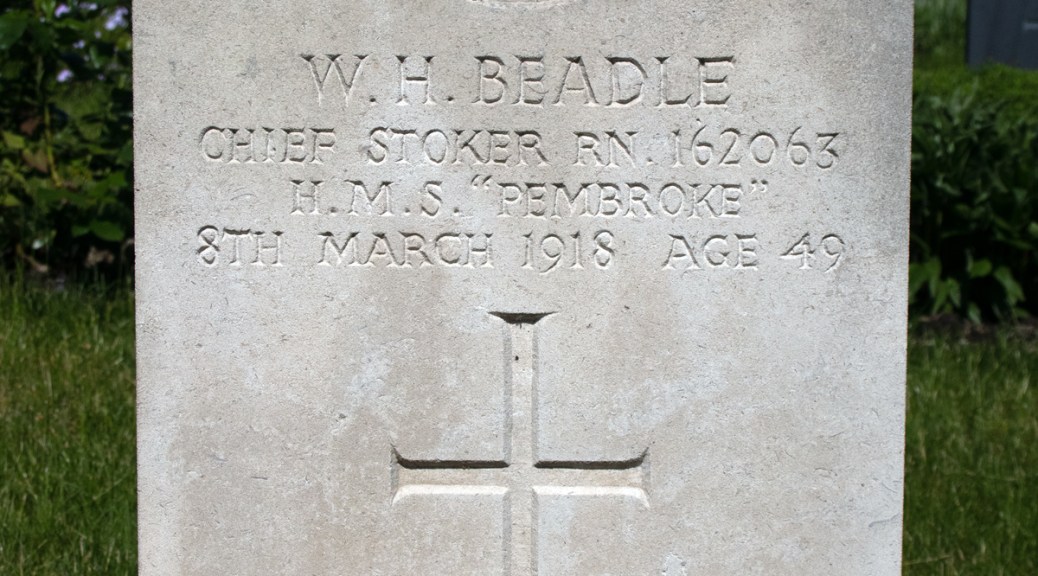
Chief Stoker William Beadle

Chief Stoker William Beadle

William Henry Beadle was born in Heybridge, Essex, on 23rd April 1870. The youngest of three children his parents were William and Sophia Beadle. William Sr was a waterman-turned-labourer, and the young family lived with Sophia’s parents.

When Sophia died in 1875, her widow and their children remained with his in-laws. William Sr died in 1887, and by the time of the 1891 census, his son was living with his now widowed grandmother. The document notes that she was a pauper, but he was a moulder in the local iron works.

William sought bigger and better things and, on 13th August 1891, he enlisted in the Royal Navy as a Stoker 2nd Class. His service records show that, as 21 years of age, he was 5ft 8ins (1.72m) tall, with brown hair, grey eyes and a fresh complexion.

Stoker Beadle was initially sent to HMS Pembroke, the Royal Naval Dockyard in Chatham, Kent, for his training. He would spend the next six months split between there and HMS Wildfire, a shore establishment downriver at Sheerness.

In 1892, William spent six months on board the troop ship HMS Tyne. He returned to Chatham in July of that year, and was promoted to Stoker 1st Class. Over the course of the next eleven years, he would go on to serve on four ships, each time returning to his base port, HMS Pembroke.

William’s service record is pretty much mark free. He was confined to cells for seven days in October 1895, although his offence s unclear. In April 1896 he was promoted to Leading Stoker 2nd Class, and made Leading Stoker 1st Class three years later. In December 1902, while on board the cruiser HMS Diana, William was promoted again, to Acting Chief Stoker, and the following August, his initial contract of service came to an end.

By this point William was a married man. He married Clara Walford in Rochford, Essex, and, while the couple did not go on to have children, there is little additional information about her.

William re-enlisted as soon as his initial twelve-year contract came to an end. In December 1903 he was promoted to Chief Stoker, and he remained at this rank until he war formally retired on 16th August 1913. He had spent more than two decades in the Royal Navy ,and travelled the world: the 1911 census recorded him as one of the crew of HMS Lancaster, moored in Malta.

Chief Stoker Beadle’s time away from the Royal Navy was not to be lengthy and, when war broke out less than a year later, he was called upon once more. He spent nine months back at HMS Pembroke, before being assigned to the new cruiser HMS Calliope. She would be William’s home for the nearly three years, and it was not until March 1918 that he came back to shore.

William’s return to Chatham seemed to coincide with a downturn in his health. He was admitted to the town’s Royal Naval Hospital with nephritis, and this is what would take his life. He died on 8th March 1918: he was 47 years of age.

William Henry Beadle was laid to rest in the military section of Woodlands Cemetery, Gillingham, not far from the naval base he had called home for so long.


Chief Stoker John Seager

Chief Stoker John Seager

John Edward Seager was born in Gillingham, Kent, in March 1869. One of eight children, his parents were labourer William Seager and his wife Maria (who was known by her middle name, Elizabeth).

John was keen to have adventure in his life, and the local Naval Dockyard in Chatham gave him that opportunity. on 23rd April 1887, he enlisted in the Royal Navy for the standard twelve years’ service. During that time, he served on six different ships, begging his career as a Stoker and rising through the ranks to become a Leading Stoker at the end of his time.

In April 1899, John re-enlisted and was given the rank of Chief Stoker. After completing his initial training at the on-shore establishment HMS Pembroke, he was assigned to HMS Cossack. Over the next ten years, he served on five more ships, before being moved over the Royal Naval Reserve in 1909.

During this time, John had gotten married. Emmeline Ada Driver was also born in Gillingham, and had found work as a nurse in the Surrey County Asylum. The couple married on 8th August 1903 in New Brompton, and set up home in a cottage close to the centre of Gillingham, close to their families and within walking distance of the dockyard.

When war broke out, John was called back into active service. He spent a year on board HMS Wildfire and five months on HMS Attentive. Most of his time, however, was spent at HMS Pembroke in Chatham. It was while he was here in January 1918 that he was admitted to hospital with pneumonia and tuberculosis. Sadly, Chief Stoker Seager was to succumb to these conditions; he died on 1st February 1918 at the age of 49 years old.

John Edward Seager was laid to rest in the Grange Road Cemetery in Gillingham, Kent. He is commemorated in the Woodlands Cemetery, which replaced this now park.


Stoker Petty Officer John Harriss

Stoker Petty Officer John Harriss

John Thomas Harriss was born on 22nd February 1878, one of seven children to George and Mary. George was a jeweller, who moved the family from London to Weston-Super-Mare when John was three or four years old.

Following in his father’s footsteps was not something John was going to do, and the move to the coast seemed to have sparked an interest in the sea. He enlisted for twelve years’ service in the Royal Navy in March 1900, working as a stoker.

After initial training at HMS Pembroke in Chatham, Kent, Stoker 2nd Class Harriss was assigned to HMS Terpsichore and, over the length of his service, he worked on a further ten vessels. During this time, he was promoted a couple of times, reaching the role of Leading Stoker by 1911, while he was serving aboard HMS Magnificent.

With war imminent, when John completed his period of service, his term was extended until the end of hostilities. He had, by the beginning of 1914, attained the rank of Stoker Petty Officer, and was assigned to HMS Russell.

After the start of the war, this ship was assigned to the Grand Fleet and worked on the Northern Patrol, and in November 1914, she bombarded German-occupied Zeebrugge. The following year, HMS Russell was sent to the Mediterranean to support the Dardanelles Campaign, though she did not see extensive use there.

On 27 April 1916 HMS Russell was sailing off Malta when she struck two mines laid by a German U-boat. Most of her crew survived the sinking, though 125 souls lost their lives. Stoker Petty Office Harriss was one of the survivors; his service records note that he was ‘commended for [the] great coolness shown on the occasion of the loss of HMS Russell’.

Brought back to the UK, John contracted pneumonia, and spent time at home with his family, in Weston-Super-Mare. It was here, sadly, that he was to succumb to the lung condition, and he passed away on 7th June 1916. He was 38 years old.

John Thomas Harriss lies at rest in Milton Cemetery in Weston-Super-Mare.


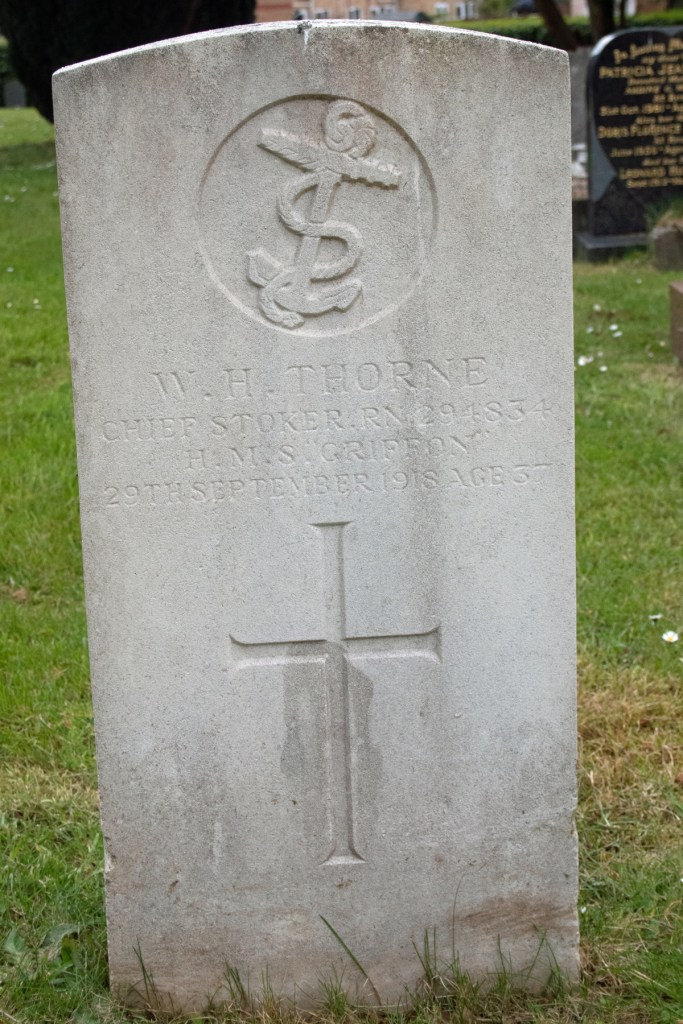
Chief Stoker William Thorne

Chief Stoker William Thorne

William Henry Thorne was born on 28th July 1881 in the Somerset village of Milverton. He was the oldest of five children to farm labourer Henry Thorne and his wife Mary.

William was a young man with a keen sense of adventure. In February 1900, he joined the Royal Navy as a Stoker. After his initial training in Devonport, he was assigned to HMS Thunderer and, after six months, joined HMS Hood, where he spent the next two years.

Over his twelve years of his service, Stoker Thorne served on six further vessels, attaining the rank of Stoker Petty Officer.

In 1907, William had married Mabel Cross, a young woman from Taunton. While her husband was away from England – the marriage certificate gives his address as ‘on the high seas’ – she set up home near the centre of town. The young couple went on to have two children, twins Phyllis and Doris, who were born in 1911.

Back at sea, and Stoker Petty Officer Thorne’s terms of service were extended in 1912, so that he would continue to be a part of the Royal Navy until the cessation of hostilities. He served on a further six vessels and was promoted to Chief Stoker in June 1917.

It was while he was serving on HMS Griffon in the autumn of 1918 that William fell ill. Brought back to shore, he was admitted to the Military Hospital in Taunton. There is nothing to confirm the illness he contracted, but it was one he would succumb to. Chief Stoker Thorne passed away on 29th September. He was 37 years old.

William Henry Thorne lies at peace in the St James Cemetery in his home town of Taunton.