
Category Archives: Leading Mechanic

Leading Mechanic Charles Harris

Leading Mechanic Charles Harris

Charles William Harris was born in Wingham, near Canterbury, Kent, on 19th July 1879. The fourth of eleven children, his parents were Charles and Kate Harris. Charles Sr was a carpenter and builder, and his son was to follow in his stead.

By the time of the 1901 census, however, Charles Jr had stepped out on his own. He had moved to London, and was boarding with the Hurley family, in rooms at 408 Bethnal Green Road, Middlesex.

On 1th June 1902, Charles Jr, now a plumber, married Esther Danton. An engine driver’s daughter from Kent, she was four years her new husband’s senior. The couple set up home at 5 Leatherdale Street in Mile End, and had two children: daughter Lilian was born in 1905, with son George following three years later.

When war broke out, Charles was called upon to play his part. He enlisted in the Royal Naval Air Service as an Air Mechanic, and was quickly promoted to Leading Mechanic. His service records show that, when he joined up on 15th June 1916, he was 5ft 7.5ins (1.71m) tall, with light brown hair, blue eyes and a fresh complexion.

Leading Mechanic Harris would be based out of HMS President, the umbrella name for the Royal Navy’s London bases. He spent time working at Wormwood Scrubs, and, in February 1917, was moved to Kingsnorth, Kent.

What happened next is summed up in a simple statement on Charles’ service papers: “26th May 1917 Accidentally killed by explosion of gas holder.” There is no further information, and nothing in the media about the incident. Leading Mechanic Harris was 37 years of age.

The body of Charles William Harris was taken to the Woodlands Cemetery, Gillingham, Kent. He was laid to rest in the naval section of the burial ground.


Tragedy was to strike again just two years later, when Charles and Esther’s daughter also passed away:

Much sympathy and respect were shown at Holy Trinity Church, Springfield, when the funeral of Lily Harris, the fourteen-year-old daughter of Mrs and the late Mr CW Harris took place. Deceased’s father, who was chauffeur to the Bishop of Chelmsford, lost his life in the war while serving with the RNAS, and this fact added to the regret felt by the parishioners at the further sad loss sustained by his widow, who is now left with only one little boy. The funeral procession included a large number of the scholars of the Springfield Day and Sunday Schools, with Mr R Coward of the day school, and practically every child carried a floral tribute. There was also a large attendance of neighbours and friends, including children, assembled at the church. The Bishop of Chelmsford officiated… [and] gave a touching address to the church, speaking particularly to the children; and his lordship also performed the last sad rites at the graveside.

[Essex Newsman: Saturday 29th November 1919]

There is no evidence of any connection between Charles and the Bishop of Chelmsford: as far as the records show, he was never a chauffeur, working as a builder, plumber and gas fitter before enlisting.

Serjeant Algernon Spurge

Serjeant Algernon Spurge

Algernon Carlyle Graham Spurge was born on 27th August 1891 in Bath, Somerset. The middle of five children, his parents were Algernon and Ida Spurge.

Algernon Sr was a portrait photographer, based in the Twerton area of the city, and this was very much a family business. The 1901 census recorded the Spurges as living in Victoria Road, Bath, with Ida’s brother, Tom Leaman, who was working as a photographic reloader.

Later that year, however, things were to take a turn for the worst. Algernon Sr seems to have been having some business worries and, on the morning of 16th December, he set off for work as usual. His and Ida’s daughter, also called Ida, arrived at the studio to find her father in some distress, a bottle of potassium cyanide – used as part of the photographic process at the time – next to him. He asked Ida to fetch him some water and salt, but when she returned, he declared it was too late, and lost consciousness. A doctor was called, but Algernon passed away shortly after he arrived.

A note was found, which read “My dearest wife, I really cannot stand the worry and anxiety of another day, to say nothing of weeks and perhaps months. Ask Mr Ashman and Mr Withy to be kind enough to help you straighten out matters a little. My best love to you and all my dear ones. AS” [Somerset Guardian and Radstock Observer – Saturday 21 December 1901] Ashman and Withy were family friends, who were also in the photography business.

An inquest was held and a verdict of suicide while temporarily insane was recorded.

The family rallied round, and Algernon’s widow and children moved in with Ida’s widowed mother in Bristol. Algernon’s daughter Ida continued working in photography, and Algernon Jr also took up the business. The 1911 census found him boarding with, and working for, his uncle Tom in Bath.

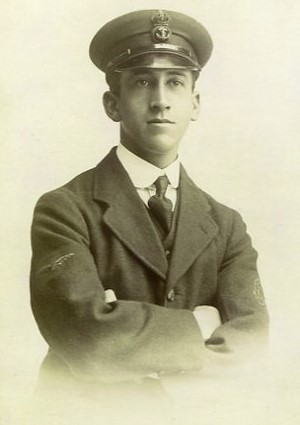
War was closing in on Europe by this point and, when it was declared, Algernon stepped up to play his part. He enlisted in the Royal Naval Air Service on 4th June 1915 as a Leading Mechanic (Photography). His service records show that he was 5ft 5ins (1.66m) tall, with dark brown hair, brown eyes and a dark complexion.

Algernon was initially assigned to the shore establishment HMS President in London for three years, rising to the rank of Petty Officer Mechanic (Photography). In April 1918, when the Royal Air Force was created he transferred across to HMS Daedalus in Lee-on-Solent, Hampshire, and rising to the rank of Sergeant Mechanic.

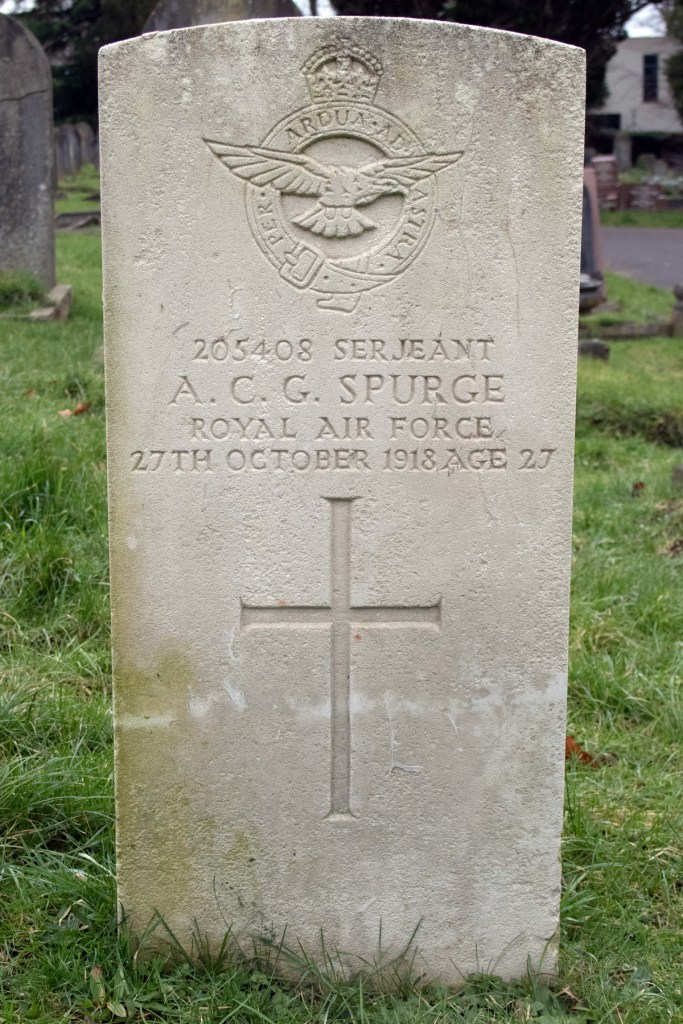
That autumn, with the end of the war in sight, Algernon fell ill. He contracted influenza, and this developed into pneumonia. He was admitted to the Military Hospital in York, but the conditions were to prove too much for his body to take. He died on 27th October 1918, aged just 27 years old.

The body of Algernon Carlyle Graham Spurge was brought back to Somerset for burial. He was laid to rest in St James Cemetery, Bath, not far from his father. When Ida passed away in 1926, she was buried in the same cemetery, father, mother and son reunited once more


Serjeant Algernon Spurge
(from ancestry.co.uk)