Thomas Hulkes Bingham Day was born on 2nd January 1855 in Frindsbury, Kent. The youngest of four children, his parents were Thomas and Emma Day. Thomas Sr was a banker and a justice of the peace. He died when his youngest was just a child, and Emma was left to raise the family, albeit with the help of five servants.
Thomas sought out a life in the military. After volunteering in the local militia, for a number of years, he gained a commission in the Dorsetshire Regiment. He took on the role of Lieutenant on 29th November 1876.
Over the next two decades, Thomas served around the world, spending time in Malta, Gibraltar, and the East Indies. He was also promoted through the ranks, rising to Captain in 1883 and Major in 1893.
On 25th March 1884, while serving in India, Thomas married Katharine Watts. The couple had a daughter, Winifred, who was born in July 1885, and, eventually they settled in Wiltshire as their base in Britain.
Major Bingham Day served in South Africa during the Boer War, taking part “in the operations at Parde Kraal, and in the operations at Poplar Grove… Vet River, Zand River, Johannesberg and Pretoria. He had the Queen’s and the King’s medals with five bars.” [Lincoln Leader and County Advertiser – Saturday 28 April 1917]
Thomas retired in 1903, and his trail goes cold until the time of the 1911 census. He and Katherine were on holiday when it was taken, and they were listed as boarding at the Beach Lodge on Roseville Street in St Helier, Jersey.
When war broke out, Thomas stepped up to play his part once more. He was put in charge of the 4th (Reserve) Battalion of the Devonshire Regiment, which was based at Sutton Veny in Wiltshire. It seems that he lived off site, as he and Katherine moved into a house in nearby Warminster.
A military funeral took place… on Monday, when Lieutenant-Colonel TH Bingham-Day, in command of a regiment at Sutton Veny, was laid to rest in the churchyard. The deceased officer died suddenly while at mess, as the result of a seizure.
[Devizes and Wilts Advertiser: Thursday 19th April 1917]
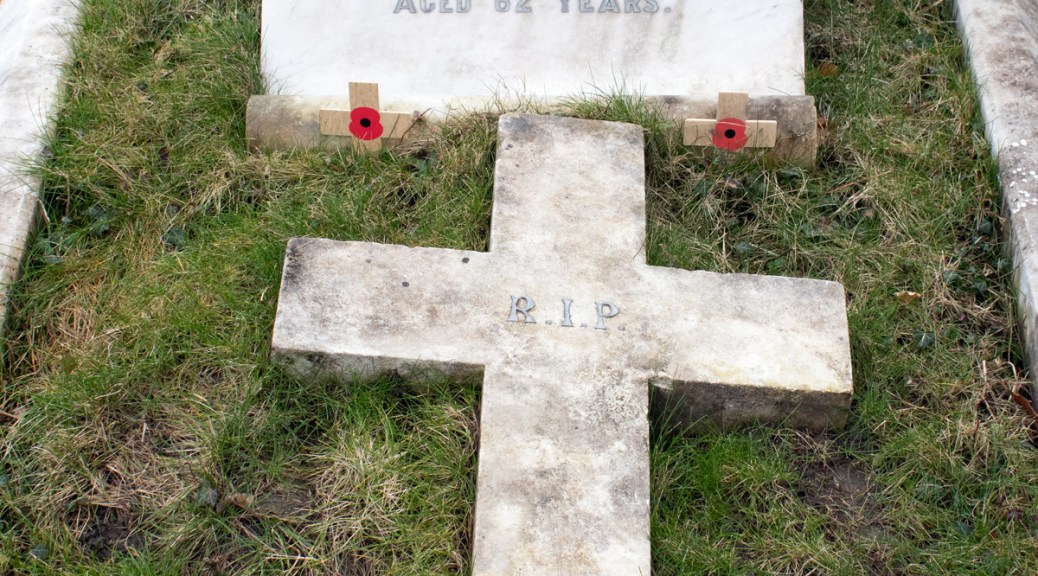
Lieutenant Colonel Thomas Hulkes Bingham Day was 62 years of age when he passed away on 11th April 1917. He was laid to rest in the graveyard of St Aldhelm’s Church in Bishopstrow, Wiltshire, not far from the base at which he had so dutifully served.
Cecil Robert Stevens was born in Arrah, India, on 14th March 1867. One of six children, his parents were Charles and Mary Stevens. Charles was a civil servant who had been born in the South Sea Islands, while Mary has been born in Bengal.
The family appear to have moved to the United Kingdom by the late 1870s. Census records for them are a bit sparse, but the 1881 document found Mary living in Honiton, Devon, with four of Cecil’s siblings and three servants. Cecil, meanwhile, was a boarding student at Malvern College, Worcestershire.
By 1891, Cecil had moved to St Columb in Cornwall. He was boarding at a hotel on Fore Street, and was employed as a general medical practitioner.
Charles was later rewarded for his service to the Empire, and received a knighthood. The 1901 census found him residing in Harcourt Terrace, Kensington, Middlesex, while his wife, now Dame Mary Stevens, was visiting a friend from India in Devon. Sir Charles died at home in 1909, following a bout of influenza.
Cecil, meanwhile, had been making his own way in the world. A qualified surgeon, he married Katharine Duff, a nurse from Aberdeen. They went on to have two children, son Cecil Jr and daughter Mignonette.
On 29th July 1893, Cecil joined the Indian Medical Service as a Lieutenant. Three years later, he was promoted to Captain, and in July 1905, he rose to the rank of Major. His commitment to duty is evident: he spent many years overseas, separated from his wife and young family, and in January 1913, was promoted to the rank of Lieutenant Colonel.
Cecil’s time in the Indian Medical Service was not without danger. In 1895, he was involved in the Relief of Chitral, for which he received a medal and clasp. He was caught up in the Tirah Campaign of 1897/98, and received a further two clasps for his role.
Lieutenant Colonel Stevens’ role during the First World War is lost in the mists of time. Given his role in the Indian Medical Service, it is likely that he served overseas, but he returned to Britain after the war, coming by way of Egypt.
By the autumn of 1919, he was back in Devon, at the family home on Elmsleigh Park Road in Paignton. His health was failing at this point, having come down with diabetes while in North Africa. him. Cecil passed away on 18th November 1919: he was 52 years of age.
Cecil Robert Stevens was laid to rest in the sprawling grounds of Paignton Cemetery.
Lieutenant Colonel Stevens’ will left £4123 13s 10d (around £180,000 today) to his sister-in-law, Alice Duff.
Katharine outlived her husband by only eight years. She passed away on 22nd December 1927 at the Field Officers’ Quarters in Gibraltar: she was 61 years of age.
Charles Edward Ridley Holroyd-Smyth was born in Ballynatray, Co. Waterford, Ireland, on 16th August 1882. The seventh of nine children, his parents were John and Harriette Holroyd-Smyth. John was a colonel in the army and, while from a a renowned family, there is actually little documented about Charles’ early life.
Given his father’s military career, it seemed natural for Charles to follow suit. His service records are tantalisingly elusive, but he certainly served in South Africa during the Second Boer War at the turn of the century.
When war broke out, Charles took up the rank of Captain in the 3rd Dragoon Guards (Prince of Wales’ Own). He set sail for France on 1st November 1914, and he found himself in the very thick of the fighting, where his battalion fought at Ypres, Loos and Arras. His conduct during the war earned him both the Distinguished Service Order and a Military Cross.
On 29th October 1916, Charles married Norah Layard, the daughter of another army officer, who had been born in Ceylon. Charles was soon back in France, however, and was promoted to Lieutenant-Colonel, and given command of the 15th Battalion of the Durham Light Infantry.
Over the course of 1918, Lieutenant-Colonel Holroyd-Smyth led his troop in the Battles of Bapaume, Messines, Kemmel and Aisne. However, it was during the Battle of Epehy that he was badly wounded. Initially treated on sight, he was quickly evacuated back to Britain for further treatment.
Lieutenant-Colonel Holroyd-Smyth was admitted to the Royal Victoria Hospital in Netley, Southampton, but his wounds were to prove too severe. He passed away on 23rd September 1918, at the age of just 36 years of age.
The body of Charles Edward Ridley Holroyd-Smyth was brought back to Somerset, where Norah was living. His funeral, at St Stephen’s Church, in Bath, was marked with some ceremony, and he was laid to rest in Lansdown Cemetery, overlooking the city.
(from ancestry.co.uk)
Charles’ death came just nine days after the passing of his mother, back in Waterford. He and Norah didn’t have any children, although tragically a newspaper report from July 1918 did note a birth: “On the 3rd July, at East Hayes House, Bath, the wife of Lieutenant-Colonel CE Holroyd-Smyth MC, a son (stillborn).” [Bath Chronicle and Weekly Gazette: Saturday 13th July 1918]
Arthur Llewellyn was born in the summer of 1873, one of four children to Evan and Mary Llewellyn. Originally from Wales, Evan was a Justice of the Peace in the Somerset village of Burrington, and the family lived in the comparative luxury of Langford Court, a mile or so from the village centre.
I use the term ‘comparative luxury’ with some sense of irony; according to the 1881 census, the family had a household staff of eight, including a governess, two nurses, housemaid, cook, kitchen maid, parlour maid and page.
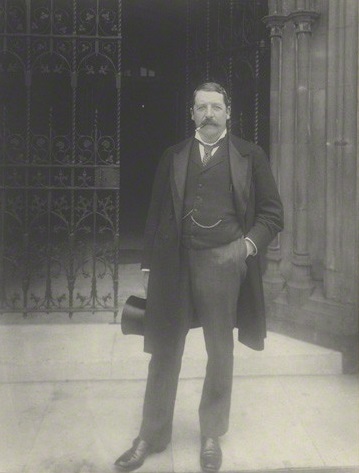
Ambition was obviously what drove Evan; he was an army office, who served in initially in the Somerset Light Infantry. In 1885, he was elected MP for North Somerset, a position he held on and off for nearly twenty years. His military service continued, however, and he led the 2nd (Central African) Battalion, King’s African Rifles in the Boer War.
Comfort ran in the Llewellyn family; according to the 1891 census, Arthur was staying with his maternal aunt, Rose Stewart. She also lived in Somerset, and, at the time the census was drawn up, she was recorded as a widow living on her own means, with her mother, mother-in-law, two nieces and Arthur, her nephew. She was not without help, however, as the house had a retinue of eight staff to support her.
Military life was an obvious draw for Arthur. He enlisted in the Somerset Light Infantry in October 1891 and, within a year, had been promoted to Second Lieutenant.
He had met and married Meriel Byrne, in 1895. The couple’s marriage certificate confirms that he had been promoted to Captain in the militia, and his residence was Buckingham Palace Road, in south west London. They were married in Holy Trinity Church, Brompton, with Meriel’s mother and Arthur’s father acting as witnesses.
The couple went on to have five children, all girls, and they settled into a comfortable life. By 1901, Meriel had set up home in Worcestershire; Arthur does not appear on that year’s census, which suggests that he may too have been fighting in South Africa.
Arthur’s mother Mary passed away in 1906, at the tender age of 39. By 1911, he had been promoted to Lieutenant Colonel in the 3rd Somerset Light Infantry, and was head of his household in Worcestershire. The family was, by this time, complete – Arthur and Meriel and their five children also had help running their home, with two nurses, a cook, parlour maid and housemaid to support them.
Evan passed away months before war was declared, at the age of 67. Lieutenant Colonel Llewellyn felt duty bound to re-enlist, and was given command of the 3rd Reserve Battalion, Somerset Light Infantry. He subsequently served as part of the Army Service Corps in France, before transferring to the Army Labour Corps in Nottingham.
According to the Evening Mail, on 27th April 1920, he “was suddenly seized with illness in the street, and died as he was being conveyed to Nottingham Hospital. He was 46 years of age.”
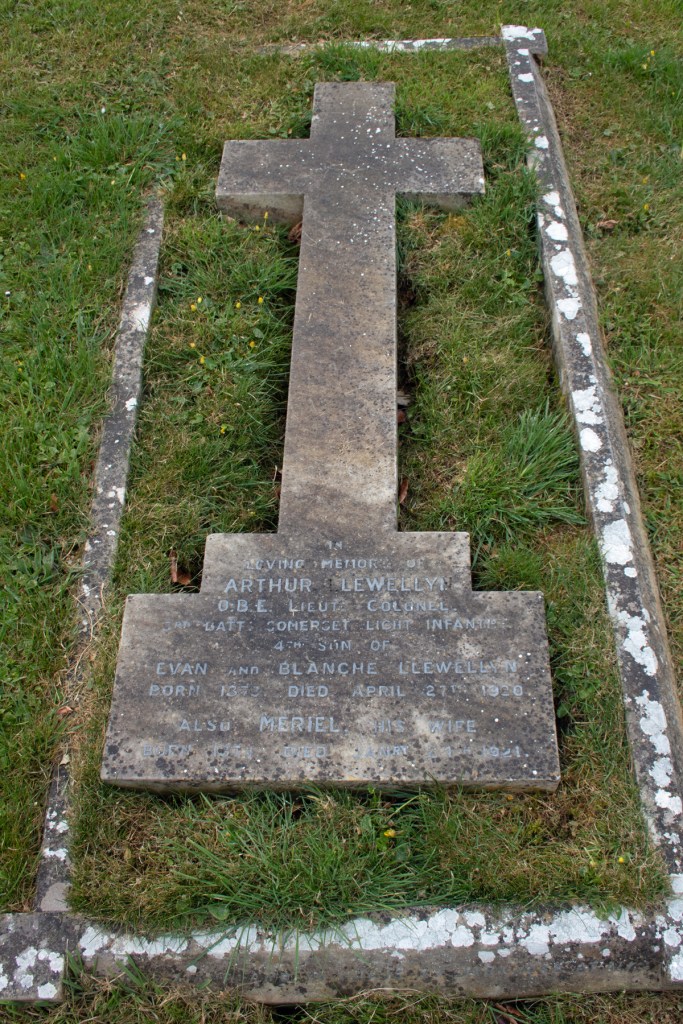
Arthur was brought back to Burrington in Somerset, where he was buried alongside his parents in Holy Trinity Churchyard.
Sadly, Meriel passed away nine months after her husband; she too is buried in Holy Trinity Churchyard.
Arthur’s estate passed to his brother, Owen, and totalled £12,023 15s 11d (approximately £530,000 in today’s money).
As an aside to Arthur’s illustrious story, another of his brothers is worthy of note. Hoel Llewellyn was two years older than Arthur.
Educated for the Royal Navy, he saw active service on the East Coast of Africa, 1888-90 with despatches. He also served as Artillery Officer and commanded artillery in the Matabele War, where he was recommended for the Victoria Cross. He was promoted Captain in the British South Africa Police, and Justice of the Peace in Matabeleland in1896.
Captain Llewellyn served throughout the South African War; commanding armoured trains north of Mafeking before transferring to the South African Constabulary in 1901. Hoel was eventually created a Companion of the Distinguished Service Order for his service in South Africa.
He was wounded while serving with the Mediterranean Expeditionary Force in the Great War. Hoel was subsequently promoted to the rank of Colonel and appointed Provost-Marshal of Egypt and the British Mediterranean Expeditionary Force.
In 1908, he had been made Chief Constable of Wiltshire, a role he was to hold for 37 years. He was key to pioneering the use of police dogs, and went on to become the oldest serving person to hold the Chief Constable role in the county.
Evan Henry Llewellyn
Another aspect of the Llewellyn family is that Evan was obviously a source of political drive for the family; his great-great-grandson is David Cameron, UK Prime Minister from 2010 to 2016.





 Death and Service