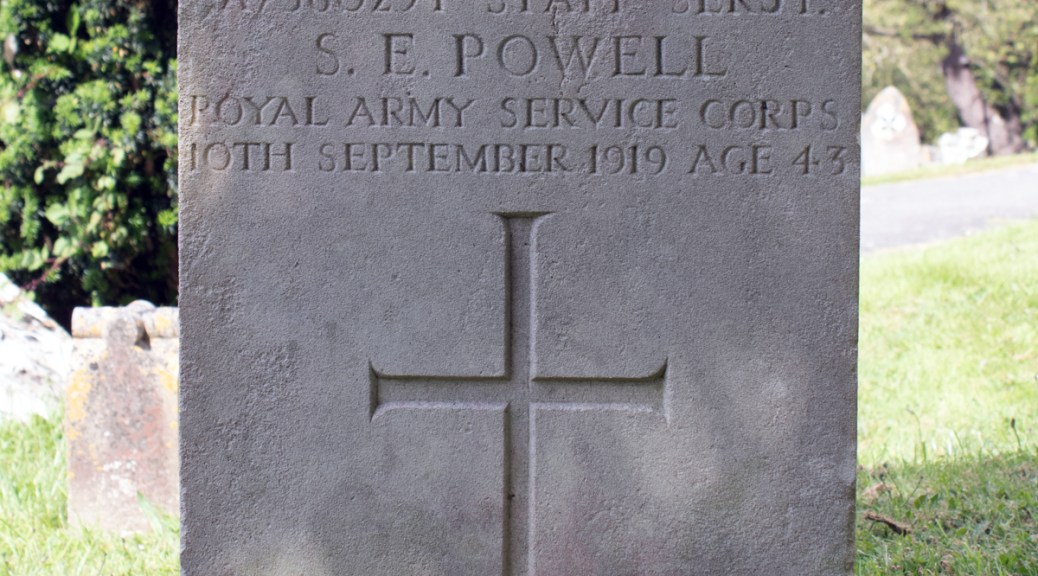
Samuel Edwin Powell was born at the start of 1876, the third of eight children to Samuel and Catherine Powell. Samuel Sr was a baker from Gloucestershire, and it was in the village of Leonard Stanley that the family were born and raised.
Much of Samuel Jr’s earlier life is undocumented, and he does not appear on either the 1891 or 1901 census returns. By the time of the next census, taken in 1911, he is recorded as living in Lewisham, Surrey.
The census noted that Samuel was employed as a commercial traveller in the chocolate industry. He was married to Stroud-born Ellen Hobbs, and had been since 1906. The couple had a son, Denis, who was a year old, and were living at 20 Hazelbank Road in Catford, with a domestic servant, Edith Price, helping Ellen while her husband was away working.
When war broke out, Samuel was called upon to play his part. He was enlisted in the Royal Army Service Corps, with the rank of Staff Serjeant, which would suggest that his absence from earlier documents was because of earlier military service.
There is little information about Samuel’s time in the army, other than that he was attached to the Clearing Office when the Armistice was declared.
The cause of Staff Serjeant Powell’s passing is not known, but the Army Register of Soldier’s Effects confirm that he died in Dorset on 10th September 1919. The connection to Dorset is unclear: he may have been serving in the area, or recuperating from an illness. He was 43 years of age.
Samuel Edwin Powell was laid to rest in Lyme Regis Cemetery, overlooking the seaside town.
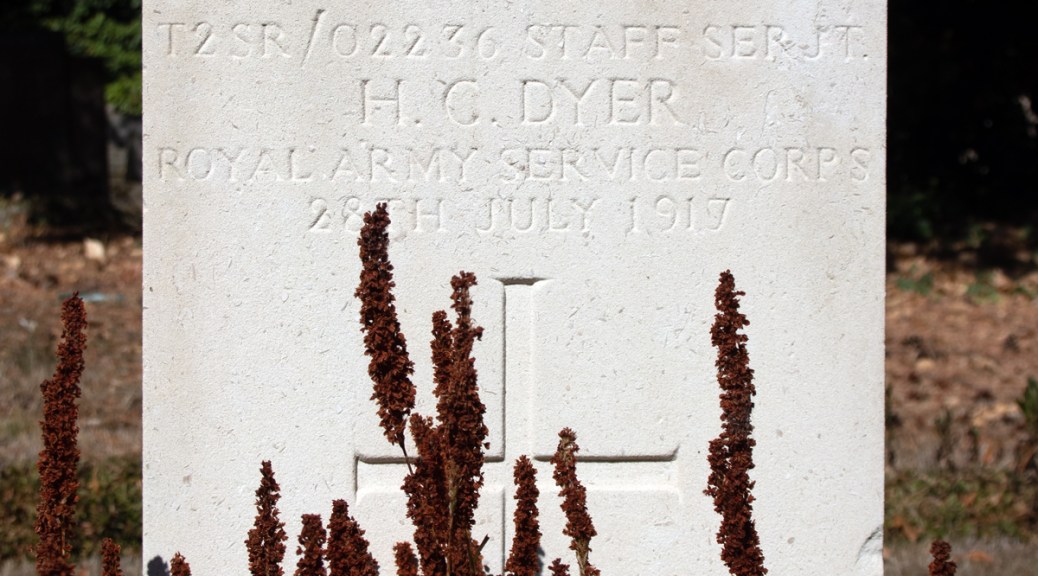
Henry Charles Dyer was born in January 1865 in the Devon town of Ivybridge. The oldest of five children, his parents were carpenter James and dressmaker Mary Dyer. When he left school, Henry found work as a cordwainer’s apprentice but, after James died in 1886, he sought out a career that would help support his mother.
Henry enlisted in the Army Service Corps on 10th July 1886 and, by the time of the next census was based at barracks in Woolwich, South London. His service records note that he was 5ft 4.5ins (1.64m) tall and weighed 124lbs (56.25kg). He had a dark hair, grey eyes and a dark complexion. He was also noted as having a tattoo of a cross on his left forearm.
Private Dyer served in the regiment on home soil for more than thirteen years, qualifying as a horse collar maker and saddler during this time and rising through the ranks. He was made a Driver in 1889, Corporal in 1895 and Staff Sergeant in October 1899.
Trouble was afoot on the other side of the world by this time and his promotion was linked to Henry being sent to South Africa. He was there for eighteen months, and was awarded the Queen’s South Africa Medal, as well as clasps for service at Tugela Heights, the Relief of Ladysmith, Laing’s Nek, Transvaal and Orange Free State.
Staff Sergeant Dyer went back to Britain in April 1901, where he remained for a further six years. On 4th July 1907, reached the end of his term of service and having completed 21 years with the Army Service Corps he returned to civilian life.
Henry moved back to Devon, moving back in with his mother and younger brother. Mary had remarried after James passed, but her second husband had also passed away, and so having two of her sons home would have been of comfort to her. The 1911 census records the family as living in three rooms of a house in Grenville Street, Plymouth. They shared the property with the Smith family, a husband, wife and two children. Henry was recorded as an army pensioner (saddler), while his brother Ernest was listed as being a watchmaker, while also in the army reserve.
War was on the horizon again, and, Henry was one of the first to step up when it was declared. He was 49 years old by this point, and so technically exempt from enlisting, but as an army life had served him well before, it must have seemed fit for him to serve King and Country once more.
Staff Sergeant Dyer’s new service records noted that he was formally employed as a saddler, and that he had put on 18lbs (8kg) since he initially signed up.
Henry was based firmly on home soil this time round, and while he was initially based in Aldershot, Hampshire, he seems to have been moved to barracks in Kent. He served for more than two and a half years, but his health seems to have been suffering by this point. At a medical on 24th July 1917, he was deemed to be no longer fit enough for war service and was discharged from the army.
It is likely that this discharge came while he was admitted to the Preston Hall Military Hospital in Aylesford. While Staff Sergeant Dyer’s earlier military service is fairly detailed, his later career is not. What is clear is that, four days after being discharged, he passed away. He was, by this time, 52 years of age.
A lack of funds may have prevented Mary from bringing her son home to Devon. Instead Henry Charles Dyer was laid to rest in the graveyard of St Peter and St Pauls Church in Aylesford, not far from the Kent hospital in which he passed.
Percy Harry Hawkins was born in Waltham Green, London, in 1886. One of five children, all boys, his parents were Frederick and Elizabeth Hawkins. Frederick initially worked as a brewer’s collector – collecting rent from tenant pub managers on behalf of the brewery – before working as a tobacconist.
In July 1908, Percy married Gladys Parnell. Sadly, tragedy was to strike and, over the next couple of years both Elizabeth and Frederick passed away in 1909 and 1910 respectively.
By the time of the following year’s census, Percy and Gladys were boarding with a dispensing doctor (or GP), and his wife. Percy listed his occupation as a ‘traveller’, was probably employed as some kind of salesman.
Tragedy was to strike Percy again. Months after the couple had their first child in July 1911, Gladys also passed away, leaving him as a widower and single parent at just 26 years old.
From his later military documentation, it seems that Percy married again in August 1915, this time to a woman called Mildred, and, by September 1919, he had gone on to have three children in total; one boy and two girls.
When war broke out, Percy was quick to enlist. He joined up in Birmingham on 10th August 1914, and gave his profession as a commercial traveller. His records show that he was 28 years and 120 days old, stood 5ft 6ins (1.69m) tall and weighed 131lbs (59.5kg).
After initially joining the Royal Warwickshire Regiment, Private Hawkins was transferred to the Royal Army Service Corps, and was assigned to one of the supply companies.
Over the four years of the war, Percy served on home soil, and was promoted a number of times, rising from Private to Lance Corporal, Staff Sergeant to Quartermaster Staff Sergeant. In September 1917, he was again promoted, this time to Staff Sergeant Major, a position he held for the remainder of the conflict, and on into 1919, when he volunteered for an extra year’s service, rather than being demobbed.
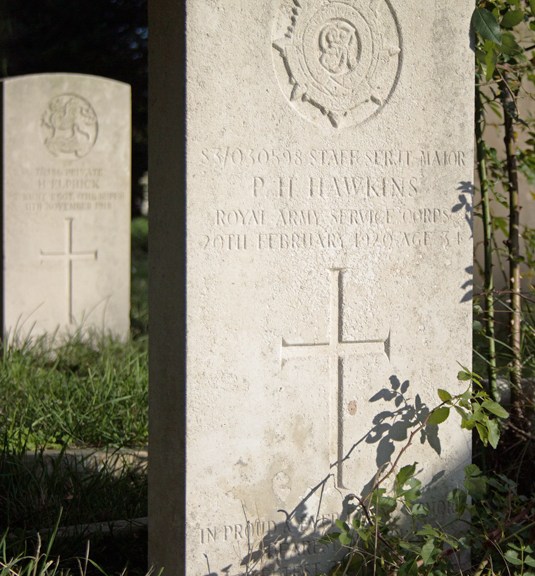
In February 1920, Staff Serjeant Major Hawkins fell ill; he was admitted to the military hospital that had been set up in Brighton Pavilion, Sussex. The diagnosis was heart failure, and, sadly, it was to this that he was to succumb. He passed away on 20th February 1920, aged just 34 years old.
Percy’s family was, by this time, living down the coast in Worthing; his body was brought there for burial and he lies at rest in the Broadwater Cemetery in the town.
William Reginald Coggan was born in Twerton, near Bath, at the end of 1882. His father, also called William, was a railway guard, and with his mother, Annie, he would go on to raise nine children, six of them girls.
William Jr became known as Reginald, presumably to avoid confusion with his father. He didn’t follow his father onto the railways, but found a way to serve his country. In the 1901 census, he was working as a baker for the Army Service Corps, and was based at the Stanhope Lines Barracks in Aldershot (along with more than 1800 others).
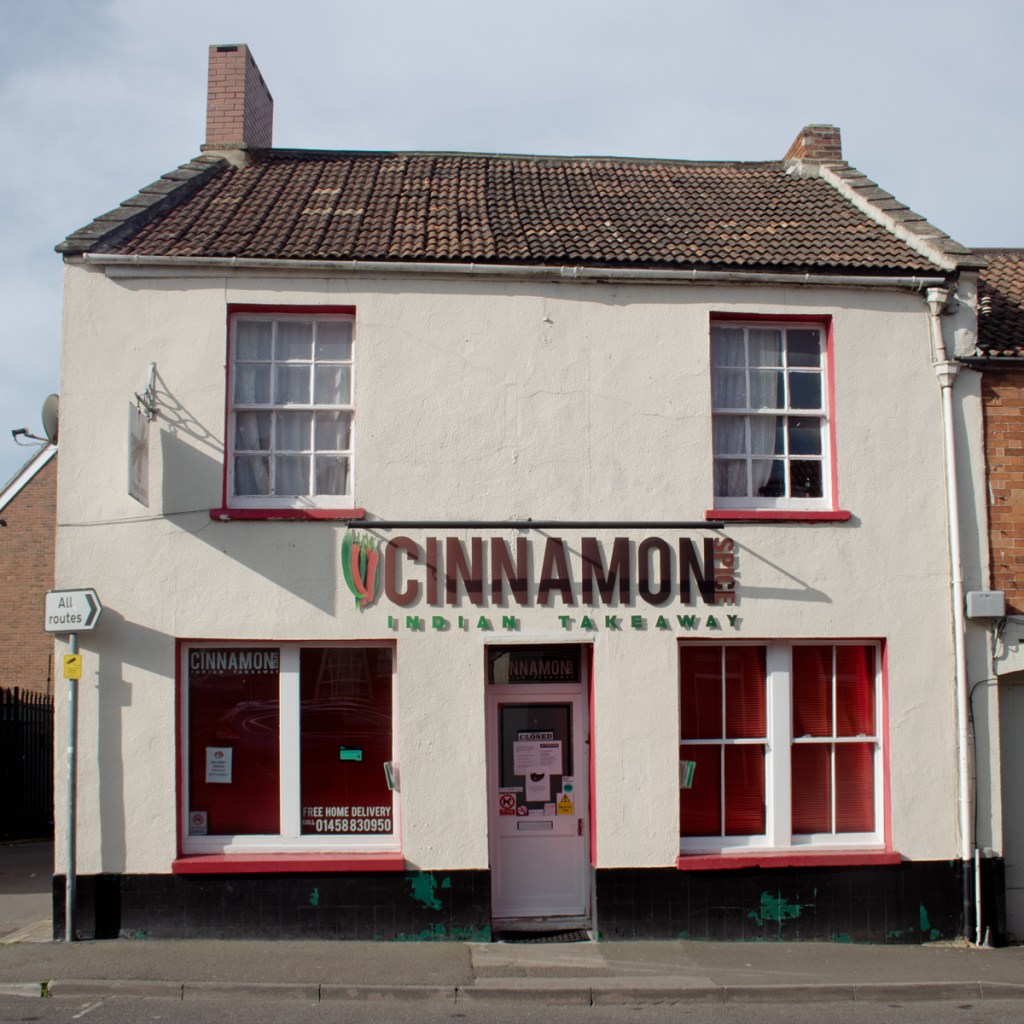
Ten years later – by the time of the 1911 census – William had left the army but continued his trade. He was listed as a baker of confections in Glastonbury, was living above the bakery with his wife of four years. I have been able to find little information about his wife, Kate, other than that she came from Dublin.
William Coggan’s former bakery in Glastonbury, Somerset.
William’s life becomes a little vague after the census. A newspaper report confirms that he had served in the South Africa war (1899-1902), and that he had seen five years’ service in France. The report – and William’s pension records – confirm that he had continued in the Army Service Corps, gaining the rank of Staff Sergeant.
William had died in Ireland, and his death registered in Fermoy, thirty miles to the north of Cork. The report confirmed that:
Nothing is yet known of how he came by his death, although a request was made for a post-mortem examination.
Taunton Courier and Western Advertiser: Wednesday 11th August 1920.
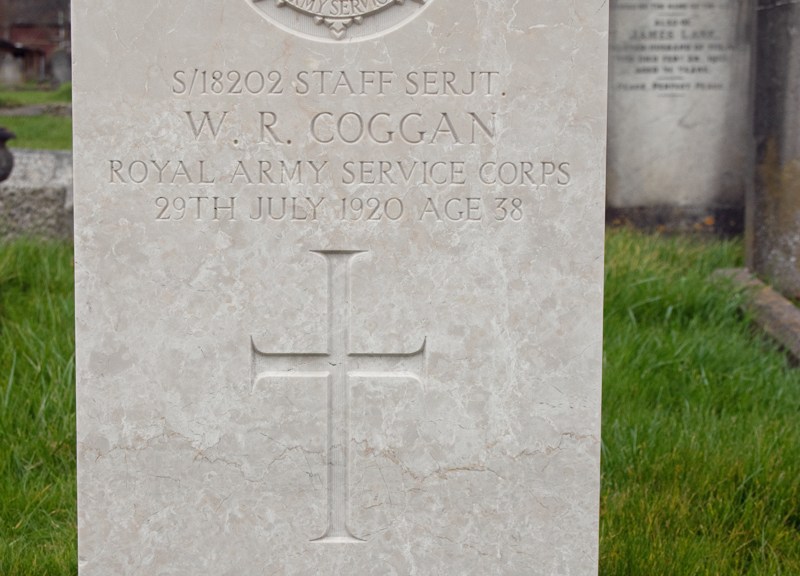
I can find no further information about his death and, unusually, his Pension Record gives the date, but not the cause. Staff Sergeant Coggan died on 29th July 1920, aged 38 years old.
William Reginald Coggan’s body was brought back to England for burial. He lies at rest in St John’s Cemetery in Bridgwater, Somerset.





 Death and Service