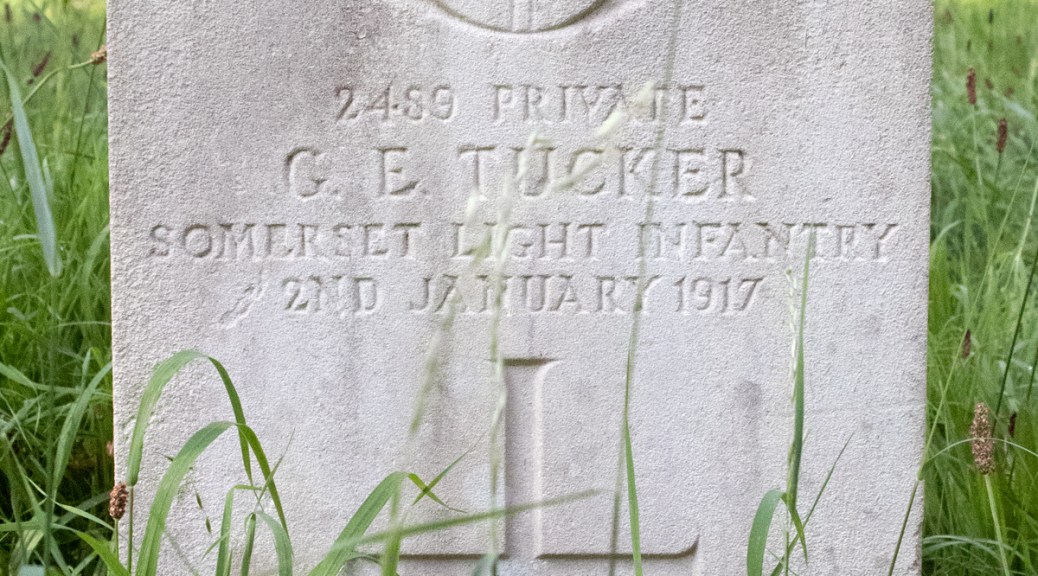
George Edward Tucker was born in Lyncombe, Bath, Somerset in the autumn of 1883. The fourth of eight children, his parents were stone mason Edward Tucker and his wife, both of whom were from northern Somerset.
When he finished his schooling, George found work as an errand boy. By the time of the 1911 census, however, he had taken a job as a painter, possibly being employed by his father’s boss.
George married Rosina Hurley at Bath Register Office at the start of 1913. the couple set up home and went on to have two children, Edina and Audrey.
George enlisted in the opening weeks of the First World War, joining the Somerset Light Infantry as a Private. His time in service was not to last long, however. He was out on a route march on 1st December, when he was pulled up with acute pain in the chest.
Private Tucker was sent back to barracks, and given light duties. A subsequent medical confirmed an enlarged heart, and he was medically discharged from military service on 31st December 1914.
At this point, George’s trail goes cold. The next record for him is that of his passing, on 2nd January 1917. He was 33 years of age.
George Edward Tucker was laid to rest in Bath’s sweeping Locksbrook Cemetery.
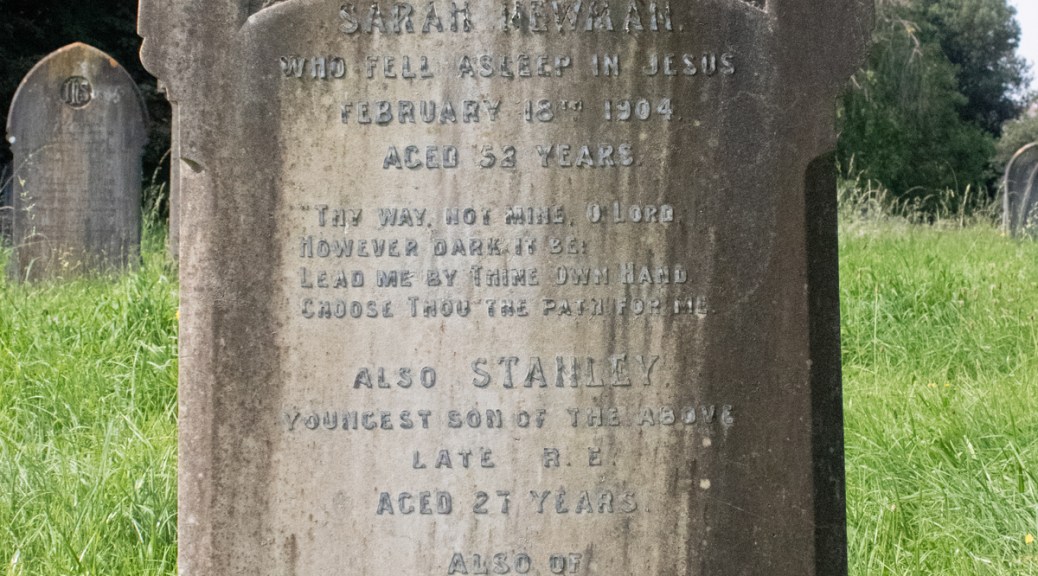
Stanley Herbert Newman was born on 14th May 1890 in the Walcot area of Bath, Somerset. One of at least six children, his parents were Charles and Sarah Newman. Charles was a stonemason and, when Sarah died in 1904, he married again, to widow Matilda Shearn, raising her children as part of the family.
When Stanley left school, he found work as a mason’s labourer – presumably either assisting his father, or having found work through him. On 3rd August 1912, he married Rosa Bean, a farm worker’s daughter from Bathwick, to the east of the Bath. The couple set up home at 7 Margaret’s Hill, and went on to have two children, Mabel and Albert.
With a growing family to support, Stanley’s work as a labourer was not going to bring enough money in, and he sought a more reliable career. On 2nd September 1912, he enlisted in the army, joining the Royal Engineers. His service record shows that he was 5ft 5.5ins (1.66m) tall.
Detailing Sapper Newman spent just over two years in the Royal Engineers, his time there coming to an end on 11th December 1914 when he was deemed medically unfit to serve.
At this point Stanley’s trail goes cold. At some point he joined the Somerset Light Infantry, although his service documents for this period of time in the army as lost to time. Attached to a Depot Battalion, it seems likely that he remained in Somerset, although this is not conclusive.
Private Newman died in a military hospital on 28th July 1917, through causes unknown. He was 27 years of age.
Stanley Herbert Newman was laid to rest in the family plot in Bath’s sweeping Locksbrook Cemetery. He was reunited with his mother, who had been buried there thirteen years before. His father, Charles, was buried with them in 1921.
William James Mackay was born in Bath, Somerset, on 2nd January 1900. The son of a woman called Matilda, the following year’s census found him living as a nurse child in the home of John and Elizabeth Logie. The household was made up of the Logies, their five children, a boarder, and another nurse child, Harold Fellows.
The next census, taken in the spring of 1911, shows a change in circumstances for the family. Matilda and William were living in the Walcot area of the city, with Matilda’s husband, William Smith. The document suggests that the couple had been married for twelve years, but this would not account for the younger William’s original surname. The census return states that he had taken the name of Smith as well, and there was a fourth resident in the household, widow Elizabeth Clarke.
War came to Europe in the summer of 1914, and William Jr was keen to step up and play his part. Because of his age he was unable to enlist immediately, and it was not until the start of 1917, that he was able to enlist.
William – who had returned to the name Mackay by this point – was working as a clerk when he joined the Royal Naval Air Service (RNAS) on 23rd January 1917. His service records show that he enlisted as a Boy Mechanic, and that he was 5ft 8.5ins (1.74m) tall. He had brown hair, brown eyes and a fresh complexion.
Boy Mechanic Mackey was assigned to HMS Daedelus, one of the RNAS shore-based facilities: it was here that he was to receive his training over the spring and summer. Military barracks were notoriously cramped and hotbeds for illness and disease, and William was not to be immune to health issues. He contracted cerebrospinal meningitis within months of arriving at the base, and passed away on 5th August 1917. He was just 17 years of age.
William James Mackay was brought back to Somerset for burial. He was laid to rest in the sweeping grounds of Bath’s Locksbrook Cemetery.
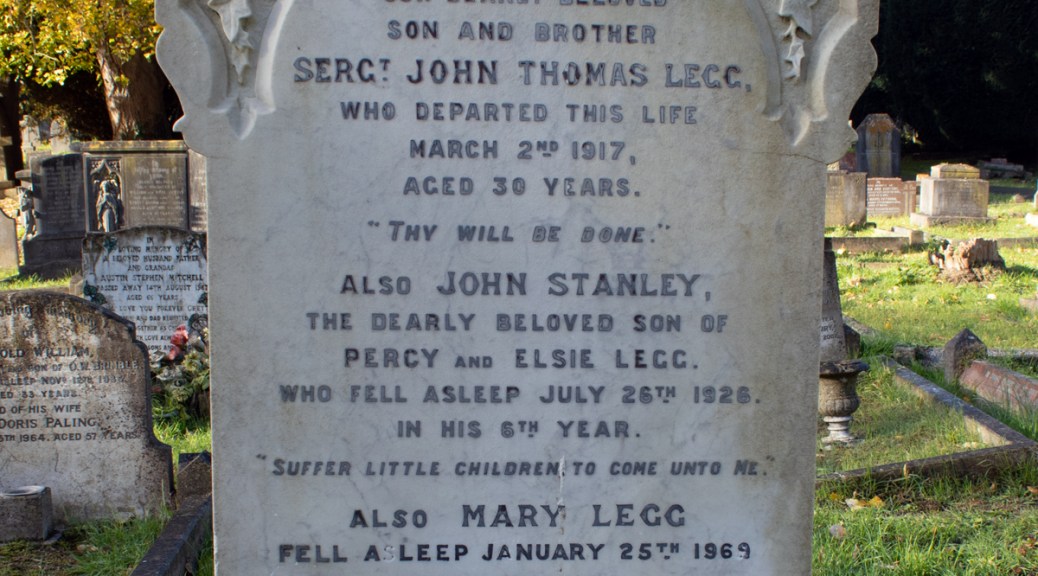
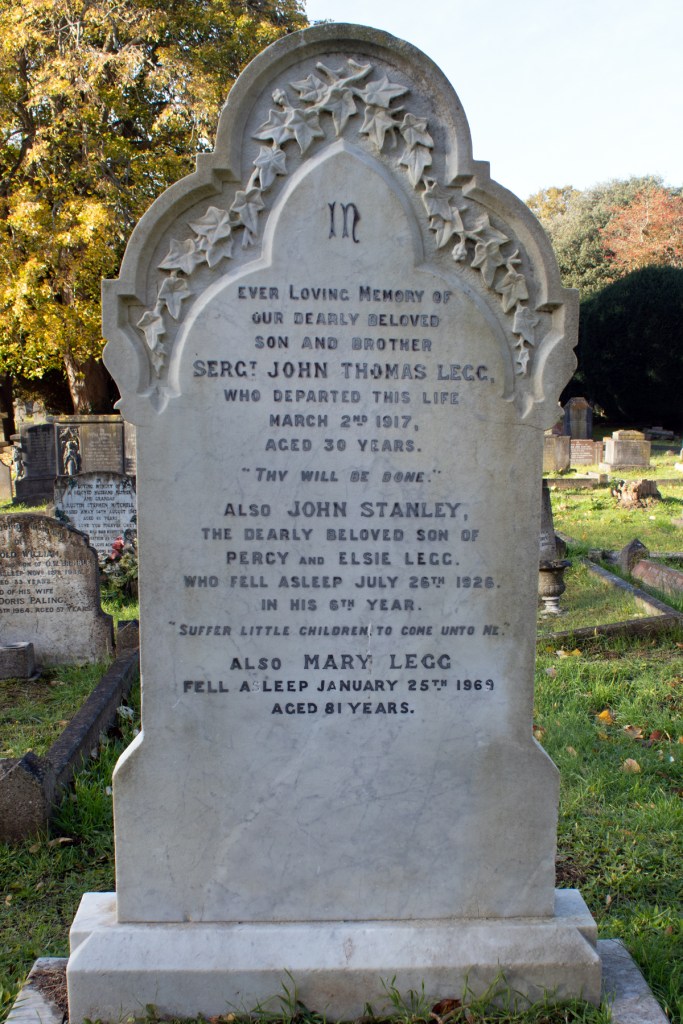
John Thomas Legg was born in the summer of 1885, the oldest of five children to Benjamin and Sarah Legg. Benjamin was a carpenter from Dorset, and it was in Bridport that John was born. Within a year or so, however, the young family moved north to Weston-super-Mare, Somerset, and this is where they settled.
When he completed his schooling, John found a job as a clerk. By the time of the 1911 census, he was working as a political assistant/clerk, and five of the six members of the Legg household were gainfully employed. Benjamin was still working as a carpenter, while John’s two sisters were dressmakers, and his younger brother Percy was a tailor’s assistant.
In the summer of 1914, war came to Europe, and John was one of the first to step up and serve his King and Country. He initially enlisted in the North Somerset Yeomanry, and was assigned to the 1st/1st Battalion. Private Legg’s unit was quickly sent to France, and fought at the Battle of Nonne Bosschen that November.
John’s service records are sparse, and so it is not possible to confirm exactly when and how he served. He moved from the North Somerset Yeomanry to the 6th Battalion of the Reserve Cavalry Regiment: his promotion to Corporal and then Lance Sergeant suggests that this move enabled him to share his skills with incoming recruits. It is unclear whether he was based in Somerset by this point, but it is certainly where he ended up by the start of 1917.
The remains of Sergeant JT Legg, North Somerset Yeomanry, were buried at Weston-super-Mare Cemetery on Wednesday. The first portion of the service was held at St Saviour’s Church, which the sergeant formerly attended, and the interior of which bears many evidences of his skill as an amateur wood-carver… Sergeant Legg was formerly chief clerk in the offices of the Well Division Conservative Association.
Bath Chronicle and Weekly Gazette: Saturday 10th March 1917
John Thomas Legg passed away on 2nd March 1917: he was 31 years of age. He was laid to rest in the sweeping grounds of Milton Road Cemetery, Weston-super-Mare, a short walk from where his family still lived.
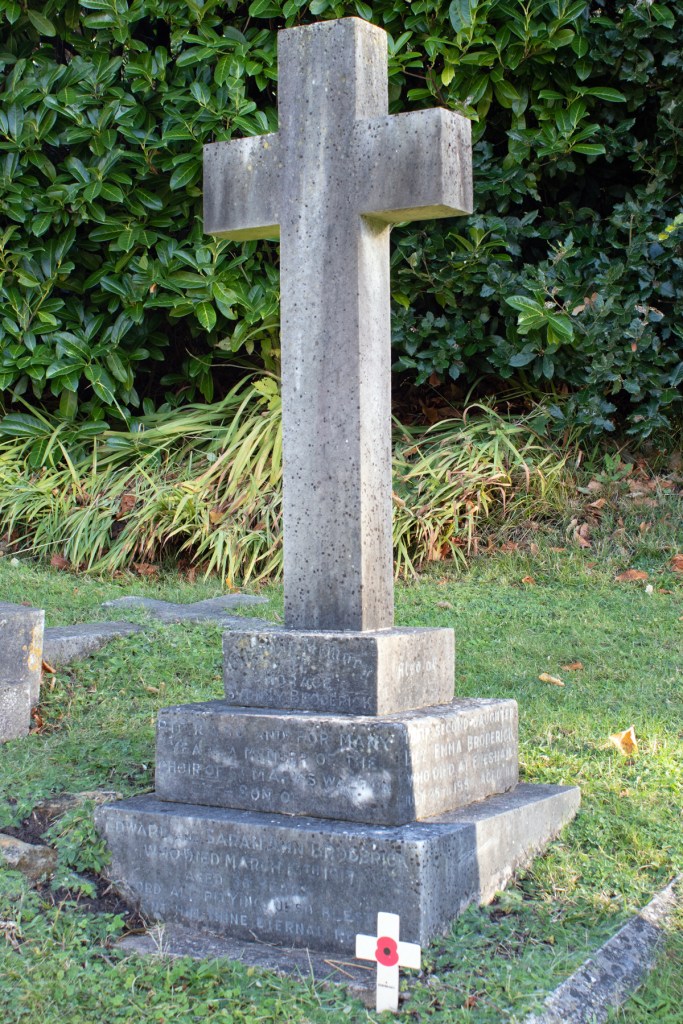
Horace Sydney Broderick was born in the summer of 1880, and was the youngest of ten children to Edward and Sarah Broderick. Edward was a clothier from Newport Pagnell, Bedfordshire, but the family were born and raised in Horfield, Gloucestershire.
By the time of the 1891 census, the family had moved to the south of Bristol, setting up home at Rugby House in Walton-in-Gordano, Somerset. Horace was still at school, and of the four other siblings living at the family home, only one, Horace’s older brother, Walter, was gainfully employed, assisting his father in the cloth trade. The Brodericks were supported by two live-in staff, a cook, Elizabeth Phipps, and a housemaid, Ada Perrett.
The next census, taken in 1901, found Horace and three of his sisters still living at Rugby House with their parents. Edward was now employing his son as a clerk to the family business, and two new staff had come on board, cook Lily Collier and housemaid Florence Hadeley.
By the time of the 1911 census, Edward and Sarah had been living in Rugby House for more than twenty years. Both now in their 70s, they still had their oldest daughters living with them, but Horace is nowhere to be found. Indeed, there is no sign of him on any of the UK census returns, and it is not until six years later that he seems to surface again.
When war broke out, Horace stepped up to enlist. He joined the Army Service Corps and, based on his service number, was employed as a Driver Mechanic. Beyond this, Private Broderick’s time in the military is lost to time.
New has been received in Bristol of the death at the Royal Herbert Hospital, Woolwich, of Pte. Horace Sydney Broderick, youngest son of the late Mr Edward Broderick (of the firm Broderick & Co,. Limited, St James’s Barton, Bristol) and of Mrs Broderick, of Walton Park, Clevedon. Deceased soldier was in his 37th year.
Bristol Times and Mirror – Thursday 15 March 1917
The report appeared in a dozen or so contemporary newspapers and, as no specific detail is given, it is likely that Horace passed away from illness, rather than injury or any unexpected cause. He died on 13th March 1917, at the age of 36 years old.
Horace Sydney Broderick’s body was brought back to Somerset for burial. He was laid to rest in the graveyard of St Mary’s Church, Walton Clevedon, next to Edward, who had passed away two years before.
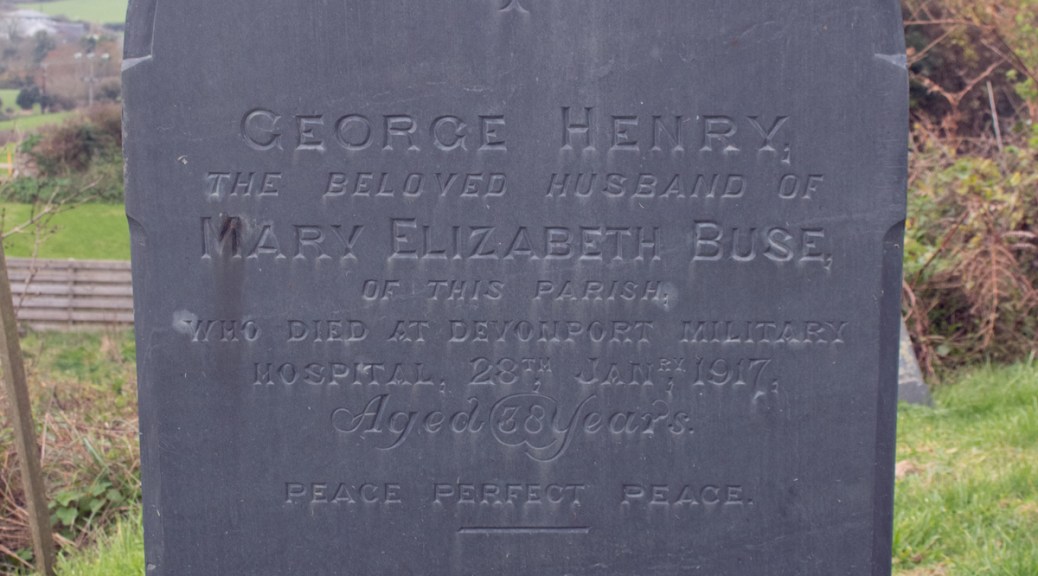
George Henry Buse was born in the Cornish village of St Minver in 1880. One of four children, his parents were Richard and Angelina. Richard was an agricultural labourer, but his son followed a different trade, finding employment as a stonemason.
In the summer of 1904, George married a woman called Mary. They went on to have a daughter, Olive, who was born in 1906, and set up home in Splatt, on the outskirts of the village.
When war came to Europe in the summer of 1914, George stepped up to play his part. He enlisted by the summer of 1916, and joined the 2nd Battalion of the Devonshire Regiment. Private Buse’s unit served on the Western Front, but it is unclear whether he fought overseas.
By the winter of 1916, George had fallen ill. He contracted pneumonia, and was admitted to the military hospital in Devonport, Devon. The condition was to prove too severe, however, and he passed away on 28th January 1917: he was 36 years of age.
George Henry Buse was brought back to Cornwall for burial. He was laid to rest in the peaceful graveyard of St Menefreda’s Church in St Minver.
Charles James Hibbs was born in the summer of 1895 the fifth of nine children to James and Emily Hibbs. James was a groom from Dorchester, Dorset, but the family were first raised in Bere Regis, where Charles was born, before moving to Amesbury, Wiltshire, by 1900.
When he finished his schooling Charles found work as an under boot for a local hotel. When war came, however, he stood up to play his part. Unfortunately, full details of his service are lost to time, but he had joined the Somerset Light Infantry by January 1917. Assigned to the 11th Battalion, Private Hibbs soon found himself barracked in Tankerton, Kent.
While there, Charles seemed to keep himself to himself, rarely mixing with any of his colleagues. His seniors did not appear to think a great deal of him. Towards the end of May, things had come to a head for Private Hibbs:
Charles James Hibbs… was found at a quarter past three on Wednesday afternoon lying dead by the downstairs front door of his billet at Buena Vista, Tankerton Road, with his right hand under the breech of the rifle and the muzzle pointing to his right shoulder.
Whitstable Times and Herne Bay Herald: Saturday 2nd June 1917
The subsequent inquest shone a harsh light on the Edwardian attitude towards mental health. In the week leading up to Charles’ suicide, he was pulled off patrol a couple of times for absentmindedness.
Deceased’s manner was very strange and his companions complained of him and said he was very strange the whole time…
He would lean about over the bannisters and one could not get any sense of reason out of him. He would not associate with his comrades in any way. If I [Sergeant Edward Risden] asked him whether there was anything the matter he would pull himself together and say “I’m all right, sergeant.” He would then be all right for a few minutes and then wander away from his comrades.
The Coroner – Did you think he was not quite right in his mind? – That was my opinion.
Whitstable Times and Herne Bay Herald: Saturday 9th June 1917
Private Hibbs was sent to see the Medical Officer, but was sent back to his unit and advised to stick to light duties.
One of Charles’ colleagues, Private Harold Prosser, was billeted him the night before he killed himself:
At 1:30am… [Prosser] heard deceased moving about in the next bed to him and the he got up in bed. Witness got a match and lit the gas. Deceased put on his trousers, boots, and hat and told [Prosser] to get back to bed and put the gas out. [Prosser] left the gas on and deceased sat on the bed for about half an hour smoking and kept saying “Yes, sir.” The deceased mentioned by name his father and mother and all his relations an then got up and said “Yes, this time I am going to do it.” Deceased went to the rifle rack and [Prosser’s colleague, Private Middleton] awoke then and told him to let the rifles alone or he would report him. Deceased then took his hand off the rifle rack and said “All right” and went back and sat on the bed again. He was still smoking. He had his eye fixed on the same rifle for about half an hour after that and then he undressed and went to bed.
Whitstable Times and Herne Bay Herald: Saturday 9th June 1917
Private Prosser then went to sleep in another room because, as he told the Coroner, he did not feel safe being in the same one. A report was made to Private Hibbs’ corporal the next morning and, when asked by the Coroner if he thought Hibbs “was a little off his head”, Harold replied “Yes, the previous day he sat in bed talking to himself all day. I asked him what was the matter and he said ‘I am all to pieces.'”
In summing up, the Coroner did show some sympathy towards Charles’ actions:
…while no military regulation might have been infringed he did think people should understand that it was most important to tell the doctor the symptoms of a patient. It not only applied to military patients, but to civilian patients. If the medical officer on [the morning of 30th May] had had the facts reported to him of the strange behaviour of the deceased during the night he would most probably have placed him in hospital and the man might have received such treatment there or elsewhere that would have got him back into a sane condition.
Whitstable Times and Herne Bay Herald: Saturday 9th June 1917
At the inquest, the jury recorded a verdict of suicide during temporary insanity. Private Hibbs died on 30th May 1917: he was just 21 years of age.
Charles James Hibbs’ body was taken back to Wiltshire for burial. He was laid to rest in Amesbury Cemetery, not far from where his grieving family lived.
Patrick Craven was born in the summer of 1898 in Drogheda, County Louth. The oldest of three children, his parents were Francis (or Frank) and Mary Craven. Mary died in 1909, and the following year Patrick’s father remarried, to widow Kate Devin. The 1911 census found the extended family living in a cottage on North Road, Frank, Kate and their seven children.
Frank was a farm labourer, and this is work that Patrick also went into when he finished his schooling. War came to Europe in 1914, and he was to be called upon to play his part.
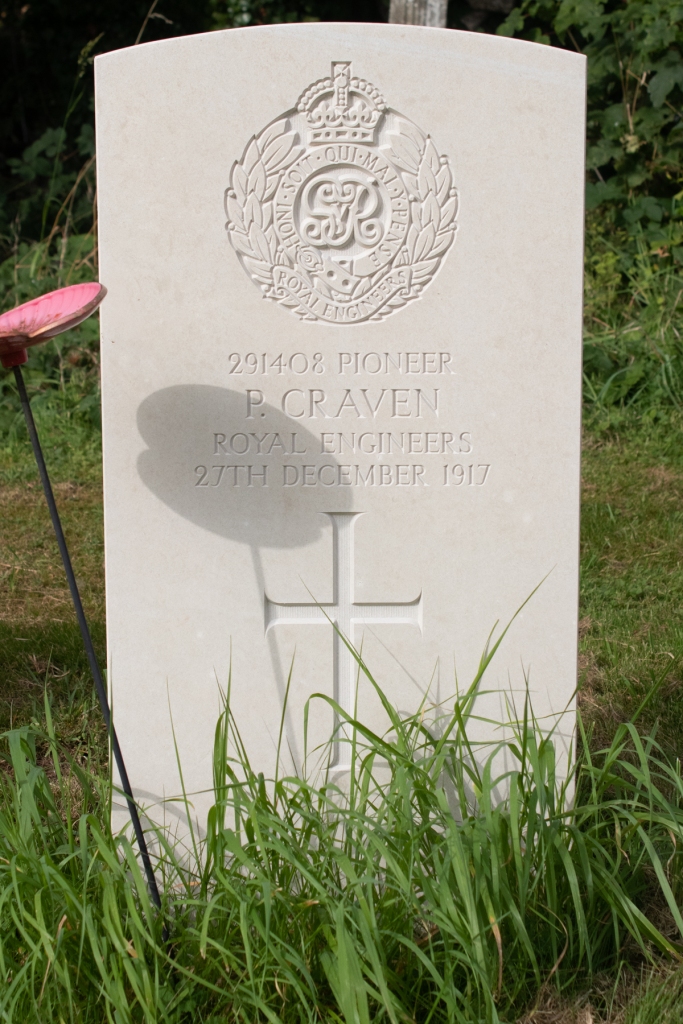
Patrick enlisted in the Royal Engineers on 6th June 1917. His service records confirm that he was 5ft 6ins (1.68m) tall, and weighed 127lbs (57.6kg). Pioneer Craven was assigned to the Inland Waterways Transport Division, and sent to Henbury, on the outskirts of Bristol, Gloucestershire, for training.
There was one blip on Patrick’s otherwise spotless service when, on 1st October 1917, he was confined to barracks for two days for ‘conduct to the prejudice of good order and military discipline, leaving the ranks without permission‘. Shortly after this, Pioneer Craven was assigned to a unit in Portbury, Somerset.
The wet summer of 1917 had given way to a cold, harsh winter, and the conditions were to lead to Pioneer Craven’s tragic demise on 27th December. The detailed report from the Medical Officer explained what had happened:
This man was found dead… in a small harness room at the Lodway Brewery, Pill, a room occupied by the IW&D, Portbury. I was called in to see him and pronounced him dead, the body was quite stiff and cold and death had probably taken place several hours before. When first discovered the body was fully pronated, with the mouth flattened against the floor, the hands were gripping the Army greatcoat which he had pulled over himself.
The harness room was heated by a coke stove the flue of which passed through the room to the ceiling and was cracked, allowing the fumes of the burning coke to emanate into the room. There was no ventilation except through a door communicating with the stables, which was found shut at the time the cadavre [sic] was found. The stove was situate[d] between the position where the body lay and the door, in a cul-de-sac.
One other man slept in the same room the same night, the deceased man having evidently entered the place after the former had fallen asleep. The second man was not affected by the fumes to any degree, but was lying between the stove and the door under which there was a certain amount of draught.
Sheltering himself from the cold winter night, Private Craven had passed away in his sleep from carbon monoxide poisoning. He was just 19 years of age.
Patrick Craven’s family were unable to afford to bring him back to Ireland for burial. Instead, he was laid to rest in the peaceful graveyard of St George’s Church in Easton-in-Gordano, not far from the brewery stables where he had passed.
Charles Bayliss was born in Birmingham in 1861. Little concrete information is available about his early life, but later documents confirm his father was called John, and he was one of at least five children.
Charles married Ellen Kimberley on 8th April 1888. The couple wed at St Mary’s Church in Kidderminster, Worcestershire, and went on to have four children – Nellie, Charles, Burt and Eva.
Charles took up manufacturing work, and ended up being a machine belt maker. He also served in the South Staffordshire Regiment, although whether this was on a paid or voluntary basis is not clear.
When was came to Europe, Charles felt the need to serve his country once more. He enlisted on 23rd August 1917, taking five years off his age to ensure he was accepted. He was assigned to the Royal Engineers, and attached to the Inland Waterways and Docks unit.
Private Bayliss was based at Portbury Camp near Bristol, and records suggest that Ellen moved to be near him, finding lodgings on Myrtle Hill in Pill.
Charles was respected for the work that he was doing, and was promoted to Lance Corporal in May 1918. His health was against him, however, and just two months later he collapsed and died from a heart attack while at work. He was 58 years of age.
Charles Bayliss was laid to rest in the graveyard of St George’s Church, Easton-in-Gordano, not far from the docks where he had served, and the riverside home in which his widow still lived.
Hubert John Cavell was born on 12th August 1882 in Bristol, Gloucestershire. The middle of three children, his parents were John and Annie Cavell. The 1901 census recorded John as a cycle manufacturer, and both he and Annie were keen to educate their children.
Hubert studied to be an architect, and was employed as such when, on 17th February 1910, he married Florence Shellard. Also born in Bristol, she was the daughter of an insurance agent. Hubert’s father, however, had changed career by the time of his son’s nuptials, and was working as a manufacturer of steel rope.
After their wedding, Hubert and Florence moved out to Easton-in-Gordano, Somerset, and went on to have two daughters: Phyllis, who was born in November 1910; and Dorothy, born in April 1912.
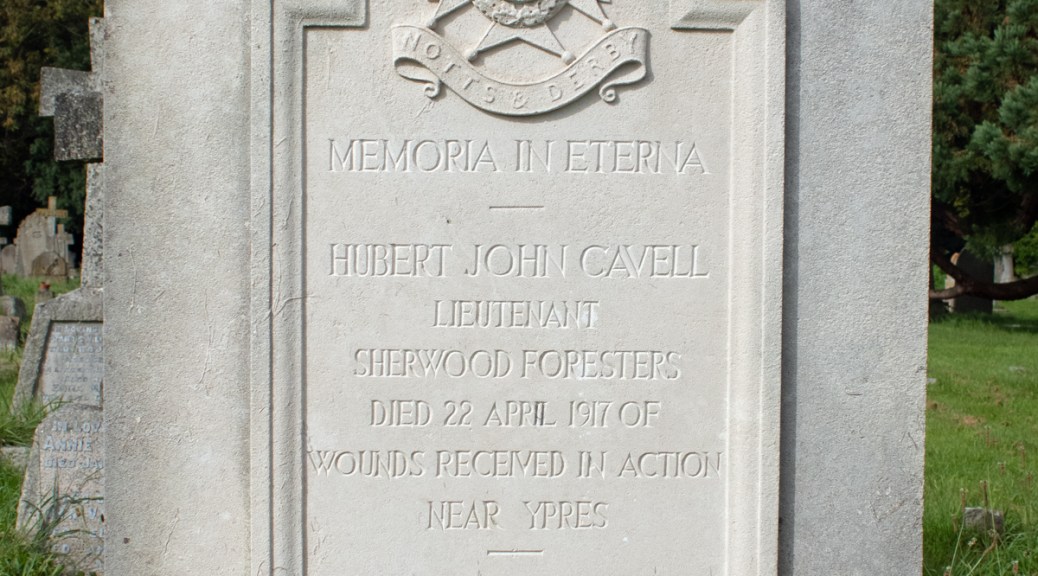
War was brewing across Europe by this point, and, when hostilities were announced, Hubert stepped up to play his part. Full service records for him are lost to time, although is it clear that he joined the Sherwood Foresters (the Nottinghamshire & Derbyshire Regiment). He was assigned to the 11th (Service) Battalion, and, by the spring of 1917, was firmly entrenched on the Western Front.
News has just been received of the death from wounds, received in action, of Lieut. Hubert John Cavell, of Easton-in-Gordano. The deceased officer was educated at the Cathedral School, and had been associated with the firm of Messrs. Paul and James, architects, for the past 16 years. He was for some years a member of the Church Ringers’ Society, being engaged in that capacity at St James’s Church, Bristol. He joined the Sherwood Foresters in January, 1916, received his commission, and had for the past three months held the position of acting-adjutant. He was 34 years of age, and leaves a widow and two little daughters.
Western Daily Press: Tuesday 24th April 1917
Lieutenant Cavell had been caught up in the fighting near Ypres, and was medically evacuated to a military hospital in Dorking, Surrey. It was here that he succumbed to his injuries on 22nd April 1917.
Hubert John Cavell’s body was brought back to Easton-in-Gordano for burial. He was laid to rest in the family plot in St George’s Churchyard. He was reunited with Florence, when he died in 1971, and Dorothy, when she passed away in 1997.










 Death and Service