Tag Archives: 1917

Private Charles Hibbs

Private Charles Hibbs

Charles James Hibbs was born in the summer of 1895 the fifth of nine children to James and Emily Hibbs. James was a groom from Dorchester, Dorset, but the family were first raised in Bere Regis, where Charles was born, before moving to Amesbury, Wiltshire, by 1900.

When he finished his schooling Charles found work as an under boot for a local hotel. When war came, however, he stood up to play his part. Unfortunately, full details of his service are lost to time, but he had joined the Somerset Light Infantry by January 1917. Assigned to the 11th Battalion, Private Hibbs soon found himself barracked in Tankerton, Kent.

While there, Charles seemed to keep himself to himself, rarely mixing with any of his colleagues. His seniors did not appear to think a great deal of him. Towards the end of May, things had come to a head for Private Hibbs:

Charles James Hibbs… was found at a quarter past three on Wednesday afternoon lying dead by the downstairs front door of his billet at Buena Vista, Tankerton Road, with his right hand under the breech of the rifle and the muzzle pointing to his right shoulder.

Whitstable Times and Herne Bay Herald: Saturday 2nd June 1917

The subsequent inquest shone a harsh light on the Edwardian attitude towards mental health. In the week leading up to Charles’ suicide, he was pulled off patrol a couple of times for absentmindedness.

Deceased’s manner was very strange and his companions complained of him and said he was very strange the whole time…

He would lean about over the bannisters and one could not get any sense of reason out of him. He would not associate with his comrades in any way. If I [Sergeant Edward Risden] asked him whether there was anything the matter he would pull himself together and say “I’m all right, sergeant.” He would then be all right for a few minutes and then wander away from his comrades.

The Coroner – Did you think he was not quite right in his mind? – That was my opinion.

Whitstable Times and Herne Bay Herald: Saturday 9th June 1917

Private Hibbs was sent to see the Medical Officer, but was sent back to his unit and advised to stick to light duties.

One of Charles’ colleagues, Private Harold Prosser, was billeted him the night before he killed himself:

At 1:30am… [Prosser] heard deceased moving about in the next bed to him and the he got up in bed. Witness got a match and lit the gas. Deceased put on his trousers, boots, and hat and told [Prosser] to get back to bed and put the gas out. [Prosser] left the gas on and deceased sat on the bed for about half an hour smoking and kept saying “Yes, sir.” The deceased mentioned by name his father and mother and all his relations an then got up and said “Yes, this time I am going to do it.” Deceased went to the rifle rack and [Prosser’s colleague, Private Middleton] awoke then and told him to let the rifles alone or he would report him. Deceased then took his hand off the rifle rack and said “All right” and went back and sat on the bed again. He was still smoking. He had his eye fixed on the same rifle for about half an hour after that and then he undressed and went to bed.

Whitstable Times and Herne Bay Herald: Saturday 9th June 1917

Private Prosser then went to sleep in another room because, as he told the Coroner, he did not feel safe being in the same one. A report was made to Private Hibbs’ corporal the next morning and, when asked by the Coroner if he thought Hibbs “was a little off his head”, Harold replied “Yes, the previous day he sat in bed talking to himself all day. I asked him what was the matter and he said ‘I am all to pieces.'”

In summing up, the Coroner did show some sympathy towards Charles’ actions:

…while no military regulation might have been infringed he did think people should understand that it was most important to tell the doctor the symptoms of a patient. It not only applied to military patients, but to civilian patients. If the medical officer on [the morning of 30th May] had had the facts reported to him of the strange behaviour of the deceased during the night he would most probably have placed him in hospital and the man might have received such treatment there or elsewhere that would have got him back into a sane condition.

Whitstable Times and Herne Bay Herald: Saturday 9th June 1917

At the inquest, the jury recorded a verdict of suicide during temporary insanity. Private Hibbs died on 30th May 1917: he was just 21 years of age.

Charles James Hibbs’ body was taken back to Wiltshire for burial. He was laid to rest in Amesbury Cemetery, not far from where his grieving family lived.


Pioneer Patrick Craven

Pioneer Patrick Craven

Patrick Craven was born in the summer of 1898 in Drogheda, County Louth. The oldest of three children, his parents were Francis (or Frank) and Mary Craven. Mary died in 1909, and the following year Patrick’s father remarried, to widow Kate Devin. The 1911 census found the extended family living in a cottage on North Road, Frank, Kate and their seven children.

Frank was a farm labourer, and this is work that Patrick also went into when he finished his schooling. War came to Europe in 1914, and he was to be called upon to play his part.

Patrick enlisted in the Royal Engineers on 6th June 1917. His service records confirm that he was 5ft 6ins (1.68m) tall, and weighed 127lbs (57.6kg). Pioneer Craven was assigned to the Inland Waterways Transport Division, and sent to Henbury, on the outskirts of Bristol, Gloucestershire, for training.

There was one blip on Patrick’s otherwise spotless service when, on 1st October 1917, he was confined to barracks for two days for ‘conduct to the prejudice of good order and military discipline, leaving the ranks without permission‘. Shortly after this, Pioneer Craven was assigned to a unit in Portbury, Somerset.

The wet summer of 1917 had given way to a cold, harsh winter, and the conditions were to lead to Pioneer Craven’s tragic demise on 27th December. The detailed report from the Medical Officer explained what had happened:

This man was found dead… in a small harness room at the Lodway Brewery, Pill, a room occupied by the IW&D, Portbury. I was called in to see him and pronounced him dead, the body was quite stiff and cold and death had probably taken place several hours before. When first discovered the body was fully pronated, with the mouth flattened against the floor, the hands were gripping the Army greatcoat which he had pulled over himself.

The harness room was heated by a coke stove the flue of which passed through the room to the ceiling and was cracked, allowing the fumes of the burning coke to emanate into the room. There was no ventilation except through a door communicating with the stables, which was found shut at the time the cadavre [sic] was found. The stove was situate[d] between the position where the body lay and the door, in a cul-de-sac.

One other man slept in the same room the same night, the deceased man having evidently entered the place after the former had fallen asleep. The second man was not affected by the fumes to any degree, but was lying between the stove and the door under which there was a certain amount of draught.

Sheltering himself from the cold winter night, Private Craven had passed away in his sleep from carbon monoxide poisoning. He was just 19 years of age.

Patrick Craven’s family were unable to afford to bring him back to Ireland for burial. Instead, he was laid to rest in the peaceful graveyard of St George’s Church in Easton-in-Gordano, not far from the brewery stables where he had passed.


Lance Corporal Charles Bayliss

Lance Corporal Charles Bayliss

Charles Bayliss was born in Birmingham in 1861. Little concrete information is available about his early life, but later documents confirm his father was called John, and he was one of at least five children.

Charles married Ellen Kimberley on 8th April 1888. The couple wed at St Mary’s Church in Kidderminster, Worcestershire, and went on to have four children – Nellie, Charles, Burt and Eva.

Charles took up manufacturing work, and ended up being a machine belt maker. He also served in the South Staffordshire Regiment, although whether this was on a paid or voluntary basis is not clear.

When was came to Europe, Charles felt the need to serve his country once more. He enlisted on 23rd August 1917, taking five years off his age to ensure he was accepted. He was assigned to the Royal Engineers, and attached to the Inland Waterways and Docks unit.

Private Bayliss was based at Portbury Camp near Bristol, and records suggest that Ellen moved to be near him, finding lodgings on Myrtle Hill in Pill.

Charles was respected for the work that he was doing, and was promoted to Lance Corporal in May 1918. His health was against him, however, and just two months later he collapsed and died from a heart attack while at work. He was 58 years of age.

Charles Bayliss was laid to rest in the graveyard of St George’s Church, Easton-in-Gordano, not far from the docks where he had served, and the riverside home in which his widow still lived.


Lieutenant Hubert Cavell

Lieutenant Hubert Cavell

Hubert John Cavell was born on 12th August 1882 in Bristol, Gloucestershire. The middle of three children, his parents were John and Annie Cavell. The 1901 census recorded John as a cycle manufacturer, and both he and Annie were keen to educate their children.

Hubert studied to be an architect, and was employed as such when, on 17th February 1910, he married Florence Shellard. Also born in Bristol, she was the daughter of an insurance agent. Hubert’s father, however, had changed career by the time of his son’s nuptials, and was working as a manufacturer of steel rope.

After their wedding, Hubert and Florence moved out to Easton-in-Gordano, Somerset, and went on to have two daughters: Phyllis, who was born in November 1910; and Dorothy, born in April 1912.

War was brewing across Europe by this point, and, when hostilities were announced, Hubert stepped up to play his part. Full service records for him are lost to time, although is it clear that he joined the Sherwood Foresters (the Nottinghamshire & Derbyshire Regiment). He was assigned to the 11th (Service) Battalion, and, by the spring of 1917, was firmly entrenched on the Western Front.

News has just been received of the death from wounds, received in action, of Lieut. Hubert John Cavell, of Easton-in-Gordano. The deceased officer was educated at the Cathedral School, and had been associated with the firm of Messrs. Paul and James, architects, for the past 16 years. He was for some years a member of the Church Ringers’ Society, being engaged in that capacity at St James’s Church, Bristol. He joined the Sherwood Foresters in January, 1916, received his commission, and had for the past three months held the position of acting-adjutant. He was 34 years of age, and leaves a widow and two little daughters.

Western Daily Press: Tuesday 24th April 1917

Lieutenant Cavell had been caught up in the fighting near Ypres, and was medically evacuated to a military hospital in Dorking, Surrey. It was here that he succumbed to his injuries on 22nd April 1917.

Hubert John Cavell’s body was brought back to Easton-in-Gordano for burial. He was laid to rest in the family plot in St George’s Churchyard. He was reunited with Florence, when he died in 1971, and Dorothy, when she passed away in 1997.


Driver John McClymont

Driver John McClymont

John McClymont was born in Cowra, New South Wales, Australia, in 1865. Full details of his early life are lost to time, but later documents confirm that his mother was called Sophia.

Most of the information relating to John’s life comes from his army service records. These confirm that he enlisted on 13th September 1915, and that he was assigned to the 8th/20th unit of the 5th Australian Infantry Brigade. He was noted as being a labourer when he joined up, with brown hair, blue eyes and a fresh complexion. The record confirms that he stood 5ft 10ins (1.78m) tall, and weighed 169lbs (76.7kg).

Private McClymont arrived in Egypt in February 1916, and transferred to the 2nd Battalion of the Australian Imperial Force. He was initially based at Tel-el-Kebir camp, close to Cairo. From here on in, he seems to have been beset with poor health, and had numerous hospital admissions for heart ailments and haemorrhoids.

By April 1916, John’s unit had arrived in France, and his commitment to the job was not to go unrewarded. On 13th July 1916, he was appointed to the role of Acting Sergeant, and just three months later, he was reassigned to the 1st Australian Infantry Brigade Headquarters, where he was mustered as a Driver.

He was still battling health issues, however, and, in 18th August 1917, he was admitted to a hospital in Boulogne with heart disease. Within a month, Driver McClymont had been medically evacuated to Britain for treatment, and he was taken to Bath War Hospital in Somerset. It was here that he was diagnosed with diabetes, and, having slipped into a diabetic coma, it was here that he passed away, on 9th October 1917. He was 42 years of age.

With all of his family on the other side of the world, John McClymont was laid to rest in the military section of Bath’s Locksbrook Cemetery.


Private Russell Smith

Private Russell Smith

Russell David Smith was born in Shoreditch, London, in the summer of 1877. The second of four children, his parents were tailor Richard Smith and his wife, Emma.

When he finished his schooling, Russell found work as a bookbinder: by the time of the 1901 census, the family had moved to a small terraced house in Cassland Road, Hackney.

On Christmas Day 1902, Russell married Alice Stretch. A year younger than her new husband, she had been born in Islington, and was the youngest child to cabman Edwin Stretch. When the couple married, she was working as a mantle maker’s assistant, making elements for gas lamps.

The newlyweds settled in a cottage in Walthamstow, and went on to have three children. The 1911 census recorded the young family living at 39 Ritchings Avenue: they had taken in a lodger, Alice Carter, to help pay the bills.

War came to Europe in the summer of 1914 and Russell was called upon to play his part. Details of his military service are sketchy, but from the documents available, it is evident that he had enlisted by the summer of 1917 joining the Labour Corps. Private Smith was attached to the 119th Labour Coy. which seems to be been based in Somerset.

It is impossible to trace Russell’s trail any further. The next record for him is that of his passing, on 17th October 1917. The cause of his death is not readily apparent, but he was 40 years old at the time.

Finances seem to have prevented Alice from bringing her husband home. Russell David Smith was, instead, laid to rest in Locksbrook Cemetery, Bath, probably as this might have been the closest burial ground to where he had passed away.


Private Thomas Bastow

Private Thomas Bastow

Thomas Bastow was born in the spring of 1889, the youngest of five children to Frederick and Mary Bastow. Frederick was from Weston-super-Mare in Somerset, but had met his Liverpudlian wife in Lancashire, and it was in the North West of England that the Bastow family had been raised. Mary passed away in 1898, when she was jus 40 years of age. Frederick remarried in 1901, Florence Travis becoming the young Thomas’ stepmother.

Frederick was an inspector for a mineral water company, but when Thomas left school, he found work as a clerk for the land registry. In the autumn of 1916, he married Margaret Hughes. Sadly, there is little more information about her, although their wedding was registered in West Derby.

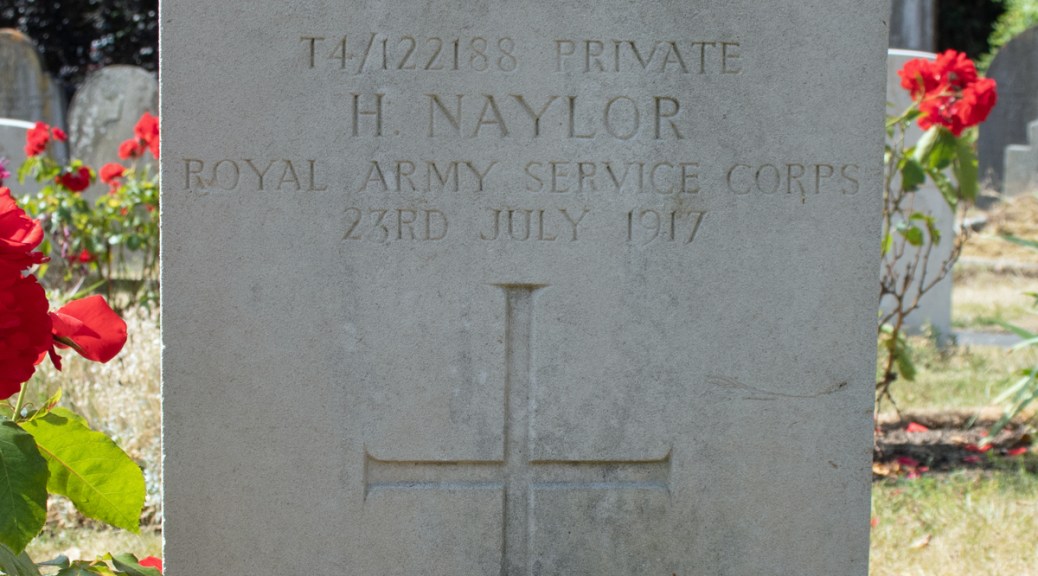
It may have been that Thomas was in the army at this point, or at least on the verge of going. He enlisted in the Royal Army Service Corps, and was attached to one of the supply units. He seems to have been based in Somerset, as this is where he was hospitalised when he came down with appendicitis.

Private Bastow’s condition was to get the better of him: he passed away on 4th May 1917 while admitted to the Bath War Hospital. He was just 28 years of age.

Finances seem to have limited Margaret’s options when it came to her late husband’s funeral. Rather then being taken back to the north wet for burial, Thomas Bastow was instead interred in Bath’s Locksbrook Cemetery.


Private Frederick Witt

Private Frederick Witt

Frederick Charles Witt was born on 19th June 1888 in Amesbury, Wiltshire. The second youngest of eight children, his parents were journeyman baker Richard Witt and his wife, Elizabeth.

By the time of the 1901 census, Richard had set up a bakery in North Tidworth, ten miles north-east of Amesbury, with Frederick’s older brother, Alfred, helping out. This was a line of work that Frederick was also to go into when he completed his schooling: the next census return, in 1911, noted him as being his father’s assistant.

On 26th December 1912, Frederick married a woman called Kate Howard. The marriage took place at St Luke’s Church, Enfield, Middlesex. Kate was living in Enfield at the time, while hew new husband was based in Southampton, Hampshire. How a connection was made between the two is unclear, but the couple settled back in Southampton, and went on to have two children: Ivy and Doris.

When war was declared, Frederick was called upon to play his part. Full details of his service are unclear, but he had joined the Royal Army Service Corps by the start of 1917. Private Witt was attached to the Reserve Supply Personal Depot in Bath, Somerset, but, soon after enlisting, he contracted pneumonia.

Frederick was admitted to the Bath War Hospital in April 1917, but the condition was to prove too severe. He passed away on 20th April, at the age of 28 years old.

Frederick Charles Witt was laid to rest in Bath’s sweeping Locksbrook Cemetery. Interestingly, a newspaper report of his funeral did not mention the attendance – or existence – of Kate or their children; instead his parents seemed to take centre stage.


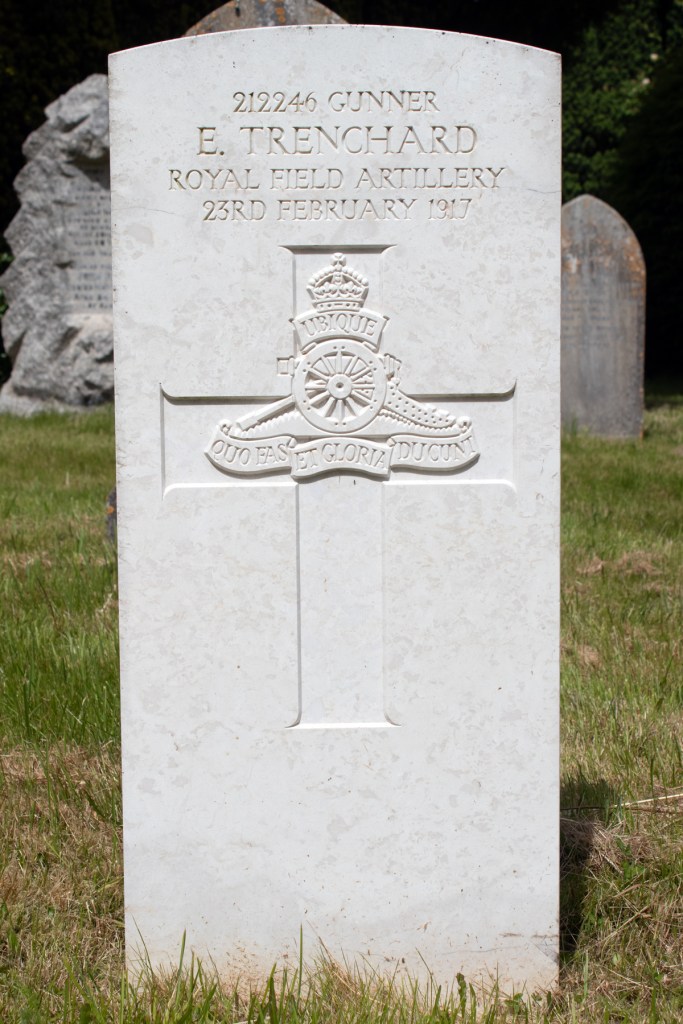
Gunner Percival Parsons

Gunner Percival Parsons

Percival James Parsons was born in the summer of 1898, and was the fourth of eight children to Henry and Emily. Henry was a railway labourer from Chilton Burtle, Somerset, and it was in the neighbouring hamlet of Chilton on Polden (now Chilton Polden) that the family were born and raised.

There is little documented about Percival’s short life. When war came to Europe, he was just 16 years of age. He was keen to play his part, however, probably spurred on by seeing his older brothers or friends step up.

Percival enlisted as soon as he turned 18 years old. He joined the Royal Field Artillery and was sent to Hampshire for training. Gunner Parsons was attached to E Battery of the 7th (Reserve) Brigade, a unit based ultimately in India during the confluct.

Gunner Parsons, however, was not to see service abroad. While he was training, he became unwell, contracting pneumonia. Admitted to the Frensham Hill Military Hospital, he was to succumb to the condition, passing away on 28th March 1917. He was just 18 years of age.

Percival James Parsons’ family had moved to Highbridge by this point, and it was here that Henry and Emily’s boy was taken for burial. He was laid to rest in the town’s cemetery.


Gunner Percival Parsons
(from andestry.co.uk)

Private Thomas Besley

Private Thomas Besley

The short life of Thomas Besley is a challenge to unpick. He was born in Bampton, Devon, early in 1896, one of ten children to farm labourer Steven Besley and his wife, Fanny.

Steven’s work took the family around the region, and the 1901 census found the Besleys living on Cordings Farm in Wiveliscombe, Somerset. The document records Thomas as being 5 years of age, sharing the accommodation with his parents and six of his siblings.

The 1911 census records Thomas working as a live-in labourer at Manor Farm in Huish Champflower, a village just three miles outside of Wiveliscombe.

Meanwhile, his family are still recorded as living in Wiveliscombe itself, Steven and Fanny residing with four of their children. Now, however, another Thomas is listed with them: seven years old, he is the only child of their oldest son, William and his late wife, Elizabeth. She had died in 1904, around the same time as young Thomas’ birth, and it would appear that Steven and Fanny adopted their grandson (he is listed on the census as their ‘son’). William went on to marry again, but his new wife, a widow called Hannah, had seven children from her first marriage. The couple would go on to have a son of their own, but it was a crowded house, and so Thomas lived permanently with his grandparents.

The older Thomas Besley signed up almost as soon as war was declared in 1914. While his service records are sparse, he joined the 3rd/5th Battalion of the Somerset Light Infantry.

What can be determined from the records is that Private Besley drowned. His death certificate – which mistakenly records his surname as Beasley – confirms that Thomas’ body was found in the River Tone in Taunton on 16th February 1915, and the cause of death noted as ‘found drowned’.

While research for Besley draws a number of blanks about the circumstances of his death, the misspelled surname featured in a contemporary newspaper report:

On Tuesday afternoon, around four o’clock, MJ Chapman… while passing the Locks at Firepool, Priory, Taunton, observed what appeared to be the body of a man floating in the swirl caused by the overflow of the Locks into the pool. The police were immediately informed… and proceeded to the spot with the ambulance and recovered the body of a man, dressed in khaki uniform. The body had evidently been in the water for a considerable time and was much decomposed. The deceased was subsequently identified as Thomas Beasley, son of Mr Stephen Beasley, of Langley Marsh, Wiveliscombe. He was a private in the 5th Battalion of the Somerset Light Infantry, and was 40 years of age. He had been in ill-health for a considerable period, and latterly had been depressed. He disappeared on January 16th, and despite all enquiries his whereabouts remained a mystery until Tuesday…

[At the inquest] Stephen Beasley, a farm labourer… gave evidence of [Thomas’] identification. He said that his son had lately been ill. Three months ago he was taken from Salisbury Plain to Bristol Hospital, where he remained for about a month. After his discharge from Hospital he went home, where he remained about a fortnight, and for the last two months he had been quartered at Taunton. In this time witness had seen his son twice, but he could not say that he had been well since he came out of Hospital. He was low-spirited, but never told witness that anything troubled him.

Florence Beasley… sister of deceased, said she last saw her brother about a month ago in Taunton. He seemed very strange and low and would not speak unless spoken to first. He seemed to be troubled, and would not shake hands with her when she left him. He seemed to be always ‘studying.’ There was no suicidal tendency in the family…

Captain Burridge stated that deceased was sent to hospital from the Plain about September. About the middle of October he had a wire from Bristol Infirmary informing him that he was dangerously ill and dying. However, he got over that, and he was discharged on October 28th. He was sent for 22 days’ furlough to his home and returned to duty on November 22nd. Ever since that time he had not been in the best of health, but nothing had been noticed of his mental condition. He believed at one time there was a talk of his being discharged as medically unfit. He disappeared on January 16th.

The Coroner asked [how] long deceased had been in the service, and witness answered that he joined on June 1st, 1913. His complaint when removed to Bristol Hospital was double pneumonia.

On the suggestion of the Coroner, the jury returned an open verdict.

Taunton Courier and Western Advertiser: Wednesday 24th February 1915

In addition to the Besley/Beasley surname, the report features a couple more discrepancies. Thomas’ father’s name is given as Stephen, when it was Steven. The deceased is also recorded as being 40 years old when he died, when he was actually half that age.

Thomas Besley was laid to rest in the peaceful graveyard of St Andrew’s Church in Wiveliscombe. It gives his age as 17 years old and the date of his death as 16th February 1917.