Reginald John Murdin’s early life is one of contradictions. Born in 1899, his parents were George White and Lily Murdin, and he is recorded with both surnames in documents from the time. George was a iron ore labourer from Northamptonshire, and is was in Woodford, near Kettering, that the family were raised.
When he finished his schooling, Reginald followed George into iron ore and, by the time war broke out he was in the employ of the Islip Iron Company Ltd. Keen to play his part, Reginald enlisted in the King’s Royal Rifle Corps on 29th January 1916.
While it’s not possible to fully identify Rifleman Murdin’s service, he was certainly caught up on the Western Front by the autumn of 1918. It was here that he was injured by “a shell which burst about two yards from him, wounding him severely in the thigh.” [Midland Mail: Friday 15th November 1918]
Reginald was medically evacuated to Britain for treatment, and was admitted to the Bath War Hospital in Somerset. Sadly, his wounds were to prove to severe, and he passed away on 2nd November 1918: he was just 19 years of age.
Reginald John Murdin was laid to rest in the sweeping grounds of Bath’s Locksbrook Cemetery.
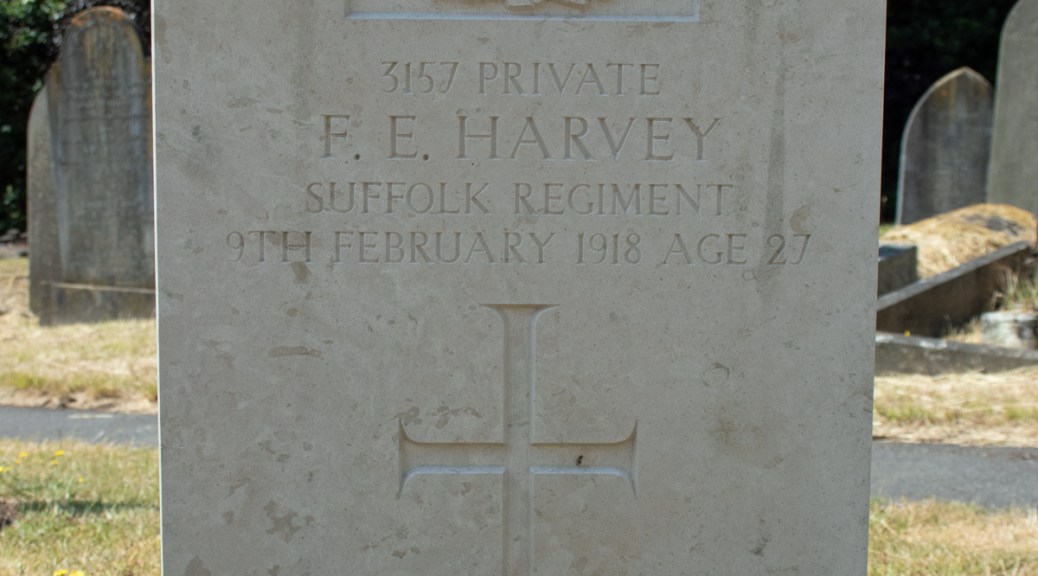
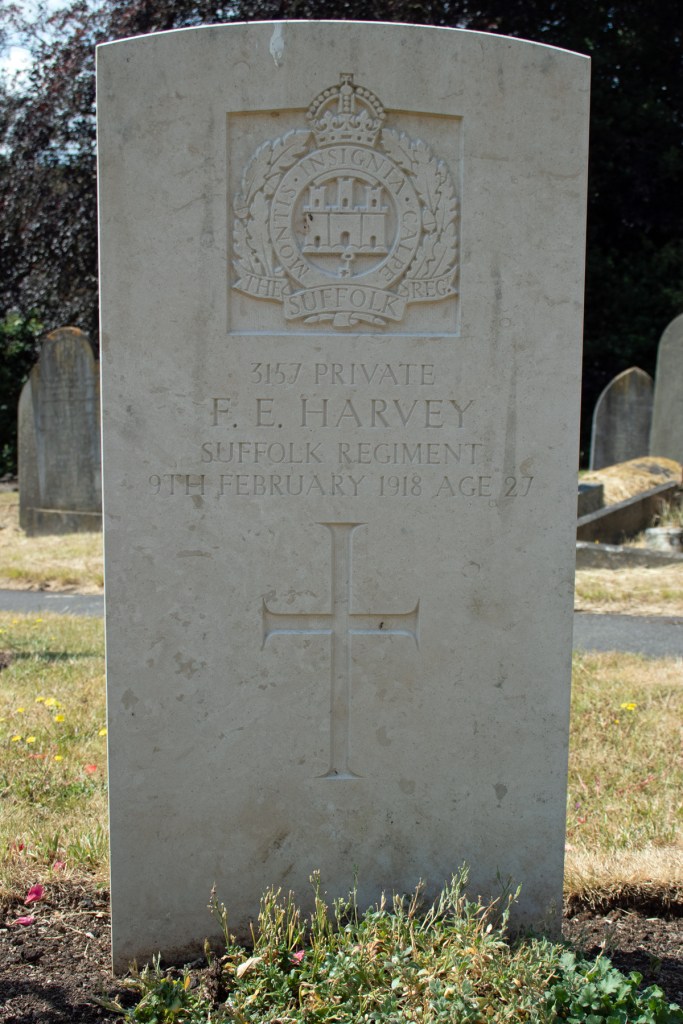
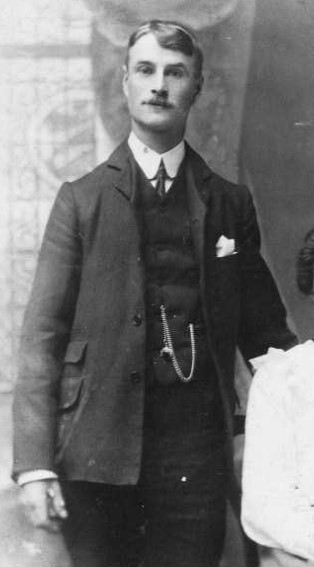
Frank Ernest Harvey was born at the start of 1892, the youngest of seven children to George and Clara Harvey. George was from Bethnal Green, London, and worked as a telegraphist clerk for the Post Office. By the time Frank was born, the family had moved to Leytonstone, while the 1901 census records them as living in Ilford.
On the day of the next census, in 1911, George and Clara were visiting friends in Guildford, Surrey. The four of their children who were still living with them were all at the family home. Ida, their daughter, was not listed as having any employment, while her three brothers were all working a clerks: one for an ironmonger, one for a stockbroker and Frank for an electrical engineer.
When war broke out, Frank stepped up to serve his king and his country. Little information is available about his military career, and, while his headstone confirms he was in the Suffolk Regiment, other records suggest that he had transferred to the regiment from the Royal Army Service Corps.
There is also little information about Private Harvey’s passing. Based on the fact that he was laid to rest in the Locksbrook Cemetery, Bath, it is likely that he had been admitted to the city’s War Hospital. This did not specialise in any single condition or set of conditions, so it could be that Frank was sent there to recuperate from an injury, or to recover from an illness.
Sadly, neither was to be the case, and Private Frank Ernest Harvey passed away on 9th February 1918. He was 26 years of age.
Richard Francis Gould was born in the autumn of 1893 in Wraxall, Somerset. One of fifteen children, his parents were Devon-born farm labourer and carter John Gould and his wife Mary, who came from Bristol.
When he left school, Richard found work as a domestic gardener, and this is what he was doing when he met Ada Archer. She was a nurse from Bristol, and the couple married in Knowle on 17th August 1908. They set up home in Bedminster, and went on to have three children: Edith, born late in 1909; Richard Jr, born in 1915; and Ronald, who was born the following year.
When war broke out, Richard was drawn to serve his country. Sadly, most of his service records have been lost to time, so it’s impossible to piece together a complete record of his time in the army. He was initially attached to the 36th Training Reserve Battalion, but was soon transferred. Attached to the 599th Agricultural Company of the Labour Corps, Private Gould was based in Somerset.
It was while serving in the autumn of 1918, that Richard fell ill. Having contracted pneumonia, he was hospitalised, but the condition proved too much, and he passed away on 19th October, at the age of 34 years old.
Ada and the children were living in the Somerset village of Long Ashton by this point, but it was in the graveyard of the local church – All Saints’ – that Richard Francis Gould was laid to rest.
Harry Payton Gadd was born on 3rd November 1899, one of ten children to Elijah and Ada Gadd. Elijah was a stone mason from the Somerset village of Dundry, and this is where the family were born and raised.
Harry found work as a farm hand when he finished his schooling but he seems to have been eager to play his part for King and Country. As soon as he turned 18, he enlisted in the Royal Navy. His service records show that he joined up as a Stoker 2nd Class on 6th November 1917. He was 5ft 3.5ins (1.61m) tall, with brown hair, grey eyes and a fresh complexion.
Stoker Gadd was initially sent to HMS Vivid, the Royal Naval Dockyard in Devonport, for training. On 28th January 1918, he was assigned his first ocean-going post, on board the frigate HMS Leander. He spent a couple of months on board, before transferring to the store ship HMS Tyne, then moving to HMT Wallington (also branded as HMS Sylvia), a requisitioned trawler, on 15th April 1918.
Stoker Gadd was on board Wallington for six weeks, when he was killed in an accident. No other information is available, and his service records state that “the death of this man… was caused… from an accident on board. No blame attributable to anyone.”
A contemporary newspaper echoes this, but gives no further information: “News has been received that Stoker Harry (Joe) Gadd, the 18-year-old son of Mr and Mrs E Gadd, of Dundry, has been killed by accident on one of his Majesty’s ships.” [Bristol Times and Mirror: Saturday 6th July 1918]
The body of Harry Payton Gadd was brought back to Dundry for burial. He was laid to rest in the graveyard of St Michael’s Church.
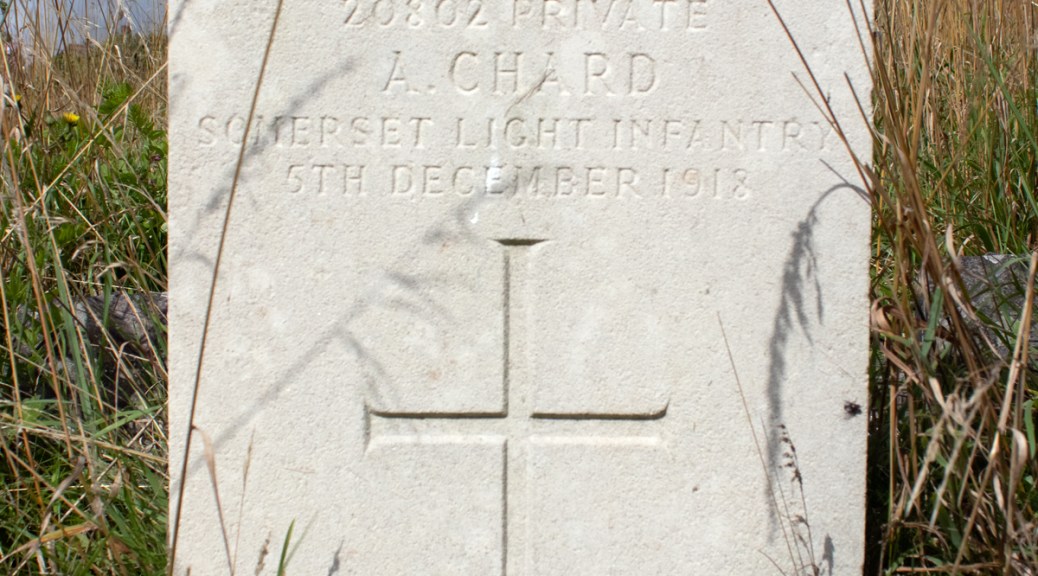
Arthur Chard was born in the spring of 1893, one of eight children to Isaac and Eliza Chard. Isaac was a labourer at the colour works in Winford, Somerset, and this is where the family were born and raised.
When Arthur finished his schooling, he found work as a farm labourer and, by the time of the 1911 census, he was living with his maternal uncle and family in the village, where he was employed as a farm lad.
As war came to Europe, Arthur stepped up to serve his country. He enlisted on 16th November 1915, joining the Somerset Light Infantry. His service records show that he was 5ft 3ins (1.6m) tall and weighed 113lbs (51.3kg).
Private Chard was formally mobilised in January 1916, and was sent to France in September, having completed his training. By May of 1917, he seems to have been back in Britain, and was transferred to the Labour Corps. There appears to have been some health issue behind this, as, on 11th August he was admitted to Henham Hall Auxiliary Hospital in Suffolk, suffering from ‘debility’. Having been moved to another hospital after a couple of weeks, he was finally discharged back to his unit on 20th September 1917.
Arthur joined the 626 Agricultural Company, which was based in Taunton. By July 1918, he had moved to another of the Somerset troops, 593 Agricultural Company. His health was still suffering, however, and he was soon admitted to Taunton Military Hospital. Private Chard passed away from nephritis on 5th December 1918. He was 25 years of age.
Arthur Chard’s body was taken back to Winford for burial. He was laid to rest in the village’s parish church, St Mary & St Peter’s.
William Reginald Hunt was born in the Somerset village of Butcombe on 14th September 1900. The youngest of six children, his parents were farmers Walter and Bertha Hunt.
Little information about William – who was known in the family as Reggie – is available. He was still at school at the time of the 1911 census and enlisted in the army in the summer of 1918. His service papers no longer exist, and his life in between these points is lost to time.
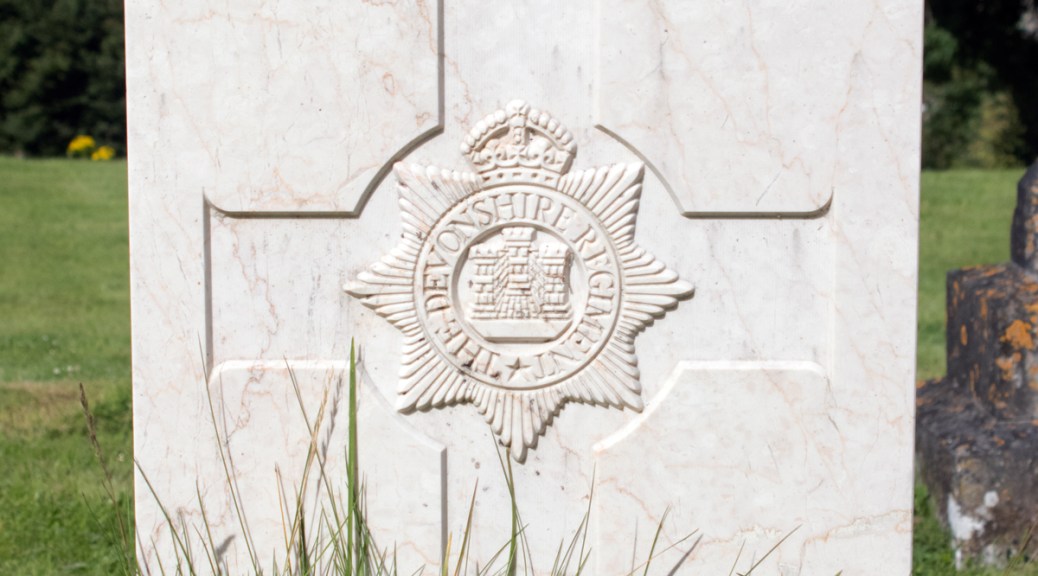
Private Hunt joined the Devonshire Regiment, and was attached to the 53rd (Young Soldier) Battalion. He was based at Rolleston Camp in Wiltshire and, while billeted there, in the cramped and overcrowded conditions of the army barracks, he contracted pneumonia.
William was admitted to the camp’s hospital, but the condition was to prove too much. He passed away on 23rd November 1918, aged just eighteen years old.
The body of William Reginald Hunt was brought back to Somerset for burial. He was laid to rest in the graveyard of St Michael’s Church, in his home village of Butcombe.
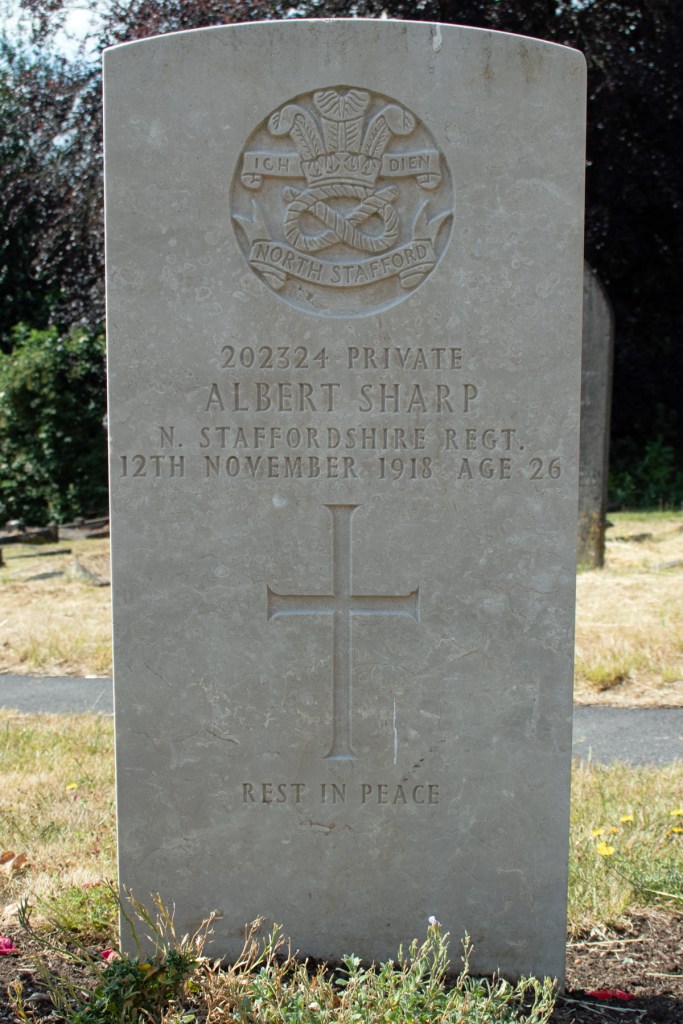
Albert Sharp was born in Rugeley, Staffordshire, in the summer of 1894. One of six children, his parents were George, who was a house painter, and Janet Sharp. When he left school, Albert found work as a bricklayer’s labourer, but, when war was declared, he sought a new adventure.
Albert enlisted in the army on 21st February 1916. Assigned to the North Staffordshire Regiment, he was initially attached to the 5th Battalion. His medical records show that Private Sharp was 5ft 6ins (1.6m) tall, and weighed 122lbs (553kg).
By November 1916, Albert found himself in France. Unusually, his life over the next couple of years is pretty well documented. His battalion saw action at the Hindenburg Line, the Third Battles of Ypres, Cambrai and the Third Battles of the Somme, but Private Sharp’s service records shed more light onto his life than simply where he fought.
Albert seems to have been a bit of a character, and this got him into trouble on more than one occasion. On 9th November 1916, he was confined to barracks for two days, for having untidy bedding and no towel on his bed. The following day, he was punished with another two days’ confinement for not attending his battalion’s role call.
On 18th December 1916, Private Sharp found himself in trouble again. This time, he was confined to barracks for five days for appearing dirty on parade, and committing a nuisance. Four days later, Albert was admitted to the camp hospital for reasons that are unclear. He returned to his unit just under a week later.
At the end of February 1917, Private Sharp transferred to the 31st Light Railway Operating Company of the Royal Engineers. He remained with the battalion for just under a year, although again his time there was not without incident. On 31st August 1917, Albert was confined to barracks for seven days for being absent from parade. The same punishment was meted out for the same offence on 8th January 1918.
Later that month, Private Sharp re-joined the North Staffordshire Regiment, and was this time attached to the 9th Battalion. He remained on the Western Front and was caught up in some of the fiercest fighting of the closing months of the conflict.
On 12th May 1918, Albert was caught up in a gas attack. Seriously injured, he was medically evacuated to Britain for treatment and admitted to the Bath War Hospital on 29th May. The next six months saw a slow and steady decline in his health. He passed away at 5:45am on 12th November 1918, the day after the Armistice was signed, from a combination of pneumonia and emphysema that was directly attributable to his injuries in France. Albert was 24 years of age.
It seems likely that Albert’s family were unable to pay for his body to be taken back to Staffordshire for burial. His service records give only his mother, Janet, as a next of kin, so it would seem that George had passed away by the time Albert enlisted. For some reason, however, while the British Register of Army Effects note that Private Sharp has effects to the value of £39 10s (£2250 in today’s money), this amount does not appear to have been paid. Janet passed away in the early 1920s, and Albert’s brother continued to try and obtain this gratuity on her behalf, but seems to have been unsuccessful.
Albert’s family did get his belongings when he died, however, which came to a postal order for 2s (around £3 today), 50 French centimes, a leather purse, two combs, two jack knives, a razor, a shaving brush, a toothbrush, two briar pipes and a pouch of tobacco, a nickel cigarette case, a text book, a wallet containing his pay book, his cap badge and six letters.
Unable to afford to bring Albert Sharp’s body back to his home town, he was, instead, laid to rest in the sweeping vista of Bath’s Locksbrook Cemetery, not far from the hospital in which he had breathed his last.
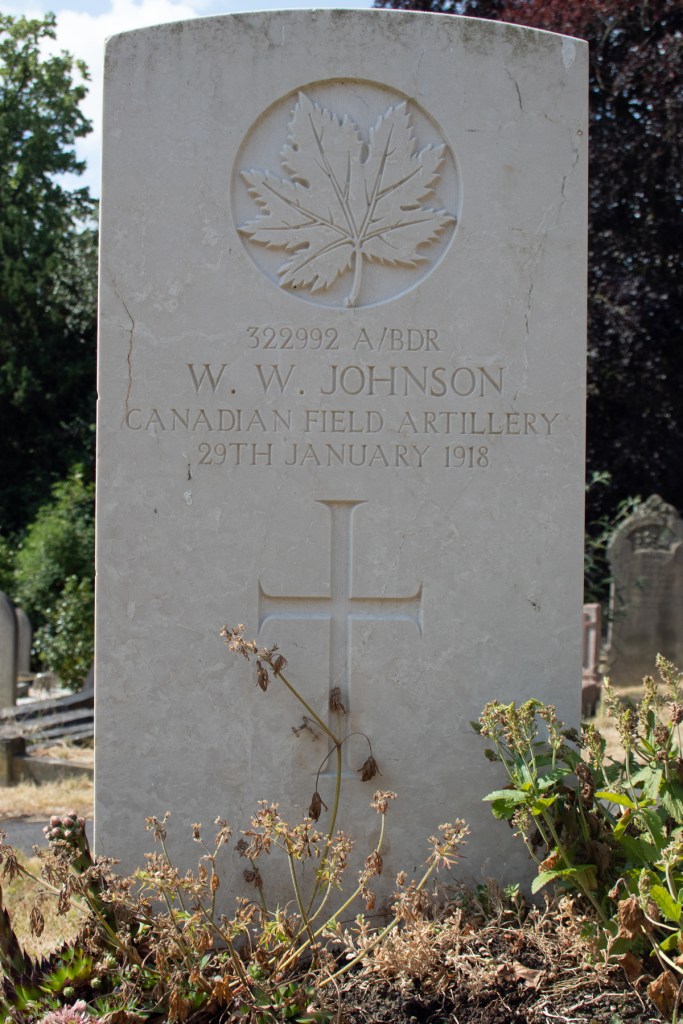
William Wilbur Johnson was born in Wingham, Ontario, Canada, on 25th August 1889, and was the son of John and Barbara Johnson. Little information is available about his early life, but he found work as a saddler when he finished his schooling.
In his free time, William volunteered in the 20th Border Horse Regiment. When war broke out in Europe, he was called upon to play his part, and joined the Canadian Expeditionary Force. His service records confirm he was 5ft 8ins (1.73m) tall, with brown hair, blue eyes and a dark complexion. He was also noted as having two scars both on his inner left forearm.
Private Johnson arrived in England in May 1916, and was initially billeted in Shorncliffe, Kent. He did not remain in Britain for long, however, and, assigned to the 2nd Brigade of the Canadian Field Artillery, he arrived in France on 1st June 1916. William would have been in the thick of things, caught up in the bloody stalemate of the Somme for most of the rest of the year.
In November 1916, William was promoted to Acting Bombardier. After a miserable winter on the Front Line, he became ill, and was admitted to a field hospital for a week with bronchitis and influenza. He recovered and remained on the Western Front during 1917, fighting at both Vimy Ridge and Passchendaele.
By the end of November 1917, Acting Bombardier Johnson’s health was suffering once more. He became jaundiced and, after some time spent in a field hospital, he was medically evacuated to Britain for further treatment. He was admitted to the Bath War Hospital in Somerset, with what turned out to be cirrhosis of the liver. This was something his body was unable to overcome: William passed away on 29th January 1918, at the age of 28 years old.
With all of his family overseas, it was not practical for the body of William Wilbur Johnson to be returned to Canada. Instead, he was laid to rest in the sweeping grounds of the Locksbrook Cemetery, not far from the hospital in which he had breathed his last.
James Douglas John Pyatt was born in the spring of 1881 in Tranmere, Cheshire. The older of two children, his parents were Somerset-born John and Clara Pyatt. John was a coal merchant, and, by the time of the 1901 census, the family had moved back south, settling in the Clifton area of Bristol.
According to that census record, the family were living at 33 Pembroke Road, which Clara ran as a boarding house. James, by this point, was employed as a butcher, while his younger brother, Hubert, was a grocer. At the time the census was taken, the family had two boarders: Emmeline Blake, who was a music teacher, and Archibald Archer, a dentist.
Happiness is Bristol was destined to be short-lived. John died in 1902, aged just 49 years old. The same year, Hubert emigrated to Canada, settling in Brandon, Manitoba. Clara and James both followed the following year, setting up home in the same town.
Clara died in December 1908, but not before seeing both of her sons marry, James to Edith Gillam in June 1907, and Hubert to Lilian Pearce twelve months later.
James was working as a shipping clerk for a brewery by this point, and he and Edith were living on Park Street, to the east of the city. This was an ideal spot for their young family – John, born in 1908, Sidney, born in 1912, and Dennis, born in 1914 – as it overlooked a park and had space around it. Hubert lived down the road with his own family, so the brothers still had each other close by.
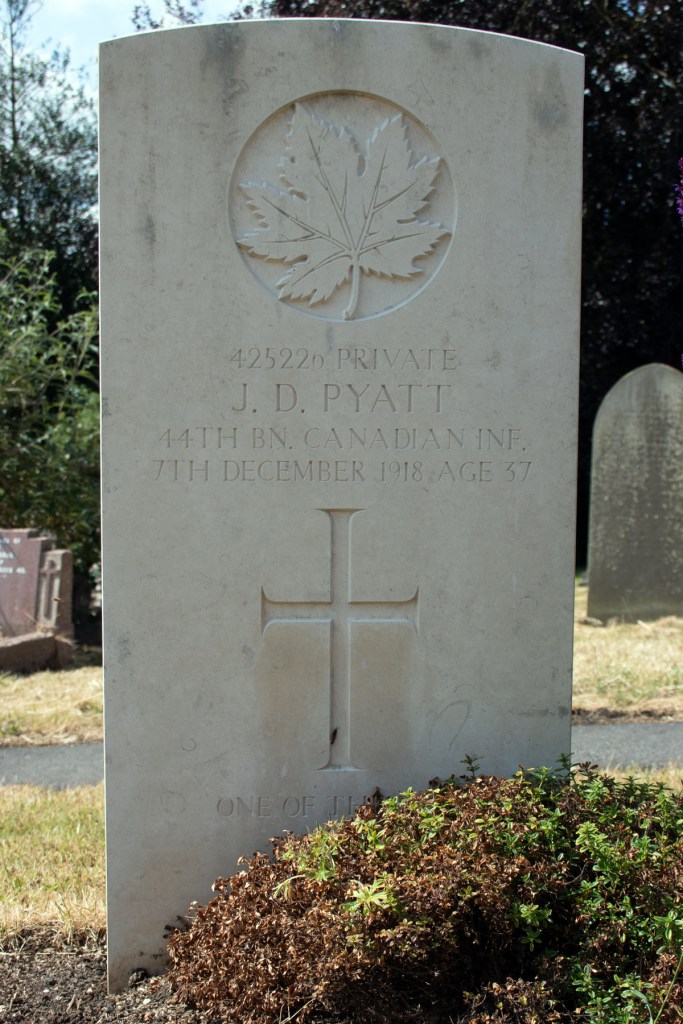
When war came to Europe, James felt compelled to play his part for King and Empire. He enlisted in the Canadian Expeditionary Force on 7th July 1915. Private Pyatt’s service records confirm that he was 33 years of age, and stood 5ft 10ins tall. He was noted as having brown hair, brown eyes and an average complexion.
James arrived back in England on 25th March 1916. Once there, he was attached to the 44th Battalion of the Canadian Infantry and by August that year, he was stationed on the Western Front. That autumn, however, he was dogged by illness and was admitted to field hospitals four times, suffering from diarrhoea, myalgia twice, and laryngitis.
By the start of 1917, however, Private Pyatt was back to full fitness. Details of his service over the next couple of years are unclear, although he remained on the Front Line. In December 1918, James was back in England on leave, and had returned to Somerset, possibly to see friends or relatives.
While here, James contracted influenza, and was admitted to the Bath War Hospital. The condition was to get the better of him, however, and he died on 7th December 1918, days after going in. He was 37 years of age.
With his surviving immediate family all in Canada, James Douglas John Pyatt was laid to rest in Locksbrook Cemetery, Bath, not far from the hospital in which he had passed away.
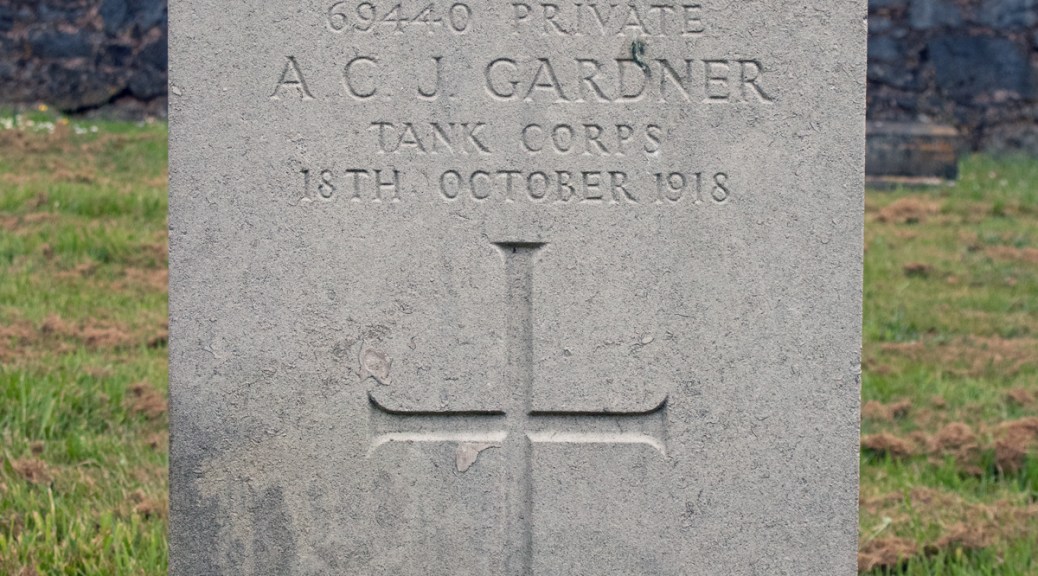
In a quiet spot in Cannington Cemetery, Somerset, is the burial plot for Anthony Charles James Gardner. His headstone confirms that he was a Private in the Tank Corps, and that he died on 18th October 1918.
Private Gardner’s service number provides only one army document: the British Army Register of Soldiers’ Effects. Sadly, this sheds little more light onto his life, confirming only that he died in the Military Hospital in Wool, the village connected to Bovington Camp in Dorset. No next of kin is evident.
Another record suggests that he may have served in the Somerset Light Infantry before transferring to the Tank Corps, but no records remain to confirm this stage of his military career.
There are no census birth or baptism records for an Anthony Gardner. While there are numerous Somerset documents connected to Charles and James Gardners, without any confirmation of his age, or whether he actually came from the county, it is impossible to identify ones relating to the soldier buried in Cannington.
Parish details confirm that Anthony worked at the Blue Anchor Inn in Cannington. The 1911 census recorded him as working there under Charles and Ann West. It confirms that Anthony was 24 years of age, and was born in Gloucester. Tantalising though this fact is, there are no earlier documents to confirm his upbringing in Gloucestershire.
There are no reports in contemporary newspapers about Anthony’s passing or his funeral, so no light can be shed down that route either.
The life of Alfred Charles James Gardner, therefore, is destined to remain lost in the mists of time. His story hidden in the cemetery in Cannington, Somerset.
My thanks to Tina at Cannington Parish Council for her help in uncovering a little of Anthony’s life.














 Death and Service