Tag Archives: 1918

Private William Earrey

William George Earrey was born in 1900, the eldest of three children to William George and Rosina Earrey. While he was baptised William George, later records – including those for his military service – show him as George William; presumably this had avoided any confusion with his father as the young William was growing up.

William Sr worked as a ships boiler maker and, while they appear somewhat disparate over the census records, the Earreys were based in Gillingham, Kent. (Given his employment, this would ensure William Sr’s proximity to the dockyard in Chatham.)

While his enlistment records are not readily available, William Jr appears to have signed up as soon as his age allowed. He enlisted in the Surrey Yeomanry and was shipped to Ireland, where the regiment has two reserve bases.

On 10th October 1918, aged 18 years old, William was returning home on leave from Ireland. He was one of 500 military personnel on board the RMS Leinster, which also had around 200 civilian passengers and 77 crew on board. Just after 10am the ship was around Kish Bank, just off the coast from Dublin, when passengers reported seeing a torpedo pass just in front of the ship’s bow. This was quickly followed by a second torpedo, which hit the ship on the port side. While it was being turned about to seek shelter back in port, a third torpedo struck, causing an explosion and the RMS Leinster sank.

The crew had managed to launch a number of lifeboats, while other passengers were able to get into the sea, clutching life rafts. Many people – William included – died during the sinking, while some of the survivors also subsequently perished.

The exact number of dead in the torpedoing of the RMS Leinster is not known, but it is estimated that at least 560 souls were lost, making it the biggest maritime disaster in the Irish Sea.

Newspapers of the time heralded the nation’s uproar at such a maritime tragedy – the sinking of the Leinster was the largest loss of life at sea around the British coast since the Lusitania three years earlier. The Derry Journal reported on the ‘fiendish crime’, that had occurred as a result of the ‘German policy of frightfulness at sea’.

The article went on to describe some of the challenges facing Dublin in the immediate aftermath of the disaster.

Owing to a strike in the undertaking trade, considerable difficulty is experienced in making arrangements for the burial of the victims. There is an insufficiency of coffins in Dublin, and all but three posting establishments are closed. The Lord Mayor is endeavouring to arrange the suspension of the strike till the Leinster victims are buried. It is stated that on a very rough estimate about three hundred bodies have been recovered…

Derry Journal: Monday 14th October 1918

Sadly, William Earrey’s body was not one of those to have been recovered; this undoubtedly left a lack of closure for his family at the lost of their young son.

Private Earrey is commemorated at the Hollybrook War Memorial in Southampton.


William George Earrey was my first cousin twice removed.
Lance Corporal Charles Stubbles

Charles Frederick Stubbles was born in Tottenham in 1892. One of eleven children to Richard and Mary Ann Stubbles, by the time of the 1911 census, the family were living in Edmonton. Charlie and his brother had found employment painting gas stoves, while his father was a building foreman.

Charles enlisted in the army in 1916, aged 25 years and 11 months. His service records show that he stood at 5ft 2ins, weighed in at 69lbs; his health was classified as C2 – Free from serious organic diseases, able to stand service in garrisons at home, able to walk 5 miles, see and hear sufficiently for ordinary purposes.

Joining the Labour Corps of the West Surrey Regiment, Private Stubbles initially served on the home front, before being transferred to France as part of the British Expeditionary Force in March 1917.

Charlie seems to have been a bit of a character and was pulled up a few times during his service. On 10th April, he was charged with “committing a nuisance in the barrack room”, for which he was confined to camp for eight days. On 21st August he went AWOL for nearly a day; he was docked eight days’ pay. On 28th October he appeared unshaven and dirty for the 7:15am parade; he was confined to barracks for seven days.

On 4th January 1918, Charles was admitted to a field hospital with diarrhoea; while there he was diagnosed with tuberculosis; he succumbed to this two days later, dying on 7th January 1918. He was 26 years old.

Lance Corporal Charles Stubbles is buried at the Haringhe Bandaghem Military Cemetery in Poperinge, Belgium.


Charles Frederick Stubbles was my great grandmother Lillian’s younger brother.

Private Frank Woods

Frank Ernest Woods was born in 1885, one of seven children to Thomas and Alice. Thomas was a labourer and he raised his family in Worcestershire.

Frank left home early – by the time of the 1901 census, he was living as a gardener for the Cornforth family, who were grain merchants in South Claines, near Worcester.

Frank’s work with the family continued; the 1911 census show that they had relocated to Kensington. The Cornforth family were now running the Eaton Court Hotel, a boarding house with nineteen rooms; the 25-year-old Frank had been elevated to the role of waiter.

Another of the Cornforths’ staff was a housemaid, 20-year-old Ethel Elizabeth James; within a matter of years, the couple were courting, and Frank and Ethel married in November 1915.

The Great War was already being waged across the Channel, and Frank enlisted, joining the Rifle Brigade in June 1916. Within three months, he was fighting on the Western Front.

Private Frank Woods was killed in action in Belgium on 10th October 1918. He was 33 years old. He is remembered on the Tyne Cot Memorial in Zonnebeke.


Frank Ernest Woods was the first husband of my Great Great Great Aunt, Ethel Elizabeth James.

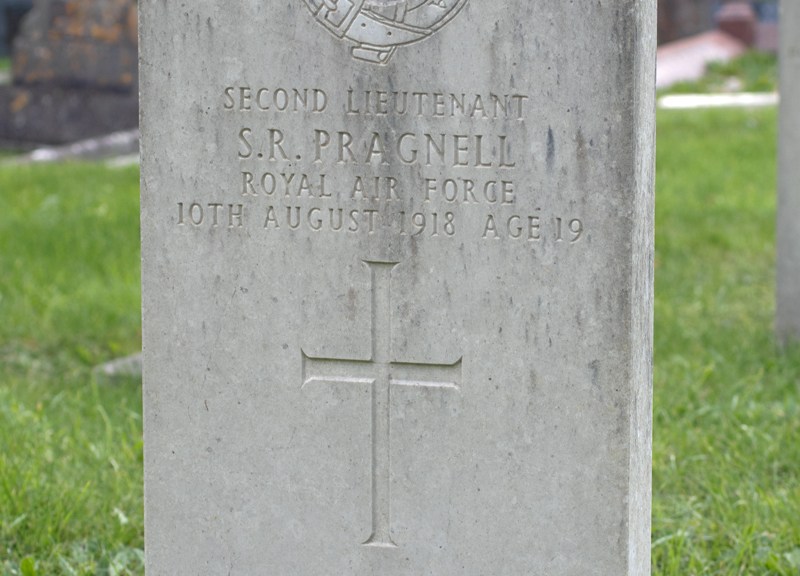
Second Lieutenant Sidney Pragnell

Second Lieutenant Sidney Pragnell

Sidney Ralph Pragnell was the eldest of two children of Edward and Ellen Pragnell. Edward grew up in Sherborne, before moving to London to work as a chef; he found employment as a cook in an officer’s mess, which took him and his wife first to Ireland – where Sidney was born – and then to the barracks at Aldershot.

By the time of the 1911 census, Edward had brought his family back to Dorset, and was running the Half Moon Hotel, opposite the Abbey in Sherborne. Sidney, aged 12, was still at school.

When war broke out, Sidney was eager to play his part, even though he was underage. An article in the local newspaper highlights his keenness and how he progressed.

…he was keen to serve his country and joined every local organisation his age would allow him to. He was an early member of the Sherborne VTC and Red Cross Detachment, and was actually the youngest member of the Volunteers to wear the uniform. Whilst still under age, he enlisted in the Royal Naval Division at the Crystal Palace and after a period of training was drafted as a qualified naval gunner to a merchant steamer carrying His Majesty’s mails and in this capacity went practically round the world. In February he joined the RNAS and after some air training in England went to France to an air station, where he passed all the tests with honours and gained the ‘wings’ of the qualified pilot. Lieutenant Pragnell then decided to go in for scouting and came back to England for advanced training in the special flying necessary for this qualification and it was whilst engaged in this that he met with the accident which resulted in his death.

Western Chronicle: Friday 16th August 1918.

The esteem in which Second Lieutenant Pragnell was held continues in the article, which quotes the condolence letter sent to his parents by his commander, Major Kelly.

It is with deep regret that I have to write you of the death of your son, Second-Lieutenant SR Pragnell. Your boy was one of the keenest young officers I have ever had under my command and was extremely popular with us all and his place will be extremely hard to fill.

The service can ill afford to lose officers of the type of which Lieutenant Pragnell was an excellent example and it seems such a pity this promising career was cut short when he had practically finished his training. May I convey the heartfelt sympathy of all officers and men in my command to you in this your hour of sorrow.

Western Chronical: Friday 16th August 1918.

What I find most interesting about this article is that the letter from Major Kelly detail how Edward and Ellen’s son died, and this this too is quoted by the newspaper.

Your son had been sent up to practice formation flying and was flying around the aerodrome at about 500 feet with his engine throttled down waiting for his instruction to ‘take off’. Whiles waiting your boy tried to turn when his machine had little forward speed. This caused him to ‘stall’ and spin and from this low altitude he had no chance to recover control and his machine fell to earth just on the edge of the aerodrome and was completely wrecked. A doctor was there within a minute, but your boy had been killed instantaneously.

Western Chronicle: Friday 16th August 1918.

Further research shows that the aerodrome Second Lieutenant Pragnell was training at was RAF Freiston in Lincolnshire, which had been designated Number 4 Fighting School with the specific task of training pilots for fighting scout squadrons. He had been flying a Sopwith Camel when he died.

Second Lieutenant Sidney Ralph Pragnell lies at rest in the cemetery of his Dorset home, Sherborne.

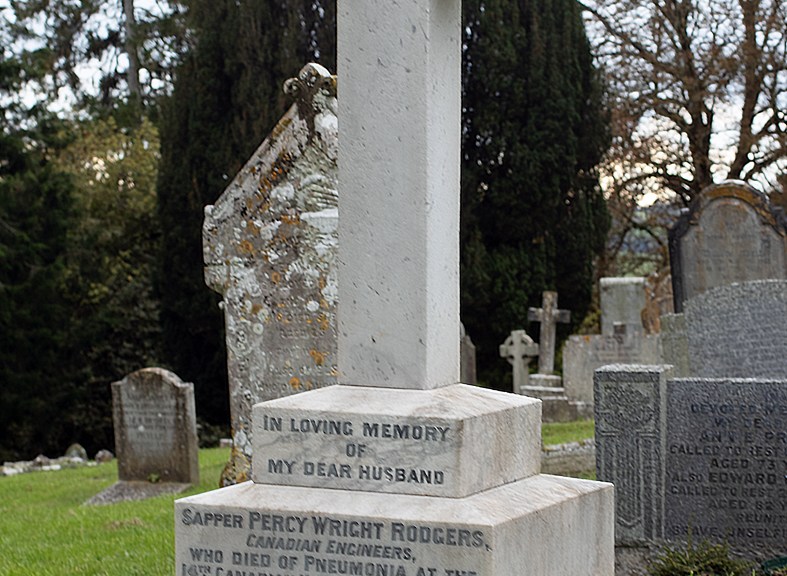
Sapper Percy Rodgers

Sapper Percy Rodgers

Percy Wright Rodgers was born in June 1888 in Pilton, Somerset. He was the fifth of eleven children to Levi and Elizabeth Rodgers.

In the 1901 census Levi was listed as a butcher and publican; ten years later, he listed himself as a butcher, slaughter man and shopkeeper.

Percy followed in his father’s footsteps – by the time of the 1911 census, he was boarding with a family in Swanage, Dorset, and worked as a butcher’s assistant.

1913 was a busy year for Percy. He married Frances Bower, they had their first child, Percy Augustus, and he emigrated to the United States (Frances and Percy Jr followed a year later).

In the 1915 New York census, Percy and his family are listed in in the town of Cortland, around 200 miles north of New York City. Percy describes himself as a meat cutter – following in his father’s footsteps – and he and his wife now have a second child, Vera, who was born in the States.

Sapper Rodgers joined the Canadian Engineers in May 1918; he was shipped abroad, back to Europe, but his service appeared short-lived. He contracted pneumonia, and was admitted to the Canadian Hospital in Eastbourne, East Sussex. He passed away on 5th November 1918, at 30 years of age.

Sapper Percy Wright Rodgers lies at rest in the churchyard of St John the Baptist in his home village of Pilton. His grave is topped with a cross dedicated by his widow, Frances.

Stoker Wilfrid Baker

Stoker Wilfrid Baker

Wilfrid David Baker was born in 1889 in Upchurch, Kent. One of ten children, to Charles and Margaret Baker, he followed his father into the brickmaking industry.

When the Great War came, Wilfrid signed up, enlisting in the Royal Navy in March 1917, as Stoker 2nd Class. During his training in Woolwich, he was promoted to Stoker 1st Class, before being assigned to the HMS Columbine naval base in Scotland.

During his work there, Stoker Baker came down with influenza and was transferred to the HMHS Garth Castle hospital ship. Wilfrid’s illness developed into pneumonia, and he passed away on 20th October 1918. He was 29 years of age.

Stoker 1st Class Wilfrid Baker is buried in the churchyard of St Mary the Virgin in his home village, Upchurch.

Driver Walter Colchin

Driver Walter Colchin

Walter George Colchin was born in 1884 in Borden, Kent. His parents, Herbert and Frances, moved the family – three sons, including Walter, and a daughter – to the village of Iwade, where they ran the Woolpack Inn.

There isn’t a great deal of information about Walter’s life. He married Bertha Sparks from the neighbouring village of Milton in 1916.

Walter joined the war effort at some point after that – I have been unable to find an exact date – and enlisted in the Royal Army Service Corps, before transferring to the Agricultural Company Labour Corps.

Private Colchin was on active service in Steyning, West Sussex, when the war came to a close. On 23rd December 1918, he suffered a cerebral haemorrhage and died. He was 34 years old.

Walter Colchin is buried in the graveyard of All Saints Church in his home village of Iwade.

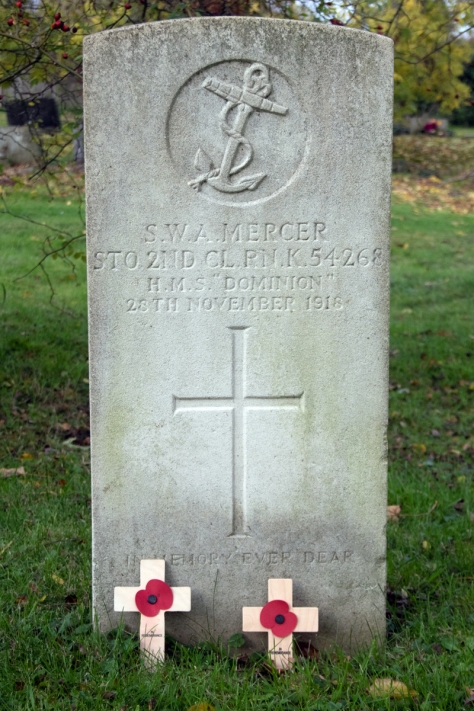
Stoker 2nd Class Stuart Mercer

Stoker Stuart Mercer

Stuart William Arthur Mercer was born in February 1890, one of seven children to William and Eliza Mercer. The family lived in the village of Upchurch, Kent, where William worked as an agricultural labourer.

Stuart followed in his father’s footsteps, and by the time of the 1911 census, he and his brother Bert were working as fruit plantation labourers with William.

He married the delightfully named Elsie Lily Singyard who was also from Upchurch, in 1914, but the couple didn’t have any children.

It was not until towards the end of the Great War that Stuart signed up for service. He enlisted in the Royal Navy on 27th September 1918, and was assigned to the HMS Pembroke II training base in Chatham.

Stoker Mercer’s service was short, however; he had contracted bronchial pneumonia within weeks of the war ending and was admitted to the Royal Navy Hospital in Chatham. He passed away there on 28th November 1918. He was 28 years old.

Stoker Stuart Mercer lies at rest in the St Mary the Virgin churchyard in his home village, Upchurch in Kent.

Driver Harry Austin

Driver Harry Austin

Harry Austin was born in the small Kent village of Bobbing in 1890. One of nine children to Richard and Emma Austin, his father was the village blacksmith, a trade two of his brothers followed after leaving school. Harry, however, became a general labourer in the coal industry.

Sadly, most of Harry’s wartime service is lost to time; we know that he enlisted in the Royal Field Artillery and served as a driver. The RFA was responsible for the medium-calibre guns and howitzers deployed close to the front line; Harry’s role, therefore, was likely to have involved driving the horses to and from the sites where the guns were needed.

Again, Driver Austin’s military records are somewhat lacking when it comes to his passing. However, where they mark him as ‘dead from disease’, a contemporary newspaper in memoriam gives a little more detail.

In ever loving memory of Driver Harry Austin, RFA… who passed away November 10th 1918, in the 1st Southern General Hospital, Birmingham, from influenza following Gun Shot wounds, aged 29 years.

East Kent Gazette – Saturday 23rd November 1918.

An untimely death for Harry, but particularly poignant, given that he passed the day before the Armistice was signed.

Driver Harry Austin lies at peace in the graveyard of St Bartholomew’s Church in his home village of Bobbing, Kent.

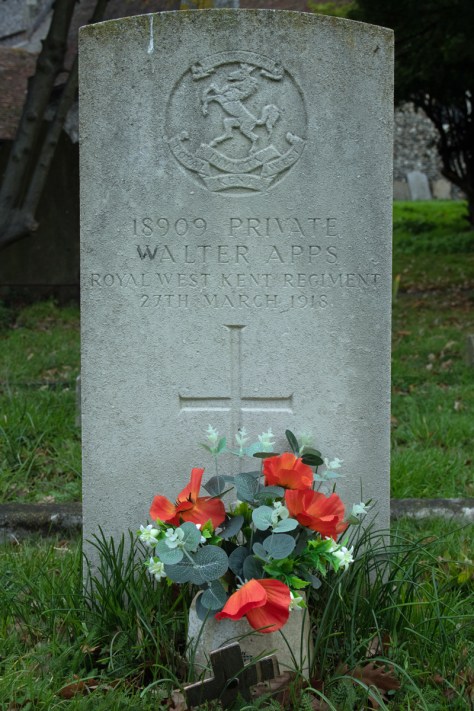
Private Walter Apps

Private Walter Apps

Walter Apps was born in 1896 in Kent. He was one of thirteen children to Richard Apps, a shepherd, and his wife Emeline. By the age of 14 he was listed as working on the farm the family lived on; his older brother Bertie was also helping out.

In February 1916 Walter was called up; his enlistment papers show he worked as a horseman, and that he joined the Royal East Kent Regiment (also known as the Buffs because of the colour of their tunic).

Private Apps was posted to the Western Front as part of the British Expeditionary Force in October 1916, and was soon transferred to the Royal West Kent Regiment.

He saw active service, and was wounded on 17th July 1917, receiving a gun shot wound to the face, which resulted in him losing the sight in his left eye.

Private Apps was repatriated on 8th August 1917, and remained there. He was discharged from the army as being no longer medically fit to serve at the beginning of the following March, but sadly passed away on 27th March 1918. He was just 22 years old.

Walter Apps lies at rest in the graveyard of St Bartholomew’s Church in Bobbing, Kent.