Tag Archives: 1921

Private Robert Mayers

Private Robert Mayers

Robert William Mayers – also known as Bob – was born in 1888, one of nine children to Charles and Louisa Mayers from Taunton in Somerset. Charles was a solicitor’s clerk, whose work changed direction in the 1890s, and who became a general labourer.

When Robert left school, he became a carpenter, while his older brother became a motor mechanic, and other siblings became messengers, collar machinists and housemaids.

With war on the horizon, Robert enlisted. His full service records no longer exist, but he enrolled in the Bedfordshire Regiment and joined the 3rd Garrison Battalion. While there is no evidence of Private Mayers’ time in the army, it is likely that he saw some service in India and Burma during and after the Great War.

Robert returned to England after being demobbed, but, having survived the war, was suffering from tuberculosis. Sadly, the condition was to get the better of him, and he passed away at his parents’ home on 2nd May 1921. He was 34 years old.

Robert William Mayers lies at rest in St Mary’s Cemetery in Taunton, Somerset.


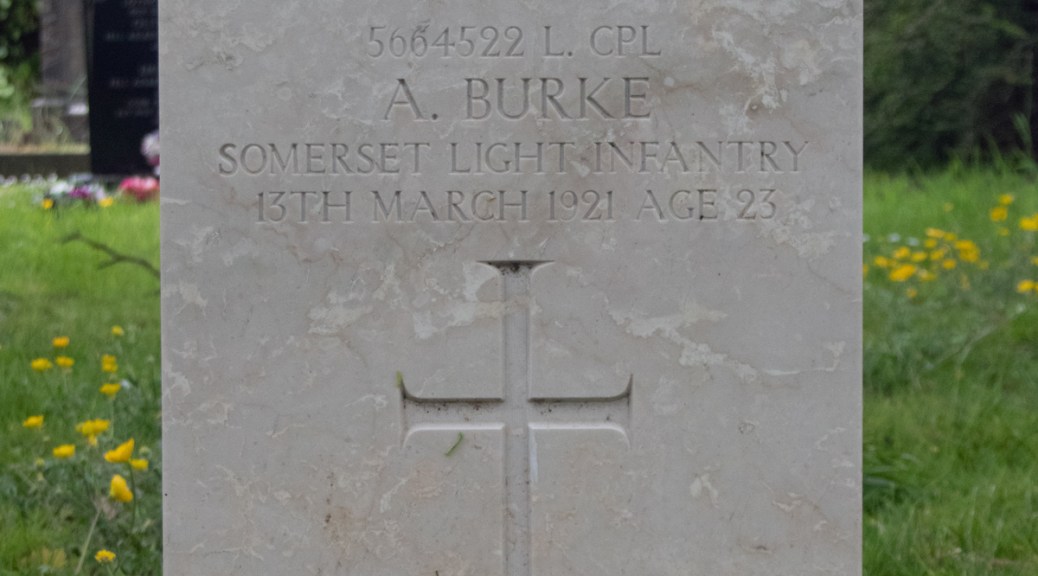
Lance Corporal Albert Burke

Lance Corporal Albert Burke

Sometimes, researching war graves can throw a bit of a curve ball, and the things you uncover can make you stop in your tracks. Such is the story surrounding Lance Corporal Albert Burke, and a media report surrounding his death in March 1921.


SCHEME OF VENGEANCE

Taunton Suicide’s Amazing Last Letter

Toll On Young Women

A sensational affair has occurred at Taunton Barracks. On Sunday morning, Albert (or Alfred James) Burke, aged 23, a Lance Corporal in the Somerset Light Infantry, was found to have taken his life by inhaling chloroform, his dead body being found on a bed at the military hospital, where he was employed as an orderly.

On Saturday night, according to the evidence, deceased appeared to be in his usual health and spirits. The next morning, a comrade found his dead body with a chloroform bottle by its side and near his face a large piece of cotton wool which he had evidently used for the purpose of inhaling the poison.

Some light was thrown on the tragedy by a letter addressed to a Taunton young woman, found on his clothing, and which was read at the inquest yesterday.

It was of an extraordinary character, and began “You wish to know what my intentions are in regard to you. Well, in the first place let me tell you I am not, as the coroner who holds the inquest will adjudge me, insane. In fact I don’t think I was ever so rational or level-minded as at the present moment, although I have had a glass or two.

“Well, Beatrice, mine is a rather long and interesting story. I married Louisa Wills some time in 1917, and I think the least said about her the better, but I wish to say this, that I have never knocked across a beast to equal her for violence. I am afraid the people around Brentford, Middlesex, could give you a far better account of her than I can.”

The writer went on to make certain allegations against the woman, and then referred to other towns where, he said, he had ruined girls before coming to Taunton and joining the Somerset Light Infantry. He added that he spent Friday night, when he was supposed to go out with Beatrice, with another girl in the barracks.

He said his father committed suicide owing to a “thing” who called herself a woman, and he (deceased) got a feeling with him that he would like to pay it back on a few girls. In conclusion, Burke expressed his satisfaction at knowing the condition Beatrice was in, and that he had been able to add another to the list of those on whom he wished to have his revenge.

Evidence was given by Alec Treeby, civilian orderly at the Barracks, who found deceased. In reply to the coroner, witness said that he knew the man was keeping company with a girl, but was not aware that there was any trouble about her.

PC Carter stated that the police had made enquiries, and a telephone message had been received that nothing was known of the man or of a wife and family of the name at Brentford…

[The] medical officer at Taunton Barracks said deceased was a steady, hard working man, and, so far as he knew, perfectly sane.

The jury returned a verdict of “suicide while of unsound mind”.

Western Times: Wednesday 16th March 1921

The newspaper report confirms the Lance Corporal’s name as either Albert or Alfred James Burke; the coroner also went on to say that he had also used the aliases of Povery and Pavey. Sadly, research around these names – and that of Louisa Wills – have either led to frustrating dead ends, or to results too vague to concretely connect them to Lance Corporal Burke.

The life and loves of Lance Corporal Burke are destined to remain a mystery. All that can be confirmed is that he took his own life on 13th March 1921; he was 23 years old.

Albert Burke lies at peace in St Mary’s Cemetery in Taunton, Somerset. He was accepted for commemoration as war dead on 27th May 2016 and was afforded a gravestone by the Commonwealth War Graves Commission.


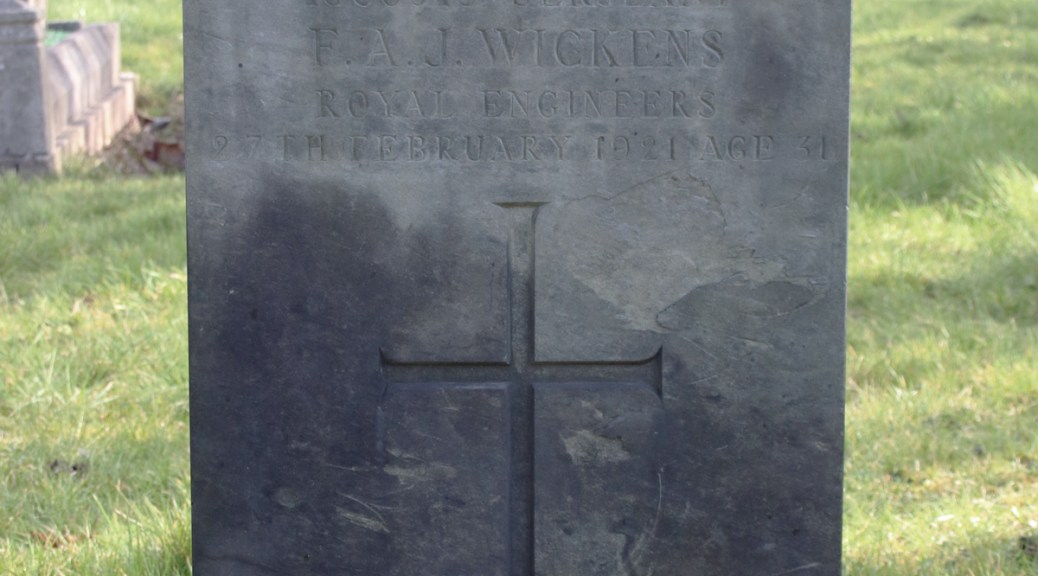
Serjeant Frederick Wickens

Serjeant Frederick Wickens

Frederick Albert John Wickens was born in Newbury, Berkshire, in the summer of 1889. The oldest of four children to Alfred and Emily Wickens, his father was a brewer’s labourer.

The military life proved more of a draw to Frederick, however. While his full records no longer exist, by the time of the 1911 census, he was recorded as being a Sapper with the 2nd Field Troop of the Royal Engineers. He was based at Potchefstroom, around 75 miles (120km) south east of Johannesburg in South Africa, and his trade was listed as a tailor.

Sadly, it is at this point that Frederick’s trail goes tepid, if not cold.

From a personal perspective, he married a woman called Rose, who was a year younger then him. Her details are scarce, and there is nothing to confirm when or where they married (other than the 1911 census, when Frederick was listed as ‘single’).

The couple must have had some connection to Gillingham, as this is where they lived; given the proximity of the Royal Engineers Barracks in neighbouring Chatham.

Sapper Wickens’ military service continued into the Great War. He was awarded the medaille militaire by Belgium, and achieved the rank of Serjeant during his career. Unfortunately, there are no details of the actions around either the award or his promotion.

Serjeant Wickens passed away on 27th February 1921; he died in Chatham, although the cause was not recorded. He was 31 years old.

Frederick Albert John Wickens lies at rest in the Woodlands Cemetery in Gillingham, Kent.


Frederick’s younger brother Thomas, also served in the Great War. He enlisted in the Princess Charlotte of Wales’s (Royal Berkshire) Regiment, and was involved in the battles on the Western Front. Sadly he was killed in the fighting on 24th May 1916, at the age of 19 years old.


Musician Henry Selley

Musician Henry Selley

Henry Louis Selley was born in 1876, one of nine children to Richard and Mary Ann Selley. His father was an agricultural labourer and the family lived in Exminster, Devon.

Initially, Henry followed his father in becoming an agricultural labourer, but the military life seems to have sparked an interest. While Henry’s military records no longer exist, he is recorded as having completed 24 years’ service with the Royal Engineers at the time of his death. He would have enlisted, therefore, in around 1897, when he was about 21 years of age.

As to his duties while in the military, these can only be guessed at. He is intriguingly noted as Musician, although there is no documentation to expand on Henry’s role any further. There were many professional musicians in the army, and they performed table music, serenades, and home concerts, mainly for high-ranking officers.

Musician Selley’s role may also have to be set timing for marches, etc, although, again, this is purely speculation on my part, as there is no evidence to suggest this was the case.

Henry married a woman called Constance in 1905; she had been born in Devon, but there is no further information on her. The 1911 census records the young couple as living in a terraced house not far from the Royal Engineers Barracks, where Henry would have been based. The couple did not go on to have any children.

And there, Musician Selley’s trail goes cold. The next that he appears in any documentation is in 1921, when his army pension record confirms that he passed away. He had been admitted to the Royal Herbert Hospital in Woolwich with pulmonary tuberculosis, and succumbed to the disease on 26th May 1921. He was 45 years old.

Henry Louis Selley lies at rest in the Woodlands Cemetery in Gillingham, Kent.


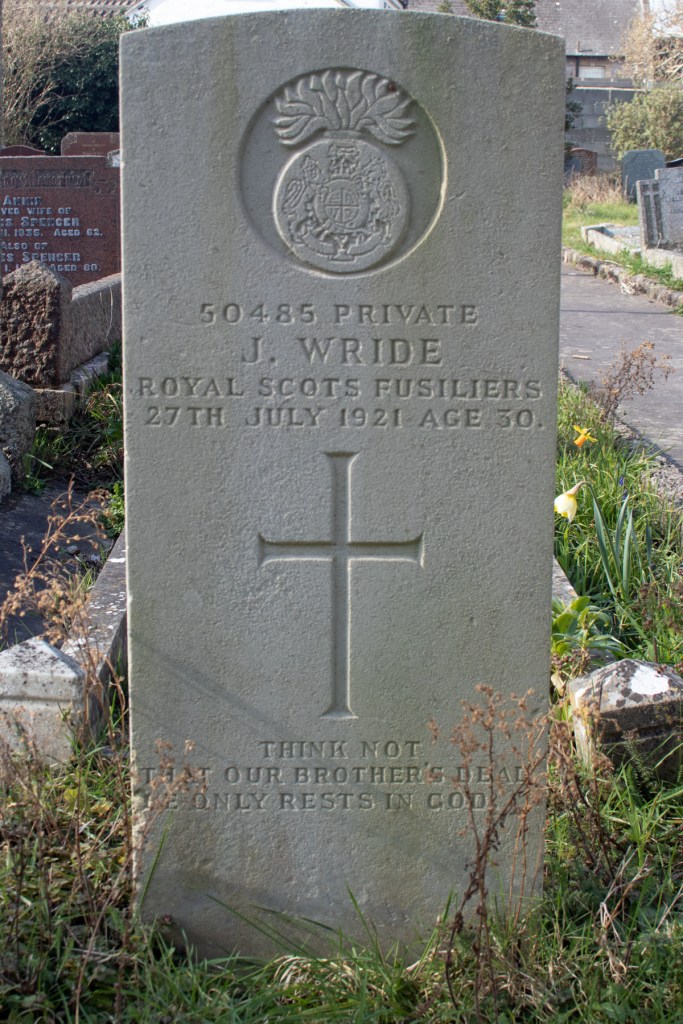
Private John Wride

Private John Wride

John Wride was born in 1891, one of eleven children to William and Kate Wride from Cheddar in Somerset. William stared as an agricultural labourer, but went on to become a market gardener, a trade at least four of his sons, John included, also went into.

Sadly, little of John’s life before the outbreak of war is documented. He enlisted on 12th February 1915, and was assigned to the Royal Scots Fusiliers. There is little information about whether he served abroad, although a number of battalions remained based in the UK.

When he enlisted, Private Wride was noted to have an enlarged thyroid and dental deficiencies. He seems to have suffered with his health during the conflict, and the medical report that accompanied his discharge from the army showed that he suffered from VDH – valvular disease of the heart – although the doctor did not attribute this to his military service.

This decision was appealed, and a subsequent report identified that John’s heart and kidney disease were in fact aggravated by his time in the army. He was medically discharged due to these conditions in February 1919.

By the time of the 1921 census, taken in June that year, John was back home in Cheddar. He was living with his parents and two siblings, and seemed to be working alongside his father in the market garden business. Sadly, however, his heart condition was to prove fatal. He passed away on 27th July 1921, aged 30 years old.

John Wride lies at rest in the Baptist Burial Ground in his home town of Cheddar.


Private Ernest Painter

Private Ernest Painter

Ernest Hart Painter was born in December 1884 one of eight children to Alfred and Elizabeth from Devon. Alfred moved the family to Cheddar, Somerset to work at a paper mill in but sadly passed away when Ernest was only eleven years old.

The family rallied round Elizabeth, however, and, by the time of the 1901 census, she was living on the outskirts of the town with her six younger children. Elizabeth worked as a domestic cook; Ernest was an agricultural labourer; his two older sisters were shirt machinists; his 13 year old brother Albert was listed as a gentleman’s servant.

Ernest, by this point, seemed to have taken on the role of head of the family; he continued work as a farm labourer, while Elizabeth earned money as a housekeeper. Alfred became a mechanic for a car dealer and, at the 1911 census, the three of them lived with the youngest member of the family, Ernest’s sister Emily, who had followed in her older sisters’ footsteps as a machinist.

As with many of the fallen men and women of the Great War, a lot of Ernest’s military service records have been lost to time. He enlisted in the Army Veterinary Corps in December 1915, his work as a farm labourer presumably having involved animals and livestock.

Private Painter must have been on the front line as, on 30th May 1918, he was shot in the ankle. Shipped back to England for treatment, he was eventually discharged from service on 19th November, a week after the Armistice. The ankle wound continued to give him trouble, however, and over the following couple of years, he had a number of operations on it.

Sadly, the last of these procedures resulted in an infection, and sepsis took hold. Private Painter passed away from blood poisoning on 15th April 1921. He was 36 years old.

Ernest Hart Painter lies at rest in the graveyard of St Andrew’s Church in Cheddar, Somerset.


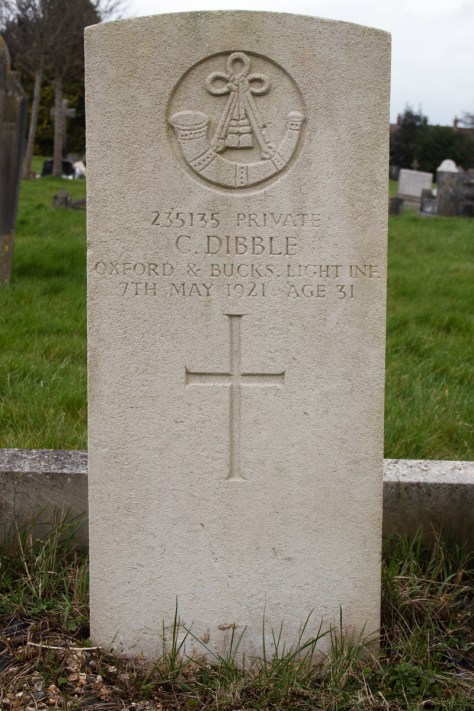
Private Charles Dibble

Private Charles Dibble

Charles Lang Dibble was born in 1890, one of nine children to Evan and Eliza Dibble from Bridgwater in Somerset. Evan was a labourer in a brickyard, and clay must have been run through the family’s veins, as Charles found employment as a kiln hand in a local tile maker when he left school.

By the 1911 census, Charles was boarding with William Rainey and his family in Bridgwater; whether there was a connection before he moved in or not, I don’t know, but the following year he married one of William’s daughters, Constance. The young couple wed on Christmas Day 1912 and went on to have one child, Charles, who was born in 1915.

Full details of Charles’ military service are not available. However, when he enlisted, he initially joined the Somerset Light Infantry, before transferring to the Devonshire Regiment and finally the Oxfordshire and Buckinghamshire Light Infantry. During his service, he was awarded the Victory and British Medals, but there is little further information about Private Dibble.

Charles survived the war, but his pension records confirm that he passed away on 7th May 1921; the cause of death was noted as exhaustion and sarcoma of the rectum. He was 31 years old.

Charles Lang Dibble lies at rest in St John’s Cemetery in his home town of Bridgwater.


Lance Corporal Sidney Turner

Lance Corporal Sidney Turner

Sidney Joseph Turner was born in 1888, the oldest of four children to Sidney and Matilda Turner from Bridgwater in Somerset. Sidney Sr was a carter, while his son became a labourer in a local cement works. Sadly, Sidney Sr died in 1903, when Sidney Jr was 15, leaving Matilda with three other children, one of whom was only 18 months old.

Sidney Jr travelled to get work, and had moved to South Wales to work as a miner by 1909. Here he married Rose Shattock, who was born in Bristol, although within a couple of years the young couple had moved back to Somerset.

Sidney and Rose had a son, also called Sidney, although sadly he died when he was only a couple of months old. Tragically for Sidney, the records seem to suggest that Rose may have died in childbirth, or shortly after, as her passing was registered in the same quarter as her son’s birth.

By this time, Sidney was living in Bailey Street, Bridgwater, a short distance from some railway sidings. This might have driven some determination in him as, by the following year, he was listed as an engine driver. In December 1913 he married his second wife, Bessie Sharman. She was the daughter of a mariner, who had become a machinist in a shirt factory by the time of their marriage. The couple went on to have a son, also called Sidney, in April 1914.

When war broke out, Sidney enlisted in the Highland Light Infantry, initially in the 12th (Service) Battalion. They landed in France in July 1915 and were there for the remainder of the war. At some point, Lance Corporal Turner transferred to the 53rd (Young Soldier) Battalion. Very much a training brigade, it seems that Sidney’s experience of the front line may have proved useful for the upcoming recruits.

Lance Corporal Turner was demobbed on 21st March 1919; his pension record shows that, during the course of his service, he had fractured his tibia and had contracted bronchitis. The 1921 census found Sidney back in Bridgwater. He was listed as being a gas engine driver for John Board & Co., although he was, at that point, out of work. He, Bessie and Sidney Jr were living at 1 Price’s Buildings.

Sidney’s health conditions were to prove his downfall, as, within a months of the census return, he had succumbed to pulmonary tuberculosis and exhaustion. He died on 2nd July 1921, aged just 32 years old.

Sidney Joseph Turner lies at rest in St John’s Cemetery in his home town of Bridgwater, Somerset.

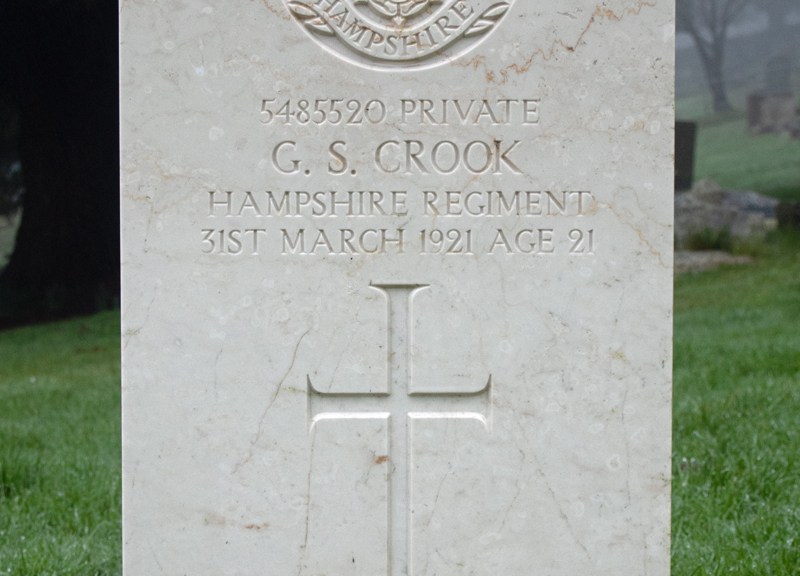
Private Gordon Crook

Private Gordon Crook

Gordon Spencer Crook was born in 1900, one of thirteen children to William and Elizabeth Crook from Somerset. William, like his father, was a gardener, and the family lived in Lower Lane, a small lane sandwiched between the railway and a stream in the centre of Shepton Mallet.

The military records for Gordon, who seems also to have gone by the name of George, are a challenge to piece together. His older brothers Walter and Bertram both died as a result of the fighting, both in 1916, and it seems likely that Gordon was keen to do his bit as soon as he could, to honour their memories.

He enlisted in the Hampshire Regiment, whose battalions served both in France and on the home front. There is conflicting information about his service, but Private Crook appears to have fought at the front, gaining the Victory and British Medals.

Again, with his passing, there is little information surrounding Gordon, or George. A brief notification in the Shepton Mallet Journal stated that “On March 31, at Royal Victoria Hospital Netley, Gordon Spencer, the dearly loved son of W and E Crook, aged 21 years.”

Gordon Spencer Crook lies at rest in the cemetery of his home town, Shepton Mallet.


Gordon’s brother Walter is also buried in Shepton Mallet Cemetery – read his story here.


A third brother, Bertie, was also gave his life in the Great War. The local newspaper had given a touching report on his death in April 1916.

Bertie Crook left school at the age of 13, and went into service with Mrs Dickinson at Whitstone, as a stable lad. He was there a year and then, on account of Mrs Dickinson giving up horses and leaving the town, they recommended him to Lord Derby’s stables at Newmarket, under the Hon. G Lambton. Small as he was, Bertie Crook undertook the railway journey alone, with a label in his buttonhole. He served five years apprenticeship, which expired at the beginning of October [1915]. He then tried to join the Royal Field Artillery, but not being tall enough he joined a West country regiment on the 20th October, and left Tidworth Barracks for France in the early part of January. He was in his 21st year, having been born on the 29th July. 1895.

The Hon. George Lambton writes “I was terribly shocked and grieved to hear of the death of your boy… Mrs Lambton and I send our deepest sympathy… I always liked your boy so much when he was in my stable; and I felt sure that with his quiet and courageous character he would make a good soldier. I shall have a plate put up in the stable in memento of his glorious death.”

Shepton Mallet Journal: Friday 21st April 1916

Lance Corporal Bertram Stanley Crook is buried at the 13th London Graveyard in Lavantie, France.


Air Mechanic Hedley Chinn

Air Mechanic Hedley Chinn

Hedley Walter Chinn was born in April 1900, one of six children to Walter and Kate Chinn. Walter was the butcher in the Somerset village of Middlezoy, and this is where the family had made their home.

There is little information on Hedley’s pre-war life, beyond the two census records of 1901 and 1911. With war breaking out and his older sister Lilian dying while nursing the troops (see below), it seems that Hedley was eager to do his duty.

Within months of Lilian’s death in 1917 – and basically as soon as his age allowed – Hedley enlisted in the Royal Naval Air Service as a mechanic. He carried out his initial training on the land-based ships President II, Impregnable and Cranwell, before officially joining the newly-formed Royal Air Force in May 1918.

Air Mechanic Chinn continued his service at Calshott, where he worked as a wireless operator for the flying boats guarding the Solent around Southampton. He continued in the role for the remainder of the war and beyond.

Hedley was eventually transferred to the RAF Reserve in February 1920, when, presumably, he returned to the family home in Somerset.

Little further is evident of Hedley’s life; but he passed away less than a year after being demobbed. There is nothing to confirm the cause of his death; given he died more than two years after the war, it is likely that it was as a result of an illness, although this is a presumption on my part. Either way, he died on 2nd January 1921, aged just 20 years old.

Hedley Walter Chinn lies at rest in the peaceful graveyard of Holy Cross Church in Middlezoy, Somerset.


It is worth noting that Hedley’s sister Lilian also served – and perished as a result of the Great War. Click here to learn more.


When I was researching Hedley’s life, I ran through the contemporary newspapers to trace his name. Nothing evident came up, although Hedley’s father, Walter’s name did appear.

In 1910, he declared himself bankrupt after being unable to pay for meat for his shop, that he had bought at auction. It appears that he had run up debts of over £300 (approximately £23,500 in today’s money) over a number of years; he put these debts down to a number of factors – “illness of my children, bad debts, having to maintain my mother for 14 years; and loss on sale of Middlezoy House, Middlezoy, three years ago, which realised £200 less than the amount I gave for it, and the amount expended on improvements”.

The 1921 census found Walter and Kate still running the butcher in Middezoy, their home empty but for each other. Walter’s debts were finally cleared in 1928 and the bankruptcy annulled.


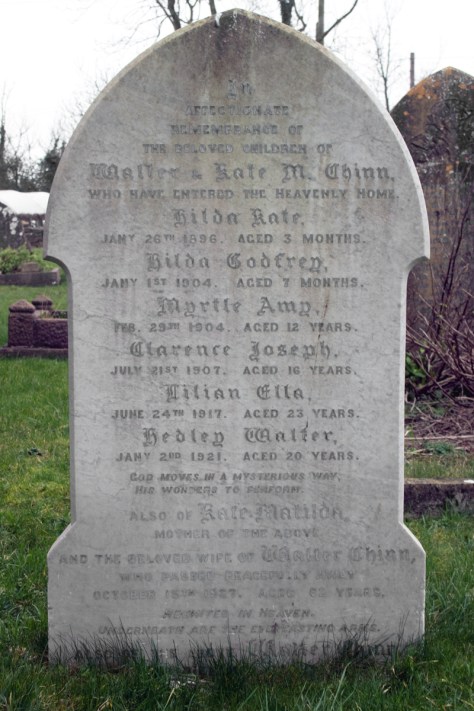
The gravestone in Holy Cross Churchyard is a haunting memorial to the tragic lives of the Chinn family.

Walter and Kat had six children, and would outlive every one of them. The stone confirms that each of their children lies in the grave:

  • Clarence Joseph (born 1891, died 1907)
  • Myrtle Amy (born 1892, died 1893)
  • Lilian Ella (born 1893, died 1917)
  • Hilda Kate (born 1895, died 1896)
  • Hedley Walter (born 1900, died 1921)
  • Hilda Godfrey (born 1903, died 1904)

The grave’s epitaph – God moves in a mysterious way, his wonders to perform – sounds cruelly hollow to 21st century ears. The only comfort to take, I guess, is that the whole family was destined to be together again: both Kate (who died in 1927) and Walter (who died in 1933) are also buried in the family grave.