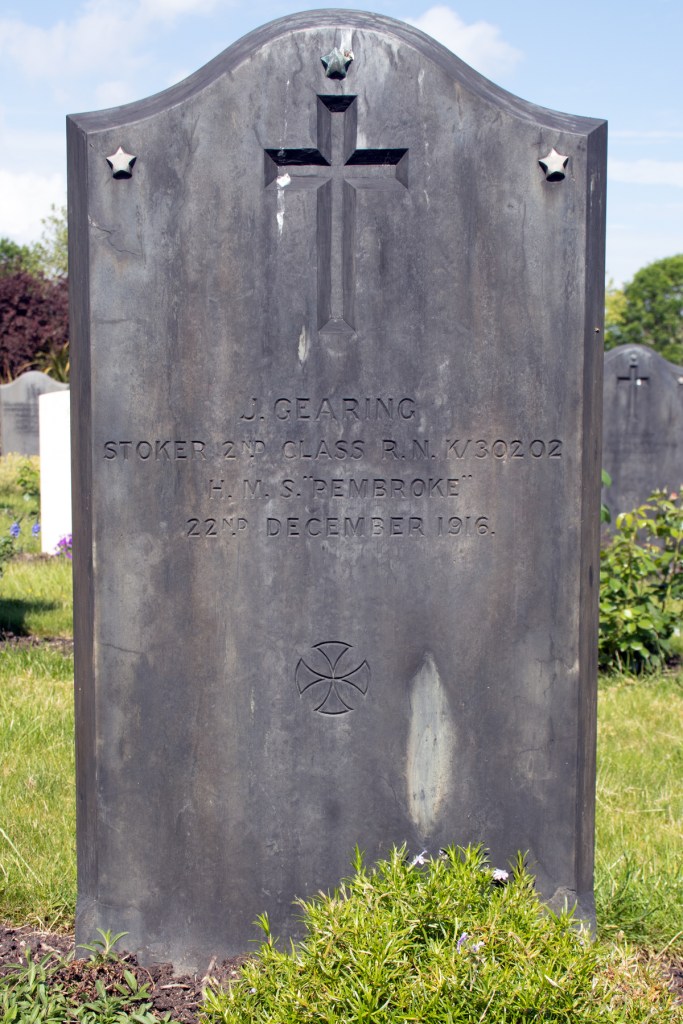
John Gearing was born in Paddington, Middlesex, on 12th August 1894. There is little concrete information about his early life, although a later document confirms he was the son of Mrs E Gearing, of 5 York Place, Hammersmith.
John was working as a fireman when war was declared. When he was called upon to serve his King and Country, he chose to enlist in the Royal Navy, joining up on 5th January 1916. His service records show that he was 5ft 9.5ins (1.76m) tall, with brown hair, blue eyes and a fresh complexion.
Stoker 2nd Class Gearing was initially sent to HMS Pembroke, the Royal Naval Dockyard in Chatham, Kent, for his training. He would remain attached to the base, and was assigned to HMS Victorious, the dockyard’s repair ship, from April 1916.
John’s time in the navy was not to be a lengthy one. Transferred back to HMS Pembroke in September, it seems that his health was becoming affected by the work he was doing. He was admitted to the Royal Naval Hospital in Chatham, suffering from what was later identified as carcinoma of the intestines. He passed away from the condition on 22nd December 1916, aged just 22 years old.
John Gearing was laid to rest in the Woodlands Cemetery, Gillingham, not far from the naval base he had come to call home.
Henry Gibbs was born in Wiveliscombe, Somerset at the start of 1871. The youngest of five children, he was the second son to John and Emma Gibbs. John was a farm labourer, but when he finished his schooling, Henry went in a different direction.
By the time of the 1891 census, Henry was boarding with his sister Lucy and her husband and young son. The extended family were living in Taunton, Somerset, where Henry was employed as a boot and shoemaker. This appears not to have satisfied him, however, and he soon found other work, enlisting in the Royal Field Artillery. While his army records are lost to time, he seems to have spent twelve years in service.
By the early 1900s Henry living back in Somerset, settling in Bishops Lydeard, to the west of Taunton. On 2nd May 1906, he married a young woman called Florence Gange. Fifteen years his junior – she was 20 years old to her husband’s 35, even though the marriage certificate gave his age as 30 – she a labourer’s daughter from the village, who was working at the Lethbridge Arms public house at the time of their marriage. The couple set up home in a small cottage, and went on to have four children: Ernest, Florence, Mabel and Arthur.
Henry’s work seems to have been transient. On his marriage certificate, he was noted as being a groom, but the next census return, taken in 1911, gave his employment as a labourer for a corn miller.
When war came to European shores, despite his growing family, Henry felt the pull to serve once more. He enlisted in the Royal Army Service Corps in the summer of 1915, with the rank of Driver. As with his previous time in the army, details are scarce, but Henry seems to have been based in Aldershot, Hampshire, or at least this is where he was based towards the end of the conflict.
Driver Gibbs had become unwell by this point, and he was suffering from oesophageal cancer. He was admitted to the military hospital in Farnham Hill, but was to succumb to the condition. He passed away on 1st September 1918, at the age of 47 years of age.
Henry Gibbs was brought back to Somerset for burial. He was laid to rest in the quiet graveyard of St Mary’s Church in his adopted home village, Bishops Lydeard.
Frederick Reginald Channing was born in the autumn of 1869, in Bath, Somerset. He was one of five children to carpenter Allen Channing and his dressmaker wife, Sarah. When Frederick was just a toddler, Allen moved the family south to Chard, and this is where his younger siblings were born.
When Frederick left school, he found work as a lace machine operator and, in fact, all of Allen’s children found work with their hands: Frederick worked alongside one of his brothers, while his two other brothers built on their father’s woodworking skills, one as a coachbuilder, another as a cabinet maker.
By the autumn of 1905, Frederick had moved back to Bath. This is where he met Elizabeth Scammell, a farm labourer’s daughter from Wiltshire. The 1901 census appears to record her as being a servant to a surgeon’s family in Wincanton, and this may have prompted a further move to the larger city where the couple met.
The couple married in Bath towards the end of 1905, and had a son, Frederick Jr, who was born in November the following year. Frederick Sr was doing general labouring work by this point, and the family had moved to Wedmore by the time a second boy, William, was born in 1910. Frederick and Elizabeth had a daughter, Eva, in 1911, and another, Gwendoline, in 1913, tragically, the same year that Eva died.
When war came to Europe, Frederick stepped up to play his part. He enlisted in September 1914, joining the Somerset Light Infantry as a Private. His service records confirm that he was 5ft 6ins (1.67m) tall, and weighed 154lbs (69.9kg). The document also gives his age as 35, although he was actually ten years older than that by this point.
Private Channing spent a year on home soil, during which time Elizabeth gave birth to their fifth child, Percival, who was born in May 1915. Based at a camp in Aylesbury, Buckinghamshire, he was hospitalised twice in this time, suffering from a contusion of his left shoulder.
By September 1915, Frederick was in France, and he remained on the Western Front, apart from when on leave, for the next three-and-a-half years. At some point during this time, he was promoted to the rank of Lance Corporal, and transferred across to the Royal Engineers.
Back at home, Elizabeth was doing her best to raise the family. She didn’t always do the right thing, though, and this resulted in her being taken to court.
Elizabeth Mary Rose Channing, 30… was indicted for having been delivered of a certain female child, did unlawfully by a secret disposition of the deceased child, endeavour to conceal the birth thereof at Wedmore the same day in the month of September 1916.
Mr Wethered prosecuted, and said that the prisoner was a married woman. Her husband was a soldier now on active service. He was last home on leave in April or May, 1917. Previously to that he had not been home for 18 months or two years, so the child could not have been his. Some boys found a parcel in the well, and they discovered the body of the child. The boys communicated with the police, who searched the well and found some pieces of carpet which agreed with a similar carpet in the possession of the prisoner. When arrested she confessed to the crime.
Frederick Channing, husband of the prisoner, said he was home on leave five months ago – May 27th. He went back on June 4th. Previously he had not been home for twenty months. He pleaded for the prisoner in the interests of their four children. He was very sorry for her to think she had thrown herself away like that.
His Lordship, addressing the prisoner, said that while her husband was away doing his duty for her any everybody, she was not faithful to him, and the result was the birth of the child which had been concealed and not revealed till a year afterwards. His Lordship understood that prisoner was already legitimately in a certain condition, and he did not wish her child to be born in prison. She would be sent to prison therefore for three months.
Wells Journal: Friday 26th October 1917
Elizabeth was released in February 1918, and the couple’s last child, Kathleen, was born the following month.
Frederick, meanwhile, returned to the Western Front. He remained in France through to the end of the conflict and beyond, only returning to Britain in February 1919, having fallen ill. Admitted to the North Evington War Hospital in Leicester with influenza, he remained there for two months.
In April 1919, Lance Corporal Channing was transferred to the Bath War Hospital, back in Somerset. This was presumably so that he could be closer to his family, although there is no evidence of whether he was fully reconciled with Elizabeth. His condition did not improve, however, and by this point he was also suffering from myalgia.
Frederick remained in hospital for eighteen months. As time passed, carcinoma of the liver was identified, and this, eventually, was the condition that would take his life. Lance Corporal Canning passed away on 5th September 1920. He was 49 years of age.
Sarah and the children were still living in Wedmore, by this point. Frederick Reginald Channing’s last journey was not to be that far, however. He was moved only a short distance from the hospital, and was laid to rest in the sweeping grounds of the Locksbrook Cemetery in Bath.
Charlie Tucker was born early in 1877 in the village of Mark, Somerset. The fifth of six children, his parents were Thomas and Caroline. Charlie’s mother died when he was only a toddler, probably during, or shortly after, the birth of his younger sister, Elizabeth. This left farm labourer Thomas to raise his family alone.
The 1881 census found the Tuckers living in Wedmore, five miles to the east of Mark, where Thomas was supported by his parents, George and Elizabeth. Both died in 1890, but by this point, Thomas had married again, to a widow, Ann Harding. She had a daughter, Mary Ann, who was welcomed into the family, but then Thomas and Ann had their own child, a son called Walter.
The next census, returned in 1891, recorded the family – Thomas, Ann, Charles, Mary Ann and Walter – living in Wedmore. Charles had finished his schooling by this point, and was employed as a general labourer and the family also had a boarder, Ralph Godney, who was just 9 years of age.
The family setup continued, and the 1901 census document found Thomas and Ann living with Charlie and Walter, all of whom were doing farm work. They still seemed to be open to supporting others, however, and had another boarder, a schoolgirl called Elizabeth Grant.
In the spring of 1904, Charlie married Lily Brown. Born in Wedmore, she was the daughter, and only child, of a labourer who was employed as a servant to an Axbridge famer at the time the couple wed. Charlie and Lily set up home in Blackford, near Wedmore, and went on to have four children: Thomas, Walter, William and Kathleen.
When war broke out in 1914, Charlie stepped up to play his part. Full details of his military career are lost to time, but it is clear from what remains that he had enlisted in the Devonshire Regiment by the autumn of 1916. Private Tucker joined the 13th (Works) Battalion, and remained stationed on home soil for the duration of his service.
Little further information about Charlie’s life is evident. Over the next couple of years his health began to fail, and in the spring of 1917 he had been admitted to Bath War Hospital with carcinoma of the stomach. This was to take his life: he passed away on 11th March 1917. He was 40 years of age.
Charlie Tucker’s body was brought back to Blackford for burial. He was laid to rest in the graveyard of Holy Trinity Church.
Lily, now widowed, was left with four young children to raise on her own. Whether for a new life and new opportunities, or to escape the painful memories that Somerset brought, she made the decision to emigrate. In April 1924, she and the children arrived in Canada, and settled in Ontario.
Further information for Lily is not readily available, but her two oldest children, Thomas and Walter, made lives for themselves, and died in 1975 and 1979, respectively.
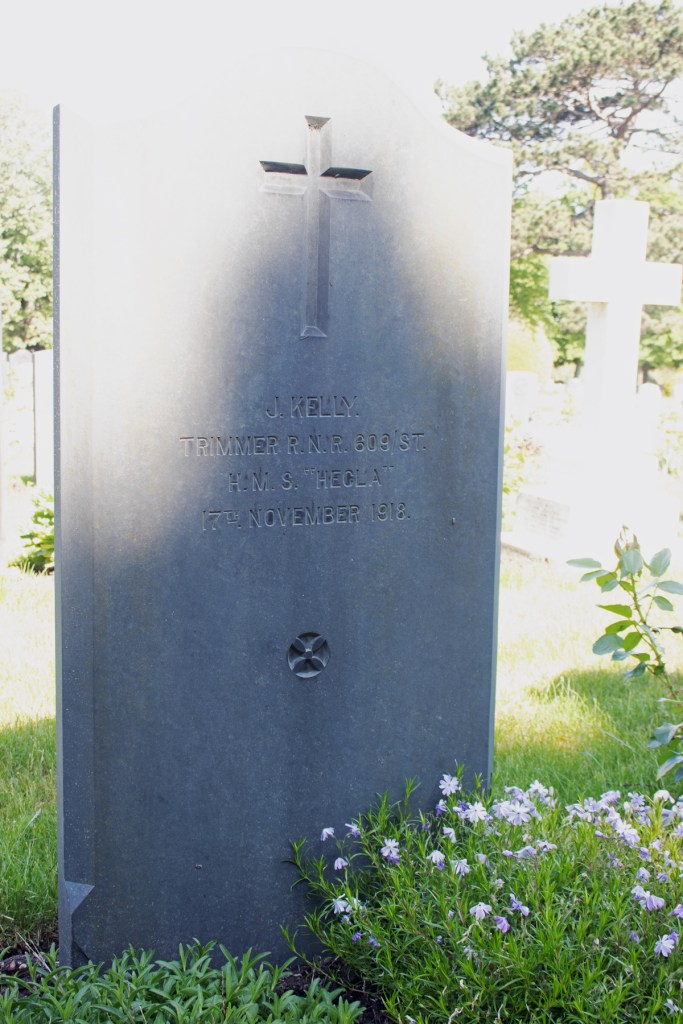
John Kelly was born in East London on 11th January 1871, the son of Charles and Jane. There is not a lot of concrete information about his early life, but he seems to have married an Isabella Coles in the late 1890s, and the couple went on to have at least one child – a daughter they called Lizzie.
On 13th May 1915, with the First World War raging, John enlisted. He joined the Royal Navy for the duration of the war as a Trimmer (or Stoker), His enlistment papers show that he stood at 5ft 6ins (1.67m tall), had a fair complexion and blue eyes. He is also noted as having a scar on his chin.
During his time at sea, Trimmer Kelly served on board a number of vessels; his primary base, however, remained HMS Pembroke, the shore-based establishment at the Royal Naval Dockyard in Chatham, Kent.
It was while he was on board HMS Hecla, a depot ship, that John fell ill with stomach problems. Returned to Chatham, he was admitted to the Naval Hospital in the town, but died of a carcinoma of the stomach on 17th November 1918. He was 47 years old.
John Kelly was laid to rest in the Woodlands Cemetery, Gillingham, a short distance from the dockyard where he had been based.




 Death and Service