
Tag Archives: Chaplain

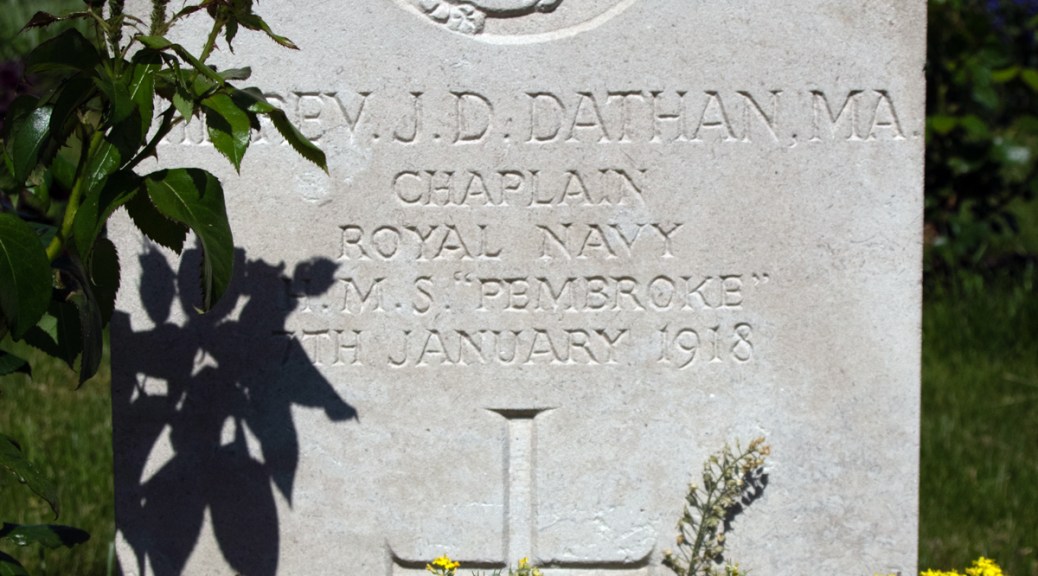
Reverend Joseph Dathan

Reverend Joseph Dathan

Much regret has been felt… at the death of Rev. JD Dathan MA, chaplain to the Royal Marines, at the age of 50 years. His death was due to pneumonia, caused by catching a chill while doing temporary duty… at the [Royal Naval Hospital, Chatham, Kent]. The eldest son of Captain JC Dathan RN, the deceased gentleman was educated at Christ’s Hospital and Cambridge, where he obtained the degree of MA. He entered the Royal Navy as a chaplain in 1896, and served on the China Station during the Boxer riots. For five years he was chaplain of Bermuda Dockyard and Hospital. He also served commissions in HMS Monmouth, Goliath and Russell. He was posted to the Royal Marine Barracks in July 1914, but on the outbreak of war he was appointed to HMS Formidable, and was transferred from the ship a week before she was lost. He was subsequently sent tot he Dardanelles for service in the Implacable at the first landing in April 1915. Later he joined the Italian Fleet, and was subsequently recalled to the Royal Marine Barracks. Three of the deceased officer’s brothers – Paymr.-in-Chief Ellis Dathan, Com. Hartley Dathan, and Eng.-Com. William Dathan – are serving in the Royal Navy.

[Naval & Military Record and Royal Dockyards Gazette: Wednesday 16th January 1918]

Joseph Duncan Dathan was born in 1866 in Halifax, Nova Scotia. The second of seven children, his parents were Joseph and Emma Dathan.

By the time of the 1891 census, the Dathan family had moved back to Britain. Joseph Sr and Emma were living in Portsea, Hampshire, while the younger Joseph was studying at Christ’s Hospital. The next return, taken in 1901, found him having taken up a role as curate at St John’s Church in Ipswich, Suffolk. He was, by this point, living on Foxhall Road on the western edge of the town.

On 25th February 1904, Joseph married Alicia Cane. The daughter of a vicar, she lived in Ipswich, and the couple married in the local parish church. By this point, Joseph was based in Portsmouth, Hampshire, and this is where the young couple set up home. Alicia gave birth to their first child, John, that November. The couple’s second son, Joseph, was born in 1906 and their third, daughter Alicia, was born in Bermuda while the family were stationed out there with Reverend Dathan’s work.

Joseph’s connection to the navy continued much as the newspaper reported. He died from pneumonia on 7th January 1918: he was 51 years of age.

Reverend Joseph Duncan Dathan was laid to rest in the naval section of Woodlands Cemetery in Gillingham, Kent, a place he would have known well, given its proximity to the Royal Naval Dockyard in Chatham, Kent, where he had been based.

Reverend Charles Jefferys

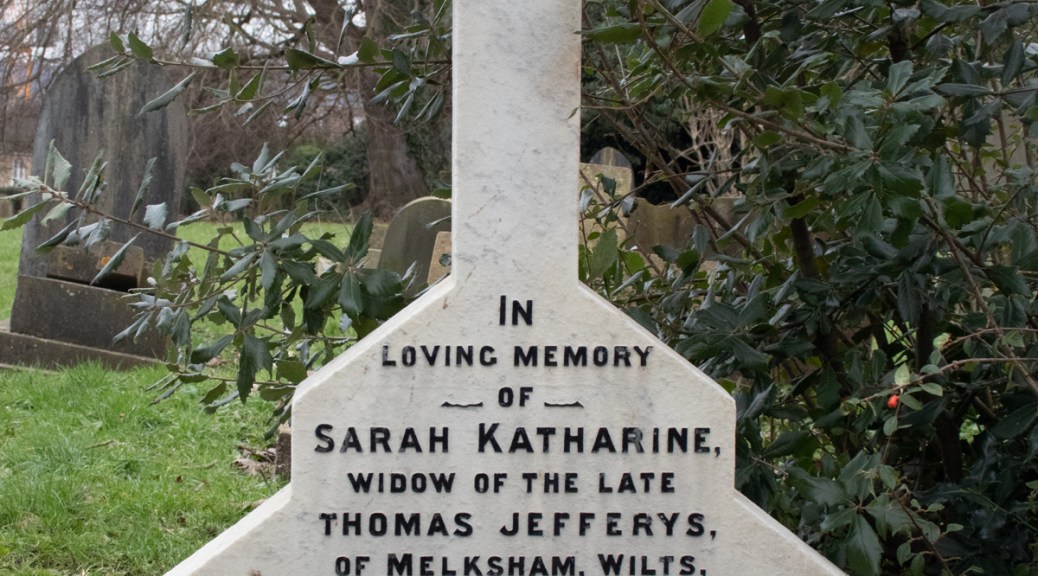
Reverend Charles Jefferys

Charles Thomas Claude Jefferys was born on 23rd August 1880 in the small Carmarthenshire town of Laugharne. One of five children, his parents were naturalist Charles Jefferys and his wife Adeline.

Charles’ Jr’s life was to be one of education, and his father’s standing allowed for the best. He studied at Ellesmere College, Shropshire, then attended Durham University and Durham Theological College. By the 1901 census he was passing that education on to others: he was listed as a schoolmaster at Stow Wood College in Hampshire.

By 1908 Charles had returned to Wales, and was living in Monmouth. On 2nd January he married Eva Pride, an estate agent’s daughter from Tetbury, Gloucestershire. The marriage certificate confirms that, by this point, Charles was a clerk in holy orders, on his way to his true calling.

The 1911 census showed what a transient life the church could lead to: Charles and Eva were listed as living in a house in Oswaldkirk, North Yorshire. Their two young children, George and Charles, born in 1909 and 1910 respectively, were living with Eva’s sister, back in Tetbury.

When war came to Europe, Reverend Jefferys must have felt compelled to play his part. He joined the Army Chaplains’ Department, and by May 1916, he found himself in France. His role – providing pastoral care to the troops – would have led him to some of the darkest places of the Front Line. He remained there for the next couple of years, only returning to the family home – now in Chelsea, London – towards the end of the conflict.

Reverend Jefferys had contracted pneumonia, and he had returned from the continent to recuperate. Sadly, the condition was to prove too much, and he succumbed to it on 20th November 1918, at the age of 38.

Charles Thomas Claude Jefferys was taken to Somerset for burial – there were close family connections in the Bath area. He was laid to rest in the family plot, alongside his paternal grandmother in the city’s St James’ Cemetery.


Further tragedy was to strike in June 1925 when Eva also passed away. Details of her death are unclear, but this left George and Charles as orphans in their early teens.


Reverend George Sweet

Reverend George Sweet

George Charles Walrond Sweet was born on 4th December 1889, the oldest of three children to Reverend Charles Sweet and his wife Maud. A Church of England vicar, Charles moved around with his work, and, when George was born, he was based in Winterborne Kingston in Devon.

George was sent away to school, and, by the time of the 1901 census, Charles and the family had moved to Milton Lilbourne in Wiltshire, to tend the local flock.

After school, George studied at Oxford, then followed in his father’s footsteps by taking holy orders, and was soon appointed rector of Symondsbury, Dorset.

When war broke out, his calling was to serve in the Royal Army Chaplain’s Department. Details of his time during the conflict are unclear, although by the spring of 1919, he was attached to the headquarters of the Army of the Rhine.

It was here that he met Phyllis Squire Hickson, who was serving as a Nurse in the Queen Mary’s Auxiliary Army Corps. The couple fell in love and, in June 1919 they returned to England to marry. The wedding occurred on 6th August 1919, and the newlyweds set off on honeymoon the following day.

On his honeymoon tour, the Revd. George C Walrond Sweet… was drowned on Thursday evening in the Cherwell at Oxford, in the presence of his wife.

Mr and Mrs Sweet engaged a punt at Tims’s boathouse and went for a trip on the river. On returning about seven o’clock, when within 300 yards of the boathouse, the punt pole was embedded in the mud and, in attempting to dislodge it the pole broke.

Mr Sweet fell on the side of the boat and then over-balanced into the river. His wife tried to reach him, but without success, and then jumped into a second punt and from that into another boat, but failed to reach him, and he disappeared. The body was not recovered until a quarter of an hour had elapsed, and life was then extinct.

Mr Sweet, who was an MA of Keble College, was only married on Wednesday at St James’s Church, West Hampstead…

[Phyllis’ father] Mr William Hickson… said his daughter became engaged to Mr Sweet in France. He did not meet him until last Tuesday. They came to England to be married. Mr Sweet met with a bicycle accident some years ago and [he] understood from his daughter that her husband was unable to swim or take any active exercise, but while he had been in France his health had much improved.

It was stated [at the inquest] that Mr and Mrs Sweet had been married only one day when the accident occurred and Dr Brooks, a university coroner, said that the tragedy was one of the saddest that had ever come under his notice.

Taunton Courier and Western Advertiser: Wednesday 13th August 1919

The inquest confirmed that the punt pole had broken about 2.5ft (0.76m) from the top. When George was dragged from the river, artificial respiration was carried out for around 50 minutes, but proved unsuccessful. The inquest returned a verdict of accidental death. George was just 29 years of age.

Reverend George Charles Walrond Sweet’s body was brought to Somerset for burial. He was laid to rest in the graveyard of Holy Cross Church in Sampford Arundel, more than likely because he or his father had been vicars there.


This was the second tragedy to befall the Sweet family. George’s younger brother, Leonard, had been schooled in Sherborne, then at the Military College in Sandhurst. He joined the 1st Battalion of the Hampshire Regiment as Second Lieutenant on 5th February 1913, and was promoted to full Lieutenant in September 1914, and Captain in October 1915.

Captain Sweet was then attached to the 29th Squadron of the Royal Flying Corps, and gained his wings at the British Flying School in Le Crotoy, France, in August 1915. On 22nd June 1916, he was on patrol duty over the British lines, when he was involved in a skirmish, and his plane crashed, killing him instantly. He was just 23 years of age.

Captain Leonard Sweet was laid to rest at the Lijssenthoek Military Cemetery in Poperinge, near Ypres.

Captain Leonard Sweet
(from findagrave.com)

Phyllis Sweet never remarried. By the time of the 1939 England and Wales Register, she was living in Bridport, Dorset, and working as a political organiser and speaker. She passed away in August 1944 in Cannock, Staffordshire, at the age of 63 years old.