Herbert Packer was born in December 1889, the youngest of nine children to Joseph and Ann Packer. Joseph was a railway carrier (or porter) and the family lived in Cheddar, Somerset.
The 1911 census found Herbert on his travels; he was working as a grocer’s assistant, and boarding with a family in Abergavenny, South Wales. He was obviously keen to develop his skills, and soon moved to Barnstaple in Devon to work for the Lipton’s grocery there.
In the autumn of 1914, Herbert married Lydia Snell, a dressmaker from Wales and the young couple lived together in the Devon town where he worked. He was very active in the community; he was a teacher at the local Wesleyan Sunday School, and active in the church choir having, according to a local newspaper, “a capital voice”.
Herbert enlisted in the spring of 1916, and had the honour of joining the Coldstream Guards. He did his training in London, and was due back to Barnstaple on leave before starting his active service when he was taken ill. Admitted to the London Hospital with pneumonia, within a couple of weeks he had succumbed to the condition. Guardsman Packer died on 3rd December 1916, aged just 26 years old.
Herbert Packer lies at rest in St Andrew’s Churchyard in his home town of Cheddar in Somerset.
Wilfred Allen Gillson was born in 1888, the fourth of nine children – and one of eight boys – to George and Emma Gillson. George was a coachbuilder from Cornwall; Emma, whose maiden name was Allen, came from Derbyshire. The family were living in Torquay by the time Wilfred was born.
In 1895, George had moved the family to Bridgwater in Somerset, presumably as railway works had dried up in the coastal Devon town. By this time his oldest son, also called George, was working as a compositor, keying text for a printer. Wilfred was still at school, but his other two older siblings – William and Albert – were both working with their father, working on railway coaches.
Wilfred was also to follow in his father’s employment, and the 1911 census found him living in Bristol, boarding with the Cridland family, earning his keep a a carriage painter.
He joined up within weeks of war breaking out, enlisting in the Worcestershire Regiment on 20th September 1914. Private Gillson readily proved his worth, and was promoted to Lance Corporal after three months, and Corporal within a year of enlisting.
Corporal Gillson’s promotion coincided with his shipment abroad, and he served on the Western Front for eight months. Returning to England in March 1916, he subsequently transferred to the Devonshire Regiment, before being moved to the 4th Reserve Battalion in the spring of 1917.
Things were not right for Wilfred; he was reprimanded for neglecting his post on the night of the 26th May that year, before being medically discharged with neurasthenia in August.
The root of the matter is detailed in his discharge report; he was hospitalised at Neuve Chapelle in February 1916, suffering from shellshock, and it seems that he never really fully recovered.
Sadly, at this point Wilfred’s trail goes cold. He passed away on 10th November 1918, aged 30 years old.
Wilfred Allen Gillson lies at rest in St John’s Cemetery in Bridgwater, Somerset.
There are a couple of additional notes to Wilfred’s life.
During the war, Wilfred’s youngest brother, Thomas, fought with the Oxfordshire & Buckinghamshire Light Infantry. He was involved in the fighting in France, but died from wounds on 10th June 1918. He was just 18 years old, and is buried at Aire-sur-la-Lys, not far from Boulogne.
Given that Wilfred was one of eight brothers, all of whom would have been of fighting age during the war, it is lucky – although still a tragedy – that only he and Thomas died as a result of the conflict.
Sadly, Wilfred’s mother, Emma, passed away in the autumn of 1914, at 57 years of age. It might be a blessing, however, that she was not alive to see two of her sons suffer so.
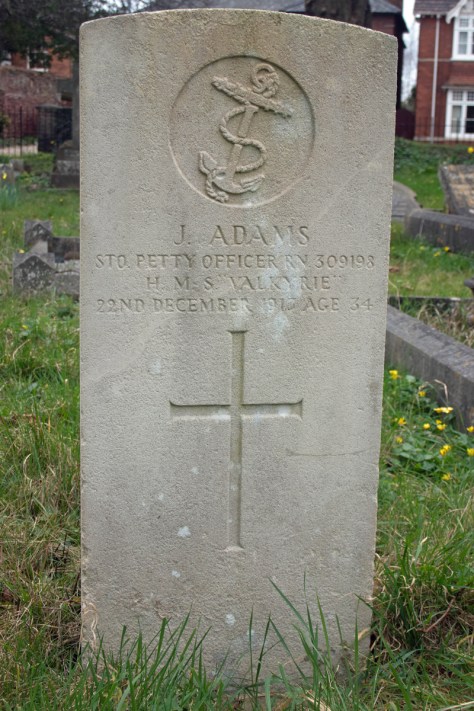
James Adams was born in June 1883, son of Robert and Eliza Adams from Bridgwater in Somerset. Robert was an agricultural labourer; James was one of seven children.
James was keen to get out and see the world. In November 1905 – aged just 12 years old – he enlisted in the Royal Navy as a stoker. After training in Devonport, Plymouth, Stoker Adams served on a number of different vessels, including HMS Victorious, Ramillies, Amphitrite, Monmouth, Andromeda and Halcyon.
By the time war broke out, James has been promoted to Leading Stoker, and was assigned to HMS Cornwall. This was an armoured cruiser that was involved in the Battle of the Falklands in December 1914.
Promoted to Stoker Petty Officer in October 1915, James continued to serve on HMS Cornwall until he was transferred to the brand new ship, HMS Valkyrie. The vessel was involved in offensive sweeps and convoy escorts based out of Harwich.
On 22nd December 1917, the Valkyrie was part of the escort for a convoy travelling to the Netherlands, when she struck a mine. In total, nineteen men were killed, twelve instantly; this included Stoker Petty Officer Adams. He was 34 years old.
James Adams lies at rest in the Wembdon Road Cemetery in his home town of Bridgwater.
Bernard Dyke was born in 1897, the oldest of three children to Albert and Edith Dyke from Bridgwater, Somerset. Albert worked for a brewery, and the young family lived in a house on the main road west out of the town.
Bernard received a scholarship to attend Dr Morgan’s School, a grammar school in the town, and he was a pupil there from autumn 1910 to spring 1913. He left at the age of 16, and became a merchant’s clerk.
War was on the horizon, however, and Bernard joined up. Full details of his military service are not available, but he enlisted in the Devonshire Regiment. Private Dyke spent some time at the Tregantle Fort, near Plymouth, and it was here that he was caught up in an accident.
It has transpired than a rather remarkable shooting fatality occurred at Tregantle rifle ranges, near Plymouth, on Friday, when Private Bernard Dyke, aged about 24, of the Devon Regiment, received a gunshot would in the left side, and almost immediately expired.
The soldier was acting as an observer for a Lewis gun section when he received the fatal injury, the section being at the time out of action awaiting the appearance of a moving target. On the deceased’s left hand side was a musketry party of nine carrying out an exercise, and when he received his injury only one or two rounds had been discharged by this party.
When the first shot or so had been fired deceased suddenly shouted “Oh! Oh!” and dropped. An officer and NCOs ran to assist him, but found that life was extinct. A military doctor was soon on the spot, and found the bullet had entered the deceased’s left side below the ribs and made its exit at the top of his right arm.
As the musketry party was 80 degrees to the right of the firing party it is strange that a shot could have been fired so wide, but the explanation may be found to be in a ricochet or a soldier’s erratic action.
Western Morning News: Monday 21st January 1918.
Private Bernard Dyke died on 18th January 1918, aged just 20 years old. He lies at rest in the Wembdon Road Cemetery in his home town of Bridgwater, minutes’ walk from his family home.
Lilian Ella Chinn was born in 1893, one of six children to Walter and Kate Chinn. Walter was the butcher in the Somerset village of Middlezoy, and this is where the family had made their home.
There is little recorded of Lilian, and the information is confusing – another Lilian Chinn was born around the same time a few miles away, so it’s a challenge to identify the correct details.
What is known, is that, with the war raging, Lilian felt that she needed to do what she could – and enlisted in the Voluntary Aid Detachment in 1916. Serving as a nurse, she was based at the military hospital in Devonport, Plymouth.
Sadly, it is evident that nursing staff were not immune to the ailments and illnesses of the soldiers they were treating. Lilian contracted meningitis and peritonitis, passing away on 24th June 1917, aged just 23 years old.
Lilian Ella Chinn lies at rest in the peaceful graveyard of Holy Cross Church in Middlezoy, Somerset.
It is worth noting that Lilian’s brother Hedley also served – and perished – as a result of the Great War. Click here to learn more.
When I was researching Lilian’s life, I ran through the contemporary newspapers to trace her name. Nothing evident came up, although her father Walter’s name did appear.
In 1910, he declared himself bankrupt after being unable to pay for meat for his shop, that he had bought at auction. It appears that he had run up debts of over £300 (approximately £23,500 in today’s money) over a number of years; he put these debts down to a number of factors – “illness of my children, bad debts, having to maintain my mother for 14 years; and loss on sale of Middlezoy House, Middlezoy, three years ago, which realised £200 less than the amount I gave for it, and the amount expended on improvements”.
The 1921 census found Walter and Kate still running the butcher in Middezoy, their home empty but for each other. Walter’s debts were finally cleared in 1928 and the bankruptcy annulled.
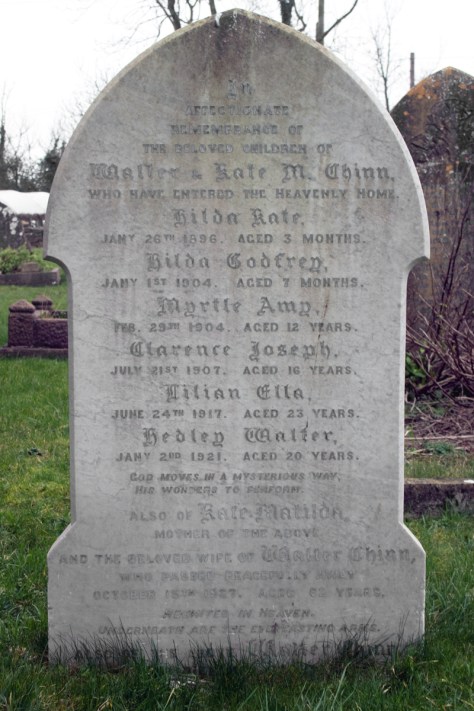
The gravestone in Holy Cross Churchyard is a haunting memorial to the tragic lives of the Chinn family.
Walter and Kate had six children, and would outlive every one of them. The stone confirms that each of their children lies in the grave:
The grave’s epitaph – God moves in a mysterious way, his wonders to perform – sounds cruelly hollow to 21st century ears. The only comfort to take, I guess, is that the whole family was destined to be together again: both Kate (who died in 1927) and Walter (who died in 1933) are also buried in the family grave.
William Cottrell was born in April 1885, the third of twelve children to Henry and Annie Cottrell from Bampton, Devon. When William left school, he became an assistant to the village baker, but new opportunities lay ahead.
In May 1907, William married Maria Wall, the daughter of a stonemason from Wedmore in Somerset. With weeks, the young couple had embarked for a new life, boarding the Empress of Britain in Liverpool, setting sail for Canada.
Emigrating to Manitoba, William became a labourer, and he and Maria had three children – Leslie, Ronald and Kathleen.
War came, and William enlisted in the Canadian Expeditionary Force in August 1915. Shipped to England in the spring of the following year, Annie followed suit, returning to Somerset with the three children.
Private Cottrell was assigned to the 44th Battalion Canadian Infantry, setting off for France in August 1916, just weeks before his fourth child – Ruby – was born.
The battalion was involved in some of the fiercest fighting of the war, and it was during the Somme Offensive that William was shot in the left arm. Initially treated in the field, he was soon shipped back to England to recover in a military hospital in Epsom. Discharged after three months, he was returned to his battalion in early 1917.
The fierce fighting continued, and Private Cottrell was wounded again in October 1918. Further treatment back in the UK was needed, and he was admitted to the 1st Eastern General Hospital in Cambridge.
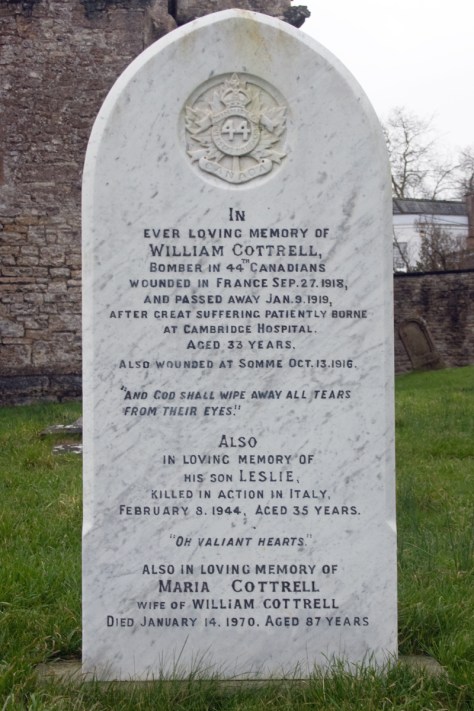
Details of the William’s injuries at the Somme are readily available, but information on his second lot of injuries is scarcer. They must have been pretty severe, however, as he was not discharged. He lost his final battle after four months, succumbing to his wounds on 9th January 1919. He was 33 years old.
William Cottrell lies at rest in the graveyard of St Mary’s Church in his widow’s home village of Wedmore, Somerset.
William’s gravestone is also a memorial to his eldest son, Leslie, who was killed during the Second World War.
Details of his military service are sketchy, but he enlisted in the Queen’s Own Royal West Kent Regiment. His battalion – the 1st – was involved in the fighting in Italy, and it was here that he lost his life. He was killed on 8th February 1944 and is buried in the Sangro River War Cemetery, in Abruzzo.






 Death and Service