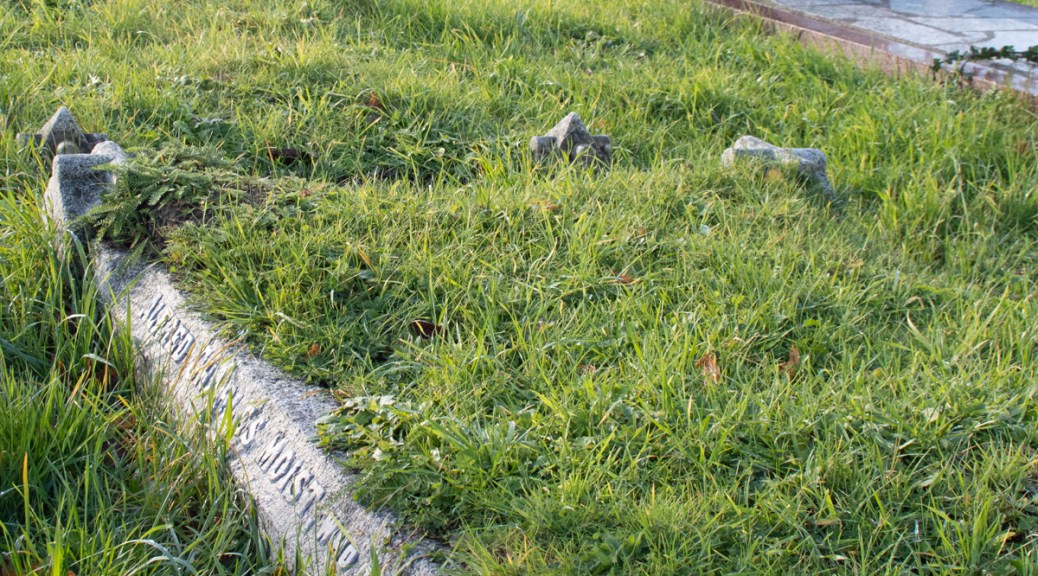
William Morrish Lamacraft was born in Guernsey in 1888, the only son of John and Annie Lamacraft. Annie passed away when William was just 4 years old, and John brought his son back to England, returning to Devon, where he himself had been born. John found employment as a porter at St Thomas’ Union Workhouse in Exeter and lived in here, while William was taken in by his paternal grandmother, Mary, who was also in Exeter.
In 1909, John also passed away. William, by this time, had left school and found work as a bootman at the Queen’s Hotel in Newport, Gwent. War was on its way to Europe by this point and, when it broke out, William enlisted as a Private in the Labour Corps.
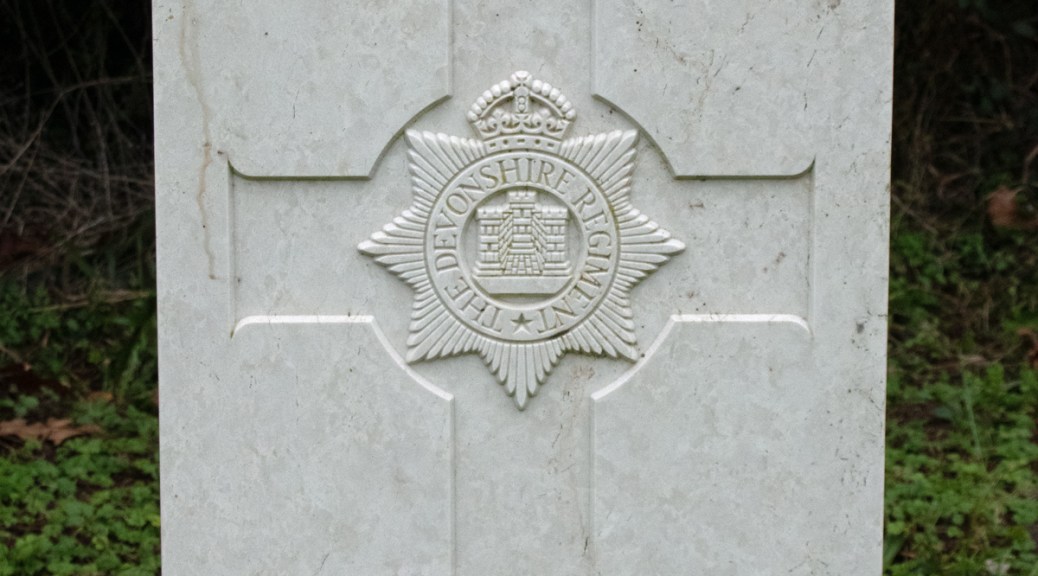
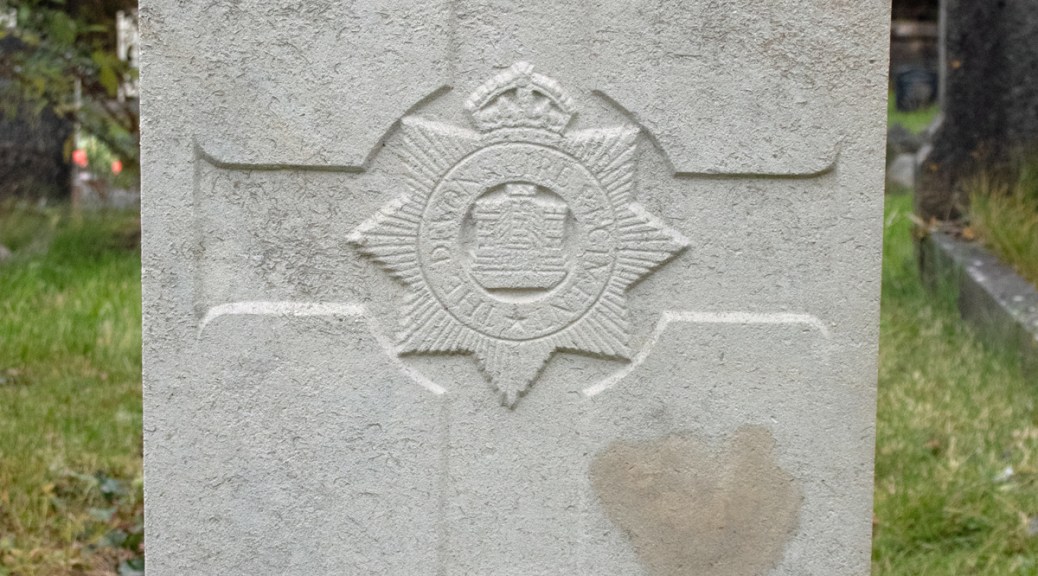
At some point William transferred across to the Devonshire Regiment, but there is little tangible evidence to document when and where he served. What is clear is that Private Lamacraft survived the war, and had returned to Newton Abbot when he was demobbed.
Sadly, William Morrish Lamacraft was not to live a long life after the Armistice was declared. He passed away on 6th June 1919, aged just 31 years old; the cause of death lost to time. He was laid to rest in Newton Abbot Cemetery.
William Henry Merrifield was born on 29th December 1893, in Newton Abbot, Devon. One of six children to Henry and Kezia Merrifield, his father was an agent for the removal company Pickford’s.
When William left school, he found work as a labourer for a local tannery. War was, by this time, on the horizon, and William soon found himself caught up in it. Full details of his military service are not available, but it is clear that he had a varied career.
William initially worked for the British Red Cross as a cook, and was sent to France in October 1914. He Subsequently joined the Royal Field Artillery as a Gunner, before transferring across to the Royal Garrison Artillery. By June 1915, he had made the move again, and was recorded as a Sapper in the Royal Engineers. During this time, he had been awarded the Victory and British Medals and the 1914 and 1915 Stars for his war efforts.
By this point, William had seen a fair amount of tragedy in his life. Kezia had died in 1905, at the age of 44, and his sister Evelyn had passed away in 1914, aged just 25 years old. The following year, Henry also died, aged 52 years of age.
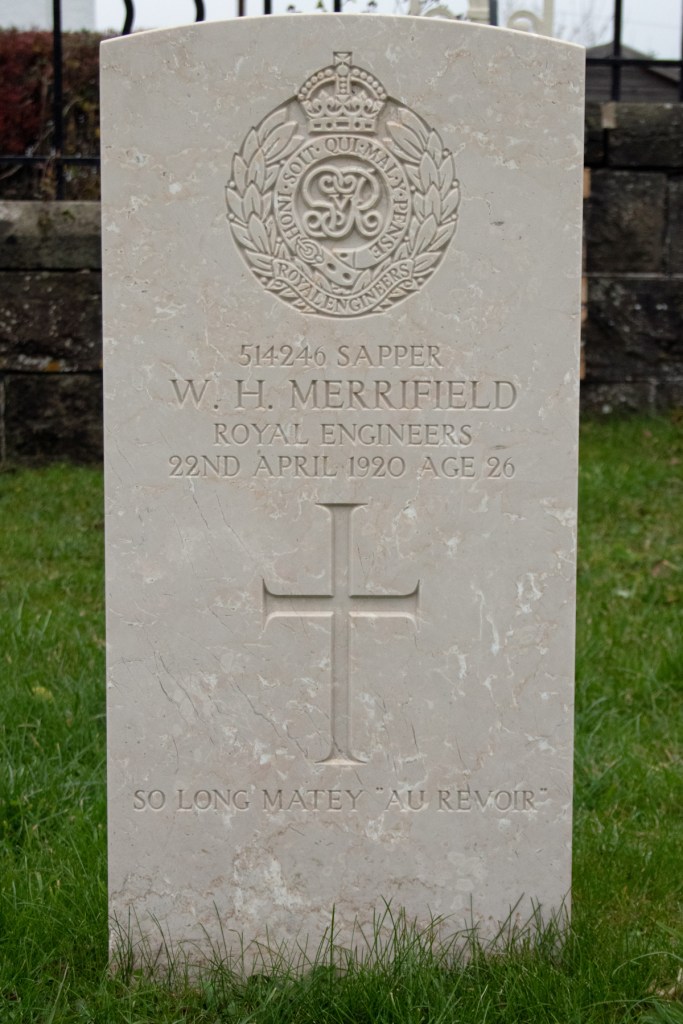
Sapper Merrifield survived the war and was demobbed in February 1919. At this point, his trail goes cold. He returned to Newton Abbot, and passed away just over a year later, on 22nd April 1920. He was 26 years old.
William Henry Merrifield was laid to rest in Newton Abbot Cemetery; his gravestone marked with the message ‘SO LONG MATEY “AU REVOIR”.
Arthur Reginald Srodzinski was born in Paignton, Devon, in October 1890. His great grandfather Stanislaus was born in Poland and emigrated to Devon in the early 1840s. He was an upholsterer, and this is a trade that his son Samuel, and his grandson – Arthur’s father – Henry also followed. Henry and his wife, Sarah, had five children, of which Arthur was the middle one; by the time of the 1901 census, Henry has moved the family to Newton Abbot.
Arthur wanted bigger and better things than upholstering, and sought out a career in the army. In March 1909, he enlisted in the Devonshire Regiment as a Private. His service records show that he was 5ft 5ins (1.69m) tall, and weighed in at 131lbs (59kg). He has hazel eyes, brown hair and a fresh complexion.
Private Srodzinski enlisted for a period of twelve years (seven on active duty), and after his initial training, he was sent overseas. Over the next few years, he was posted to Malta, Cyprus and Egypt but, when was came to Europe, he returned to England, before heading to the Western Front.
Arthur’s time in France was not to be a long one – at the end of December 1914, he was medically evacuated to England, suffering from a heart condition. This was to turn out to be a serious issue, and he was formally discharged from the army on medical grounds just four months later.
Back in Devon, Arthur found work as a butcher and, in the autumn of 1917, he married local carpenter’s daughter Carrie Larkworthy; the couple set up home in Newton Abbot.
In March 1918, Arthur was attending a meeting of discharged soldiers at the Commercial Hotel in Newton Abbot, when he collapsed. Medical treatment was sought, but it proved too late; he had died of a heart attack. Arthur was just 28 years of age.
Arthur Reginald Srodzinski was laid to rest in Newton Abbot Cemetery. Three months later, Carrie gave birth to their one and only child, who she named Reginald.
Thomas Carmichael was born on 19th December 1888, the older of two children to George and Elizabeth – Lizzie – Carmichael. George was an engine fitter from Hull, Yorkshire, and this is where he and Lizzie raised their young family.
Little further information is available for Thomas’ early life. He married a woman called Annie, but no documents remain to confirm when their wedding was. The couple settled in Hull, and went on to have two children, a girl and a boy.
War had his Europe by this point, and Thomas enlisted in the Royal Naval Reserve. He joined the Royal Naval Reserve as an Engineman on 16th May 1916, serving primarily at the shore-based establishments of HMS Pembroke (the Royal Naval Dockyard in Chatham, Kent), HMS Gunner (the Granton Naval Base in Edinburgh) and HMS Vivid (the Naval Dockyard in Devonport).
Engineman Carmichael arrived in Chatham in August 1917. The Dockyard was particularly busy that summer, and the large number of extra servicemen meant that Thomas was billeted in temporary accommodation in Chatham Drill Hall.
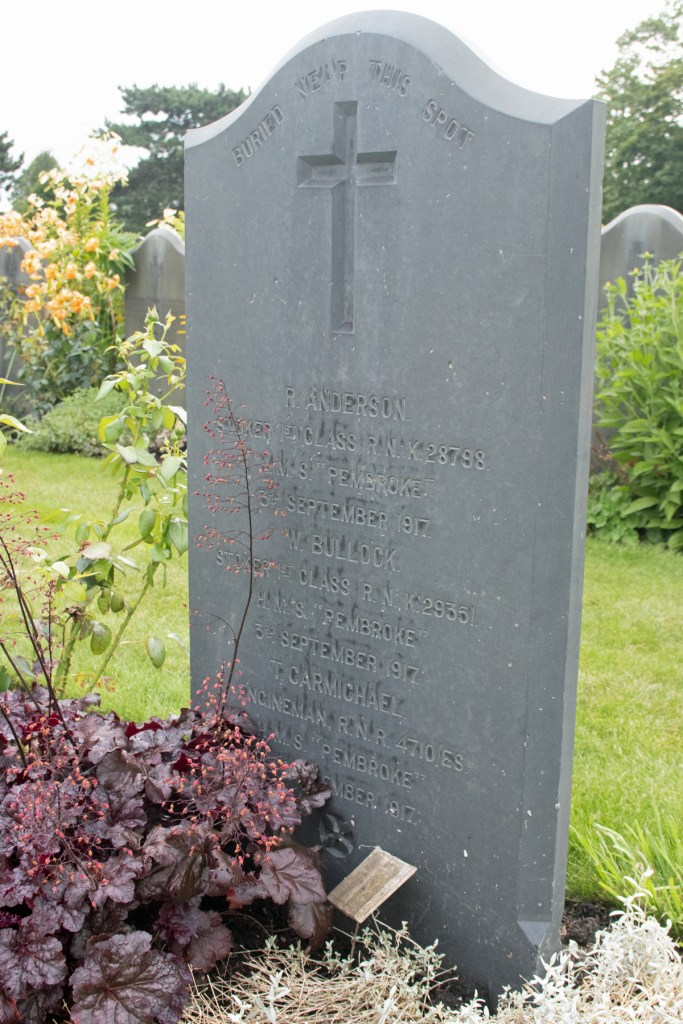
On the 3rd September 1917, the first night air raid carried out by the German Air Force bombarded the town, and scored a direct hit on the Drill Hall; Engineman Carmichael was among those killed. He was just 28 years of age.
Thomas Carmichael was laid to rest, along with the other victims of the Chatham Air Raid, in the Woodlands Cemetery, Gillingham. Tragically, the Navy Death Records state that he was Buried as unidentified in one of the following graves: 516, 522, 642, 735, 935, 937 or 948.
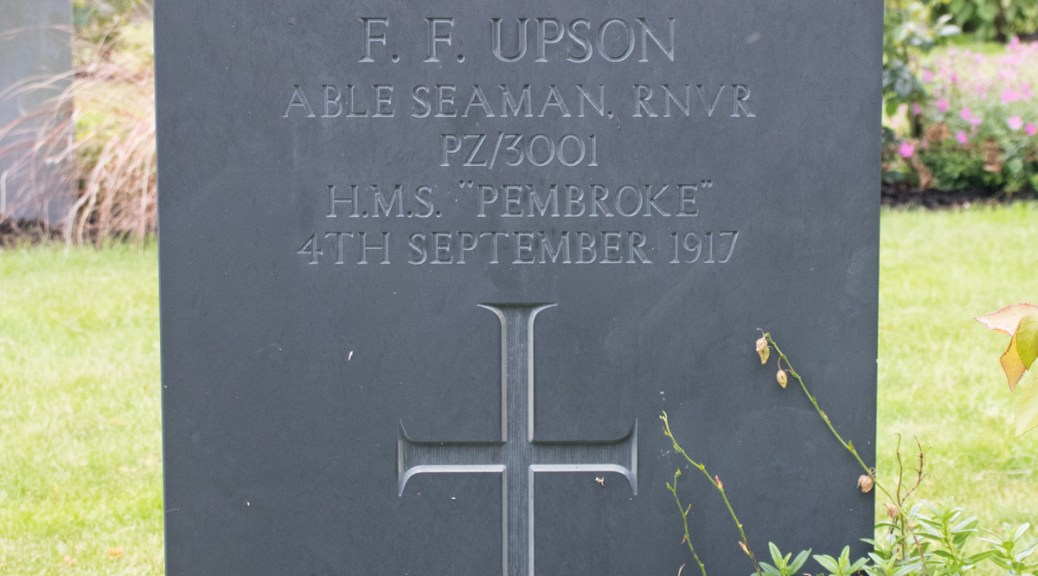
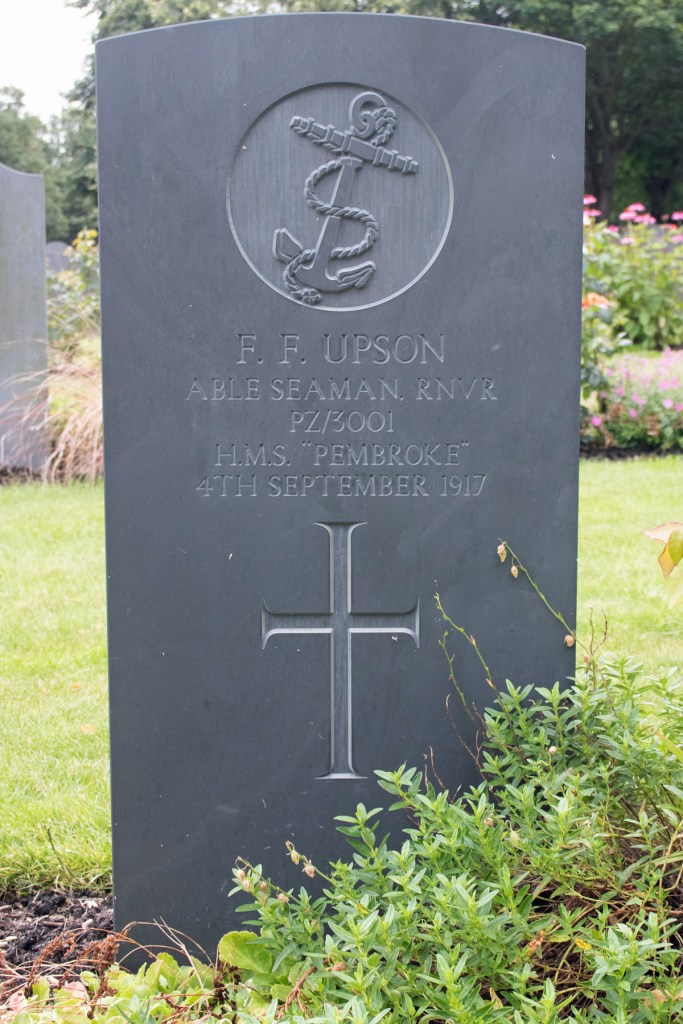
Frederick Frank Upson was born in Woodbridge, Suffolk, on 4th June 1897 and was one of eight children to Frederick and Mary Upson. Frederick Sr was an agricultural labourer and horseman, and when he left school, his soon took on a shepherding role on the same farm.
With the war raging, and the port of Ipswich not far from home, Frederick Jr seemed destined for a life at sea. In June 1915, having turned 18 years old, he enlisted in the Royal Navy as an Ordinary Seaman. His service records show that he stood 5ft 6.5ins (1.69m) tall, had brown hair, grey eyes and a fair complexion.
Frederick’s first posting was at HMS Vivid, the training base at Devonport, Devon. He spent a couple of months there, before being given his first ocean-going assignment on board the scout cruiser HMS Blonde. Ordinary Seaman Upson was on board for just over a year, and was promoted to Able Seamen during his time there.
In January 1917, he returned to shore, and was transferred to HMS Pembroke, the shore-based establishment at the Royal Naval Dockyard in Chatham, Kent. The base was particularly busy that year, and temporary accommodation was set up in the Drill Hall; Frederick found himself billeted there for the summer.
On the 3rd September 1917, the German Air Force carried out one of its first night-time air raids on England: Chatham was heavily bombed and the Drill Hall received a direct hit. Able Seaman Upson was badly injured and died of his wounds in hospital the following day. He was just 20 years of age.
Frederick Frank Upson was laid to rest, along with the other victims of the Chatham Air Raid, in the Woodlands Cemetery, Gillingham.
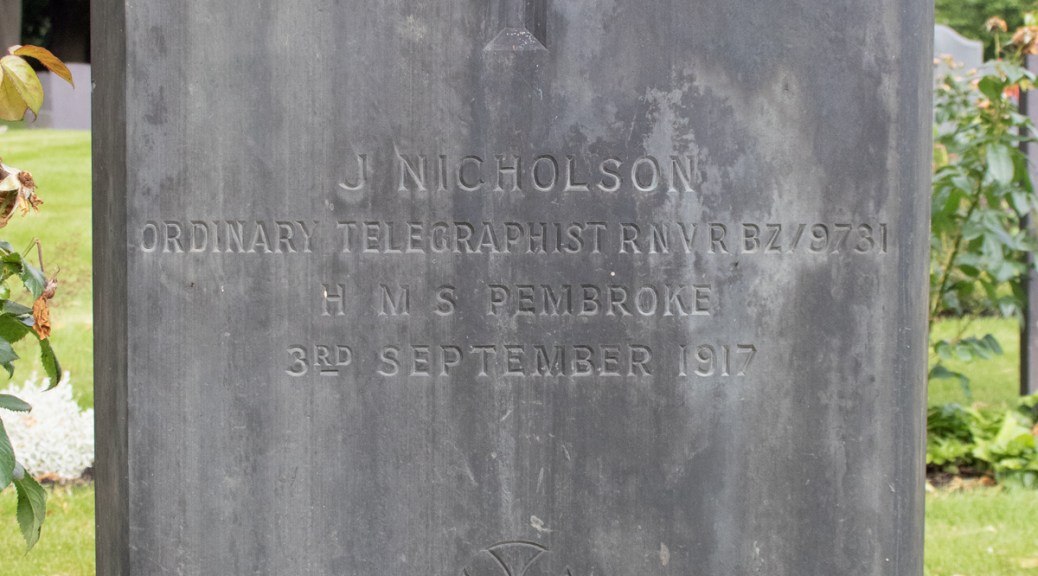
Jack Nicholson was born on 23rd August 1893. There is very little documentation on his life, although the following can be pieced together.
Jack was called up for military service on 22nd March 1916, at which point he was working as a music hall artist. His service records show that he stood 5ft 11.5ins (1.82m) tall, had dark brown hair, brown eyes and a sallow complexion.
Jack enlisted in the Royal Navy as an Ordinary Seaman, and was assigned to HMS Victory in Portsmouth. After a couple of months he was promoted to Able Seaman and, by March 1917, he had been reassigned, to HMS Vivid in Plymouth. By this point he had taken on a specific role with the navy, and alongside Able Seaman, held the rank of Ordinary Telegraphist.
Within a matter of months, Jack was on the move again, this time to the Royal Naval Dockyard in Chatham, Kent. HMS Pembroke – as it was also known – was a busy place during that summer of 1917, and, with its barracks having reached capacity, Jack found himself billeted at Chatham Drill Hall, which was being used as temporary accommodation.
At this point in the war, the German Air Force was aiming to minimise the losses it was suffering during daylight raids. It began trialling bombing raids at night and, on 3rd September 1917, Chatham found itself in their line of fire. The Drill Hall Ordinary Telegraphist Nicholson was sleeping in received a direct hit, and he was killed. He was just 24 years old.
Jack Nicholson was buried alongside the other victims of the Chatham Air Raid. He lies at rest in the Woodlands Cemetery, Gillingham, not far from the Royal Naval Dockyard in neighbouring Chatham.
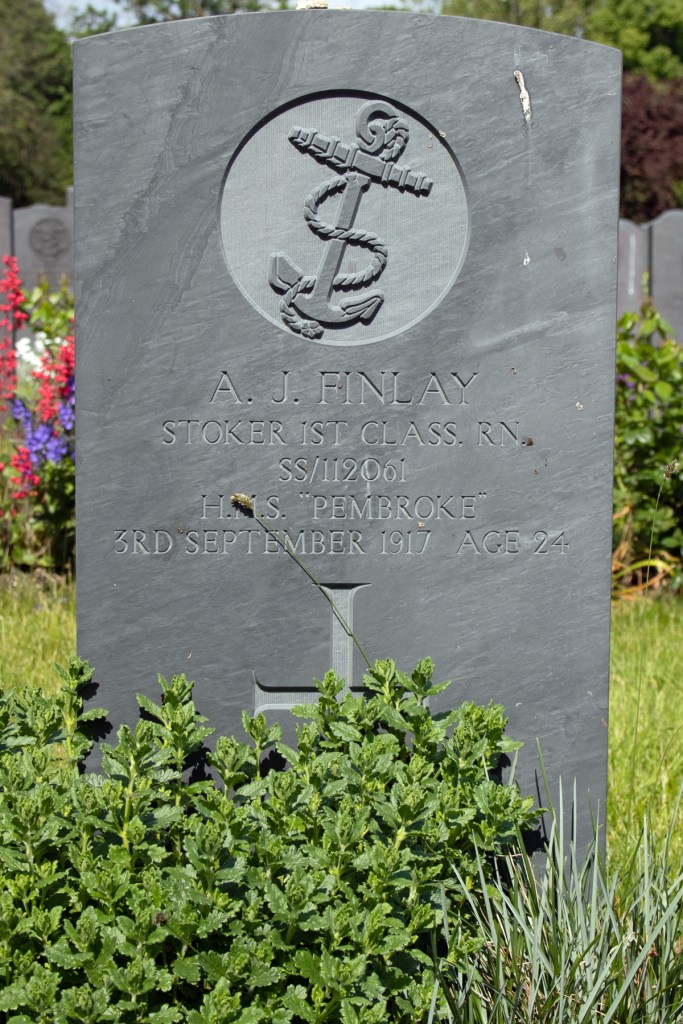
Alfred James Finlay was born in Croydon, Surrey on 7th September 1893. His mother was Emily Finlay, although there is little more information to confirm details of his early life.
He was working as a shop porter when he was drawn to a life at sea and, on 9th April 1912 he enlisted in the Royal Navy as a Stoker 2nd Class. Alfred’s enlistment papers confirm that he was 5ft 5ins (1.66m) tall, had brown hair and brown eyes. While he had a fair complexion, he was also noted to have a scar above his left eye, another on his left thigh, and had a tattoo of a pierced heart on his left arm.
After his initial six months’ training at HMS Pembroke – the shore-based establishment at the Royal Naval Dockyard in Chatham, Kent – he was assigned to the cruiser HMS Lancaster, where he spent a couple of months. He had another few weeks at HMS Pembroke, before being sent to another cruiser, HMS Chatham.
Alfred spent more than three years on Chatham, and was promoted to Stoker 1st Class during his time aboard. Returning once again to Kent, his service from here on in seems to have been mainly shore-based: HMS Pembroke in Chatham; HMS Vivid in Devonport; HMS Victory in Portsmouth.
Stoker Finlay returned to HMS Pembroke in the summer of 1917. It was a busy period for the Naval Dockyard in Chatham, and a lot of the servicemen there – Alfred included – were billeted in temporary accommodation at the nearby Drill Hall. It was here that he was sleeping on the 3rd September, when the German Air Force undertook their first night raid over England. One of the bombers scored a direct hit on the Drill Hall, and Alfred was killed. He was just 24 years old.
Alfred James Finlay was laid to rest, along with the dozens of other victims of the Chatham Air Raid, at the Woodlands Cemetery in nearby Gillingham.
Alfred Charles Moist was born early in 1887 in the Devon village of Chudleigh Knighton. His parents were William and Mary Moist, and he was the youngest of eight children. William was a clay miner and his neighbours – who included the young Thomas Willcocks – all worked in the same trade.
William died in 1899, leaving Mary to raise the family alone. By the time of the 1901 census, her widowed daughter Emma had moved back in with her son, and was working from home as a dressmaker. Alfred, meanwhile, and his two older brothers Frank and Reginald were all employed as brick dressers and together they earned enough to keep the family going.
The next census – compiled in 1911 – found Alfred still living with Mary, but the household had a different set up. Emma had remarried and was living in nearby Ilsington with her publican husband. Another of Alfred’s sisters, Bessie, had moved in with her daughter, Florence, and was keeping house for her mother. Reginald was also still living at home and was still employed by the brickyard. Alfred, however, had found now work as a police constable.
Mary passed away in the spring of 1913, by which point, Alfred had met Edith Mary Sampson, a labourer’s daughter from North Devon. The couple married in Broadhempston, near Totnes, on 21st November 1913.
War came to Europe, and Alfred enlisted in December 1915. His job in the police force, however, meant that he was initially placed on reserve, and he was not formally mobilised until April 1918, when he joined the Coldstream Guards. His enlistment papers show that he stood 5ft 11ins (1.8m) tall and weighed in at 10st 4lbs (65kg).
Guardsman Moist was barracked in London, but fell ill in September 1918. He was admitted to the Queen Alexandra Military Hospital with a haematoma and renal calculus (kidney stones). He spent a total of four months in hospital before being discharged back to duty.
At this point, Alfred’s trail goes cold. The next record for him comes in the form of the record of his death, which was registered in Hampstead, London. This suggests that he was either still in the Coldstream Guards or that he had been hospitalised again because of his previous illness. Either way, he died on 28th August 1919, at the age of 32 years old.
Alfred Charles Moist’s body was brought back to Devon. He lies at rest in the Graveyard of St Paul’s Church in his home village of Chudleigh Knighton.
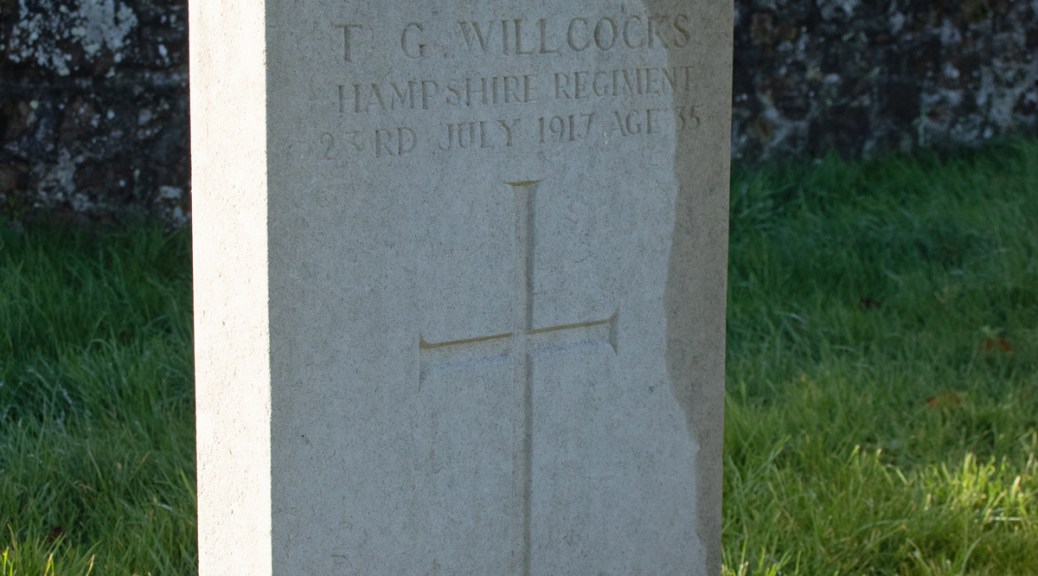
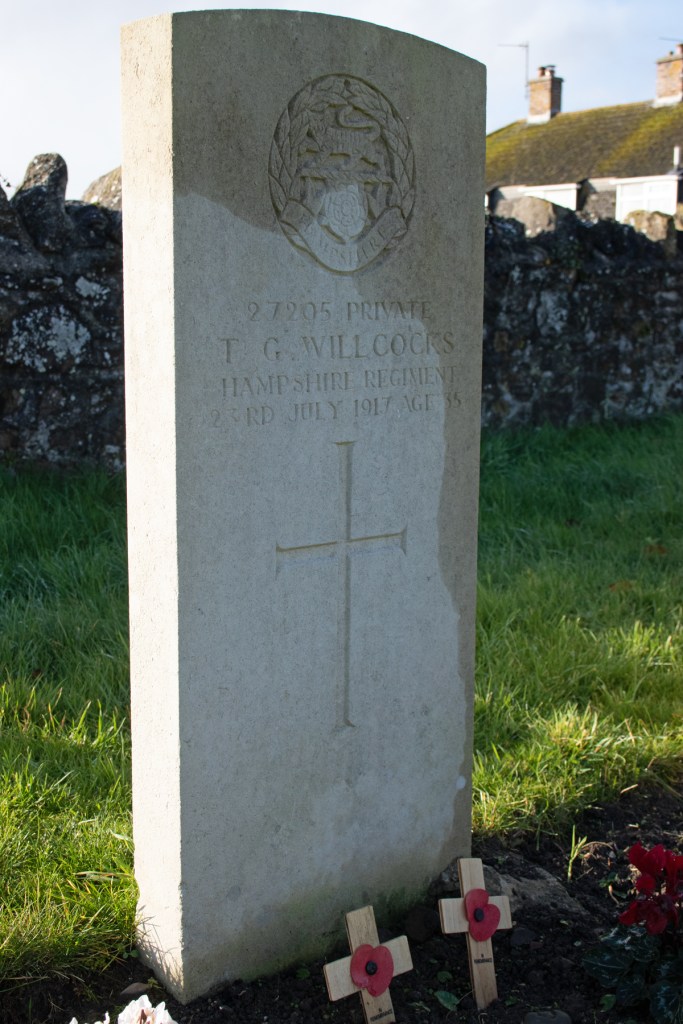
Thomas George Willcocks was born on 18th April 1882, in the Devon village of Chudleigh Knighton. The oldest of five children, his parents were William Willcocks and his wife Emma. William worked as a clay cutter, and this was a trade Thomas followed when he left school.
By 1899, Thomas had met Sophy Gale, a clay cutter’s daughter from nearby Hennock; the couple married and had a daughter, Violet. Thomas was also working as a cutter, and moved into his in-laws house to start raising his young family.
Life can be cruel: the 1911 census shows that Thomas and Sophy had moved to Chudleigh Knighton – where Sophy was originally from. Violet had, by this point, sadly passed away; Thomas’ brother-in-law, Albert, had moved in with the couple to help pay their way.
War was coming to Europe and, although full details of Thomas’ service no longer remain, it is possible to piece together some of his time in the army.
Private Willcocks enlisted in the Duke of Cornwall’s Light Infantry at some point before January 1917, although he soon transferred across to the Hampshire Regiment. His battalion – the 15th – were moved to France in the summer of 1916, and it seems that Thomas was caught up in a gas attack, while in the trenches of the Western Front.
Private Willcocks’ health deteriorated and he was medically evacuated back to the UK for treatment. He was admitted to the Red Cross Hospital in Glasgow, but reports are confused – some identify the impact of the gas on his lungs, while others suggest he was suffering from rheumatism and trench fever. Regardless of the cause, he passed away on 23rd July 1917 at the age of 35 years old.
The body of Thomas George Willcocks was brought back to Devon for burial. He was laid to rest in the graveyard of St Paul’s Church in Chudleigh Knighton.
Thomas’ brother in law, Albert, also died as a result of the First World War; he lies in the grave next to Thomas. His story can be found here.
Thomas’ neighbour was Alfred Moist. He also lies in the same churchyard and his story can be found here.
Albert Gale was born in the Devon village of Chudleigh Knighton in October 1883, one of five children to John and Elizabeth Gale. It seems that Elizabeth may have died when Albert was young, as, by the time of the 1901 census, John was married to a Sarah Gale, and the family were living in the village of Hennock.
John was a clay cutter, and this was a trade into which Albert followed his father. Again, as time moves on, things change; the 1911 census found Albert boarding with his sister Sophy and her husband, fellow cutter Thomas Willcocks, back in Chudleigh Knighton.
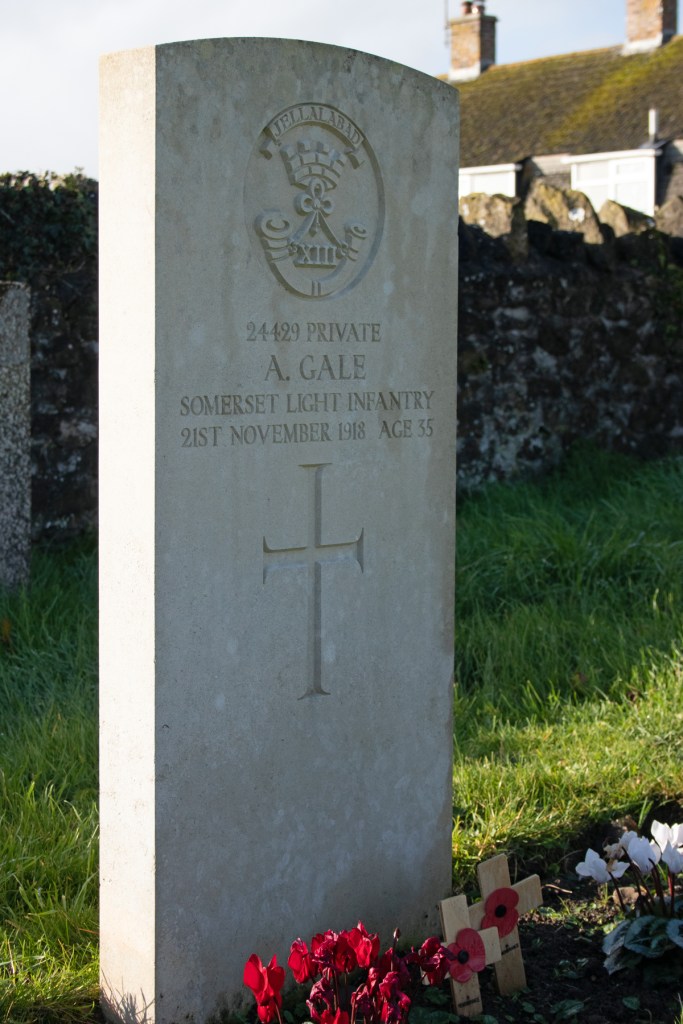
War was coming to Europe and, in April 1916, Albert enlisted, joining the Somerset Light Infantry as a Private. He would have cut a commanding figure; his enlistment papers show that he stood at 5ft 10ins (1.77m) tall.
Albert served on home soil. While attached to the Somerset Light Infantry, he was assigned to the 661st Agricultural Company of the Labour Corps, working in Kent and Sussex.
During this time, he received hospital treatment on four separate occasions: in August 1916, he was admitted with cellulitis of the arm; in December 1916 and January 1917, he was treated on two separate occasions for scabies. In November 1918, however, he was admitted to the Military Hospital in Chichester, West Sussex, as he was suffering from influenza. Sadly, this last condition was to worsen and, on 21st November 1918, Private Gale died, having subsequently contracted pneumonia. He was 35 years old.
Albert Gale’s body was brought back to Devon for burial. His brother-in-law Thomas had died the previous summer; his story can be found here. Albert was laid to rest in the grave next to his sister’s husband in the churchyard of St Paul’s in Chudleigh Knighton.
With Thomas dead, Sophy had been left a widow. Understandably bitter at what the war had taken from her, when she was asked if she wanted a memorial for her brother, she returned the form with the following statement: “I don’t require the plaque and scroll in memory of my dear brother; a piece of paper won’t keep me.”