Tag Archives: Dorset

Private Edgar Bowditch

Private Edgar Bowditch

Edgar George Bowditch was born in the spring of 1887, in the Dorset village of Melbury Osmond. One of seven children, his parents were William and Sarah Bowditch. William was an agricultural labourer turned gamekeeper, and Edgar helped his father out when he left school.

William passed away in 1911, and Edgar fell off the radar until March 1914, when he married local mason’s daughter Rosetta Morris. The couple settled down in her home village of West Coker, Somerset.

When war was declared, Edgar stepped up to serve his King and Country, and enlisted in the Machine Gun Corps as a Private. He was assigned to the 37th Battalion, and certainly saw action overseas. He “came through without a scratch and in good health until demobilised in France.” [Western Chronicle: Friday 21st February 1919]

Private Bowditch was unwell when he arrived back in West Coker on 4th February 1919. While his condition is unclear, it worsened, and he passed away at home ten days later. He was 32 years of age.

Edgar George Bowditch was laid to rest in the graveyard of St Martin’s Church in his adopted home of West Coker.


Rosetta married again in 1921, to a John Axe. The couple remained in the same part of Somerset, John dying in 1947. Rosetta lived on, passing away in Yeovil in 1963, at the age of 77 years old.


Private William Tewkesbury

Private William Tewkesbury

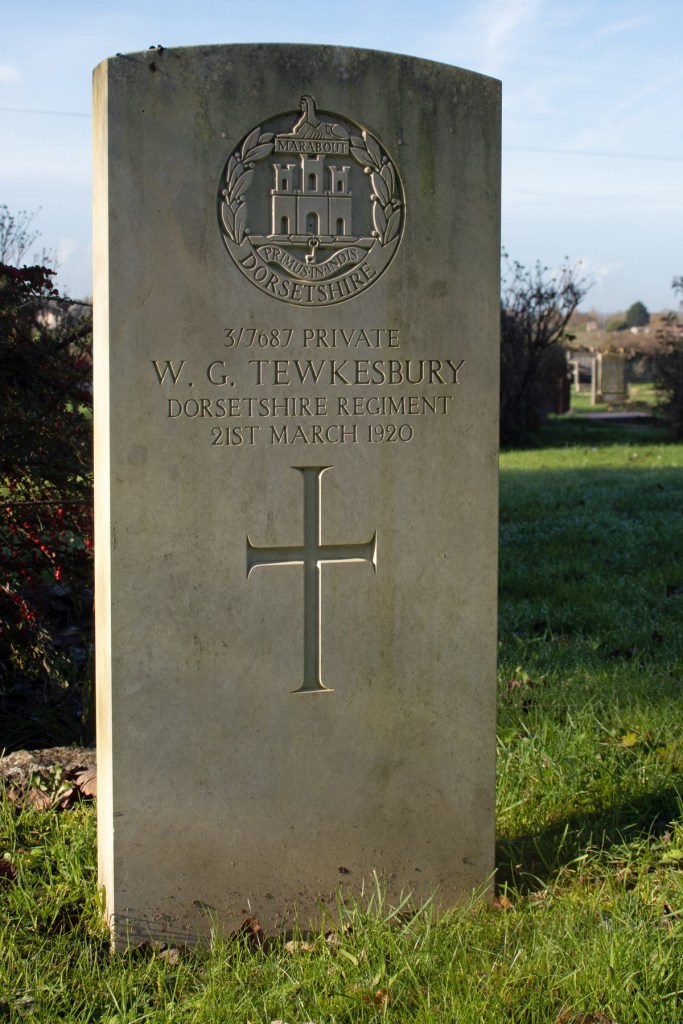
William Gilbert Tewkesbury was born in Ilchester, Somerset, in the autumn of 1881. The middle of three children (although his older brother died in 1887), his parents were William and Jane Tewkesbury. William Sr was a farm labourer, and this is something that William Jr and his younger brother, Hedley, also went into.

When war arrived on Europe’s shores, William Jr stepped up to play his part. Full details of his military service are, sadly, lost to time, but he enlisted in the Dorsetshire Regiment, and was assigned to the 2nd Battalion. His mother, Jane, passed away in 1915, and it is unclear whether this loss proved to be the catalyst for her son’s enlistment.

Private Tewkesbury’s battalion served in the Middle East for the duration of the conflict.

During the past week we have had three of our local men who have seen active service home for a few days’ leave… Private William Tewkesbury… who has been on active service in Mesopotamia…

Western Chronicle: Friday 8th June 1917

William survived the war, and was awarded the Victory and British Medals for his service. He returned home, and, presumably, took up his previous employment once he was demobbed in February 1919.

The next available record for William is that of his passing, and even this is sketchy. He passed away on 21st March 1920 in Sherborne, Dorset, though the cause is unknown. He was 39 years of age.

William Gilbert Tewkesbury’s body was brought back to Ilchester for burial. He was laid to rest in the village’s parish cemetery. While not recorded, it is likely that this is where Jane had been buried five years earlier, and where William Sr would be laid to rest just months later, when he too passed away.


Lieutenant Hugh Punchard

Lieutenant Hugh Punchard

Hugh Punchard was born in February 1895, the oldest of three children to William and Jane Punchard. William was a civil engineer from London, and Hugh was born in Surbiton.

The 1901 census recorded the family living in the 14-room house, Pope’s Garden, in Twickenham. Along with the family, there were four members of staff – a governess, housemaid, cook and a nurse. By the time of the next census, sixteen-year-old Hugh was away at school, boarding with more than 400 others at Haileybury College in Hertfordshire.

War was coming to Europe by this point, and Hugh was keen to play his part. He enlisted in the Royal Navy on 20th October 1914 and, while he was only there for a short period, his records shed some light onto the man he had become. He enlisted as a mechanic, and was noted as being 6ft 4ins (1.93m) tall, with dark brown hair, grey eyes and a fair complexion.

Hugh remained in the Royal Navy for only a month, and, while full details of his service are no longer available, it would seem that it was at this point that he transferred to the Royal Garrison Artillery. He appears to have performed his duties well, and achieved the rank of Lieutenant. He also made another transfer, when he was attached to the Tank Corps.

Lieutenant Punchard was based in Dorset by the last year of the war, and it was while he was serving there that he became unwell. He contracted pneumonia, and was admitted to Wareham Military Hospital. Sadly, the condition was to take his life, and he passed away on 31st October 1918, at the age of just 23 years old.

Hugh Punchard’s paternal grandparents lived in Devon, and, as William had passed away two years earlier, the decision was to lay him to rest in Totnes Cemetery.


Hugh’s will left his estate to his mother, Jane. When he passed, she became the beneficiary of his effects, totally some £3,600 7s 6d (around £250,000 in today’s money).

Jane stayed living in Twickenham: when she passed away on 29th July 1937, she was brought to Devon for burial, and was laid to rest with her son.


A number of documents relating to Hugh give his name as R Hugh Punchard. Sadly, I have not been able to unearth details of what his official first name might have been.


Gunner Henry Brewer

Gunner Henry Brewer

Henry William Brewer was born the spring of 1869 in Bitton, Gloucestershire. His is a common name for the area, and so it is not easy to unpick details of his early life.

On 5th May 1895, Henry married Ann Williams, a carter’s daughter from Keynsham, Somerset. The couple wed in St Thomas’ Church in Widcome, near Bath, and their marriage certificate gives Henry’s trade as a labourer, and his father as Louis Brewer.

The young couple up home in Kingswood, near Bristol, and went on to have three children, Henry, Lucy and Ethel. The 1901 census recorded Henry’s trade as a coal miner and hewer, but noted that he was also a Gunner in the Royal Artillery.

Sadly, Henry’s military records are lost to time, but if he was employed in the army, this would account for the lack of documents relating to his early life. It may be that he had completed his initial term of service by the time he and Ann married, or that he was a volunteer with the Royal Artillery at the time of the census.

Whatever his connection with the army, when war broke out he was called into service. He joined the 30th Company of the Royal Garrison Artillery, and was based in Weymouth, Dorset, as part of Britain’s South Coast defences.

Without military documents, it’s challenging to identify Gunner Brewer’s trail during the war. Sadly, the next documents relate to his passing. He was admitted to a military hospital in Weymouth, suffering from the kidney condition nephritis. This was ultimately to kill him, and he passed away on 28th February 1917, at the age of 48 years old.

Henty William Brewer’s body was brought back to Gloucestershire for burial. He was laid to rest in the graveyard of St Mary’s Church in Bitton.


Private Bernard Lane

Private Bernard Lane

Bernard Fred Lane was born in Wellington, Somerset, in the spring of 1880, and was the oldest of nine children to Frederick and Agnes Lane. Frederick was a house painter and, after a stint as a butcher, his son followed the same work. By the time of the 1901 census he was one of four boarders with the Hapgood family, living in Bournemouth, Dorset.

On 5th October 1901, Bernard married Annie Louisa Joyner. The couple wed in St Paul’s Church in Poole, but soon settled back in Wellington, and went on to have four children: Agnes, James, Mildred and Winifred.

War came to Europe in 1914, and Bernard wanted to play his part. Full details of his military service are not available, but it is clear that he had enlisted in the Devonshire Regiment by March 1918. At some point during the conflict Private Lane was assigned to the Labour Corps, and attached to the 312th Company.

Bernard was serving on Salisbury Plain by the autumn of 1918, and fell ill, although it is not clear what befell him. Admitted to the Fargo Military Hospital at Larkhill, Wiltshire, he passed away on 15th October 1918. He was 38 years of age.

Bernard Fred Lane was brought back to Somerset for burial. He was laid to rest in Wellington Cemetery, the resting place for several other members of his family.


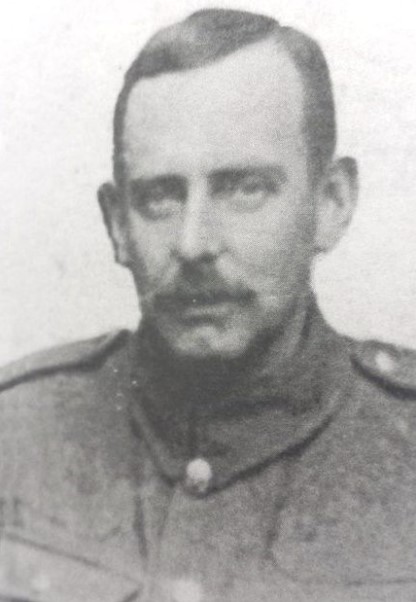
Private Bernard Lane
(from findagrave.com)

Private Albert Stockley

Private Albert Stockley

Albert William Stockley was born in the spring of 1897, the youngest of twelve children to Frank and Mary Ann Stockley. Frank was a clay cutter from Dorset, and he and his wife raised their family in the picturesque village of Corfe Castle.

Sadly, much of Albert’s life is lost to time. He would have been 17 years old when war broke out, so it seems likely that he would not have been in the first wave of men to enlist.

Albert joined the Dorsetshire Regiment and, as a Private, was assigned to the 1st/4th Battalion. His troop was based in India for the first part of the war, before moving to Mesopotamia in 1916. There is nothing to confirm, however, whether Private Stockley served abroad, or if he remained as part of a territorial force.

Private Stockley was demobbed on 22nd May 1919, and awarded the Victory and British Medals for his service. He returned to Dorset, but is it at this point that his trail goes cold.

All that is evident is that Albert William Stockley passed away on 1st April 1920, ages just 23 years old. was laid to rest in the Old Church Cemetery in his home town of Corfe Castle.


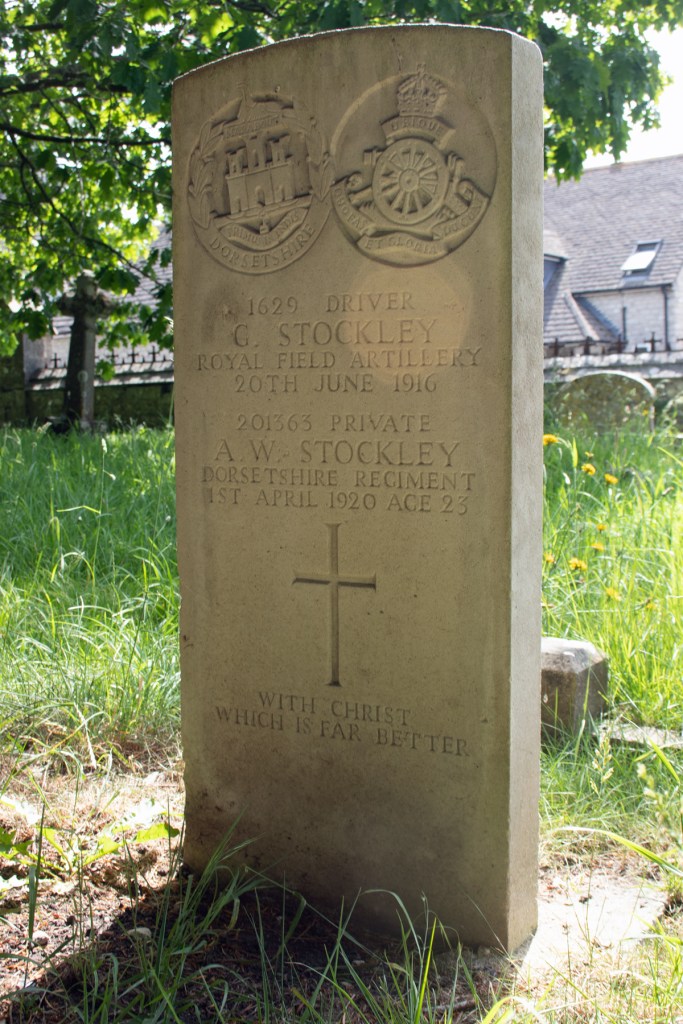
Albert shares his grave with his older sibling, George Stockley, who died in June 1916. The brothers are commemorated on the same headstone.


Driver George Stockley

Driver George Stockley

George Stockley was born in December 1888, one of twelve children to Frank and Mary Ann Stockley. Frank was a clay cutter from Dorset, and he and his wife raised their family in the picturesque village of Corfe Castle.

When he left school, George found work as a house painter but it seemed this was not to be a career. In March 1913, he married Lillian May Stockley, who had been born in Frome, Somerset, but who was working as a barmaid in nearby Weymouth. Later that year, the couple had a daughter, Georgina, and, by the time he enlisted two years later, George was working as a barman, and the young family were living in Bournemouth.

George had joined up on 10th February 1915, and was assigned to the 3rd/6th Hampshire Battery of the Royal Field Artillery. His service records show that he was 5ft 4ins (1.63m) tall, but they also confirm that, when he had his medical examination on 30th May, he was deemed as medically unfit for military service.

Sadly, there is no further information to confirm why Driver Stockley’s military career was cut so short. His trail goes for a year, until, on 20th June 1916, he passed away, aged just 27 years old. The cause of his passing is also lost to time

George Stockley was laid to rest in the Old Church Cemetery in his home town of Corfe Castle.


George shares his grave with his youngest sibling, Albert William Stockley, who died in April 1920. The brothers are commemorated on the same headstone.


Ordinary Seaman Sidney Towills

Ordinary Seaman Sidney Towills

Sidney George Towills was born in Soho, London, on 14th May 1900. He was the youngest of two children to Henry and Maria Towills. Both had been born in Dorset, but Henry had found work as a constable for the Metropolitan Police and they had moved to London by the early 1890s.

The 1901 census recorded the family as living in Plaistow, but ten years later the family had moved back to Dorset, and were ensconced back in Maria’s home village of Abbotsbury.

When war broke out, Sidney was only 14 years old. He wanted to play his part, however, and as soon as he was able to enlist, he did so. He joined the Royal Navy on 9th April 1918 and, because of his age, was given the rank of Boy 2nd Class.

Sidney’s service records show that he was 5ft 9ins (1.75m) tall, had brown hair, blue eyes and a health complexion. He was assigned to the cruiser HMS Powerful and, on his eighteenth birthday, just over a month after enlisting, he was awarded the rank of Ordinary Seaman.

Tragically, Ordinary Seaman Towills’ service was not destined to be a long one. In June, he was admitted to the Royal Naval Hospital in Plymouth with empyema, a lung disease; he passed away from the condition on 2nd July 1918. He was barely 18 years of age and had served in the Royal Navy for 96 days.

Sidney George Towills was brought back to Abbotsbury for burial. He was laid to rest in the graveyard of St Nicholas’ Church in the heart of the village.


Private William Moore

Private William Moore

William John Moore was born in October 1893 in the Dorset village of Puncknowle. He was the second of four children to Richard and Elizabeth Moore. Richard was a farm labourer and Elizabeth’s family were all fishermen, but is was agricultural work that William sought out when he left school.

There is little direct information available about William’s life. When war came to Europe, he joined up, enlisting as a Private in the Dorsetshire Regiment at some point before April 1918. He served on home soil, and was based at one of the regiment’s depots on Salisbury Plain.

At some point late in 1918, Private Moore was admitted to the Military Hospital in Tidworth, although the cause for his admission is not known. Tragically, William died in the hospital on 13th October 1918. He was just 25 years of age.

William John Moore was laid to rest in the cemetery in his home village of Puncknole.


Serjeant Charles Flower

Serjeant Charles Flower

Charles Franklin Flower was born in Walcot, Bath, at the end of 1879. The middle of five children, his parents were stonemason John Flower and his dressmaker wife, Elizabeth.

John died when his son was only eleven years old, and Elizabeth passed away just two years later, leaving Charles an orphan at just 13 years of age.

He disappears off the radar for a time, only reappearing again when, in the summer of 1895, he enlisted in the 13th Battalion of the Somerset Light Infantry. Charles’ service records show that he stood 5ft 7ins (1.69m) tall, weighed 121lbs (55kg) and had grey eyes, light brown hair and a fair complexion. He was also noted as having a tattooed ring on his left ring finger.

After eighteen months on home soil, Private Flower was sent out to the East Indies, where, apart from a short stint back in England, he spent the next twelve years. He was promoted to Lance Corporal in May 1898, but though his own volition, reverted to the rank of Private seven months later. Charles was destined for bigger things, though, and was again promoted to Lance Corporal in September 1900. Over the next few years, he received further promotions – to Corporal in September 1905 and Lance Serjeant eighteen months later.

In the autumn of 1908, Charles returned to home soil, but his military service continued. On 12th April 1909, he married Elizabeth Ann Wills, a gamekeeper’s daughter from Cannington, Somerset. They set up home in Portland, Dorset, where Charles was based, and went on to have a son, Herbert, a year after they married.

By 1910, Charles had again been promoted, and was now a Serjeant. In the next couple of years, the family moved from the Dorset coast to the Somerset town of Frome. Serjeant Flower’s service continued, but he remained on home soil, even when war broke out.

All was not well with Charles’ health, however, and by the summer of 1915, he was admitted to hospital. He was thin and anaemic, with an enlarged liver and an ‘enormously swollen’ spleen. This was discovered to be a malignant growth, and Serjeant Flower was discharged from military service on medical grounds on 20th December 1915. He had been in the Somerset Light Infantry for more than two decades.

Charles Franklin Flower was not to recover from his illness. He passed away at home on 27th February 1916, at the age of just 37 years old. He was laid to rest in the graveyard of Holy Trinity Church in Frome.


Serjeant Charles Flower
(from ancestry.co.uk)