Arthur William Young was born on 11th July 1900, in the Gloucestershire village of Charfield. His parents, James and Eliza, were both born in the area, and this is where they raised their nine children.
James worked as a bone turner and sawyer, working the material for things like buttons. This was a family trade, and something that Arthur followed his father and older siblings into when he finished school.
By this point, storm clouds were brewing over Europe. Arthur was too young to enlist when war first broke out, but when his older brother Francis died in Northern France in December 1917, this seemed to have driven him to play his part as well.
Arthur enlisted in the Royal Marine Artillery on 1st July 1918, a couple of weeks before his eighteenth birthday. Assigned the rank of Private, his records show that he was 5ft 9ins (1.65m) tall, had blue eyes, brown hair and a fresh complexion. It was also noted that he had a scar on his right wrist and another on his forehead.
After nine months’ service, Arthur was promoted to Gunner and, by the autumn of 1919, he was assigned to the dreadnought HMS Queen Elizabeth.
On 1st December 1920, while moored in Portland Harbour, Dorset, a concert was held on HMS Warspite. Gunner Young attended, but on the trip back to his own ship, the boat he was on collided with another, and he and three others were knocked overboard and drowned. He was just 20 years of age.
Arthur William Young was brought back to Gloucestershire for burial. He was laid to rest in the family plot in the Congregational Chapelyard in his home village of Charfield.
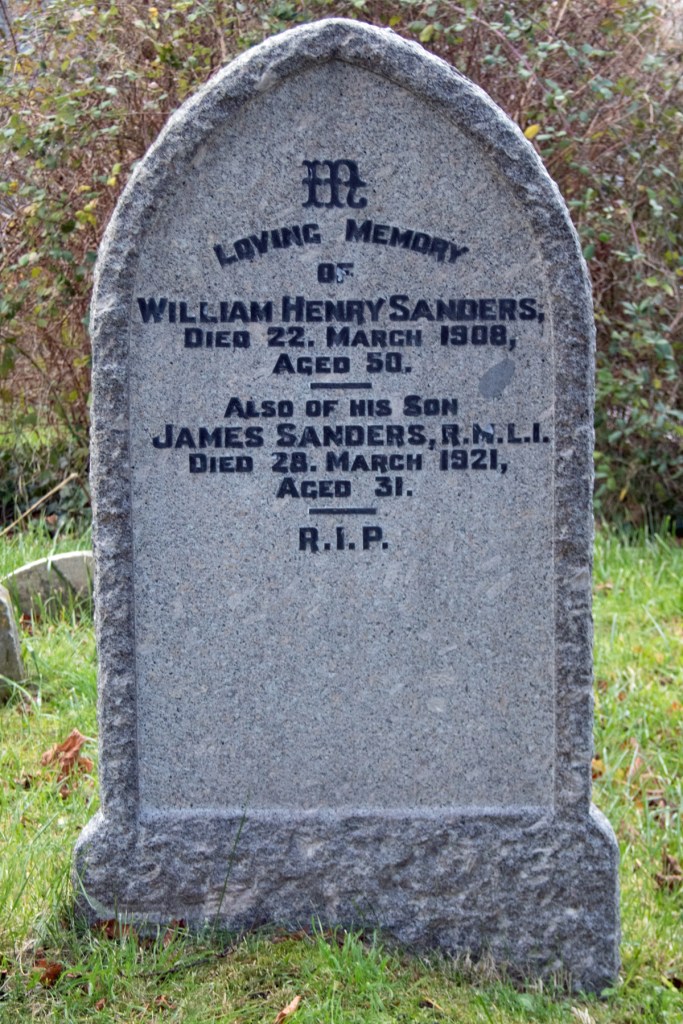
James Sanders was born on 17th April 1889. One of nine children, his parents were William and Emily Sanders. William worked for a clay company in his home town of Kingsteignton, Devon. He had various roles, including caretaker, inspector and messenger.
William’s son, however, was after bigger things in life and, on 17th July 1907, he enlisted in the Royal Marine Light Infantry. James’ service records show that he was 5ft 6ins (1.67m) tall, had light brown hair, grey eyes and a fresh complexion.
Based out of Plymouth, Private Sanders signed up for an initial period of twelve years. During this time, and throughout the war, he served on six vessels, including 30 months on HMS Argyll (where he was based for the 1911 census) and more than five years on HMS Colossus.
In April 1919, Private Saunders returned to land. When his initial contract was up, he re-enlisted, this time remaining at the Naval Dockyard in Plymouth.
James’ trail goes a little cold for the next couple of years, although he continued in his role with the Royal Marine Light Infantry. On the night of the 28th March 1921, however, he encountered some trouble. The local newspaper reported on the subsequent inquest.
Kingsteignton Man’s Mysterious Death
At an enquiry held at Teignmouth on Saturday afternoon into the circumstances attending the death of Private James Sanders, RMLI… who was found drowned in the river Teign on Friday, it was stated that deceased and seven other Kingsteignton men on Monday visited Teignmouth to attend a football match, at which Sanders acted as touch-judge.
After the match they went to a public house, where deceased had three or four pints of beer and some spirits, which made him unsteady.
They left to catch a bus, but at Station Road deceased turned back. One of his companions followed him, but could not persuade him to return, so he left deceased on his own to travel back home.
The man considered Sanders was in a condition to look after himself. An open verdict was returned.
Wester Times: Friday 8th April 1921
Private James Sanders died on 28th March 1921, aged 31 years old. He was laid to rest with his father, William, who had died in 1908, in the graveyard of St Michael’s Church in Kingsteignton.
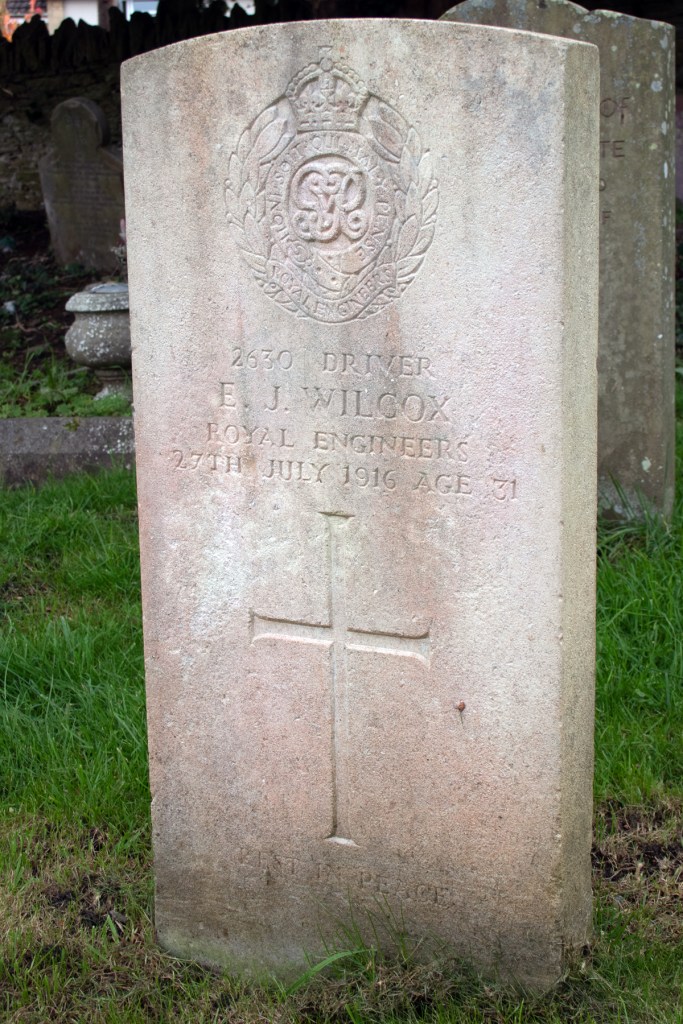
Edgar James Wilcox was born in Frome, Somerset, on 2nd February 1885, and was the third of six children to Robert and Louisa Wilcox. Robert was a coal dealer and he and Louisa raised their family in the town of their own birth.
When he left school, Edgar found work on a local farm, tending to, and milking the cows. He met a woman called Ellen Snelgrove and, on 31st October 1908, the couple married at the parish church in Ellen’s home village of Corsley, just over the border in Wiltshire.
By the time of their wedding, Edgar had found employment as a carman for the local railways. The young couple set up home in Frome, and went on to have four children, Edward, Phyllis, Gladys and Cecil.
War was coming to Europe, and, when the conflict broke out, Edgar initially enlisted in the National Reserves in Frome. From there, he joined the Royal Engineers and was assigned as a Driver in the Wessex Regiment Field Company. In his new regiment, he was first based in Taunton, but soon moved to the East Coast.
It was while Driver Wilcox was here that Germany carried out a number of Zeppelin raids on the east of the country. One of these raids, in the spring of 1916, proved too much for Edgar and he suffered a nervous breakdown. He was brought back to Somerset for treatment and admitted to a hospital in Bath.
A contemporary newspaper picked up his story:
On Thursday last week Mrs Wilcox paid her husband one of her periodical visits. They spent several happy hours together, and in the afternoon he went to see her off by train. She then wishes him good-bye, when he seemed as usual, and Mrs Wilcox went to catch a train. It now seems that deceased did not return to the hospital, and after being missing for three days his body was found in the river at Bath.
Somerset Standard: Friday 4th August 1916
Driver Wilcox had taken his own life on 27th July 1916. He was just 31 years of age. An inquest was held and the verdict of ‘drowned’ was reached.
Edgar James Wilcox’s body was brought back to Frome: he was laid to rest in the graveyard of the Holy Trinity Church in the town.
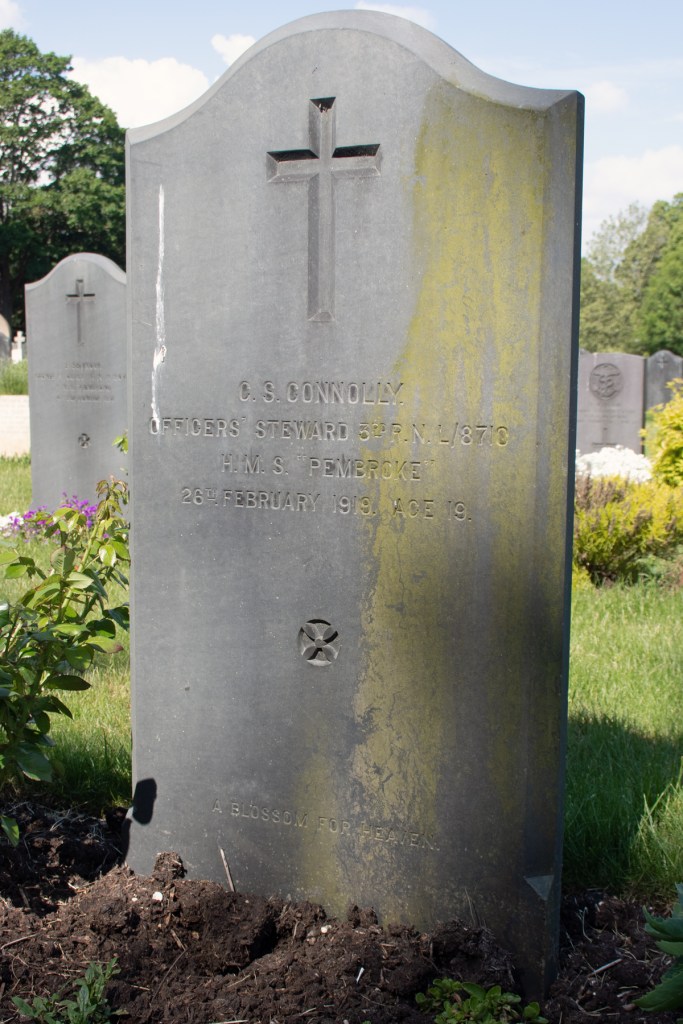
Gerald Sidney Connolly was born in the spring of 1899, one of eleven children to Thomas and Mary Connolly. Thomas was a retired soldier who had been born in Malta, while Mary had come from Portsmouth. The couple had lived in India for a while, but, by the time Gerald was born, had settled in Kildare, Ireland.
Retirement from the armed forces left Thomas needing to financially support his family, and so they made the move to London in 1910. According to the following year’s census, the family had settled in Manor Park, to the east of the city, where Thomas was working as a storekeeper for a local hostelry.
Military service was obviously in young Gerald’s blood and, in April 1916, he gave up work as an errand boy for a life in the Royal Navy. Initially taken on as a servant boy at HMS Pembroke and HMS President – the shore-based establishments in Chatham, Kent – he subsequently served on HMS Shannon, a cruiser that patrolled the North Sea for German warships.
It was while he was aboard the Shannon that Gerald came of age, and was given the rank of Officer’s Steward (3rd Class). During the next few years, he served short periods on five further vessels, before returning to HMS Pembroke in December 1918.
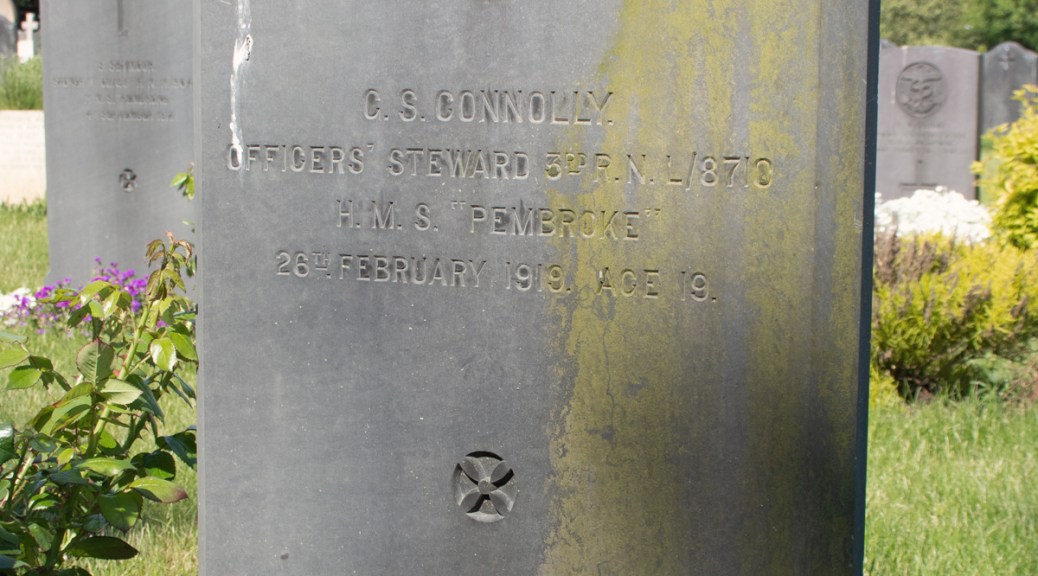
Officer’s Steward Connolly was still serving in Chatham two months later, and he kept himself active. It was while he was making use of the barracks’ swimming baths that an accident befell him. His service record confirmed that he was found drowned in the baths on 26th February 1919 and a subsequent inquest identified that no foul play was to blame. Gerald had ‘accidentally drowned whilst bathing’. He was just 19 years of age.
Gerald Sidney Connolly’s body was laid to rest in the Woodlands Cemetery in Gillingham, Kent, not far from the Naval Dockyard where he was based.
Frederick John Shiplee was born on 15th November 1895 in the Essex town of Harwich. The oldest of eight children, his parents were Frederick and Matilda. Frederick Sr worked as a carter for the local railway, while his son found employment as a butcher’s errand boy when he left school.
In November 1913, having just turned 18, Frederick Jr enlisted in the Royal Navy as an Officer’s Steward, and spent three years training and serving on board HMS Ganges, the shore establishment at Shotley, near Ipswich.
From Suffolk, Frederick moved to Kent, and was based at the HMS Pembroke in Chatham. From here, he was involved in trips on HMS Spey, an old river gunboat that had been converted for use as a diving tender. It was during one of these trips that tragedy struck.
STORY OF A COLLISION IN THE THAMES
Mr CB Sewell resumed the inquest at Chatham, on Monday, on the 13 naval men who lost their lives after a collision between the London County Council steam hopper Belvedere and an old naval vessel in the Thames on March 7th [1917]…
The collision occurred shortly before four o’clock in the afternoon, the weather being bitterly cold and boisterous, and the sea extremely rough. The men, who had taken to a raft, were drifting about till 9pm before the raft was driven ashore. On the raft, when discovered, were a pile of dead men, who had been rendered unconscious by the cold and subsequently drowned through the raft being partly submerged. Lieutenant Humphreys, Royal Naval Reserve, and the other officers were all drowned. In all, 30 of the 37 members of the ship’s company lost their lived, and several bodies have not been recovered. Thirteen of the ship’s crew managed to get ashore at Sheerness in the cutter and three reached the shore at the Isle of Grain in the gig, while one was saved by the hopper.
Arthur George Chick, able seaman, said he was at the wheel of the naval vessel, which was steaming up river at six knots an hour to secure shelter from the weather. Lieutenant Humphreys and a warrant officer were on the bridge, and there were two look-out men. All were now missing. He saw the hopper coming down the river when she was two miles away. When the vessels were nearing each other, the hopper suddenly altered her course to starboard. The witness then altered his course to port by his officer’s orders, but the hopper crashed into his ship, stroking it a glancing blow in line with the forepart of the bridge on the starboard side. The ship sank in three minutes.
Alfred Rawlings, leading signalman, stated that the hopper changed her course when almost abreast of the naval vessel. The hopper’s alteration of course was, he considered, the cause of the collision.
Henry Davies, second officer, and Joseph Beard Hasdell, master of the hopper, gave evidence that they considered the collision was caused through the naval vessel’s error of judgment in starboarding, instead of going to port. The hopper, they stated, ported its helm in accordance with the ‘rule of the road’.
South Eastern Gazette: Tuesday 27th March 1917
While not mentioned in the newspaper report for security reasons, the ‘old naval vessel’ was, in fact HMS Spey. Annoyingly, I can trace no further report of the inquest, other than the conclusion that the deaths were due to drowning following a collision at sea.
Officer’s Steward Shiplee was one of the twenty men who died that day. He was just 21 years of age.
Frederick John Shiplee’s body was laid to rest in the Woodlands Cemetery in Gillingham, not far from the Naval Dockyard in Chatham, where he had been based.






 Death and Service