William Harry Lye was born in Ilchester, Somerset, in the spring of 1875. The middle of five children, his parents were agricultural labourer Charles Lye and his wife, Sarah. Over the years, Charles found additional work as a groom and, by the time of the 1901 census, this is what William turned his hand to as well.
On 8th April 1901, William married Elsie Drayton, who was from Bishops Lydeard, to the west of Taunton. Elsie was the daughter of a labourer, and the couple married in St Mary’s Church her home village. The couple set up home in nearby Kingston St Mary, and went on to have two children, Herbert, who was born in 1902, and Reginald, who came along six years later.
When war came to Europe, William was called on to play his part. His service records are lost to time, but from what remains it is possible to confirm that he enlisted in the Royal Army Service Corps. His peacetime experience with horses made him an ideal candidate for the Remount division, and he was assigned to the 75th Squadron.
Private Lye survived the war, and by early 1919, was placed on furlough to await being demobbed. His trail goes cold at this point, and the last record for him is that of his passing, through causes unknown, on 24th May 1919. He was 43 years of age.
William Harry Lye was laid to rest in the quiet graveyard of St Mary’s Church, in Kingston St Mary, not far from where Elsie and the children still lived.
In a quiet corner of St John’s Churchyard, Staplegrove, is a commemorative headstone to three soldiers of the Somerset Light Infantry. The bottom two, share the same surname, and are, in fact, father and son: Francis and Harold Hill.
Harold James Hill was born 23rd November 1896 in Milverton, Somerset. He was the only child to former army man turned storekeeper, Francis Hill and his wife, Florence.
When he finished his schooling, Harold found work as an office boy. By the time of the 1911 census, the family had moved six miles east of Milverton, to the village of Staplegrove. Francis was employed as a house painter, Florence had taken in work as a glove maker, and the Hills also had a boarder, Reginald Cave, who was a nursery foreman.
Storm clouds were brewing by this point and, when war broke out, Harold was keen to play his part, possibly because he wanted to emulate his father’s army life. He enlisted in the Somerset Light Infantry and was assigned to the 2nd/5th Battalion. Private Hill’s medical records show that he was 5ft 10ins (1.78m) tall, and weighed 140lbs (63.5kg). By coincidence, these are almost exactly the same measurements as those of his father, when he joined the army 28 years before.)
After three months’ training, Harold’s battalion was sent overseas, and he arrived in India on 12th December 1914. Within a matter of months, his health began to suffer and, between May 1915 and February 1916, Private Hill was admitted to hospital on six separate occasions, all but one for intestinal problems.
In the end, Harold was taken back to Britain for treatment: he arrived on home soil at the end of March 1916, and within three months had been medically discharged from the army.
At this point, Harold’s trail goes cold, although he did return to Somerset. His illness continued, however, and he passed away from his stomach condition on 23rd October 1916. He was just 19 years of age.
Harold James Hill was laid to rest in the graveyard of St John’s Church, Staplegrove. His grave is lost to time, but it can be assumed that he was buried close to his father, who had died just nine months before. Father and son are commemorated on a special memorial, close to the entrance of the church.
One can only imagine the heartache for Florence Hill, having lost her husband and her only child within a year. Details of her late husband’s life can be found here.
Few details remain of her life, although she is recorded on the 1939 England and Wales Register boarding with an Eda Cummings in Greenway Avenue, Taunton. She was noted as a widow, and employed to do household duties.
Francis Robert Hill was born in the spring of 1868, the middle of seven children to William and Mary Hill. William was a shoemaker from Wiveliscombe, Somerset, and this is where he and Mary raised their family.
When Francis finished his schooling, he found work as a baker. However, he wanted bigger and better things and, in June 1886, he enlisted in the 1st Battalion of the Oxfordshire Light Infantry. Private Hill would have cut a striking figure: at eighteen years old, he was 5ft 10ins (1.78m) tall and weighed 136lbs (62.6kg). He had light brown hair, grey eyes and a fair complexion.
Francis did not spend any time overseas, instead working in the regiment’s depot in Alverstoke, near Gosport, Hampshire. He spent seven years in the military, and was stood down on 16th June 1893.
By the end of 1895, Francis was back in Somerset as, on Boxing Day that year, he married Florence Ida Giles, a shoemaker’s daughter. The couple were both living in Milverton at the time, and Francis’ profession was noted as storekeeper. On 23rd November 1896, the couple had a son, Harold, and the family were living on Fore Street, the village’s main road.
The 1901 census shows another change in work for Francis, who was now noted as being a house painter. This was a career that seemed to stick with him, as he was still employed in the role by the time of the next census, in 1911. The Hills had moved to Staplegrove, on the outskirts of Taunton, by this point. Florence had taken in work as a glove maker, Harold, now 14 years old, was employed as an office boy, and the family had a boarder, Reginald Cave, who was a nursery foreman.
At this point Francis’ trail goes tantalisingly cold. When war broke out, he enlisted once more, this time joining the Somerset Light Infantry. The only other confirmed document gives a tragic hint as to his death, at the age of 48. His entry in the Pension Ledger reads simply “18.2.16: Accidentally killed by passing train while on military duty.” There are no other records to back this up, and no contemporary newspapers report on his passing.
However it happened, Francis Robert Hill’s body was brought back to Somerset for burial. He was laid to rest in the graveyard of St John’s Church, Staplegrove. His grave is lost to time, but he is commemorated on a special memorial, close to the entrance of the church.
Tragedy was to strike a second time for Francis’ widow, Florence, when, in October 1916, Harold was also to pass away. Read his story here.
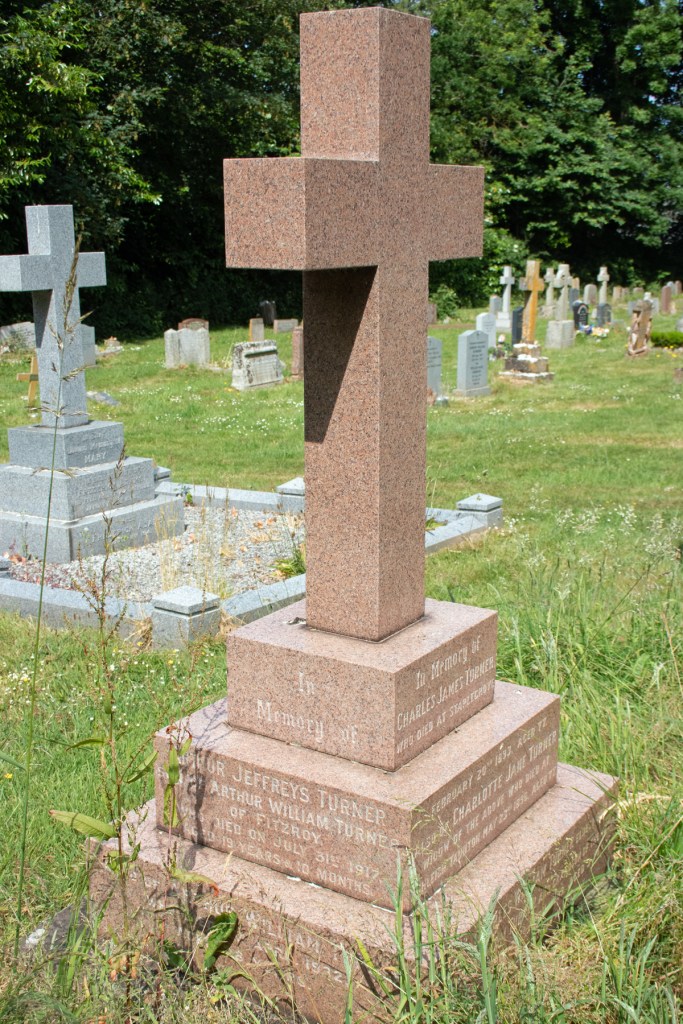
It is with great regret that we announce the death of Mr Arthur Jeffreys Turner, which took place on Tuesday last. The deceased was the only surviving son of Mr AW Turner, or Fitzroy.
Taunton Courier and Western Advertiser: Wednesday 8th August 1917
Arthur Jeffreys Turner was born in Staplegrove, near Taunton, in 1897. There is little concrete information about his life, although the newspaper report of his funeral acts as a starting point.
Arthur – who, the report suggests, was known as Jeff – was the son of Arthur William Turner. The son of a gentleman, Arthur Sr was a coffee planter, who disappears from the UK Census returns from 1881 and 1891. On 4th August 1894, he married Carsina Florence Marie le Gay, the Paris-born daughter of Gustave Ferdinand le Gay, an officer in the French Army. Arthur was 40 years old, and gave his address as the Travellers’ Club in Piccadilly, London, while Carsina, who was just 21 years of age, lived in Richmond.
Of Carsina, there appears to be no further record. The 1901 census found Arthur Sr based back in his Piccadilly Club, and gives his marital status as married. Ten years later, Arthur Sr is recorded as living in Fitzroy House, to the north west of Taunton. He is still noted as married, and a retired coffee planter, and that he had two children, of whom only one survived. Arthur Sr’s only companions in the 14-roomed manor house, however, were two servants, Bessie Hill and Eva Caddy.
The same census recorded Arthur Jr boarding at a prep school in Berrow, Somerset. Naish House been purpose-built just seven years before, when the school moved down the coast from Clevedon. Arthur was one of 39 boarders, who were supported by a dozen staff.
Within three years of the census being taken, Britain was at war. Arthur Jr was 17 at this point, and was sent to Cambridge, where he enlisted in the Officers’ Training Corps (OTC). No details of his military career exist, but at some point he made the move to the Somerset Light Infantry. He was given the rank of Private, somewhat unusually, given his time in Cambridge. This would suggest either that he didn’t complete his OTC training, that he did not pass it, or that he chose to work his way up through the ranks, rather than accepting a paid commission.
At this point, Private Turner’s trail goes cold. There are no records to expand on his military career and the newspaper report spends more time focused on the inscriptions on the floral tributes at his funeral, than on his short life.
The Commonwealth War Graves Commission documentation confirms that Arthur had died “of heart failure 31st July 1917. Age 20.” No other context is available, to whether heart failure was the primary cause, or it was brought on by another illness or injury can only be guessed at.
The body of Arthur Jefferys Turner was laid to rest in the graveyard of St John’s Church in Staplegrove, once a separate village, now a suburb of north west Taunton. He was buried in the family plot, alongside his paternal grandparents, Charles and Charlotte Turner.
Private Arthur Turner (from findagrave.com)
Arthur Turner Sr lived on for a further six years after his son’s death. He died on 9th April 1923, and was also laid to rest in the family plot in St John’s Churchyard, Staplegrove. The newspaper report on his funeral gives similarly little away about his life:
The funeral took place at Staplegrove, Taunton, on Tuesday, of Mr Arthur William Turner, of Fitzroy, Norton Fitzwarren, who died… in his 79th year.
…the chief mourners were Lieut.-Com. Kenderdine and Mrs Kenderdine (son-in-law and daughter)…
The late Turner was a keen follower for many years of the Culmstock Otter Hounds, and the oldest member of the Somerset Country Club.
Langport & Somerton Herald: Saturday 16th April 1932
The youngest of three children to William and Annie, Walter Harold Fry was born in the summer of 1897 in Shepton Mallet, Somerset. William’s job as a railway guard and porter meant the family moved around the area and, by the time of the 1901 census, they had settled in Twerton, to the west of Bath.
Little information is available about Walter’s early life and, indeed, documents from that time seem to record him as both Walter Harold and Harold Walter. When war came to Europe, He was keen to serve his country, presumably because his older brother, William Jr, was already serving overseas in the Somerset Light Infantry.
Walter enlisted in the Gloucestershire Regiment, and, as a Private, was assigned to the 4th (City of Bristol) Battalion. His initial training took place in Wiltshire and Essex, but by March 1915, the battalion had been sent to the Western Front.
Private Fry’s service records no longer exist, by his headstone, in the family plot, suggests that he was injured in France in March 1916. He was medically evacuated back to Britain, although, again, details are sketchy, and admitted to a military hospital in Aldershot, Hampshire.
At this point, Walter’s trail goes cold. The next record for him is that of his passing, while still admitted to the hospital, on 31st December 1916. He was just 19 years of age.
The body of Walter Harold Fry was brought back to Somerset for burial. He was laid to rest in Bath’s Twerton cemetery, a short walk from the family home.
Walter’s brother William had enlisted in the Somerset Light Infantry by 1911. That year’s census recorded him as being billeted at St Andrew’s Barracks in Malta, but by the time war broke out, his troop, the 2nd Battalion, was based in Quetta, India.
He remained based in this far outpost for the duration of the conflict and, while his service records are no longer available, he seemed to have been dedicated to his job as, by October 1918, he had risen to the rank of Sergeant.
William was based in Rawalpindi by that point, and it was here that he died, through causes unknown, on 31st October 1918. He was 26 years of age.
Buried in Rawalpindi Military Cemetery, Sergeant William Fry is also commemorated on the family grave in Twerton.
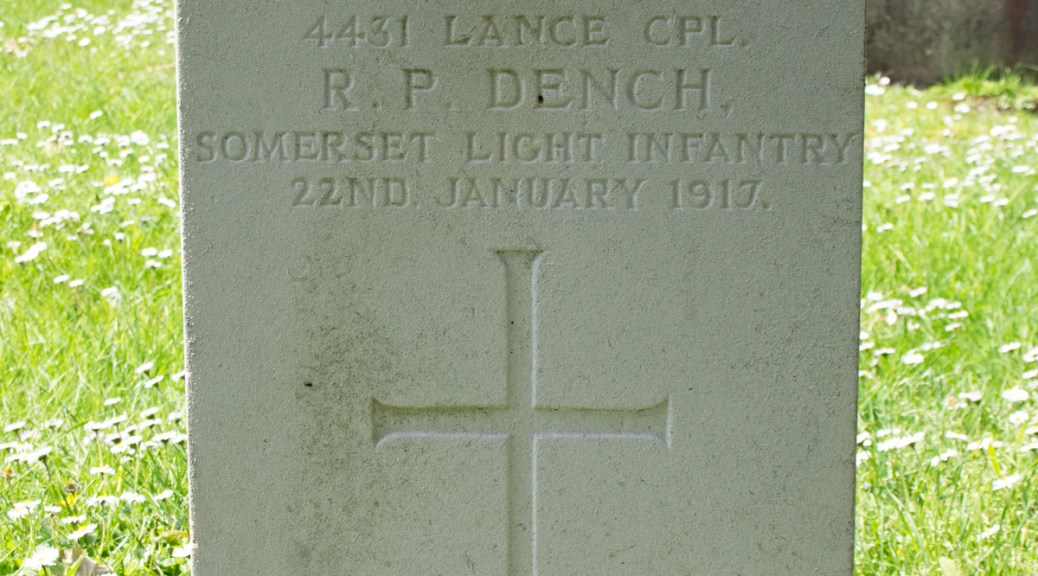
Reginald Percy Dench was born in the spring of 1884 in Twerton, Somerset. He was one of seven children to Henry and Jane – known as Lily – Dench. Henry was a shoe maker turned cloth dyer, but Reginald found work as a stone mason when he finished his schooling.
War came to Europe in 1914, and Reginald stepped up to play his part. His full service details are no longer available, but from what remains it is clear that he had enlisted in the Somerset Light Infantry by the summer of 1916. He was attached to the 5th Battalion, which spent of the conflict in India and Egypt, but there is nothing to confirm that Private Dench served overseas.
Reginald earned a promotion during his military career, and, by the end of 1916 was a Lance Corporal. By this point, however, he had fallen ill, contracting pleurisy. He was, by this point, back in Somerset, and it is likely that he was admitted to the Bath War Hospital. The condition was to get the better of him, and he passed away on 22nd January 1917. He was 32 years of age.
Reginald Percy Dench was laid to rest in Twerton Cemetery, a short walk from the family home in Mill Lane, and close to his two brothers, Edmund and Edward, who had died some twenty years before, while still children.
Tragedy was to strike again for the Dench family when, just six weeks after Reginald’s passing, Henry also died. He was laid in the same cemetery, not far from his sons. When Lily passed away in 1924, she was also buried in Twerton Cemetery, reunited with her family once more.
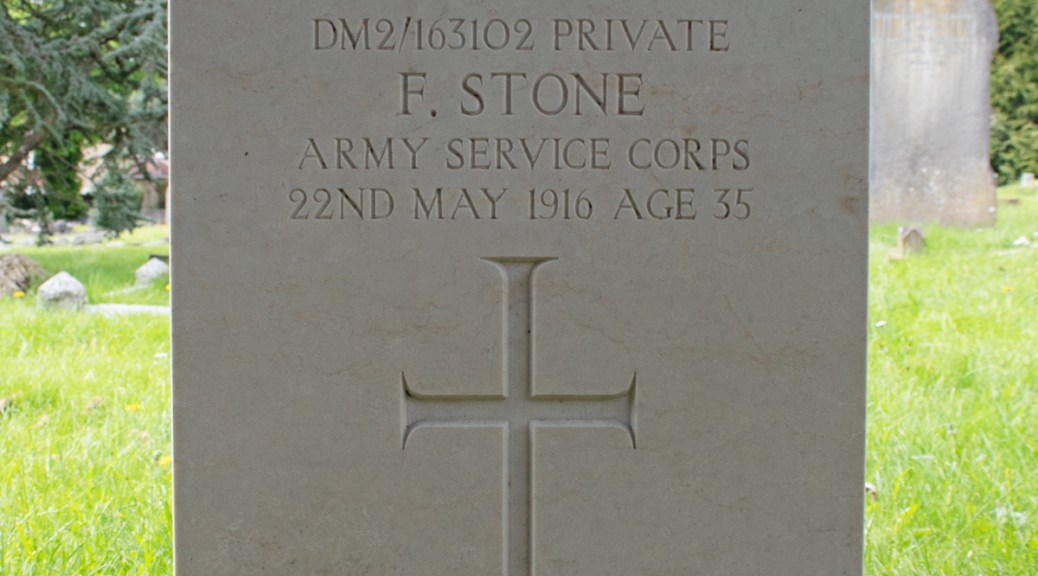
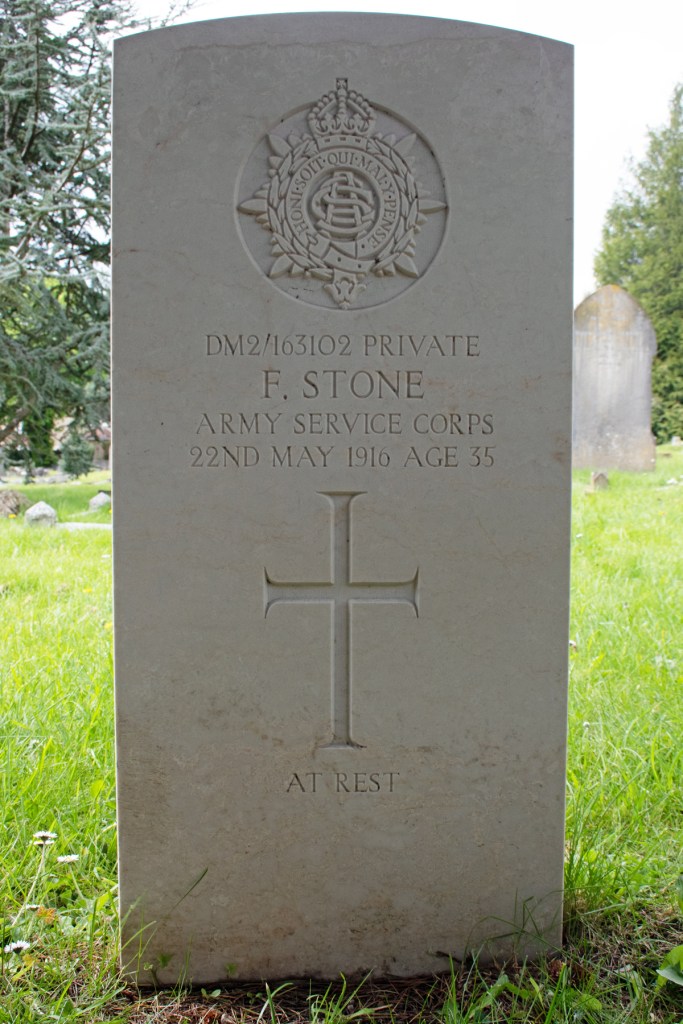
A lot of the life of Frederick Stone is destined to remain shrouded in mystery. His grave lies in the St Michael’s Cemetery, Bath, Somerset. The headstone confirms that he was a Private in the (Royal) Army Service Corps when he passed away on 22nd May 1916, at the age of 35.
The Commonwealth War Graves Commission give a little more information – he was the husband of Millie Stone, who lived at 9 Mount Road, Englishcombe. Private Stone was attached to the 623rd Mechanical Transport Company.
The 1911 census records a Fred and Millie Stone living at 22 Paragon, Bath, a twelve room Georgian terraced house near the centre of the city. Fred is listed as a gas maker for an ice factory, while Millie, who was eight years older than her husband, is noted as being a boarding house keeper. They couple were recorded as having been married for two years, and they had a seven month old daughter, Emily.
There is no marriage record for the couple, nor a baptism record for Emily, so it is not possible to glean any further information. There are four Bath-born Fred/Frederick Stones in the 1901 census, so again confirming which relates to the Private lying in the city’s cemetery is a challenge.
Private Frederick Stone’s death is not reported in the contemporary newspapers and so seems not to have been out of the ordinary. He was laid to rest in St Michael’s Cemetery, at peace.
Hidden away above the busy A371 to the north of Axbridge, Somerset is an unassuming graveyard. Overgrown and haunting, with headstones lining the boundary of the copse, this is the cemetery for the former St Michael’s Sanatorium, now the St Michael’s Cheshire Home. In the middle of the plot, next to the central memorial, is a headstone dedicated to Sidney Gordon, notably buried somewhere else in the grounds.
Sidney Vincent Gordon was born in Upton Park, Essex, on 7th May 1897. There is little information about his early life, other than his mother’s name, May.
The 1911 census recorded Sidney as being an inmate at the Scattered Home for the West Ham Union, the workhouse that covered the area. At 13 years of age, he was one of the older of the thirteen students boarding in the home, which was overseen by Emma Caroline Simpson, the House Mother.
When Sidney completed his schooling, he managed to find employment as an undertaker’s boy. But he sought out bigger things and, on 8th June 1914, he enlisted in the Royal Navy. His service records note that he was 5ft 6ins (1.68m) tall, with brown hair, blue eyes and a fresh complexion.
Being under-age when he enlisted, Sidney was given the rank of Boy. He was first sent to HMS Pembroke, the Royal Naval Dockyard in Chatham, for training, and remained there for a couple of months. In August 1914, Boy Gordon was moved down the coast to HMS Actaeon, a torpedo school based in Sheerness, Kent.
After five months, he moved to HMS Wildfire, another part of the Sheerness base, and it was while there he turned 18, and could formally join the Royal Navy. He was given the rank of Officer’s Steward 3rd Class and remained at Wildfire until the end of 1915. After a short stint back in Chatham, Sidney was given a new posting on board the supply ship HMS Tyne, where he remained until the following May.
Officer’s Steward Gordon returned to HMS Pembroke once more, and was assigned to his final sea-going ship, the newly launched monitor, HMS Erebus. She was to be his home until June 1917, when, having become unwell, he was posted back to HMS Pembroke.
Sidney had contracted pulmonary tuberculosis, which led to him being invalided out of the Navy on 1st August 1917. At this point his trail goes cold once more, but it is likely that, by the start of 1919, his condition had led to his admission to St Michael’s.
When he died there, on 5th March 1919, Sidney was just 21 years old. Given his background, it seems probable that his mother, if she was still alive, would not have been able to afford for his remains to be brought back to Essex. Sidney Vincent Gordon was laid to rest in the sanatorium’s cemetery, in the foothills of the Mendips, finally at peace.
William Ephraim Stitch was born in Biddisham, Somerset, on 6th August 1879. The oldest of seven children, his parents were James and Mary Stitch. James was a farmer, and this was a trade into which William followed.
The 1901 census found William boarding with a farmer in nearby Badgworth. His employer was George Burrow, who had a live-in housekeeper, Ellen Norris. Ten years later, William was boarding with another family in the village – Benjamin and Bertha Wall and their two children – and, at 32 years old, he was still employed as a farm labourer.
When war came to Europe, William stepped up to play his part for King and Country. He enlisted in the Royal Army Service Corps on 3rd December 1915, and was assigned to the 530th Horse Transport Company. His service records note that he was 5ft 4ins (1.63m) tall and weighed 126lbs (57.2kg).
Driver Stitch was based in Northumberland, and remained on home soil throughout his time in the army. He returned to Somerset a couple of times, most noticeably in September 1917, when he married Bertha Wall, who he had been boarding with according to the 1911 census. There is no evidence of the passing of Bertha’s husband, Benjamin, but William’s service records note that he classed Bertha’s two children as his own.
Driver Stitch went back to Somerset on leave over Christmas 1917, arriving back in Blyth, Northumberland, on 28th December. He was billeted at Link View Villa in the town, and looked after the horses stabled there.
William was last seen in the Orderly Room that evening, by a Corporal John Kearton, his senior officer who was based in the same digs. He disappeared, and, despite a lengthy search, it was only on 1st February 1918 that his body was found in the brickyard pond, close to where the horses were stabled.
At the subsequent inquest, the doctor who carried out the postmortem confirmed that there was no sign of violence. Corporal Kearton suggested that, as William was getting water from the pond, he might have slipped into the water accidentally. With no evidence of any deliberate intention to end his life, the jury returned a verdict of drowning, but that there was no evidence to show how Driver Stitch had gotten into the water. William was recorded as having died on 28th December 1918, at the age of 39 years of age.
The body of William Ephraim Stitch was brought back to Somerset for burial. He was laid to rest in the quiet graveyard of St Congar’s Church in Badgworth.
Charlie Tucker was born early in 1877 in the village of Mark, Somerset. The fifth of six children, his parents were Thomas and Caroline. Charlie’s mother died when he was only a toddler, probably during, or shortly after, the birth of his younger sister, Elizabeth. This left farm labourer Thomas to raise his family alone.
The 1881 census found the Tuckers living in Wedmore, five miles to the east of Mark, where Thomas was supported by his parents, George and Elizabeth. Both died in 1890, but by this point, Thomas had married again, to a widow, Ann Harding. She had a daughter, Mary Ann, who was welcomed into the family, but then Thomas and Ann had their own child, a son called Walter.
The next census, returned in 1891, recorded the family – Thomas, Ann, Charles, Mary Ann and Walter – living in Wedmore. Charles had finished his schooling by this point, and was employed as a general labourer and the family also had a boarder, Ralph Godney, who was just 9 years of age.
The family setup continued, and the 1901 census document found Thomas and Ann living with Charlie and Walter, all of whom were doing farm work. They still seemed to be open to supporting others, however, and had another boarder, a schoolgirl called Elizabeth Grant.
In the spring of 1904, Charlie married Lily Brown. Born in Wedmore, she was the daughter, and only child, of a labourer who was employed as a servant to an Axbridge famer at the time the couple wed. Charlie and Lily set up home in Blackford, near Wedmore, and went on to have four children: Thomas, Walter, William and Kathleen.
When war broke out in 1914, Charlie stepped up to play his part. Full details of his military career are lost to time, but it is clear from what remains that he had enlisted in the Devonshire Regiment by the autumn of 1916. Private Tucker joined the 13th (Works) Battalion, and remained stationed on home soil for the duration of his service.
Little further information about Charlie’s life is evident. Over the next couple of years his health began to fail, and in the spring of 1917 he had been admitted to Bath War Hospital with carcinoma of the stomach. This was to take his life: he passed away on 11th March 1917. He was 40 years of age.
Charlie Tucker’s body was brought back to Blackford for burial. He was laid to rest in the graveyard of Holy Trinity Church.
Lily, now widowed, was left with four young children to raise on her own. Whether for a new life and new opportunities, or to escape the painful memories that Somerset brought, she made the decision to emigrate. In April 1924, she and the children arrived in Canada, and settled in Ontario.
Further information for Lily is not readily available, but her two oldest children, Thomas and Walter, made lives for themselves, and died in 1975 and 1979, respectively.








 Death and Service