Tag Archives: gas

Private Gilbert Smyth

Private Gilbert Smyth

Gilbert Rowland Locke Smyth was born in the summer of 1897, and was the oldest of three children to Charles and Elizabeth. Charles was a postman and bootmaker and both he and his wife came from North Molton in Devon. The 1901 found the young family taking rooms in Dobbs Cottage on East Street, midway between two pubs: the Poltimore Arms and the Miner’s Arms.

Gilbert – who was better known as Roy – found work as a clerk she he finished his schooling. By the time war broke out, he was had moved to East Sheen, Surrey, and was employed by the civil service. He was keen to play his part, and enlisted in the army on 10th December 1915.

Initially assigned to the Suffolk Regiment, Private Smyth’s service records give an insight into the young man he had become. At eighteen years of age, he was 5ft 8.5ins (1.74m) tall, and weighed 112lbs (50.8kg). While he had worn spectacles for a couple of years, he was noted as being of fair physical development. The document confirms that he had a mole on the top of his right arm.

Roy was not formally mobilised until October 1916. After four months’ training on home soil, his unit, the 14th Battalion, was sent to France. Private Smyth remained overseas for nearly a year, during which time he transferred to the 12th Battalion of the York & Lancashire Regiment.

At the end of July 1918 Roy was caught up in a German gas attack, and this would have a long-term effect on his health, particularly his eyesight. He returned to Britain on 30th November 1918, and, after a couple more months spent in France, he was formally discharged from the army on medical grounds on 5th April 1919.

The deepest sympathy is extended to Mr and Mrs C Smyth in the loss of their eldest son, Roy… Deceased, who was employed in London in the Civil Service, was taken ill with pneumonia, and died before his father could arrive.

[Exeter and Plymouth Gazette: Friday 6th August 1920]

Gilbert Rowland Locke Smyth died on 3rd August 1920: he was 22 years of age. He was brought back to Devon for burial, and was laid to rest in All Saints’ Churchyard in his home village of North Molton.

Private Garfield Peardon

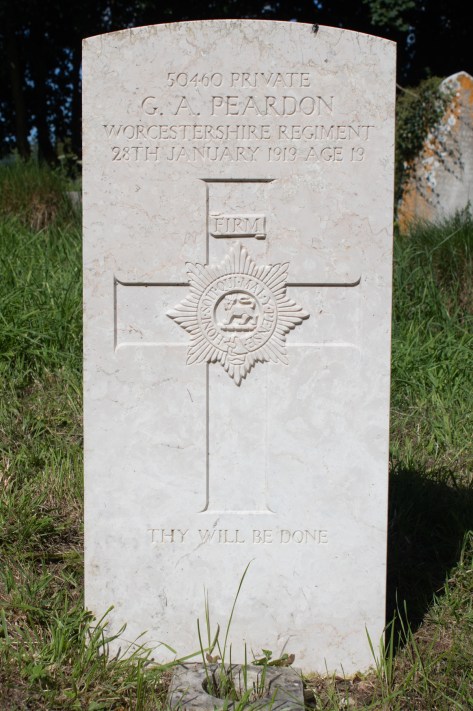
Private Garfield Peardon

Garfield Ambrose Peardon was born on 24th February 1899, the older of two children to William and Margaret. Both farm labourer William, who had been widowed in 1885, and his second wife, Margaret were from Devon. The 1891 census found the extended family – Garfield and his parents and his older half-brother, William Jr., living in Market Street, Buckfastleigh.

Ten years later, and the family had moved just up the road to Market Street. Both of Garfield’s parents were working for the local woollen mill, William as a horseman and Margaret as a serge weaver. Garfield and his younger brother, Eric, were too young to work, and were both still at school.

Garfield stepped up to play his part for King and Country, although details of his service are a bit of a mystery. He had certainly enlisted by the start of 1918, presumably as soon as he came of age. He joined the Worcestershire Regiment, and was attached to the 3rd Battalion.

Private Peardon served in France, and was likely involved in the Battles of the Somme and Lys in the spring of 1918. His pension ledger records note that, on 27th May, he was recorded as ‘missing’: this was the day of a massive German gas and artillery bombardment and, in the confusion that followed, it appears that Garfield was identified as a potential casualty.

At this point, Private Peardon’s trail goes cold. The next available document is his entry on the Army Register of Soldiers’ Effects: this confirms that he passed away on 28th January 1919 in the 2nd Scottish General Hospital in Edinburgh. This would suggest that Garfield was wounded in the attack, and medically evacuated to Britain for treatment. He was a month short of his 20th birthday when he died.

The body of Garfield Ambrose Peardon was taken back to Devon for burial. He was laid to rest in the the grounds of Holy Trinity Church, Buckfastleigh.


Sapper Edward Pullinger

Sapper Edward Pullinger

Edward Arthur Pullinger was born in Sutton, Surrey, in the summer of 1897. The oldest of three children, his parents were gardener Arthur Pullinger, and his wife, Ellen.

Arthur seemed to move the family to wherever the work was. By 1902 they had settled in Monkton Wyld, in Dorset, where he was employed on a local estate. Edward’s two siblings, sisters Constance and Nellie, were both born there, but the 1911 census shows that the Pullingers had moved again, to the village of Charlton Mackrell in Somerset.

When war came to Europe, Arthur stepped up to play his part. Sadly, full service records are no longer available, but it is clear from what remains that he enlisted in the Royal Engineers as a Sapper. He remained in the army, until being discharged from duty on 21st May 1919.

Another sad death took place on Wednesday of last week in the person of Mr EA Pullinger, only son of Mr and Mrs A Pullinger… Deceased, who was of a bright and happy disposition and a favourite with all, was gassed in the Great War, from the effects of which he never really recovered. He was always ready and willing to help in the social life of the village and will be missed greatly.

Langport & Somerton Herald: Saturday 12th March 1921

Edward Arthur Pullinger had succumbed to tuberculosis on 2nd March 1921, at the age of 23 years old. He was laid to rest in the peaceful graveyard of St Mary’s Church, in Charlton Mackrell.


Lance Corporal Frederick Beaven

Lance Corporal Frederick Beaven

Frederick Henry Jacob Beavan was born in Street, Somerset, in the summer of 1891. There is little information available about his early life, although later records suggest that his parents were Mr & Mrs Tom Beaven.

Frederick married a woman called Elsie late in 1910 or early in 1911 and, while there is little information about her, they went on to have three children, Harwood, Hubert and Tom. The 1911 census noted that Frederick was working as a boot and shoe maker in the town’s factory, Clark’s.

The only other documents for Frederick relate to his passing. When war broke out, he enlisted in the Worcestershire Regiment, although it is not possible to determine which battalion he was assigned to. Private Beaven did serve overseas, however, and, by the summer of 1918, had been promoted to the rank of Lance Corporal.

Frederick was injured during a German gas attack that summer, and was medically evacuated to Britain for treatment. His weakened condition was to prove too severe, however, and he passed away on 10th July 1918, from double pneumonia. He was 27 years of age.

Frederick Henry Jacob Beaven was brought back to Street for burial. He was laid to rest in the town’s cemetery.


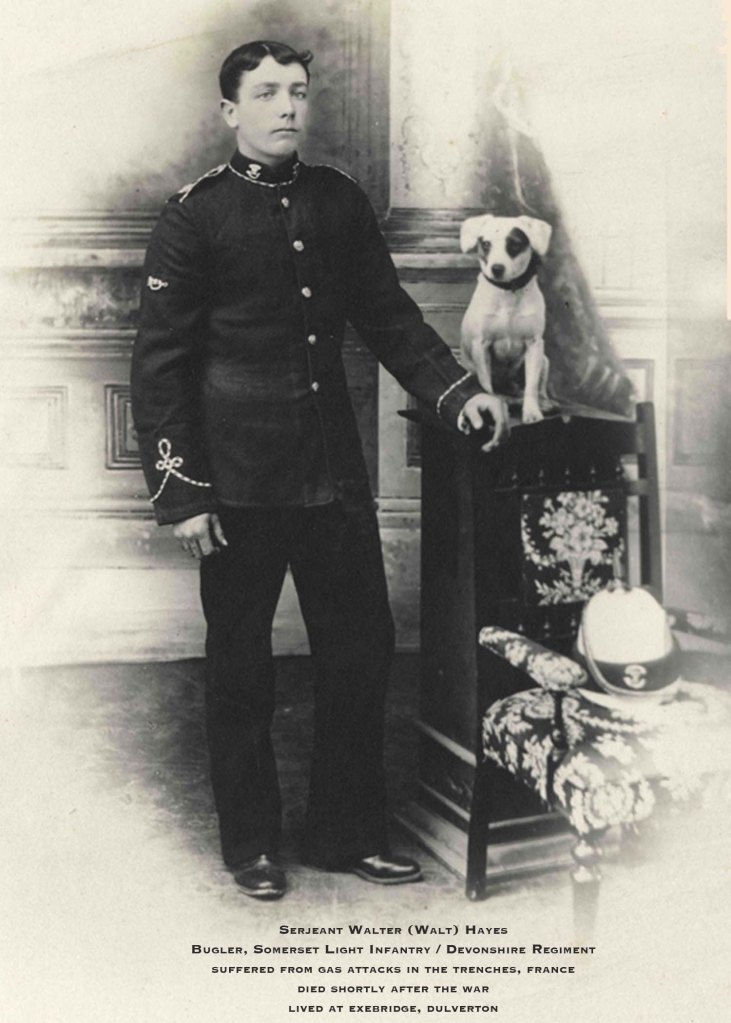
Serjeant Walter Hayes

Serjeant Walter Hayes

Walter Hayes was born in Somerset in 1883. The oldest of seven children, his parents were William and Mary Hayes. William was an agricultural labourer, and the family lived and worked at Houndhill, to the south east of Stogumber.

Walter also fell into farm work and, in the spring of 1914, he married Emily Mary Tarr. The wedding took place in Tiverton, Devon, but the couple did not stay there for long as, just weeks after their wedding day, Emily gave birth to a daughter, Edith, over the Somerset border in Dulverton.

Storm clouds were brewing over European shores, and Walter was called upon to play his part. His service records are also sparse, but they confirm that he initially joined the Somerset Light Infantry, before moving across to the Devonshire Regiment.

Walter had either been in the army earlier in his life, or he worked his way up during the war, and at some point he reached the rank of Serjeant. He saw fighting overseas and, according to later documentation, was caught up in a gas attack. This was to have an impact on his health and he was discharged from army service sooner than he might otherwise have done. Officially stood down in March 1919, he returned home to his wife and family.

Emily and Walter had a second child, William, later that year, and the family were finally able to settle into a routine. Walter’s health, however, was severely impacted and, on 12th January 1921, he passed away from bronchitis. The lung condition was found to be directly attributable to his war service, and that gas attack, Walter was 38 years of age.

Walter Hayes was laid to rest in the quiet graveyard of All Saints’ Church in Dulverton.


Emily was pregnant when her husband died: she gave birth to their third child, a son she named Walter, just a few months later. She did not re-marry, and, according to the 1939 Register, she was boarding in a house in Dulverton and carrying out unpaid domestic duties.

Emily lived on until the autumn of 1973, passing away in Taunton at the age of 85.


Serjeant Walter Hayes
(courtesy of Trevor Hayes)

The early life of Walter Hayes was a challenge to piece together, as his was not an uncommon name in the area at the time. My thanks go to his great nephew, Trevor Hayes, for his help in pulling together the story and for the image of his great uncle.


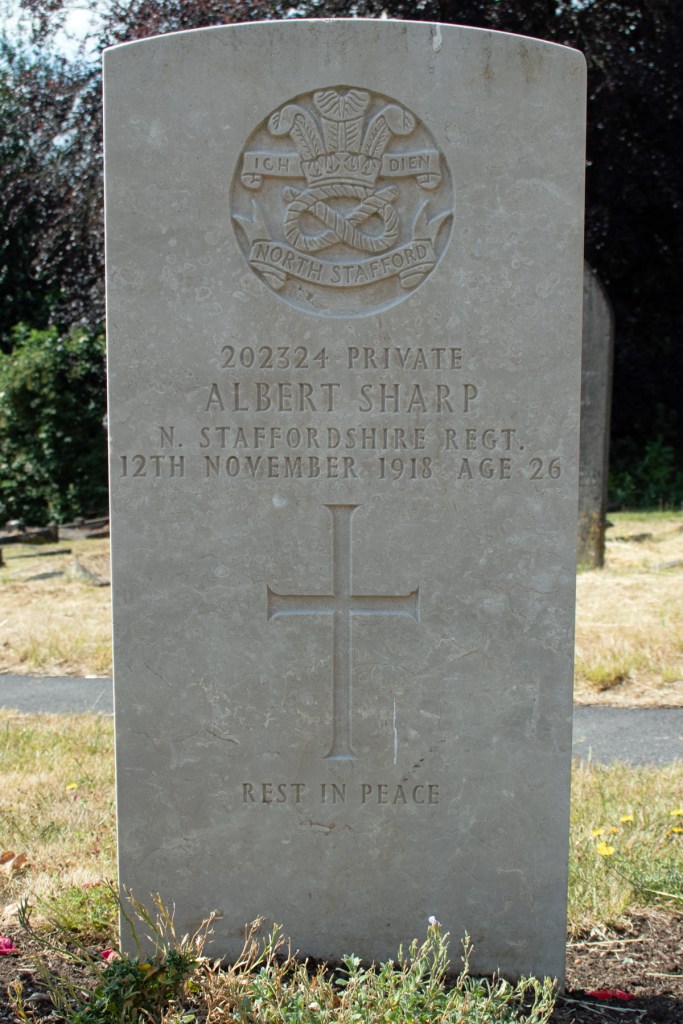
Private Albert Sharp

Private Albert Sharp

Albert Sharp was born in Rugeley, Staffordshire, in the summer of 1894. One of six children, his parents were George, who was a house painter, and Janet Sharp. When he left school, Albert found work as a bricklayer’s labourer, but, when war was declared, he sought a new adventure.

Albert enlisted in the army on 21st February 1916. Assigned to the North Staffordshire Regiment, he was initially attached to the 5th Battalion. His medical records show that Private Sharp was 5ft 6ins (1.6m) tall, and weighed 122lbs (553kg).

By November 1916, Albert found himself in France. Unusually, his life over the next couple of years is pretty well documented. His battalion saw action at the Hindenburg Line, the Third Battles of Ypres, Cambrai and the Third Battles of the Somme, but Private Sharp’s service records shed more light onto his life than simply where he fought.

Albert seems to have been a bit of a character, and this got him into trouble on more than one occasion. On 9th November 1916, he was confined to barracks for two days, for having untidy bedding and no towel on his bed. The following day, he was punished with another two days’ confinement for not attending his battalion’s role call.

On 18th December 1916, Private Sharp found himself in trouble again. This time, he was confined to barracks for five days for appearing dirty on parade, and committing a nuisance. Four days later, Albert was admitted to the camp hospital for reasons that are unclear. He returned to his unit just under a week later.

At the end of February 1917, Private Sharp transferred to the 31st Light Railway Operating Company of the Royal Engineers. He remained with the battalion for just under a year, although again his time there was not without incident. On 31st August 1917, Albert was confined to barracks for seven days for being absent from parade. The same punishment was meted out for the same offence on 8th January 1918.

Later that month, Private Sharp re-joined the North Staffordshire Regiment, and was this time attached to the 9th Battalion. He remained on the Western Front and was caught up in some of the fiercest fighting of the closing months of the conflict.

On 12th May 1918, Albert was caught up in a gas attack. Seriously injured, he was medically evacuated to Britain for treatment and admitted to the Bath War Hospital on 29th May. The next six months saw a slow and steady decline in his health. He passed away at 5:45am on 12th November 1918, the day after the Armistice was signed, from a combination of pneumonia and emphysema that was directly attributable to his injuries in France. Albert was 24 years of age.

It seems likely that Albert’s family were unable to pay for his body to be taken back to Staffordshire for burial. His service records give only his mother, Janet, as a next of kin, so it would seem that George had passed away by the time Albert enlisted. For some reason, however, while the British Register of Army Effects note that Private Sharp has effects to the value of £39 10s (£2250 in today’s money), this amount does not appear to have been paid. Janet passed away in the early 1920s, and Albert’s brother continued to try and obtain this gratuity on her behalf, but seems to have been unsuccessful.

Albert’s family did get his belongings when he died, however, which came to a postal order for 2s (around £3 today), 50 French centimes, a leather purse, two combs, two jack knives, a razor, a shaving brush, a toothbrush, two briar pipes and a pouch of tobacco, a nickel cigarette case, a text book, a wallet containing his pay book, his cap badge and six letters.

Unable to afford to bring Albert Sharp’s body back to his home town, he was, instead, laid to rest in the sweeping vista of Bath’s Locksbrook Cemetery, not far from the hospital in which he had breathed his last.


Gunner Valentine Wilkinson

Gunner Valentine Wilkinson

Valentine Burnett Wilkinson was born early in 1889 in Combe Down, Somerset. One of eight children, his parents were Harry and Eliza Wilkinson, Harry was from nearby Bath and worked as a gardener, and this is the trade into which Valentine also went when he finished school.

In the spring of 1913, Valentine married Florence Moody. She was the daughter of a stone mason and, at the time of the 1911 census, she was employed as a live-in sewing maid at Monkton Combe Junior School.

Gardening seems to have been a footstep to something bigger for Valentine, and he soon found other employment, as a police constable. He and Florence moved to Street, near Glastonbury, and this is where they were living when war broke out.

Keen to play his part, Valentine enlisted in the Royal Garrison Artillery on 11th December 1915. He was placed on reserve, possibly because of his occupation, and was not formally mobilised until the end of June 1917, just six weeks after Florence had given birth to their first and only child, Joan.

Gunner Wilkinson’s service records note that he was 5ft 11ins (1.8m) tall, and had a scar on his right wrist. He spent five months training, split between No. 3 Depot in Plymouth, Devon, 473 Siege Battery and No. 1 Reinforcing Depot in Bexhill-on-Sea, Sussex. On 3rd November 1917, however, he was sent to France, and was attached to the 234th Siege Battery.

Gunner Wilkinson’s time overseas was to be brief, however. He was caught up in a gas attack in December, and evacuated back to Britain for treatment. His health was now impacted and, during the summer of 1918, he was admitted to hospital having contracted pleurisy. After two months in hospital, Valentine was sent to the Military Convalescent Hospital in Ashton-in-Makerfield, near Wigan.

The war was in its closing stages by this point, and in November 1918 Gunner Wilkinson resumed some of his duties, albeit on home soil. His health was still suffering, and he contracted tuberculosis on the lung and throat. He was formally discharged from the army on 27th February 1919, no longer physically fit to serve.

Valentine returned home to Somerset, and it was here, on 1st April 1919, that his body finally succumbed to the lung conditions that had dogged him for nearly eighteen months. He was just 30 years of age.

Valentine Burnett Wilkinson was laid to rest in the quiet graveyard of St Michael’s Church in the parish of his childhood home, Monkton Combe.


Gunner Alfred Taylor

Gunner Alfred Taylor

Alfred Taylor was born in the summer of 1888 in Crewkerne, Somerset. The second of twelve children, his parents were Henry and Selina Taylor. Henry, who was also known as Harry, was a stone mason, but when Alfred and his siblings left school, they went into the weaving industry, a key employer in the area.

War came to European shores in the summer of 1914, and Alfred was keen to play his part. He had already been a part of the 3rd (Special Reserve) Dorset Regiment, but formally enlisted on 9th December 1915, joining the Royal Garrison Artillery. His service records note that he was 5ft 9ins (1.77m) tall and weighed 149lbs (67.6kg). The document also confirms his next of kin as his father, who, at 48 years old, had also joined up, and was serving in the Royal Engineers in Canterbury, Kent.

Gunner Taylor was not mobilised until September 1916, and served the next eighteen month on home soil. He did his initial training in Hilsea, Portsmouth, before moving around the country. He finally made it to France in February 1918.

During his time in France, Alfred was caught up in a couple of gas attacks, and was evacuated to Britain at the end of August because of the impact on his lungs. Admitted to the 2nd Eastern General Hospital in Brighton, Sussex, his body finally succumbed to pneumonia. He passed away on 25th January 1919, at the age of 30 years old.

The body of Alfred Taylor was brought back to Somerset for burial. He was laid to rest in the Townsend Cemetery of his home town, Crewkerne. “…All the members of Gunner Taylor’s family were present, except his father and his brother George, who [were] with the Army of Occupation in Germany.” [Western Chronicle: Friday 7th February 1919]


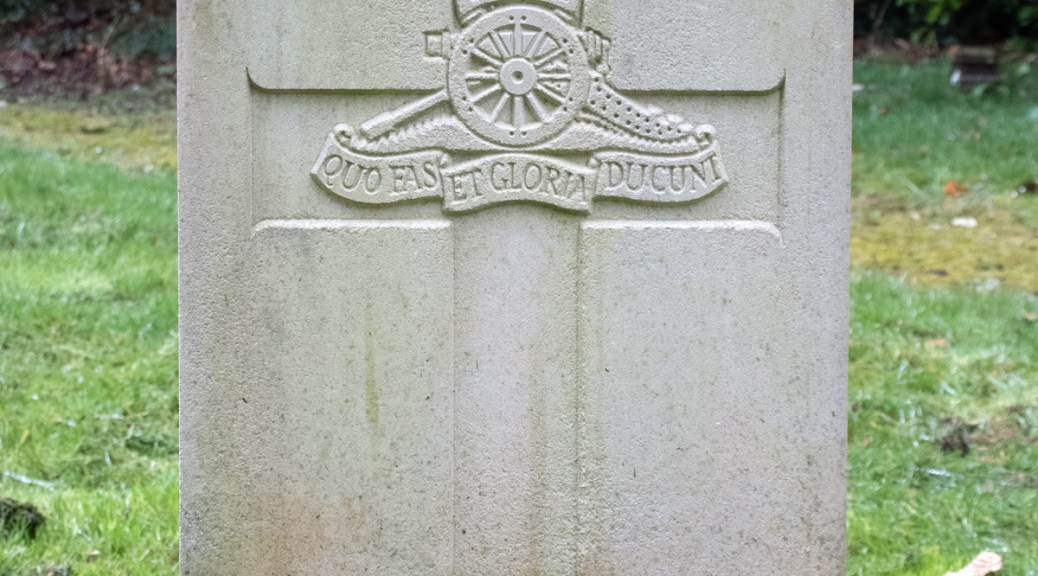
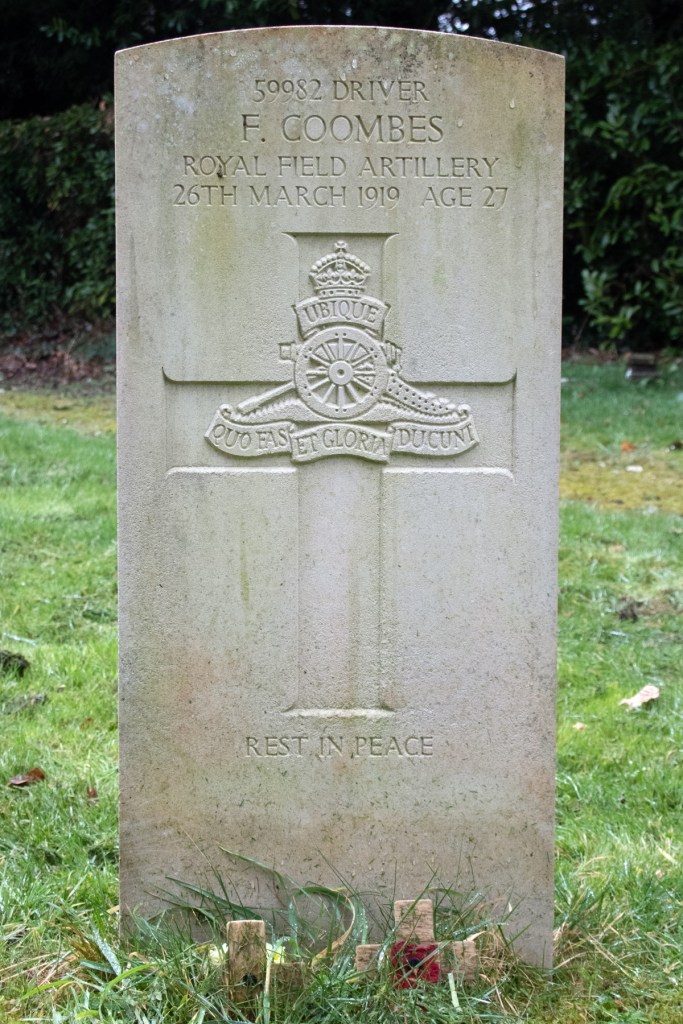
Driver Frederick Coombes

Driver Frederick Coombes

Frederick Walter Coombes was born in 5th July 1891 in Chard, Somerset. He was the oldest of eight children and his parents were mason’s labourer Walter Coombes and his wife, Sarah.

The family moved to nearby Crewkerne and, when he left school, Frederick found work as a weaver. He quickly realised, however, that he needed a career, and the the military could offer one. On 18th October 1909, he enlisted in the the Royal Field Artillery, signing up for three years with the regiment, followed by nine years on reserve.

Frederick’s service record confirms the man he had become. His medical examination gave his height as 5ft 6ins (1.68m) and his weight as 139lbs (63kg). He was noted as having brown hair, hazel eyes and a fresh complexion. He was also recorded as having a tattoo of a man’s head on the back of his right wrist and a small scar on his left hip.

After a year on home soil, Driver Coombes was sent to South Africa. He was to spend a little over two years in the country, the 1911 census recording him at the Roberts Heights Barracks in Transvaal, as part of the 98th Battery.

When his initial three year contract came to an end, Frederick was placed on reserve status and returned home. His trail goes cold for a couple of years, but when war was declared in 1914, he was immediately brought back into active service.

By the middle of August 1914, Driver Coombes was on the Western Front in France. Within a matter of weeks he was caught up in the Retreat from Mons, and was gassed in the process.

He soon recovered and, in December 1915 his troop was moved to Mesopotamia, modern-day Iraq. Within a month, Frederick fell ill again, having contracted malaria. He was treated at the base and, eventually remained in the Middle East for a year.

By December 1916 Frederick was on the move again, this time to India. His lungs had had a battering by this point, however, and he fell ill once more, this time having developed tuberculosis. Initially treated in India, by February 1917 he had been medically evacuated back to Britain. The condition was seen as unlikely to improve, and he was eventually discharged from the army as being no longer fit enough to serve.

Driver Coombes’ medical report confirmed that the condition was fully the result of his army service, and treatment at a sanatorium was recommended. His last day with the Royal Field Artillery was 7th May 1917: his career had lasted 7 years 202 days.

Again, Frederick’s trail goes cold at this point. It seems likely that he would have returned to Somerset and would possibly had been admitted to a medical facility for treatment and recuperation. The next record for him is that of his death, which happened at home on 26th March 1919. He was just 27 years of age.

Frederick Walter Coombes was laid to rest in Crewkerne’s Townsend Cemetery.


Driver Frederick Coombes

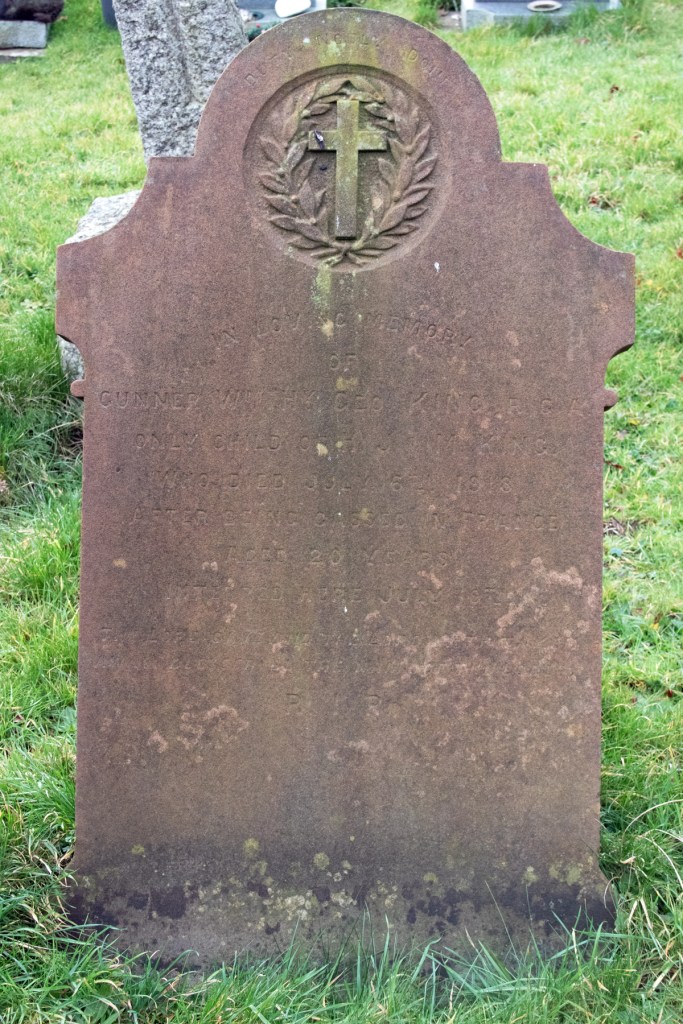
Gunner William King

Gunner William King

William Henry George King was born in the summer of 1898 and was the only child of Henry and Martha King. Henry was a grocer in the Somerset village of Witham Friary, and this is where William was born and raised.

When he left school, William found work as a draper’s assistant in Wells, but when he turned 18, with war raging across Europe, he gave that up to play his part. He enlisted in the Royal Garrison Artillery in August 1916, and was assigned as a Gunner in the 99th Siege Battery. His service records show that he was 6ft (1.83m) tall and weighed in at 140lbs (63.5kg).

Gunner King received his initial training in Plymouth, but was eventually shipped to France, arriving there in August 1917. He was caught up in a German gas attack at the end of June 1918, and was invalided back to Britain for treatment on 2nd July. He was admitted to the War Hospital in Bradford, but died of a combination of his injuries and the resulting bronchitis on 6th July 1918. He was just 20 years of age.

The body of William Henry George King was brought back to Somerset for burial He was laid to rest in the family plot in the graveyard of St Mary’s Church in his home village of Witham Friary.