George Henry Curtis was born in Oldland, near Bristol, in around 1887. His parents were George and Frances (Fanny) Curtis, and he was one of their four children.
There is little direct information about George’s life: his was a common name in the Gloucestershire area, and so it is difficult to identify if some documents are related to him nor not.
The first piece of concrete evidence for him is his marriage certificate. He wed Elizabeth May Henly on 7th November 1914. She was the daughter of an engineer, while George gave his trade as a tobacco operator (possibly making cigars and cigarettes). The wedding took place at St Anne’s Church in Oldland, local to bother bride and groom.
When war broke out, George stepped up to play his part and enlisted in the Royal Garrison Artillery as a Gunner. He did not see action overseas, but was awarded both the Victory and British Medals for his service.
Gunner Curtis’ adult life is hard to piece together. All that can be confirmed is that he passed away on 9th July 1921, at the age of 32 years old.
George Henry Curtis was laid to rest in the graveyard of the church in which he had been christened and married, St Anne’s in his home village, Oldland.
Philemon Witheridge Richards was born on 9th July 1891 in Porthleven, Cornwall. He was one of at least seven children to George and Ann Richards. George was a sailor, as were he two oldest sons and, by the late 1890s, the family had made the move to Penarth in Glamorganshire.
When he left school, Philemon followed his father and older brothers into sailing. By the time he turned eighteen, George had passed away and Philemon wanted bigger and better things. On 16th July 1909, he enlisted in the Royal Garrison Artillery. His service records show that he stood 5ft 9.5ins (1.76m) tall, had good vision and was of good fitness.
Gunner Richards was posted to No. 6 Company and remained part of the territorial force. On 1st July 1911, after twenty months’ service, he was, at his own request, discharged from the army.
The trail goes cold for a while, and Philemon seems to have returned to a life at sea. This changed, however, when war broke out and, in October 1915, he was drafted into the Royal Naval Reserve as a Deck Hand.
Philemon’s time in service seems to have been shore-based however. After an initial posting to HMS Vivid, the Royal Naval Dockyard in Devonport, he moved to HMS Victory, which was the name given to the dockyard in Portsmouth, Hampshire. He moved on again in the autumn of 1916, by which point he was based at HMS Pembroke, the Royal Navy’s shore-base in Chatham, Kent.
It was here that Deck Hand Richards fell ill. It is unclear what the condition was, but he was admitted to the Military Hospital in Chatham on 20th October 1916. His illness worsened, and he passed away there on 2nd November. He was just 25 years of age.
Philemon Witheridge Richards was brought back to Glamorganshire for burial. He lies at rest in the graveyard of St Augustine’s Church in Penarth.
Philemon’s gravestone is also dedicated to his brother, Thomas Witheridge Richards. Eighteen years Philemon’s senior, Thomas had been a sailor, and, while no records remain, it seems likely that he may also have been called into service during the First World War. He died at home on 4th July 1918, at the age of 45 years old. He was laid to rest in the same plot as his younger brother.
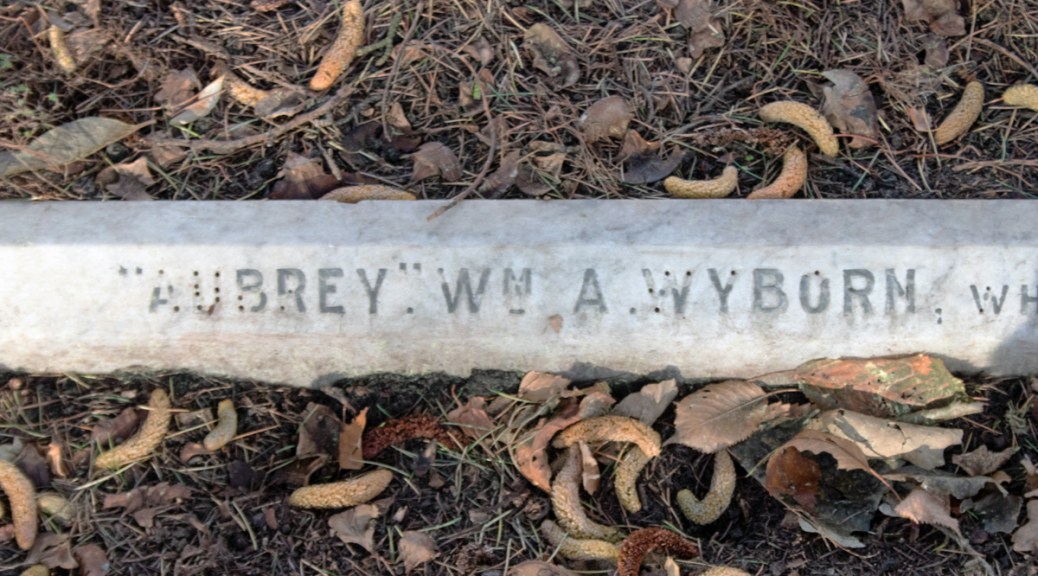
William Aubrey Wyborn was born on 15th November 1897, the middle of three children to farmer-cum-greengrocer-cum-butcher Henry Wyborn and his wife, Esther. The family lived in the Kent village of Tilmanstone, not far from Deal, but soon moved to Faversham in the north of the county.
William proved to be an astute student. After being a pupil at Faversham District Schools, he gained a scholarship to the towns Grammar School. He spent six years there, and proved to be a studious pupil, gaining a prize for maths. He was then granted a scholarship to the Sheffield School of Engineering, and, while studying for his degree there, war broke out.
William joined the West Lancashire Royal Field Artillery in June 1916 and was sent to Aldershot for training. sadly, Gunner Wyborn’s career was to be cut short – while training, he contracted diphtheria and pneumonia, passing away from a combination of the illnesses on 3rd November 1916. He was just short of his 19th birthday.
William Aubrey Wyborn was brought back to Kent for burial. He lies at rest in the family plot in the Faversham Borough Cemetery.
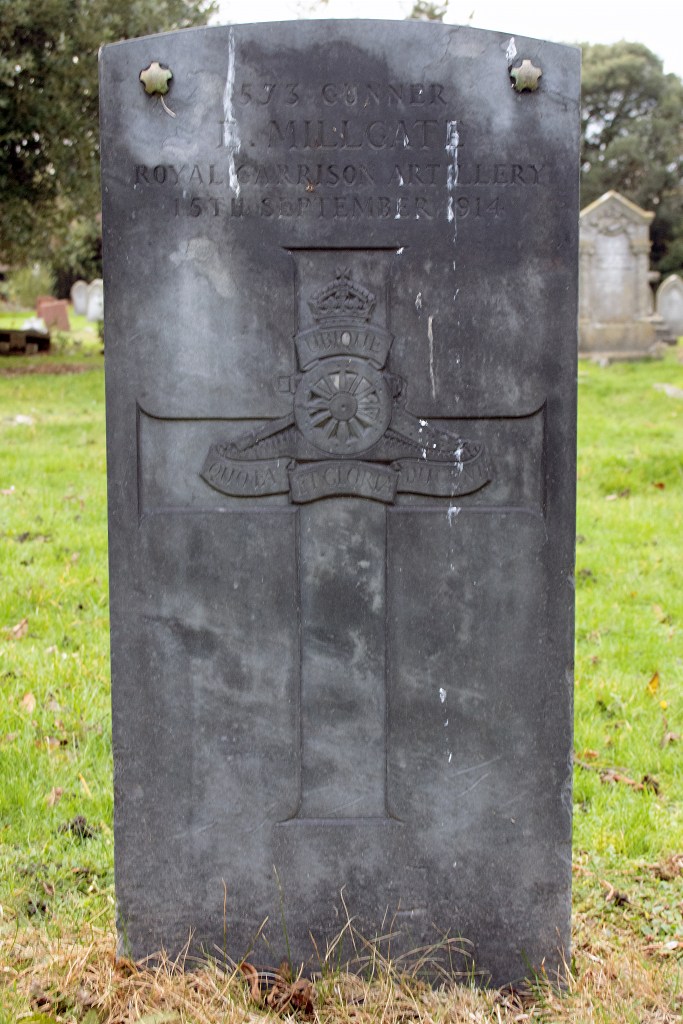
Ernest Millgate was born in late 1893, the fifth of six children to Henry and Agnes. Henry was a brewer’s drayman from Boughton, Kent, but it was in nearby Faversham that he and Agnes raised their family.
Ernest found work as a labourer in the town’s Cotton Powder Works, but when war was declared, he was one of the first to enlist. He joined the Royal Garrison Artillery as a Gunner on 5th September 1914, and was billeted nearby on the Isle of Sheppey. His service records show that he stood 5ft 9ins (1.75m) tall, had fair hair, blue eyes and a fresh complexion.
Gunner Millgate’s military service was to be tragically short, as a contemporary local newspaper was to report:
A terrible tragedy occurred at Minster, Sheppey, on Tuesday morning last, Ernest Millgate… who joined the Kent Heavy Battery barely a fortnight ago, being accidentally shot by a comrade, George Walter Cornelius… a gunner of three years’ service in the same Battery.
Gunner Cornelius, it appears, was handling a rifle preparatory to going on sentry duty shortly after eleven o’clock on Tuesday morning. On examining the rifle he had found that the magazine was charged but that there as no charge in the bore. Apparently the cut-off was in operation, for he pulled the trigger and there was no discharge. He examined the breech a second time and, afterwards pulled the trigger again. To his dismay there was this time a discharge and Millgate, who was standing near, fell dead, having been shot through the head. The theory is that Cornelius’ great coat, which he was wearing, caught in and released the cut-off, thereby bringing the magazine into operation.
Faversham Times and Mercury and North-East Kent Journal: Saturday 19th September 1914
An inquest was held, and it was a verdict of accidental death was given.
Gunner Ernest Millgate was just 21 years old, and had been in the service of the army for just eleven days. His body was brought back to Faversham, and he lies at rest in the town’s Borough Cemetery, just a few minutes walk from the home he had left just a fortnight before.
The same newspaper also ran a report on on Ernest’s older brother, Henry.
Private Millgate was a volunteer for the Northumberland Fusiliers, and was called into active service a couple of weeks before his brother. He had been caught up in the fighting at Mons, le Cateau and the Marne, and was, according to the newspaper, injured.
Medically evacuated to England for treatment, at the time of his brother’s funeral he was in a hospital in Newcastle-upon-Tyne.
Henry survived the war; he and his wife, Elizabeth, had two children, and he lived until 1939, passing away at the age of 52 years old.
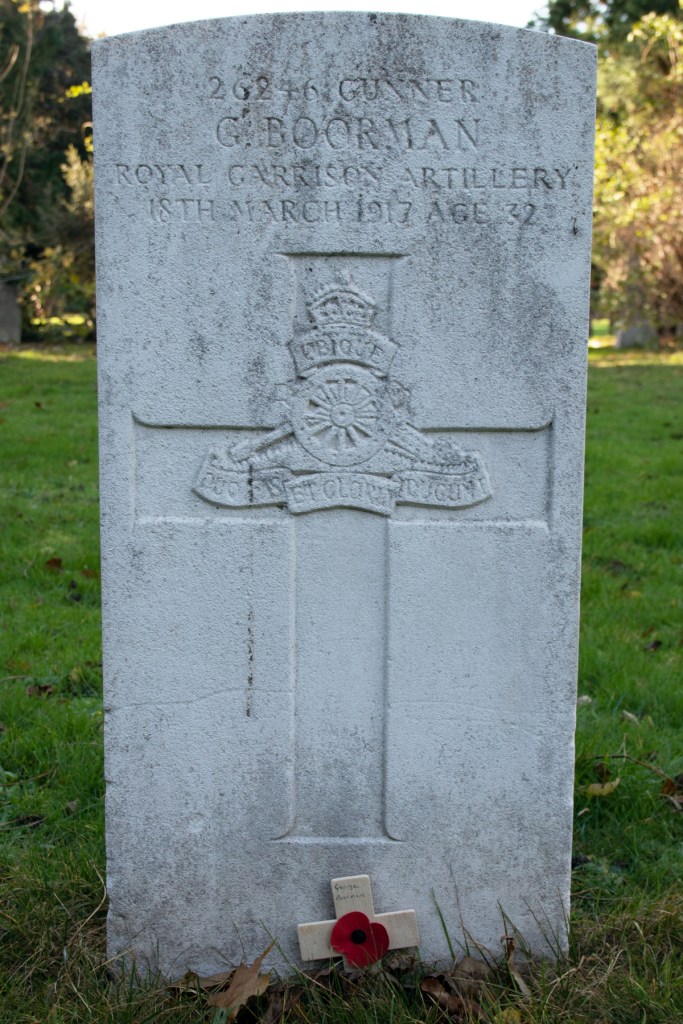
George Boorman was born in Lenham, Kent, in the spring of 1886, one of thirteen children to farm labourer George Boorman and his wife, Sarah. There is little further information about his early life, other than that he went into labouring when he finished school.
And agricultural life was not enough for George, however, and, on 15th January 1907, he enlisted in the Royal Garrison Artillery. His records show that he was 5ft 9.5ins (1.77m) tall and weighed 134lbs (60.8kg). George had hazel eyes, brown hair and a fresh complexion.
Full details of Gunner Boorman’s military service are not available, but the 1911 census records him as being attached to the 64th Company, based in Aden.
Further information about George’s life is difficult to piece together. His father died in 1913, and the next evidence of Gunner Boorman is that of his passing, on 18th March 1917. The cause of his death is lost to time, but he was 31 years of age.
George Boorman was laid to rest in the Borough Cemetery in Faversham, Kent.
Tragedy struck Sarah Boorman on more than one occasion. Four of George’s brothers died before they turned eighteen, while only six of her thirteen children outlived their mother.
William Reeves was born in the summer of 1896, one of eleven children to James and Ruth Reeves. James was a house painter from Henfield in West Sussex, and it was there that he and Ruth raised their growing family.
When war came to Europe, William was keen to play his part. He enlisted as a Gunner in the Royal Garrison Artillery, and, by October 1915, was in France.
Little information survives about Gunner Reeves’ military service, but by the time he was demobbed, he had earned the Victory and British Medals, the 1915 Star and the Silver War Badge. The latter award was given to those servicemen who had been honourably discharged from service due to wounds or sickness.
William returned to Sussex, but to a quieter home, James having passed away in the spring of 1916. William was also suffering with his health. He had contracted tuberculosis while in the army, and this is the condition to which he finally succumbed. He passed away on 16th December 1919, aged just 23 years old.
William Reeves was laid to rest in Henfield Cemetery, within walking distance of his family home.
James Joseph Wing was born in Tonbridge, Kent, in the summer of 1876 and was the oldest of six children to Henry and Frances Wing. Henry was a labourer, but when he finished school, James found work as an errand boy for the post office.
This was not a long-term career, however, and by the time of the 1901 census, when James was 25, he was labouring for the railway. His mother had died in 1897, and Henry remarried, to a woman called Frances Stapley.
In the spring of 1902, James also married, to Sussex-born Mary Ann Goacher. The couple wed in Steyning, near Worthing, but settled in Henfield. James seemed to be picking up work where he could – the census of 1911 recorded him as a coal porter, but by the time he enlisted, in June 1916, he gave his trade as a gardener.
James joined the Royal Garrison Artillery as a Gunner, and was initially assigned to the No. 1 Depot in Newhaven. Full details of his service are unclear, but he transferred to No. 2 Depot in Gosport, Hampshire, in the summer of 1918.
Gunner Wing had only been in Gosport for a couple of months, when he was admitted to the 5th Southern General Hospital in nearby Fratton. At 12:15pm on 4th December 1918, he passed away, a post mortem revealing he had succumbed to a cerebral tumour. He was 42 years of age.
James Joseph Wing was brought back to Sussex for burial. He was buried in the cemetery in his adopted home town of Henfield.
William Wellman was born in March 1890 and was one of nine children. His parents, road builder Thomas and collar machinist Eliza were both born in Somerset, and it was in Chard that they married and raised their family.
William and his siblings found work in the local lace industry – the 1911 census recorded most of the family in Chard, but William was boarding in Stapleford, Derbyshire, with his older brother Fred; both were working as lace hands.
War was coming to Europe, and, as a previous member of the territorial force of the Somerset Light Infantry, William was keen to play his part. In February 1915, he enlisted in the Royal Field Artillery: his records show that he was 5ft 7ins (1.69m) tall, had light brown hair, grey eyes and a slender build, weighing 129lbs (58.5kgs).
Gunner Wellman was sent to Wiltshire for training but, while in barracks, he fell ill. Having contracted tuberculosis of the kidney, he was admitted to a hospital in Sutton Veny. After two months’ treatment, his health did not improve sufficiently enough, and he was discharged from the army on medical grounds in February 1916.
William returned to Chard, but was not to get any better. He passed away at home on 1st April 1916; he was just 26 years old.
William Wellman was laid to rest in the cemetery of his home town, not far from his brother, Private Arthur Wellman.
William and Arthur were not the only two of the siblings to fight in the Great War.
Their youngest brother, Private Bert Wellman fought with the Somerset Light Infantry, and died in fighting in Mesopotamia on 22nd November 1915. He was just 20 years of age.
Charles – known as Charlie – Hooper was born on 22nd August 1898, the second youngest of nine children to Sidney and Sarah Hooper. Sidney was a carter from the village of Chillington in Somerset, but it was in nearby Cudworth that the family were born and raised.
Charlie, attended the local school like his older siblings, joining on 2nd June 1902, and remaining there until 28th August 1911. The following month his older sister died, and the next year his mother also passed away.
War was coming to Europe, and, while Charlie was too young to enlist when it first broke out, he seemed keen to play his part as early on as he could. He enlisted with the Royal Field Artillery at the start of 1917, and was assigned to the 23rd Reserve Battery.
Gunner Hooper was sent to Wiltshire for training. The next record for him is that of his passing. He died in Salisbury on 29th April 1917, the cause unrecorded. He was just 18 years of age.
Charlie Hooper’s body was brought back to Somerset for burial. He was laid to rest in the graveyard of St Michael’s Church in his home village, Cudworth.
Arthur William Young was born on 11th July 1900, in the Gloucestershire village of Charfield. His parents, James and Eliza, were both born in the area, and this is where they raised their nine children.
James worked as a bone turner and sawyer, working the material for things like buttons. This was a family trade, and something that Arthur followed his father and older siblings into when he finished school.
By this point, storm clouds were brewing over Europe. Arthur was too young to enlist when war first broke out, but when his older brother Francis died in Northern France in December 1917, this seemed to have driven him to play his part as well.
Arthur enlisted in the Royal Marine Artillery on 1st July 1918, a couple of weeks before his eighteenth birthday. Assigned the rank of Private, his records show that he was 5ft 9ins (1.65m) tall, had blue eyes, brown hair and a fresh complexion. It was also noted that he had a scar on his right wrist and another on his forehead.
After nine months’ service, Arthur was promoted to Gunner and, by the autumn of 1919, he was assigned to the dreadnought HMS Queen Elizabeth.
On 1st December 1920, while moored in Portland Harbour, Dorset, a concert was held on HMS Warspite. Gunner Young attended, but on the trip back to his own ship, the boat he was on collided with another, and he and three others were knocked overboard and drowned. He was just 20 years of age.
Arthur William Young was brought back to Gloucestershire for burial. He was laid to rest in the family plot in the Congregational Chapelyard in his home village of Charfield.







 Death and Service