Tag Archives: Hampshire

Second Lieutenant Walter Pawson

Second Lieutenant Walter Pawson

Walter William Stead Pawson was born in South Shields, County Durham, on 7th October 1895. The second of six children, his parents were Albert and Louise Pawson. Albert was a joiner by trade, and his work took the family north for a while. The 1901 census found them living in Glasgow, but by the time Walter’s youngest sibling was born in 1905, they were back in County Durham once more.

Little further information is available about Walter’s early life, but in around 1912, he sought a new life for himself, and emigrated to California. When war broke out, however, he felt the need to serve his home country and enlisted on 5th June 1917. His US draft card show that he was working as a clerk at the Hotel de Luxe in Long Beach, California. He was noted as being tall and slender with blue eyes and light brown hair. The document also confirms two years’ voluntary service in the militia while in Scotland, during which time he reached the rank of Lance Corporal.

The next record for Walter is a second enlistment document, this time on 6th September 1917. Signing up in Toronto, Canada, he was now joining the country’s Royal Flying Corps. Whether he had been turned down for US service, of whether he felt joining the Canadian Expeditionary Force offered him better options is unclear.

Returning to Britain, he took a commission in the Royal Flying Corps, and was attached to the 70th Training Squadron based in Hampshire. His service papers do not give much detail of the man he had become, but do note his height as 6ft (1.83m).

Second Lieutenant Pawson spent the next few months training. On the 6th Mary 1918, he was piloting an Avro 504J biplane, when things went wrong. He was looping the aircraft, when it fell into a spin and he was unable to recover it. The aeroplane crashed to the ground and Walter was killed.

The RAF Casualty Card noted that: “The court having carefully considered the evidence and having viewed the wreckage are of the opinion that the accident… resulting the fatal injuries to the pilot… was due to an error of judgement on the part of the pilot who was under instruction at the time.”

Walter was 22 years of age when he died. An obituary stated that he was a “bright promising youth, and a splendid type of British manhood he us but one of the many precious lives lost through this terrible war.” [Jarrow Express: Friday 24th May 1918]

Walter William Stead Pawson was laid to rest in the graveyard of St Mary’s Church, East Boldre, Hampshire, not far from the airfield he had so recently called home.


Lieutenant Alexander Talbot

Lieutenant Alexander Talbot

Thomas Alexander Talbot was born in Wellington, Ontario, Canada, on 16th February 1896. The youngest of seven children, he was one of two sons to Thomas and Jean Talbot. To avoid any confusion with his father, he was known by his middle name.

Before Joining the forces of the empire, Alex. Talbot was a student for three years at the University of Alberta. At the time of enlistment he was a student at law with A. G. MacKay, KC. He was well known in Edmonton and always took an active part in all sports connected with the university.

[Edmonton Journal: June 1918]

When war broke out, Alexander was keen to play his part. He enlisted in the Royal Flying Corps in 1917, although as his service records no longer exist, the above newspaper expands on his military career: “He trained at Camp Mohawk, ON., and after receiving his commission was instructor at Camp Borden, later going in the same capacity to Fort Worth, Texas. In February last he went overseas where he was a most efficient and painstaking officer and gained promotion rapidly.”

By the spring of 1918, he had gained a commission in the Royal Flying Corps and was based in East Boldre, Hampshire.

On 3rd June, Lieutenant Talbot was piloting a Sopwith Camel, when the engine stalled. The RAF Casualty Card noted: “The cause of the accident was in our opinion due to the choking of engine after being opened out following an overshooting in landing and stalling in turn and spinning to earth owing to an error of judgement on the part of the pilot.”

Lieutenant Alexander Talbot was killed in the aircraft crash. He was 22 years of age. His body was laid to rest in the graveyard of St Mary’s Church in East Boldre, not far from the airfield which he called home.


Lieutenant Alexander Talbot

Second Lieutenant Ronald Brown

Second Lieutenant Ronald Brown

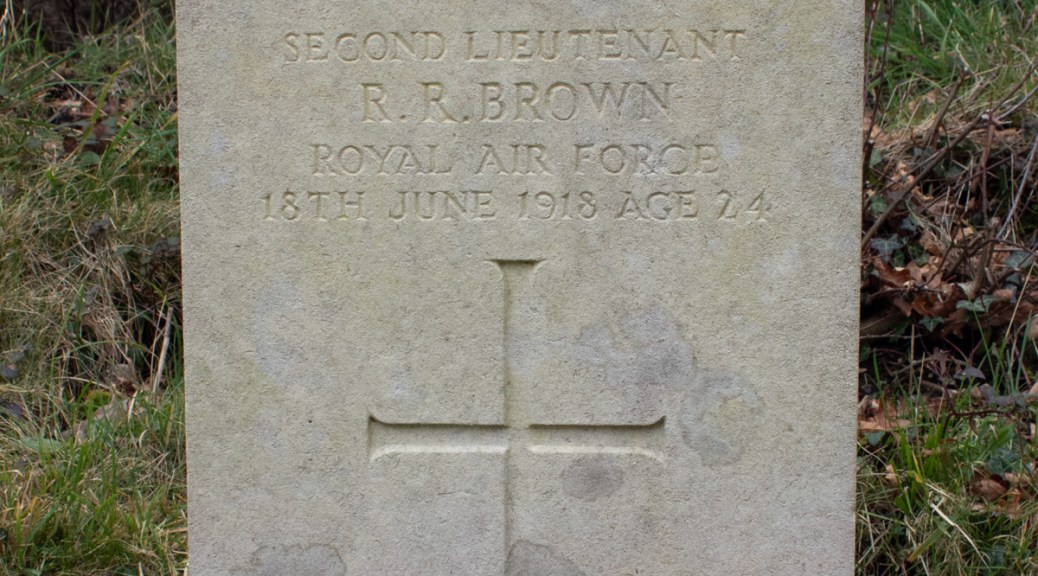
In the churchyard of St Mary’s, East Boldre, Hampshire, is a headstone dedicated to Second Lieutenant RR Brown of the Royal Air Force, who died on the 18th June 1918, at the age of 24.

The Commonwealth War Graves Commission confirms his father as William Brown of Lynnville, Ontario Canada. The 1901 census return confirms his forenames as Robert Ray and his mother as Annie Brown. William was a general labourer, but there is little further information about his son’s early life.

What can be confirmed is that, by the summer of 1918, Robert had stepped up to serve the Empire. He had gained a commission in the Royal Air Force, but it is unclear which part of the Canadian Expeditionary Force he had served with previously. Second Lieutenant Brown was, however, based at the 73rd Training Squadron in Hampshire.

On 18th June 1918, Robert was piloting a Sopwith Camel across the New Forest and out towards the Isle of Wight. His aircraft stalled, and fell into the Solent, and he was killed instantly. The RAF report card on the incident stated that: “The cause of the accident was, in our opinion, 1) The machine getting over the vertical in a dive. 2) Stalling on completion of a half-roll and nose diving into the Solent.”

The body of Robert Ray Brown was brought back to shore. He was laid to rest in the graveyard of St Mary’s Church, East Boldre, not far from the airfield he had called home.


Second Lieutenant John Morrison

Second Lieutenant John Morrison

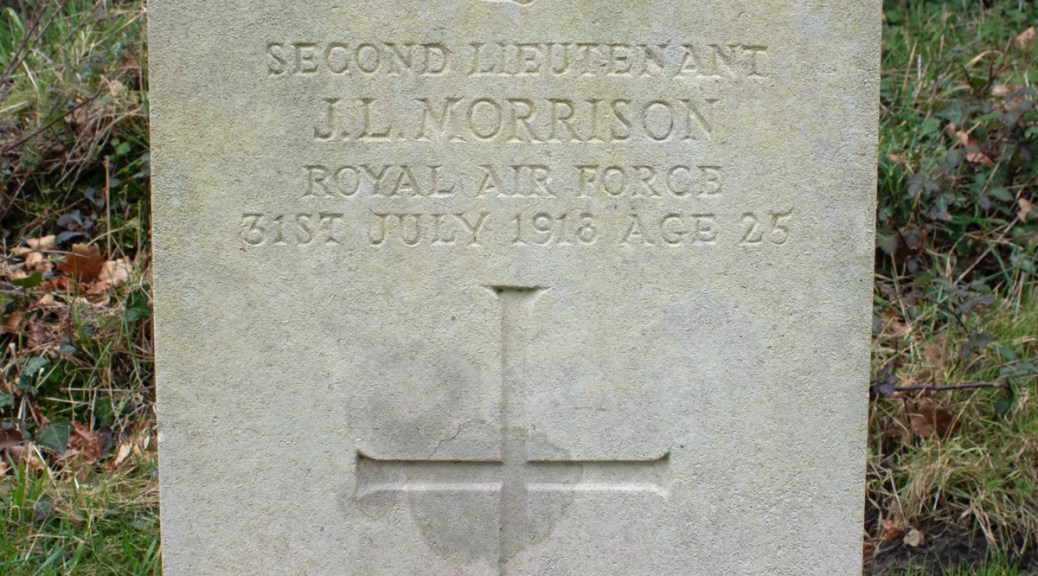
John Lindsay Morrison was born in Elma, Ontario, Canada, on 1st February 1894. One of eight children, his parents were farmers William and Elizabeth Morrison.

When John completed his schooling, he found employment as a bank clerk. He gave this up, however, when war broke out, enlisting in the Canadian Expeditionary Force on 24th August 1915. His service papers show that he was 5ft 7ins (1.7m) tall, with black hair, grey eyes and a dark complexion. No distinguishing marks were noted, but his religion was given as Presbyterian.

Private Morrison arrived in Britain on 11th April 1916. Assigned to the 32nd Battalion of the Canadian Infantry, he was billeted in Shorncliffe, Kent. His services records note that he arrived in France in June, and was promoted to Lance Corporal in February 1917. By May he was back in Britain, at Hursley Park, undertaking an aeronautics course with the Royal Flying Corps.

This seems to have been the route John wanted to take, and on 18th February 1918, he took a commission as a Second Lieutenant. He was based at the 29th Training Depot Station in East Boldre, Hampshire.

The role of a pilot was fraught with risk and, on 1st May 1918 – a month after the formation of the Royal Air Force – John was injured. His aircraft, an Avro 504, sideslipped while taking off from East Boldre airfield.

The court having viewed the wreckage at the scene of the accident, and having examined the wreckage area are of the opinion that 2nd/Lt. Morrison stalled Avro on a left hand turn and had not sufficient height to extricate the machine from the resulting spin.

Second Lieutenant Morrison would recover from his injuries, but more was to follow. Just three months later, on 31st July 1918, he had taken a Sopwith Camel up, and the aircraft crashed:

The cause of the accident was due to an error of judgement of pilot, in that he probably switched off at top of turn and had not time to get his nose down. Engine cut out at top of turn, causing machine to stall and then spin.

John was not to be so fortunate this time around. He was killed when the aircraft his the ground. He was 24 years of age.

Thousands of miles from home, the body of John Lindsay Morrison was laid to rest alongside colleagues from the squadron in St Paul’s Churchyard, East Boldre.


Serjeant Jack Hogan

Serjeant Jack Hogan

The personal life of Jack Hogan is a challenge to piece together, and much of the information is pulled from his service record. This confirms that he was born in 1890 in Cork, Ireland, and gives his next of kin as his mother, Annie Hogan, who was living in Southsea, Hampshire. He seems to have been born John Hogan, Jack being a common nickname, but there are too many census records with potential matches to narrow down a definite connection.

A Roman Catholic, Jack was 5ft 5.5ins (1.66m) tall. He had dark hair, brown eyes and a fresh complexion. He was also noted as having two small moles on his left cheek. He enlisted in the Royal Flying Corps as an Air Mechanic 2nd Class on 1st October 1915, leaving his job as a motor and cycle fitter to do so.

Jack seemed to have been proficient at what he was doing, and was promoted to Air Mechanic 1st Class less than a year after enlisting. On 5th February 1918 he rose again, taking the role of Acting Sergeant. When the Royal Air Force was formed in April that year, his rank was made permanent.

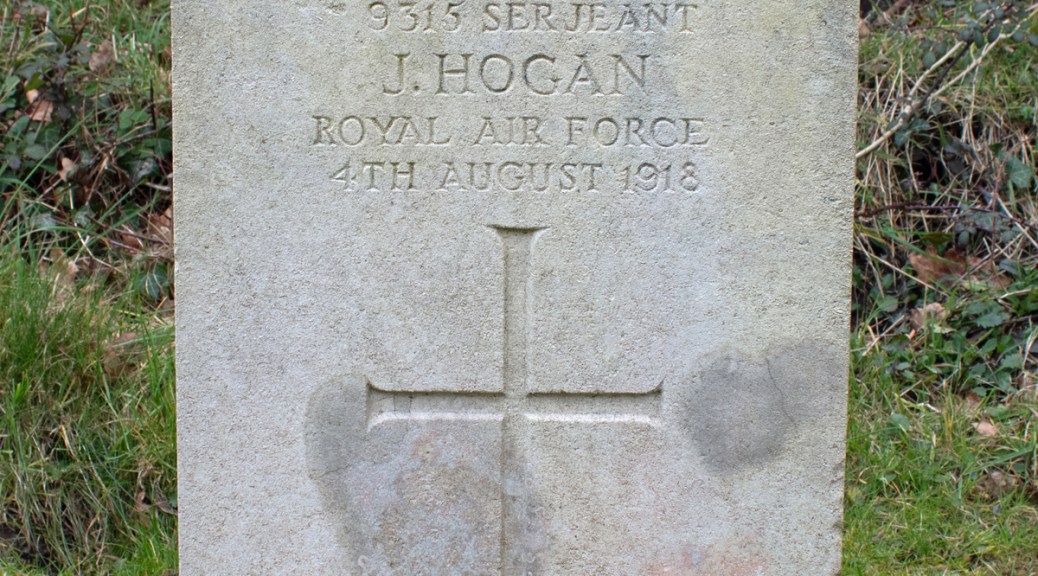
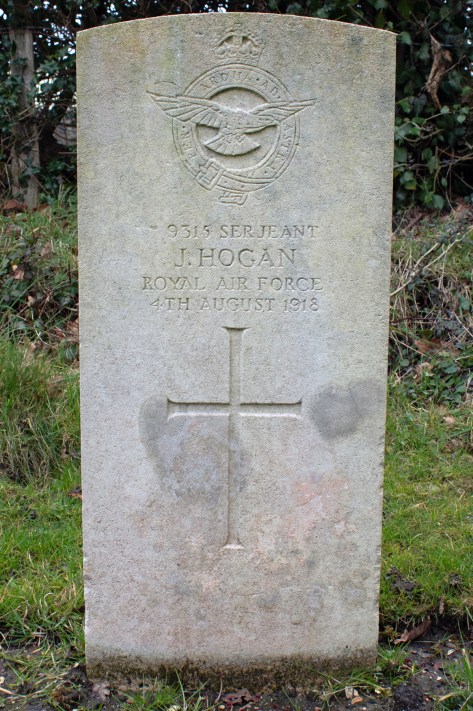
Sergeant Hogan was attached to the 29th Training Depot Station near East Boldre, Hampshire. On 4th August 1918, he was piloting an Avro 504, when it collided with another aircraft. There is little recorded about the incident, and his RAF Casualty Card does not give details of the other vehicle or its pilot. Jack’s biplane fell to the ground and he was killed. He was 28 years of age.

The body of Jack Hogan was laid to rest in the graveyard of St Paul’s Church in East Boldre, not far from the base that had become his home.


Second Lieutenant Vernon Kidd

Second Lieutenant Vernon Kidd

Vernon Monroe Kidd was born in Waco, Missouri, on 6th December 1896. One of nine children, his parents were William and Frances Kidd. William was a blacksmith and, by the time of the 1900 census, he had moved the family to Delaware, Indiana.

Details of Vernon’s life are a challenge to uncover, but a later newspaper report sheds some light on him:

Lieutenant Vernon Kidd, formerly of Yorktown, was killed August 30 in France, the news coming to Yorktown yesterday to his two brothers, J Wesley and William E Kidd. He was serving with the Canadian Aviation Corps and was but 21 years old. Only last April, while visiting Yorktown, Lieutenant Kidd spoke there at the ME Church. He sailed on June 18 for overseas service. He had tried numerous times to enlist in the United States army but was rejected and later went to Canada, enlisting at Toronto. He had another brother now serving in the army against Germany.

[The Star Press: 2nd September 1918]

Vernon’s service papers give a bit more information. He enlisted in Toronto on 12th October 1917, joining the Canadian Royal Flying Corps. He gave his next of kin as his father, who by now, was living in Port Angeles, Washington. Just short of his twentieth birthday, he was noted as being 5ft 9ins (1.75m) tall.

Sent to Britain, Vernon was based at the 29th Training Depot Station in East Boldre, Hampshire. When the Royal Air Force was founded in April 1918, he transferred across, and just a month later, he received his commission.

On the 30th August 1918, Second Lieutenant Kidd was piloting an Avre 504J biplane. It had just taken off, but the engine cut out. He had little choice but to crash land, and was killed in the impact. Vernon was 21 years of age.

Thousands of miles from home, the body of Vernon Monroe Kidd was laid to rest in the graveyard of St Paul’s Church in East Boldre.


Second Lieutenant Vernon Kidd
(from findagrave.com)

Second Lieutenant Arthur Belyea

Second Lieutenant Arthur Belyea

Arthur Fred Belyea was born in Penetanguishene, Ontario, Canada, on 21st October 1894. The second of five children, he was one of three sons to John and Sarah. John was a farmer, and local to the area, but Sarah, who was sixteen years her husband’s junior, had been born in Pennsylvania, and lived in Kansas for twenty years before moving to Canada.

By the time of the 1911 census, the family had moved to Calgary, where John had taken up work as a horse dealer. Interestingly, the census also recorded the Belyeas’ racial background, which was German, although John and Sarah were at least second generation North American.

Arthur had finished school by this point, and had found employment as a bookkeeper for the Royal Bank of Canada. He was settled in for a career, and, by 1916 had achieved the role of assistant accountant. War was on the horizon, however, and life was to change.

Full details of Arthur’s military service have been lost to time, but it is clear that he enlisted in the Canadian Royal Flying Corps on 3rd December 1917. His service papers show that Air Mechanic 3rd Class Belyea was 5ft 5.5ins (1.66m) tall, with dark brown hair, hazel eyes and a medium complexion.

Arthur was sent to Britain and stationed at East Boldre, Hampshire. When the Royal Air Force was formed on 1st April 1918, he transferred across. He was obviously proficient at what he did, because at the end of May he earned a commission, and rose to the rank of Second Lieutenant.

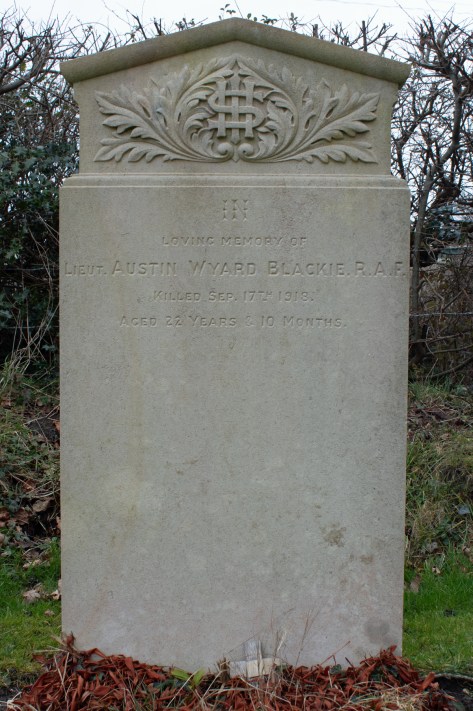
Mr A C Hallett, Deputy County Coroner, held inquests on Tuesday, of Lieut. Austin Wyard Blackie, RAF, of California, and Second-Lieut. Arthur Fred Belyea, RAF, of Calgary, Canada, who met thwir deaths while flying. The evidence showed that their machines collided at a great height, and that death in each case must have been instantaneous. Verdicts of “Accidental death” were returned.

[Hampshire Advertiser: Saturday 21st September 1918]

The RAF report card on the incident noted that: “The cause of the accident was in our opinion an error of judgement on one pilot (unknown) in flying his machine into the other machine from the rear, causing the left hand frame of Camel C8322 and the right hand frames of Camel C96 to collapse, thus causing each machine to spin to the ground. The one pilot was probably attempting to obtain good photographs of the other machine.”

Arthur Fred Belyea was 23 years of age when he died on 17th September 1918. He was laid to rest alongside Lieutenant Blackie in the graveyard of St Paul’s Church, East Boldre, not far from the airfield at which he served.


You can read about the life of Lieutenant Blackie here.


Second Lieutenant Arthur Belyea
(from findagrave.com)

Lieutenant Austin Blackie

Lieutenant Austin Blackie

Austin Wyard Blackie was born in Spring Bay on Ontario’s Manitoulin Island on 17th November 1895. The seventh of eight children, his parents were farmers John and Mary Blackie. John took the family to where the work was: by the time of the 1901 census they had relocated to Algoma, 190km (120 miles) to the north west.

Little further information is available about Austin’s early life. When war broke out, he stepped up to play his part. His military records take a bit of unpicking, but he joined the Canadian Expeditionary Force on 10th April 1916, and was assigned to the 227th Battalion as a Sergeant. He was dismissed from service on 15th December 1916, as he was deemed medically unfit.

Undeterred, Austin’s service papers confirm that he re-enlisted on 7th March 1917, and that he was a student at the University of Toronto Officers’ Training Corps at the time. This document also gives his year of birth incorrectly as 1894.

Austin’s medical in 1917 confirmed that, at 22 years of age (based on the incorrect year of birth), he was 5ft 7.5ins (1.71m) tall and weighed 143lbs (64.9kg). He had fair hair, grey eyes and a fair complexion, good hearing and 20/20 vision. He was also recorded as having a number of scars: two either side of his stomach from an operation, and a third on the right side of his left ankle.

Sergeant Blackie’s time in the army was not destined to be a lengthy one, and there is a sense of his determination to better himself. On 5th May 1917, he was discharged from service again, but this time because he mad the transfer to Canadian Royal Flying Corps.

At this point, Austin’s trail goes frustratingly cold. He was shipped out to Britain, and was based at the 29th Training Depot Station in East Boldre, Hampshire. When the Royal Air Force was formed, he transferred across, and, at some point during this time, he was promoted to the rank of Lieutenant.

Mr A C Hallett, Deputy County Coroner, held inquests on Tuesday, of Lieut. Austin Wyard Blackie, RAF, of California, and Second-Lieut. Arthur Fred Belyea, RAF, of Calgary, Canada, who met thwir deaths while flying. The evidence showed that their machines collided at a great height, and that death in each case must have been instantaneous. Verdicts of “Accidental death” were returned.

[Hampshire Advertiser: Saturday 21st September 1918]

The report’s suggestion that Austin was from California is incorrect, although his parents had, by this point, moved there from Canada.

The RAF’s own report gave a little more detail on what happened:

The court considered the evidence, found that the cause of the accident was entirely due to misadventure in that the [Lieutenant Blackie’s] foot became entangled behind the rudder bar, the machine thus being our of control.

It appears that Austin had been offered a different aircraft to the Sopwith Camel in which he he had been killed. “He apparently took his machine up without asking his Flight Commander’s permission or his Instructor’s, contrary to standing orders.”

Second Lieutenant Belyea’s report card adds a stark twist to the crash: “The cause of the accident was in our opinion an error of judgement on one pilot (unknown) in flying his machine into the other machine from the rear, causing the left hand frame of Camel C8322 and the right hand frames of Camel C96 to collapse, thus causing each machine to spin to the ground. The one pilot was probably attempting to obtain good photographs of the other machine.”

Austin Wyard Blackie was just 22 years of age when he died on 17th September 1918. He was laid to rest alongside Second Lieutenant Belyea in the graveyard of St Paul’s Church, East Boldre, not far from the base in which he had served.


You can read about Second Lieutenant Belyea’s life here.


Lieutenant Austin Blackie
(from findagrave.com)

Sergeant Charles Chown

Sergeant Charles Chown

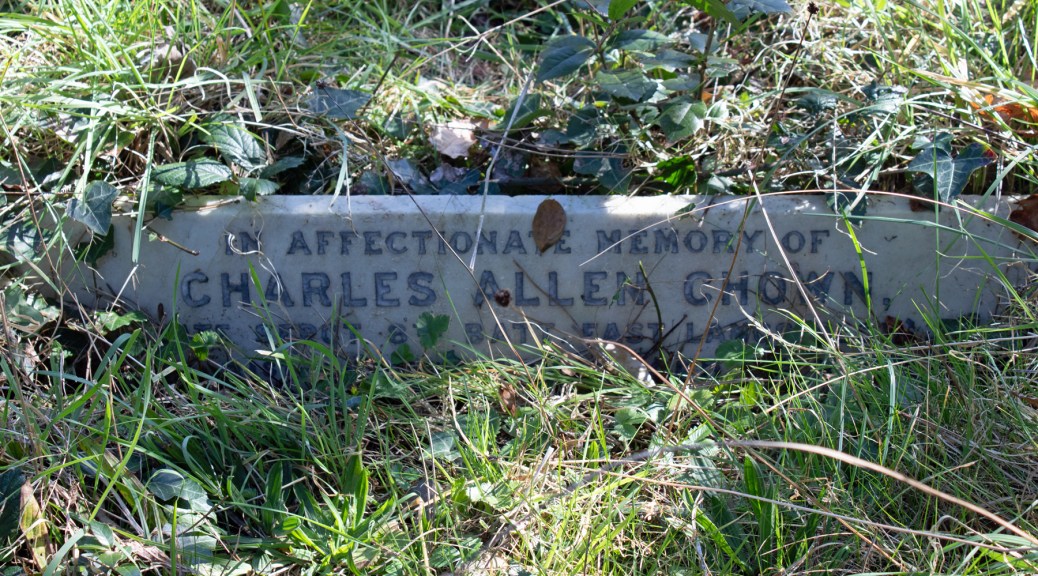
Charles Allen Chown was born in the Sussex village of Lyminster, at the start of 1882. The tenth of eleven children, his parents were Samuel and Mary Chown. Samuel was a general labourer, and when he passed away in 1898, Charles and his siblings rallied to support his now widowed mother.

The 1901 census found Mary, Charles and his brother Jesse living at 32 Lennox Road, Worthing, West Sussex. Jesse was employed as a brickmaker, while Charles had found work as a solicitor’s clerk. The family had two boarders, Helen and Rosie Bulbeck, and Charles’ niece, Minnie, was also staying with them.

Away from work, Charles was a music lover, and joined the local operatic society. In 1904 he appeared in a local version of Iolanthe, his “piece of portraiture being described as one of the successes of the occasion, for his facial play was good, and the drolleries of the character were displayed in an each and natural manner.” [Worthing Gazette: Wednesday 12th September 1917] In the following year’s Mikado, he took the role of the Lord High Executioner, and he was noted as being a “born comedian, with the most mobile countenance and a singularly dry form of humour…” [Worthing Gazette: Wednesday 12th September 1917]

By the time of the 1911 census, Charles had moved on with work, and moved out of home. Taking a room at 7 Tarring Road, Worthing, his landlords were Harold and Rose Ward. Still employed as a clerk, he was now employed by one of the estate agents in the town, although it is clear that his passion was elsewhere. When he joined up in the autumn of 1914, he gave his trade as musician.

Charles enlisted on 7th October 1914 in Ashton-under-Lyme, Lancashire. What took him north is unclear, although a theatre tour is a possibility. His service records note that he was 5ft 8.5ins (1.74m) tall and weighed 138lbs (62.6kg). He had dark brown hair, brown eyes and a sallow complexion.

Initially assigned to the Manchester Regiment, Private Chown was soon transferred to the 8th (Service) Battalion of the East Lancashire Regiment. He was obviously dedicated to his job: by the end of October 1914 he had been promoted to Lance Corporal, and within six weeks he rose to Sergeant.

In July 1915, Charles’ unit was dispatched to France. That autumn, they remained based near Tilques, in Northern France, but Sergeant Chown’s health was beginning to suffer. After just three months overseas, he was medically evacuated to Britain to receive treatment for pleurisy, and was hospitalised in Chatham, Kent.

When he recovered, Sergeant Chown was reassigned to the 10th Battalion of the East Lancashire Regiment, before being transferred to the 47th Training Reserve Battalion in September 1916. That winter, however, his health received a setback, and he contracted tuberculosis. He would spend the first half of the following year in hospitals in Aldershot in Hampshire, Sutton Veny in Wiltshire and, from May 1917, the 3rd Southern General Hospital in Oxford.

Sergeant Chown’s health would continue to deteriorate, and he was formally discharged from the army on 6th July 1917. He returned to Worthing, and his mother’s home, 2 Montague Place. Charles would eventually succumb to his medical condition, and he passed away on 31st August 1917, at the age of 35 years old.

The body of Charles Allen Chown was laid to rest in the family plot in Broadwater Cemetery, Worthing.


Lieutenant Allan Furlong

Lieutenant Allan Furlong

Allan Hyde Furlong was born the autumn of 1874, and was the oldest of seven children to Joseph and Adelaide Furlong. The place of his birth varies depending on which document you’re looking at, with census records suggesting he was born in Pembrokeshire, Wales, or Aldershot, Hampshire. His birth was registered in Eastry, Kent, however, so it is possible that this is where the family were based at the time.

Joseph was an officer in the North Lancashire Regiment, and his work meant the family moved time and time again. Allan’s younger siblings were born in Hampshire, Pembrokeshire and Athlone, Ireland. By the early 1880s, they had settled in Lancashire, the 1891 census recording them as living in the Fulwood Barracks in Preston.

Given his father’s military background, it is not surprising that Allan was drawn to follow suit. He took a different route, however, and enlisted in the Royal Naval Reserve. Midshipman Furlong took a commission on 27th August 1892, and would make a career out of the navy.

By the time war broke out, Allan was serving on board the SS Burma. In May 1915 he was promoted to Sub Lieutenant, and a further rise in rank – to full Lieutenant – followed in January 1918. He survived the war, and remained at sea through to the start of the new decade.

In March 1920, Lieutenant Furlong was admitted to the Royal Marine Infirmary in Deal, Kent, suffering from a combination of influenza and pneumonia. The conditions would get the better of Allan, and he passed away from them on 14th March 1920: he was 45 years of age.

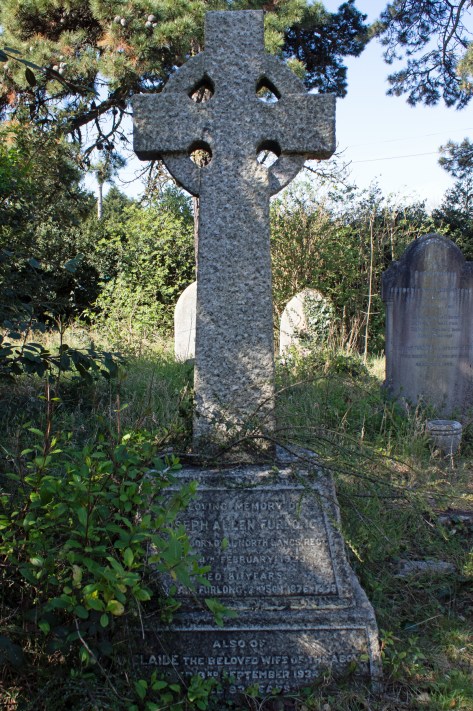
Joseph and Adelaide were living in Worthing, West Sussex, by this point. Keen to bring their son home, the body of Allan Hyde Furlong was laid to rest in the town’s Broadwater Cemetery.