Tag Archives: Hampshire

Stoker 1st Class Stanley Curtis

Stoker 1st Class Stanley Curtis

Stanley Curtis was born on 31st October 1899, and was one of 21 children to Rowland and Sarah Curtis. Rowland was a gardener and labourer from Warminster, Wiltshire, and it was here, at 9 Marsh Street, that the family were raised.

There is little information available about Stanley’s early life: he was only two years old at the time of the 1901 census, and still at school for the next return in 1911. Later document, however, confirms that he worked as a farm labourer when he completed his schooling and that he was an active member of the Warminster Cadets.

Stanley was keen to play his part when war broke out. He enlisted in the Royal Navy as soon as he was able to, joining as a Stoker 2nd Class on 7th December 1917. His service records show that he was 5ft 4ins (1.62m) tall, with brown hair, brown eyes and a fresh complexion.

Stoker 2nd Class Curtis was sent to HMS Victory, the Royal Naval Dockyard in Portsmouth, Hampshire, for his training. After four months there he was given his first assignment, on board the protected cruiser HMS Amphitrite. Working as a minelayer, she served in the North Sea, and was positioned off Scotland when Stanley fell ill.

Stoker Curtis was disembarked in Edinburgh, and was admitted to the city’s Royal Naval Hospital with peritonitis. Sadly the condition was to prove fatal, and he passed away on 13th September 1918, a few weeks short of his 19th birthday.

The body of Stanley Curtis was brought back to Wiltshire for burial. He was laid to rest in the graveyard of Christ Church, Warminster, just a few minutes’ walk from where his grieving family lived.


Sergeant Herbert Marriott

Sergeant Herbert Marriott

Herbert Ernest Marriott was born on 15th November 1881 in the Hampshire village of Alverstoke (now part of Gosport). The younger of two children, his parents were George and Sarah Marriott. George was a navy pensioner, who died a matter of months after his youngest son was born, leaving Sarah to raise their two children alone.

The 1891 census found Sarah living at Prince Alfred Cottage in Alverstoke, with her two sons – Herbert, aged 9, and Joseph, aged 22 – and grandson, one-year-old Charles. She was employed as a launderess, while Joseph was employed as a bricklayer’s labourer.

Herbert was keen to build a career for himself and, on 20th July 1897, he enlisted in the Royal Marine Light Infantry. His service record shows that he was 5ft 7.5ins (1.71m) tall, with dark brown hair, brown eyes and a fresh complexion. He was also recorded as having a small scar on his left shoulder.

Private Marriott was sent just along the coast to Portsmouth for his training: this would become his land base in between voyages. He evidently showed some musical talent as, just two months after enlisting, he was given the rank of Bugler. Over the years the career he had sought grew, and his abilities grew with it.

Between 1897 and 1914, Herbert would serve on nine vessels in total. In February 1900 he became a Private once more, but by the end of the following year he had been promoted to Corporal. He continued to rise through the ranks, becoming Lance Sergeant in January 1905 and full Sergeant in the summer of 1907.

In the spring of 1901, Herbert married navy pensioner’s daughter Annie Hill. The newlyweds would set up home at 140 Queen’s Road, Gosport, and have six children between 1904 and 1914.

Back at sea and, by the time war was declared, Sergeant Marriott had been assigned to the battleship HMS Bulwark for two years. Part of the Channel Fleet, she was charged with patrolling and protecting the water off the south coast of England.

On 16th November, Bulwark was moored in the River Medway, near Sheerness, Kent, and being restocked with ammunition. A number of cordite charges had been stored incorrectly and overheated. These detonated the nearby shells and the resulting chain reaction of explosions ripped apart the battleship, sinking it and killing more than 740 crewmen, including Sergeant Marriott. He had turned 33 years of age just the day before.

The bodies recovered were laid to rest in the naval section of Woodlands Cemetery, Gillingham, Kent. As his had been identified, Herbert Ernest Marriott was buried in a marked grave.


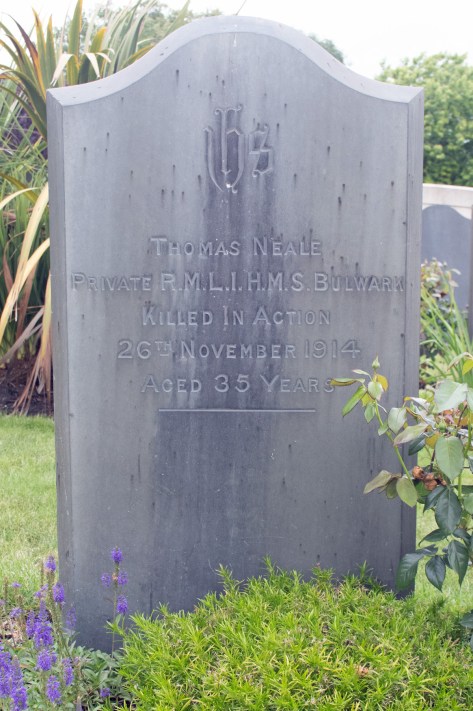
Private Thomas Neale

Private Thomas Neale

Thomas Neale was born in the Botley, Oxfordshire, on 3rd June 1876. One of eight children, his parents were George and Mary Neale. George was an agricultural labourer and the family would settle in Cumnor, just over the Berkshire border.

Thomas was keen to make a life for himself and, on 29th December 1898, he enlisted as a Private in the Royal Marine Light Infantry. HIs service papers show that he had been employed as a general labour and the point he signed up, and give an indication into the man he was becoming. He was noted as being 5ft 7ins (1.7m) tall, with grey eyes, brown hair and a fresh complexion. He was also recorded as having a small scar on his right knee.

Private Neale was initially sent to the Royal Marines barracks in Deal, Kent, for his training. Over the next sixteen years, he would serve on eight ships, each time returning to what would become his home base, the Royal Naval Dockyard in Portsmouth, Hampshire, in between voyages. While never outstanding, his annual reviews reported his good or very good character, and very good ability.

When war broke out in the summer of 1914, Private Neale was serving on board the battleship HMS Bulwark. Part of the Channel Fleet, her role was to patrol and protect the English Channel and south coast.

On 26th November she was moored up in the lower reaches of the River Medway, not far from Sheerness, being re-stocked with ammunition. That morning, a number of cordite charges overheated, detonating the shells stored nearby. The resulting explosion ripped through the battleship, and more than 740 crew were killed. Thomas was amongst those whose bodies were recovered and identified: he was 38 years of age.

The bodies that were recovered from the tragedy were taken to the Woodlands Cemetery in nearby Gillingham and laid to rest. Thomas Neale was buried alongside his colleagues in a marked grave, while those whose remains had not been identified were laid to rest in a mass grave nearby.


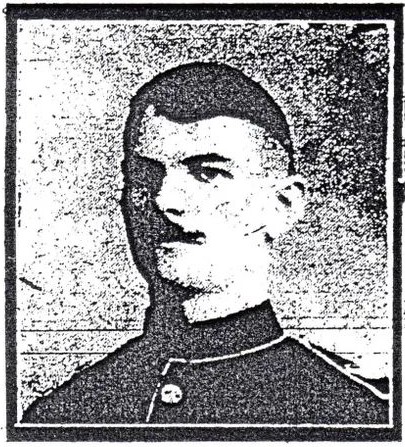
Private Thomas Neale
(from findagrave.com)

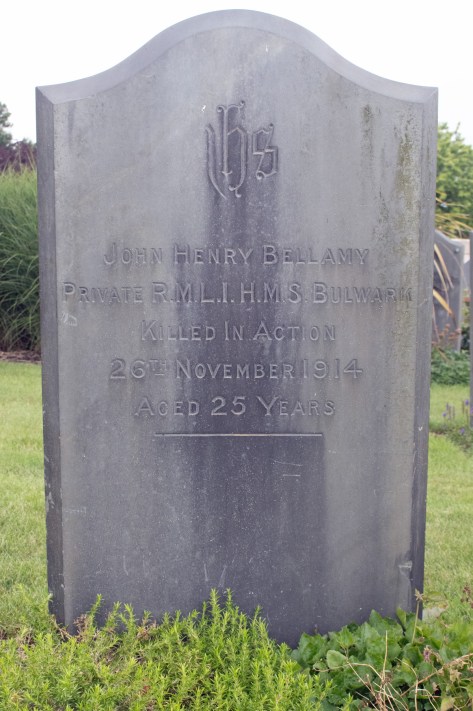
Private John Bellamy

Private John Bellamy

John Henry Bellamy was born in Leicester, Leicestershire, on 14th August 1890. The oldest of four children, his parents were Joseph and Alice Bellamy. Joseph worked as an iron moulder, and the couple lived at 70 Friars’ Causeway when their first child was born.

By the time of the next census, taken in 1901, the Bellamy family had moved, and were living at 19 Pingle Street. Close to the river, this was presumably also close to the foundry where Joseph was employed. John sought a more regular income, however, and, on 22nd November 1907, he gave up his work as a shoe dresser, and enlisted in the Royal Marine Light Infantry.

John’s service records show that he was just over 5ft 5ins (1.65m) tall, with light brown hair, grey eyes and a fair complexion. He had a number of scars, including one by his left elbow and another on the right side of his chin.

Private Bellamy was sent to Deal, Kent, for his training. He spent a year at the Royal Marines base there, and this is where his ability to swim was tested. Over the next seven years, he would go on to serve aboard five ships, more often than not being based in Portsmouth, Hampshire, between assignments.

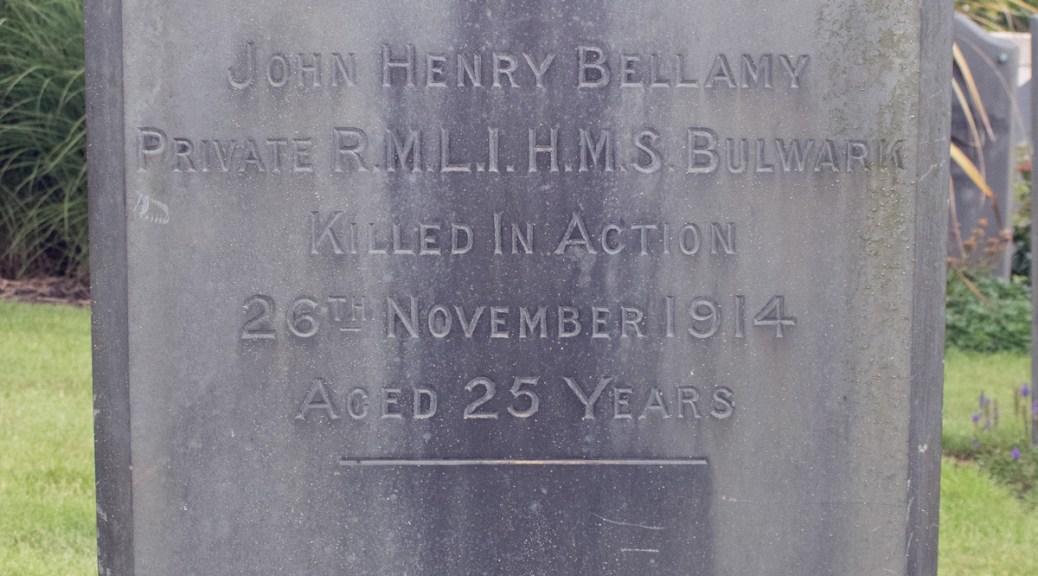
In July 1914, John was assigned to HMS Bulwark, and would remain with her for the next few months. Indeed, he was on board Bulwark on the 26th November 1914, when she was moored close to Sheerness, Kent. That morning, an explosion ripped through the ship, sinking it and killing more than 740 people. Private Bellamy was amongst them: he was just 24 years of age.

The body of John Henry Bellamy was laid to rest in a marked grave in the naval section of Woodlands Cemetery, Gillingham, Kent.


Leading Seaman Dan Pierson

Leading Seaman Dan Pierson

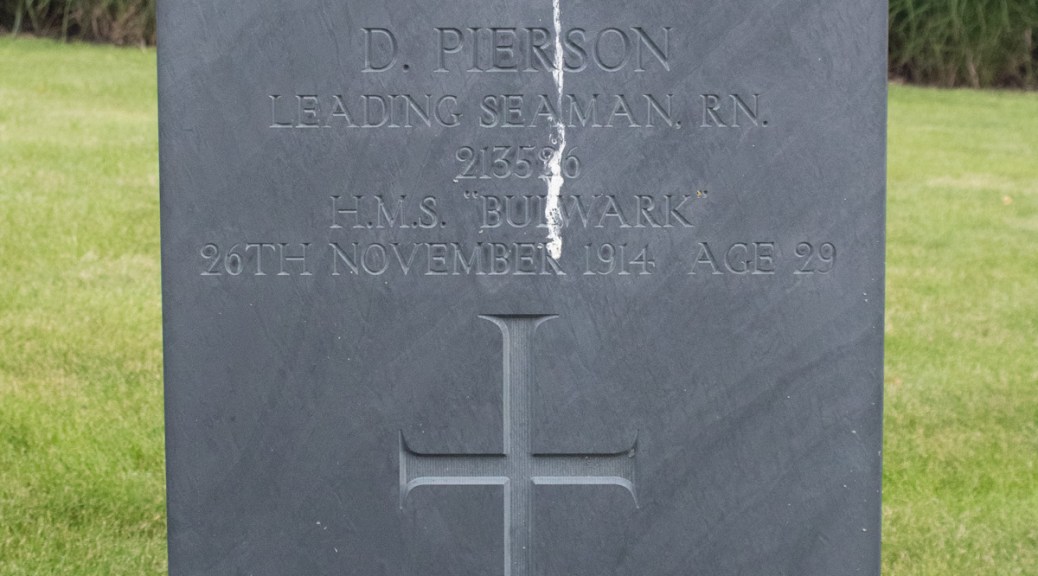
Dan Pierson was born in Liss, Hampshire, on 14th February 1884. One of eleven children, he was the third of four sons to Daniel and Annie Pierson. Daniel was an agricultural labourer, but his son wanted a more guaranteed career and, on 21st February 1901, he joined the Royal Navy.

Having only just turned 17, Dan was too young to formally enlist, and so was given the rank of Boy 2nd Class. He would spend the next year on training ships – HMS Northampton and HMS Calliope – and was also billeted at HMS Victory, the Royal Naval Dockyard in Portsmouth, Hampshire. Just two months after joining, he was promoted to Boy 1st Class and, when he came of age in February 1902, he was fully enrolled into the navy, and given the rank of Ordinary Seaman.

Dan was assigned to the gunboat HMS Redbreast by this point, and his service records show the young man he had become. He was 5ft 6ins (1.68m) tall, with dark brown hair, grey eyes and a fresh complexion. He also had two tattoos: one of a woman on his right arm, and another of a swallow on his left.

Ordinary Seaman Pierson’s contract was for twelve years and, over that time, he served on board eight different vessels. His annual reviews commented on his very good character and his superior ability, both of which backed up his progression through the ranks. On 11th June 1903, towards the end of his three years aboard Redbreast, he was promoted to Able Seaman, and on 1st December 1913, just a couple of months before the end of his initial term of service, he rose to Leading Seaman.

By this point, Dan had married. His new wife, Edith, was a railway worker’s daughter from Harting in Sussex. She was working as a housemaid for Reverend John Leake and his wife Helena at the time of their wedding.

When his contract came to an end, Leading Seaman Pierson immediately renewed it. His papers show that he had grown to 5ft 9.5ins (1.77m) in height but that he had been injured in the intervening years: it was noted that the little toe of his right foot was missing, and that he had a scar on his left leg.

By the time war broke out, Leading Stoker Pierson was assigned to the pre-dreadnought battleship HMS Bulwark. During the summer of 1914, she was one of the Channel fleet used to protect ships transporting troops across to France. He was on board Bulwark when, on the morning of 26th November 1914, an explosion ripped through the ship while it was moored near Sheerness, Kent, tearing it apart and sinking it. In all 741 souls were lost, Dan amongst them. He was 30 years of age.

Dan Pierson’s body was recovered and identified. He was laid to rest in Woodlands Cemetery, Gillingham, Kent, not far from Chatham Dockyard.


Edith’s brother Ernest Pay was also serving in the Royal Navy. Attached to HMS Bulwark as well, Leading Stoker Pay was also killed in the explosion: he was 28 years of age. Tragically for Edith and her parents, Ernest’s body was never recovered. His loss is commemorated on the Portsmouth Naval Memorial in Hampshire.


Second Lieutenant Frank Reid

Second Lieutenant Frank Reid

Frank Rice Reid was born on 1st September 1898 in Toronto, Canada. One of four children, his parents were Nova Scotians George and Annie Reid. George was a commercial traveller, and the family had moved back to Nova Scotia by the time of Frank’s youngest sibling’s birth in 1910.

When Frank finished his schooling, he found work as a clerk, but was drawn to the excitement of flight and, soon became an aviation cadet. War was raging across Europe by this point, and, on 9th October 1917, he enlisted in the Royal Flying Corps. At 19 years and one month old, his service papers show that he was 5ft 7ins (1.7m) tall.

By the spring of 1918, Frank was in Britain, and had been a commission to Second Lieutenant. Assigned to the newly-formed Royal Air Force’s No. 1 Training School in Beaulieu, Hampshire, within a matter of months he was working as an instructor, flying Sopwith Camels.

On the morning of the 30th September 1918, Second Lieutenant Reid was flying his aircraft, when it crashed into the ground and he was killed. He had not long turned 20 years of age. The report of the incident noted that “the cause of the accident was an error of judgement on the part of the pilot in doing a half-roll too near the ground and not having enough height to come out of the dive.”

The body of Frank Rice Reid was laid to rest in the graveyard of St Paul’s Church, East Boldre, not far from the base he had called home.


Second Lieutenant Frank Reid
(from finagrave.com)

Flight Cadet Douglas Baker

Flight Cadet Douglas Baker

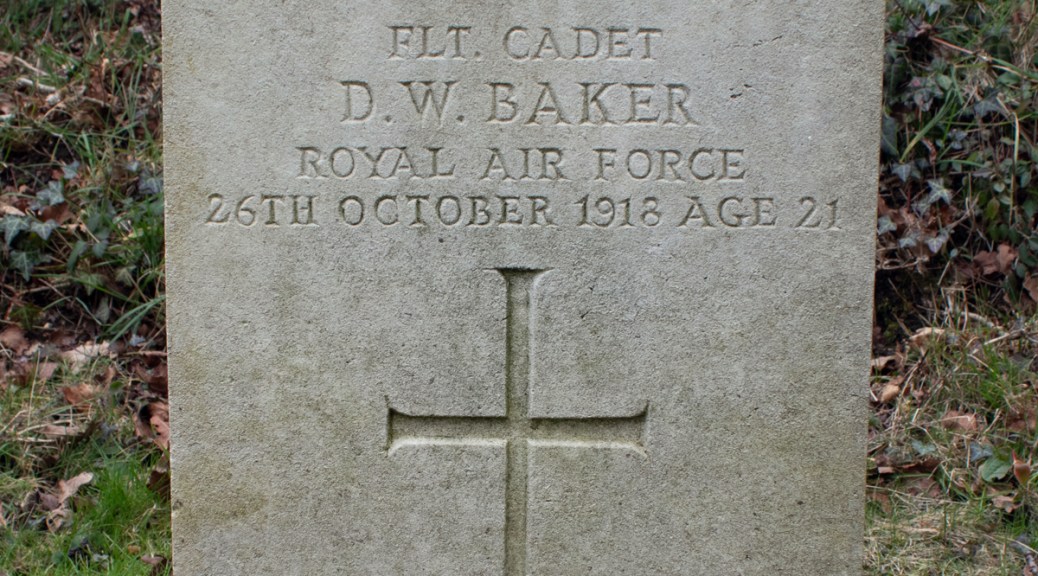
Douglas Walter Baker was born in Newbury, Berkshire, in 1898. One of seven children, his parents were Henry and Rosa Baker. Henry was a commercial traveller for a cornmeal, cake and flour merchants, and the family lived at 91 Crescent Road, Reading at the time of the 1901 census, then at 196 King’s Road, Reading, ten years later.

There is little concrete information about Douglas’ early life. When war broke out, he enlisted in the 4th Battalion of the Royal Berkshire Regiment, later documents seeming to suggest that he had added three years to his age to enable him to do so. His unit served in France from April 1915, but, as his army service records have been lost, it’s unclear when or if Private Baker went with them.

Douglas seemed to want more, though, and, on 18th December 1915, he transferred to the Royal Flying Corps. Given the rank of Air Mechanic 2nd Class, he was attached to No. 1 Aircraft Repair Depot. By March 1917, he had been promoted to Air Mechanic 1st Class. Again, however, he sought more and, just a few months after the Royal Air Force was formed, he started flying lessons.

The now Flight Cadet Baker had transferred to 29 Training Depot Station in Hampshire. Based at an aerodrome near Beaulieu, Douglas was taught in a Sopwith Camel. Two months into his instruction, he was undertaking a routine flight, when his aircraft got into a spin he was unable to get out of. The machine fell to the ground, and Douglas was killed instantly.

A report of the incident noted that: “the cause of the accident was in our opinion due to the machine spinning to the ground from about 500ft. The reason the pilot could not regain control of the machine is unknown.” [Royal Air Force Casualty Card]

Douglas Walter Baker was just 20 years of age when he died on 26th October 1918. His body was taken to the graveyard of St Paul’s Church, East Boldre, not far from the air base at which he had been billeted.


Flight Cadet Douglas Baker
(from findagrave.com)

The life of a WW1 pilot was notoriously dangerous. On the same day of Douglas’ death, and at the same airfield, fellow pilot Second Lieutenant Malcolm Vande Water lost his life in a separate incident.


Second Lieutenant Malcolm Vande Water

Second Lieutenant Malcolm Vande Water

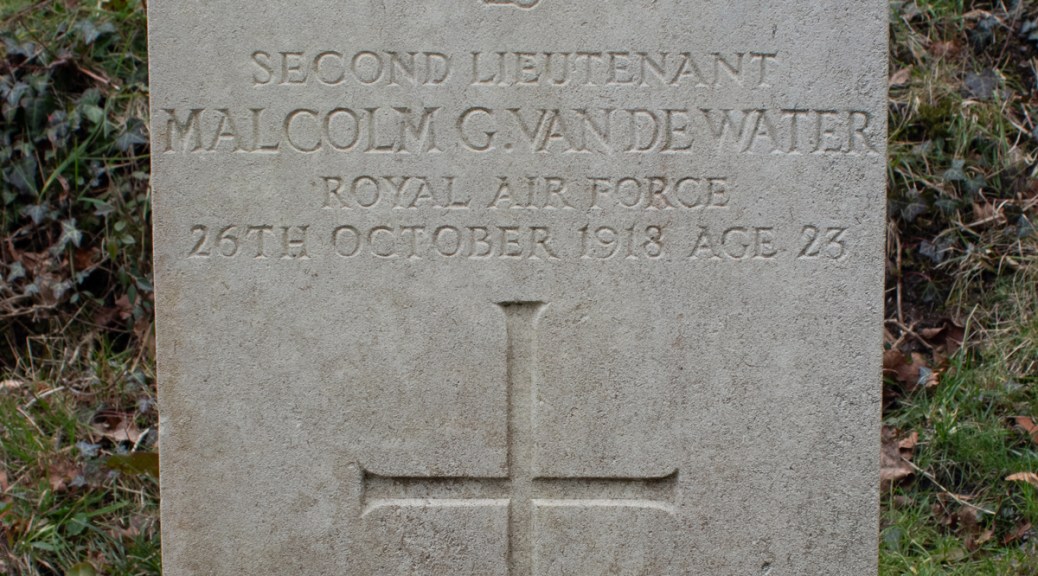
Malcolm Gifford Boggs was born on 14th August 1894 in Brooklyn, New York. The second of four children, his parents were Seth and Anna Boggs. Seth died in 1905, and Anna married again, to widower lawyer Charles Vande Water: her children took his name.

The next record for Malcolm is that of his Royal Flying Corps service records. Interestingly, they note that he enlisted on 10th September 1917, and did so in Toronto, Canada. While the United States had entered the First World War by this point, it may have been easier for him to join via a colonial route.

Malcolm’s papers show that he was 5ft 11ins (1.81cm) tall, and was a student aviator at the time he joined up. He was recorded as being an Air Mechanic 3rd Class, but that came to an end when, on 2nd February 1918, he was accepted for a commission.

Second Lieutenant Vande Water was attached to the 29th Training Depot Station in Hampshire. There is little information about his time there, but a later American newspaper provided details of what happened to him:

Intelligence reaching relatives of Lieutenant Malcolm G Vande Water, of the Royal flying corps, a former Passaic newspaper man, is that he was killed in a fall while testing a new airplane at the British airdrome in Beaulieu, France. Wande Water was the first member of the Pica club to pay the supreme sacrifice. He was on leave in England, after six months’ active service at the front, having operated a machine across the English channel to France on the day before his fatal fall. His machine gun shot off a propellor blade while he was flying 100 feet in the air and the airplane dove to the earth.

[The Morning Call: 17th December 1918]

The accuracy of the information included in the article is variable to say the least. Malcolm may have enlisted in the Royal Flying Corps, but, by the time of the accident on 26th October 1918, that had become the Royal Air Force. The Beaulieu aerodrome mentioned was in Hampshire, not France. The RAF’s records for the incident do confirm, however, that the propellor of his Sopwith Camel was indeed shot through, causing the aircraft to fall to the ground.

Second Lieutenant Vande Water was taken to the Forest Park New Zealand General Hospital in Brockenhurst, Hampshire, for treatment, but his injuries would prove too severe. He died later that day, at the age of 24 years old.

The body of Malcolm Gifford Vande Water was laid to rest in the graveyard of St Paul’s Church in East Boldre, Hampshire, not far from the base he had called home.


The life of a WW1 pilot was notoriously dangerous. On the same day of Malcolm’s death, and at the same airfield, Flight Cadet Douglas Baker was also killed, in a separate incident.


Second Lieutenant Edward Topley

Second Lieutenant Edward Topley

Edward Percival Augustus Topley was born on 6th November 1899 in Woolwich, Kent. He was the third of seven children to Percival and Sarah Topley. Percival was a grocer, and the 1901 census found the family living at 64 Eglinton Road, Plumstead.

Details about Edward’s early life are sketchy. There is a record of him learning to fly at the Cambridge School of Flying, and gaining his wings on 4th November 1917. “…he went through a course at the Royal Naval College, Greenwich. From there he was sent to Beaulieu Aerodrome, Hants…” [Kentish Independent: Friday 15th November 1918]

Edward rose to the rank of Second Lieutenant when the Royal Flying Corps and Royal Naval Air Service merged to become the Royal Air Force on 1st April 1918. Attached to the 29th Depot Training Station, he seems to have built up a fair amount of flying experience.

On 30th October 1918, Second Lieutenant Topley was flying his Sopwith Camel, when the engine stalled, and the aircraft crashed to the ground. Edward was killed instantly. He was a week shy of his nineteenth birthday.

The body of Edward Percival Augustus Topley – “a very promising young officer, and loved by all who knew him” [Kentish Independent: Friday 15th November 1918] – was taken to St Paul’s Church, East Boldre, not far from the base he had begun to call home, and laid to rest.


Second Lieutenant Edward Topley
(from britishnewspaperarchive.co.uk)

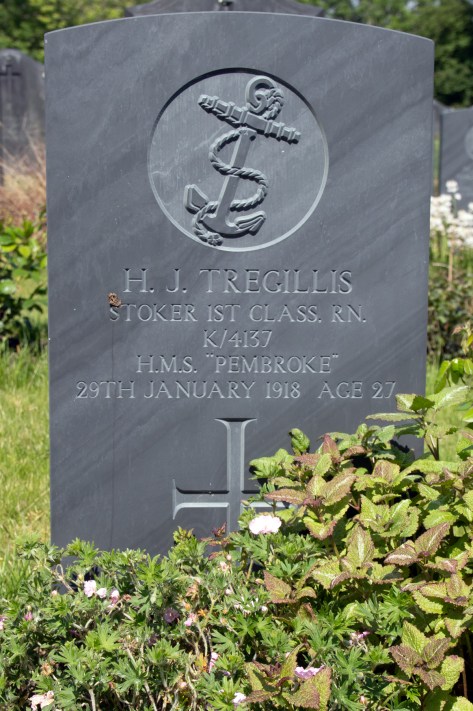
Stoker 1st Class Henry Tregillis

Stoker 1st Class Henry Tregillis

Henry Johnson Tregillis was born on Christmas Day 1890 and was one of six children to Edward and Emma. Edward was a journeyman baker from Westminster, Middlesex, but the family were raised in Woolwich, Kent.

When Henry finished his schooling, he found work as a general labourer, but as he got older, he sought a more reliable trade. On 15th September 1909 he enlisted in the Royal Navy as a Stoker 2nd Class. His service papers show that he was 5ft 9ins (1.65m) tall, with light brown hair, blue eyes and a fresh complexion. He was also noted as having a number of tattoos: a soldier and rifle on his left forearm, a girl on his left upper arm, Buffalo Bill on his right upper arm, the words In loving memory of my dear father and his mother’s name, Emma, on his right forearm.

Stoker Tregillis was sent to HMS Pembroke, the Royal Naval Dockyard in Chatham, Kent, for his induction. In March 1910 he was assigned to the battleship HMS Lord Nelson. He would spend the next five years attached to Lord Nelson and, while he was promoted to Stoker 1st Class, his time on board was not without incident. He spent two separate periods in the cells – totally 21 days – for unrecorded demeanours.

Henry left HMS Lord Nelson in July 1915, and over the next couple of years he served on two more ships, before becoming shore based – first at HMS Victory, the Royal Naval Dockyard in Portsmouth, Hampshire, then back at HMS Pembroke again. His annual review were mediocre, ranging from fair to very good, and he spend three more periods of time in the brig: 7 days in October 1915, 28 days in April/May 1916 and 14 days in June 1916.

By the start of 1918, Stoker 1st Class Tregillis had been at Chatham Dockyard for six months. That winter he came down with pleurisy, and was admitted to the town’s Royal Naval Hospital. The condition would prove fatal, and he breathed his last on 29th January 1918: he was 27 years of age.

The body of Henry Johnson Tregillis was laid to rest in the naval section of Woodlands Cemetery, Gillingham, walking distance from the dockyard that had become home.