Tag Archives: history

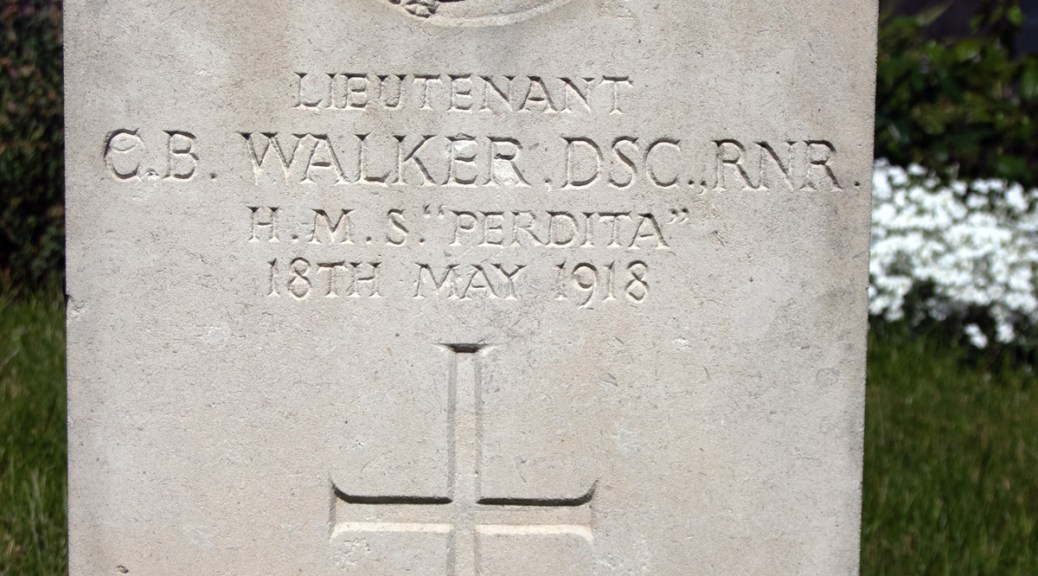
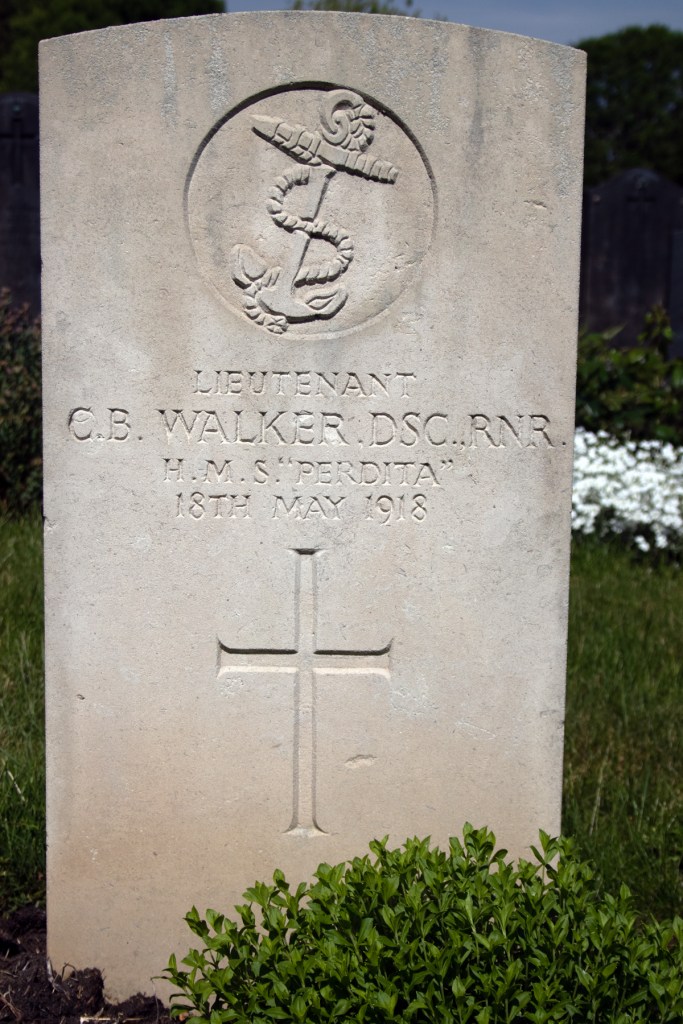
Lieutenant Claude Walker

Lieutenant Claude Walker

“The funeral took place on Wednesday with naval honours of Lieut. Claude Bennett Walker, RNR, whose home is a 23, Overcliffe, Gravesend, and who died at the Royal Naval Hospital, Chatham, on Saturday. His death was a naval casualty, and it was only on Friday, a day before his death, that he was taken to the Chatham Hospital.”

[Kent Messenger & Gravesend Telegraph: Saturday 25th May 1918]

Claude Bennett Walker was born on 6th July 1882 in Deal, Kent. The oldest of five children, his parents were George and Amelia Walker. George was a Trinity pilot, navigating ships off the Kent coast and beyond, and it was only natural that his first born followed in his stead.

Claude set to a life at sea when he completed his schooling. By August 1904, he was a registered Second Mate on board sea-going vessels, and within two years, he was deemed competent to become a First Mate. By 1909 he was certified as a Master of a foreign-going ship. At some point he joined the Royal Naval Reserve, and on 5th July 1912, was given the rank of Sub-Lieutenant.

That autumn, Claude married Gwen Case. The wedding took place in her home town of Melksham, Wiltshire, and the couple would go on to have two children – son Alec in 1913, and daughter Alison three years later.

When war broke out, Claude would be called upon to play his part, serving on the battleship HMS Majestic and the destroyer HMS Recruit early on in the conflict. By the spring of 1915, he was assigned to the minelayer HMS Biarritz, and that October, he was promoted to full Lieutenant.

On 9th March 1917, Claude was given command of the minelayer HMS Perdita. She served in the Mediterranean, and would be caught up in some skirmishes. In October 1917, Lieutenant Walker was awarded the Distinguished Service Cross, and the following April he was mentioned in dispatches.

The Perdita was back in Kent by the spring, by which point Claude had fallen ill. He was admitted to the Royal Naval Hospital in Chatham with cerebrospinal meningitis, and this would be the condition to which he would succumb. He passed away on 18th May 1918, at the age of 35 years of age.

Claude Bennett Walker was laid to rest in the naval section of Woodlands Cemetery, Gillingham, Kent.

Private John Slade

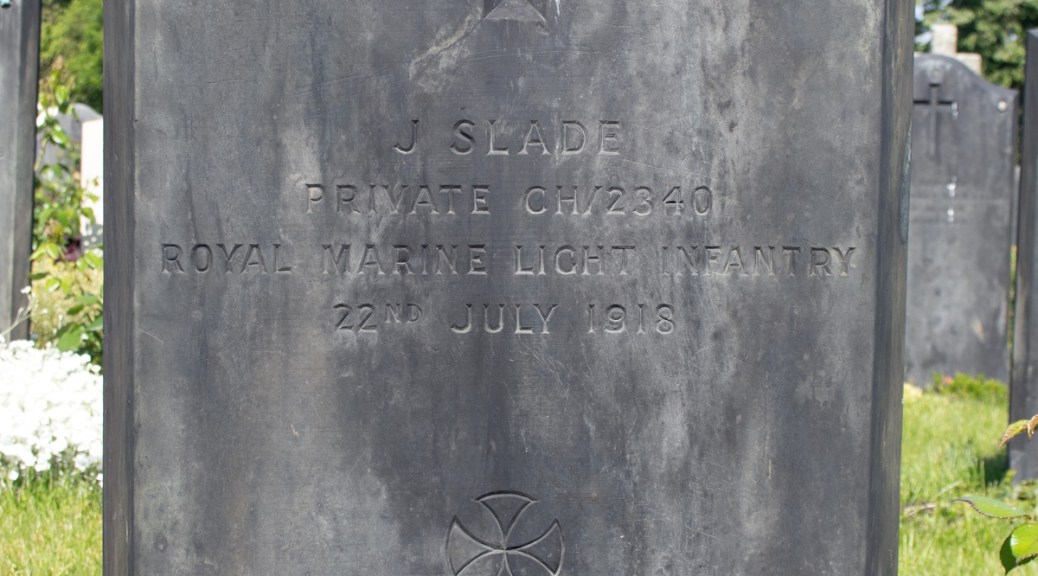
Private John Slade

John Slade was born in Winchmore Hill, Buckinghamshire, in 1865. One of three children to Edward and Mary, he also had three half-siblings from his mother’s previous marriage. Edward was a hawker, but when he left school, his son sought bigger and better things. By the time of the 1891 census he was recorded as being a Private in the Royal Marine Light Infantry, and was based in Chatham, Kent.

Sadly, Private Slade’s service records have been lost to time, so it is not possible to identify where his role took him. The 1901 census, however, shed some light on his time in the navy. It found him living at 36 Cross Street in Gillingham, Kent, with his wife, Annie, and his adopted daughter, Lillie. They had also taken on three boarders – Frank Hall, Harry Monk and Charles Barwell – all of whom were in the navy as well.

Ten years later on, and thing had changed once more. Still living in Gillingham, it seems that John’s time in the Royal Marine Light Infantry had come to an end. Instead, he was living at 54 James Street and giving his trade as an unemployed labourer. Still noted as being married, there is no sign of either Annie or Lillie: instead John was living with widow Laura Greyson and her two teenage boys, Charles and George.

At this point, John’s trail goes cold. As he was formally granted a Commonwealth War Grave, he must have stepped up to serve his country once more when war broke out in 1914. He would, however, have been getting on in years at this point, so how for long that service continued is anyone’s guess. He passed away from ‘disease’ on 22nd July 1918, at the age of 53 years of age.

John Slade was laid to rest in the military section of Woodlands Cemetery, Gllingham, the town that had been his home for more than three decades.


Stoker 1st Class Thomas Ellis

Stoker 1st Class Thomas Ellis

Thomas Ellis was born in 1896 in St Leonard’s, Sussex. The third of twelve children, his parents were George and Ellen Ellis. George was a general labourer, but when he finished his schooling, Thomas found work as a golf caddy. The 1911 census recorded the Ellis family living in four rooms at 7 Caves Road to the east of the town centre.

There is little additional information about Thomas, sadly. He joined the Royal Navy when war broke out, and was working as a Stoker 1st Class by the closing months of the conflict. He passed away, through causes unknown, on 7th July 1918, at the age of just 23 years old.

Thomas Ellis was laid to rest in the naval section of the Woodlands Cemetery in Gillingham, Kent, not far from the Royal Naval Dockyard in Chatham – HMS Pembroke – at which he was based.


Acting Leading Seaman William Wood

Acting Leading Seaman William Wood

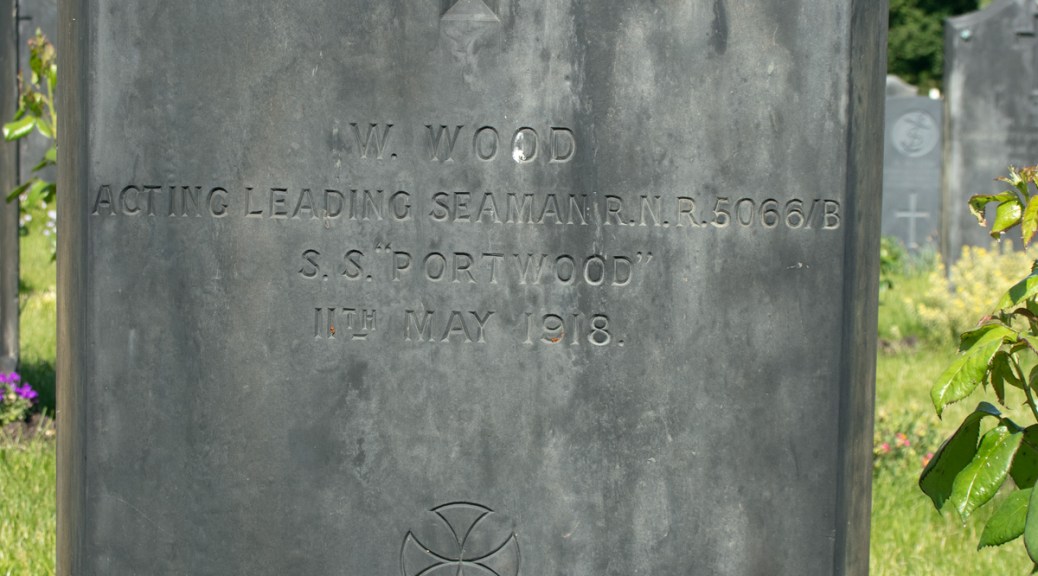
The life of William Wood, who is buried in Woodlands Cemetery in Gillingham, Kent, is a challenge to piece together. His headstone confirms that he held the rank of Acting Leading Seaman in the Royal Naval Reserve, and that he was assigned to SS Portwood at the time of his death.

Full service records for William have long since disappeared, but his pension ledger index card gives his widow as Catherine Rose Wood, of Greenfield Street in Govan, Scotland. It also suggests that the couple did not have any children under full age.

The Royal Navy and Royal Marine War Graves Roll provides William’s date of birth – 28th December 1887 – and goes on to suggest that he was born in London. Sadly, his name is far too common to narrow down census records, and there are no documents relating to his and Catherine’s marriage, so any additional family connections are also lost.

Acting Leading Seaman Wood’s entry on the pension ledger confirms his died of general paralysis of the insane, and his burial in the Gillingham cemetery would suggest that he had passed away in the Royal Naval Hospital in Chatham, Kent. He died on 11th May 1918, at the age of 29 years old.

William Wood was buried in the military section of Woodlands Cemetery, Gillingham, Kent.


Private John Morton

Private John Morton

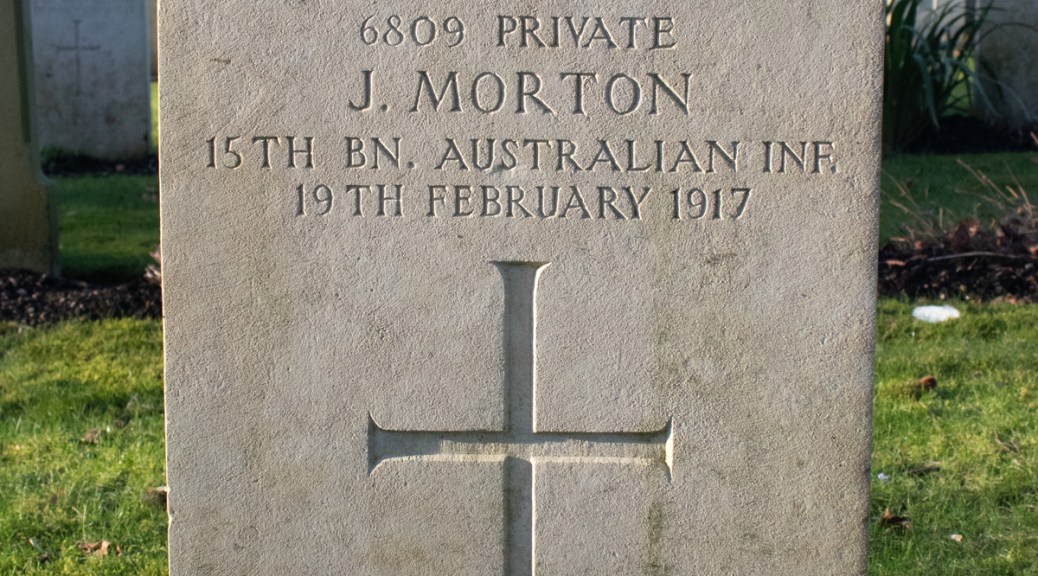
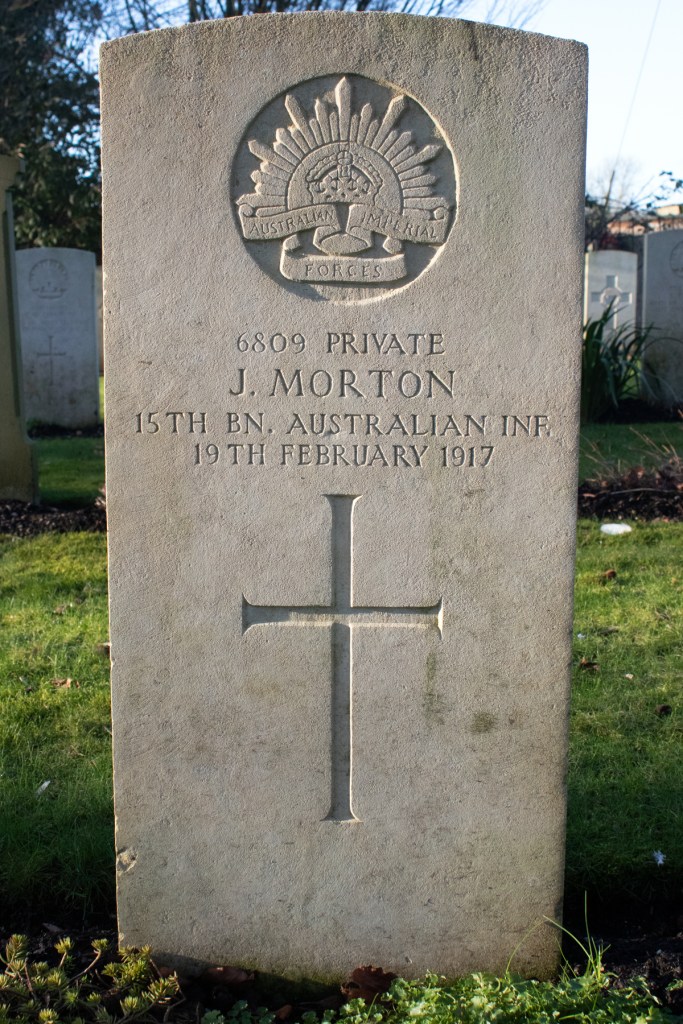
The life of Private John Morton is a challenge to unpick. His entry on the Commonwealth War Graves Commission website confirms that Morton was the name he served under, but that his birth name was John Lessells.

John’s army paperwork gives his age, 20 years old, his place of birth as Dunfermline, Scotland, and provides a next-of-kin, William Morton. John had enlisted on 9th September 1916 in Brisbane, Australia, although no emigration records remain. His service document noted that he was working as farmer, so, like thousands of others, it is likely that John sought a bigger and better life in a land of opportunity.

The medical section of John’s service records confirm something of the man he had become. He was 5ft 3ins (1.6m) tall, and weighed 125lbs (56.7kg). He had brown hair, blue eyes and a medium complexion. Interestingly, it also noted that John had been turned down for military service before because of an “under standard chest”.

Private Morton’s unit set sail for Europe on 17th November 1916. The transport ship – the Kyarra – departed from Brisbane, and arrived in Plymouth, Devon, nearly three months later. During the voyage, he was admonished for disobeying a reasonable order given by a superior order, although what the order was is unclear.

On landing in Britain, John was assigned to the 15th Battalion of the Australian Infantry. His unit was moved to a camp on the outskirts of Codford, Wiltshire, which would become their base of operations. Sadly, the journey from Australia seemed to have taken it out of John. On 14th February 1917, he was admitted to the camp hospital, suffering from a bout of influenza. His condition worsened, and two days later he was moved to a military hospital in nearby Sutton Veny.

Private Morton’s condition was to get the better of him. He passed away from pneumonia on 19th February 1917. He was 20 years of age.

John Morton, or John Lessells, was laid to rest in the graveyard extension to St Mary’s Church in Codford. He was surrounded by colleagues from the ANZAC regiments.


Private John Flanagan

Private John Flanagan

John Richard Flanagan was born in Healsville, Australia, in 1875. The second of four children – and the only son – his parents were Luke and Ann Flanagan.

Little information is available about John’s early life. Ann died in 1898, with Luke passing just seven years later, leaving John effectively an orphan in his early 30s. By this point he was working as a post and telegraph official, and this provided his employment when the world went to war in 1914.

John stepped up to serve his King in January 1916. His medical report confirms that he was 5ft 7ins (1.7m) tall, and weighed 166lbs (75.3kg). He had light brown hair, blue eyes and a florid complexion.

Assigned to the 16th Battalion of the Australian Infantry, Private Flanagan first had to travel from Healsville to Fremantle. From there his unit departed for Europe on board the Argyllshire. He left Australia on 9th November 1916, and arrived in Devonport, England, two months later. The 16th Battalion’s journey was not over yet, however: they made their way from Devon to Wiltshire, heading for a military camp on the outskirts of Codford.

Within a couple of weeks, Private Flanagan found himself confined to barracks. On 24th January he was sent to his billet for 24 hours by Major Turynarn (possibly Turynam), his offence was neglecting to obey an order.

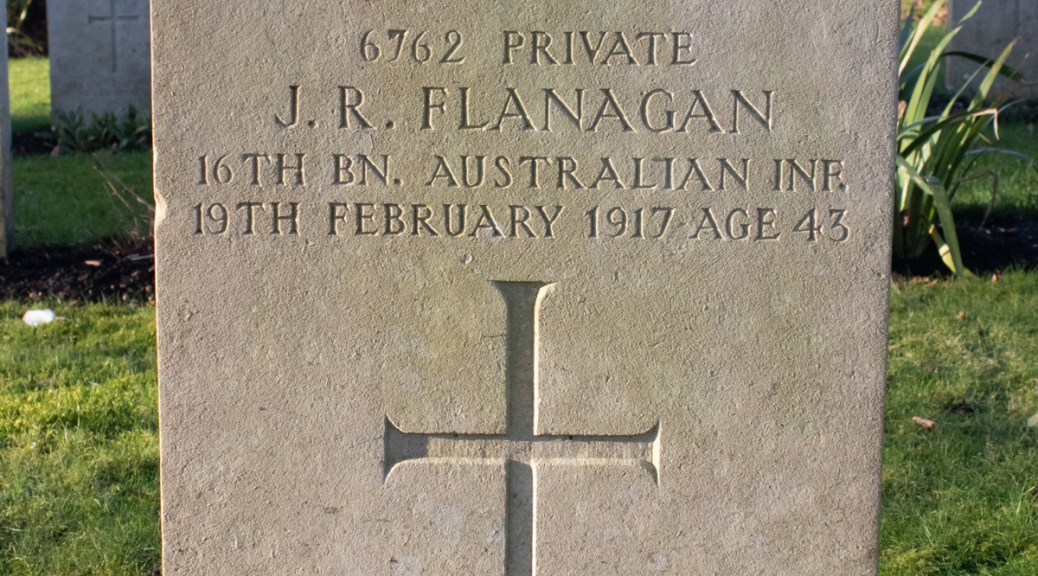
Illness seemed to run rampant at Codford early in 1917, and John was not to escape health issues. On 18th February he was admitted to the camp hospital, having contracted pneumonia. Tragically his move the the medical facility was to prove too little, too late. Private Flanagan passed away the following day: he was 42 years of age.

Thousands of miles from home, John Richard Flanagan was laid to rest in in the graveyard of St Mary’s Church, not far from where he had breathed his last.


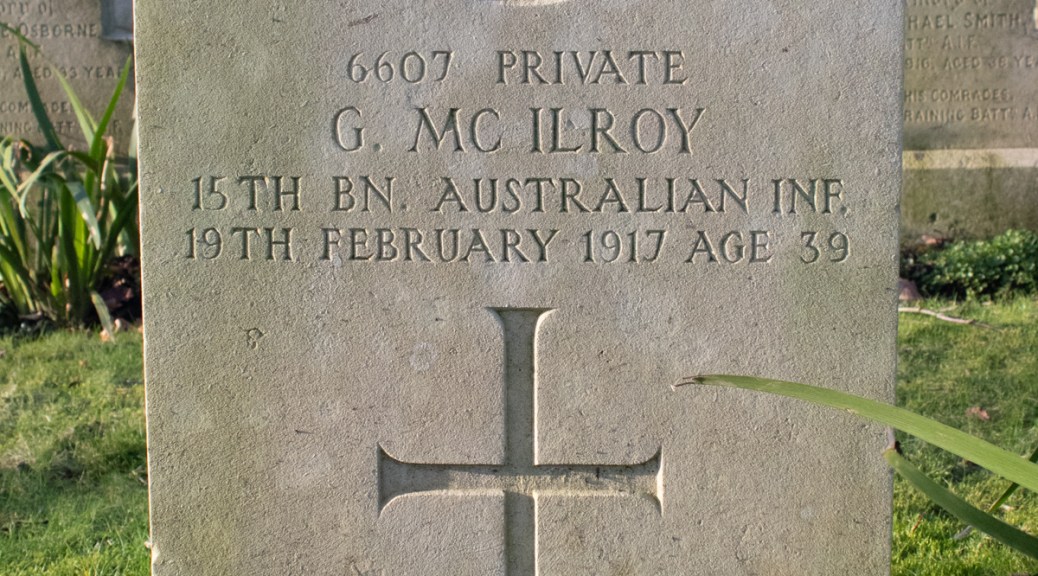
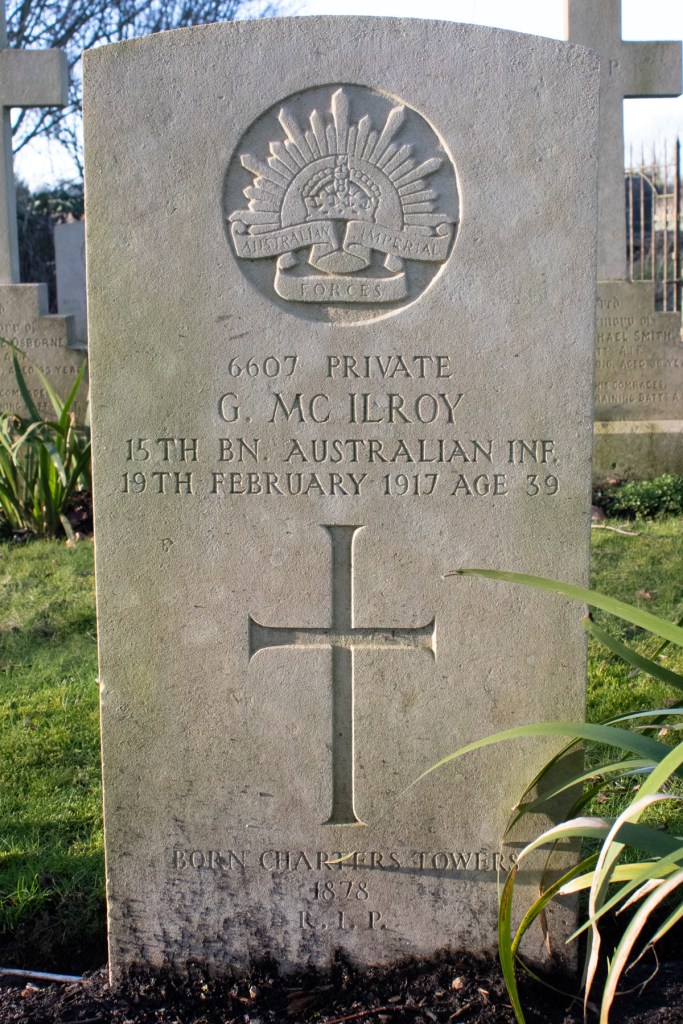
Private Gabriel McIlroy

Private Gabriel McIlroy

Gabriel McIlroy was born in the Australian town of Charters Towers in 1878. The oldest of four children, his parents were Patrick McIlroy – of whom there is little information – and his Danish-born wife, Ann.

There is little information available about Gabriel’s early life. He never married and, by time he enlisted in January 1916, he was employed as a labourer, and gave his mother as his next of kin.

Gabriel joined the Australian Imperial Force, and his service records give an insight into the man he had become. He was noted as being 5ft 3.5ins (1.61m) tall, and weighed 126lbs (57.2kg). Private McIlroy had a fair complexion, with brown hair and bluish eyes. He had a scar on his right arm, and was recorded as being Roman Catholic.

Gabriel’s unit – the 15th Battalion of the Australian Infantry – set sail from Brisbane on 21st October 1916. They sailed to Britain on the Boonah, a ship that had been built in Germany for trade with Australia. On the outbreak of way, she was docked in Sydney, and was seized by the Commonwealth authorities. Hastily converted to a troop ship, she was soon used to transport soldiers to Europe.

Private McIlroy arrives in Plymouth, Devon, on 10th January 1917. His battalion marched to Codford, in Wiltshire, where they were based before transferring to the Western Front. Sadly, he would not accompany his colleagues.

On 17th February, Gabriel was admitted to a military hospital in Sutton Veny, just a few miles from the camp. He was suffering from bronchitis, and the condition would prove fatal. Private McIlroy passed away on 19th February 1917: he was 39 years of age.

The body of Gabriel McIlroy was taken back to Codford for burial. He was laid to rest in the graveyard extension to the village’s St Mary’s Church.


The ship that had brought Gabriel to Britain would add its own footnote to the First World War. In October 1918, not long before the end of the conflict, she was one of the last vessels to leave Australia carrying troops. During the voyage, more than 300 of those on board had contracted influenza, in what became known as the Boonah Crisis.


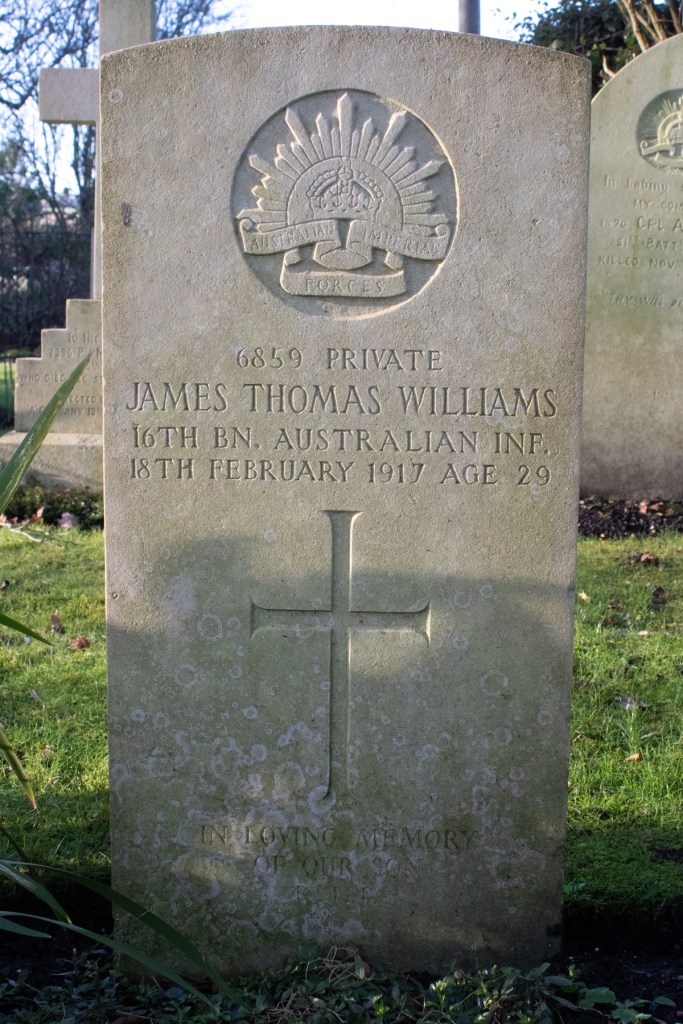
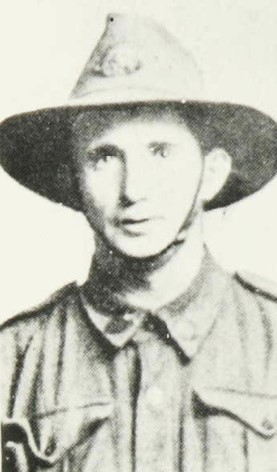
Private James Williams

Private James Williams

James Thomas Williams was born in Toodyay, Western Australia, in May 1888. The third of eight children, his parents were John and Mary Williams.

When he finished his schooling, James found work farming. Details of his early life are lost to time, but it seems likely that he had followed in his father’s footsteps.

When war engulfed the Empire, James stepped up to serve his King and enlisted in the Australian Imperial Force on 24th August 1916. His service records show that he was 5ft 6ins (1.68m) tall and that he weighed 134lbs (60.8kg). He was noted as having auburn hair, blue eyes and a fresh complexion.

Private Williams’ unit departed Australia from Freemantle on 9th November 1916. He would spend the next two months on board the Argyllshire, and eventually reached British shores on 10th January 1917. Assigned to the 16th Battalion of the Australian Infantry, his unit disembarked at Devonport, Devon, and made straight for base near Codford, Wiltshire.

The ANZAC troops had spent weeks cramped in the bowels of their ships, and space was once again at a premium in their army barracks. This congestion would prove fatal for numerous soldiers, as disease ran rife across the encampments.

Sadly, James would not be immune to poor health. Having contracted influenza, he was initially admitted to the camp infirmary, before being moved to the military hospital in nearby Sutton Veny. The condition was to get the better of him, and Private Williams passed away from a combination of flu and heart failure on 18th February 1917. He was 29 years of age.

The body of James Thomas Williams was laid to rest in the peaceful graveyard of St Mary’s Church in Codford, surrounded by others from his regiment.


Private James Williams
(from ancestry.co.uk)

Private Arthur Couchman

Private Arthur Couchman

Arthur John Couchman was born in the spring of 1887, the oldest of seven children to John and Emma. John was a farm labourer from the parish of Wilmington, Kent, and this is where he and Emma raised their family.

When he completed his schooling, Arthur found work as a house boy, but soon turned his hand to gardening. When the opportunity was presented to him, however, and in the autumn of 1908, he emigrated to Australia, presumably to find work as a farmer.

Little about Arthur’s time overseas is detailed. He settled in Freemantle, to the south of Perth, and, early in 1916, he married Sarah McAlinden. She had left London for the Antipodes to work as a domestic four years previously. Their marriage seems to have been spurred on by Arthur’s imminent departure for the home country, as, on 19th June 1916, he enlisted in the Australian Imperial Force.

Working as a general labourer by this point, Arthur’s service records show that he was 5ft 3.5ins (1.61m) tall, and weighed 146lbs (66.2kg). He was found to have fair hair, grey eyes and a ruddy complexion. He also had tattoos on both of his forearms.

Private Couchman’s unit departed Freemantle on 9th November 1916, on a journey to Devonport, Devon, that would take two months. On his arrival, he was assigned to the 51st Battalion of the Australian Infantry, and dispatched to a camp near Codford in Wiltshire.

Tragically, Arthur’s army career was to follow a not uncommon path for those arriving in Britain from overseas. Within a matter of weeks he had been sent to the New Zealand Hospital in Codford, as he was suffering from bronchial pneumonia. On 15th February 1917, just four days after his admission he passed away from the condition. He was 29 years of age.

Thousands of miles from his Australian life, Arthur John Couchman was laid to rest in the new extension to St Mary’s Churchyard in Codford, not far from the camp in which he had been briefly based.


Private Harold Spackman

Private Harold Spackman

Harold John Spackman was born on 24th May 1897 and was the youngest of two children to Frederick and Eliza Spackman. Frederick was a cowman from Wiltshire, and the family were raised on a farm in Manningford Bohune, near the village of Pewsey.

Harold was educated at Woodborough School, and found work as a nurseryman when he completed his schooling. When war broke out, he was quick to enlist, and joined the 10th (Service) Battalion of the Devonshire Regiment on 17th September 1914.

Private Spackman’s unit was sent to Somerset for training, and it was here, in cramped, busy barracks, that he contracted meningitis. He was admitted to the Red Cross Hospital in Bath, but succumbed to the condition on 12th March 1915. He was just 17 years of age.

Harold John Spackman was laid to rest in Bath’s Locksbrook Cemetery. His was a joint funeral with another Private from his unit, Albert Matthews, who had died on the same day in the same hospital.


Private Harold Spackman
(from findagrave.com)