Ossian Emanuel Richards was born in Westonzoyland, Somerset, in December 1897. He was the youngest of two children and his parents – Emmanuel and Jane – were farmers in the area.
Ossian enlisted later in the war, joining the RAF in June 1918. While little detail of his service is available, he had been a fitter before joining up, so it may well have been on the mechanical side of things that he was involved.
After nine months’ service, Ossian has been promoted to Corporal, and, with the war over, he was transferred to the RAF Reserves in March 1919.
Sadly, as with many young men of his generation, Corporal Richards succumbed to the flu pandemic that followed the war. He died on 15th September 1919, aged just 21 years old.
Ossian Emanuel Richards lies at rest in the cemetery of his home village of Westonzoyland.
Harry Kick was born in August 1900, the oldest of six children to George and Georgina Kick from the small village of Middlezoy in Somerset. George was an agricultural labourer, while his wife helped with the dairy side of Jones Farm, where he worked.
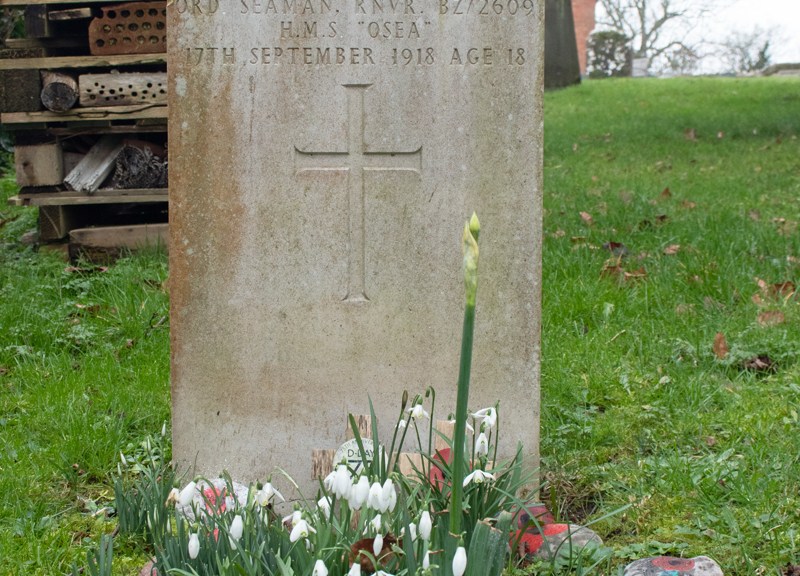
Details of Harry’s military service are scarce, but, based on his age, it is likely to have been the second half of the war when he enlisted. He joined the Royal Navy and was assigned to HMS Osea, a naval base in Essex.
Sadly, there is little evidence of Harry’s time in the navy. His pension records confirm that he passed away on 17th September 1918, having been suffering from pneumonia. He was just 18 years old when he died.
Harry Kick lies at peace in the churchyard of Holy Cross Church in his home village of Middlezoy, Somerset.
Hedley Walter Chinn was born in April 1900, one of six children to Walter and Kate Chinn. Walter was the butcher in the Somerset village of Middlezoy, and this is where the family had made their home.
There is little information on Hedley’s pre-war life, beyond the two census records of 1901 and 1911. With war breaking out and his older sister Lilian dying while nursing the troops (see below), it seems that Hedley was eager to do his duty.
Within months of Lilian’s death in 1917 – and basically as soon as his age allowed – Hedley enlisted in the Royal Naval Air Service as a mechanic. He carried out his initial training on the land-based ships President II, Impregnable and Cranwell, before officially joining the newly-formed Royal Air Force in May 1918.
Air Mechanic Chinn continued his service at Calshott, where he worked as a wireless operator for the flying boats guarding the Solent around Southampton. He continued in the role for the remainder of the war and beyond.
Hedley was eventually transferred to the RAF Reserve in February 1920, when, presumably, he returned to the family home in Somerset.
Little further is evident of Hedley’s life; but he passed away less than a year after being demobbed. There is nothing to confirm the cause of his death; given he died more than two years after the war, it is likely that it was as a result of an illness, although this is a presumption on my part. Either way, he died on 2nd January 1921, aged just 20 years old.
Hedley Walter Chinn lies at rest in the peaceful graveyard of Holy Cross Church in Middlezoy, Somerset.
It is worth noting that Hedley’s sister Lilian also served – and perished as a result of the Great War. Click here to learn more.
When I was researching Hedley’s life, I ran through the contemporary newspapers to trace his name. Nothing evident came up, although Hedley’s father, Walter’s name did appear.
In 1910, he declared himself bankrupt after being unable to pay for meat for his shop, that he had bought at auction. It appears that he had run up debts of over £300 (approximately £23,500 in today’s money) over a number of years; he put these debts down to a number of factors – “illness of my children, bad debts, having to maintain my mother for 14 years; and loss on sale of Middlezoy House, Middlezoy, three years ago, which realised £200 less than the amount I gave for it, and the amount expended on improvements”.
The 1921 census found Walter and Kate still running the butcher in Middezoy, their home empty but for each other. Walter’s debts were finally cleared in 1928 and the bankruptcy annulled.
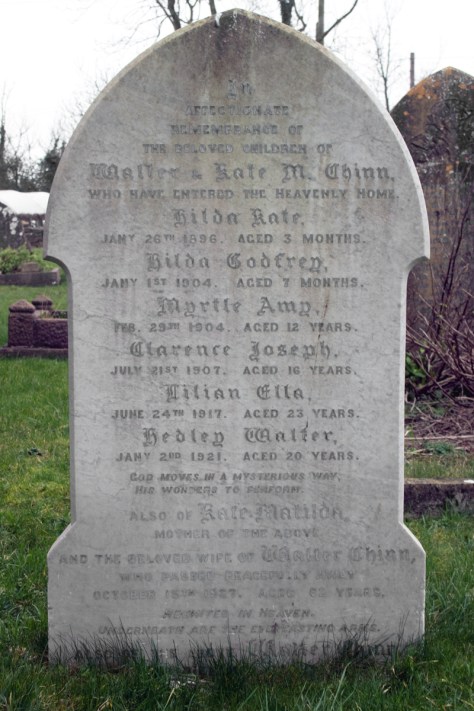
The gravestone in Holy Cross Churchyard is a haunting memorial to the tragic lives of the Chinn family.
Walter and Kat had six children, and would outlive every one of them. The stone confirms that each of their children lies in the grave:
The grave’s epitaph – God moves in a mysterious way, his wonders to perform – sounds cruelly hollow to 21st century ears. The only comfort to take, I guess, is that the whole family was destined to be together again: both Kate (who died in 1927) and Walter (who died in 1933) are also buried in the family grave.
Lilian Ella Chinn was born in 1893, one of six children to Walter and Kate Chinn. Walter was the butcher in the Somerset village of Middlezoy, and this is where the family had made their home.
There is little recorded of Lilian, and the information is confusing – another Lilian Chinn was born around the same time a few miles away, so it’s a challenge to identify the correct details.
What is known, is that, with the war raging, Lilian felt that she needed to do what she could – and enlisted in the Voluntary Aid Detachment in 1916. Serving as a nurse, she was based at the military hospital in Devonport, Plymouth.
Sadly, it is evident that nursing staff were not immune to the ailments and illnesses of the soldiers they were treating. Lilian contracted meningitis and peritonitis, passing away on 24th June 1917, aged just 23 years old.
Lilian Ella Chinn lies at rest in the peaceful graveyard of Holy Cross Church in Middlezoy, Somerset.
It is worth noting that Lilian’s brother Hedley also served – and perished – as a result of the Great War. Click here to learn more.
When I was researching Lilian’s life, I ran through the contemporary newspapers to trace her name. Nothing evident came up, although her father Walter’s name did appear.
In 1910, he declared himself bankrupt after being unable to pay for meat for his shop, that he had bought at auction. It appears that he had run up debts of over £300 (approximately £23,500 in today’s money) over a number of years; he put these debts down to a number of factors – “illness of my children, bad debts, having to maintain my mother for 14 years; and loss on sale of Middlezoy House, Middlezoy, three years ago, which realised £200 less than the amount I gave for it, and the amount expended on improvements”.
The 1921 census found Walter and Kate still running the butcher in Middezoy, their home empty but for each other. Walter’s debts were finally cleared in 1928 and the bankruptcy annulled.
The gravestone in Holy Cross Churchyard is a haunting memorial to the tragic lives of the Chinn family.
Walter and Kate had six children, and would outlive every one of them. The stone confirms that each of their children lies in the grave:
The grave’s epitaph – God moves in a mysterious way, his wonders to perform – sounds cruelly hollow to 21st century ears. The only comfort to take, I guess, is that the whole family was destined to be together again: both Kate (who died in 1927) and Walter (who died in 1933) are also buried in the family grave.
George Henry Palmer is one of those names that has been a challenge to research and who risked being lost to time.
George and Henry are common names for the late Victorian era, so a simple search on Ancestry brought up too many options to confirm anything specific.
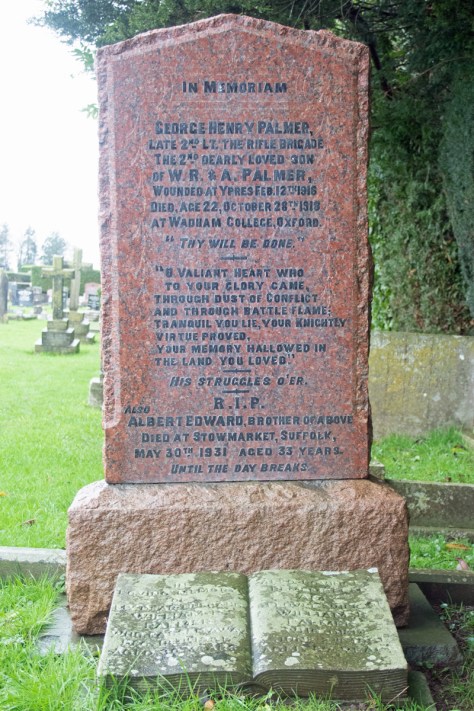
Given the ornate nature of his headstone, it seemed reasonable that his passing and funeral would have been recorded in contemporary media, and indeed it was; the only identifiable name was his own. (His parents “WR and A Palmer” and featured, as is his grandfather “Rev. J Palmer”, but, again, this is not enough to go on for research.)
The additional name on the gravestone, however – George’s brother Albert – proved to be the key, though, identifying the following.
George Henry Palmer was born in May 1896, one of five children to William Richard Palmer and his wife Amy. William was a chemist’s assistant, a job that seemed to move him around the country. William was born in Wells, Somerset, as was his wife and eldest son; George was born in Regents Park, London, while Albert, who was a year younger, was born back in Wells. By the time of the 1901 census (when George was 4 and Albert 3), the family were living in Leicester, and they remained so for the next ten years.
Details of George’s military service comes primarily from the newspaper report of his funeral:
Deceased… was discharged from the Army through wounds received at Ypres in February, 1916, and had resumed his studies at Oxford and entered on a course of forestry, which he was following with great success.
He was well known in Wells, having spent a considerable time in the city and vicinity. He took a great interest in the Wells Volunteers, and was able to drill them in true Army style, having received his training in the Artist Rifles, and later gained his commission in the Rifle Brigade, where he was spoken highly of by his brother officers and men.
Mr Palmer was most thorough and painstaking in all his duties and studies. He was a Wyggestine [sic] scholar at the age of ten years in open competition, and later senior scholar at Wadham College Oxford.
Wells Journal: Friday 1st November 1918.
Second Lieutenant Palmer contracted pneumonia while up at Oxford, succumbing to the illness on 28th October 1918, just a fortnight before the end of the war. He was 22 years of age.
George Henry Palmer lies at rest in the cemetery of his home city of Wells.
Stanley Hugh Russ was born in 1888, the youngest of five children to Alfred and Elizabeth. The family lived in Wells, Somerset, where Alfred worked as Clerk to the Guardians of the local workhouse. They were doing well for themselves, as they had two domestic servants at the time of the 1891 census.
Stanley seems to have been a studious young man, and by 1911 was boarding in London, where he was a dental student.
Details of Stanley’s military service are scant, but he obviously did well at his job, and rose to the rank of Lieutenant. The local newspaper gave a good overview of his life when reporting on his funeral:
The deceased gentleman was a dentist by profession, and served his apprenticeship with Mr Goddard of Wells. He afterwards went to London, where for some years he had been following his profession at Guy’s Hospital.
At the outbreak of was he joined the Middlesex Yeomanry as a trooper. He was later given a commission in the same regiment… After much service in France, he was, by reason of a physical disability incurred whilst on service, transferred to the Royal Army Service Corps (Mechanical Transport).
He again went to France and was attached to the North Somerset Yeomanry. He was invalided home, but went out a third time, being attached to a Canadian Siege Battery. He took part in the great push around Arras and Vimy Ridge.
He returned to England in October 1918, suffering from heart trouble, severe shell shock, and slight gassing. He was discharged from hospital in January 1919 and demobilised in the following March.
His health gave way, and he was subsequently operated on by a Harley Street specialist. He derived little benefit, and was afterwards removed to a nursing home, where he died.
The deceased gentleman, who was unmarried, was of a very bright and happy disposition, and enjoyed a wide circle of friends.
Wells Journal: Friday 5th November 1920
Stanley Hugh Russ died on 28th October 1920. He was 32 years old. He lies at rest in the cemetery of his home city of Wells.
William Charles Stevens was born in Wells in 1884. The eldest child of Alfred and Susan, William was one of eleven children. Alfred worked at the local paper mill, while William became a labourer, and found work as a stonemason.
William seemed keen to improve his prospects, however; he enlisted in the army at the start of 1903, serving in the Royal Field Artillery for a period of four years, before being demobbed to the reserves.
On Christmas Day 1907, William married Minnie Bailey; the census four years later gives the young couple as living in their home city. William, by now, was labouring on the railway, and the census shows, they had had a child, who had sadly passed away.
War was looming, and Gunner Stevens was recalled to duty in August 1914. Quickly posted overseas with the 23rd Brigade, he fell ill with myalgia and was shipped home to recover towards the end of the year.
Sent back to the front in 1915, William was promoted to Corporal and transferred to the 51st (Howitzer) Brigade. Sadly, his ‘tremble’ returned and he was sent back to England in October 1915. By this point, Minnie had given birth to their second child, a little girl they called Lilian.
Corporal Stevens’ condition continued, and he was medically discharged in March 1916. No further records exist, but it seems that he finally succumbed to the condition later that year. He passed away on 2nd November 1916, aged 32 years old.
William Charles Stevens lies at peace in the cemetery of his home town, Wells in Somerset.
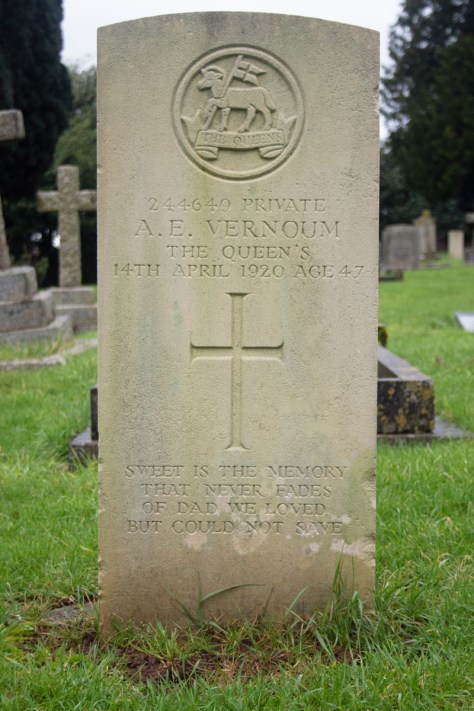
Arthur Edward Vernoum was born in 1874, the second of seven children to David and Sabina Vernoum. David worked on the railways, while Arthur went into labouring, as a stonemason.
He married Elizabeth Parker in 1896, and the couple settled in Wells, Somerset. They had four children – William, Samuel, Richard and Winifred.
Arthur’s military service records are a bit scarce; he enlisted in the Royal West Surrey Regiment (The Queen’s). Given his age – he was 40 when war broke out – if is likely that this was towards the end of the conflict.
While is troop served in many of the key battles of the Great War, there is no evidence whether Private Vernoum was involved – again, because of his age, it may well have been that he served as part of a territorial, rather than European force.
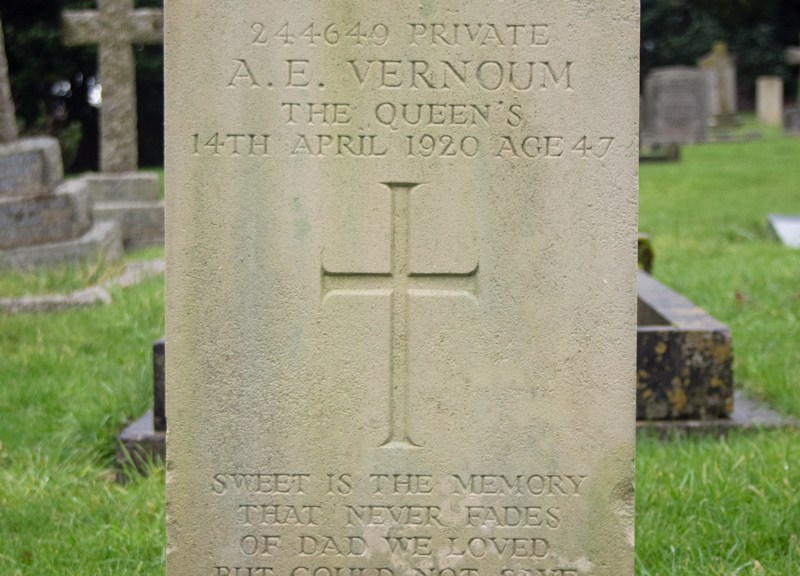
Arthur’s pension records show that he passed away on 14th April 1920, of a carcinoma of the tongue and a haemorrhage. He was 46 years old.
Arthur Edward Vernoum lies at rest in the cemetery of his home town, Wells in Somerset.
Alfred Henry Richards was born in 1891, the oldest of five children to William Henry Richards and his wife Jane. William (who was known as Henry) worked in the local paper mill, and this is a trade that his two sons – Alfred and Leslie – were to follow as well.
Paper making was a driving force in this part of Somerset during the Victorian era, employing a large number of people in Wells and the nearby village of Wookey, which is where Alfred and his siblings were born.
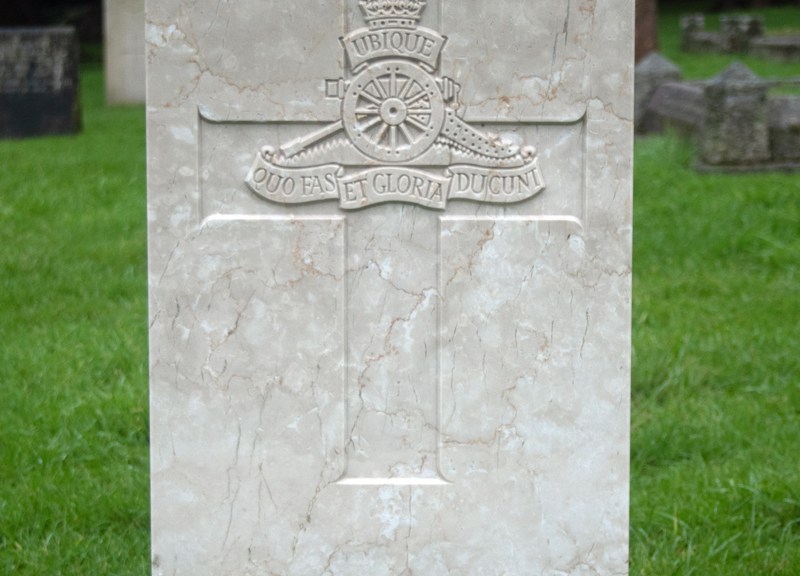
Details of Alfred’s military service are sketchy. He enlisted as a Gunner in the Royal Horse Artillery, although when during the war this happened is unknown.
His troop – the 18th Brigade, 1st Somerset Royal Horse Artillery – was stationed in the UK for the first couple of years of the war, before serving in the Middle East. Again, I have not been able to confirm how much of this service Gunner Richards was involved in.
Alfred returned to Somerset after being demobbed, but within a few months of the end of the war, he succumbed to double pneumonia. He passed away on 1st March 1919, aged just 28 years old.
Alfred Henry Richards lies at rest in the cemetery in Wells, Somerset, not far from his home.
Francis George Smith was born in Glasgow in 1890. Records are scattered, but some of the pieces pull together to give an outline of his life.
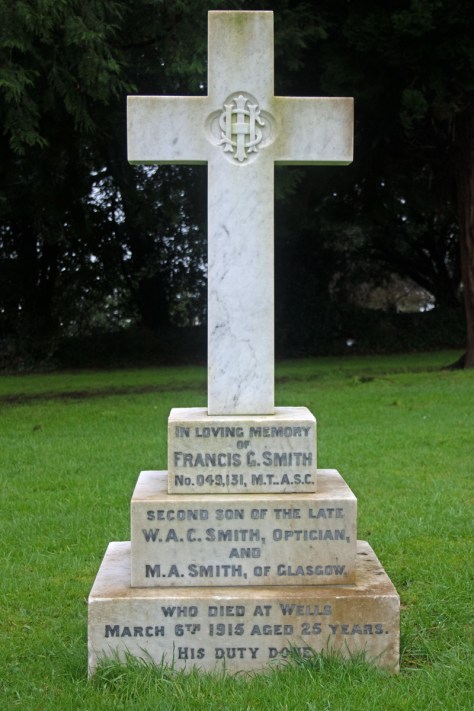
The son of William and Mary Smith, Francis was the fourth of six children. His tombstone confirms that William had worked as an optician, but passed away when Francis was a young man.
Francis was an electrical engineer, and had assisted Mary in her business in Glasgow before signing up.
Private Smith enlisted early on in the war, “on February 24th of this year [1915], when he left his native city for London, where he joined the motor transport section of the Army Service Corps” [Wells Journal, Friday 12th March 1915].
Billeted in Wells, he had been assigned to the 133 Mechanical Transport Company. Within weeks of moving there, however, it seems that Francis fell ill. Sadly, his was a life cut too short, and he passed away from pneumonia on 6th March 1915, aged just 25 years old.
Francis George Smith lies at rest in the cemetery in Wells.










 Death and Service