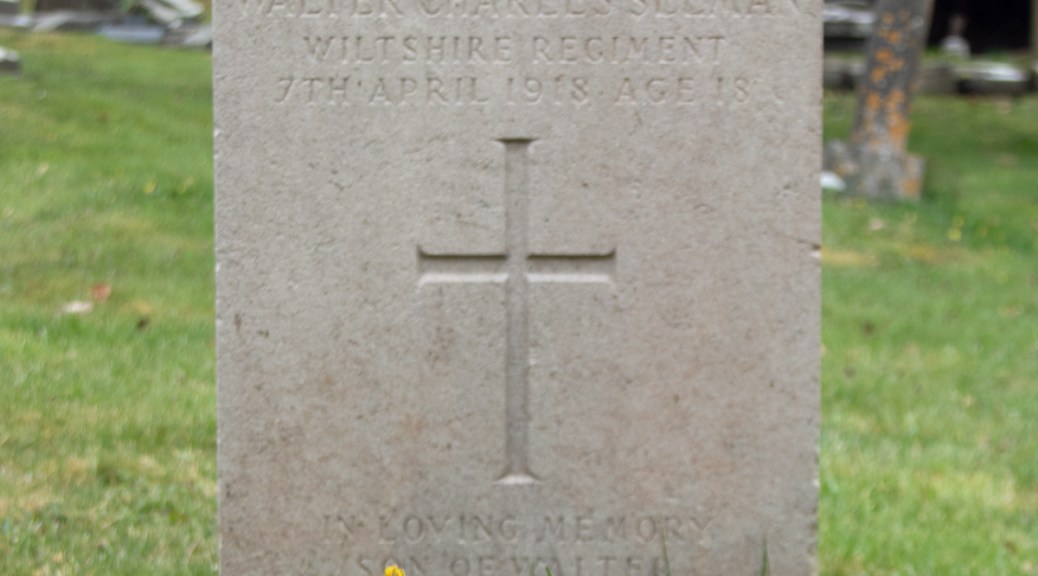
Walter Charles Selman was born on 7th June 1899, the youngest of four children to Walter and Annie Selman. Walter Sr was a gardener and, by the time of the 1911 census he had moved the family to the sleepy Somerset village of Burrington.
Sadly, there is little documentation surrounding Walter’s young life. His gravestone confirms that he enlisted in the Wiltshire Regiment; although there is no date to confirm when he enrolled, it is likely to have been in the second half of the conflict, given his age.
Private Selman was assigned to the 4th Battalion, but there is no clear confirmation of where he served. The 1/4th Battalion fought in India and Egypt; the 2/4th was also based in India but remained there for the duration. The 3/4th Battalion – the most likely to be Walter’s troop – was a reserve troop, based on home soil.
Where little is known about Private Selman’s military service, there is similarly little information about his passing. His pension records bluntly put his cause of death as ‘disease’; as with many other recruits towards the end of the war, it is likely that this was, in fact, either influenza or pneumonia.
Sadly, the mustering of the Allied armies – and the associated mixing of young men from across the country in crowded barracks – brought a real danger of disease, and lung complaints were commonplace. While there is no definite proof, it appears that Private Selman may have succumbed to one of these conditions; he passed away in a military hospital on Salisbury Plain on 7th April 1918, two months short of his 19th birthday.
Walter Charles Selman lies at rest in the graveyard of Holy Trinity Church in his home village of Burrington, Somerset.
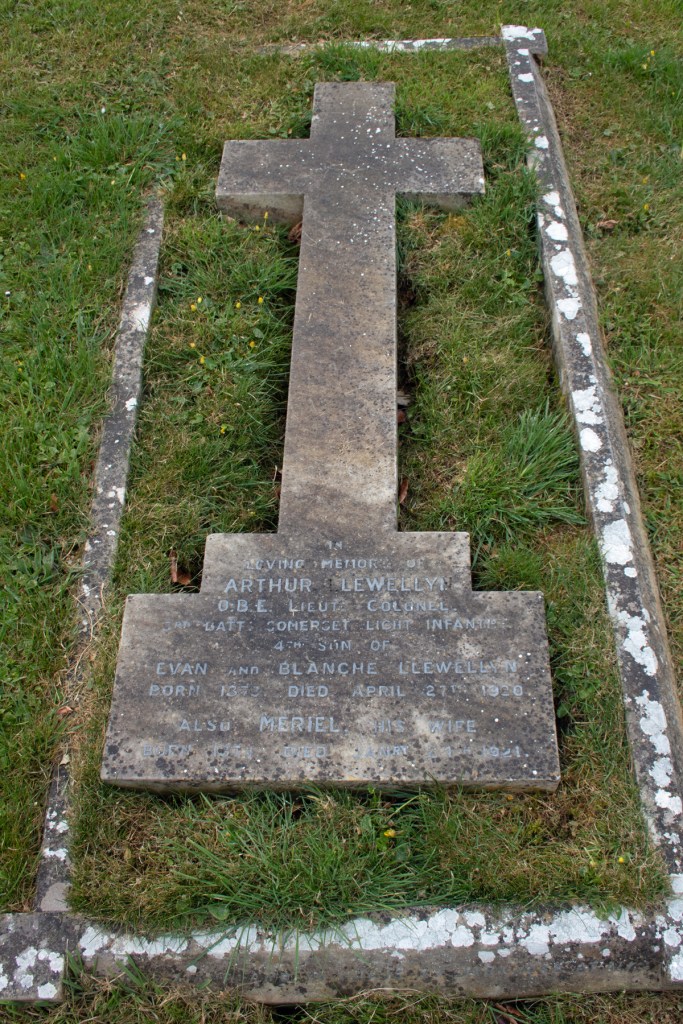
Arthur Llewellyn was born in the summer of 1873, one of four children to Evan and Mary Llewellyn. Originally from Wales, Evan was a Justice of the Peace in the Somerset village of Burrington, and the family lived in the comparative luxury of Langford Court, a mile or so from the village centre.
I use the term ‘comparative luxury’ with some sense of irony; according to the 1881 census, the family had a household staff of eight, including a governess, two nurses, housemaid, cook, kitchen maid, parlour maid and page.
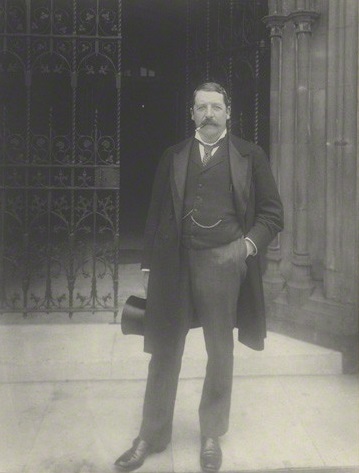
Ambition was obviously what drove Evan; he was an army office, who served in initially in the Somerset Light Infantry. In 1885, he was elected MP for North Somerset, a position he held on and off for nearly twenty years. His military service continued, however, and he led the 2nd (Central African) Battalion, King’s African Rifles in the Boer War.
Comfort ran in the Llewellyn family; according to the 1891 census, Arthur was staying with his maternal aunt, Rose Stewart. She also lived in Somerset, and, at the time the census was drawn up, she was recorded as a widow living on her own means, with her mother, mother-in-law, two nieces and Arthur, her nephew. She was not without help, however, as the house had a retinue of eight staff to support her.
Military life was an obvious draw for Arthur. He enlisted in the Somerset Light Infantry in October 1891 and, within a year, had been promoted to Second Lieutenant.
He had met and married Meriel Byrne, in 1895. The couple’s marriage certificate confirms that he had been promoted to Captain in the militia, and his residence was Buckingham Palace Road, in south west London. They were married in Holy Trinity Church, Brompton, with Meriel’s mother and Arthur’s father acting as witnesses.
The couple went on to have five children, all girls, and they settled into a comfortable life. By 1901, Meriel had set up home in Worcestershire; Arthur does not appear on that year’s census, which suggests that he may too have been fighting in South Africa.
Arthur’s mother Mary passed away in 1906, at the tender age of 39. By 1911, he had been promoted to Lieutenant Colonel in the 3rd Somerset Light Infantry, and was head of his household in Worcestershire. The family was, by this time, complete – Arthur and Meriel and their five children also had help running their home, with two nurses, a cook, parlour maid and housemaid to support them.
Evan passed away months before war was declared, at the age of 67. Lieutenant Colonel Llewellyn felt duty bound to re-enlist, and was given command of the 3rd Reserve Battalion, Somerset Light Infantry. He subsequently served as part of the Army Service Corps in France, before transferring to the Army Labour Corps in Nottingham.
According to the Evening Mail, on 27th April 1920, he “was suddenly seized with illness in the street, and died as he was being conveyed to Nottingham Hospital. He was 46 years of age.”
Arthur was brought back to Burrington in Somerset, where he was buried alongside his parents in Holy Trinity Churchyard.
Sadly, Meriel passed away nine months after her husband; she too is buried in Holy Trinity Churchyard.
Arthur’s estate passed to his brother, Owen, and totalled £12,023 15s 11d (approximately £530,000 in today’s money).
As an aside to Arthur’s illustrious story, another of his brothers is worthy of note. Hoel Llewellyn was two years older than Arthur.
Educated for the Royal Navy, he saw active service on the East Coast of Africa, 1888-90 with despatches. He also served as Artillery Officer and commanded artillery in the Matabele War, where he was recommended for the Victoria Cross. He was promoted Captain in the British South Africa Police, and Justice of the Peace in Matabeleland in1896.
Captain Llewellyn served throughout the South African War; commanding armoured trains north of Mafeking before transferring to the South African Constabulary in 1901. Hoel was eventually created a Companion of the Distinguished Service Order for his service in South Africa.
He was wounded while serving with the Mediterranean Expeditionary Force in the Great War. Hoel was subsequently promoted to the rank of Colonel and appointed Provost-Marshal of Egypt and the British Mediterranean Expeditionary Force.
In 1908, he had been made Chief Constable of Wiltshire, a role he was to hold for 37 years. He was key to pioneering the use of police dogs, and went on to become the oldest serving person to hold the Chief Constable role in the county.
Evan Henry Llewellyn
Another aspect of the Llewellyn family is that Evan was obviously a source of political drive for the family; his great-great-grandson is David Cameron, UK Prime Minister from 2010 to 2016.
Henry John Venn was born in September 1900, the youngest of three children to Charles and Mary Venn. Charles was a gardener, and the family lived in the small Somerset village of Shipham.
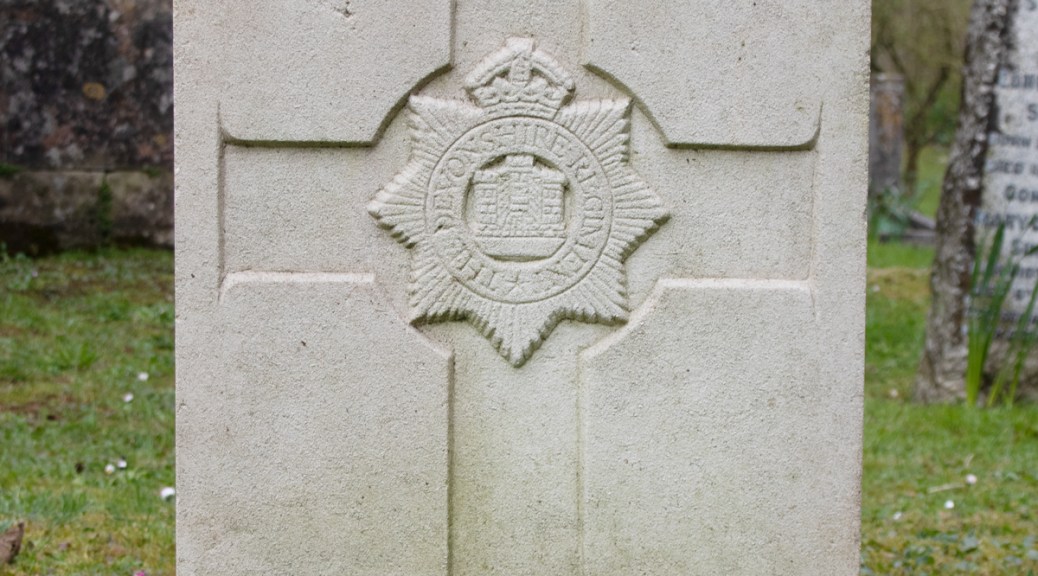
Sadly, there is little information available about Henry’s life, although when war broke out, he enlisted as a Private in the Devonshire Regiment. There is no documentation to confirm exactly when he enrolled, although, given his age when the conflict began, it it unlikely to have been before 1918.
Indeed, later records show that his parents were refused a war gratuity. This was only usually the case where a soldier had completed less than six months’ service. It is likely, therefore, that Private Venn did not join up before he turned 18 years old in September 1918.
Henry joined the 53rd Training Reserve Battalion; they were based at the Rollestone Camp near Stonehenge, Wiltshire. It is here that he likely became unwell, as he was subsequently admitted to the Military Hospital on Salisbury Plain. He was suffering from influenza and pneumonia, and this is what he succumbed to. Private Venn passed away on 10th November 1918 – the day before the Armistice that ended the conflict. He was just 18 years old.
Henry John Venn lies at rest in the graveyard of St Leonard’s Church in his home village of Shipham in Somerset.
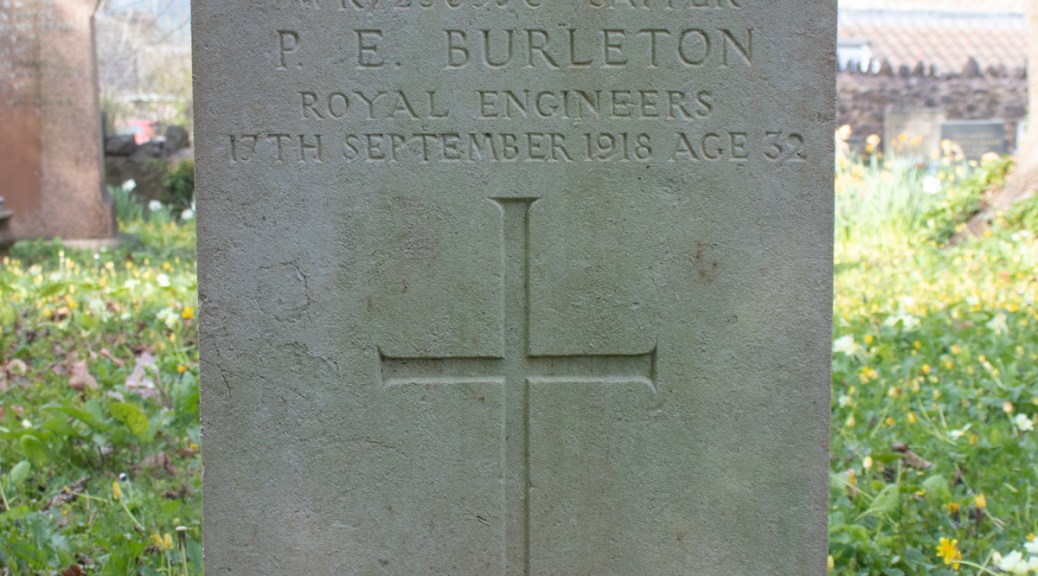
Percy Edward Burleton was born on 24th July 1885, the youngest of seven children to George and Lucy Burleton. George was a quarryman, and the family lived in the village of Draycott, near Wells in Somerset.
Percy’s older brother Lewis worked for the railways, and this is a trade that his younger sibling followed. By the time of the 1911 census he was living with his brother in Glastonbury and worked as a carman, delivering goods to and from the local station.
In February 1914, Percy appeared as a witness in an inquest about the death of a colleague, George Gillett. George had gone missing one night after the two had met for a drink in a local pub. The alert was raised when George’s coat was found hanging on a branch on the banks of the River Brue, to the south of the town; the waters were dredged and George’s body found.
At the inquest, Percy confirmed that the two men had had a drink in a local pub, and that George had seemed a little strange, but not the worse for drink. He reported that the deceased man had been quieter than usual at the railway stables for a week or so. George had left the pub at 10:55 that evening, and that was the last time that Percy had seen him.
Part of a carman’s duty was to collect money for the goods they had delivered; this was then paid to the station clerk on a daily basis. In the week leading up to his death, the stationmaster had been advised of some financial discrepancies, and on the day he drowned, he had been spoken to and advised the matter would be reported to the police if the missing amount was not paid back.
The place where George’s coat was found was not on his way home from the pub, and he would have had to have gone out of his way to get there. When considering their findings, the jury returned a verdict of suicide during temporary insanity, citing that the financial situation George had apparently gotten himself into.
When war broke out, Percy seemed to have been keen to get involved. Initially joining the Devonshire Regiment in September 1914, his experience with his job saw him transferred to the Railway Operating Division of the Royal Engineers.
Shipped to France on 22nd September 1915, his service saw him awarded the Victory and British Medals and the 1915 Star. Sapper Burleton was moved to the Eastern Front and served in the Balkans for three years. According to the Central Somerset Gazette, which reported his passing, he contracted ‘a chill’ on the boat back to England and was admitted to Frensham Hill Hospital in Surrey.
Sadly, the chill seems to have been more severe than the report suggested, and Sapper Burleton passed away on 17th September 1918. He was 32 years old.
Percy Edward Burleton lies at rest in the graveyard of St Peter’s Church in his home village of Draycott, Somerset.
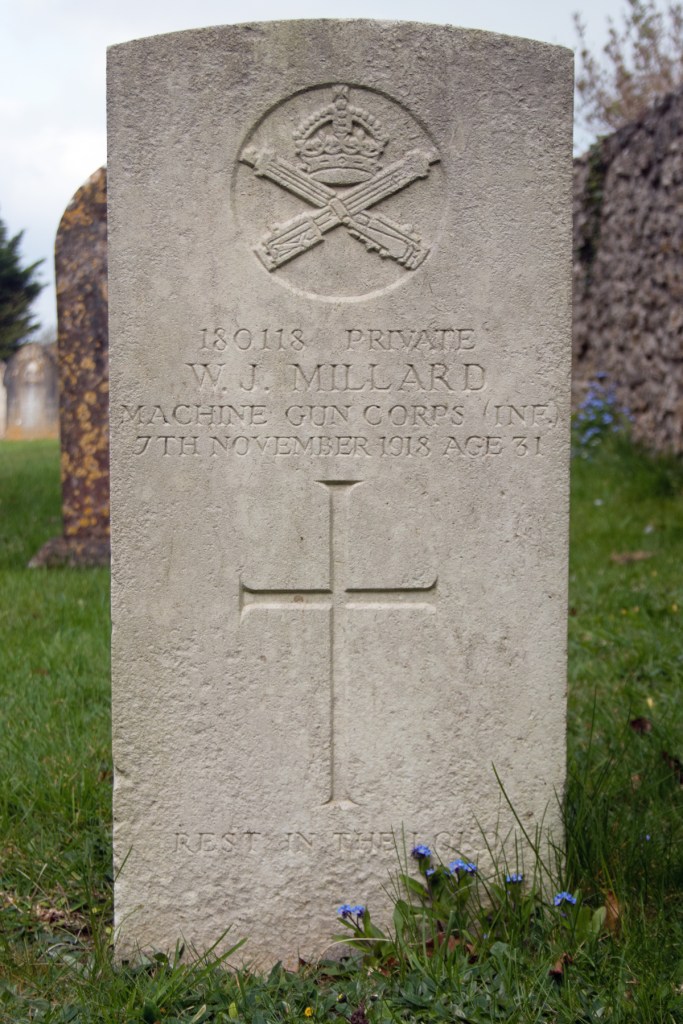
Walter John Millard was born in the summer of 1887, the youngest of nine children to Robert and Elizabeth. Robert was a farmer, and brought his family up in the village of Wedmore, Somerset. Walter followed in his father’s footsteps, and by the time of the 1911 census, was listed as a farm labourer in Wedmore, working for a William Millard, who presumably was a cousin of the family.
In March 1915, Walter married Jessy Masters, daughter of a grocer in nearby Wells. The couple set up home in the neighbouring village of Wookey, but would later make their home in Westbury-sub-Mendip.
In December 1915, aged 28, Walter was called up, and assigned to the Reserve Machine Gun Corps. He was not formally mobilised for almost three years when, in October 1918, he was shipped to Rugeley, Staffordshire, for training.
During this time, Private Millard was taken ill, and was admitted to the Military Hospital at Cannock Chase within weeks with influenza. His health deteriorated and, on 7th November 1918, he died from pneumonia. He was 31 years of age.
Had it not been for the quirk of fate of having been mobilised a month before the war ended, tragically, this would likely not be a story that needed to be told.
Walter John Millard was brought back to Somerset, and lies at rest in the graveyard of St Lawrence Church in Westbury-sub-Mendip.
William Diamond was born in around 1888, although documentation relating to his life are tantalisingly absent. From what does remain, the following can be identified.
William was one of ten children, whose mother was Maryann (or Mary Ann) Diamond. His father had passed away by the time of the 1911 census, by which point the Maryann was living with six of her children, including William, in the village of Litton, on the north side of the Somerset Mendips.
When war broke out, William enlisted, and was assigned to the 15th Battalion of the Hampshire Regiment. Again, there is little documentation to confirm his military service; sadly, the next time Private Diamond appears in the records is to confirm his passing.
The local newspaper reported on his funeral:
The funeral took place on Sunday afternoon, at Litton, his native place, of Private W Diamond, 28 [sic], late of the Hampshire Regiment, who died in hospital in Northampton after a serious illness, after serving some seven months at the front.
Among the chief mourners was a younger brother in khaki (an elder one is now serving in India) and several officers of the AOF, of which deceased was a member.
Shepton Mallet Journal: Friday 24th August 1917
Private William Diamond passed away on 15th August 1917, at the age of 29 years old. He lies at rest in the churchyard of St Mary the Virgin, in Litton, Somerset.
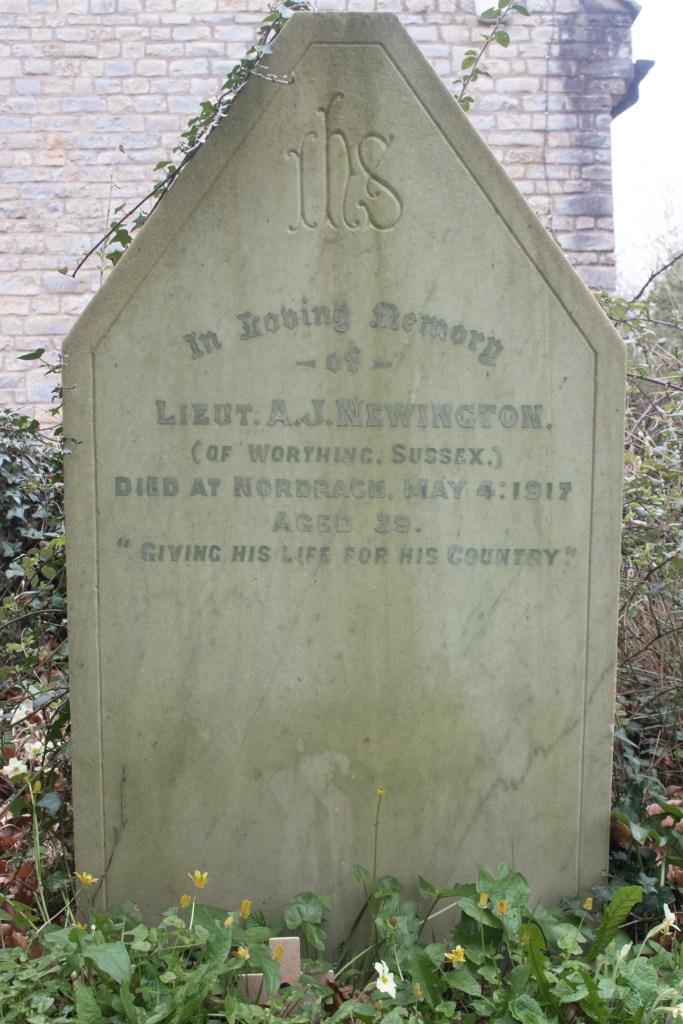
Alfred John Newington was born in 1878. The oldest of four children to Alfred and Minna Newington, Alfred Sr was a hosier, and the family lived in Brighton, Sussex.
Alfred Sr passed away in 1899, and by this time, his eldest son had followed his trade, becoming a gentleman’s outfitter. By the time of the 1911 census, he was the only one of the siblings still living at home, and was supporting Minna financially and in the family business along the coast in Worthing.
As with his early life, details of Alfred’s military service are a little scarce. However, a newspaper report of his passing gives more detail.
DEATH OF LIEUTENANT NEWINGTON
We learn with regret that Lieutenant Alfred J Newington died at Nordrath [sic], Blagdon, Somerset, on Friday. He was the eldest son of the late Mr Alfred Newington and of Mrs Newington, of Somerset Villa, Richmond Road.
The death of Mr Newington Sr took place after an illness of a long duration, in July 1899, after he had been in business her for about sixteen years. He came hither from Brighton, and established himself as an outfitter at the corner of Warwick Street at the premises now occupied by Messrs. Kinch Brothers.
During his residence here, Mr AJ Newington, who assisted his father in the business, had an exciting experience in the summer of 1896. He and Mr Frederick Barnwell and a friend names Wadham went towards Lancing on a fishing expedition and the boat was capsized, and Mr Barnwell was drowned, whilst Mr Newington and Mr Wadham were in the water for an hour and a half, eventually reaching the shore in an exhausted condition.
In February 1897, Mr Newington went to South Africa, and when War broke out he became a trooper in the South Africa Light Horse. He was subsequently awarded the silver medal with six bars, bearing the names of Belmont, Laing’s Nek, the Relief of Ladysmith, Orange Free State, Tugela Heights and Cape Colony.
When he came back to England, Mr Newington returned to the business and was a member of the Somerset Yeomanry, in which he advanced to the rank of Sergeant Major. His health failed about eight years ago, and he undertook a trip to the Baltic.
During the present War, he joined the Army Service Corps, and was attached to the Indian Cavalry Division in France, and it is only within a comparatively brief period that he was on leave at Worthing. His relatives will receive the sympathy of a wide circle of friends in the loss they have now sustained.
Worthing Gazette: Wednesday 9th May 1917
Second Lieutenant Newington had actually been admitted to the Nordrach Sanatorium near Blagdon in Somerset. This was a hospital that specialised in the treatment of tuberculosis, so it is safe to assume that this is the condition that affected him. He passed away on 4th May 1917, at the age of 39 years old.
Alfred John Newington wasn’t taken back to Worthing for burial. Instead, he lies at rest in the quiet churchyard of St Bartholomew’s in the village of Ubley, near Blagdon, in Somerset.
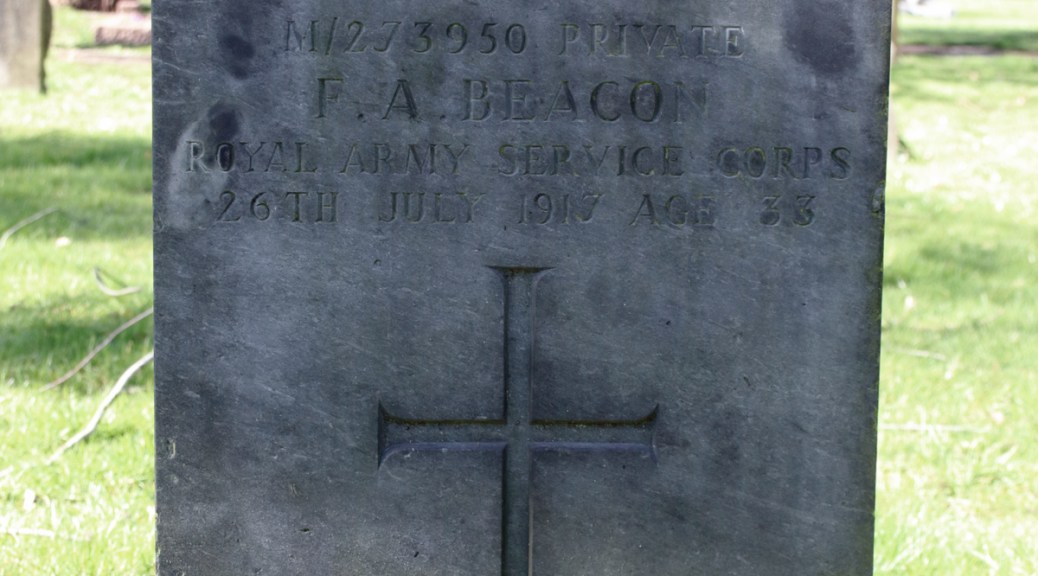
Frank Archibald Beacon was born in 27th April 1884, one of five children to William and Frances Beacon. William was a bargeman and the family lived in the village of Barrow Green near the North Kent marshes.
Tragically, William died at the age of only 36, leaving Frank without a father from the age of 2 years old. Frances found work as a charwoman, before finding love again. She married James Seager in 1895, who took in Frank and his siblings as his own.
After leaving school, Frank found work both as a builder and farm labourer and this was to stand him in good stead until the outset of war.
In January 1909, Frank married Kate Amelia Smart; she was the daughter of a victualler, and was born on Kent’s east coast, in Sandwich. The couple settled down to live in Newington, a village close to where Frank grew up, and had two children, Annie and Frank.
War was looming, and Frank enlisted. He joined the Royal Army Service Corps, working as a Private for the Mechanical Transport Company. Full details of his military service are not evident, but he was awarded the Victory and British Medals, which suggest that he service overseas at some point.
In the summer of 1917, Private Beacon fell ill, and was admitted to the Military Hospital in Boscombe. He was suffering from pleurisy and tetanus, and is was to these illnesses that he was to succumb. He passed away on 26th July 1917. He was 33 years old.
Frank Archibald Beacon was laid to rest in the Woodlands Cemetery in Gillingham, Kent, close to where he had made a new home with Kate.
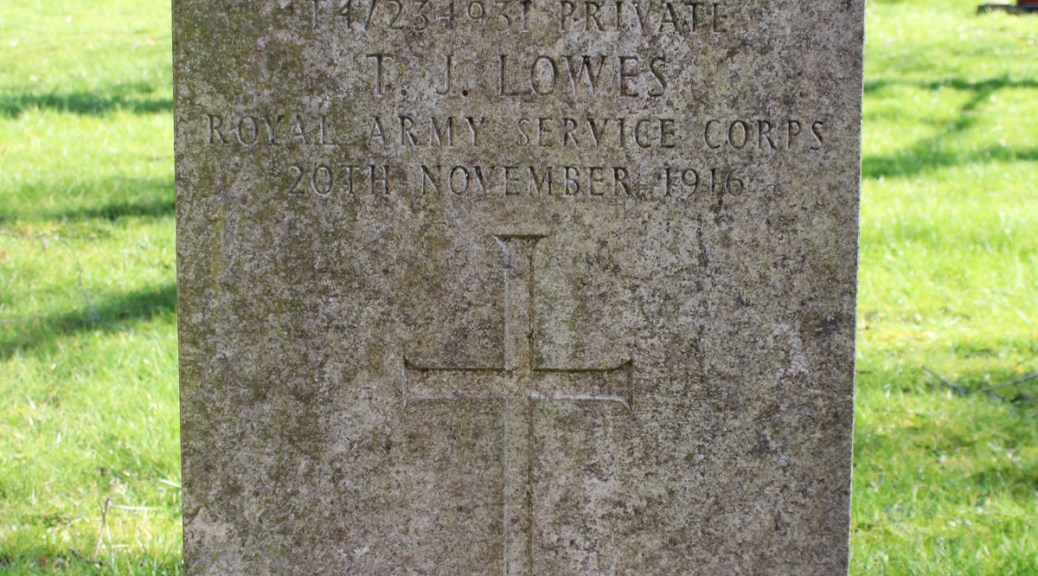
TJ Lowes is another of those names that challenges you to find out more about their lives. A quick search against the surname and service number identified the full name of Thomas James Lowes, and the Commonwealth War Graves Commission website confirms he was the husband of Mary Lowes.
There is enough circumstantial evidence available to suggest a particular set of records, but nothing to fully connect this gravestone to those records.
Based on that documentation, this is what I believe to be the Thomas James Lowes’ life.
Thomas James Lowes was born in Chatham, Kent, in 1863. One of eight children, his parents were Joseph and Jane Lowes, who came from Durham. Joseph was a shipwright, and moved the family to Hampshire in around 1860, before settling in Kent a year or so later. Given his trade, it the sea ports were an obvious draw, and he found work in the Naval Dockyard in Chatham.
When he left school, Thomas found work as a painter, and this was work that stood him in good stead all his life. He started decorating houses, but soon found employment in the dockyard.
Joseph died at some point in the 1880s, and by the 1891 census, Thomas was living at home with his mother and three of his younger siblings, all working to bring money in.
It was later that year that he got married, to a woman called Mary. The couple went on to have two children – Elsie (who was born in Sutton, Surrey) and Thomas Jr (who was born back in Kent). The young family came to live close to the dockyard again, as this is where Thomas was obviously earning his living.
War was on the horizon and, while Thomas’ full service records do not exist, it’s been possible to piece some bits together. He enlisted in the Royal Army Service Corps early on in the conflict, and worked as a farrier for No. 2 Company Depot. From here on in, however, Private Lowes’ documentation becomes confusing.
The Army Register of Soldier’s Effects confirms the service number documented elsewhere – T4/234931 – and that he passed away on 20th November 1916. It states that the the money was passed to his father, Thomas, which doesn’t tally up with the other records.
The other documentation available – the Pension Ledger and Index Cards – all include the Private Lowes’ service number, but give his widow , Mary Lowes, as his beneficiary.
Thomas contracted pneumonia while on active service; he was admitted to the Royal Herbert Hospital in Woolwich, but succumbed to the illness on 20th November 1916. He was 53 years old.
Thomas James Lowes was laid to rest in the Woodlands Cemetery in Gillingham, Kent.
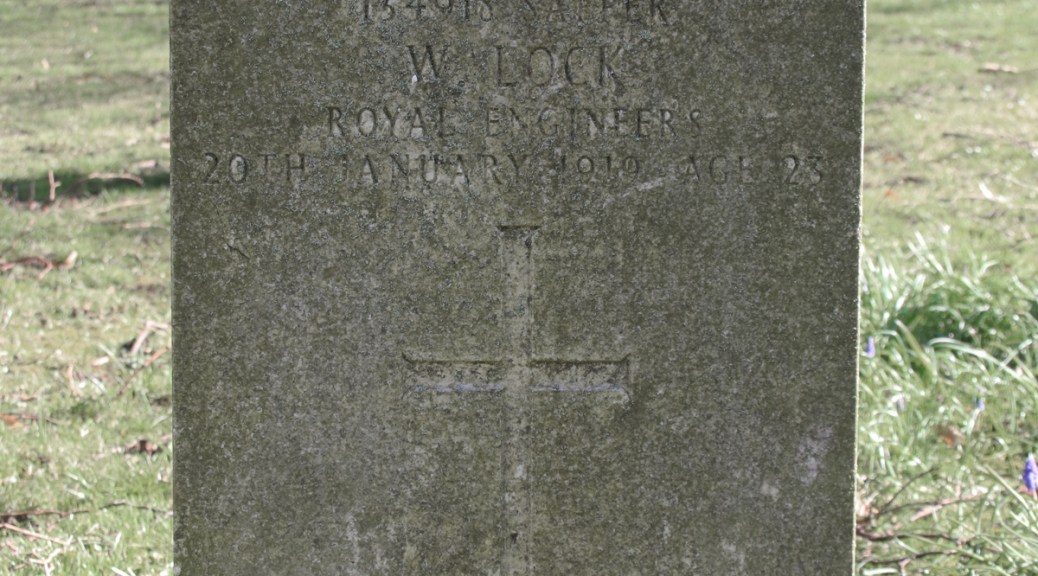
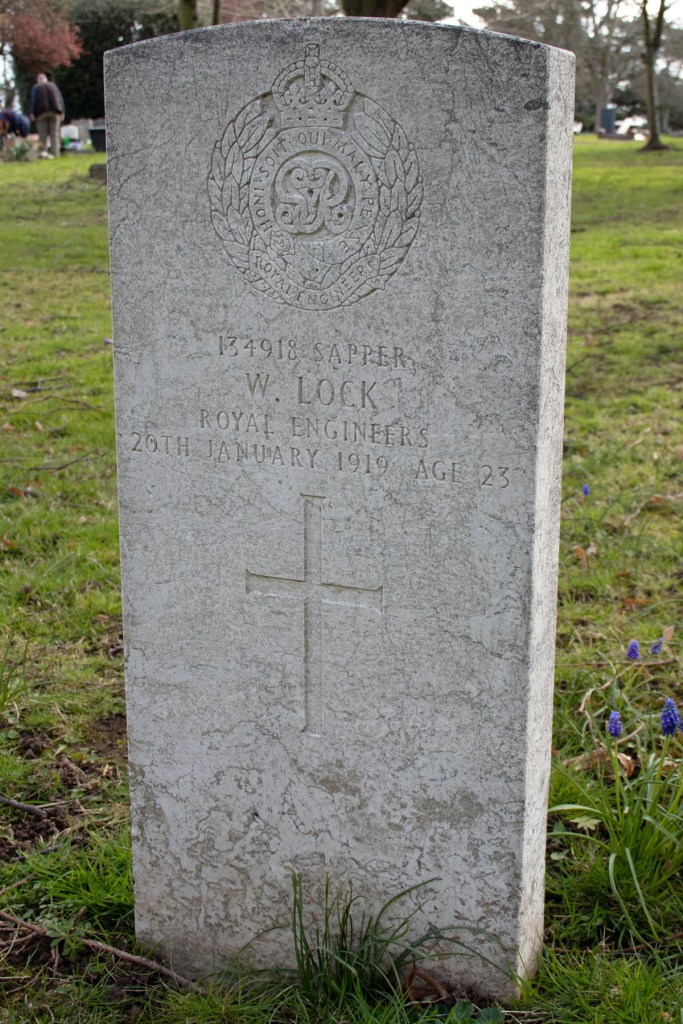
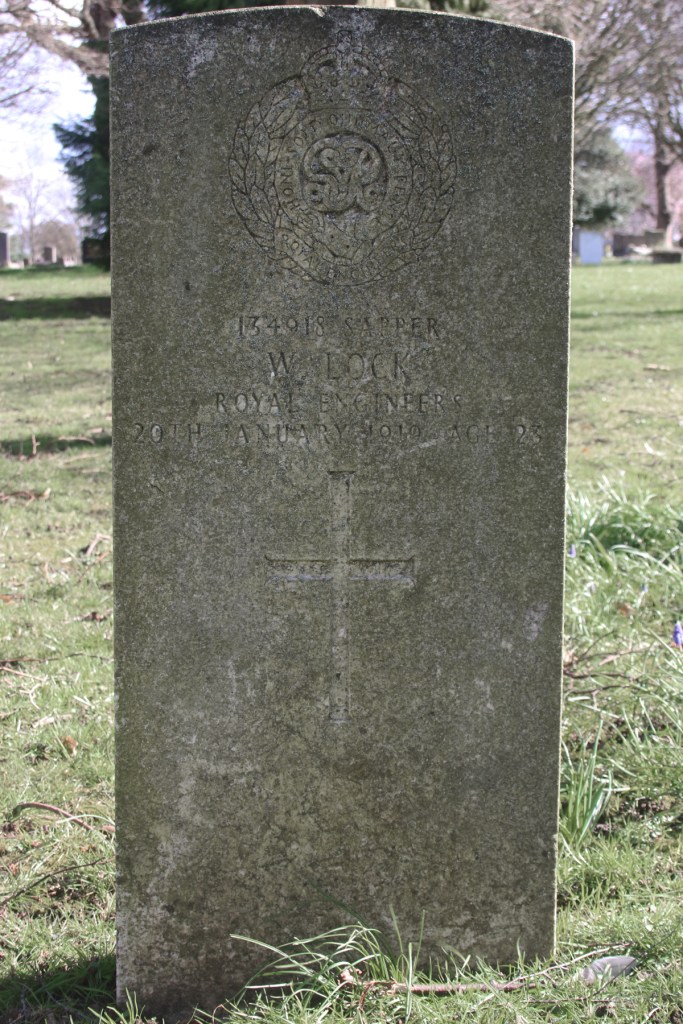
William Lock was born in Devon in 1896, one of three children to Tom and Mary Lock, although sadly only William survived childhood. Tom was a shipwright in on the Devon coast, but brought his young family to Kent, where he found work in the Naval Dockyard in Chatham.
When William left school, he set about finding a trade. By the time of the 1911 census, aged 15, he was listed as “learning house joinery”, presumably a trade for which his father’s work would have stood him in good stead.
War was looming, however, and William enlisted. He joined the Royal Engineers at a time where they were being inundated with volunteers. Sapper Lock was assigned to G Company, a provisional troop that formed part of the Depot Battalion.
Documentation relating to Sapper Lock’s military service are no longer available; he was awarded the Victory and British Medals, which suggests that he saw some kind of service overseas, but there is nothing on file to confirm this.
The next document relating to William is his war pension, which confirms that he died on 20th January 1919 from ulcerated endocarditis, or heart disease. He was just 23 years old.
Tom and Mary had lost the third of their three children.
William Lock was laid to rest in the Woodlands Cemetery in Gillingham, Kent.