Tag Archives: India

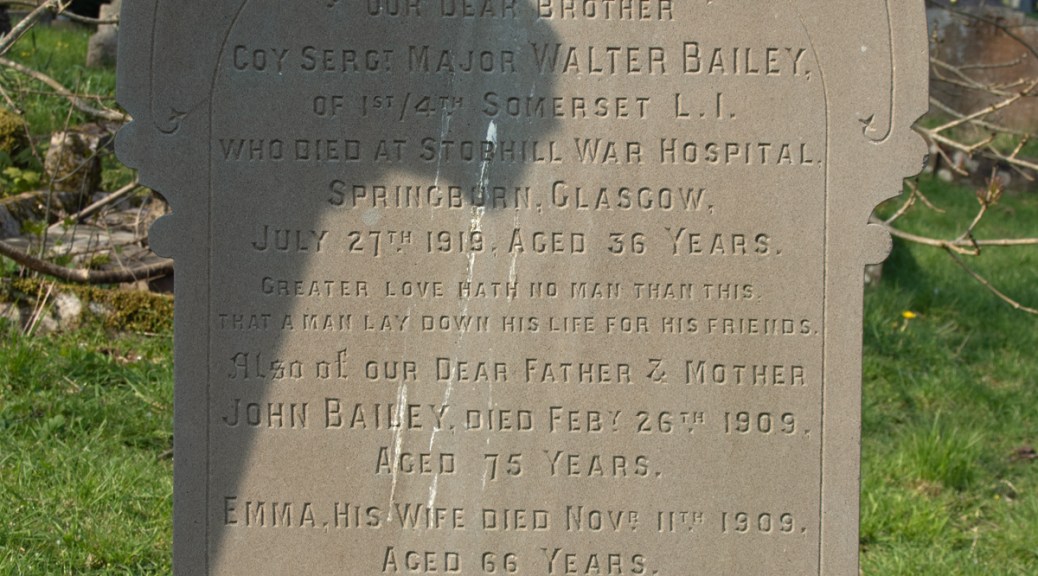
Company Serjeant Major Walter Bailey

Company Serjeant Major Walter Bailey

Walter Bailey was born on 6th October 1882 in Midsomer Norton, Somerset. He was one of eight children to Wiltshire-born labourer John Bailey and his wife, Emma, who came from the town in which they settled.

When he left school, Walter followed his siblings into the local boot industry and, by the time of the 1901 census, was working as a shoemaker. He was a sporty young man, and played in the local Welton Rovers Football Club.

When war came to Europe, Walter was eager to play his part. He enlisted in the 1/4th Somerset Light Infantry and, on 9th October 1914, was shipped to India. His battalion later moved to Mesopotamia where, on 8th March 1916, he was wounded in the foot in fighting. (Walter’s nephew, Corporal Tom Bailey was in the same regiment and, in the same fighting, he was killed. He is commemorated on the memorial in Basra, Iraq.)

Walter was invalided to India, but returned to his regiment when he recovered. He continued fighting, and was eventually promoted to Company Sergeant Major, while being mentioned in dispatches in 1918.

While waiting to return to England when the war ended, Walter fell ill. He was transported back to Southampton on a hospital ship, and from there was taken to a hospital in Glasgow. Sadly, the dysentery and anaemia he was suffering from were to get the better of him: Company Sergeant Major Bailey passed away on 27th July 1919, at the age of just 36 years old.

Walter Bailey’s body was brought back to Somerset for burial. He lies at rest in the family plot in the cemetery of St John the Baptist Church in his home town, Midsomer Norton.


Company Sergeant Major Walter Bailey
(from britishnewspaperarchive.com)

Colour Serjeant Major Frederick Davis

Colour Serjeant Major Frederick Davis

Frederick Davis was born in Street, near Glastonbury, in February 1876. One of four children, his parents were Frank and Ann. Frank was an agricultural labourer, while Ann worked as a shoe binder in the local Clark’s Factory.

By the 1891 census, Frederick had left school, and had also left home, boarding with a farmer in nearby Walton, where he also worked as a labourer on the farm. Ten years later, he was living with his paternal grandmother and his older brother in the village, with both brothers working as labourers.

During this time, it seems that Frederick had his sights on bigger and better things. Full details are not available, although it appears that he enlisted in the Army and served in India and South Africa between at least 1897 and 1902. He was awarded the Distinguished Conduct Medal in 1902 for his actions, although again little information around this survives.

Confirmation of his service overseas at this time appears on Frederick’s later military service records as, in January 1909, he again enlisted in the army. Frederick’s 1909 records show that his next of kin was his wife, Mrs AL Davis, although no marriage documents are apparent. He is also recorded as living in Castle Cary, just to the south of Glastonbury.

This time he was assigned to the 4th Battalion of the Somerset Light Infantry, serving for five years on home soil. During this time, he rose through the ranks from Private to Lance Corporal to Corporal to Sergeant.

When war was declared, the 4th Battalion was sent out to India. Sergeant Davis spent the next eighteen months there, before being moved to the Persian Gulf. He was obviously well thought of as, with the move came a further promotion, this time to Company Sergeant Major.

In June 1917, Frederick returned to England from overseas, and, at the end of his term of service two months later, he was demobbed. He returned home to Somerset, but, within a couple of months, on 2nd October 1917, he passed away. The cause of his death is not recorded, but he was 42 years of age.

Frederick Davis was laid to rest in the peaceful surrounds of the Castle Cary Cemetery.


Private Albert Sparrow

Private Albert Sparrow

Albert Edward Sparrow was born in Frome, Somerset, in March 1880. One of four children, his parents were Albert and Louisa Sparrow. Albert Sr was a labourer at an iron foundry, and the family were raised close to the centre of the town.

When he left school, Albert Jr found work as a labourer. However, after his father passed away in 1895, he sought longer term prospects. On 11th November 1898 he enlisted in the Royal Fusiliers as a Private for a period of twelve years. His service records show that he stood 5ft 6in (1.67m) tall, weighed 115lbs (52.2kg), had brown eyes, curly brown hair and a sallow complexion.

During his time in the army, Private Sparrow served in Gibraltar, South Africa and Burma. He returned home in March 1903, was placed on reserve in November 1906, and then ended his contract four years later.

At this point, Albert’s trail goes cold. However, when war was declared, he was keen to play his part. He re-enlisted on 27th August 1914, and was assigned to the Somerset Light Infantry. Assigned to the 6th (Service) Battalion, he was sent to France in December that year.

In July 1916, while fighting at the Somme, he was hurt when he received a gunshot wound to his right buttock. The injury proved enough for him to be medically evacuated back to England, and he spent the next five months recovering, and then working, on home soil.

In December 1916, Private Sparrow was sent back out to France. Six months later, he contracted bronchitis and was again evacuated back to England. He was admitted to the Royal Infirmary in Liverpool and, after a month there, he was moved to the Plas Tudno Nursing Home in Llandudno to recover.

Albert’s condition meant that he could not continue in military service, and he was discharged from the army on 18th December 1917. He returned home to Somerset, but his lung condition proved too much; he passed away on 19th January 1918, at the age of 37 years old.

Albert Edward Sparrow was laid to rest in the graveyard of Holy Trinity Church in his home town of Frome.


Private Herbert Ford

Private Herbert Ford

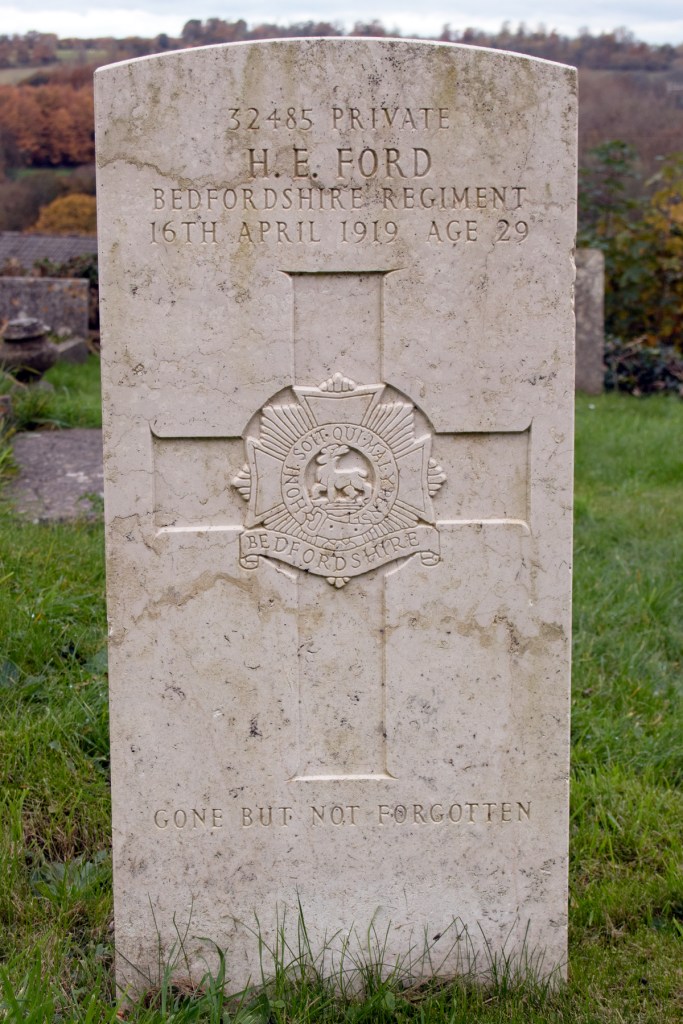
Herbert Edgar Ford is one of those people whose early life is destined to remain lost to time. His first names appear interchangeably on documents, with Herbert also being shortened to Bertie, but this means there is no definite trail to his early years.

He was born in Frome, Somerset, around the beginning of 1890, though nothing remains to suggest who his parents would have been. He married at the start of 1914, to local woman Ethel Mary Butler, and they went on to have a daughter, Doreen, at the end of the year.

By that point, war had been declared, and Herbert wanted to play his part. Full details of his military service are not available, but it is evident that he had enlisted in the Bedfordshire regiment by 1918. His troop – the 1st Garrison Battalion – were dispatched to India and were based in Delhi for the majority of the war, but it is unclear when or if Private Ford joined them.

Sadly, the next record for Private Ford is the notice of his death in the local newspaper. This confirms that he died on 16th April 1919 at Birmingham Hospital, “after a long and painful illness” [Somerset Standard: Friday 25th April 1919]. He was just 29 years of age.

Herbert Edgar Ford’s body was brought back to Somerset: he was laid to rest in the graveyard of Holy Trinity Church in his home town of Frome.


Serjeant Charles Flower

Serjeant Charles Flower

Charles Franklin Flower was born in Walcot, Bath, at the end of 1879. The middle of five children, his parents were stonemason John Flower and his dressmaker wife, Elizabeth.

John died when his son was only eleven years old, and Elizabeth passed away just two years later, leaving Charles an orphan at just 13 years of age.

He disappears off the radar for a time, only reappearing again when, in the summer of 1895, he enlisted in the 13th Battalion of the Somerset Light Infantry. Charles’ service records show that he stood 5ft 7ins (1.69m) tall, weighed 121lbs (55kg) and had grey eyes, light brown hair and a fair complexion. He was also noted as having a tattooed ring on his left ring finger.

After eighteen months on home soil, Private Flower was sent out to the East Indies, where, apart from a short stint back in England, he spent the next twelve years. He was promoted to Lance Corporal in May 1898, but though his own volition, reverted to the rank of Private seven months later. Charles was destined for bigger things, though, and was again promoted to Lance Corporal in September 1900. Over the next few years, he received further promotions – to Corporal in September 1905 and Lance Serjeant eighteen months later.

In the autumn of 1908, Charles returned to home soil, but his military service continued. On 12th April 1909, he married Elizabeth Ann Wills, a gamekeeper’s daughter from Cannington, Somerset. They set up home in Portland, Dorset, where Charles was based, and went on to have a son, Herbert, a year after they married.

By 1910, Charles had again been promoted, and was now a Serjeant. In the next couple of years, the family moved from the Dorset coast to the Somerset town of Frome. Serjeant Flower’s service continued, but he remained on home soil, even when war broke out.

All was not well with Charles’ health, however, and by the summer of 1915, he was admitted to hospital. He was thin and anaemic, with an enlarged liver and an ‘enormously swollen’ spleen. This was discovered to be a malignant growth, and Serjeant Flower was discharged from military service on medical grounds on 20th December 1915. He had been in the Somerset Light Infantry for more than two decades.

Charles Franklin Flower was not to recover from his illness. He passed away at home on 27th February 1916, at the age of just 37 years old. He was laid to rest in the graveyard of Holy Trinity Church in Frome.


Serjeant Charles Flower
(from ancestry.co.uk)

Private Charles Baily

Charles Baily

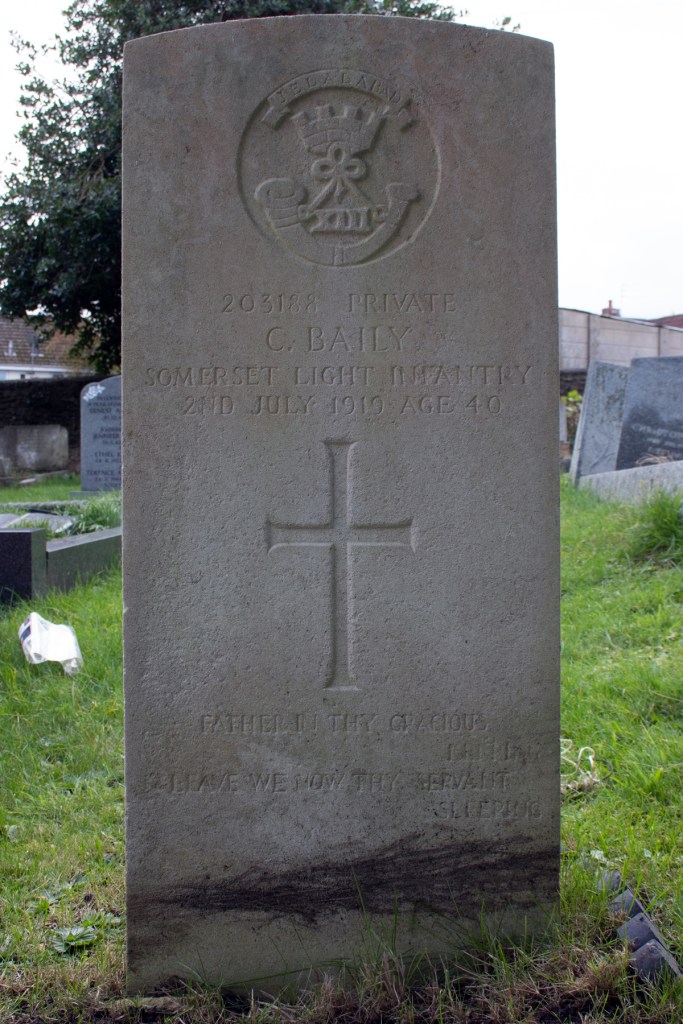
Charles Baily was born in Frome, Somerset, in March 1879; he was the middle of three children to Charles and Sarah Baily. Charles Sr was a plasterer, and the family were raised in a small cottage to the south of the town centre.

When Charles Jr left school, he found work as a carpenter and, on 17th March 1902, he married local woman Fanny Howell. Her father was a carter and she had not long returned from South Wales, where she had found employment as a parlour maid. Charles and Fanny set up home just three doors down from his parents, and went on to have five children.

War was coming to Europe, but the details of most of Charles’ military service are lost. He enlisted as a Private in the Somerset Light Infantry, and was assigned to B Company of the 1st/4th Battalion. The troop was sent to Bombay in the autumn of 1914; it then moved to Basra in the spring of 1916, remaining in Mesopotamia for the remainder of the conflict. Sadly, it’s not possible to know how much of this travel Private Baily undertook himself.

Charles survived the war, and was demobbed soon after the Armistice. He returned home, but his time back with his family was to be short: Private Baily died at home through causes lost to time on 2nd July 1919. He was 40 years old.

Charles Baily was laid to rest in the graveyard of Holy Trinity Church in his home town of Frome.


One sad aside to the story is that Charles and Fanny’s oldest child, daughter Frances Baily, had passed away in the summer of 1917. The cause of her passing is also lost to history, but she was just 16 years old when she died.


Lieutenant Herbert Marshall

Lieutenant Herbert Marshall

Herbert William Hare Marshall was born in Ambala, India, on 19th August 1890. His father – Herbert Seymour Marshall – was a Colonel in the army, and was serving in India with his wife, Charlotte, when their children – Charlotte (known as Jessie) and Herbert Jr – were born.

The family were back in England by 1898, and had set up home in the Somerset seaside town of Weston-super-Mare. When Herbert Sr passed away that year, Charlotte was set up on a widow’s pension, and this allowed her to send her son to St Peter’s, a private boarding school in the town.

When her son’s schooling was complete, Charlotte took the family off to Canada. They settled in British Colombia, in Revelstoke, a mountain town halfway between Calgary and Vancouver. Here, Herbert found work as a bank clerk, but war came to Europe, and he felt a need to do his bit for King and Country.

Herbert enlisted in the Canadian Expeditionary Force (CEF) in November 1914; his service papers record him as being 5ft 8ins (1.73m) tall, 148lbs (67kg) in weight. He had black eyes, brown hair and a dark complexion – something that he may well have inherited through his mother’s genes.

Shipped to England, by August 1915, Private Marshall had been discharged from the CEF as part of a transfer to the New Army – also known as Kitchener’s Army, the volunteer British Army raised as a direct result of the outbreak of war.

Detailed information about Herbert’s military service is lacking, although it seems that he joined the 17th Battalion of the West Yorkshire Regiment, one of the regiments heavily involved during the Battle of the Somme.

By October 1916, however, the now Lieutenant Marshall had made another move, this time joining the Royal Flying Corps. On the afternoon of 26th August 1917, he was an observer on a flight at Marham, in Norfolk. The pilot, a Lieutenant Challington, was banking the aircraft, when it dived and crashed, killing both men. Lieutenant Marshall had turned 27 years old the week before.

Herbert William Hare Marshall’s body was brought back to his adopted home of Weston-super-Mare. He lies at rest alongside his father in the town’s Milton Road Cemetery.


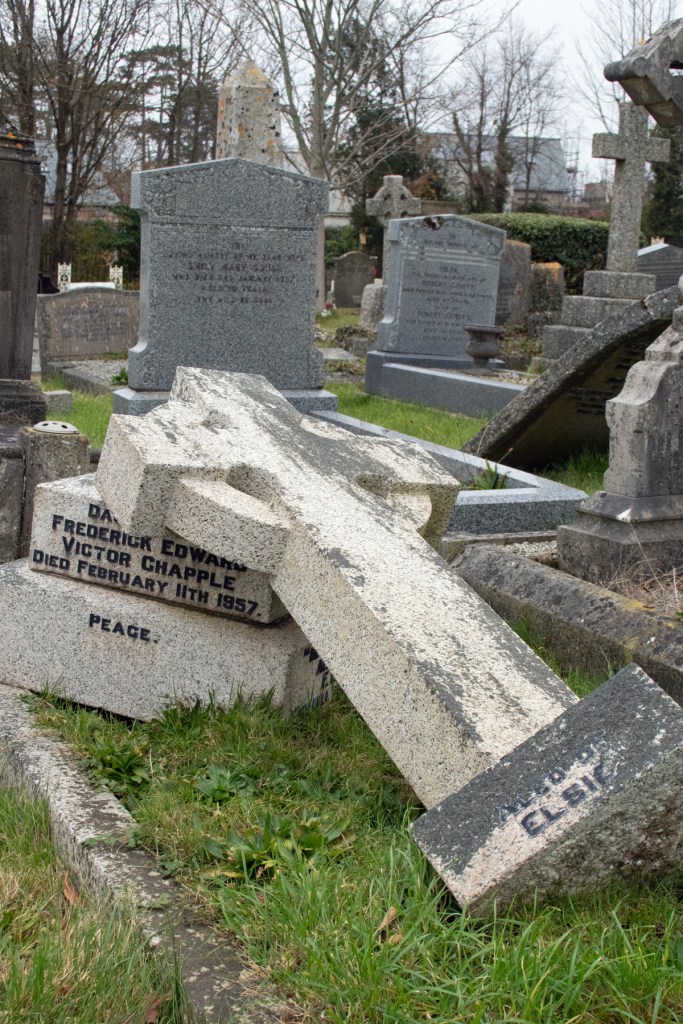
Corporal Bruce Chapple

Corporal Bruce Chapple

Bruce Chapple was born in the autumn of 1893, the youngest of four children to Frederick and Elizabeth Chapple. Frederick was born in Newton Abbot and ran the managed a public house in the town (now the Locomotive Inn), although the 1901 census also listed him as a tobacco pipe manufacturer.

According to the next census – in 1911 – Bruce had taken over the pipe making, which meant that Frederick was devoting his time to being a publican. By this time, Bruce had another interest; military service. He had volunteered for the Devonshire Regiment in October 1909 and, over the next few years, the 5ft 3.5ins (1.61m) tall teenager received training in and around the county.

When war broke out in 1914, Private Chapple was formally enrolled and, as part of the 1st/5th Battalion, he set out for India that October. Initially based in Multan – in what is now Pakistan – he subsequently moved on to Lahore.

Bruce spent a total of two-and-a-half years in India, receiving a promotion to Lance Corporal in the process. In March 1917, his battalion transferred to Egypt, and the now Corporal Chapple went with them.

On 23rd November, Bruce was wounded in action, receiving a gun shot wound to his left thigh; he was not medically repatriated for treatment, but appears to have recovered from his injury and remained in Egypt until July 1918.

Back home in England, Corporal Chapple remained in the army for a further couple of months, before he was discharged as being no longer medically fit for service in September. Sadly, the cause for his discharge is lost to time.

It is at this point that Bruce’s trail goes cold. The next available record is of his death, on 16th November 1919; he was 26 years old.

Bruce Chapple was laid to rest in the family plot in Newton Abbot Cemetery.


Rifleman Arthur Langdon

Rifleman Arthur Langdon

Arthur William Langdon was born on 23rd December 1882, the son of Rose Langdon, from the Somerset village of Chiselborough. While Arthur’s father is lost to time, Rose married Frederick Hockey in 1886, and the couple went on to have three children – half-siblings to Arthur.

Arthur was destined for a life of adventure, and in 1902, at the age of 19, enlisted as a Rifleman in the King’s Royal Rifles, a career that was to last more than a decade.

On 13th April 1903, Arthur married Florence Beatrice Druce, who was also from Chiselborough. Noticeably absent from the marriage certificate was the name of the groom’s father; he was simply marked as ‘unknown’. The newlyweds would go on to have a son, also called Arthur, the following year.

Rifleman Langdon was soon destined for service overseas, however. After 18 months in South Africa, he returned to England for a year. He was sent to India for four years; it is likely that Florence went with him, or at least that Arthur returned home on leave during this time, as two further children – Henry and Reginald – were born in 1907 and the summer of 1910 respectively.

Arthur returned to England in February 1910, and remained on reserve home service – supplementing his income by working as a gardener – until the outbreak of the First World War. During this time he and Florence had two further children, Frederick, born in 1912, and Ivy, born just a month before war broke out.

With the start of the conflict, Rifleman Langdon was send to France as part of the British Expeditionary Force. After five months on the Western Front, he had a brief respite back in England, before being shipped back to France in May 1915, and on to Salonika in the Balkans that November.

Rifleman Langdon did not stay in Greece for long, however. Within a couple of months he was back in England and on 14th April 1916, he was discharged from the army on medical grounds. Sadly, details of the cause of his exit from the army are not detailed.

Arthur was not one to rest on his laurels, however, and continued work as a gardener and labourer. Military life wasn’t far away, though, and in June 1918, he enlisted again, this time joining the Royal Air Force as a Private.

Initially based at Long Sutton, Arthur moved to Edinburgh Castle in March 1919. Full details of his time there are lost, but he remained in Scotland until being demobbed at the end of April 1920.

Details of Arthur’s life back on civvy street are not available. All that can be confirmed is that he passed away on 28th February 1921, at the age of 38 years old. Arthur William Langdon was laid to rest in the graveyard of St Margaret’s Church in the Somerset village of Middle Chinnock, where his widow now lived.


Arthur William Langdon
(from ancestry.co.uk)

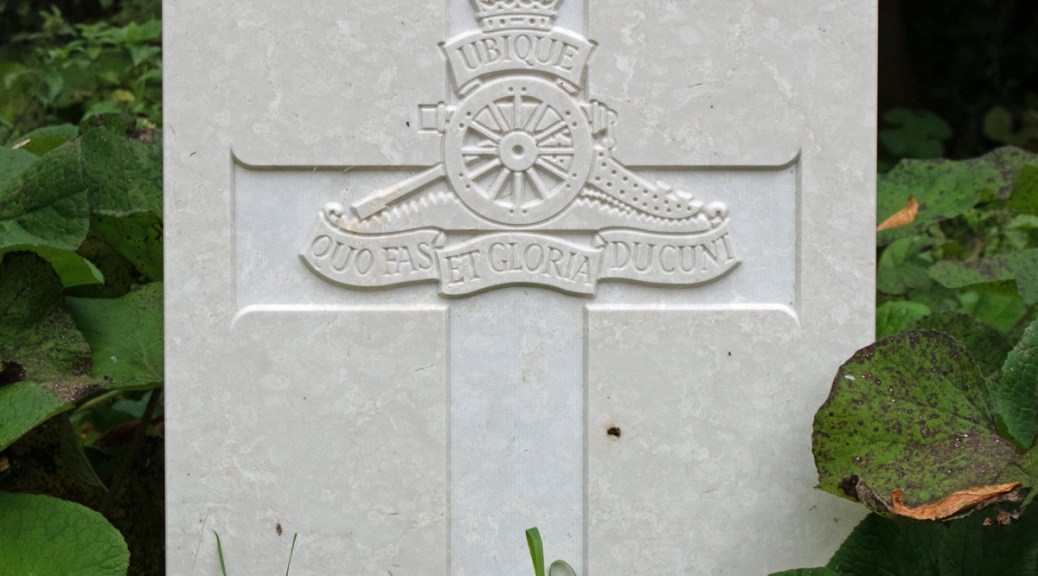
Gunner William Hann

Gunner William Hann

William Hann was born towards the end of 1871, the son of Harry Hann, who was a stonemason, and his wife Susan. Born in Stoke-under-Ham (now Stoke-sub-Hamdon), he was one of nine children, although sadly five of his siblings passed away at a young age.

Sadly, little of William’s early life remains documented. A newspaper article that reported on his passing, however, confirms that he served in the Royal Field Artillery, and was based in India for four years, before being shipped to South Africa to fight in the Boer War.

Back in Somerset in the early 1900s, he married a woman called Ellen, and the couple went on to have four children – Hilda, Herbert, Kate and Louisa.

At the outbreak of the [First World War], though under no obligation, [Gunner Hann] responded to the call of duty and was among the first to volunteer from Stoke. He was attached to the Indian Expeditionary Force and sent to France, and it is interesting to know that he saw some of the native soldiers whom he had bet while serving in India many years ago.

After serving in France for some time, he was transferred to Mesopotamia, and it was there that his health became impaired, which made him an easy victim of the disease which caused his death.

Western Chronicle: Friday 1st June 1917

Gunner Hann had contracted cellulitis in his right arm, which turned septic. He returned home on sick leave on 22nd May 1917, but died at home from blood poisoning just two days later. He was 48 years of age.

William Hann was laid to rest in the graveyard of St Mary’s Church, in his home village of Stoke-sub-Hamdon.