Tag Archives: London

Second Lieutenant Arthur Bentley

Second Lieutenant Arthur Bentley

Arthur Webb Butler Bentley was born on 1st January 1884 to Dr Arthur Bentley and his wife Letitia. The oldest of five children, they were a well-travelled family. Dr Bentley had been born in Devon, but his and Letitia’s first two children were born in Singapore, while their second two were born in Ireland, where Letitia herself had been born.

By the time of the 1891 census, the family were living in Paddington, London, where Arthur’s father was a medical practitioner.

Arthur Jr looked set to follow in his father’s footsteps; becoming a student of medicine in Edinburgh, although it seems his life was destined to take a different route.

By 1905, his father was working at a practice in Egypt. It was around this time that his mother made the newspaper headlines.

VICTIM OF CHROLODYNE

A painful story was told at the Clerkenwell Sessions when Letitia Bentley, the wife of a doctor holding an official position in Cairo, pleaded guilty to the theft of a diamond and ruby ring from the shop of Messrs. Attenborough, Oxford Street [London]. It was stated that Mrs Bentley was addicted to the drinking of spirits and chlorodyne, and that 240 empty bottles which had contained the latter drug had been found in her rooms in Bloomsbury.

Dr Bentley said he would keep his wife under strict supervision in the future, and she was bound over.

Shetland Times: Saturday 3rd June 1905.

The ring concerned was valued at five guineas (around £700 in today’s money), and another report confirmed that her husband “supplied her with ample means” [financially].

In the 19th century, chlorodyne was readily used as a treatment for a number of medical conditions. Its principal ingredients were a mixture of laudanum (an alcoholic solution of opium), tincture of cannabis, and chloroform, it readily lived up to its claims of relieving pain and a sedative.

Letitia does not appear in any other contemporary media; sadly, however, she passed away “at sea” in June 1907, presumably on the way to or from Cairo, where Arthur Sr was still working. She was just 47 years old.

Arthur seems to have taken the decision to move away, and he emigrated to Canada, settling in Winnipeg. Leaving England behind, he left the idea of medicine with it, finding work as a lineman instead, constructing and maintaining telegraph and power lines.

Arthur’s father is the next member of the family to appear in the local newspapers. Working in Cairo during the winter and Llandrindod Wells in the summer, he travelled to Wales in April 1911. One evening he collapsed and died while in the smoking room of his hotel. The media reported that he was “formerly Colonial Surgeon to the Straits Civil Service, Singapore” and that “he was going to deliver a lecture at Owen’s College [now the Victoria College of Manchester] on tropical diseases, upon which he was an expert.

Arthur Jr was now 27, and had lost both of his parents. War was on the horizon, though, and he seemed keen to become involved. He enlisted in December 1915, joining the Canadian Expeditionary Force. His sign-up papers gave him as just short of 32 years old, standing at 5ft 8ins (1.72m) tall, with a fair complexion, blue eyes and brown hair. The document also recorded his next of kin as his brother, William, who was living near Cairo.

Arthur arrived in England on 25th September 1916; during his time in the army he remained on English soil, primarily at a signal base in Seaford. Transferred to a reserve battalion in January 1917, he was eventually discharged seven months later.

His records suggest that his services were no longer required, but t is likely that Arthur’s discharge was his transfer to the Yorkshire Regiment, complete with a commission.

The now Second Lieutenant Bentley was assigned to the 3rd Special Reserve Battalion but never saw action in Europe. The troop’s main duties were to train men for service overseas and to provide coastal defences. While there is no confirmation of exactly where Arthur was based, there were units in and around Hartlepool, County Durham.

Sadly, there is little further information about Arthur. By the end of the war, he was living in Taunton, Somerset, where his younger sister Eileen had settled. Second Lieutenant Bentley survived the war, but passed away not long afterwards, on 2nd December 1918. There is no cause given for his death. He was just 35 years old.

Arthur Webb Butler Bentley lies at rest in St Mary’s Cemetery in Taunton, Somerset.


Second Lieutenant Archibald Walsh

Second Lieutenant Archibald Walsh

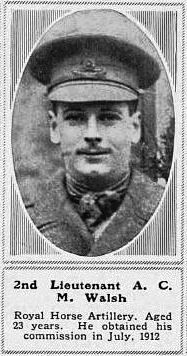
Archibald Charles Mark Walsh was born on 3rd February 1892, the youngest of three children to Henry Alfred Walsh and his wife Ann. Henry had a distinguished military career, and his sons – Archibald and his older brother Theobald – seemed destined to do the same.

Henry’s service took him around the world, and, by the time Archibald was born, the family had settled in Devon. In tracing the family’s life, however, an unusual quirk arises around the turn of the century.

In 1901, the majority of the Walsh family disappear from census records. For someone like Henry, this would not be unusual; his career took him overseas, and it is likely that records were lost or destroyed.

However, Archibald and his sister Gwladys do appear in the records. They are set up in a seafront villa in the Kent town of Hythe, Gwladys is listed as both a school pupil and the head of the household – at the age of 14 – and the two siblings are living there with a governess, Mary Porter.

By the time of the next census, Cadet Walsh had followed his father into the military. He was a student at the Military Academy in Woolwich, and the following year achieved his commission, becoming a Second Lieutenant in the Royal Horse Artillery.

When war broke out, Archibald’s regiment were shipped off to the Western Front. In March 1915, he was caught up in the Battle of Neuve Chapelle, and was badly wounded.

Shipped back to England for treatment, he was admitted to the Hall-Walker Hospital for Officers in Regents Park, London. Sadly, Second Lieutenant Walsh’s injuries were too severe, and he passed away on 18th March 1915. He was just 23 years old.

Brought back to Taunton, near his family home, Archibald Charles Mark Walsh lies at rest in St Mary’s Cemetery.


Second Lieutenant Archibald Walsh

Major Thomas Clark

Major Thomas Clark

Thomas James Clark was born in Worcester at the beginning of 1853, the oldest of two children to James Clark and his wife Sarah. James was an engine smith and gas fitter, and moved the family with his work, initially to London, then on to the Kent coast.

Documentation relating to Thomas’ early life is difficult to track down; the 1871 census has him listed as a gas fitter like his father, but it is likely that he enlisted in the army fairly shortly after this date.

In 1875, he married a woman called Emily Ann. There life was to take on a grand new adventure as their first child, a boy named after his father, was born in Bombay, India, later that year.

It seems likely that it was Thomas’ military service that took the young family overseas. This was to be the case for at least a decade, as Emily gave birth to four further children in India. James, their fifth child, was born in Bombay in 1884. Their sixth, and last child, Ellen, was born in Gillingham, Kent, ten years later.

Given that the standard time for military service was twelve years, it is possible that Thomas served all of that time overseas, returning to England in around 1887.

Back home in Kent, Thomas is given the commission of Quartermaster in November 1897. By this point, he has been in the Royal Engineers for just under 21 years. He and his family are living in central Gillingham, within easy walking distance of the Royal Engineers Barracks and School of Engineering.

The 1901 census also lists Thomas as Quartermaster for the regiment, while three of his sons are by this time working in the Naval Dockyard as shipwrights and engine fitters.

Ten years later and the family are still living in the same house. By now, and aged 57, Thomas is recorded as a Retired Captain and Quartermaster for the Royal Engineers. He and Emily have been married 36 years, and their three youngest children (now aged 29, 26 and 17) are still living with them.

War was looming by now, although, age 61 when it broke out, it is unlikely that Retired Quartermaster Clark would have been involved in any front line activity. While no military records survive for Thomas, it seems possible that he may have been recalled for a training or administrative role at the barracks nearby.

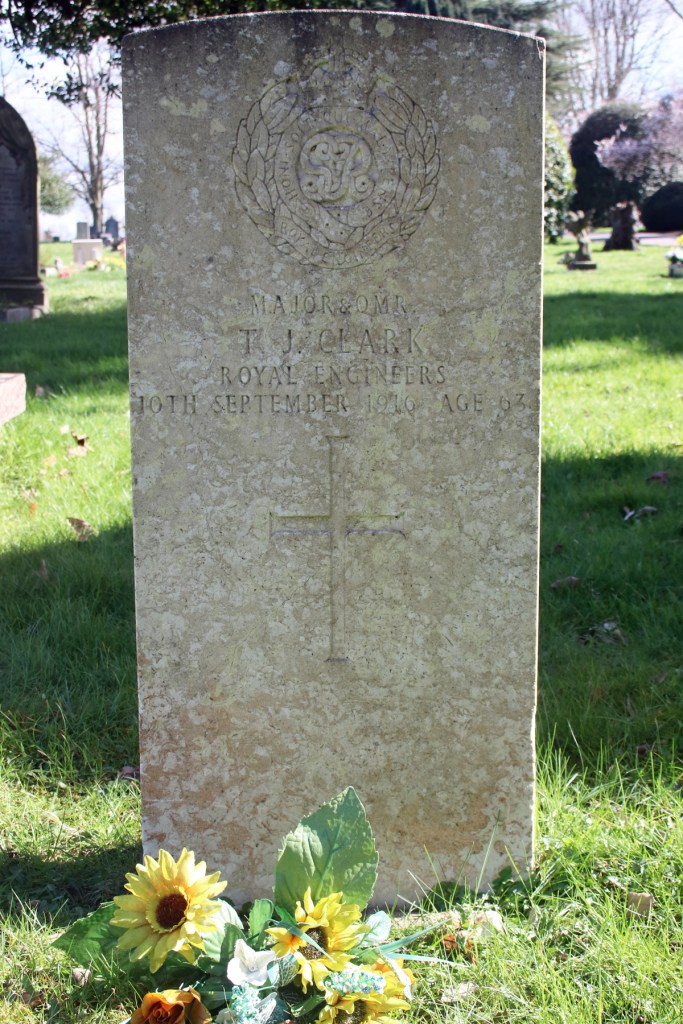
Any re-commission would not have lasted for long, however, as Quartermaster Clark passed away at home on 10th September 1916. He was 63 years old.

Thomas James Clark lies at peace in the Woodlands Cemetery in Gillingham, Kent.


Thomas’ widow, Emily, passed away just two years after her husband. She was also laid to rest in the Woodlands Cemetery.

Thomas left his estate in the hands of his youngest son, James, who was still living at his parents’ home when they passed away.


Chief Stoker Ernest Ware

Chief Stoker Ernest Ware

Ernest George Ware was born in the autumn of 1871 in Marylebone, London. Details of his early life are scant, but records show that he enlisted in the Royal Navy in February 1895, serving as a Stoker for an initial period of twelve years.

During this time, he worked on a number of different vessels – Wildfire, Theseus, Warspite, Amphion, Acheron and Sapphire. He was also based on a number of shore vessels; potentially Southsea in Hampshire and Pembroke in Wales.

In 1905 he married Mary Emery; she was the same age as Ernest, and was born in Hampshire. The young couple had a daughter, Muriel, and, by the time of the 1911 census, the family were living in Pembroke Dock, in South Wales.

War was inching closer, and Stoker Ware’s service was extended for the duration; he served on a number of other vessels – Leander, Blenheim, Blake and Tyne – before being promoted to Chief Stoker on HMS Blonde in 1911. He transferred to HMS St George two years later, before moving on shore to the training vessel HMS Victory II (based in Crystal Palace, South London) in 1915.

Chief Stoker Ware’s health seemed to have been in decline by this point; he was admitted to the Royal Naval Hospital Haslar in Gosport in early 1916, suffering from malignant endocarditis. Sadly, he passed away on 16th February, aged 44 years old.

Ernest George Ware was buried in the Woodlands Cemetery in Gillingham, Kent, close to where his widow was now living.