Tag Archives: Mesopotamia

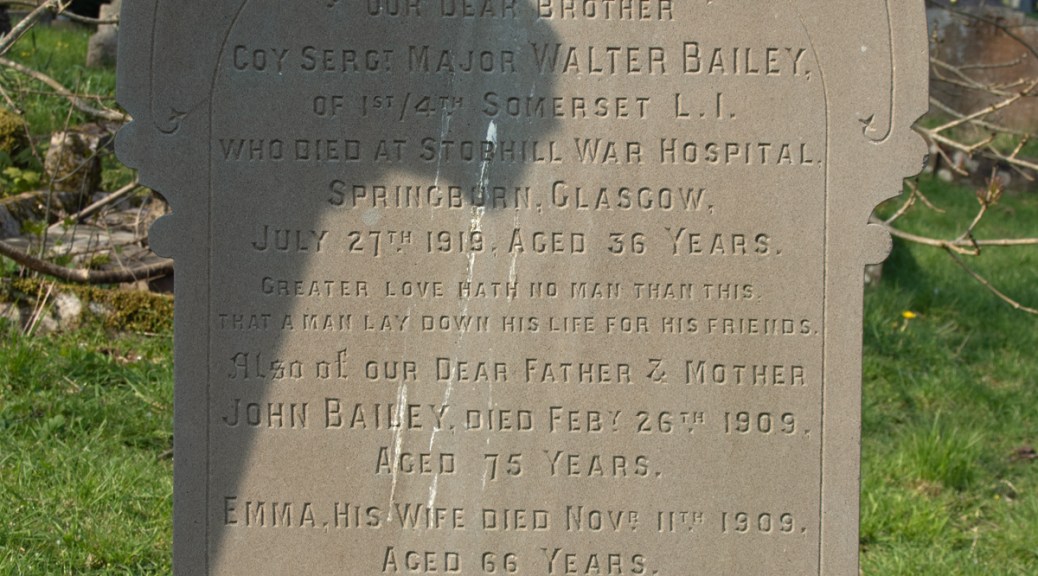
Company Serjeant Major Walter Bailey

Company Serjeant Major Walter Bailey

Walter Bailey was born on 6th October 1882 in Midsomer Norton, Somerset. He was one of eight children to Wiltshire-born labourer John Bailey and his wife, Emma, who came from the town in which they settled.

When he left school, Walter followed his siblings into the local boot industry and, by the time of the 1901 census, was working as a shoemaker. He was a sporty young man, and played in the local Welton Rovers Football Club.

When war came to Europe, Walter was eager to play his part. He enlisted in the 1/4th Somerset Light Infantry and, on 9th October 1914, was shipped to India. His battalion later moved to Mesopotamia where, on 8th March 1916, he was wounded in the foot in fighting. (Walter’s nephew, Corporal Tom Bailey was in the same regiment and, in the same fighting, he was killed. He is commemorated on the memorial in Basra, Iraq.)

Walter was invalided to India, but returned to his regiment when he recovered. He continued fighting, and was eventually promoted to Company Sergeant Major, while being mentioned in dispatches in 1918.

While waiting to return to England when the war ended, Walter fell ill. He was transported back to Southampton on a hospital ship, and from there was taken to a hospital in Glasgow. Sadly, the dysentery and anaemia he was suffering from were to get the better of him: Company Sergeant Major Bailey passed away on 27th July 1919, at the age of just 36 years old.

Walter Bailey’s body was brought back to Somerset for burial. He lies at rest in the family plot in the cemetery of St John the Baptist Church in his home town, Midsomer Norton.


Company Sergeant Major Walter Bailey
(from britishnewspaperarchive.com)

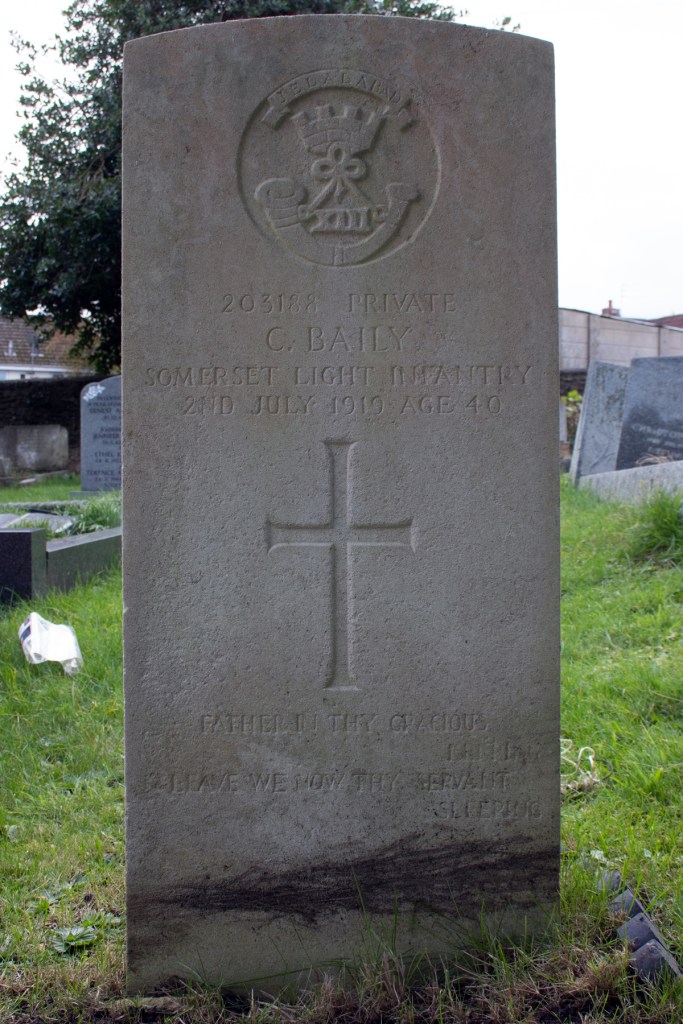
Private Charles Baily

Charles Baily

Charles Baily was born in Frome, Somerset, in March 1879; he was the middle of three children to Charles and Sarah Baily. Charles Sr was a plasterer, and the family were raised in a small cottage to the south of the town centre.

When Charles Jr left school, he found work as a carpenter and, on 17th March 1902, he married local woman Fanny Howell. Her father was a carter and she had not long returned from South Wales, where she had found employment as a parlour maid. Charles and Fanny set up home just three doors down from his parents, and went on to have five children.

War was coming to Europe, but the details of most of Charles’ military service are lost. He enlisted as a Private in the Somerset Light Infantry, and was assigned to B Company of the 1st/4th Battalion. The troop was sent to Bombay in the autumn of 1914; it then moved to Basra in the spring of 1916, remaining in Mesopotamia for the remainder of the conflict. Sadly, it’s not possible to know how much of this travel Private Baily undertook himself.

Charles survived the war, and was demobbed soon after the Armistice. He returned home, but his time back with his family was to be short: Private Baily died at home through causes lost to time on 2nd July 1919. He was 40 years old.

Charles Baily was laid to rest in the graveyard of Holy Trinity Church in his home town of Frome.


One sad aside to the story is that Charles and Fanny’s oldest child, daughter Frances Baily, had passed away in the summer of 1917. The cause of her passing is also lost to history, but she was just 16 years old when she died.


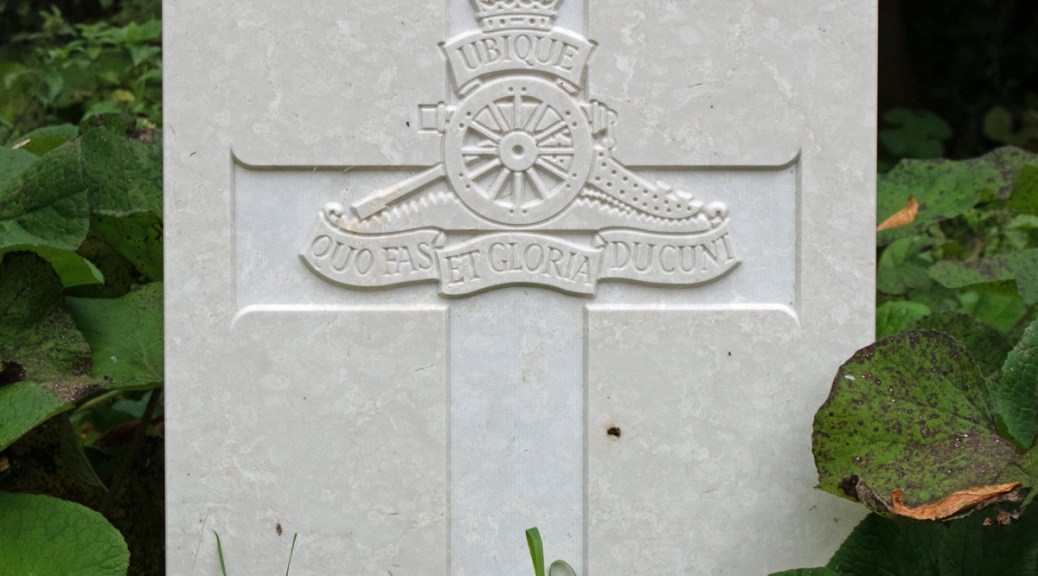
Gunner William Hann

Gunner William Hann

William Hann was born towards the end of 1871, the son of Harry Hann, who was a stonemason, and his wife Susan. Born in Stoke-under-Ham (now Stoke-sub-Hamdon), he was one of nine children, although sadly five of his siblings passed away at a young age.

Sadly, little of William’s early life remains documented. A newspaper article that reported on his passing, however, confirms that he served in the Royal Field Artillery, and was based in India for four years, before being shipped to South Africa to fight in the Boer War.

Back in Somerset in the early 1900s, he married a woman called Ellen, and the couple went on to have four children – Hilda, Herbert, Kate and Louisa.

At the outbreak of the [First World War], though under no obligation, [Gunner Hann] responded to the call of duty and was among the first to volunteer from Stoke. He was attached to the Indian Expeditionary Force and sent to France, and it is interesting to know that he saw some of the native soldiers whom he had bet while serving in India many years ago.

After serving in France for some time, he was transferred to Mesopotamia, and it was there that his health became impaired, which made him an easy victim of the disease which caused his death.

Western Chronicle: Friday 1st June 1917

Gunner Hann had contracted cellulitis in his right arm, which turned septic. He returned home on sick leave on 22nd May 1917, but died at home from blood poisoning just two days later. He was 48 years of age.

William Hann was laid to rest in the graveyard of St Mary’s Church, in his home village of Stoke-sub-Hamdon.


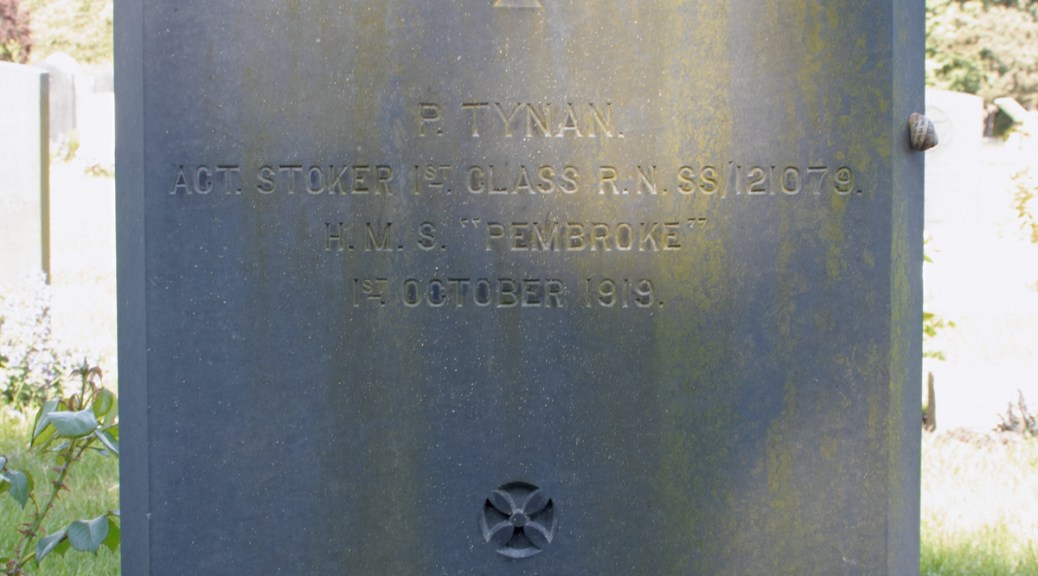
Stoker 1st Class Patrick Tynan

Stoker 1st Class Patrick Tynan

Patrick Tynan was born in Roscrea, Southern Ireland, on 9th June 1893. He was the eldest of four children to John and Anne Tynan, but sadly, there is no further information available for his early years.

Patrick’s story really picks up on 14th December 1915, when he joined the Royal Engineers as a Private. His service record states that he was living in Bangor, Gwynedd, and that he was a stall keeper at a fairground – a subsequent document noted his trade as a showman. He was noted to be 5ft 8ins (1.72m) tall, weighed 151lbs (68.5kg), and had numerous scars on his back.

Private Tynan did not stay in the UK for long. Assigned the new role of Driver, he was attached to the GHQ Signal Company and sailed from Devonport on 30th June 1916, bound for Mesopotamia. Arriving in Margil – the port connected to Basra – he was based here for more than a year, before moving north to Baghdad.

By this time, Patrick had risen to the rank of Lance Corporal, and was obviously a trustworthy member of the company. Towards the end of 1917, he had again been promoted, this time to Corporal.

During his time in modern day Iraq, Patrick was admitted to hospital a handful of times; there is little information on the conditions he suffered, but none appear to have been life threatening, as they were only for short periods. It’s also interesting to find that his service records confirm a month’s leave in May 1918, spent in India.

When the war came to a close, Corporal Tynan was still in the Middle East. Ready to be demobbed, his company moved to India and boarded the SS Chupra in Calcutta on 26th February 1919, bound for home.

Back in the UK, however, Patrick was not ready to give up the formal military life. Having returned to Gillingham in Kent, where the Royal Engineers were based, he initially found work as a tram conductor, but soon signed up for a five year term with the Royal Navy as a stoker.

He was based on HMS Pembroke II, the shore-based establishment at Chatham Dockyard, but sadly, his time in the navy was to be a short one. Admitted to the Royal Naval Hospital in the town with pneumonia, he passed away form the condition on 1st October 1919. He was just 26 years old.

Patrick Tynan was laid to rest in the Woodlands Cemetery in Gillingham. He had a short but full life, something his modest gravestone doesn’t begin to hint at.


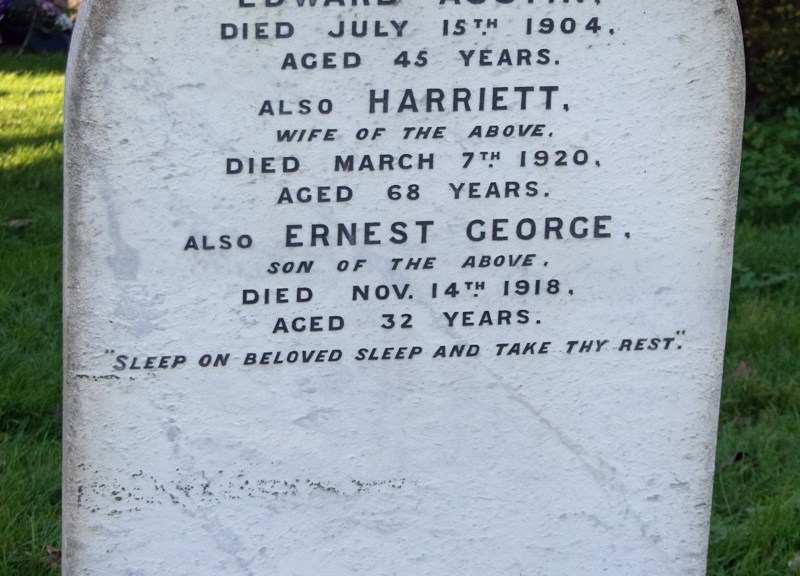
Private Ernest Austin

Private Ernest Austin

Ernest George Austin was born in early 1888, one of four children – all boys – to Edward Austin and his wife Harriett. The Austin family lived in the village of Cliffe, in the North Kent countryside, where Edward was a carpenter.

Ernest’s older brother Edward worked as a telegram messenger when he left school, and Ernest followed suit, becoming a postman by the time of the 1911 census. The four boys all lived with their now-widowed mother, their father having died seven years earlier.

Duty soon called, however, and Ernest enlisted in July 1916, joining the Army Service Corps. After training in England, he was shipped overseas that autumn.

Private Austin was discharged from the army just over a year later, and the medical report from that time sheds a lot more light onto this young man’s life:

Father [Edward] died of “consumption”.

Has had a chronic cough since a boy. Developed tubercle of lung in 1907. Went to Chile same year, where all symptoms disappeared. Put on weight and lost his cough completely. Returned to England and joined Army July 1916.

Has been in Mesopotamia three months. Cough has returned. Lost weight. Night sweats. Admitted to [military hospital] with sore throat; TB found present.

Admitted to this hospital 14th June 1917 with above symptoms. High temperature, evidence of infection.

In my opinion, the relighting of a latent infection is entirely attributable to active service in Mesopotamia.

Private Ernest Austin’s medical board record, 23rd Jun 1917

Ernest had been hospitalised in the Cumballa War Hospital, Bombay. He was sent home and ultimately discharged from active service on 8th October 1917.

Demobbed, Ernest married Antoinette Gurton at the start of 1918. The marriage was to be short-lived, however, as Ernest appears to have finally succumbed to his illness less than a year later.

Private Ernest Austin passed away on 14th November 1918. He was 31 years old. He lies at rest in the graveyard of St Helen’s Church in his home village of Cliffe, Kent.